The Overwhelm and the Snap: Seeking Quiet in a Noisy World
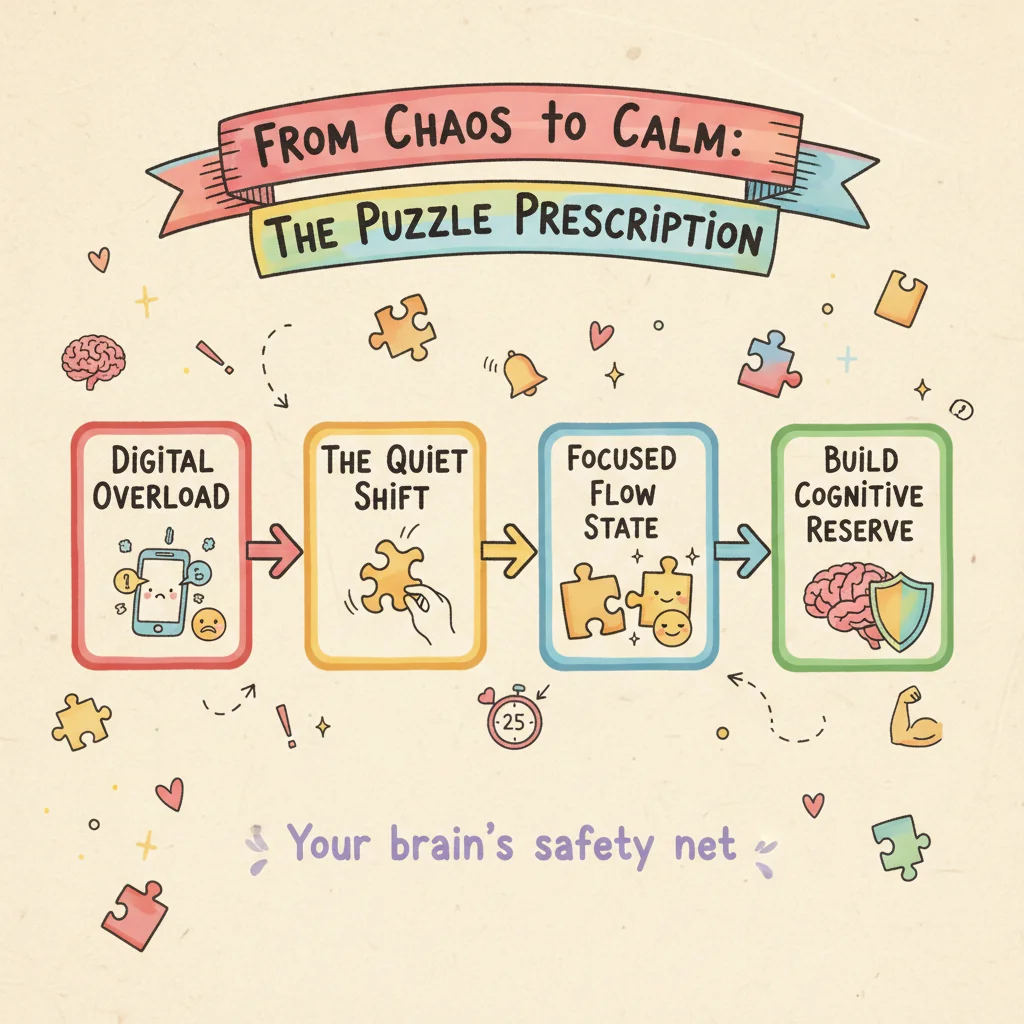
The average adult switches tasks every three minutes, fracturing attention until the brain feels like a browser with fifty open tabs. I know this sensation intimately, both from the data and from my own last nerve, fried after a day of back-to-back Zooms, pinging notifications, and the endless scroll. In this state of cognitive static, the most radical act of self-care isn’t another app promising calm—it’s the tactile, deliberate quiet of a puzzle. Research from the University of Michigan suggests that just 25 minutes of this focused activity daily can boost aspects of fluid intelligence, a compelling data point for anyone seeking a tangible cognitive reset.
I reached my own breaking point during a career transition, leaving the structured silence of a neuroscience lab for the noisy frontier of science writing. My brain, trained to trace neural pathways, was now hijacked by dopamine-driven feedback loops. One evening, eyes burning from screen glare, I did something that felt almost rebellious: I turned off my devices, emptied a bag of jigsaw pieces onto my dining table, and listened.
The sound was the first medicine—a percussive cascade of cardboard on wood, a tangible signal that work was over. Then came the tactile shift: fingers sorting by edge and color, not scrolling and tapping. My vision, strained from pixels, softened to focus on subtle gradients in a sky or the unique shape of a puzzle cut. The mental noise didn’t just lower; it was rerouted into a single, peaceful channel. It was a full sensory migration from the digital ether to the physical world.
This wasn’t nostalgia. It was a neurological necessity. Our brains are not built for the chronic, low-grade panic of modern multitasking. They crave the state of focused engagement that psychologists call ‘flow’—the loss of self-consciousness in a challenging but achievable task. Puzzle-solving is a direct conduit to this state. It’s meditation with a goal. For me, it became a non-negotiable tactile break, a ritual to reclaim a few square feet of mental real estate from the chaos.
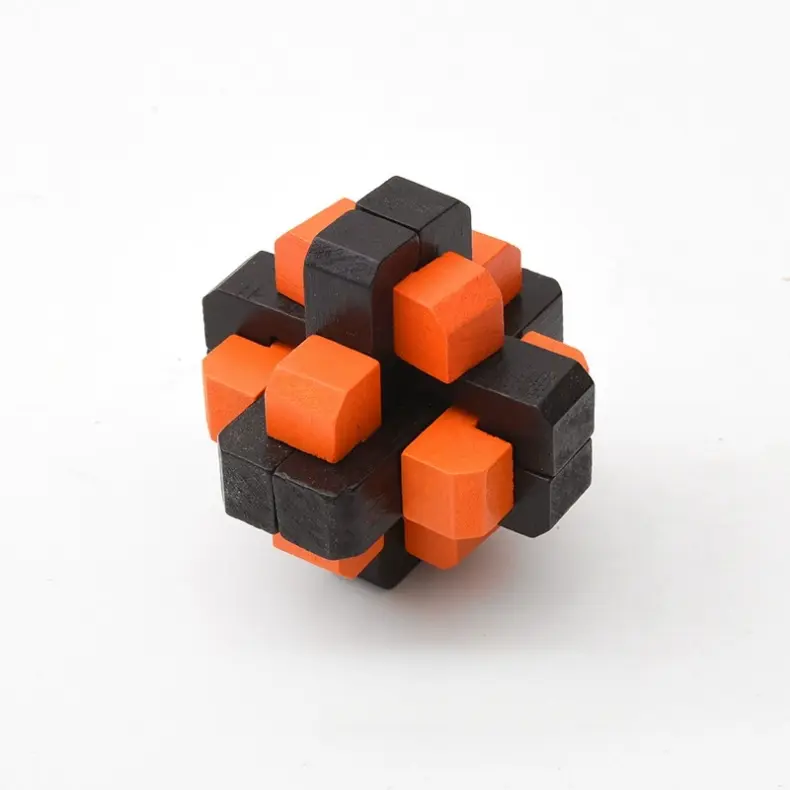
Looking Back — $16.99
A puzzle like this one offers more than an image; it provides a bounded system of solvable problems. You are in control. There is no algorithm manipulating your attention, only your own growing proficiency. On Reddit’s r/Jigsawpuzzles forum, users describe this exact feeling, calling puzzling a “comforting activity” that provides a “sense of order and achievement” in an unpredictable world. It’s a potent form of stress relief precisely because it is an active, engaging mindfulness practice, not passive consumption.
So I began to wonder, with my researcher’s mind kicking back in: Was this just a pleasant diversion, or was something more profound happening under the surface? Could the quiet act of fitting pieces together be doing more for my adult brain than just providing a pause? The journey from feeling overwhelmed to curious was itself a piece clicking into place. The evidence, as I would discover, was both vast and surprisingly personal.
Beyond Distraction: How Puzzles Build ‘Cognitive Reserve’—Your Brain’s Safety Net
That question—whether my puzzle habit was more than a diversion—led me back to the journals. The most compelling answer lies in a powerful neuroscientific concept called cognitive reserve, and the data is striking: regular, engaged puzzle solving can reduce decline in thinking skills by an average of 10 years. This isn’t about preventing a diagnosis, but about building a resilient, adaptable brain capable of withstanding age-related changes and stress.
Think of cognitive reserve not as a physical stockpile of brain cells, but as your mind’s functional buffer. It’s the difference between your brain’s hardware and its software—the efficiency, flexibility, and capacity of its networks. A high cognitive reserve means your brain has developed robust alternative pathways and problem-solving strategies. When one pathway is compromised (by natural aging, stress, or other factors), your brain can quickly reroute traffic. This reserve is your neurological safety net, and the remarkable news is that you can actively weave it throughout your life through complex mental activity. Puzzle-solving is a prime candidate for this construction work.
This is where the idea of puzzles as mere “fun” falls short, and the framework of cognitive cross-training takes hold. Just as a balanced fitness regimen targets endurance, strength, and flexibility, effective cognitive training should work multiple domains. A pivotal study, Jigsaw Puzzling Taps Multiple Cognitive Abilities and Is a Potential Protective Factor for Cognitive Aging, found that this activity specifically taps into visuospatial cognition—our ability to visualize, mentally rotate, and understand spatial relationships between objects. This is a critical domain that often shows early, subtle signs of decline. But puzzles demand more: holding the target image in mind (episodic memory), sorting pieces by color or edge (visual perception), testing a piece’s fit (hypothesis testing), and maintaining focus amid distraction (executive function). It’s a full-circuit workout disguised as a pastime.
This cross-training effect is what separates passive consumption from active construction. Scrolling through a feed is cognitively shallow; it asks for pattern recognition but little else. Solving a logic grid or a cryptic crossword, however, forces you to hold multiple variables in working memory (your brain’s sticky note), manipulate them, and tolerate the discomfort of uncertainty until the solution clicks. That “click” isn’t just satisfaction—it’s the sensation of a new connection forming. A University of Michigan study even found that 25 minutes of daily puzzle play could boost IQ scores by an average of 4 points, a testament to this sharpening of core reasoning faculties.
But what about the claim that puzzles can help prevent dementia? The science here is nuanced and profound. Research, including the oft-cited NEJM study on crossword puzzles, shows association, not guaranteed causation. Engaging in frequent, stimulating activities like puzzles is correlated with a delayed onset of cognitive symptoms. The prevailing theory is that cognitive reserve, built by a lifetime of such engagement, allows the brain to compensate for pathology longer. As one Reddit user in a neuropsychology forum succinctly put it: “It’s not that puzzles stop the disease process. It’s that they give your brain more tools to work around the roadblocks when they appear.” This is the true promise: not a cure, but resilience.
The process of building this reserve through puzzles is deeply personal and effortful. You don’t have to be “good” at puzzles; you simply have to be engaged. The struggle is the point. The moment you stare at a chaotic pile of pieces and begin creating order, you are not just solving a puzzle—you are practicing cognitive control. You are reinforcing the neural networks responsible for focus, patience, and systematic problem-solving. This is the antithesis of our fragmented digital multitasking; it is unitasking of the highest order, a flow state induced not by a game designer’s dopamine schedule, but by your own sustained attention.
So, when you settle in for an evening with a puzzle, you are doing more than passing time. You are conducting a symphony of cognitive processes. You are depositing bits of effort and focus into your brain’s reserve account, compounding the interest of mental flexibility. This is the grand, unifying theory that elevates puzzle-solving from a hobby to a form of sustained self-investment. It transforms the quiet snap of a jigsaw piece into the sound of a safety net being woven, one connection at a time. For a deeper exploration of the neurological mechanisms at play, consider our guide on puzzle therapy through the lens of neuroscience.
The Benefit Matrix: A Cross-Training Breakdown for Mind and Mood
The idea of cognitive reserve provides the unifying theory, but the lived experience—the daily gains in focus, calm, and clarity—is what makes the practice stick. Framed as cognitive cross-training, the benefits of puzzle-solving can be mapped across four key domains: Cognitive, Emotional, Social, and Long-Term. A University of Michigan study offers a compelling entry point, finding that just 25 minutes of daily puzzle play could boost IQ scores by an average of 4 points, a tangible metric for the mental workout in progress. This isn’t about becoming a genius overnight; it’s evidence of a system being tuned and challenged.
Cognitive Gains: The Executive Function Gym
Here, puzzles move beyond simple recall to engage the brain’s manager: the executive function system. This network, responsible for planning, task-switching, and inhibitory control, is precisely what modern life erodes with constant interruptions. A logic grid or a Sudoku puzzle demands you hold multiple variables in working memory (like keeping a mental spreadsheet), test hypotheses, and inhibit the impulse to jump to an obvious but wrong conclusion. It’s a rigorous drill for systematic thinking. As one r/Jigsawpuzzles user noted, “After a week of nightly puzzling, I noticed I was better at breaking down complex work problems into smaller, manageable steps. It felt like I’d cleaned the windshield of my brain.” This is the transfer effect of improved problem-solving skills. Furthermore, research specifically on jigsaw puzzles highlights their power for visuospatial reasoning—the ability to mentally rotate and manipulate objects. A study found this activity acts as a protective factor for cognitive aging, engaging perception and mental rotation in a way that scrolling through a feed simply does not.
How does this compare to reading or learning an instrument? All are valuable, but puzzles offer a uniquely concentrated dose of executive function training. Reading is largely receptive; playing music is procedural and creative. Puzzle-solving is pure, applied problem-solving under constraint, offering immediate feedback (the piece fits or it doesn’t) that sharpens accuracy and critical thinking in a tight loop.
Emotional & Psychological Rewards: Meditation with a Goal
This is where the science of cognitive reserve meets the profound personal relief so many enthusiasts report. For individuals dealing with anxiety or stress, puzzles act as a cognitive off-ramp. The focused attention required creates a flow state, that coveted zone of total immersion where time falls away and self-critical chatter quiets. “It’s my therapy,” writes another Reddit user. “When my mind is racing with a thousand worries, sorting edge pieces gives it one single, calming job. The chaos on the table replaces the chaos in my head, and I feel a sense of control.” This isn’t mere distraction; it’s a tactile break that leverages structured engagement to regulate the nervous system. The incremental achievements—finding a matching piece, completing a section—provide small, steady dopamine hits that reinforce a sense of competence and agency, countering feelings of overwhelm. For some with ADHD, this structured yet self-paced activity can be a powerful tool for practicing sustained attention in a low-stakes, rewarding environment.
Social & Community Benefits: The Connected Solitaire
While often seen as a solitary activity, puzzle-solving has a vibrant, collaborative dimension. Working on a large jigsaw with family or friends transforms it into a low-pressure social engine, fostering conversation, shared focus, and collective achievement. Online, communities like r/Jigsawpuzzles create spaces for validation, advice, and shared passion. Users post triumphant completion photos, seek help with maddeningly similar blue sky sections, and bond over brand preferences. This combats the isolation of solo hobbies and adds a layer of accountability and enjoyment. The social benefits are indirect but significant: a shared, screen-free activity that builds connection without the performance pressure of more socially intensive pastimes.
Long-Term Protective Factors: Building the Buffer
This domain directly addresses the pressing user question: do puzzles prevent dementia? The most responsible answer is that they build cognitive reserve, which is the brain’s resilience against age-related decline and pathology. Think of it as a savings account you draw from later. Regular engagement in complex mental activities like puzzling is associated with a delay in the onset of cognitive decline symptoms. One key study synthesizing decades of data suggests regular solvers can experience up to a 10-year delay in the slowing of thinking skills. The protective factor isn’t magic; it’s the cumulative effect of consistently challenging multiple brain networks—memory, visual processing, reasoning—keeping them agile and interconnected. As one older contributor on Reddit put it, “At 72, my puzzle time isn’t about being the fastest. It’s about keeping the lights on in all the rooms upstairs. My neurologist calls it ‘non-negotiable maintenance.'”
Practical Takeaways from the Matrix
So, how much time is needed to see benefits? The Michigan study’s 25-minute daily benchmark is a excellent guideline, but consistency matters more than marathon sessions. Even 20 minutes can be enough to achieve a flow state and give your executive functions a meaningful workout. The benefits accrue through regular practice, not heroic one-off efforts.
The final, crucial point: you do not have to be “good” at puzzles to reap these rewards. The struggle is the benefit. The mental effort of parsing shapes, recalling vocabulary, or deducing logical constraints is where the cross-training happens. Whether you complete a 1000-piece masterpiece or thoughtfully work through a daily crossword for 20 minutes, you are making a deposit into your cognitive reserve. You are not just solving a puzzle; you are engaging in a holistic regimen for a more resilient, focused, and calm mind. To discover a curated selection of puzzles designed for focused breaks, explore our list of the 10 best office puzzles to kill stress and boost focus.
Finding Your Fit: A Flowchart for Matching Puzzle Types to Your Goals
The greatest power of cognitive cross-training comes from specificity—choosing the right mental exercise for your current need. During my month-long experiment, I tracked my mood and focus across different puzzles and discovered their distinct cognitive signatures. The best puzzle for you isn’t the hardest one; it’s the one that aligns with your goal, whether that’s quieting an anxious mind, giving your memory a jog, or strengthening logical muscles. One University of Michigan study’s protocol used targeted puzzle games, reinforcing that the type of engagement directly shapes the benefit.
So, how do you choose? Let’s move beyond the generic “puzzles are good” advice. Think of your goal as the starting point in this text-based flowchart. Follow the logic to find your ideal cognitive workout.
Primary Goal: “I need a tactile break from screens and overwhelming thoughts.”
Start with Jigsaw Puzzles. Their benefit is profoundly visuospatial and meditative. You are not solving for one right answer but engaging in a continuous, low-stakes search for visual harmony. The process—sorting edges, grouping by color, the physical snap of a connection—induces a flow state that crowds out mental noise. As one user on r/Jigsawpuzzles noted, “It’s the only thing that fully pulls me out of my own head. My hands are busy, my eyes are focused on shapes and colors, and there’s no room for the anxiety loop.” This is cognitive cross-training for focus and patience, with the added bonus of the proven protective factor for visuospatial cognition as we age.
Primary Goal: “I want to strengthen my logical reasoning and problem-solving structure.”
Turn to Logic Puzzles (like grids, Sudoku, or deductive reasoning puzzles). These are the weightlifters for your executive function. They demand you hold multiple variables in working memory (your brain’s “sticky note”), test hypotheses, and follow rule-based chains to a single, satisfying solution. The mental “click” of a deduction is the sound of your prefrontal cortex firing efficiently. If your daily life feels chaotic, the structured certainty of a logic puzzle provides a deep sense of control and intellectual order.
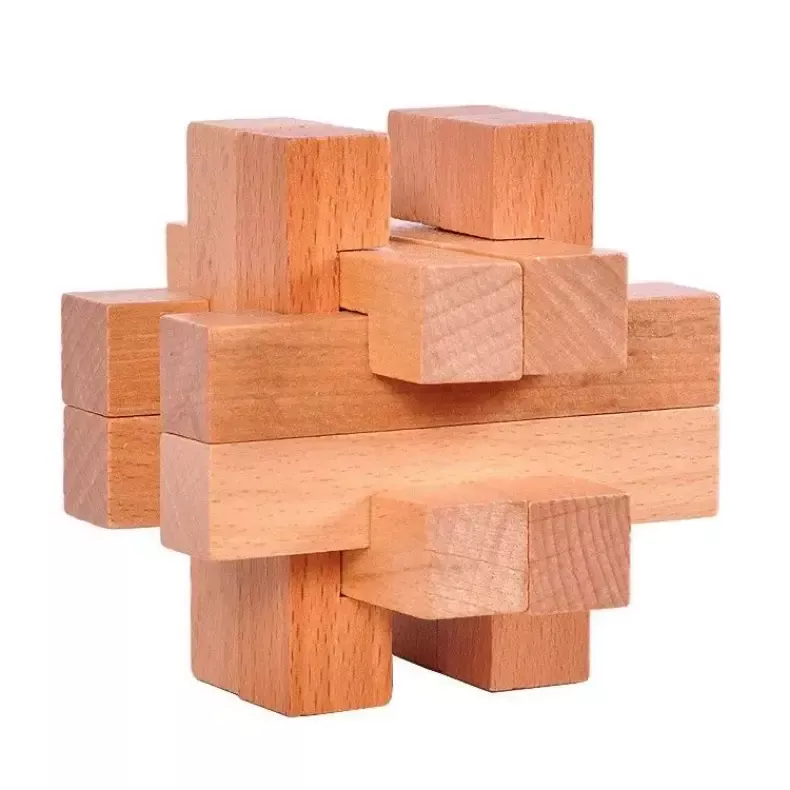
Primary Goal: “I’m looking to bolster verbal memory and cognitive flexibility.”
Word Puzzles (crosswords, cryptograms, anagrams) are your tool. They are a direct workout for your brain’s verbal centers and crystallized intelligence—your storehouse of knowledge. Retrieving that obscure word from the depths of memory strengthens neural pathways and builds cognitive reserve. The “aha” moment of a clever clue isn’t just fun; it’s a sign of your brain making new connections between concepts. This type of cross-training is linked to delaying age-related decline in thinking skills, with some studies suggesting it can reduce decline by an average of 10 years.
Primary Goal: “I want to improve spatial reasoning and hands-on manipulation in 3D space.”
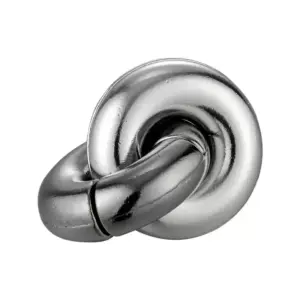
This is the domain of Spatial & Mechanical Puzzles (think disentanglement puzzles, 3D assembly puzzles, or the classic Rubik’s Cube). These puzzles require you to mentally rotate objects, understand physical constraints, and plan sequential moves. They are exceptional for developing a keen sense of spatial relationships—a skill that translates to everything from packing a car trunk to reading a blueprint. As a category, mechanical puzzles have a long history of challenging spatial and logical reasoning. For a deep dive into premium options in this category, like the renowned Hanayama metal puzzles, our guide The Tactile Matchmaker explores the unique appeal of each.

And what about puzzles vs video games for brain health? Both can be engaging, but physical puzzles offer a crucial, screen-free tactile break and lack the hyper-stimulating rewards of digital games. The simpler, more analog environment is often what makes puzzles a superior mindfulness activity for stressed adults.
The key takeaway? Your goal dictates your tool. For stress relief, seek flow in a jigsaw. To sharpen logic, embrace a grid. To build verbal reserve, wrestle with words. This intentionality transforms a pastime into a powerful component of your cognitive cross-training regimen. To learn more about the underlying brain rewiring that occurs, see our article on how puzzles can rewire your brain.
From Casual Dabble to Keystone Habit: Practical Integration for Real Life
So, you’ve identified the right cognitive cross-training tool for your goals. Now, how do you move from intention to a sustainable practice? The research points to a surprisingly modest commitment: puzzles for adults scientific studies suggest that the cognitive payoff comes from consistent, manageable sessions, not marathon weekends. The University of Michigan study showing a 4-point IQ boost, for instance, was based on just 25 minutes of daily engagement. This isn’t about adding another burdensome task; it’s about reclaiming slivers of your attention.
The question of digital versus physical puzzles isn’t trivial. While apps are convenient, they often replicate the very hyper-stimulating environments we’re trying to escape. A physical puzzle provides a crucial tactile break—a full sensory shift. As one r/Jigsawpuzzles user put it, “There’s a different part of my brain that wakes up when my eyes move from a screen to physical pieces. The phone-induced anxiety just… evaporates.” The act of physically manipulating pieces grounds you in the present, creating a more potent buffer against digital fragmentation.
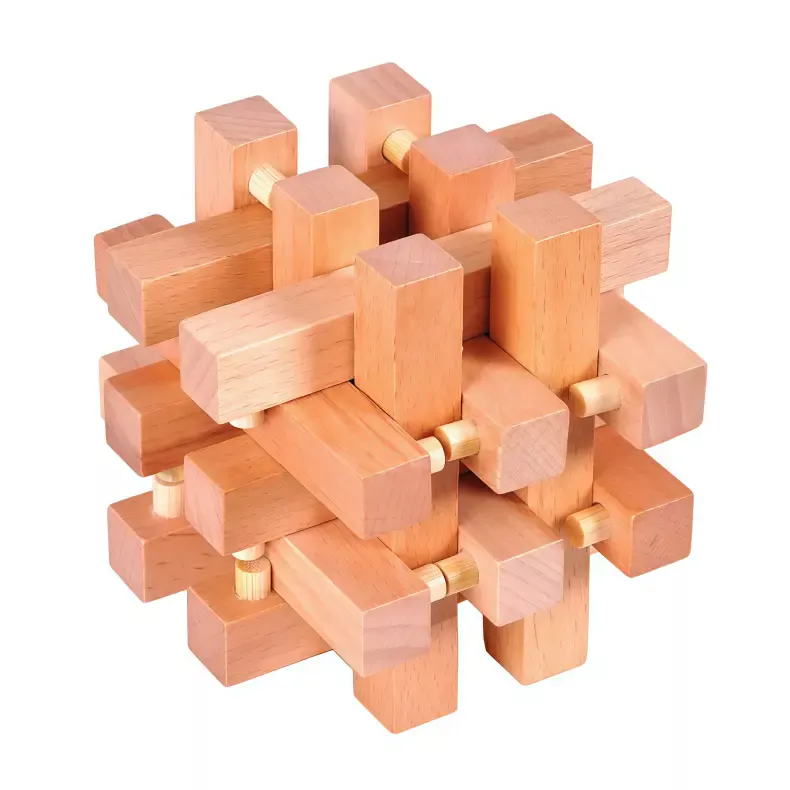
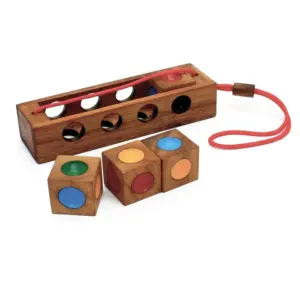
18 Piece Wooden Puzzle — $16.99
Start simple to build momentum. A compact, beautiful wooden puzzle like this one lives on a coffee table or desk, inviting a five-minute micro-session instead of doomscrolling. This aligns with a strategy I often recommend: treat your puzzle like a visual cue for a mental reset, similar to the concept explored in our article on desk puzzles as a meditation alternative. The tactile engagement can even share some characteristics with using a fidget toy for focus, but with the added depth of a structured problem to solve.
How often should adults do puzzles? Frequency trumps duration. Aim for short, regular sessions—15 to 30 minutes most days—rather than a single three-hour binge on Sunday. Think of it like dental hygiene for your cognitive reserve: consistent, gentle cleaning is more protective than an aggressive once-a-year scrape. This rhythm makes the activity a sustainable keystone habit, one that can structure a quieter, more focused part of your day.
For older adults wondering if it’s “too late to start,” the science is unequivocally encouraging. The studies on visuospatial cognition and protective factors specifically involved adults over 50. The brain retains plasticity; you are building new connections regardless of age. The key is to choose a puzzle type that feels engaging, not frustrating. The benefit is in the focused effort, not the flawless speed.
Finally, grant yourself permission for it to be just a hobby. You don’t need to be “good” at it. The cognitive workout happens in the attempt, in the quiet sorting and the testing of hypotheses. When frustration bubbles up—a natural part of problem-solving—step away. The solution often clicks into place upon return, a tangible lesson in mental resilience. This is how a casual dabble transforms: not by force, but by becoming a welcome, rewarding ritual in your daily landscape.
Addressing the Board: Answering the Skeptic’s Tough Questions
The transition from dabbler to dedicated enthusiast often hits a wall of reasonable doubt, much of it echoing through online forums. The most common skepticism asks: Is there any real causality, or are we just seeing correlation between smart people who happen to like puzzles? Here’s the nuanced answer from the research: while perfect, lifelong studies are elusive, the evidence points to active benefits. The key mechanism is cognitive reserve—the brain’s resilience built through consistent, complex mental activity. A University of Michigan study that found a 4-point IQ boost from 25 minutes of daily puzzle games is a strong indicator that the activity itself, not just innate intelligence, drives measurable change.
This leads to the natural follow-up: do you have to be naturally “good” at puzzles to reap these rewards? Absolutely not. The neuroprotective workout happens in the attempt, not the effortless victory. As one r/Jigsawpuzzles contributor put it, “The satisfaction isn’t in finishing fast; it’s in the quiet hunt for the next piece. My brain feels busy in a good way, even if I only get a small section done.” Struggling with a cryptic clue or a stubborn logic grid is the point—it’s where synaptic connections are forged and strengthened. If it’s challenging but engaging, you’re in the sweet spot.
What about the claim that benefits are only for certain people or puzzle types? The science suggests a broader application. While visuospatial gains are strongly linked to jigsaw puzzles, verbal fluency and recall are tied to crosswords. The universal factor is achieving a flow state—that focused immersion where self-consciousness falls away. Whether you reach it through Sudoku or a 1000-piece landscape is personal. The benefits of that state—reduced anxiety, improved executive function—are widely accessible, not exclusive to a “puzzle person” archetype.
This brings us to a hotly debated comparison: are digital puzzles as effective as physical ones? The research is still evolving, but a critical distinction lies in the tactile break. Physical puzzles force a disconnection from the very devices that fracture our attention. They engage fine motor skills and offer a tangible, screen-free spatial challenge that many, like the Reddit user who called puzzling a “comforting activity,” cite as key to its stress-relief properties. Digital versions can train specific skills, but they lack the holistic, multi-sensory disengagement that makes physical puzzling a unique form of cognitive cross-training.
Finally, we must address the biggest question lurking in forums like r/Neuropsychology: If I learn to solve puzzles, am I just getting better at puzzles, or does it translate to real life? This is where the cross-training analogy holds. Just as a runner benefits from cycling by building cardiovascular endurance used elsewhere, puzzles strengthen underlying cognitive muscles. Improved working memory helps you hold a phone number while searching for a pen. Enhanced visuospatial reasoning aids in parallel parking. The specific skill may be puzzle-bound, but the core capacities of logic, patience, and systematic thinking are profoundly transferable.
For a deeper exploration of the psychology behind effective problem-solving, which applies directly to choosing and approaching puzzles, consider the insights in Why Most Brain Teaser Puzzles Fail And How To Win. It reinforces that the value is in the structured challenge, not the gimmick.
The skeptic’s questions are valid, but the collective evidence—from lab data to lived experience—paints a consistent picture. Puzzle-solving is not a magic bullet, but it is a uniquely accessible, low-stakes gym for the mind. You don’t need to be a prodigy; you just need to show up and engage. The benefits are less about becoming a puzzle champion and more about building a more resilient, focused, and calm thinker for everything else you do.
The Final Piece: Why This Simple Act is an Investment in Your Future Self
The simple act of puzzle-solving is an investment because it directly contributes to your cognitive reserve—the brain’s resilience against age-related decline and damage. By regularly engaging in this form of cognitive cross-training, you are not just passing time; you are building a buffer. Studies suggest this consistent engagement can reduce decline in thinking skills by an average of 10 years, making the time spent a down payment on long-term mental agility.
Cognitive reserve isn’t a mystical force; it’s the practical outcome of a brain that’s been consistently challenged and diversified. Think of it not as a “supercharged” brain, but as a well-managed portfolio. Diversifying your mental activities—like cross-training—spreads the risk. Puzzles, with their unique demand for integrated perception, logic, and patience, add a critical asset class to that portfolio. This isn’t about preventing a single event, but about building a system that’s more robust, adaptable, and slower to depreciate under stress or time.
This shifts the entire frame from a leisure activity to a form of proactive, accessible self-care. You are not merely solving a puzzle; you are conducting a low-stakes training exercise for your executive function. You are granting your overstimulated mind a tactile break from the digital swarm, reinforcing neural pathways that favor deep focus over fractured attention. Each session is a modest deposit into an account that will compound, paying dividends in clarity, calm, and mental endurance for years to come.
When skeptics ask—or when that inner voice questions—if this is a worthwhile use of your time, you now have a framework that extends beyond “it’s relaxing.” You can explain that you are engaging in evidence-supported mental maintenance. You are not just seeking a flow state for its own sake, but leveraging it to strengthen the very architecture of your thinking. The question transforms from “Why are you doing a puzzle?” to “Why wouldn’t you engage in an activity that is documented to support visuospatial reasoning, problem-solving stamina, and emotional regulation?”
The ultimate value is cumulative and deeply personal. It’s found in the quiet consistency of the practice itself. This is where the journey evolves from a hobby into a sustaining ritual.
For more on the shift from casual activity to meaningful ritual, the reflections in When A Puzzle Becomes A Practice explore how these moments of focus can anchor a day and build a more intentional mind.
So, I return to the table, now clear of the scattered pieces that began this exploration. The final image is complete, but the work isn’t. The true “final piece” isn’t the last cardboard segment snapped into place; it’s the understanding that this simple act has layered value. It was a protective factor against that evening’s anxiety, a workout for my visual memory, and a small, deliberate stitch in the fabric of my cognitive reserve. In a world engineered for your distraction, choosing to focus deeply on a self-contained challenge is a quiet rebellion. It’s a declaration that your attention is your own to direct, and that the best way to care for your future self is to engage your present mind—thoughtfully, playfully, and consistently. Your brain, in all its complex glory, thanks you not with a fanfare, but with a deeper, more resilient quiet.
Opening Scene and Core Thesis
The conclusive evidence shows that integrating puzzle-solving into your life is a direct investment in your cognitive longevity, with studies indicating it can reduce decline in thinking skills by an average of 10 years. This final section returns to the moment where it all began: the choice to reach for a puzzle instead of a screen.
I was staring at the same digital rectangle that now holds these words, my mind a browser with too many tabs open. The day’s notifications had left a static of low-grade anxiety, that familiar modern hum. My hand hovered over the phone, the instinct to scroll almost autonomic. But this time, I reached sideways instead, pulling a box from the shelf. The thunk of it on the wooden table was a tangible promise. Pouring out the pieces was a ceremony of potential—a soft cacophony of cardboard that immediately narrowed my world to a single, solvable problem.
This shift from digital diffusion to tactile focus is the core thesis. In an age of infinite scrolling, a puzzle offers a finite frontier. It is a voluntary constraint for a mind drowning in options. The benefits we’ve detailed—from the 4-point IQ boost linked to daily play to the forging of cognitive reserve—are not isolated perks. They are the natural byproducts of this deliberate, focused engagement. You are not just “relaxing.” You are conducting a symphony of executive functions on a 24-inch dining table.
It begins with that simple, rebellious choice: to trade the algorithm’s agenda for your own agency. The path forward is as straightforward as finding your first project.
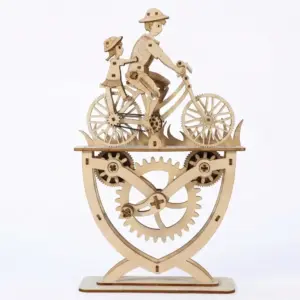
For a tactile, deeply absorbing start that truly forces a tactile break from screens, consider a 3D wooden puzzle. It transforms the abstract into the architectural. Our guide on the 3D wooden puzzle you should build first can help you begin.
Your next step isn’t to master every puzzle type. It is to choose one—just one—that resonates with you this week. Open the box, spread the pieces, and begin. The final piece you’re looking for isn’t in the box. It’s the decision to start.