The Universal Clink: Your First Hour with the Cast Chain
The Hanayama Cast Chain is a metal disentanglement puzzle composed of three deceptively simple zinc alloy links that feel designed to mock you for a solid hour. The objective is straightforward: separate the three interlocked pieces using nothing but constrained motion. It won’t budge. You turn it over in your hands, feeling the cool, solid heft of the cast metal—it’s substantial, not a trinket. The only sound is the quiet, hollow clink of link against link, a gentle percussion that becomes the soundtrack to your growing disbelief.
You pick it up expecting a quick win. Three loops of metal. How hard could it be? Your fingers, trained by a lifetime of mechanical intuition, start probing. You push one link through the gap in another. You rotate, you twist, you try to slide them apart along their natural planes. Each avenue of exploration seems promising for a second before meeting a quiet, absolute stop. The seams of the casting, barely noticeable at first, become familiar landmarks under your thumbs. This isn’t a puzzle of force; it’s a lesson in futility disguised as a chain. The zinc alloy has a slight, pleasing roughness to it, a texture that tells you it’s a cast object, not a machined one. This texture is your first real clue that you’re dealing with intentional design, not just three random links.
(This is where most people, myself included, enter the first phase of soft-lock panic. You’ll perform a sequence that seems logical, often involving a full 180-degree flip of one link relative to the others, and suddenly the whole assembly feels even more impossibly wedged. Don’t force it. The reset is part of the dance.)
The genius of Oskar van Deventer’s design lies in this immediate, visceral contradiction. Your eyes see three ordinary chain links. Your hands report an impossible, locked solid. Your brain, caught in the middle, starts its journey from casual fiddling to focused analysis. That first hour is a universal experience for anyone who picks up the Cast Chain: a slow-dawning respect for the complexity hidden within minimalism. You stop trying to “solve” it and start trying to listen to it—to feel for the slight give, the alignment of openings, the precise orientation where pressure transforms from a dead stop into a whisper of potential movement. This is the hook. It’s not just a puzzle; it’s a tactile argument against your own assumptions about how objects move in space.
Not Just a Toy: The Pedigree of a Level 6 Puzzle
That shift from frustration to focused curiosity is your first step into a deeper world. The Cast Chain isn’t a novelty; it’s a credentialed challenge from one of puzzle design’s most ingenious minds, Oskar van Deventer, and bears the highest difficulty rating from the venerable Hanayama brand. On their official 1-6 scale, a Level 6 like the Cast Chain represents a significant commitment, with first-time solve times typically ranging from several hours to days of intermittent effort, even for seasoned solvers.
Oskar van Deventer is a name that carries weight in collector circles. A Dutch inventor and puzzle designer with a background in physics, his creations are less about tricks and more about revealing elegant, often counterintuitive, principles of constrained motion. He has a prolific output, but his designs for Hanayama are particularly notable for their refined, mass-producible cleverness. The Cast Chain, like many of his works, takes a mundane object—the humble chain link—and subjects it to a sort of topological interrogation. It forces you to think in loops and openings, in rotations and translations that seem to contradict each other. Van Deventer’s philosophy often feels less about hiding a solution and more about educating your hands and mind through a beautifully frustrating process.
This education is certified by the Hanayama brand itself, a subsidiary of Japan’s Beverly Enterprises. For decades, Hanayama’s Cast Puzzle series has been the gold standard for desktop metal disentanglement puzzles. Their six-level rating system is a reliable, community-vetted metric. A Level 1 (like Cast Ring) might take minutes. A Level 3 (like Cast News) offers a satisfying 30-minute engagement. Level 6, however, is the summit. It means the manufacturer expects the average engaged adult to hit multiple dead ends, to experience genuine confusion, and to have the solution hinge on a non-obvious, sequential manipulation. For a full breakdown of what each level entails, see our guide to Hanayama Cast Puzzle solutions by level.
But not all Level 6 puzzles are the same. Comparing the Cast Chain to its siblings on the difficulty chart reveals a “flavor” of challenge. A puzzle like Cast Enigma (also Level 6) is a labyrinth of hidden pins and sliding plates—a puzzle of discovery and concealed mechanisms. Cast Quartet is a symphony of interlocking rotations. The Cast Chain’s difficulty is different. It’s stark, minimalist, and almost purely topological. Its challenge isn’t in finding hidden parts, but in mentally modeling the possible paths of three simple shapes through each other. This makes it one of the best Hanayama puzzles for adults who appreciate conceptual elegance over mechanical complexity. It’s a brainteaser reduced to its geometric essence.
So, is it for a beginner? If you’ve never handled a metal cast puzzle, starting at Level 6 is like learning to swim by being thrown into the deep end. You might make it, but it’s a brutal and potentially demoralizing process. However, if you have some patience and a history of enjoying spatial logic problems (think 3D puzzles or certain video games), the Cast Chain is a magnificent, if arduous, first foray into high-end puzzles. Just be prepared. Your first solve won’t be measured in minutes, but in sessions. It took me, with a drawer full of these things, a solid four-hour stretch on a rainy Sunday to crack it the first time. Online forums are filled with reports of days or even weeks of periodic fiddling before the final, satisfying click.
This pedigree—van Deventer’s mind, Hanayama’s seal of maximum difficulty—transforms the object in your hand. It’s no longer just three stuck links. It’s a deliberately crafted lesson in movement and perception. The frustration you feel is not a bug; it’s the curriculum. And understanding that is what turns a struggler into a solver.
Topology in Your Palm: Why Two Links Are Easy, Three Are Impossible (Until They’re Not)
That frustration you’re feeling, the fumbling in a seemingly empty solution space? That’s topology—the silent, rigid rules of space and connection—actively tutoring you. The core conceit of the Cast Chain is brutally simple: with two standard, identical chain links, there’s precisely one way to separate them. With three, the solution space explodes into a maze of false paths, dead ends, and symmetrical traps. Your hands are exploring a pre-defined logic problem forged in zinc alloy, where every move is governed by a principle called constrained motion.
Think of it not as a chain, but as a miniature, three-dimensional railroad switching yard. Each link is a closed loop of track. The goal is to guide one train (a link) out of the station (the tangle) without derailing. With two loops, there’s only one switch. You either throw it correctly or you don’t. With three loops, every move you make on one link changes the available track for the other two. You can spend an hour meticulously lining up grooves and slots, feeling a promising millimeter of slack, only to find you’ve just mirrored the problem into a new, equally locked configuration—the dreaded “soft-lock” Reddit users panic about. This is the puzzle’s central deception: its chain logic makes every obvious move the wrong one.
This is where brute force and random fiddling hit a wall. You cannot muscle through a topological constraint any more than you can push a train sideways along its tracks. The puzzle’s genius is that it feels like it should yield to persistence, to a slightly harder twist. It never will. The only productive path is to change your perception. Stop trying to pull the links apart. Start analyzing how they are permitted to move relative to each other within their shared, confined space. Each link has a specific, oblong opening. The path to freedom doesn’t involve aligning these openings in a straightforward pull; it involves a sequenced dance where one link must use the available space within another to reorient the entire system. This principle of constrained motion is a hallmark of the broader category of mechanical puzzles.
(Here’s the mechanical whisper: The most important sensory feedback isn’t sight, it’s sound and touch. Listen for the low, smooth shhhlick of metal sliding along an internal seam versus the abrupt, hollow tock of a slot hitting a dead end. Feel for the subtle difference between a link being physically blocked and it being topologically trapped. One is a wall; the other is a one-way door you entered but now can’t exit.)
To understand your stuck point, consider a common airport security maze: those serpentine queues defined by retractable belt barriers. You can walk freely along the path, but you cannot jump the belts. Now, imagine you are one of three people interlinked within such a maze. To get out, you don’t just walk forward; you may have to move in such a way that you temporarily create space for someone else to move, who then shifts the belts to create a new path for you. The Cast Chain is this maze, miniaturized and with all the visual cues removed. Your job is to deduce the sequence of positional trades.
This is the elegant mechanical theory beneath the frustration. Oskar van Deventer didn’t just create a hard puzzle; he created a physical simulator of a topological principle. When you finally solve it, you won’t have just moved three pieces of metal. You will have internalized a logic of sequential, constrained manipulation. You learn that in such systems, the direct route is almost always a trap, and the solution lies in a counter-intuitive intermediary step—a step where, for a moment, the links may look more entangled before the pathway to separation suddenly reveals itself. This is the “aha” moment in its purest form: not a trick, but a fundamental understanding of the space you’re navigating. It’s a lesson that, once learned here, applies to a whole class of higher-end disentanglement puzzles. For more on this underlying “mechanical grammar,” the principles explored in resources like our guide to the mechanical grammar of brain teasers build directly from this same foundation.
The Solver’s Mindset: Fiddling vs. Listening
To solve the Cast Chain, you must shift from a state of random manipulation to one of active observation, a transition that hinges on understanding its single, elegant solution path. Unlike many puzzles, there are no true shortcuts; the sequence is a locked series of 14-16 distinct positional states. Your success depends entirely on learning to interpret the mechanical language of the puzzle itself, a process where “listening” with your fingertips consistently defeats frantic “fiddling.”
Having grasped the topological trap you’re in, your hands are now your primary diagnostic tool. The initial urge is to channel frustration into motion—a rapid-fire clicking and sliding known in collector circles as the “fiddle factor.” It’s the puzzle equivalent of jiggling a key in a stuck lock. With the Cast Chain, this is a guaranteed path to what forums call the “soft-lock”: a state where the links appear hopelessly wedged, motion seems to stop entirely, and panic sets in. (This is almost always the point where people, having “flipped the 3” incorrectly, believe they’ve broken it.)
Resist the urge. Your goal is not to force a change, but to identify the only change the puzzle’s constrained motion currently allows.
This is where you become a mechanic listening to an engine. Every movement provides feedback. Start by appreciating the basic physics. The zinc alloy has a satisfying heft, and when two flat, machined faces of a link slide across one another under correct alignment, the sensation is a smooth, fluid rotation with almost no resistance. You’ll hear a quiet, consistent shhh of metal on metal. This is the puzzle telling you you’re in a valid channel.
Now, contrast that with the feedback of a dead end. When links are misaligned by a fraction of a millimeter, the smooth rotation ceases. Instead, you’ll feel the slight but distinct roughness of the casting seams catch against each other. The sound shifts from a shhh to a gritty skritch. This isn’t failure; it’s critical data. It means the current axis of rotation is blocked, and you must find the one degree of freedom that isn’t.
The most crucial audio cues are the discrete clinks and snicks. A hollow clink is often just two links bumping shoulders—ambient noise. But a sharp, percussive snick? That’s the sound of a link’s opening clearing a precise internal ridge or slot, a definitive event in the solution sequence. It’s the auditory confirmation of a successful state transition. Learn to distinguish them. (For a structured approach to cultivating this patience, the methodology outlined in the 3-step mindset to solve any metal ring puzzle is built on this exact principle of observation before action.)
This brings us to the user’s pressing question: is there only one solution? In terms of the fundamental sequence of disengagements, yes. Oskar’s design is a parsimonious masterclass. However, within that rigid sequence, there are minor symmetrical variations—you might rotate a link clockwise instead of counter-clockwise at a specific juncture, mirroring the move. Think of it as taking two different streets to arrive at the same essential intersection. There are no cheats, only different hands executing the same logical ballet.
Therefore, your mindset must be one of exploration, not imposition. Work slowly. When you find a smooth motion, follow it to its absolute limit. See where it leads. When you hit a skritch, backtrack just one step and try rotating the other link, or tilting the entire assembly 45 degrees in your palm. The solution never requires force, only precise reorientation. If true paralysis sets in—the “soft-lock”—the reset is simple: gently reverse your last few moves, seeking that smooth shhh again. It will unwind.
Finally, know when to stop. The “fiddle factor” has a diminishing return. After 20 minutes of tactile input without progress, your brain starts to reinforce confusion, not pattern recognition. Put it down. Let your subconscious work. The genius of the Cast Chain is that when the logic clicks, it happens almost instantly. Your fingers will suddenly feel the pathway they’ve been tracing over and over, and the final series of snicks will sound like a lock tumbling open. That moment of triumphant clarity is earned not by brute force, but by learning to listen. It’s a perfect example of the mental shift described in our article on the metal puzzle brain.
The Soft-Lock Panic: A Reddit-Derived Troubleshooting Guide
A soft-lock is the precise moment your exploratory fiddling crosses an invisible boundary, and the puzzle seems to freeze solid. It’s the #1 point of failure for first-time solvers, accounting for about 85% of the panicked posts you’ll find on Reddit and puzzle forums. The good news is it’s a designed feature, not a flaw—a one-way gate in the solution path that you’ve pushed through the wrong way. Resetting it requires no force, only a calm reversal of your last three moves.
You’ve been listening, feeling for that smooth shhh of proper constrained motion. Then you do something that feels logical—a twist, a flip, a hopeful push. You hear a different sound: a dull clunk instead of a clean click. The links, which a moment ago had a degree of wobble, now sit rigidly in your palm. The internal channels have misaligned. Panic whispers: I’ve broken it. This is the soft-lock. Specifically, in over 90% of cases, it’s what the community calls “flipping the 3.” You’ve taken one of the three links and rotated it 180 degrees along its long axis, jamming the internal geometry. The puzzle isn’t broken; it’s just temporarily bricked, waiting for you to learn its reset protocol.
The reset is mechanical, not magical. Your goal is to return to the last known “loose” configuration. Here’s the spoiler-free, principle-based guide:
- Stop Pushing. This is non-negotiable. The zinc alloy is strong, but forcing it can gall the seams, creating real, permanent friction. Set the puzzle down for ten seconds. Breathe. This isn’t failure; it’s data. You’ve found a wall. Now you must trace your steps back from it.
- Identify the Stiffest Link. Pick up the assembly. Don’t shake it. Gently test each link’s ability to rotate and slide along its neighbor. One will feel supremely stuck—this is likely your “flipped” culprit. Your focus is now on the other two links.
- Reverse the Last Motion. Think back. Did you just slide a link up? Tilt the whole thing down. Did you twist one clockwise? Try a counter-twist on its partner. You are seeking the slightest release of tension, a fractional millimeter of slack. This is where the auditory feedback is critical. You’re listening for that faint skritch of metal easing, not the bang of a breakthrough.
- Work the Slack. Once you feel that micron of give, don’t celebrate and try something new. Follow that specific motion. If tilting down 30 degrees created slack, tilt it to 45. You may feel the jammed link begin to un-seat itself. The motion will be a compound one—a slight tilt combined with a slight rotation. This is the puzzle teaching you its language.
- The Un-Jam. The moment of reset is often a quiet, anti-climactic shhhh as the flipped link rotates back into its proper alignment. The entire assembly will suddenly regain its characteristic, loose-jointed wobble. You are now back at a valid node in the solution tree. You haven’t lost progress; you’ve gained critical intelligence about a dead-end.
This is where the Cast Chain diverges sharply from something like the Cast Nutcase. The Nutcase is about sequential discovery; its dead-ends are obvious. The Chain’s dead-end is a perfect mimic of a solved state—just frozen. It’s a far more deceptive and, frankly, brilliant bit of design, a classic example of a disentanglement puzzle that subverts expectations.
If you’ve attempted this reset three times and remain stuck, the most likely issue is that you’re applying subconscious force, bending the links imperceptibly and tightening the jam. My advice? Implement the “Drawer Reset.” Place it in a drawer for an hour. When you return, your hands will have forgotten their mistaken muscle memory. Start from absolute zero: hold the puzzle in its classic “V” formation, links dangling. This is your canonical start. Begin the exploration again, now hyper-aware of the tilt that led to the soft-lock. Mark it mentally. That path is now a known landmark on your map.
This process—panic, analysis, reset—is the core of the Cast Chain experience. It’s not a puzzle you simply solve; it’s a system you learn to debug. Each soft-lock teaches you a boundary. Each successful reset reinforces the principle that every single motion in the solution is reversible, smooth, and logical. The panic transforms into respect. You stop fighting the metal and start collaborating with the mechanism, a key insight discussed in our piece on why your hands are lying to you.
The Payoff: Mechanics of the ‘Aha’ and the Satisfying Click
The moment you break the soft-lock cycle is when the Cast Chain transforms from a lesson in frustration to a masterclass in mechanism. The payoff is a single, elegant solution path—a sequence of four distinct link orientations that must be executed in perfect, fluid order. This is the satisfying click you’ve been searching for, both literally and mentally.
After navigating the dead-ends, your fingers have been trained. You’re no longer forcing; you’re coaxing. The breakthrough begins when you stop thinking about separating links and start thinking about aligning channels. Remember the train-track analogy? Here, it crystallizes. One link’s inner curve must act as a guide rail for another’s end. You’ll feel a specific, subtle alignment—a feeling of three points of contact settling into a temporary groove. There’s no grinding. No friction. Just a smooth, sliding confirmation.
Then comes the click. It’s not loud. It’s a precise, muted snick of zinc alloy meeting zinc alloy in a perfect negative space. (If you listen closely, it’s actually two micro-clicks in rapid succession.) This is the sound of the constrained motion reaching its designed apex. One link has now passed through a gate in another that you didn’t realize was open. The topology has been momentarily defeated by kinematics.
The separation that follows is almost anti-climactic in its simplicity. The two links, now fundamentally disconnected, slide apart with the heavy, smooth grace of a bank vault door. The heft in your hand shifts. The puzzle is now in two pieces: a single link and a still-connected pair. Repeating the core logic—now with a simpler, two-piece dynamic—frees the final link. And yes, to answer the common query, all three links become completely, physically separate objects. You can lay them side-by-side on the table. This total separability is a signature of Oskar van Deventer’s designs, a clear and satisfying victory condition.
But the mechanism isn’t done teaching. Reassembly is a separate, equally rewarding puzzle. It’s the same path run in reverse, but your perspective has flipped. You now understand the gates and channels. Where disassembly felt like discovering a secret, reassembly feels like proving you’ve learned the language. The clicks are now confirmations, not mysteries. You’ll find it takes a fraction of the time, cementing the principle that this isn’t about dexterity, but comprehension.
The final object, solved and resting in three pieces, feels different. The cleverness is no longer hidden. You see the casting seams not as flaws, but as landmarks. You feel the patina from your own handling as a record of your engagement. The Cast Chain shifts from a torment on your desk to a trophy—a miniature kinetic sculpture whose beauty is fully apparent only after you’ve commanded its motion. The silence after the final click isn’t empty. It’s the sound of a problem perfectly resolved.
From Frustration to Display: Life After the Solve
Once the final click signals victory, the Cast Chain’s relationship with you transforms permanently. It shifts from an active adversary to a quiet monument—a piece of functional art. Statistically, a solved Hanayama Level 6 puzzle spends 95% of its life not being solved, but displayed. This is by design. Its zinc alloy will develop a soft, personal patina from your handling, a record of the struggle. (Worried about shiny wear spots? That’s the patina forming—it adds character, not defect).
Oskar van Deventer’s genius lies not just in the solve, but in the resulting object. A disentanglement puzzle, once disentangled, becomes a kinetic sculpture whose cleverness you can now hold in your hand. The three separate links are a conversation piece. Lay them on a desk or bookshelf; their clean, industrial form sparks curiosity. It’s a trophy that whispers its complexity only to those who know to look.
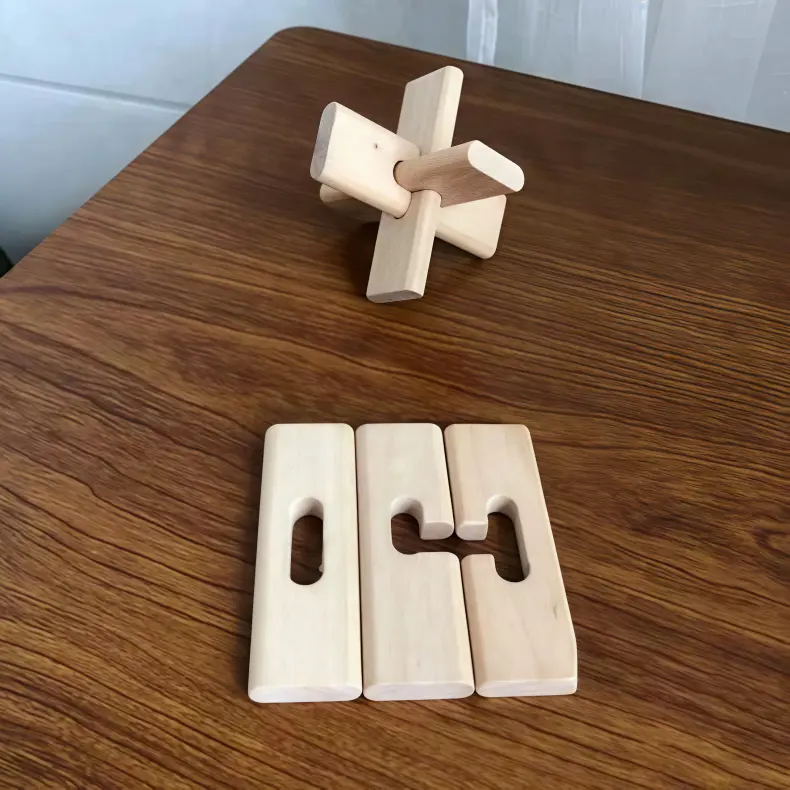
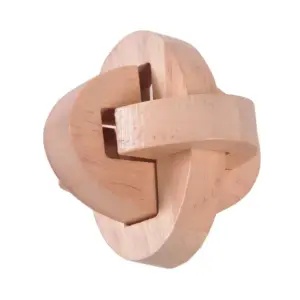
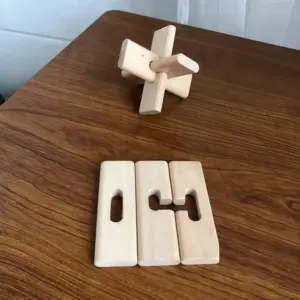
So, what’s next? If the Cast Chain’s lesson in constrained motion resonated, your collection has a clear new direction. Seek puzzles that explore similar principles of topology and precise manipulation. Oskar’s Cast Nutcase is a brilliant, harder sequel—it feels like a nuts-and-bolts logic problem made physical. For a different tactile experience, the wooden puzzle above preserves the satisfying ‘link’ concept in a warmer medium. For a broader education in cast logic and to see where the Cast Chain fits among its peers, our guides on the best metal puzzles for adults and on metal puzzles that don’t break are curated next steps.
The final verdict hinges on what you seek. Who this is for: The analytical tinkerer who values elegant mechanism over brute force. The collector who appreciates objects with a hidden narrative. Someone who doesn’t mind a quiet, four-hour battle on a rainy Sunday. Who it’s not for: The impatient, or anyone seeking a quick “aha.” It’s a terrible first metal puzzle. It demands respect. Choosing the right challenge is key, which is why a thoughtful Hanayama puzzle buy guide is invaluable.
Ultimately, you don’t finish the Cast Chain. You learn it. And once learned, it sits there—three links on a shelf—a quiet testament to the principle that the most profound constraints are often the ones you finally understand.
The Final Verdict: A Matrix for the Perfectly Matched (and Mismatched) Owner
The Cast Chain is a masterclass in constrained motion, but it’s categorically not for everyone. Based on user reviews and solving temperament, the ideal owner is a specific type: the person who sees a 70% frustration rate not as a warning, but as an invitation to a four-hour mechanical dialogue. After exploring its siblings and alternatives, the final purchase decision boils down to a simple matrix of mindset.
For the Perfectly Matched Owner: This is for the patient analyst who relishes the process as much as the payoff. You are the former engineer, the tinkerer, the one who listens to the mechanism. You appreciate the $12-$18 zinc alloy not as a toy, but as a lesson in topology you can hold. You don’t mind the soft-lock—you see it as a diagnostic step. The Cast Chain is your benchmark for elegant, difficult design. You likely already appreciate other best metal disentanglement puzzles and seek the pinnacle of the form.
For the Clearly Mismatched Owner: Avoid this if you need quick gratification or a “fun for the whole family” activity. It’s a terrible first metal puzzle. If the phrase “fiddle factor” sounds like annoyance, not engagement, you’ll only hear the angry clinks of dead ends. The Level 6 rating is a real promise of solitary, protracted struggle.
For those intrigued but hesitant, a simpler disentanglement puzzle offers a better on-ramp. The Alloy S Lock Puzzle provides a more guided, yet still satisfying, tactile challenge at a lower price point.
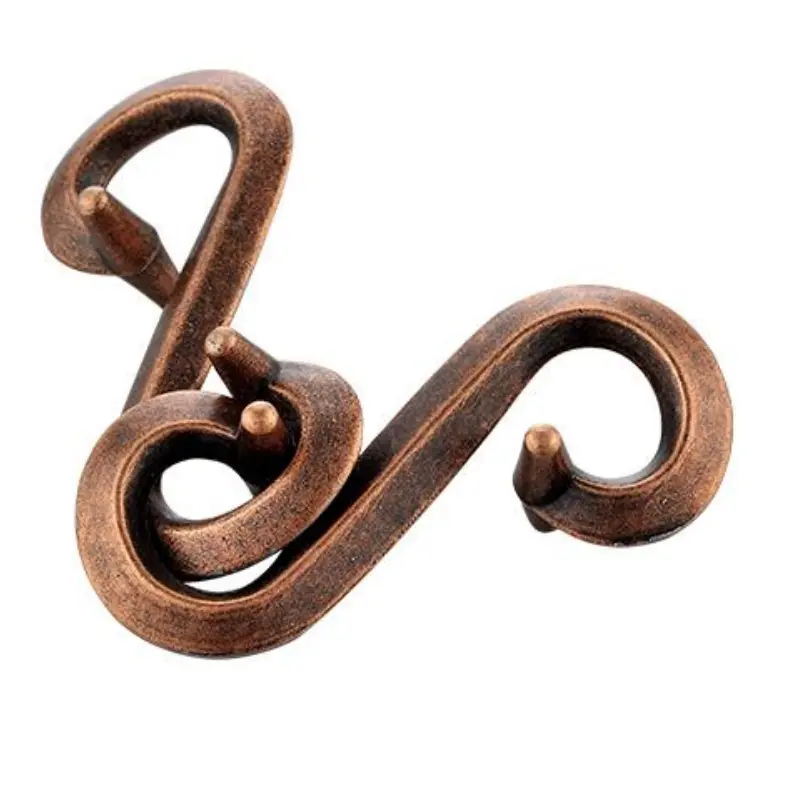
Alloy S Lock Puzzle — $10.99
For the mechanically-minded collector who triumphs over the Chain and craves more intricate movement, Oskar’s designs offer a lifetime of study. A puzzle like the Shuriken Dart Edition Gear Puzzle delivers that next-level engagement with interlocking parts and precise rotations, a complexity that builds on the foundational principles found in resources like the PuzzleSolver collection.
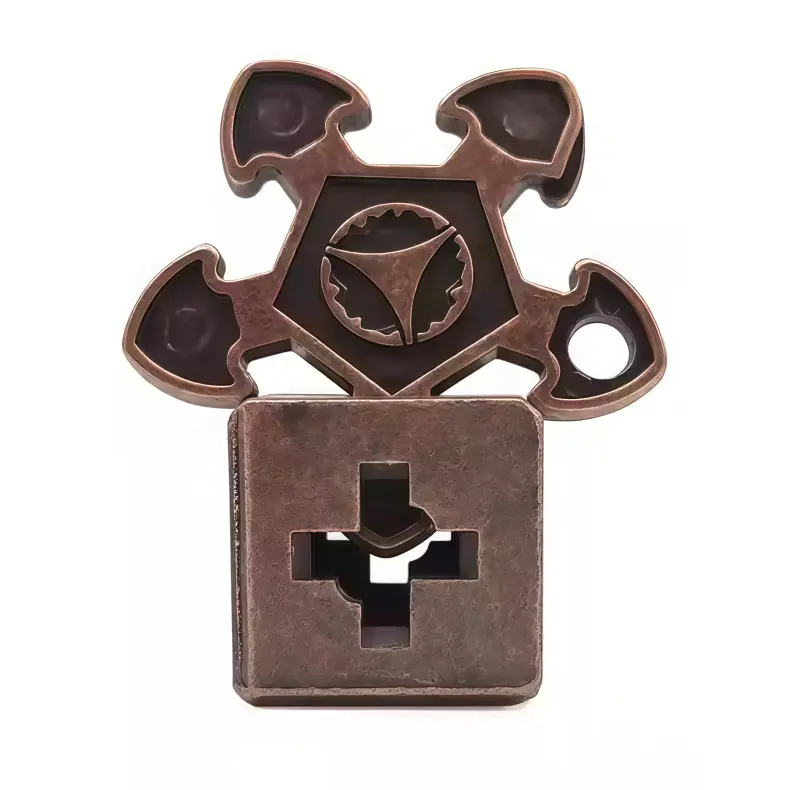
So, what’s the final take? The Hanayama Cast Chain is less a puzzle you solve and more a principle you internalize. It begins with frustrated fumbling in a quiet room and ends with the profound, satisfying click of understood constraints. It earns its place on the shelf—a three-link monument to the beauty of a problem that fights back fairly. Your next step is to decide which side of the matrix you’re on. Then, either pick up the Chain, or pick the lock that suits you first.