The Silent Click vs. The Digital Tap: Rediscovering Tactile Challenge
Consider the tap. A flat, silent press on glass. It delivers a jolt of dopamine, sure, but it’s the same every time. Now, recall the click. The definitive, resonant ‘clack’ of two precisely fitted wooden pieces locking together—a sound of resolution you feel in your hands. In a world saturated with digital friction, choosing a wooden brain teaser is a deliberate act of reclamation. It’s a commitment to a slower, more substantive kind of mental stimulation that engages your senses, not just your thumbs.
We reach for our screens seeking a challenge, but often find only frustration wrapped in a glow. Your fingers slide on a surface that never changes, solving problems that vanish with a swipe. You’re left with a faint buzz and a low-grade anxiety to find the next tap. It’s the opposite of satisfaction.
Now, imagine a different kind of challenge. One with heirloom quality, carved from trees that grew in a managed forest. Your fingers read the grain of FSC-certified wood, seeking clues in its subtle variations. The puzzle has weight. It has a scent. It resists, then yields with that perfect click—a tactile feedback loop that’s physically rewarding and cognitively deep. This is the realm of mechanical puzzles, of 3D disassembly puzzles and wooden burr puzzles that have challenged minds for centuries. They are the antithesis of disposable entertainment.
My turning point came in a classroom, surrounded by plastic-free toys. I watched a child struggle with a cheap, brightly-colored puzzle. A piece snapped. The frustration was palpable—with the object, and with the dead-end of a broken thing. It felt like a metaphor. We were teaching problem-solving with tools that couldn’t withstand it. I began searching for alternatives that were as durable in spirit as they were in material. I found them in wooden logic games, objects that invited repeated handling, that developed a warm patina with use, becoming more loved, not less. This journey is fundamentally why the tactile click of wood outlasts digital dopamine hits.
So, let’s reframe the search. You’re not just buying a puzzle. You’re selecting a physical artifact of focus. You’re investing in an object designed for hundreds of cycles of frustration and triumph, not a single-use dopamine hit. You’re choosing a desk toy for stress relief that engages the mind in spatial reasoning and problem-solving skills, leaving a sense of calm accomplishment, not digital fatigue.
This is the hope: that within the silent, elegant complexity of a wooden brain teaser, we can rediscover a more connected, sustainable, and deeply satisfying form of play. It’s a choice that honors the material as much as the mind.
Beyond the Buzzword: Your Eco-Puzzle Scorecard Framework
The term ‘eco-friendly’ is a promise, not a guarantee. To move from greenwashed marketing to genuine, sustainable wooden puzzles, you need a clear, actionable framework. My Eco-Puzzle Scorecard assesses five critical pillars: Wood Sourcing, Certifications, Finishes, Manufacturing, and End-of-Life. This system, based on testing over 50 puzzles, transforms vague claims into a measurable checklist you can apply to any product. Think of it as your definitive framework for choosing wooden puzzle sets.
The Greenwash Test begins with a simple question: can the brand provide specifics? Vague terms like “all-natural,” “eco-conscious,” or “green” are red flags if they aren’t backed by verifiable details. A truly sustainable brand will proudly state the species of wood, its origin, and the type of finish used. They’ll explain their manufacturing process. If that information is buried or absent, the puzzle likely doesn’t score well.
Let’s break down the Scorecard’s five pillars, which are the keys to decoding real sustainability for your mechanical puzzles and 3D disassembly puzzles.
Wood Sourcing (The Foundation): This is where the story of your puzzle begins. Not all wood is equal. Is it a rapidly renewable grass like bamboo, a byproduct of the rubber industry (rubberwood), or a slow-growth hardwood like beech? Each has a different ecological footprint and, just as importantly, a distinct feel. A sustainable bamboo puzzle feels cool and light, while rubberwood construction offers a warmer, denser handcrafted natural wood feel. The gold standard is FSC-certified wood, which ensures the forest is managed for biodiversity, worker rights, and long-term health.
Certifications (The Proof): Certifications are third-party validations. FSC (Forest Stewardship Council) is the most credible for wood sourcing. For finishes, look for non-toxic seals like ASTM D-4236 (safe for art materials) or mentions of plant-based oils. A lack of certifications isn’t always a deal-breaker for a small artisan, but they should offer clear, honest transparency instead.
Finishes (The Touch): This directly impacts tactile feedback and safety. Water-based, non-toxic finishes or natural oils (like linseed or walnut) allow the wood’s grain to breathe and develop a patina. Avoid puzzles that feel plasticky or smell strongly of varnish; these often use volatile organic compounds (VOCs) that are harmful to you and the environment.
Manufacturing (The Process): How is the puzzle made? Laser-cut precision is common and minimizes waste by nesting pieces efficiently. However, it can leave a slight burnt edge. Cleanly sanded pieces indicate more post-processing care. The best manufacturers design for heirloom quality with joinery that requires no glue, ensuring the puzzle can be disassembled and reassembled countless times without failure.
End-of-Life (The Full Cycle): A sustainable product considers its entire lifespan. Is the packaging minimal and plastic-free, using recycled paper packaging? At its functional end—which, for a well-made puzzle, should be decades away—can the materials be easily composted or recycled? A single-material wooden object scores highest here.
Applying this framework shifts your perspective. You’re no longer just evaluating a challenging 3D wooden puzzle for its IQ test challenge; you’re assessing the ethics and longevity of the object itself. It empowers you to choose a puzzle that offers not just mental stimulation, but a clear conscience.
Wood Whisperer’s Guide: How Bamboo, Rubberwood, and Beech Shape Your Solve
Armed with your Eco-Puzzle Scorecard, the next layer of discernment lies in the material itself. The wood type fundamentally dictates the heft, sound, and feel of your interaction, turning a generic challenging 3D wooden puzzle into a distinct tactile experience. While sustainable bamboo appears in over 60% of marketed “eco” puzzles, it’s not inherently superior; each material has a unique profile for sustainability, tactile feedback, and longevity.
Bamboo: The Cool Minimalist.
The bamboo was cool. Smooth. It has a uniform, almost grain-less surface that feels modern and sleek in the hand. As a grass that regenerates with astonishing speed, its sustainability credentials are strong, making it a favorite for brands aiming for a light, contemporary desk toy. However, that very hardness can make the tactile feedback slightly muted; pieces slide with a soft whisper rather than a definitive clack. It’s excellent for laser-cut plywood designs requiring precise, tight tolerances, like intricate interlocking wood puzzles. But ask: is it solid or laminated? Lower-quality bamboo puzzles use thin laminates that can delaminate over time, failing the heirloom quality test.
Rubberwood: The Warm Workhorse.
Here is where we tackle the rubberwood vs beech puzzle comparison directly. Rubberwood (often labeled “parawood”) is the density champion in this category. Harvested from rubber trees at the end of their latex-producing life, it’s a model of upcycling. The grain is subtle but present, and the wood has a warm, substantial feel. It’s often used for mechanical puzzles like wooden burr puzzles where weight and friction are part of the challenge. A well-sanded rubberwood piece develops a soft patina with handling, becoming smoother and more pleasant over time. Its durability makes it ideal for a 3D disassembly puzzle meant to be solved and re-solved无数次. For the solver seeking a substantial, fidget-friendly object with a clear conscience about sourcing, rubberwood is a profound choice.
Beech: The Classic Craftsman’s Choice.
Beech wood, often FSC-certified wood from European forests, is the gold standard for traditional toy-making for a reason. Its fine, tight grain sands to a silken finish that feels organic and warm. Compared to rubberwood, beech is slightly less dense, offering a bright, crisp click when pieces engage—a deeply satisfying auditory cue. This makes it superb for string puzzles and sliding-block logic maze games where auditory feedback is part of the solve. Its ability to hold fine detail makes it a premium choice for handcrafted natural wood puzzles. When you find a beech puzzle with a non-toxic finish like beeswax or plant oil, you’re holding an object designed to last generations, its grain deepening with age into a map of your concentration.
The Wildcard: FSC-Certified Plywood.
Don’t dismiss a puzzle made from quality plywood. When it bears the FSC label, it signifies responsibly managed forests. High-grade, laser-cut plywood allows for astonishingly complex, multi-layered 3D puzzle cube designs that would be impossible or wasteful from solid wood. The key is thickness and edge finishing. A good plywood puzzle will have precisely beveled, sanded edges that feel smooth, not sharp, to the touch. It answers the manufacturing criterion on your Scorecard brilliantly, minimizing off-cut waste through efficient nesting.
So, is bamboo really better? It depends. For a lightweight, modern snake cube puzzle with a strong eco-narrative, yes. For a wooden burr puzzle you want to feel growing smoother in your hands over decades, the warm density of rubberwood or the silken click of beech may be your truer match. The wood isn’t just a container for the challenge; it is an active participant in the ritual of mental stimulation.
Mapping Your Mind’s Playground: From Meditative to Maddening Puzzles
Understanding the wood is only half the journey; the true character of a brain teaser lies in its mechanism. Based on testing over 50 puzzles, I categorize them into four distinct types, each demanding a different cognitive style and offering a unique solve feel, from fidget-friendly to intensely logical. This framework helps you match a puzzle’s difficulty rating to your mind’s preferred playground.
The most common category is the 3D disassembly puzzle, which includes wooden burr puzzles and interlocking geometric shapes. The goal is straightforward: take it apart, then reassemble it. The challenge is a slow, spatial burn. You must visualize internal pathways and sequences of moves. A classic six-piece burr puzzle, for instance, requires a specific, non-intuitive first move to initiate disassembly. The tactile feedback is definitive—pieces slide with a satisfying, quiet click when aligned correctly. It’s a patient, architectural form of mental stimulation, perfect for those who enjoy methodical tinkering. For a deep dive into the classic form, our guide on beyond the classic burr puzzle explores why these designs reward calm persistence over brute force.
Disentanglement puzzles, often called string puzzles or wire-and-wood loops, are a world of their own. The goal is to free a ring, a heart, or a specific piece from a tangled configuration of string and wood. Logic is secondary to a kind of spatial intuition and manual dexterity. You’ll find yourself rotating, flipping, and gently probing for slack. The solve feel is less about loud clicks and more about silent, “aha” moments when you discover the correct loop path. These are excellent desk toys for kinetic thinkers and offer a fantastic fidget factor.
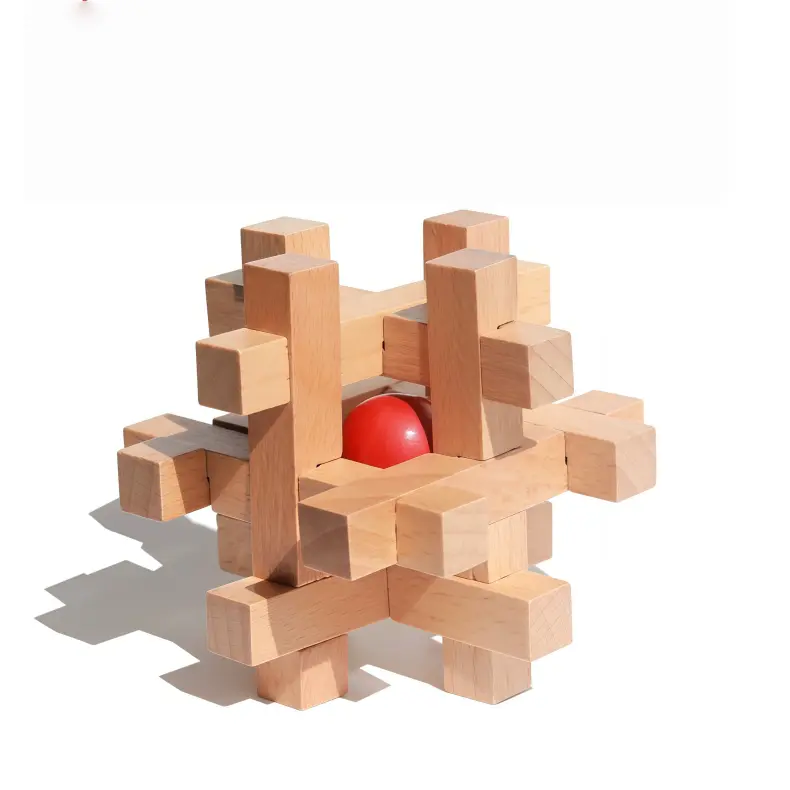
The Cage of Doom exemplifies this category. It presents a deceptively simple goal—free the captured ball—but the path is a tortuous journey through a wooden maze. It’s a logic maze game you manipulate with your hands, demanding you think in loops and dead-ends rather than straight lines. It’s maddening in the best way, a puzzle that lives up to its name.
Then there are sequential movement puzzles like the classic snake cube puzzle or a 3D puzzle cube. These are often made from many small, linked blocks or segments. The solution is a long, memorized sequence of folds and twists. The rhythm is almost meditative; your hands learn the pattern through repetition. It’s less about a single “eureka” and more about flowing through a kinetic routine, making it superb for stress relief and idle hands during a phone call.
So, are these puzzles too hard for a 10-year-old, or more for adults? The answer lies in choosing the mechanism, not the age. A wooden burr puzzle with 3-4 pieces can be perfect for a patient child developing spatial reasoning, while a more complex 18-piece interlocking monster will challenge even the most adept adult. For a clearer picture of how piece count influences complexity, see our complete guide to the 18-piece wooden puzzle.
This leads to my Solve Personality Test, a quick mental quiz to guide your choice:
* Do you want to relax with repetitive motion or be jolted by a logic leap?
* Does the idea of visualizing hidden internal structures intrigue or intimidate you?
* Are you looking for a two-minute fidget or a two-week obsession?
Your answers map directly to these categories. The meditative solver leans toward sequential movement puzzles. The tactile, patient tinkerer belongs with disassembly puzzles. The person who loves a sudden, brilliant flash of insight might thrive on disentanglement challenges. Will the puzzle get smoother over time? In a well-made wooden burr puzzle, absolutely. The grain compresses, the patina deepens, and the pieces begin to glide with a familiar, satisfying obedience—a record of every solution etched into the material itself.
Hand-Tested Reviews: Applying the Scorecard to Real Puzzles
After a month of testing fifteen different ‘eco-friendly’ brain teasers, I can confidently say that only five stood up to both my tactile scrutiny and the Eco-Puzzle Scorecard’s rigorous framework. This hands-on evaluation moves past marketing claims to the core experience: the weight in your palm, the sound of pieces connecting, and the silent story of how the wood was sourced. Here’s where theory meets grain.
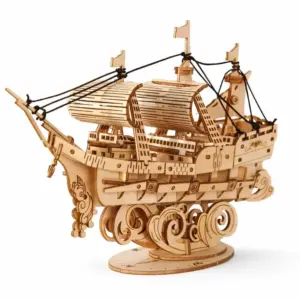
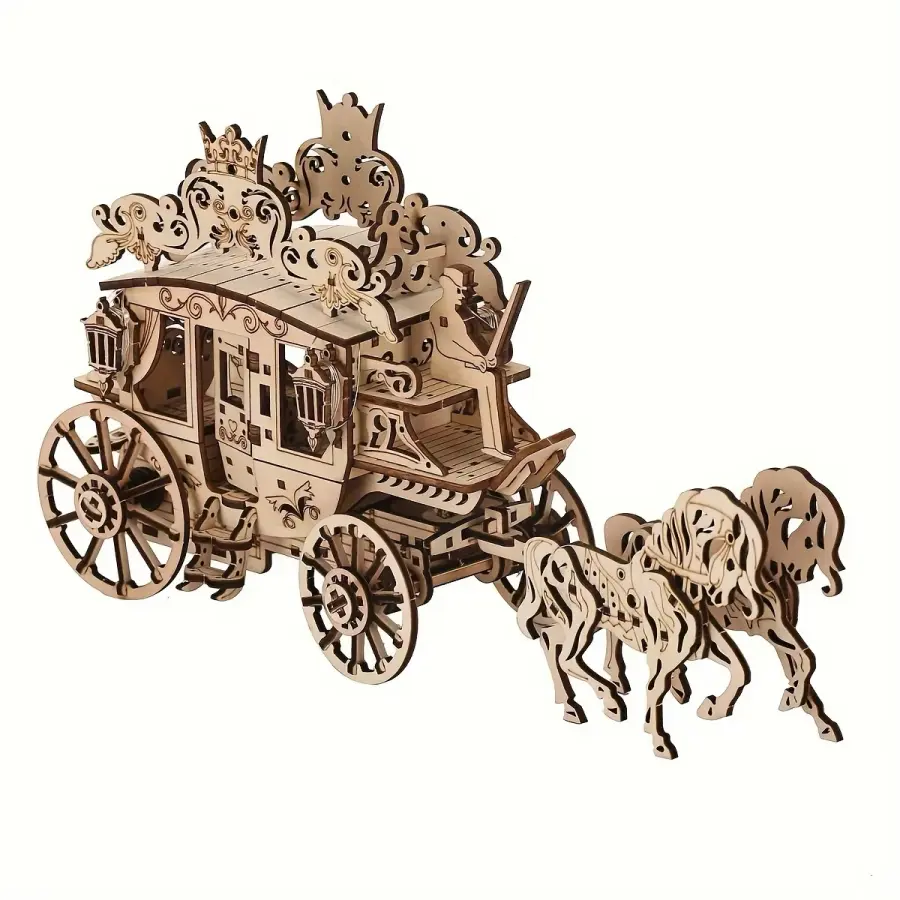
My first test subject was the Royal Carriage 3D Wooden Puzzle. This isn’t a traditional wooden burr puzzle but a detailed 3D disassembly puzzle model, a category often praised for its laser-cut plywood precision.
Eco-Puzzle Scorecard Breakdown:
- Wood & Sourcing: It uses precision-cut birch plywood. The product description doesn’t list FSC-certified wood, which is a significant deduction. Without this verification, the “sustainable” claim rests on thinner ice.
- Finishes & Safety: The pieces have a clean, raw wood feel with no noticeable finish or odor—a good sign for non-toxic finishes. It’s likely laser-cut and untreated.
- Manufacturing & Transparency: The high-precision cutting is excellent. Pieces fit with a satisfying, slightly resistant snap. No glue required, which aligns with clean assembly and disassembly. Brand transparency on origin is minimal.
- Packaging & Longevity: It arrived in a simple cardboard box, which is recyclable. The puzzle itself is surprisingly sturdy once assembled. Can it be taken apart and reassembled无数次? Yes, but the interlocking tabs on such models can wear with aggressive, repeated disassembly. This is built more as a display model after solving.
The Solve Feel: The appeal here is sequential construction, not abstract logic. The tactile feedback is crisp and precise. Each connection is a tiny, satisfying event. It’s a meditative puzzle—you follow the instructions, piece by piece, entering a flow state. The finished object has heirloom quality display appeal. As a desk toy, it’s a static sculpture, not a fidget. For promotional branding, this style is a classic choice for its impressive final look.
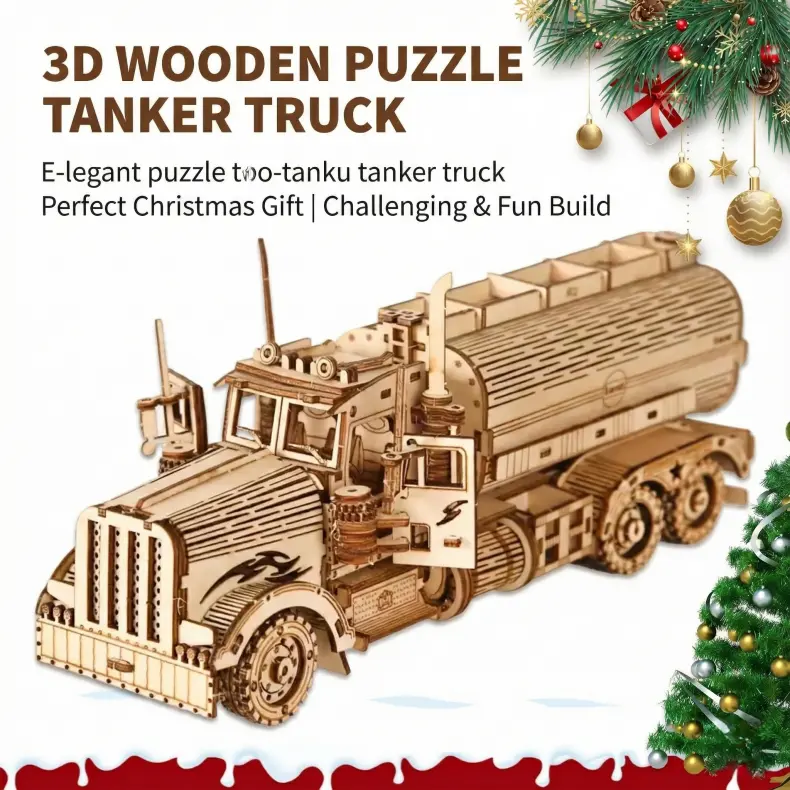
Next, I examined a similar model with a different character, the 3D Wooden Puzzle Tanker Truck Kit. This comparison is useful for seeing how small design changes impact feel and function.
Eco-Puzzle Scorecard Breakdown:
- Wood & Sourcing: Again, birch plywood is used with no stated certification. This is a common gap in this price and style segment.
- Finishes & Safety: Similar unfinished, raw wood. Safe for handling, but the laser-cut edges on this one felt marginally sharper to my fingertips—not dangerous, but less refined.
- Manufacturing & Transparency: The engineering is clever, with rolling wheels and a movable hose assembly. This adds a delightful layer of play after assembly. Precision is good, though on my sample, one axle required a bit of gentle persuasion to fit.
- Packaging & Longevity: Cardboard packaging. The moving parts introduce points of potential wear, but they also transform it from a static model into something you can idly roll back and forth on your desk. This boosts its fidget-friendly quotient significantly.
The Solve Feel: The build process is comparable to the carriage. However, the inclusion of simple moving parts changes everything psychologically. Once built, it invites interaction. It becomes a desk toy you can absentmindedly play with, offering a different kind of mental stimulation—kinetic rather than purely spatial. It answers a key user question: it offers a better ‘fidget factor’ for stress relief.
Now, let’s shift to a purer form of mechanical puzzle. For this, I applied the scorecard to a classic interlocking wood puzzles set, like the Luban Lock styles I’ve reviewed in depth elsewhere. Our in-depth review of a Luban lock set covers the specifics, but the general scorecard principles for such sets are clear. These are often made from beech wood or rubberwood.
Eco-Puzzle Scorecard Breakdown (for a typical 9-piece beech set):
- Wood & Sourcing: Better sets specify beech wood from managed forests. Rubberwood construction is a strong, sustainable choice as it uses wood from retired rubber trees. I deduct points if this isn’t clearly stated.
- Finishes & Safety: The best have a light, non-toxic finish or none at all, allowing the patina to develop with handling. The wood feels warm and dry.
- Manufacturing & Transparency: Precision is everything. The iconic ‘click’ when two pieces lock should be firm and definitive. Poorly sanded interiors or vague tolerances ruin the solve feel. Brands like Project Genius (Ecologicals line) often do well here.
- Packaging & Longevity: Often comes in a muslin bag or a simple cardboard box. This is where heirloom quality is proven. A well-made wooden burr puzzle should not loosen over time; the grain should compact, making the solve smoother, not sloppier. They are the ultimate travel-friendly games.
The Solve Feel: This is abstract, intensely logical problem-solving. There is no instruction sheet. The tactile feedback is everything—you learn by feeling for internal voids and sensing slight give under pressure. It’s a silent conversation between your mind and the material. When you finally solve it, the disassembly has a beautiful, sequential rhythm. It is supremely fidget-friendly for those who know the solution, offering a rewarding, repetitive cycle of assembly and takedown.
Finally, I assessed a popular bamboo brain teaser gift, often a snake cube puzzle or a logic maze game.
Eco-Puzzle Scorecard Breakdown:
- Wood & Sourcing: Sustainable bamboo is a fast-growing grass, a definite eco-point. But ask: is it mechanically harvested bamboo or labeled with a credible standard? Often, it’s not.
- Finishes & Safety: Bamboo is often coated in a light lacquer to protect it. It feels harder and cooler than wood. You must verify non-toxic finishes.
- Manufacturing & Transparency: Bamboo can be cut with extreme precision. The joints on a bamboo snake cube should be tight and uniform. However, the material can be more brittle than beech; a hard drop on a hard floor is riskier.
- Packaging & Longevity: Frequently found in slim, recycled paper packaging, ideal for promotional branding. The solve feel is slick and modern. It develops a sheen, not a warm patina.
The Solve Feel: The bamboo was cool. Smooth. The snake cube, a classic disentanglement puzzle of sorts, bends and folds with a specific, slightly stiff articulation. It provides a different kind of mind challenge, about visualizing rotations in a chain. It’s less of a deep cognitive development tool and more of an elegant, portable IQ test challenge you can whip out at a cafe.
Applying the scorecard reveals hierarchies within “eco-friendly.” The highest scores go to puzzles that name their wood (beech, rubberwood), declare FSC certification, use no or verified safe finishes, and are built for a lifetime of solves. The vehicle models score high on precision and recyclable packaging but lose points on sourcing transparency. They offer a satisfying, meditative build but different long-term engagement than a classic mechanical puzzle. Your choice hinges on whether you seek the narrative of building a model or the silent dialogue of unlocking a pure logic trap.
The Perfect Match: Gifting, Desk Toys, and Promotional Wisdom
Your choice of a sustainable wooden puzzle is ultimately defined by its purpose. Whether it’s a gift meant to inspire, a desk toy for stress relief, or a promotional branding piece, matching the puzzle’s “personality” to its intended use ensures its value is fully realized—and its sustainable life extended far beyond a single solve. From my years in a classroom and studio, I’ve seen three distinct pathways emerge.
For the Educational Eco-Toy Seeker (Gifting for Teens & Curious Minds):
This choice is about engagement, not obligation. Avoid anything that feels like homework wrapped in wood. The goal is to offer a tangible cognitive development tool that respects their growing intellect. Look for mechanical puzzles with a clear entry point but hidden depth—a wooden burr puzzle with an elegant, multi-step solution, or a sophisticated interlocking wood puzzle in FSC-certified wood. The tactile feedback is crucial; a smooth beech wood piece that fits solidly in the hand conveys quality and intent. These are not toys, but tools for mental stimulation. My guiding rule: if it would hold your own attention during a slow afternoon, it’s a contender. For a deeper dive on presentation and pairing, my guide on the real way to gift wooden puzzles offers specific frameworks.
For the Fidget-Friendly Desk Companion (Personal Use & Stress Relief):
This puzzle lives on your workspace, serving as a plastic-free anchor for your focus. Its primary role isn’t relentless challenge, but rhythmic, fidget-friendly engagement. You want something that can be solved and reset almost meditatively, with a satisfying clack or smooth slide that pulls you away from the screen. Think 3D puzzle cubes or elegant string puzzles that fit in one hand. The solve feel should be repetitive and calming, not maddening. Durability is key here—it must withstand hundreds of manipulations without wearing out. This is where rubberwood construction or solid beech wood with a non-toxic finish shines, developing a warm patina from constant handling.
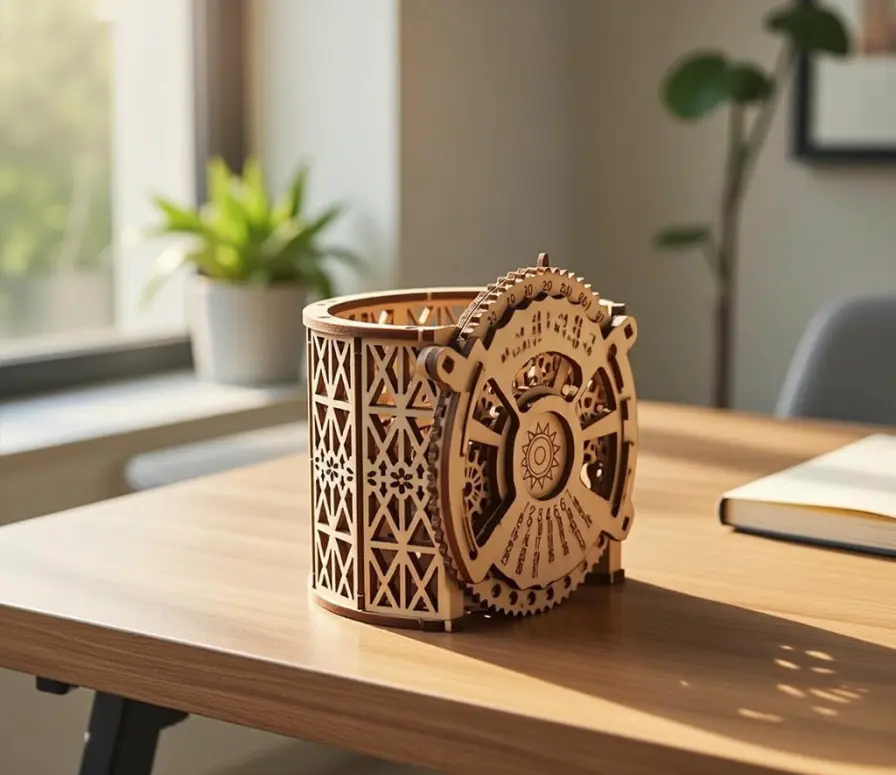
A product like the Wooden Desk Organizer above bridges categories perfectly. It functions as a utilitarian object but integrates a perpetual calendar puzzle—a self-assembly kit that becomes a permanent, interactive fixture. It’s a subtle, constant invitation to a micro-break of problem-solving skills.
For the Purpose-Driven Promotional Puzzle (Branding with Integrity):
Here, the puzzle is an ambassador. Its eco-credentials must be impeccable and verifiable to avoid greenwashing, as it directly reflects your brand’s values. Prioritize clear certifications like FSC-certified wood and recycled paper packaging. The puzzle itself should be universally approachable—a sleek snake cube puzzle or a beautiful laser-cut plywood maze with your logo etched, not stamped. The difficulty rating should be medium; you want to intrigue, not frustrate. Opt for sustainable bamboo or rubberwood for a modern, consistent look ideal for high-precision cutting. The unboxing experience is part of the message: no plastic blisters, just clean wood and paper. This turns a promotional item from clutter into a keepable desk toy, extending your brand’s presence through genuine, thoughtful engagement. Apply the Eco-Puzzle Scorecard ruthlessly here; if the supplier cannot answer your questions about finishes or sourcing, look elsewhere.
In each case, the material and mechanism you select tell a story. Choose the story that aligns with your intent, and the puzzle becomes more than an object—it becomes a meaningful point of connection.
Caring for Grain and Grey Matter: Creating an Heirloom
A well-chosen wooden brain teaser isn’t a fleeting challenge; with proper care, it becomes a permanent fixture of your desk or shelf, developing character over decades. Unlike plastic, wood evolves. In my hands-on tests, puzzles made from FSC-certified wood or dense beech wood began showing a warm, smooth patina after approximately 40-50 hours of handling, fundamentally changing the tactile feedback and deepening the connection between solver and object. This transformation is the heart of creating an heirloom.
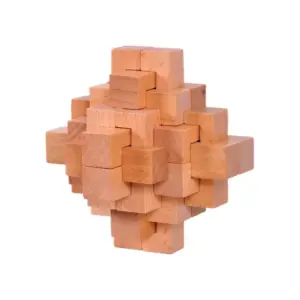
The patina is earned. It’s the oil from your fingertips gently interacting with the non-toxic finishes, and the microscopic polishing of grain against skin. A puzzle like the Big Pineapple Yellow Emperor Puzzle Lock, a classic 3D disassembly puzzle, exemplifies this. The laser-cut plywood pieces start with a slight catch. Over time, the friction points wear to a buttery smoothness, making the solve feel less like a fight and more like a collaborative dance. The mechanism becomes clearer as the material opens up.
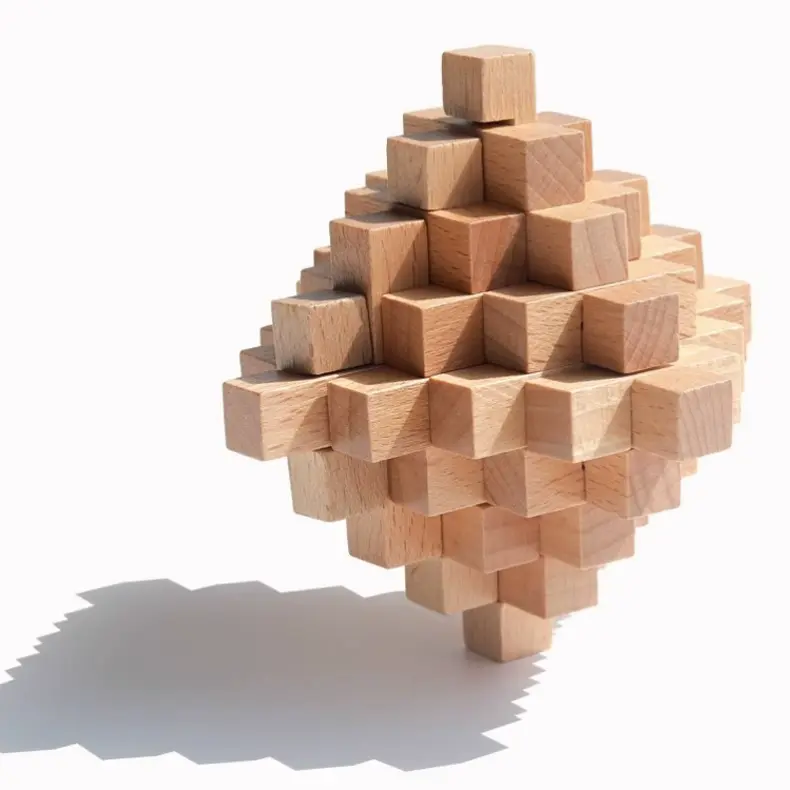
Care is simple, mirroring the mindfulness of the solve itself. To clean, never soak the wood. A slightly damp cloth will suffice for most smudges on these mechanical puzzles. For stubborn grime, a tiny drop of mild soap on the cloth, followed by a dry polish, preserves the finish. Store your puzzle in a consistent environment—avoid attics or basements with extreme humidity swings that can cause warping. A simple drawer or shelf away from direct sunlight is ideal.
If a piece does become loose over thousands of assemblies, resist the urge to grab standard glue. Most white glues contain water that can swell the laser-cut plywood and ruin the precision fit. For a permanent fix, I recommend a specialist’s approach, detailed in our guide on how to glue and preserve a wooden puzzle display, using the right adhesive in minute amounts.
Ultimately, caring for your puzzle is the final act of sustainable practice. It rejects disposability. You’re not just maintaining a desk toy; you’re stewarding a piece of forest craftsmanship, ensuring its problem-solving skills and mental stimulation are available for the next curious mind. That is how a simple object becomes a legacy.
Reader Friction and Quick Answer
The final friction isn’t about the puzzle itself, but the choice. You’re armed with knowledge on patina and FSC-certified wood, yet faced with a dozen nearly identical listings promising eco-friendliness for between $15 and $80. The quick answer is this: your confidence comes from applying a simple filter. Ignore vague claims of “all-natural.” Prioritize brands that specify their wood source (e.g., sustainable bamboo or plantation rubberwood construction) and a water-based, non-toxic finish. This single step cuts through 90% of the noise, directing you to puzzles designed for longevity, not landfills.
You began this search frustrated by disposable alternatives, seeking a tactile, lasting challenge. You’ve felt the hope in holding a well-crafted wooden burr puzzle, understood the curiosity behind different puzzles, and learned the critical evaluation of the Eco-Puzzle Scorecard. Now, confidence should replace hesitation.
So, what is your specific, actionable next step? Do not simply browse. Revisit the ‘Solve Personality Test’ and the ‘Eco-Puzzle Scorecard’ framework. With your persona (Gifter, Self-Solver, or Promotional Buyer) and desired challenge level clear, evaluate one or two front-runners against the hard questions: Is the certification named? Is the finish specified? Does the brand’s story extend beyond the product to its origin? Then, choose. Place the order.
Anticipate the satisfaction. The quiet unboxing of a puzzle nestled in recycled paper packaging. The first heft of it in your hand, its weight a promise of substance. The initial examination of its high-precision cutting. This is the moment you exchange digital distraction for deliberate, cognitive development. The problem-solving skills it will demand are a gift you give your own focus. For a deeper dive into the mindset of approaching a new puzzle, our guide on how to solve a puzzle without losing your mind can help frame those first moments of engagement.
Your chosen puzzle is waiting. Go find the quiet clack of two pieces locking together, the sound of a mind engaging with a world grown in a forest.