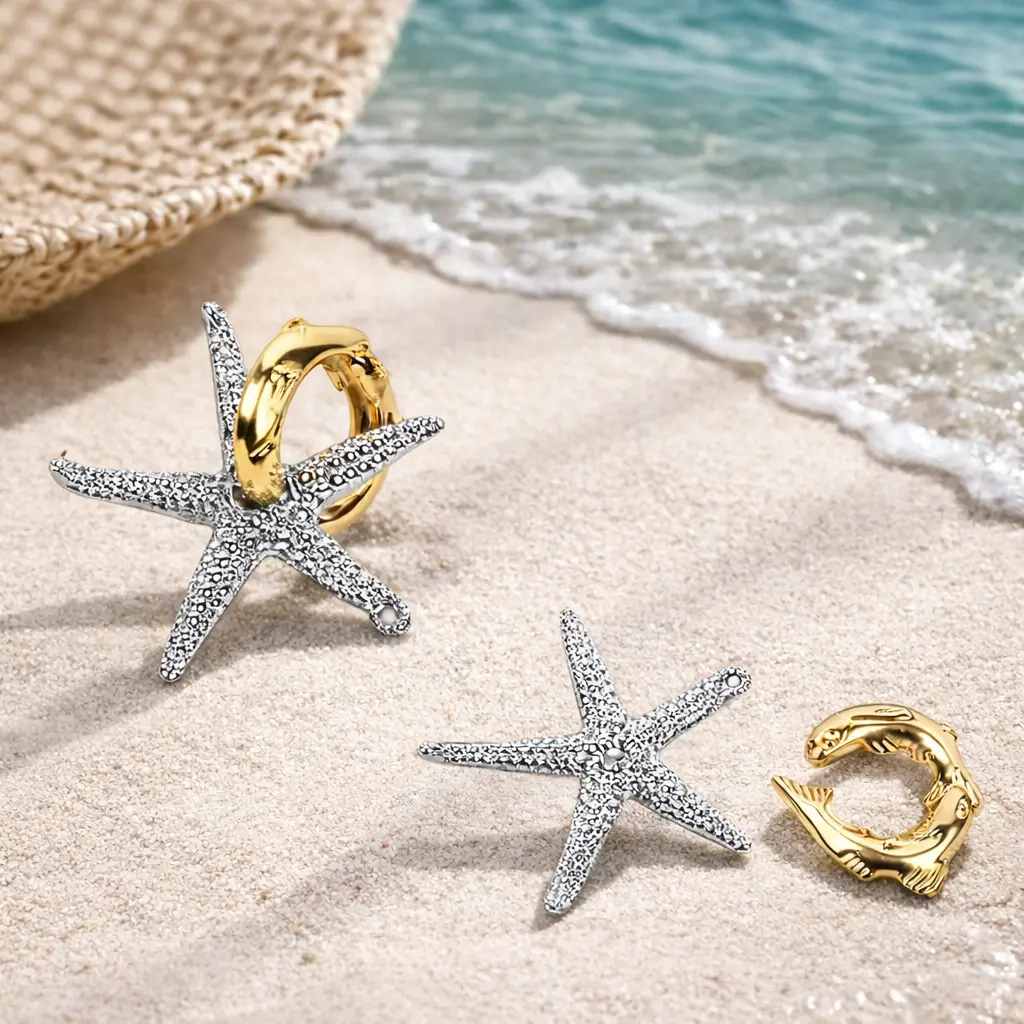
Your thumb finds the first arm of the chrome starfish—smooth, cool to the touch, the texture subtly dimpled like real echinoderm skin. The gold ring threads through its center, twisted into itself with a knotted loop that seems to defy simple geometry. You rotate the starfish clockwise. The ring stays locked. Counterclockwise. Still locked.
This isn’t a burr puzzle where pieces slide apart in sequential moves, and it’s not a sequential lock where numbered steps guide you. The Metal Starfish Puzzle Ring is a disentanglement challenge—two zinc alloy pieces that look like they should separate in five seconds but typically take 15 to 30 minutes of focused manipulation to free.
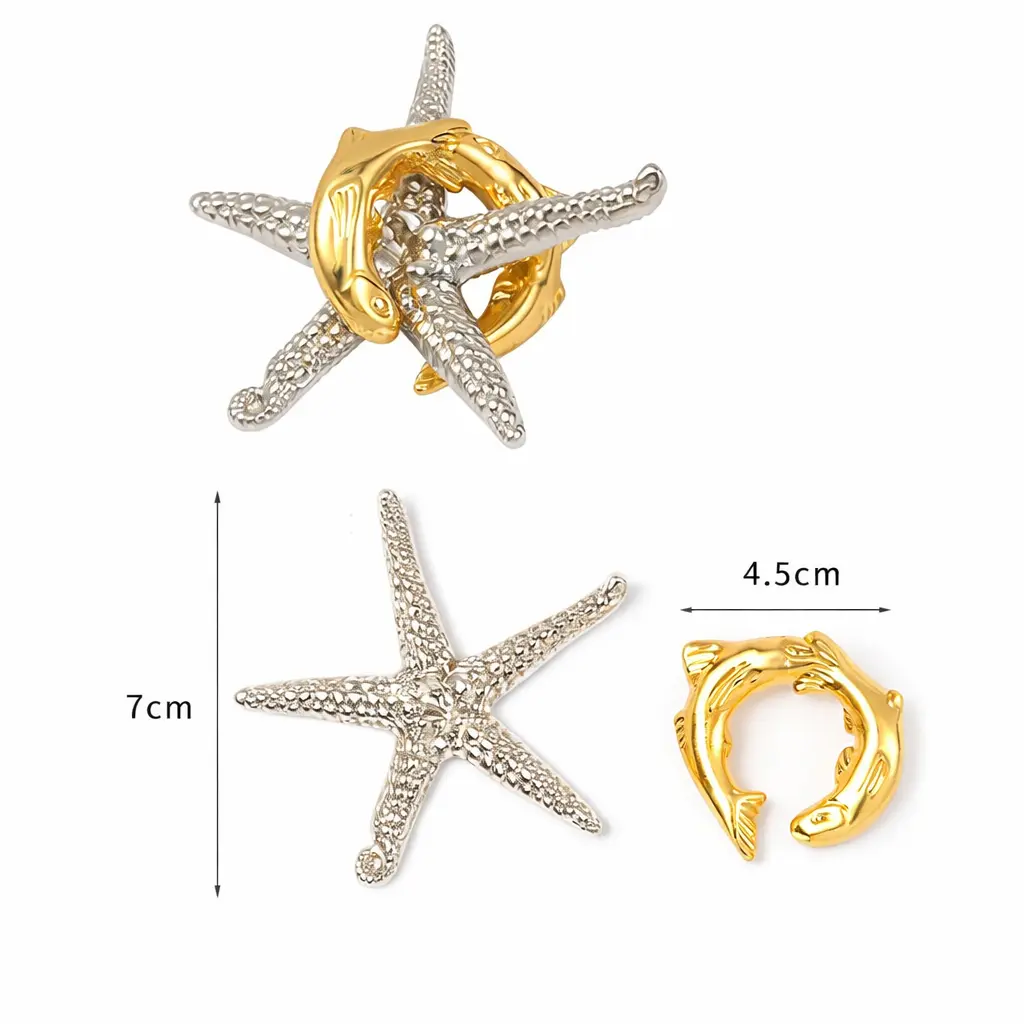
The starfish measures approximately 6cm across—compact enough to fit in your palm or pocket, substantial enough (at roughly 80 grams) that it feels like a quality object, not a disposable trinket. The contrast between the brushed gold ring and the chrome silver starfish catches ambient light in a way that makes the puzzle visually compelling even when sitting idle on a desk.
What you’re holding is a modern iteration of a puzzle category documented since at least the 16th century—a lineage that extends back to Chinese antiquity and forward through Victorian tavern puzzles into today’s precision-cast designs.
What You Actually Get: Grounded Unboxing
The product page specifies two pieces constructed from zinc alloy with a chrome silver finish on the starfish and a brushed gold finish on the twisted ring. The dimensions are listed as palm-sized at approximately 6cm × 5cm, with a weight of around 80 grams. The difficulty rating is medium, recommended for ages 14 and up, with an estimated solve time of 15–30 minutes for first-time solvers.

The finish quality is smooth across both pieces—no sharp casting burrs that snag on skin, no rough edges at the junction points where the ring threads through the starfish arms. This isn’t paint that will chip after a few drops onto hardwood floors; the metallic finish is integrated into the zinc alloy casting process.
No solution guide is included. This is intentional design philosophy rather than an oversight—disentanglement puzzles rely on the solver discovering the principle of movement rather than following numbered steps. That said, the absence of hints can extend solve time significantly for those unfamiliar with how disentanglement mechanisms work.
What’s not specified on the product page: the exact internal clearances between the ring and starfish arms, the precise sequence of rotations required, or whether any deformation of the metal is part of the solution (it’s not—force is never the answer with properly designed disentanglement puzzles).
The puzzle arrives ready to use. No assembly required, no pieces to lose. The compact size means it fits easily in a jacket pocket, a desk drawer, or a carry-on bag for travel.
The Unlock Journey: Step-by-Step Reality
This section details the actual solving experience based on the mechanical principles of disentanglement puzzles and the specific constraints visible in this design.
Step 1: Initial Assessment (Minutes 0-2)
What you try: Intuitive pulling—grasping the starfish in one hand and the ring in the other, attempting direct separation.
What you feel: Immediate resistance. The ring doesn’t budge. This is where many solvers instinctively apply more force, which is precisely the wrong response.
What goes wrong: Disentanglement puzzles are topological challenges, not strength tests. The pieces are locked not by friction or tight tolerances but by geometric pathways—the ring must follow a specific route through three-dimensional space to clear the starfish’s arms. According to the Smithsonian’s mechanical puzzle collection, force never unlocks a well-designed disentanglement—understanding the freedom of movement does.
Fix: Rotate the puzzle slowly in your hands, examining how the ring passes through different starfish arms. Look for gaps and angles where the ring might have clearance to move in directions other than straight-line pulling.
What you learn: The ring isn’t uniformly thick—the twisted, knotted design creates varying cross-sections. This asymmetry is a clue: certain orientations create more clearance than others.
Step 2: Finding the First Movement (Minutes 2-8)
What you try: Rotating the starfish while holding the ring stationary, then reversing—holding the starfish while manipulating the ring.
What you feel: At certain angles, the ring shifts slightly—maybe 2-3 millimeters—along a starfish arm before jamming again. This is the first real progress: confirmation that movement is possible along specific axes.
What goes wrong: The initial breakthrough movement often feels like it should lead directly to the solution. It doesn’t. Many solvers thread the ring partially through one arm opening, only to find themselves at a dead end where no further movement is possible. Backtracking becomes necessary but frustrating, especially if you can’t remember the exact sequence that led to the current position.
Fix: Disentanglement puzzles often involve what topologists call “non-intuitive pathways”—the ring must sometimes move away from the apparent exit point to eventually reach the true release position. When you hit a dead end, don’t force—retreat and try a different arm or angle.
What you learn: The zinc alloy construction means the pieces maintain their shape under normal handling pressure. This isn’t a flexible wire puzzle where bending is part of the solution. The path to separation exists within the rigid geometry as designed.
Mini-checkpoint: If you’ve found at least one axis where the ring shifts a few millimeters, you’re on the right track. If after eight minutes the ring hasn’t moved at all, you’re likely trying to exit through a geometrically impossible pathway. Reset and examine which starfish arms have the most internal clearance.
Step 3: The False Summit (Minutes 8-15)
What you try: Assuming you’ve identified the correct arm for threading, you continue manipulating the ring through what appears to be the exit path.
What you feel: Smooth progress for several movements—the ring glides along a starfish arm, rotating naturally, and for a moment it feels like separation is imminent. Then: hard stop. The ring is now positioned differently than at the start, but still completely locked to the starfish.
What goes wrong: This is the psychological challenge of disentanglement puzzles. Progress doesn’t follow a linear path toward the goal. According to research on solving strategies for disentanglement puzzles, the solution path often requires temporary increases in entanglement before reaching the final configuration.
Fix: The “rubber concept” from puzzle theory suggests mentally treating the puzzle as if made from flexible material—visualize how the ring could pass through if the starfish arms could momentarily bend. While you can’t actually bend the zinc alloy, this mental exercise helps identify which arm positions and ring orientations create the necessary spatial alignment for passage.
What you learn: The knotted design of the gold ring means it has multiple “profiles”—depending on how it’s rotated, it presents different widths to the gaps between starfish arms. The narrowest profile is the key, but finding it requires systematic rotation testing.
Mini-checkpoint: If you can position the ring near the tips of the starfish arms (rather than trapped at the center), you’re closer to the solution than you think. Many solvers give up at this stage, assuming they’ve reached an impossible configuration, when they’re actually one or two moves from separation.
Step 4: The Critical Insight (Minutes 15-25)
What you try: Instead of focusing on one arm in isolation, you begin testing how the ring’s position relative to one arm affects its relationship to adjacent arms. Disentanglement puzzles from the same tradition as the Chinese Rings puzzle family often require understanding the system as a whole rather than solving component by component.
What you feel: A subtle click or shift—not mechanical (there are no internal mechanisms), but a tactile change in resistance as the ring finds an alignment where it can rotate freely through a critical junction point.
What goes wrong: Even after finding this alignment, the final release requires precise orientation in three axes simultaneously. Lose the alignment and the ring jams again. This is where patience separates those who solve from those who abandon.
Fix: Slow down. The estimated 15-30 minute solve time accounts for this precise maneuvering phase. Small adjustments—2-3 degree rotations—matter more than large movements at this stage.
What you learn: The chrome and gold finishes serve a practical purpose beyond aesthetics: the visual contrast helps you track which starfish arm you’re currently working with and whether the ring has rotated back to a previously tested orientation.
Step 5: Separation and Reassembly (Minutes 25-30+)
What you try: The final movement is often surprisingly simple once the correct configuration is reached—a gentle pull and rotation, and the ring slides free of the starfish.
What you feel: Relief, followed immediately by the realization that you must now reverse the process. Reassembly can be harder than disassembly because you’re working toward a locked state rather than away from one—it’s difficult to know if you’re making progress.
What goes wrong: Memory failure. Unless you paid close attention to the exact sequence during separation, reassembly requires rediscovering the path. Many solvers report that solving the puzzle a second time can take as long as the first attempt.
Fix: Mental mapping during the first solve pays dividends during reassembly. Note landmarks: “When the ring is positioned at this specific starfish arm with this orientation, it moves freely toward this adjacent arm.”
What you learn: The puzzle’s difficulty rating of “medium” is well-calibrated. It’s not a five-minute diversion, but neither does it require specialized knowledge or exceptional spatial reasoning. Persistence matters more than puzzle-solving experience.
Why It Gets Stuck: The Mechanics You Can Feel
Disentanglement puzzles exploit the mathematical field of topology—the study of properties preserved under continuous deformation. In practical terms, this means the puzzle’s difficulty comes not from tight mechanical tolerances but from how three-dimensional paths intersect in space.
The zinc alloy construction ensures dimensional stability. Unlike cheaper cast puzzles that can develop micro-deformations from repeated handling, quality zinc alloy maintains its shape. The smooth finish reduces friction to near zero, which paradoxically makes the puzzle harder—there’s no tactile feedback from scraping or grinding to indicate when you’re forcing an incorrect movement.
The knotted ring design creates what puzzle theorists call “variable cross-sections.” As you rotate the ring, different portions of the knot pass through the starfish arm gaps. The puzzle is solvable only when the narrowest cross-section aligns with the widest gap at the precise angle that allows passage. This requires coordination between rotational freedom (spinning the ring on its axis) and translational freedom (moving the ring along a starfish arm).
Force distribution matters. When you pull the ring, stress concentrates at the contact points between metal surfaces. If you’re pulling at an incorrect angle, even small force creates binding pressure that jams the pieces together. The solution path requires movements where force is distributed evenly or where no force is needed at all—the ring should glide freely once correctly positioned.
The 80-gram weight contributes to the solving experience. Lighter puzzles can feel insubstantial, making it harder to detect subtle resistance changes. The heft of quality metal provides tactile feedback: you can feel when the ring is moving freely versus when it’s binding against a starfish arm. This sensory information, registered through fingertips and palm pressure, guides the solution process as much as visual assessment.
Craft & Origin: Where Metal Disentanglement Sits in Puzzle History
Disentanglement puzzles trace lineage to ancient China, where legend attributes the Chinese Rings puzzle to general Zhuge Liang (181-234 AD), according to the University of Indiana’s puzzle archives. Historical records from the Sung Dynasty (960-1279 AD) reference wire and ring puzzles used as “wisdom games” to develop intellectual capacity.
By the 16th century, European craftsmen began producing metal disentanglement puzzles, recorded in texts like Luca Pacioli’s “De Viribus Quantitatis” (circa 1500) as Problem 107. The Renaissance period saw these puzzles evolve from practical lock mechanisms into pure recreational challenges, crafted by blacksmiths as demonstrations of metalworking skill.
The Victorian era brought mass production and popularization. Tavern puzzles—so named because they were common fixtures in 19th-century public houses—used simple bent nails or cast iron rings to challenge patrons while they socialized. The American frontier adapted these designs, with cowboys creating hobble puzzles from wire to secure horses at night.
The 1950s marked a commercial boom. Companies like Peter Pan produced keychain disentanglement puzzles as affordable souvenirs and promotional items. Casting technology improved, allowing more intricate designs with tighter tolerances. Where 19th-century puzzles relied on thick wire with visible gaps, mid-20th-century designs could use complex three-dimensional forms that appeared impossible to separate.
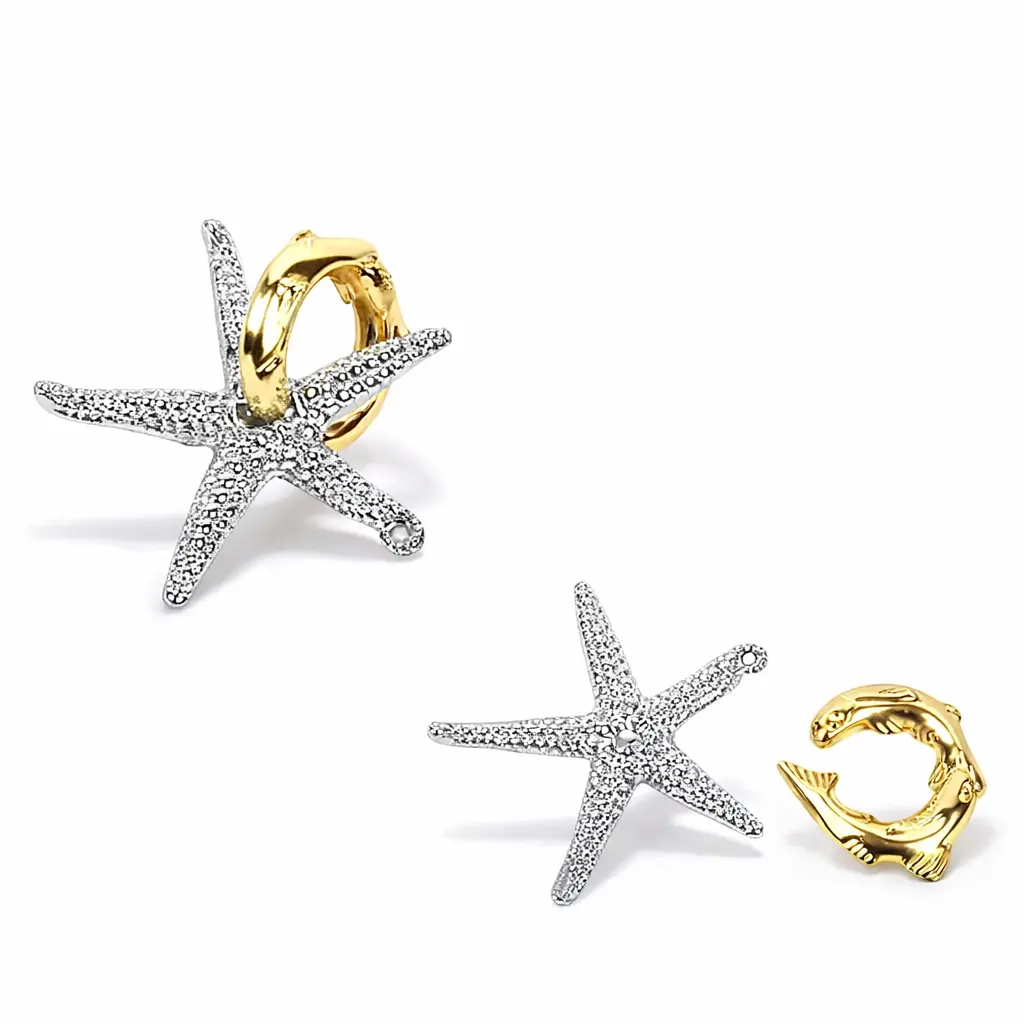
The Metal Starfish Puzzle Ring fits within this modern precision-casting tradition. Zinc alloy replaced brass and iron as the preferred material—cheaper to produce, easier to finish, and more resistant to corrosion than brass while maintaining the heft that steel provides. The starfish form represents a shift from purely geometric designs (rings, horseshoes, abstract curves) toward representational objects that double as desk sculpture.
Contemporary design philosophy, explored in detail in Tea-Sip’s mechanical engineering analysis of puzzle design, balances aesthetic appeal with functional difficulty. The brushed gold and chrome silver finishes aren’t merely decorative—the color contrast helps solvers track piece orientation during manipulation, reducing cognitive load and making the puzzle accessible to casual enthusiasts rather than only dedicated collectors.
Who This Is For (and Who Should Skip It)
This puzzle suits several specific profiles:
Desk fidgeters seeking professional appearance: The metal construction and jewelry-like finish mean this puzzle doesn’t read as “toy” in office environments. During long video calls or while thinking through problems, manipulating the puzzle provides tactile engagement without the visual distraction of stress balls or fidget spinners.
Gift buyers navigating the $10-20 range: Secret Santa, white elephant exchanges, or casual gift-giving occasions where you need something interesting but not expensive. The puzzle looks more valuable than its $13.99 price point suggests, and the packaging is minimal—no excessive plastic clamshell or cardboard waste.
Puzzle hobbyists building collections: Those working through disentanglement puzzle categories will appreciate the starfish design as a clean example of two-piece wire-style geometry without string or flexible components that complicate the solving approach.
Parents or educators teaching spatial reasoning: The 14+ age recommendation is conservative. Younger teens with patience for non-digital challenges can engage productively with the puzzle. The absence of solutions forces problem-solving rather than pattern-following, making it educationally distinct from assembly instructions or puzzle books.
Travelers needing compact diversions: The pocket-sized form factor and durable construction mean the puzzle survives being tossed in bags, dropped on airplane tray tables, or handled during turbulence. No pieces to lose, no batteries to charge.
Skip this puzzle if:
- You prefer puzzles with clear progress markers. Disentanglement offers no partial credit—until the pieces separate, you can’t know if you’re one move away or ten.
- You find repetitive manipulation frustrating. Solving requires testing dozens of similar-seeming configurations. If this feels like pointless trial-and-error rather than systematic exploration, the experience will be unrewarding.
- You want collaborative solving. Two-person manipulation is physically awkward with puzzles this size—one person ends up passive while the other works. Choose multi-piece interlocking sets for shared problem-solving.
- You’re building a collection of very hard puzzles. At medium difficulty, experienced solvers may find this too straightforward. Look instead at six-piece burr variations or sequential locks with higher move counts.
The learning curve is gentle but non-zero. If you’ve never solved a disentanglement puzzle, expect the full 30 minutes. Second solve typically drops to 15 minutes. Third solve might hit 5-8 minutes as muscle memory develops. But unlike sequential puzzles where memorization makes solving trivial, disentanglement maintains some challenge because small orientation errors still create binding.
Patience profile matters more than puzzle experience. This isn’t about speed or competition—there’s no timer, no leaderboard. The reward is the tactile satisfaction of pieces sliding free after focused manipulation, the same quiet accomplishment that comes from untangling a knotted chain or threading a needle on the first try.
Buying Decision Framework + Soft CTA
Before adding to cart, consider this quick decision matrix:
- ✓ Buy if: You want a desk object that serves triple duty as puzzle, fidget tool, and visual interest.
- ✓ Buy if: You’re gifting to someone who appreciates tactile challenges but doesn’t identify as a “puzzle person.”
- ✓ Buy if: You value durable construction—this puzzle will outlast any plastic equivalent by years.
- ✓ Buy if: You’re exploring puzzle categories and want an accessible entry point into disentanglement mechanics.
- ✗ Skip if: You need a 5-minute time-filler. This puzzle demands 15-30 minutes of focused attention.
- ✗ Skip if: You’re frustrated by puzzles without explicit solutions or progress feedback.
- ✗ Skip if: You’re allergic to zinc alloy or have metal sensitivities (rare but worth noting).
The Metal Starfish Puzzle Ring ships with same-day dispatch and qualifies for free worldwide shipping on orders over $100. Tea-Sip’s 30-day return policy covers situations where the puzzle doesn’t meet expectations, though shipping costs may apply for non-defective returns.
For those building broader collections, Tea-Sip’s complete metal puzzle category offers variations at similar price points: the ABC Maze Lock introduces sequential movement to disentanglement principles, while the 4 Band Puzzle Ring scales up complexity with interconnected pieces.
The company’s founding mission emphasizes “mindful diversions”—objects that provide cognitive engagement without digital screens. The starfish puzzle embodies this philosophy: no apps to download, no instructions to lose, no batteries to replace. Just two pieces of shaped metal and the question of how they separate.
Whether this puzzle ends up on your desk as a conversation piece, in your pocket as a travel companion, or wrapped as a gift for someone who seems to have everything, the mechanics remain the same: patience, exploration, and the eventual satisfaction of pieces sliding apart after you’ve finally understood the path they must follow.