The Click You’ve Been Missing: Why Analog Assembly is the New Deep Focus
That sound. The precise, resonant snap of a laser-cut plywood piece locking into its neighbor for the very first time. It’s a sound you feel in your fingertips, a confirmation of order emerging from chaos. It’s the antithesis of the digital pings, swipes, and scrolls that fill our days. And right now, for countless adults, it’s the gateway to a different kind of focus.
Welcome to the world of 3D wooden puzzles for adults. Forget the simple jigsaw. This is about constructing a three-dimensional, functional sculpture from a stack of pre-cut wood sheets. There’s no screen, no battery, and often, no glue required. Just you, a set of step-by-step instructions, and the raw satisfaction of turning a flat sheet into a complex, display-worthy object. In an era of endless digital noise, this hands-on crafting is becoming a vital form of constructive meditation.
I discovered this during a period of professional burnout. As a former industrial designer, my days were spent manipulating pixels on a screen, creating designs that felt intangible. I needed to make something real. My first mechanical puzzle kit—a tiny, gear-driven Ferris wheel—arrived in a flat box. Skeptical, I began. Two hours vanished. The world outside my workshop dissolved. My mind wasn’t wandering to emails or anxieties; it was fully engaged in the spatial puzzle solving of part A-17 slotting into crossbeam B-3. This was the deep, analog focus I’d been missing.
This is the core appeal. Every kit is a promise: follow the path of laser-cut precision, and you will be rewarded not with a digital trophy or a completed to-do list, but with a physical artifact. You will have engineered it. The stress relief isn’t passive; it’s active and earned. Your hands are busy, your mind is occupied in a singular, rewarding task, and the result is a testament to your patience and attention.
It answers a quiet question many of us have been asking: What does my leisure time actually build? Scrolling builds nothing. Binge-watching leaves only a vague memory. But building a wooden model kit—a detailed locomotive, a kinetic music box, a sprawling marble run—leaves you with a tangible piece of functional art for your shelf. It’s a conversation piece that comes with a story: I built this.
The materials themselves invite this focus. There’s a warmth and organic imperfection to wood that plastic lacks. You notice the grain and finish. You might lightly sand an edge for a smoother fit. The process forces a slower, more deliberate pace. It’s not about speed; it’s about the correctness of the fit, the alignment of the gears, the smoothness of the mechanical movement. As noted in a veteran reviewer’s deep dive into 3D wooden puzzles for adults, this tactile, problem-solving engagement is the consistent draw across hundreds of builds, transforming a simple pastime into a deeply satisfying practice in mindfulness and micro-engineering.
This isn’t about nostalgia or playing with toys. It’s about rediscovering a fundamental human satisfaction: the act of making. It’s about the quiet triumph when a complex subsystem of gears finally meshes and turns freely. It’s about looking at a beautifully complex object on your desk and knowing, down to the last wooden pin, exactly how it works because you assembled it from the ground up.
That first satisfying snap is just the beginning. It’s the sound of a door opening to a quieter, more focused room. Let’s step inside.
Blueprint to Reality: Dissecting a Wooden Puzzle Kit’s Anatomy
That first snap is the sound of a single piece finding its home. But what are you actually holding, and how does this flat-packed sheet of wood become a functional sculpture? Let’s reverse-engineer the kit itself. Every complex wooden puzzle kit is a masterclass in minimalist design, a contained universe of potential energy waiting in laser-cut precision.
Open a box from a brand like ROKR or Rolife, and you’re greeted not by a jumble of parts, but by orderly sheets of pre-cut wood sheets, usually birch plywood. This is the raw material. Its subtle grain and finish are part of the final aesthetic. A common user question: Is the wood splintery? Fresh from the laser, edges can be slightly charred and sharp. This is why even the most basic kit includes sandpaper. A few light passes transform a potentially prickly piece into something smooth to the touch—your first act of craftsmanship in the model building process.
The pieces are connected to the frame by tiny, deliberate tabs. The instinct is to twist them free. Don’t. Twisting can shear the fragile wood grain. Instead, push them out gently from the back using a fingernail or the flat end of a pen. If your fingers ache, you’re using force, not finesse. Lay the sheet on a flat surface and apply even pressure directly behind the piece. It’s a fundamental technique that separates a frustrating start from a smooth one.

Take a kit like the wooden sailboat above. It’s a perfect study in the core principle of most DIY wooden puzzles no glue: interlocking joints and friction-fit assembly. The hull plates slot together with a combination of tabs and grooves, held fast by the engineered tension of the wood itself. This is where the mechanical puzzle begins. It’s not just a static architectural model; understanding this joinery is the foundation for appreciating the moving mechanisms in more advanced kits.
Which brings us to the hidden mechanics. This is what transforms a pastime into a portal for micro-engineering. Most kits that do something—a turning windmill, a walking T-Rex, a music box—rely on a few elegant principles. The step-by-step instructions will guide your hands, but understanding the why unlocks a deeper appreciation.
- Gears: The most familiar. They transfer motion and change speed or force. A large gear turning a small one increases speed but reduces torque. In a wooden marble run kit, you might see this in a crank-lift system.
- Linkages: A system of rods and pivots that converts one type of motion into another. The classic example is a piston converting rotary motion (a crank) into linear motion (the piston moving up and down). This is the heart of many WoodTrick mechanical models.
- Cantilevers: A beam anchored at only one end, used in cranes or balance-based mechanisms. They create dramatic, precarious-looking movement that feels alive.
These elements are hidden in plain sight within the 3D wooden puzzles. The schematics are your blueprint, but the physical assembly is the real teacher. You feel the meshing of gears, witness the slop in a poorly fitted linkage, and engineer the fix—often with just the included sandpaper.
And what about after the build? Can you take them apart and rebuild them? It’s possible, but with caution. These are not designed like LEGO for infinite reuse. The joints rely on that precise, sometimes tight, friction. Disassembly risks wearing down these critical connections. They are meant as a one-way journey from blueprint to reality, culminating in a display-worthy piece. For a look at how this journey unfolds with a more complex nautical build, the process of constructing a detailed ship—a true study in gear-driven motion and structural integrity—is explored in our deep dive into the anatomy of a galleon wooden puzzle.
This anatomy lesson isn’t academic. It’s practical. Knowing that the wood can be tamed with sanding, that pieces should be pressed not twisted, and that a simple wheel turning another wheel is a fundamental gear train—this knowledge builds confidence. It turns intimidating sheets of laser cut wood into a comprehensible system. You’re not just following instructions. You’re reading a physical language of tension, geometry, and motion.
Decoding ‘Difficulty’: A True Roadmap from First Snap to Master Builder
Now that you can read the blueprint, you face the most common—and most crucial—question: where to start? Brand descriptions like ‘Intermediate’ or ‘Challenging’ are useless without context. Is ‘Intermediate’ a pleasant weekend or a month of evenings filled with muttered curses? The gap between a static model and one with a functioning gear train is vast. Let’s replace vague labels with a clear, use-case-based progression. Think of it not as a ranking, but as choosing the right trailhead for your hike.
Level 1: The Absolute Beginner (The Foundation: 2-6 hours)
You are here if: Your model-building résumé might be a childhood LEGO set, or nothing at all. Your primary goal is to learn the language of the kits—how pieces detach, how friction fits feel, how to follow step-by-step instructions that are entirely visual. This stage is about trust. Trust that the pieces will fit, and learning the tactile feedback of a correct joint versus a forced one.
The Build Experience: Simple structures, often architectural or geometric. Think small treasure boxes, decorative trees, or simple animal silhouettes. The mechanics are minimal to non-existent. The challenge lies purely in spatial assembly and developing a gentle, precise touch. Are these harder than LEGO? In some ways, yes. LEGO has forgiving, standardized connections. Here, you’re working with natural material and exacting laser cut wood joints that require a bit more finesse. It’s closer to a delicate, monochrome 3D jigsaw puzzle.
Kit Examples for Your First Snap:
* ROKR’s ‘Music Box’ series (basic models): A flat-pack music box mechanism teaches simple gear alignment and results in a functional, charming object. The payoff—a tune you’ve mechanically enabled—is instant gratification.
* Rolife’s ‘Sam’s Study’ or similar room dioramas: While detailed, these are assemblies of static furniture and walls. They teach sub-assembly techniques and patience without the pressure of complex moving parts.
* Small WoodTrick vehicles (without complex engines): A basic model car chassis introduces axles and wheels, the most fundamental form of moving mechanisms.
Level 2: The Confident Builder (Introducing Motion: 8-15 hours)
You graduate here after completing 1-2 beginner kits without (much) frustration. The initial mystery is gone. You now crave cause and effect. You want to turn a crank and see something happen. This level is defined by mechanical puzzles with a single, clear action: a windmill that spins, a car that rolls, a drawbridge that lifts.
The Build Experience: This is where micro-engineering begins. You’ll encounter basic gear trains (a small gear turning a larger one), linkages (rods that transfer motion), and cams (egg-shaped wheels that create irregular movement). The mental shift is from building a shape to building a machine. The instructions must now be followed with absolute precision; a gear mounted one millimeter off-axis will jam. This is where the hobby transforms from craft into constructive meditation.
Kit Examples to Flex Your New Skills:
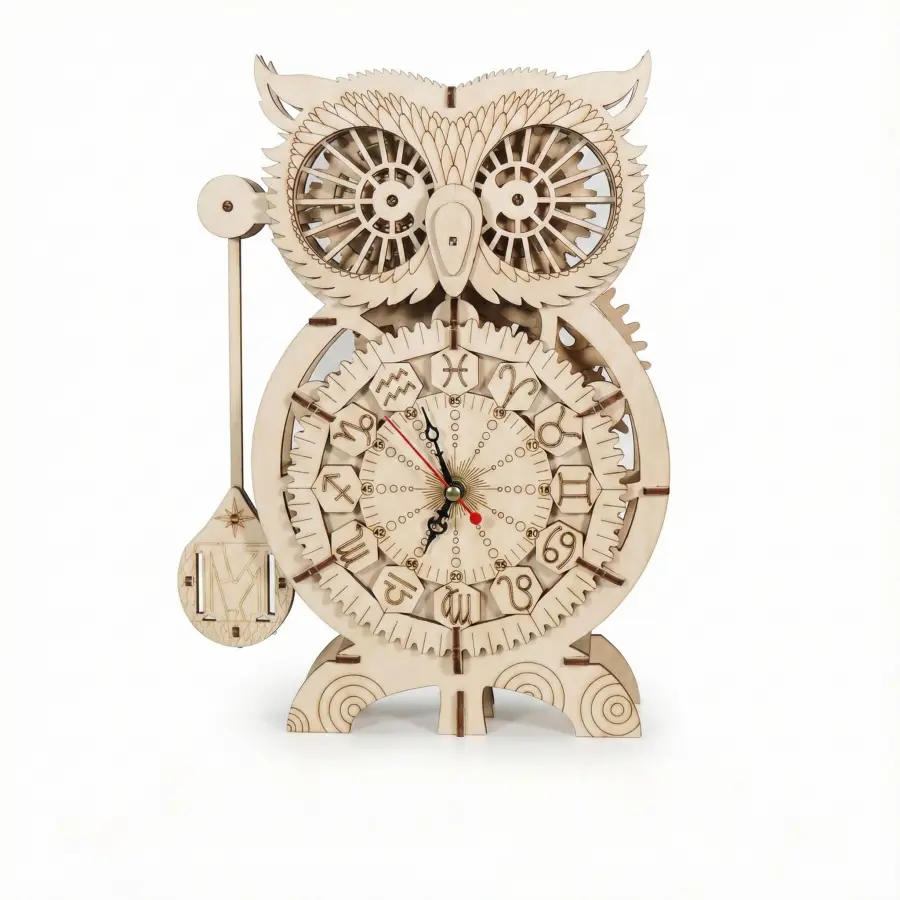
* The 3D Zodiac Owl Mechanical Clock (shown above): A perfect bridge project. It integrates a functional clock mechanism with decorative gears, teaching you to integrate a purchased movement with a custom wooden assembly. The motion is continuous and predictable (clock hands), but the build involves precise alignment.
* ROKR’s ‘Marble Run’ kits: Physics becomes your partner. You’re not just building a structure, but a pathway for momentum and gravity. It requires thinking in 3D about angles and clearances to ensure a smooth, satisfying run. It’s a deeply rewarding hands-on crafting project.
* WoodTrick’s ‘V8 Engine’ model: This is the deep end of Level 2. It replicates the internal combustion process with moving pistons, a crankshaft, and a fan belt. It’s a crash course in linkages and rotational force, resulting in a stunning functional sculpture for your desk.
Level 3: The Engineering Enthusiast (Complex Systems: 15-30+ hours)
You are ready for this when the phrase “compound differential gear train” sparks curiosity, not fear. You’ve internalized mechanical principles and now seek kits that simulate real, complex machines with multiple interacting systems. These are complex wooden puzzle kits designed to test your patience, intellect, and dexterity over many sessions.
The Build Experience: This is advanced model building. You will manage hundreds of small, similar-looking pieces. The instructions may assume you understand concepts like escapements, reciprocating motion, or ratchet mechanisms. Tolerance for troubleshooting is mandatory. A completed kit isn’t just a model; it’s a kinetic art piece and a testament to your skill. How does this compare to Metal Earth? Metal Earth is about ultra-fine, soldering-like precision in 2D metal. These challenging 3D wood puzzles are about building robust, often large-scale, wooden machines with layers of interdependent parts.
Kit Examples for the Master Builder:
* UGEARS’ or WoodTrick’s fully mechanical ‘Tractors’ or ‘Trebuchets’: These involve gearboxes, multiple axles, and working steering. They are intricate simulations of real machinery.
* Complex Automata (like a galloping horse or a pianist): The pinnacle. These kits use cams, levers, and followers to create lifelike, irregular motion from a regular crank turn. They are the closest you can get to building a wooden robot without electronics. For a taste of this depth, exploring a DIY 3D model like a full ship reveals similar layers of complexity, as seen in our deep dive into the Galleon 3D Wooden Puzzle.
* Where to find them: After mastering the mainstream brands, your hunt for wooden model kits leads to boutique designers on Etsy, specialized hobbyist sites, or the enthusiast communities on Reddit (r/modelmakers, r/woodworking). This is where you discover limited-run kits of Stirling engines, mechanical computers, or breathtaking architectural models. This is the frontier, where your journey from first snap to master builder is complete. For those who embrace this chaos, the reward is unparalleled, a concept explored in complex mechanical wooden puzzles.
When the Pieces Talk Back: A Pragmatic Troubleshooting Guide
So you’ve navigated the roadmap, chosen your challenge, and begun your build. Then, it happens. A piece refuses to slot into its mating surface. A schematic symbol looks like ancient runes. You hear a faint crack.
This isn’t failure. This is the kit speaking to you. In micro-engineering, friction and ambiguity are part of the dialogue between designer and builder. Your response isn’t panic; it’s pragmatic problem-solving. Let’s translate.
First Contact: Extracting Pieces Without the Agony.
“My fingers hurt” is the universal first cry. Stop using your fingernails. The goal is to shear the tiny laser-cut tabs, not lever the piece against the grain. Use a craft knife’s back (not the blade) or a flat, rigid guitar pick to apply direct downward pressure on the tab itself. A gentle twisting motion from a small pair of needle-nose pliers can also work wonders. The satisfying snap should come from the tab breaking cleanly, not from you forcing the piece.
When the Wood Decides to Move.
Plywood is a stable material, but it’s still wood. A warped sheet is common, not a defect. Humidity changes during shipping can cause a gentle curve. Do not force it flat. For mildly warped pieces, a few hours under a heavy book often coaxes them back. For a warped sub-assembly, dry-fit it loosely and let the interlocking tension of adjacent pieces pull it true as you progress. Remember: wood has memory. Work with it.
Deciphering the Hieroglyphics (a.k.a. The Schematics).
Step-by-step instructions can be… abstract. A dotted line might mean “align,” “flip over,” or “this is underneath.” The key is pattern recognition. Before applying pressure, study the exploded-view diagrams for three steps ahead. Where is this piece’s ultimate home? What other parts will lock it in place? This spatial forethought is the core of model building. As explored in our piece on solving wooden puzzles without brute force, observation always beats brute force. If a step seems impossible, you’ve likely misinterpreted an orientation. Walk away for five minutes. Look again. The answer is usually there.
The Sound of Breaking: Simple Triage and Repair.
A broken piece isn’t the end. For a clean snap, a tiny dot of cyanoacrylate (CA) glue—applied sparingly with a pin—creates a bond often stronger than the original wood. Clamp it with gentle pressure from a binder clip while it cures. For a lost or shattered piece, all is not lost. Trace the outline onto a scrap of similar thickness basswood (from any craft store) and carefully cut a replacement with your craft knife. This act of fabrication marks your transition from assembler to true builder.
Fragility and the Myth of Rebuildability.
These are functional sculptures, not LEGO. The no glue required joint system relies on friction and precise tolerances. Disassembling a completed model will inevitably loosen these joints. Think of it as a one-way journey. That’s why the process is the purpose. The finished piece is a testament to that journey, meant for display, not repeated disassembly. Handle your completed mechanical puzzle with respect, but not with fear—a well-built model is surprisingly robust.
The true mark of a builder isn’t a flawless build. It’s the invisible repair on a gear tooth, the understanding of why a piece warped, the patient realignment of a stubborn linkage. This is where constructive meditation meets real-world physics. You’re not just following instructions anymore. You’re listening, adapting, and engineering a solution. The click of that final, troublesome piece snapping home? That’s the sound of a conversation completed.
From Kit to Keepsake: Finishing and Displaying Your Functional Sculpture
The final click echoes in the quiet room. The last gear meshes. You’ve listened, adapted, and engineered your solution. Now, the conversation is over, and a new one begins—the one between your completed functional sculpture and the space it inhabits. This is where a kit becomes a display-worthy keepsake. It’s the difference between a project that ends on the worktable and one that earns a permanent place in your home, its story visible in every laser-cut line.
Let’s talk post-build. The raw pre-cut wood sheets, once assembled, have a certain honest appeal. But the grain and finish can be elevated. This is your move from assembler to curator.
Sanding: The Invisible Labor of Love.
Every edge you touch has a micro-burr from the laser. Running a finger along a seam often reveals this subtle roughness. This is where the included sandpaper is your first tool, but not your last. For a piece you intend to handle—a mechanical puzzle with moving gears—a light pass with 220-grit paper on all exposed edges transforms it. The feel goes from “manufactured kit” to “crafted object.” Don’t just sand the outside profile. Deburr the internal cuts of gear teeth for smoother operation. This is the micro-engineering mindset applied to aesthetics.
Staining and Sealing: Capturing Depth.
Plywood has a layered beauty. A thin wash of wood stain (water-based is safest) can accentuate the laser-cut precision, darkening the edges to make the laminations pop. Always, always test on a spare sprue or the back of a sheet first. For a clear, protective finish that doesn’t yellow, a matte or satin spray polyurethane is my workshop staple. It seals the wood against humidity (which can cause warping over time) and provides a durable, touchable surface. Two light coats, sanding gently with 400-grit in between, yields a professional, heirloom-ready finish.
The Alchemy of Light.
This is where a static model becomes ambient sculpture. Many advanced wooden model kits now include LED circuits. But you can retrofit almost anything. Battery-powered, coin-cell LED units (the kind used in tea lights) are a non-destructive mod. Tuck one inside a cathedral model to cast intricate shadows, or behind the gears of a clockwork mechanism to create dramatic silhouettes.
Consider a kit designed for this very purpose. It integrates the lighting element from the start, making the glow an intrinsic part of its character.

Display as Narrative.
Where you place your finished DIY 3D model tells the second half of its story. A complex marble run or gear-driven motion model needs to be seen in action—place it where guests can be invited to turn the crank. An architectural model gains gravity on a dedicated plinth or recessed shelf, treating it like the sculpture it is. Groupings can be powerful: a series of Robotime or ROKR music box kits creates a visual chorus of mechanical forms.
Think about sight lines and interaction. Does the model have a captivating side profile? Use a rotating display stand. The goal is to honor the hands-on crafting journey and elevate your project into home decor. For more inspired display philosophy that moves beyond basic shelves, I’ve compiled some of the best thinking on displaying wooden puzzles properly.
This phase—the finishing, the lighting, the staging—is the final, silent chapter of your constructive meditation. It’s the moment you step back and see not just a puzzle solved, but a world built. A small, precise, wooden world that you engineered into existence. And now, it’s home.
The Brand Philosophies: Choosing Between Aesthetic Elegance and Mechanical Intrigue
That final act of display—deciding where your creation lives—often circles back to the very first choice: the brand you built. Not all wooden model kits are created equal. Where you find your satisfaction—in the silent, elegant lines of a finished sculpture or the rhythmic, turning gears of a working machine—will dictate which brand philosophy sings to you. This isn’t about picking the ‘best’ kit. It’s about matching the manufacturer’s intent to your own desired form of constructive meditation.
The major players in this space have carved out distinct territories. Understanding their core design language is the key to avoiding mismatch and ensuring your 10, 20, or 50 hours of hands-on crafting align with your expectations. Let’s decode the landscape.
Rolife / Robotime: The Aesthetician’s Canvas
If your primary draw is creating a beautiful, display-worthy object that could pass as a boutique home decor item, Rolife (often branded as Robotime) is your likely starting point. Their design philosophy prioritizes aesthetic cohesion and decorative charm. Think of their kits as three-dimensional etchings. You’ll find intricate, often whimsical designs—vintage cameras, detailed dollhouses, cozy bookstore facades.
The mechanical puzzle aspect here is often secondary. Moving parts are present in some kits, like a turning Ferris wheel or a simple gear, but they serve the scene, not the engineering intrigue. The complexity lies in the sheer number of pieces and the precise, layered assembly required to achieve that final, picturesque look. Their step-by-step instructions are generally clear and pictorial, favoring visual flow over technical schematics. For the beginner attracted to the art object first, a Rolife kit offers a stunning reward with a moderate technical challenge. Price points sit comfortably in the $30-$70 range for most of their catalog, making them a prevalent choice for adults hobby seekers and a common gift idea.
ROKR: The Thematic Storyteller
ROKR occupies a compelling middle ground. They blend recognizable, thematic subjects with genuine mechanical function. This is the brand for the builder who wants their functional model to tell a story and perform a party trick. A ROKR kit isn’t just a model car; it’s a car with a working V8 engine model you assemble from tiny laser-cut wood pistons and crankshafts. It’s not just a music box; it’s a planetary gear assembly that plays music.
Their design philosophy is about balance. The aesthetics are clean and modern, but they are undeniably in service to the mechanism. Building a ROKR kit feels like reverse-engineering a clever gadget. You’ll encounter proper gear-driven motion, clever linkages, and satisfying cause-and-effect chains. This makes them an excellent bridge from decorative building to true micro-engineering. The instructions demand more spatial reasoning, often showing exploded views of sub-assemblies. Complexity and price scale significantly with ambition: a small music box might be $40, while their large, multi-function marble run or orrery kits can reach $150+. For those asking, “Are there kits that actually do something?”—ROKR is often the answer.
WoodTrick & Hands Craft: The Mechanical Purist’s Workshop
When the mechanism is the art, you enter the realm of brands like WoodTrick and Hands Craft. Their philosophy is raw, mechanical intrigue. The finished object often looks like a beautiful, skeletal diagram of physics itself. Exposed gear trains, pendulum escapements, complex marble run tracks, and walking automata are their staples.
Here, the aesthetic is industrial beauty. The wood is often left unfinished, celebrating the material and the jointwork. The challenge is cerebral and deeply technical. You are not just assembling; you are building a kinetic machine from the ground up, where tolerance and alignment are critical for function. A “simple-looking” windmill from WoodTrick will involve a multi-stage gear reduction and an escapement mechanism to regulate the sail speed—the very hidden mechanics we love to geek out over.
These kits are for the builder who has moved past the need for a decorative shell and wants to engage directly with the principles of motion. Instructions can be more schematic and assume a higher frustration tolerance. This is the territory of complex wooden puzzle kits, with build times regularly soaring past 20 hours. Prices reflect the engineering depth, with significant kits in the $80-$200+ range. If you’ve mastered the basics and are actively searching for “really challenging, complex kits,” this is your next frontier.
So, how do you choose? It’s about diagnosing your own craving.
* Choose Rolife for contemplative, decorative building with a stunning visual payoff.
* Choose ROKR for a balanced mix of theme, story, and genuine, educational mechanics.
* Choose WoodTrick or Hands Craft when the click-and-snap of a perfectly meshing gear train is your primary reward, and the finished sculpture is a diagram in motion.
Your perfect build isn’t on a generic “best of 2024” list. It’s in the alignment of a brand’s purpose with your own. For a deeper dive into this matching process, I’ve outlined a more granular framework in my guide on choosing the right wooden puzzle brand. Because the right kit doesn’t just challenge your hands—it resonates with your mindset.
The Moving Parts Catalog: Finding Kits That Actually Do Something
Once you’ve aligned with a brand’s philosophy, the real magic begins. This is where a collection of parts transcends into a functional sculpture. We move past static decor to the realm of mechanical wooden model kits—where the final click of assembly isn’t the end, but the beginning of motion.
For the micro-engineering mindset, this is the core appeal. It’s one thing to build a castle. It’s another to build a castle where a tiny wooden drawbridge lowers on command, powered by a hidden gear train you assembled yourself. So, what defines a kit that does something? It’s the incorporation of fundamental physics and simple machines: potential to kinetic energy transfers, gear reductions, linkages, and pinned music barrels.
Let’s decode the three primary categories of motion.
The Marble Run: Kinetic Energy, Visualized. This is physics in its purest, most delightful form. A wooden marble run kit is a lesson in gravity, momentum, and trajectory, carved from laser-cut wood. You’re not just building a track; you’re engineering a reliable path for kinetic energy. The best designs include lifts—often crank-powered or, in more advanced kits, electric—that reset the system, creating a perpetual, meditative cycle. The satisfaction is dual: the precision of the build, followed by the hypnotic dance of the marbles.
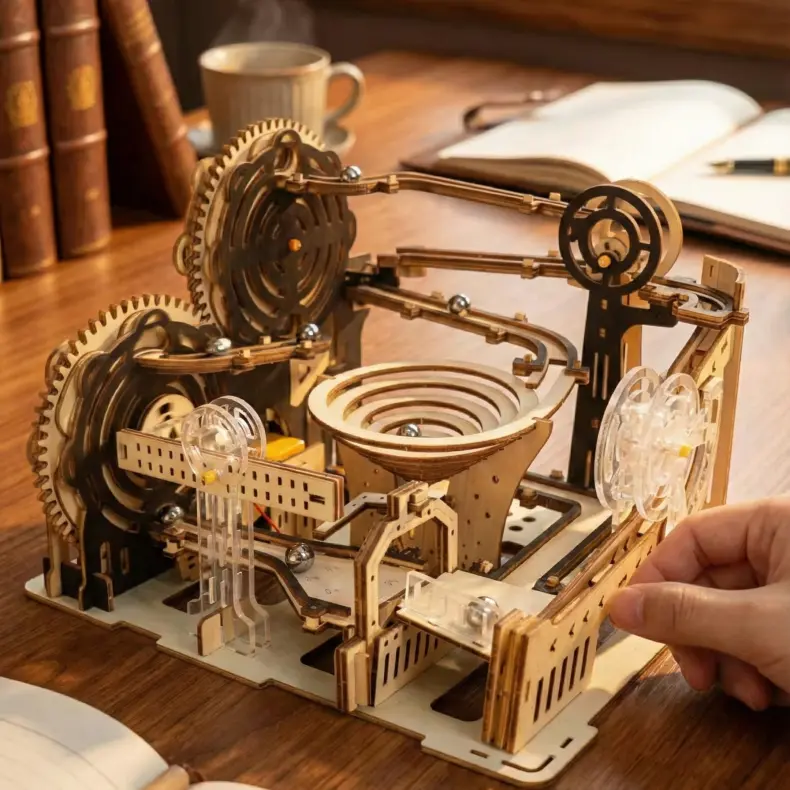
Gear-Driven Automata: The Poetry of Linkages. This is classic automata, simplified into a kit. Think waving figures, dancing bears, or turning windmills. The hidden mechanics here are often a cam (an off-center disk) converting rotary motion into linear motion, or a series of linkages creating complex movement from a simple crank. Remember the windmill example? That simple-looking model likely uses a gear-driven motion system: the crank turns a central gear, which engages a perpendicular “crown” gear to turn the sails, while a separate cam or linkage might control a tiny figure sawing wood below. Building it teaches you kinematic diagrams in 3D wood, a fascinating branch of mechanical puzzles with a long history you can explore through resources like Wikipedia’s entry on mechanical puzzles.
The Music Box: Pinned Barrel Precision. A 3d wooden music box kit is the pinnacle of functional art for many. The mechanism is a marvel of analog sound engineering. You’ll assemble a hand-cranked gearbox that turns a pinned brass barrel. As it rotates, the pins pluck the teeth of a steel comb, each tooth tuned to a specific note. The build requires meticulous care—the alignment of the comb to the barrel is everything—but the reward is profound. You don’t just see the motion; you hear the tangible result of your hands-on crafting. The history of this beautiful marriage of wood and music is a story in itself, which I’ve touched on in a deeper dive into engineering marvels like music boxes.
Choosing a moving kit demands a slight shift in approach. Tolerances are tighter. A gear that’s even slightly misaligned will bind. The instructions for these DIY 3D models must be followed with an engineer’s patience. But when you finish, and you turn that crank for the first time, the entire system whirring to life? That’s the definitive satisfying snap. It’s proof of concept, rendered in birch plywood and your own focus.
Your Next Click: Finding the Tribe and the Rare Finds
You’ve just put the final piece on a complex mechanical model. The gears turn. You feel that deep, quiet pride. This is the moment the journey shifts from solitary focus to shared passion. The final step in the micro-engineering mindset isn’t just about the build—it’s about connection.
The click-and-snap of wood finding its place has a sound others recognize. You need your tribe. Start on Reddit, at r/modelmakers. It’s the grand central station for scale modelers of all mediums. Search for “wooden puzzle kits” or “mechanical puzzle,” and you’ll find build logs, painstakingly detailed photos of internal gear trains, and crucially, collective troubleshooting wisdom. It’s where you post a blurry photo of a stubborn linkage and get three clear solutions by morning. This is your primary resource for moving beyond the instructions.
For visual inspiration and a more curated feed, Instagram and Facebook groups are goldmines. Search hashtags like #woodenkits or #3dwoodenpuzzle. Here, you’ll see master-level builders who modify kits, add custom motors, or apply stunning finishes. You witness what happens when a DIY 3D model becomes a personal canvas. These communities are less about troubleshooting and more about aspiration—showing you the art of the possible.
Then come the rare finds. The mainstream brands are a gateway. To find the truly esoteric—a kinetic sculpture of a galloping horse, a cathedral clock with a working pendulum—you must go deeper. Etsy is a treasure trove for collectible kits from boutique laser shops in Eastern Europe and Asia. Search for “wooden automata kit” or “mechanical wooden model kits.” The prices are higher, the instructions may be minimalist, but the designs are often breathtakingly original. Specialized hobby sites or smaller outlets that cater to serious model building also stock limited-run designs you won’t find on Amazon.
This is how a hobby becomes a practice. You start with a kit, but you stay for the people who speak its language. You share your hands-on crafting triumph, you get advice on sourcing a replacement for a piece the cat batted under the sofa, and you discover the next impossible-looking project that calls your name. It completes the arc from digital discovery to analog creation and back to digital community—a virtuous cycle that enriches the craft. For those looking to make that initial leap from digital distraction to tangible creation, the philosophy behind finding handheld puzzles to unplug is a perfect starting point.
Your next click shouldn’t be into the void of a generic search. Make it intentional. Open a new tab, go to r/modelmakers, and sort by “Top” for the year. Witness the gallery of what’s possible. Or, as a direct counter to the mindless scrolling we began by rejecting, let that search for “wooden automata kit” be your first deliberate step into the deeper end of the pool. The water is fine, and the company is brilliant. And remember, you’re participating in a long tradition of puzzle solving and creation, a human impulse well-documented in the broader history of the puzzle itself. Now go build something.