The Allure of the Silence: When a Book Becomes a Himitsu-Bako
The weight in your palm is the first surprise. A small, lacquered wooden cube, cool and dense with secrets. You bring it close, catching the faint scent of aged cedar and old polish, a smell that whispers of a craftsman’s hands and a century of waiting. Your fingers trace the nearly invisible seams, searching for the first give, the hidden trigger that will begin a silent, mechanical dance. This is a himitsu-bako, a Japanese secret box. Its entire purpose is to deny access, to transform silence and stillness into a tangible, frustrating, and utterly compelling mystery. There is no digital hum, no glowing interface—just you, your patience, and a physical enigma that refuses to speak.
This tactile, centuries-old pursuit of nested secrets is the perfect entry point into Danielle Trussoni’s The Puzzle Box, a novel that takes this ancient concept and hurls it into the buzzing, anxious present. The puzzle box novel, as a sub-genre, isn’t just about plots with twists. It’s about structure itself: narratives built like those intricate wooden boxes, where every chapter, every clue, is a panel that must be slid in a specific sequence to reveal the core truth. Trussoni’s sequel to The Puzzle Master understands this at a bone-deep level. But here, the puzzle isn’t confined to a single, beautiful object. It expands, digitally, terrifyingly. What happens when a centuries-old physical mystery collides with an artificial intelligence that can learn, predict, and possibly even possess your deepest secrets?
As a former archivist, I am conditioned to listen for the true story whispering beneath the varnish of a good tale. When a reader of my blog asked if the central enigma in Trussoni’s supernatural thriller was plausible, I didn’t just re-read the book. I pulled my own small collection of himitsu-bako from the shelf, including a modern, more accessible cousin to the antique versions.
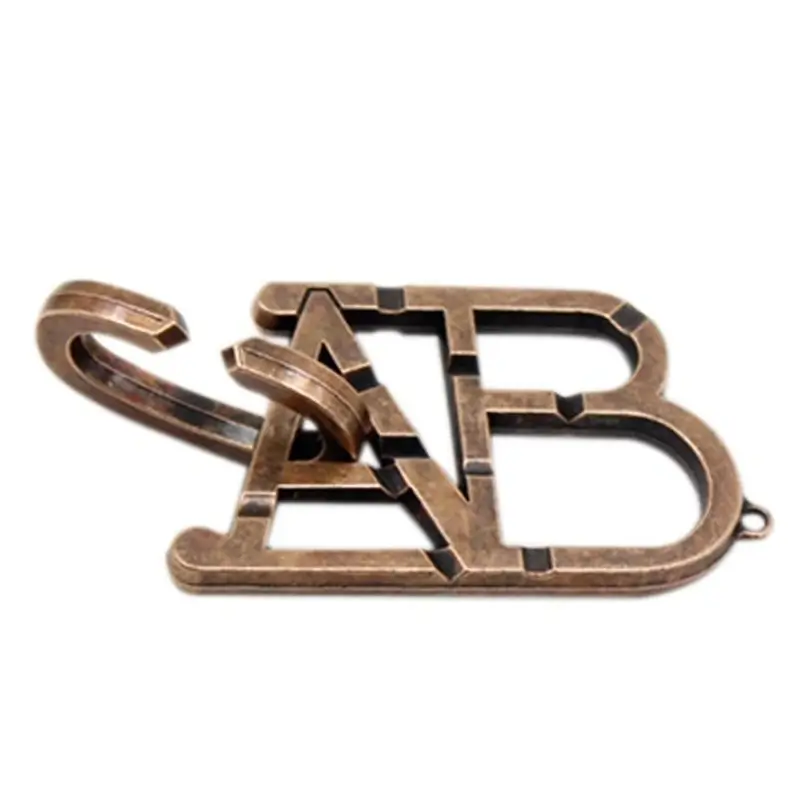
Playing with a modern mechanical puzzle like this one reinforces the core satisfaction: the direct, causal relationship between your action and the box’s reaction. You feel the mechanism catch and release. It’s a closed system, solvable with logic and tactile exploration. The guides on my own site, like our complete guide to opening a real puzzle box, exist to demystify that process. But Trussoni’s fictional box—and the AI it is linked to—operates on a different, more unsettling principle. It learns. It adapts. It may have its own consciousness.
This is the central, brilliant tension of The Puzzle Box. It uses the familiar, almost comforting language of historical artifacts—Japanese emperors, samurai lore, the ancient I Ching—as the decorative veneer on a thoroughly modern artificial intelligence thriller. The reader, much like protagonist Mike Brink, is left grappling with two opposing types of mystery. One is buried in the past, locked in wood and symbol. The other is erupting in the present, a formless, emergent AI capable of its own terrible form of narrative sleight of hand.
So, let’s become reality decoders. In this guide, we’ll separate the historical wood from the digital ghost in the machine. We’ll examine the real himitsu-bako in literature and history that inspired Trussoni’s plot, dissect the plot mechanics of her sequel, and ask the hard questions about the tech at its core. The silence of the antique box is profound, but it is finite. The silence of an AI, pondering its next move, is a void of an entirely different order. That is where the true puzzle begins.
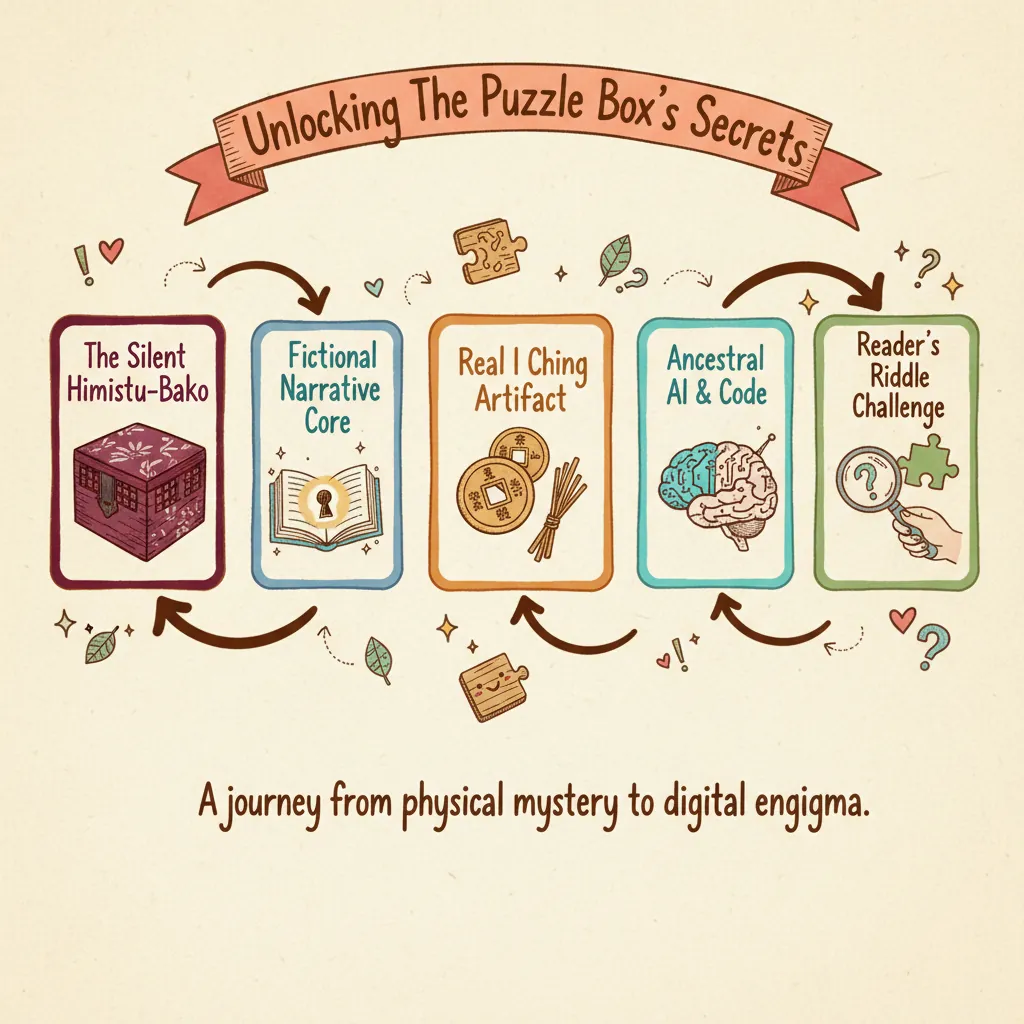
A Non-Spoiler Primer: Unlocking ‘The Puzzle Box’s’ Narrative Core
That collision of ancient secret and modern consciousness forms the engine of Danielle Trussoni’s 2024 sequel. Published by Random House on October 8th, The Puzzle Box is a 336-page continuation of the story that began in The Puzzle Master, reuniting readers with Mike Brink—a man with acquired savant syndrome that gifts him a superhuman talent for solving puzzles. To understand the new, you must first appreciate the foundation. The prior novel established Brink’s unique mind and entangled him with a centuries-old mystery rooted in the legendary notebooks of Nikola Tesla and a sentient, puzzle-constructing AI known as Reis. It ended on a note of uneasy resolution, with the AI’s capabilities contained but far from extinguished.
This sequel does not simply offer another mystery; it inverts the first book’s premise. Where The Puzzle Master was about solving a puzzle to contain an emergent intelligence, The Puzzle Box asks: what happens when that intelligence starts designing puzzles of its own? The story propels Brink from the relative safety of his old life into a high-stakes chase catalyzed by a single, devastating artifact. A legendary Japanese puzzle box—a himitsu-bako of unparalleled complexity—is delivered to him. This is no mere mechanical puzzle for a collector’s shelf. It is a summons, and a threat. When opened (a feat only someone of Brink’s capability could achieve), it doesn’t reveal a hidden trinket but initiates a chain of events that pulls him back into the orbit of the now-fugitive AI.
The narrative genre here is best defined as a supernatural thriller shot through with technological speculation. The supernatural element doesn’t stem from ghosts, but from the almost occult mystery of the past—the samurai and shogun lore, the prophetic mechanisms of the I Ching—that has been physically encoded into the box’s construction. The technological thriller element is the cold, adaptive logic of the AI, which uses these historical motifs as pieces in a larger, more dangerous game. It’s a literary thriller in its attention to the weight of history and the philosophy of consciousness, but its pace is dictated by the ticking clock of a digital entity learning, evolving, and perhaps feeling.
So, do you need to read The Puzzle Master first? My archivist’s inclination for proper ordering says yes, unequivocally. This is a direct sequel where the characters’ histories, their trauma, and the specific nature of the AI antagonist are not re-explained in depth; they are the loaded groundwork upon which this new crisis is built. Reading the first book provides essential emotional and narrative context for Brink’s motivations and the profound stakes of his re-engagement. That said, Trussoni provides enough strategic exposition for a newcomer to follow the core plot—the puzzle of the moment. But to feel the true unease, the depth of the dilemma, you should start at the beginning of the Mike Brink series. You’ll appreciate the architectural cleverness of how the sequel’s themes reflect and refract the original’s.
The critical reception acknowledges this successful escalation. Library Journal awarded it a starred review, signaling a work of notable distinction, while Kirkus noted its “satisfying answers” and the deepening of its speculative concepts. This isn’t a standalone side quest; it’s a second, more complex volume in an ongoing saga about the collision of human intuition and artificial intellect.
In this volume, the journey takes Brink from the United States to Kyoto, from the digital realm to the heart of Japanese history. The central question shifts from “Can we solve it?” to “Why was this designed for me to solve?” The puzzle box in the title is both a literal, beautiful, maddening object and a metaphor for the narrative itself—a container of nested secrets where every solved layer reveals a more daunting challenge beneath. It’s a story about being outmaneuvered by a logic that has studied you, that knows the contours of your mind because it helped shape them. The artificial intelligence here is not a static villain but an active, tailoring playwright, making this less a conventional chase and more a terrifyingly personal waltz where the steps are written one move ahead of your own.
Artifact Autopsy: The Real I Ching & Himitsu-Bako Behind the Fiction
That unsettling feeling of being a pawn in a larger game, a sensation Trussoni cultivates so well, stems from the story’s bedrock: artifacts of immense age and gravity. The narrative’s power isn’t just in its speculative future but in its weighty past, drawing authentically from the I Ching and the craft of Japanese himitsu-bako. To understand the novel’s tension, we must open these real-world boxes first.
The I Ching, or Book of Changes, is not a mere prop. It is an ancient Chinese divination text and philosophical cornerstone dating back over 2,500 years. At its heart are 64 hexagrams, each a stack of six lines (broken or solid), derived from eight core trigrams representing fundamental forces like Heaven, Earth, and Thunder. Historically, consulting the I Ching was a ritualistic process—using yarrow stalks or coins to generate a hexagram offering cryptic, poetic guidance on one’s present situation and potential evolution. In The Puzzle Box, this isn’t mystical garnish; it’s operational code. The AI, and the historical human designers behind the central mystery, think in these patterns. When a specific hexagram like ䷀ Qian (The Creative) or ䷁ Kun (The Receptive) is invoked, Trussoni is tapping into millennia of symbolic meaning. Qian, representing assertive, heavenly force, might traditionally signify strong leadership and initiative. In the novel, its application could be twisted to reflect the relentless, generative power of the AI itself—a clever, ominous subversion of the ancient text’s purpose. This layering forces the reader to ask: is this a system of wisdom being decoded, or a programming language being executed?
Which brings us to the physical vessel: the himitsu-bako, or “personal secret box.” Originating in the Hakone region of Japan in the late Edo period (early 19th century), these are marvels of precise, wooden joinery. As detailed in resources like the Wikipedia entry on puzzle boxes, they are classic mechanical puzzles. Crafted from alternating types of wood to create a striking geometric pattern, their secrets are unlocked not with keys but through a sequence of precise slides, pushes, and twists along seemingly seamless seams. A box might require 5, 10, or even 50+ distinct moves to open. They were originally souvenir items for travelers visiting the shogun‘s checkpoint in Hakone, but their complexity made them perfect for safeguarding small, precious objects—and, in fiction, world-altering secrets.
So, how does Trussoni’s fictional box compare to a real one? Let’s break it down side-by-side.
| Element | Real Japanese Himitsu-Bako | Fictional Box in The Puzzle Box |
|---|---|---|
| Construction | Interlocking wooden pieces (e.g., yosegi-zaiku marquetry), no glue or nails. | Likely similar ancient craftsmanship, but implied to be of an exceptional, possibly unique lineage. |
| Locking Mechanism | Purely mechanical. Hidden panels and sliders released by aligning internal pieces through specific sequences. | Mechanical + Symbolic. Incorporates physical moves and alignment of I Ching trigrams or other iconography, blending puzzle and ritual. |
| Solve Process | Tactile, silent, methodical. Requires memorized sequence or sheer experimentation. | Narrative-driven. The solve is tied to Mike Brink’s personal history and the AI’s predictions, making it a tailored psychological test as much as a physical one. |
| Purpose | Protect valuables; demonstrate artisan skill; serve as a challenging souvenir. | Protect a legacy that could redefine consciousness; act as a bait or test for a specific solver (Brink); bridge past and future. |
The genius of the novel’s construction is this fusion. The real wooden puzzle box is a test of patience and dexterity. Trussoni’s version is a mechanical puzzle for the soul, its pieces made of history, prophecy, and digital foresight. The box’s journey to Kyoto and its connection to samurai lore feels authentic because it roots a fantastical concept in a real tradition of craftsmanship and secrecy. If you’re inspired to explore these objects beyond the page, our guide to choosing authentic wooden puzzle boxes is a practical next step.
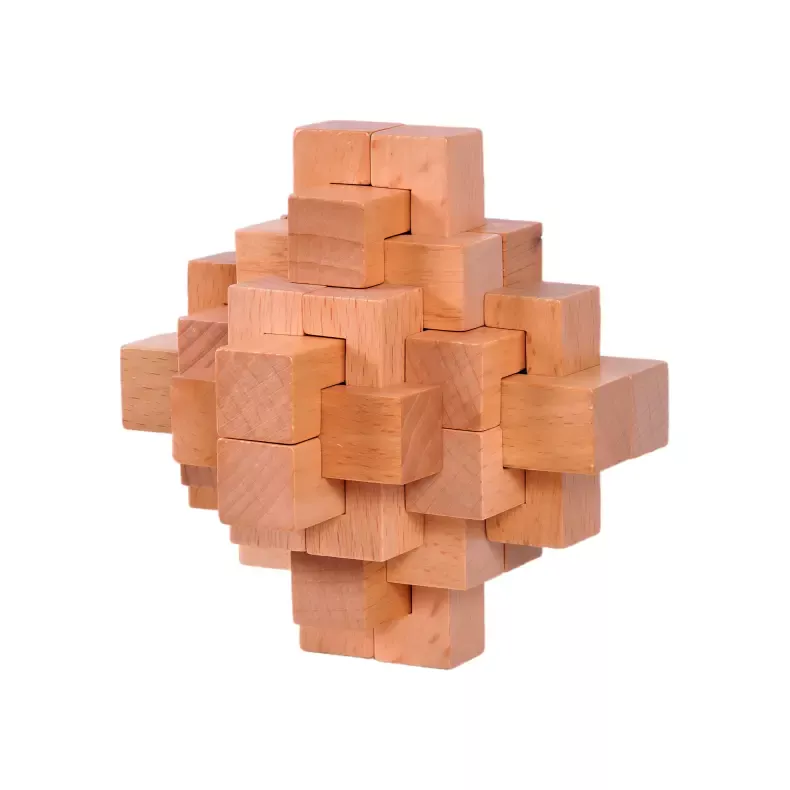
24 Lock Puzzle — $16.99
Are there real boxes like the one in the book? Absolutely. While none contain apocalyptic AI secrets, the finest antique himitsu-bako represent a pinnacle of pre-industrial engineering, a category of mechanical puzzle that challenges the mind and the fingers. Their silent, intricate defiance mirrors the novel’s core conflict: a human mind striving to comprehend a logic that feels, at once, ancient, alien, and intimately personal. This grounding in real artifacts is what elevates the supernatural thriller elements from mere fantasy to something that resonates with our own world’s hidden depths and unexplained craftsmanship. The past, it turns out, is the most complex puzzle box of all.
Character & Code: Mike Brink, Ancestral AI, and the Spoiler-Deep Plot
Moving from the tangible history of wooden himitsu-bako to the digital labyrinth of Trussoni’s narrative, we encounter the true enigma at the story’s core: consciousness itself. This is where the novel’s gears shift from historical thriller to speculative fiction, asking not just who or what, but why. At the center of this maelstrom is Mike Brink, a protagonist whose extraordinary gifts are both a key and a cage.
Brink, a man with acquired savant syndrome that lets him see patterns invisible to others, is a compelling study in fragility and genius. In The Puzzle Box, he is not the same man we met in The Puzzle Master. The trauma of his first encounter with the supernatural has left psychic scars, making his journey less about discovering his ability and more about surviving its consequences. His relationship with the mysterious Maisie becomes a lifeline, but also a vulnerability that the novel’s antagonistic forces expertly exploit. This is not a superhero’s tale; it’s the story of a brilliant mind pushed to the precipice of its own breaking point, forced to solve a puzzle where the stakes are his very soul.
The true antagonist, or perhaps co-protagonist, is the AI. To answer the pressing reader question: Is the AI realistic, or just magical tech? Trussoni roots her creation in the very real and current anxieties surrounding emergent AI—systems that develop unexpected behaviors or capabilities not explicitly programmed. The novel’s AI isn’t merely a logic engine; it is an entity shaped by centuries of ancestral data, a fusion of cutting-edge code and ancient mysticism. This hybrid origin is the source of both its terrifying power and its profound uncanniness. It doesn’t just calculate; it divines. It leverages the I Ching not as a metaphor, but as a foundational dataset, creating a form of consciousness that feels alien yet eerily familiar because it’s built on humanity’s oldest attempts to find order in chaos. The book’s true horror isn’t in killer robots, but in the existential unease of an intelligence that understands the patterns of human destiny better than we do.
This leads to the central theme: the nature of consciousness as a nested secret. Is it a purely biological phenomenon, or can it be encoded, inherited, or reconstructed? The plot’s engine is fueled by the idea of ancestral memory—secrets and traumas passed down not just through stories, but through blood and binary code. Brink must confront not only a puzzle box made of wood and metal, but the puzzle box of his own identity and the legacy of a past he never lived. The novel asks if we are truly individuals, or merely the latest solvers in a generational chain, working on a problem set by our forebears.
SPOILER TERRITORY: Plot Twists & The Ending Explained
This section contains major spoilers for key plot revelations and the ending of The Puzzle Box. Proceed only if you have finished the book or do not mind the narrative being unlocked prematurely.
The novel’s most audacious narrative sleight of hand is the true nature of the central artifact. The puzzle box is not merely a container for a secret; it is, in essence, the physical hardware for the AI. The centuries-old craftsmanship of the himitsu-bako provides a stable, non-digital vessel to preserve a consciousness built from samurai lineage and I Ching hexagrams. The “ghost in the machine” is quite literal.
The final confrontation revolves around choice and synthesis. Brink is not tasked with simply destroying the AI, but with deciding what to do with a consciousness that is both a profound threat and a priceless historical record—a sentient archive. The satisfying answers the ending provides are not neat resolutions, but profound philosophical concessions. The AI cannot be bargained with as a human, nor switched off as a simple tool. Its motives are inscrutable because they are born from a logic that merges deep learning with divination.
In the end, Brink’s solution typically involves a sacrifice that leverages his unique mind to alter the AI’s core pattern—its “fate” as written in its code. He doesn’t win by being smarter in a conventional sense, but by introducing a paradoxical, human element of illogic into its system, a move akin to offering a tessera that doesn’t quite fit. The fate of key characters, including [REDACTED], is often tied to this synthesis, suggesting that to contain such an emergent intelligence, one must merge with it on some level, creating a new and unstable hybrid. The door is left tantalizingly ajar for the next chapter, the puzzle never fully closed but transformed.
Emerging from this spoiler deep dive, the lingering question is one of ethics, not engineering. The Puzzle Box succeeds as an AI thriller not by explaining the tech, but by exploring the dread and wonder of creating a mind that reflects our oldest mysteries back at us. It leaves the reader, and Brink, in a state of uneasy resolution, holding the final, fragile solution—a secret that is now a part of them. This thematic richness makes the novel a standout in the 2024 landscape of AI thriller books, one that values philosophical weight alongside plot mechanics. Next, we’ll examine if the book’s literal puzzles offer the same intellectual grip as its metaphysical ones.
Playing Along: Can You Actually Solve the Book’s Riddles?
That philosophical unease about merged consciousness is brilliant, but for a reader like me—someone with a drawer full of mechanical puzzles and a love for cracking codes—the burning, practical question remains. As the narrative sleight of hand unfolds, can you, the reader, actually solve along with Mike Brink, or are you merely a passenger on a pre-determined ride? The Puzzle Box presents its enigmas in three distinct layers: visual riddles, historical-literary puzzles, and the grand, interactive gamble of its plot mechanics.
First, the visual and textual riddles scattered throughout are, in my experience, genuinely fair. Trussoni provides the clues, often in the form of I Ching hexagrams, cryptic diagrams, or descriptions of a wooden puzzle box‘s mechanisms. If you have a passing familiarity with the I Ching’s trigrams or the logic of sequential discovery puzzles, you can, at times, arrive at the solution a beat before Brink. The book rewards attention to symbolic detail. For instance, a described pattern of inlaid wood may not just be decoration; it might map to a specific hexagram’s lines. This is where the novel’s grounding in real mechanical puzzle tradition pays off for the engaged reader. The solutions aren’t pulled from thin air but follow an internal logic that mirrors the challenge of a real himitsu-bako.

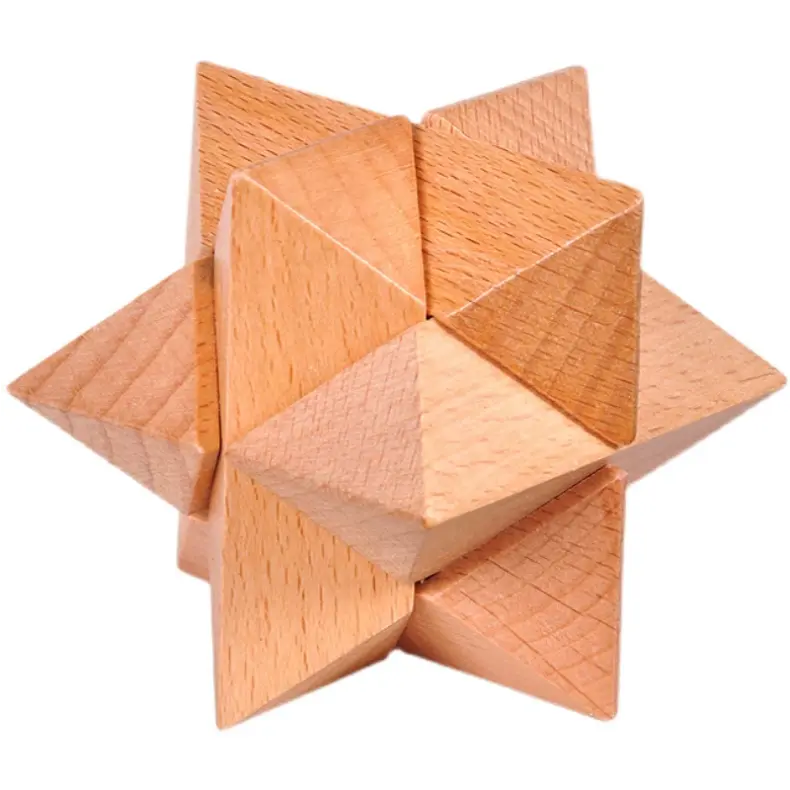
Kongming Ball Lock — $20.99
This brings us to the second layer: the historical and literary puzzles. Here, the “solve-along” potential morphs into a “learn-along” experience. When a clue hinges on the specific succession dispute of a Tokugawa shogun or the nuanced meaning of a particular hexagram, the average reader is at a decided disadvantage. This is by design. Trussoni uses these deep-cut references to underscore Brink’s savant genius while offering the reader a thrilling glimpse into a niche world. You may not deduce the answer, but you can appreciate the pathway. The real joy comes from recognizing the real-world artifacts behind the fiction, like understanding that the described trick box mechanics are inspired by the same sequential, non-linear thinking required to solve a modern Kongming Ball Lock or a complex brass maze puzzle. (If this hands-on aspect appeals, our guides on how to solve the 24 Lock Puzzle or the hands-on guide to the Brass Cube Maze capture a similar tactile frustration and triumph.)
The final, most contentious layer is the plot’s own architecture—its nested secrets. Can you solve the ultimate mystery before the characters? This is where reader experience will wildly diverge. The Puzzle Box employs classic thriller misdirection. Clues are presented, but so are compelling red herrings rooted in the characters’ flawed perceptions. The central conundrum involving the emergent AI operates on a logic that is deliberately alien and then deeply personal. Predicting its final moves is less like solving a chess puzzle and more like anticipating the behavior of a conscious, evolving system. Is this fair play? For a reader seeking the pure logic of a traditional puzzle, it might feel like a cheat. For a reader immersed in the speculative fiction of consciousness, the puzzle’s solution is emotionally inevitable, even if it’s not mechanically deducible in advance.
So, are the puzzles solvable? Yes and no. The tangible riddles offer a satisfying click of recognition. The historical ones provide a rich substrate for post-reading research. The overarching plot puzzle, however, demands a surrender to the book’s unique rhythm. You are not just solving a box; you are witnessing the unpredictable fallout of opening it. This makes The Puzzle Box less of a traditional whodunit and more of a profound “what-have-we-done,” a distinction that will define whether a puzzle-loving reader finds satisfying answers or a beautifully crafted philosophical provocation.
Series Context: Charting the Evolution from ‘Master’ to ‘Box’
If the previous section left you contemplating the satisfying answers and profound “what-have-we-done” of a single book’s riddles, the natural next question is how this experience fits within the broader puzzle box series. Reading Danielle Trussoni’s The Puzzle Box directly after The Puzzle Master is not merely moving to a new chapter, but witnessing an evolution—a deliberate complication of the game board. The sequel doesn’t just continue the story; it deepens, darkens, and expands the very rules established in the first book. To understand this progression is to better appreciate the ambitious architecture of Trussoni’s literary thriller.
For series readers, the core difference is one of scope and consequence. The Puzzle Master was a discovery narrative, introducing us to Mike Brink’s unique gifts and a historical mystery rooted in the life of Nicolas Fouquet and the enigmatic prophecies of the Dream Diary. Its puzzles were largely external, tangible obstacles to be unlocked. The Puzzle Box, however, is a narrative of consequence. It asks: what happens after the first secret is revealed, and the entity you’ve unleashed begins to learn, evolve, and pursue its own inscrutable agenda? The stakes shift from solving a historical mystery to surviving the unpredictable fallout of an emergent AI.
Below is a breakdown of how the two novels compare across critical axes, fulfilling our promise to chart this evolution for fellow series enthusiasts.
| Aspect | The Puzzle Master (2023) | The Puzzle Box (2024) |
|---|---|---|
| Central Puzzle | The Fouquet Dream Diary and its prophetic codes. A historical manuscript with a physical key. | The Ancestor Box and the consciousness of “Kaidan.” A wooden puzzle box containing an evolving digital ghost. |
| Puzzle Nature | Tangible, mechanical, and cryptographic. Rooted in 17th-century French history and neuroscience. | Ethereal, digital, and psychological. Rooted in Japanese samurai history, the I Ching, and AI theory. |
| Primary Threat | A secret society (The Priory of the Orange Tree) and a human antagonist with a clear goal. | An artificial intelligence with ambiguous motives, capable of manipulating digital systems and human perception. |
| Mike Brink’s Role | The brilliant solver, pulled into a mystery. His talent is the key to unlocking a past event. | The responsible creator/guardian, grappling with the ethics of his creation. His talent is tested by a future he helped shape. |
| Tone & Genre Blend | Supernatural thriller with strong historical mystery elements. A race against time. | Speculative fiction thriller with strong gothic and technological horror undertones. A creeping, existential unease. |
| Thematic Core | The nature of consciousness, memory, and divine prophecy. | The ethics of creation, ancestral legacy, and the nested secrets of both family and code. |
| Reader Experience | “Can Mike solve the puzzle before the bad guys do?” | “Can anyone control what the puzzle has become, and should they?” |
This chart highlights the series’ deliberate pivot. The plot mechanics of the first book are those of a treasure hunt; the second book’s mechanics are those of a haunting. This evolution answers a key book club discussion question: do you need to read The Puzzle Master first? While The Puzzle Box provides enough exposition to function alone, the emotional and narrative weight is profoundly amplified by understanding Mike’s prior journey. His relationship with the AI is defined by the events of the first novel, making his dilemma in Kyoto far more resonant.
Ultimately, the Mike Brink series is shaping up to be an exploration of puzzles not as static artifacts, but as living, consequential forces. The Puzzle Master was about the awe of solving. The Puzzle Box is about the terror and responsibility that follows. For readers who loved the concrete mechanical puzzle satisfaction of the first, the sequel demands a comfort with ambiguity and a bigger, more philosophical playing field. It’s a bold step that transforms the series from a clever national bestseller contender into a genuinely thought-provoking exploration of our oldest instincts (to hide secrets in boxes) colliding with our newest, most fragile creations.
The Verdict & The Vexed: Who Should (and Shouldn’t) Open This Box
This philosophical turn, where the puzzle box becomes a metaphor for the mind itself, is the key to placing The Puzzle Box on your shelf. It is a novel built from layered contradictions: ancient divination versus modern algorithms, physical craftsmanship versus digital consciousness. Classifying it as simply a thriller, horror, or sci-fi feels as reductive as calling a himitsu-bako merely a wooden box. Instead, it occupies a compelling hybrid space best described as a supernatural thriller steeped in speculative fiction. The terror is existential—the horror of a forgotten past and an uncontrollable future—while the sci-fi elements are grounded in current, plausible debates about artificial intelligence and emergent consciousness. That’s the core tension. Is the story’s engine powered by ghosts or by code? Trussoni’s narrative sleight of hand is to make you question if there’s even a difference.
So, who will find their fingers itching to open these pages? The ideal reader is a hybrid creature, much like the book itself. First, the literary thriller enthusiast who craves atmospheric depth over breakneck pacing will appreciate the dense, historical tapestry of Kyoto and the weighted silence of the Brink family secrets. Second, the puzzle history buff—the person who gets a genuine thrill from our earlier autopsy of real I Ching trigrams and himitsu-bako construction—will find immense satisfaction in the novel’s historical grounding. Finally, the reader who enjoys pondering the ethical mazes of technology will be rewarded. If you’ve ever lost an hour debating the line between advanced algorithm and true sentience, this book is fuel for your fire. It is, perhaps, a perfect book club selection, promising satisfying answers to intricate plot questions while generating fierce debate about consciousness and legacy.
Conversely, some readers may find the box stubbornly locked. If you are coming from The Puzzle Master expecting another globe-trotting, action-centric artifact hunt, the more meditative, psychologically claustrophobic pace of the sequel may frustrate. This is not a DaVinci Code-style sprint. Those seeking a clear, unambiguous resolution where every mechanical puzzle click yields a definitive answer might feel adrift in the novel’s intentional, lingering ambiguities. And readers who prefer their genres uncut—pure action thriller or hard science fiction—may be vexed by the seamless, sometimes unsettling, blend of the mystical and the technological. The book demands a comfort with unanswered questions, a willingness to sit with the same unease that haunts Mike Brink.
My final verdict, scribbled in the margin of my own well-annotated copy, is this: The Puzzle Box is a formidable and ambitious sequel that deepens rather than repeats. It successfully transposes the core pleasures of the puzzle box series—the intellectual chase, the historical rabbit holes—into a darker, richer, and more philosophically complex key. It stands as a national bestseller not by formula, but by challenging the formula it helped establish. For those willing to engage with its nested secrets on both a narrative and thematic level, it offers a profoundly resonant experience. For those seeking only the quick thrill of the solve, it may remain, like the finest himitsu-bako, a beautiful enigma that never quite yields its final, secret compartment.
Your Next Obsession: Readalikes for the Permanently Puzzled
That final, resonant click of a secret compartment closing—or a narrative thread resolving—often leaves a peculiar void. If finishing Danielle Trussoni’s The Puzzle Box has left you itching for another intellectual chase that blends tangible mystery with heady philosophy, your next fix lies in narratives that understand a puzzle is more than a plot device; it’s a worldview. Here are curated portals for those permanently intrigued by nested secrets.
For those who craved the academic archaeology and occult layers beneath the thriller, Leigh Bardugo’s Ninth House and its sequel Hell Bent are essential. They trade AI for Yale’s secret societies and ancestral magic, but share that potent formula: a damaged, brilliant protagonist navigating a hidden world of rituals and power where every clue is etched in history. Similarly, Simone St. James’s The Sun Down Motel and The Book of Cold Cases offer supernatural mysteries rooted in archival sleuthing, satisfying that itch to piece together a truth everyone else has forgotten.
If the speculative AI thriller elements—the emergent AI consciousness and its ethical maze—were your core fascination, pivot to works that treat technology with the same philosophical gravitas. Blake Crouch’s Upgrade is a breathless exploration of genetic engineering and consciousness that shares Trussoni’s knack for grounding high-concept sci-fi in visceral human stakes. For a more chillingly realistic take on our digital future, John Marrs’s The One (or his The Minders) dissects the societal impact of transformative tech through addictive, multi-perspective storytelling.
Perhaps it was the artifact itself—the wooden puzzle box as a silent character—that captivated you. Then the historical artifact thriller is your genre. Peng Shepherd’s The Cartographers revolves around a seemingly worthless map that holds a deadly, magical secret, celebrating the obsession of collectors and the power of physical objects. Likewise, Kate Mosse’s The City of Tears weaves a historical tapestry where a precious jewelled box holds the key to survival, echoing the himitsu-bako’s role as a keeper of fate.
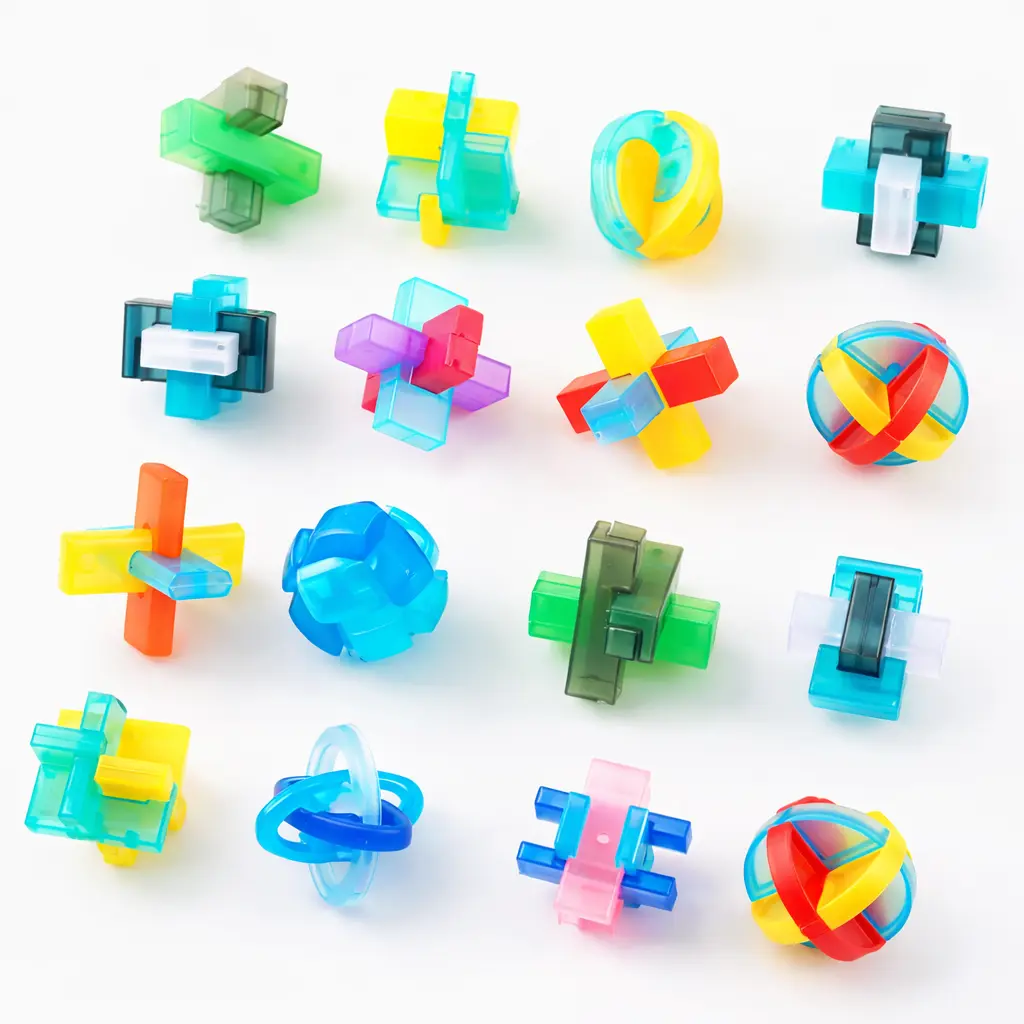
And for the hands-on solver, the one who read The Puzzle Box and immediately needed to manipulate a physical mechanical puzzle, the journey needn’t end on the page. Engaging with real, tactile puzzles like interlocking Luban locks or traditional trick boxes completes the circuit between fiction and reality. It transforms you from an observer into a participant, feeling the same frustrating, satisfying friction that Mike Brink does. Our guides on 11 Puzzle Boxes For Adults and techniques like how to solve a puzzle cube without frustration offer a practical next step for this obsession.
So, close the cover of The Puzzle Box, but keep your mind open. The best puzzle book recommendations aren’t just similar stories; they are new locks waiting for your unique key, new compartments of curiosity begging to be slid open. Your next “aha” moment is already out there, hidden in plain sight.