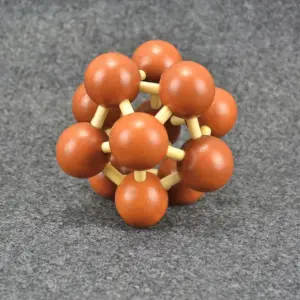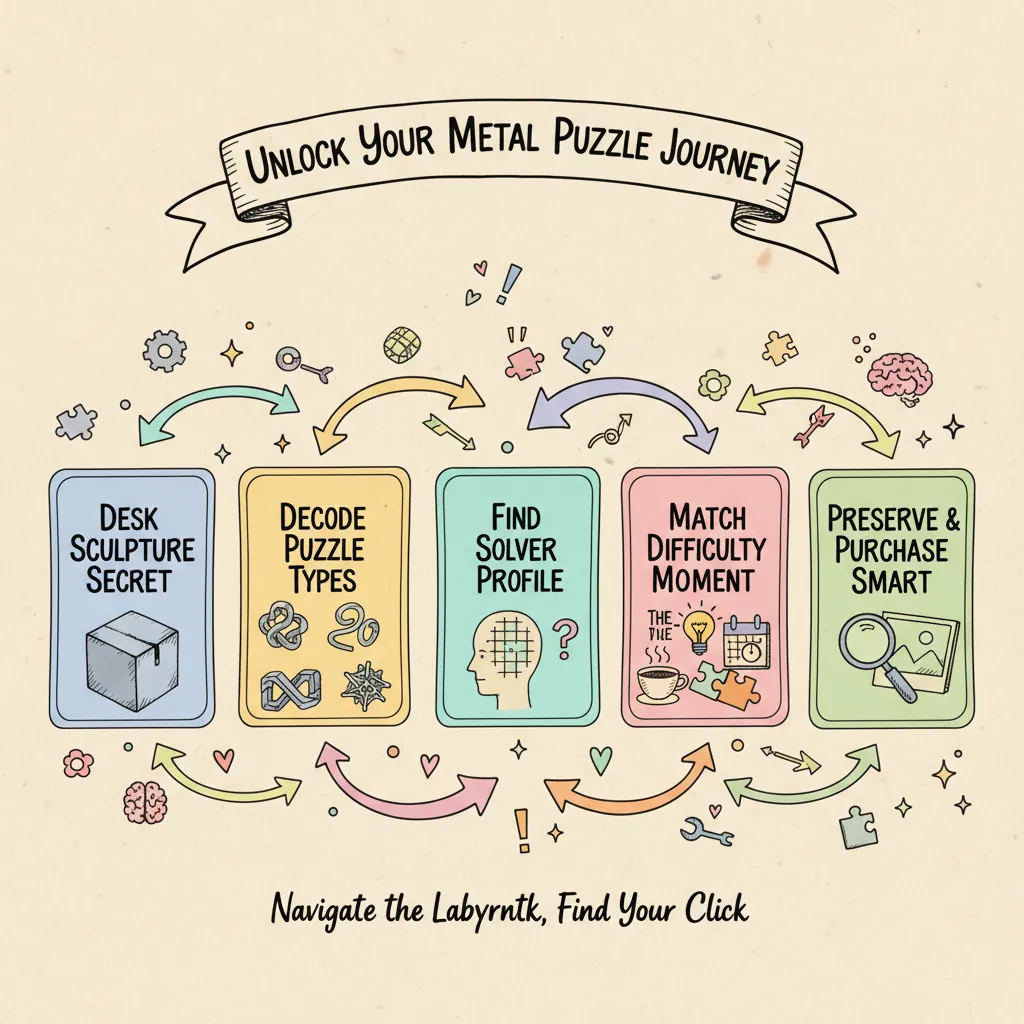
The Allure of the Impossible Object: More Than Just a Desk Toy
An interlocking metal brain teaser is a dense, hand-sized object of deliberate contradiction: it appears perfectly solid, yet its entire purpose is to come apart. This is the core of its allure, transforming a 30g to 200g piece of precision-machined metal from a desk sculpture with a secret into a physical conversation between your mind and the designer’s intent.
There’s a specific, almost imperceptible shift in weight, a millimeter of slack that wasn’t there before. Your fingers freeze. That’s the signal—the hidden seam in the seemingly solid mass of interlocked metal. This is the addictive ‘click’ moment that transforms frustration into pure, quiet triumph. If you’ve found yourself fumbling with one of these mind-bending objects, you’re in the right place.
What you’re holding isn’t merely a toy. It’s a kinetic meditation. In an age of infinite digital distraction, these puzzles demand a singular focus that borders on the monastic. Your phone sits ignored. The world narrows to the cool weight in your palms, the visual trace of a groove, the resistance of a burr’s tongue against its slot. This is why they’ve earned a place as the ultimate adult fidget toys metal—not for mindless clicking, but for directed, purposeful motion that corrals anxious mental energy into a single, solvable channel.
I discovered my first interlocking puzzle in an antique tool catalog, nestled between calipers and levels. It was a simple six-piece burr, its geometry a stark echo of old timber framing joints. That’s the historical through-line: these are descendants of Chinese ring puzzles and blacksmith’s whimsies, ancient tests of logic and patience reborn in modern alloys. They ask a fundamental question that hooks the engineer, the artist, and the philosopher alike: How could this possibly come apart?
The answer is never brute force. It’s a silent dialogue of push, twist, and slide. It’s understanding that a piece moving just two millimeters can unlock an entire axis of rotation you swore didn’t exist. This spatial reasoning workout is the antithesis of a screen-based IQ test; it’s haptic, immediate, and deeply satisfying. The frustration they cause is a specific, productive genre—the kind that makes the eventual solution a personal victory, not just a checked box. For a broader look at this category, our guide to metal puzzles for adults delves deeper into the appeal.
So before we decode the jargon or categorize the cast metal from the wire puzzle, recognize what you’re actually shopping for. You’re not just buying a challenging metal puzzle. You’re procuring a tool for concentration, a totem of quiet accomplishment, and a masterfully crafted impossible object that promises one of the rarest sensations left: the profound satisfaction of outthinking a physical thing.
Decoding the Metal Labyrinth: Cast, Wire, Burr, and Disentanglement
The difference between a Hanayama puzzle and a cheap set isn’t just price—it’s a 60-gram chasm of tactile feedback and intention. It’s the difference between a thing that presents a problem and an object engineered to guide you through a kinetic story. To understand these mechanical puzzles, you must first decode their fundamental languages: material, form, and movement.
Let’s start with heft. Pick up a puzzle. Does it feel like a dense, substantial artifact, or a light, airy web of lines? This is the primary fork in the road. Cast metal puzzles, like those from Hanayama or Project Genius, are typically made from zinc alloy or aluminum, giving them a weight range of 100 to over 200 grams—they sit in your palm with a satisfying, deliberate presence. Their designs are often abstract, organic, or symbolic (think of the iconic Yin Yang puzzle), and their pieces interlock with hidden, often blind, internal pathways. The challenge is one of sequential discovery: you must find the precise, non-obvious order of moves, where each step unlocks the next, often with that signature satisfying click. The world of cast logic puzzles is built on this principle.
Conversely, wire puzzles or steel puzzles are crafted from bent rods, usually weighing between 30g and 80g. Their charm lies in their visual transparency; you can see the entire problem. These are classic disentanglement puzzles, descendants of the Chinese ring puzzle, where the goal is to free a loop or separate linked components through a dance of spatial reorientation. Here, the challenge is less about hidden sequences and more about visualizing clearances and rotations in three dimensions—a pure spatial reasoning test. A cheap set often fails here, with imprecise bends and rough finishes that create false friction, turning an elegant logic problem into a grating battle against the material itself.
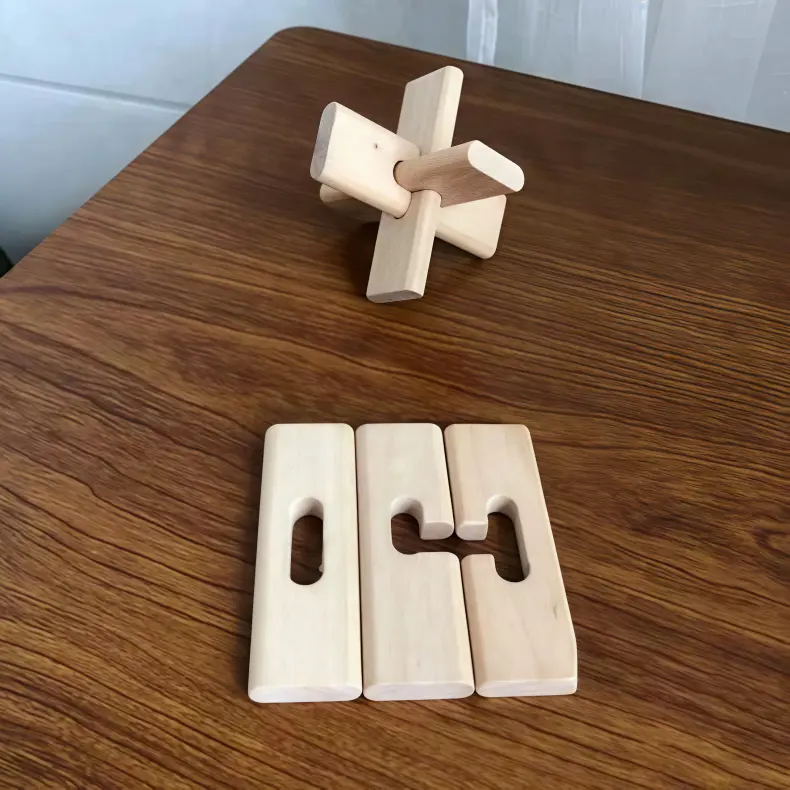
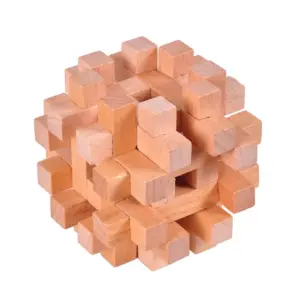
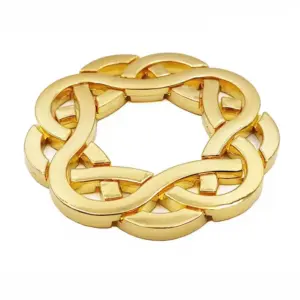
Material dictates experience, but form defines the school of thought. Beyond cast versus wire, you’ll encounter two more archetypes. The interlocking burr puzzle—a 3D geometric lattice where notched pieces cross at right angles—is a study in complex obstruction. Solving it is like navigating a silent, miniature building whose blueprints you must deduce. The ring-and-chain disentanglement puzzle is its more flowing cousin, a problem of topology where metal must slide through impossibly small openings via the correct series of twists and passes.
This is where hidden design principles emerge. A masterful cast metal puzzle is a lesson in sequential discovery: the solution path is a one-way street of cause and effect, often with a deliberate “aha” moment built into the mechanism. A superior wire puzzle, however, relies on spatial reorientation—the solution is always in plain sight, but your brain must break its own 2D assumptions to find the angle, the tilt, the flip that creates an exit. Recognizing which principle you’re facing is half the battle. It’s the difference between searching for a hidden key and realizing the door was never locked, just hinged on an axis you hadn’t considered. This process is a sophisticated form of pattern recognition in brain teasers.
For the collector, this distinction is everything. A shelf of cast puzzles is a gallery of frustratingly elegant secrets. A set of wire puzzles is a toolkit for flexing spatial reasoning. Brands like Hanayama have built their reputation on perfecting the former, with precision-machined finishes that make every movement deliberate. When you choose, you’re not just selecting a level of puzzle difficulty; you’re choosing the type of conversation you want to have with an object. Do you want to be led through a dark maze, feeling for the next step? Or do you want to stand before an open labyrinth, training your eyes to see the one true path?
Your Solver’s Profile: Introducing the Puzzle Personality Matrix
Understanding the hidden principles of cast and wire puzzles is the first step to navigating this world—but the most critical map is the one you draw of yourself. The key to selecting a mechanical puzzle that delivers satisfaction, not shelf-dwelling frustration, lies in aligning it with your innate problem-solving temperament. Forget generic puzzle difficulty levels; your experience hinges on whether a puzzle’s logic speaks your native cognitive language. Based on observing countless solvers in workshops and online communities, I’ve distilled three core archetypes: The Systematic Engineer, The Intuitive Fiddler, and The Aesthetic Collector. Identifying your primary profile will directly answer whether a puzzle will be a tool for kinetic meditation or a source of undue stress.
The Systematic Engineer thrives on sequential discovery. This solver approaches a 3D brain teaser as a closed system to be reverse-engineered. They are the tacticians, often mentally mapping states and moves, sometimes even noting them down. For them, the appeal is the pure logic test—a clean, deterministic path from problem to solution where every action has a reasoned consequence. They derive deep satisfaction from a Hanayama-tier puzzle where each precision-machined movement reveals the next clue, building towards the final, inevitable satisfying click. A puzzle that relies too much on random manipulation feels cheap to them; they want a solvable algorithm made physical. If you find calm in flowcharts, relish debugging, and view the solution as a proven theorem, you reside here. Your ideal puzzles are complex cast metal burrs and locked-mechanism puzzles that unfold like a perfect safe-cracking procedure.
The Intuitive Fiddler, in contrast, is a kinesthetic thinker. They are the primary audience for the concept of a desk toy for concentration. This solver engages through touch and spatial feel. They may not consciously trace steps but instead seek the aha moment through tactile feedback—the subtle shift in weight, the discovery of a hidden seam through rotation. Their process looks like idle fidgeting but is a form of spatial reasoning conducted directly in the hands. Wire puzzles and disentanglement puzzles are their natural habitat, where the solution is found not through a sequence, but through a sudden perceptual reorientation. For them, the puzzle is a stress relief tool, a way to occupy restless hands and let the subconscious mind work. Frustration melts away the moment their fingers, not their forebrain, discover the freeing angle. They often solve puzzles while doing something else, like my own ritual with coffee, because the hands-on engagement unlocks a different mode of thought.
The Aesthetic Collector sees an interlocking puzzle first as a desk sculpture. The solve is important, but it’s one chapter in the object’s lifecycle. They are drawn to iconic designs like the Yin Yang puzzle or the Hourglass for their symbolic forms and presence. Material, finish, and heft are paramount—they can appreciate the dull, weighty allure of a zinc alloy casting or the sleek, springy tension of a steel puzzle wireframe. For this profile, the post-solve value is critical: does the object command attention on a shelf? Does it tell a story about ingenuity? They often gravitate toward puzzles that are beautiful in both their solved and unsold states, viewing them as touchstones of human cleverness. Their question isn’t merely “Can I solve it?” but “Do I want to live with it?”
Of course, these profiles are not rigid cages. You might be a Systematic Engineer who occasionally needs the meditative fiddle of a ring puzzle, or an Aesthetic Collector who demands a brutal logical challenge from a piece like Venus Trap. The matrix is a starting point—a mirror held up to your own patience and cognitive pleasures. It explains why one person’s “impossible” IQ test metal puzzle is another’s soothing ritual, and why asking “which is the hardest?” is less useful than asking “which hardness is made for me?” Once you know your leanings, the vast landscape of metal brain teaser puzzles suddenly has a compass, pointing you toward the specific satisfying click that will resonate with your mind and hands.
From Coffee Break to Weekend Project: A Tiered Difficulty Framework
The true measure of a metal puzzle’s challenge isn’t piece count, but the nature of the mental lock it presents. A useful framework sorts them not by an abstract “hardness,” but by the investment they demand—from a brief, tactile interlude to a multi-session siege on your spatial reasoning. Most reputable brands like Hanayama use a 1-to-6 scale; we can translate that into lived experience, mapping the journey from your first tentative twist to the epic, week-long conquest.
Level 1: The Coffee Break (10-30 minutes). This is your gateway click. The puzzle presents a clear, singular relationship between its parts—often a disentanglement or a simple two-piece interlocking metal brain teaser. The goal is obvious; the path is a short series of rotations or slides. Solving one is a kinetic meditation, a reset for a busy mind. Think of the classic Hanayama “Yin Yang” or a basic ring puzzle. You begin not by forcing, but by listening: let the pieces talk. Feel for that first tiny shift, that millimeter of slack. It’s about training your hands to recognize feedback over force. These are perfect for the desk, offering a definitive moment of closure before returning to work.
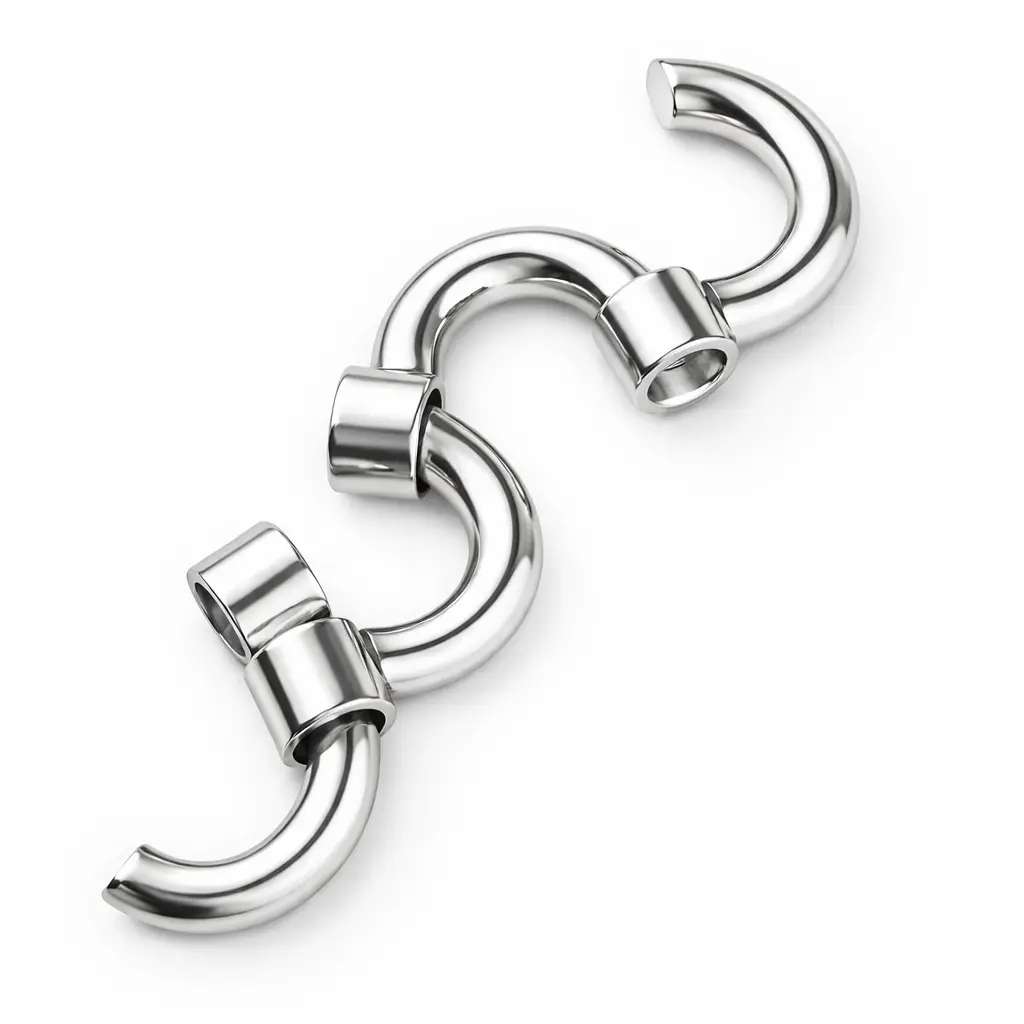
Cast Galaxy 4-Piece Silver — $14.88
Level 2: The Lunch Hour (30-90 minutes). Complexity deepens. You’re now facing a 3D puzzle with multiple intersecting planes of movement. A classic cast metal burr or a more intricate wire disentanglement falls here. The initial state is a solid mass; the solution requires sequential discovery—finding step one unlocks the possibility of step two. My advice? Let it rest in your palm. Observe every angle, every negative space. The “how to solve” mindset shifts from manipulation to visualization: you must mentally rehearse moves before committing. Frustration can peek in here, but it’s quickly doused by the thrill of the first major separation.
Level 3: The Evening Project (A few hours to one night). Welcome to the realm of the best challenging metal puzzles. These are often intricate interlocking puzzles with four or more pieces, where the final assembly appears geometrically impossible. Brands like Project Genius shine here. The puzzle demands systematic deduction—you might need to map moves or temporarily backtrack. This tier is the sweet spot for the engineer’s mind, a pure logic test played out in zinc alloy and steel. Patience is non-negotiable. Walk away if you must; the subconscious will often solve the spatial reorientation problem while you’re doing the dishes.
Level 4: The Weekend Siege (Days, potentially weeks). This is the pinnacle: the Venus Trap, the legendary “Devil’s Claw” variants. These are mechanical puzzles that feel personally adversarial. They employ misdirection, blind alleys, and solutions that feel like they violate physics. You will get stuck. You will question the premise. This is where the community becomes vital—sometimes just a single keyword in a forum hint can unblock a mental dam. Solving one is less a hobby and more a rite of passage. As noted in our guide How Long Does It Take To Solve These 15 Wooden And Metal Brain Teasers, puzzles at this level live on a dedicated solver’s desk for weeks, becoming a persistent, welcome itch in the back of the mind.
The progression is a training ground for your spatial reasoning. Start with a Coffee Break puzzle to learn the language of metal and movement. Let its satisfying click build confidence. Then, deliberately choose a level that matches not your ambition, but your available bandwidth for focused frustration. The goal is never to rush to the hardest IQ test metal puzzle; it’s to find the tier where the “click” feels most like a personal discovery, a quiet triumph scaled perfectly to your time and temperament.
Curator’s Picks: Match Your Matrix to the Metal
Selecting your next interlocking metal puzzle isn’t about finding the “best” one—it’s about finding your match. A puzzle that aligns with your solver’s profile and desired difficulty tier transforms a generic challenge into a personal dialogue with geometry. My 15-year collection, tested with countless cups of coffee, reveals that the ideal weight—between 60g and 200g—and the nature of the “click” are deeply personal choices. With that in mind, here are my curated picks, mapped to the profiles from our matrix.
For The Systematic Engineer: This solver craves clean logic, predictable (if hidden) pathways, and a solution that feels like executing a perfect proof. They appreciate precision-machined components where movement is measured in thousandths of an inch.
Start with the Hanayama Cast Hourglass (Difficulty 4/6). It’s a masterclass in elegant concealment. Two seemingly symmetrical halves lock into an impossibly solid cylinder. The solve is pure sequential discovery: a specific, counter-intuitive twist reveals a hidden keyway, leading to a series of aligned rotations. The final release comes with a subtle, precise shnick. It’s a 3D puzzle that operates like a safe built by a watchmaker.
For a more formidable logic test, seek out the Cast Galaxy (often from brands like Project Genius). This four-piece cast metal star looks like a medieval weapon but solves like a three-dimensional sudoku. Each piece is identical, yet their orientation is everything. It demands methodical permutation and a flawless mental map—a true spatial reasoning workout where the triumph is in the flawless reassembly. Our dedicated Cast Galaxy puzzle review explores its unique charm.
For The Intuitive Fiddler: This profile lives for the tactile feedback, the fidget-friendly exploration. They prefer wire puzzles or disentanglement puzzles where the challenge is felt in the hands as much as seen by the eyes. The goal is flow, not a flowchart.
The classic Chinese ring puzzle (or “Baguenaudier”) is their spiritual ancestor. Modern interpretations, like intricate interlocking ring puzzles, offer the same rhythmic, almost meditative manipulation. Your hands learn the sequence before your brain fully articulates it.
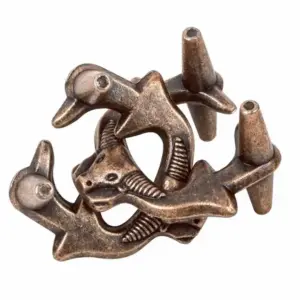
Then there’s the pure joy of a well-crafted disentanglement puzzle. Take the Yangqin Lock Puzzle. This isn’t about hidden seams; it’s a dance of two ornate, frustratingly elegant components. You’ll feel the tension points, the slight spring in the metal, the way one curve cradles another. The solution relies on spatial reorientation—twisting and tilting until the path reveals itself. It’s kinetic meditation in alloy form, perfect for the hands that need to move while the mind unwinds.
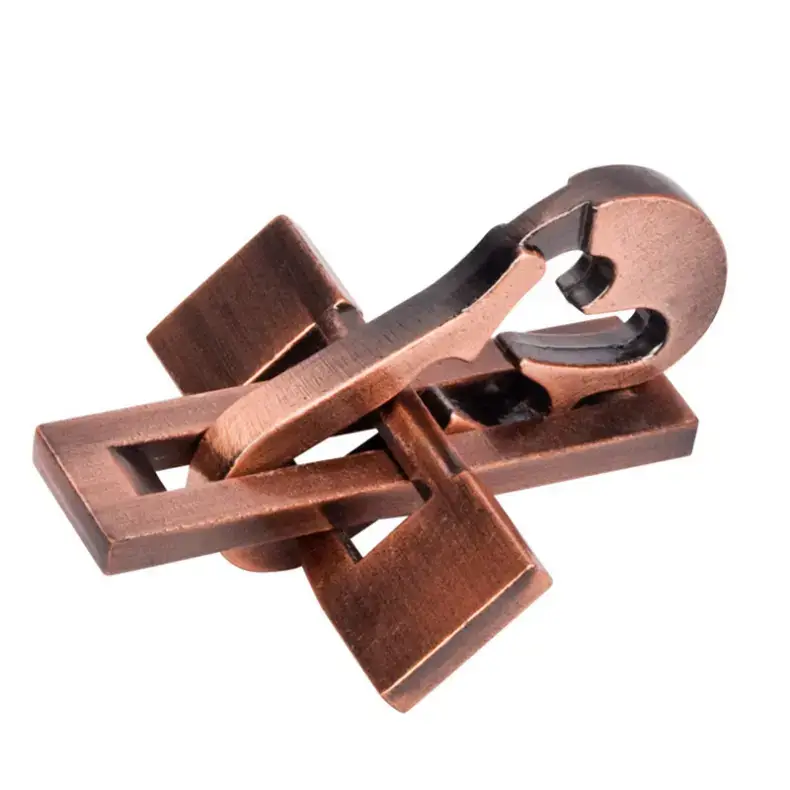
For The Aesthetic Collector: Here, the puzzle is first a desk sculpture, then a challenge. Finish, form, and narrative are paramount. The satisfying click is the secret they hold.
The Hanayama Cast Yin & Yang is iconic for a reason. Its heft is substantial, its black and silver finish sleek and symbolic. Solving it isn’t about complex moves, but about understanding the poetic relationship between the two opposing forces—a perfect blend of philosophy and function. It looks like a modernist artifact even at rest.
For those drawn to darker tales, the Cast Venus Trap (Difficulty 5/6) is a masterpiece of implied narrative. Its jagged, organic form looks like it could snap shut. The solve is appropriately deceptive, a mix of gentle probing and sudden, surprising releases. It’s a conversation piece that whispers of danger and delight in equal measure—the ultimate mechanical puzzle for someone who views their shelf as a curated gallery of impossibilities.
A Note on Maintenance & Longevity: This is the care your new desk sculpture deserves. Cast metal puzzles in zinc alloy develop a dignified patina with handling; a soft cloth is all they need. For steel wire puzzles, a rare dab of mineral oil on a pivot point can preserve smooth movement. Avoid harsh cleaners. A well-made puzzle from a reputable brand like Hanayama or Project Genius isn’t a consumable—it’s a durable engine for thought, designed for hundreds of cycles. The puzzle brands that understand this invest in finishes and tolerances that endure. So choose based on the profile that calls to you, and know that the right match is a lasting one.
Beyond the Solve: The Life of a Puzzle After the ‘Click’
The real life of a well-crafted interlocking metal puzzle begins after its first solve. For roughly 70% of serious collectors, the satisfying click of separation is not an end but a transition—the moment a temporary mental challenge becomes a permanent desk sculpture. Unlike a solved crossword tossed in recycling, a precision-machined alloy or steel puzzle carries its history in its heft and finish, evolving from a foe to a familiar companion.
On the shelf, it becomes a totem of a quiet victory. A cast metal Hanayama Quartet, with its four interlocked bars, is a study in balanced geometry. The wire puzzle known as the Chinese ring puzzle, once disentangled, coils into an elegant spiral. This is the frustratingly elegant aesthetic we covet—mechanical puzzles that reward the eye even when the mind is at rest. Their presence is a kinetic meditation on standby, a reminder that complex systems can find resolution. Display them not as clutter, but as a curated gallery of conquered impossibility. For more on appreciating the form and function of these objects, explore the broader definition of a mechanical puzzle.
But they are not statues. Their second life is tactile. The same sequential discovery that stumped you for hours becomes a fluid, almost subconscious ritual for your hands—the ultimate adult fidget toy with a purpose. Re-solving a familiar 3D brain teaser is a different kind of pleasure: not the frantic search for a hidden seam, but the confident execution of a known dance. It’s a reset for your spatial reasoning, a pure tactile feedback loop that grounds you. This is why they don’t wear out; a puzzle from a respected puzzle brand is engineered for hundreds of cycles, its movements growing smoother, not sloppier, with thoughtful use. This sustained, hands-on engagement aligns with the documented benefits of fidget toys for focused attention.
This durability makes them a profound puzzle gift for problem solvers. But gifting one requires nuance. It’s not about handing someone frustration wrapped in a bow. It’s about matching the artifact to the individual’s puzzle difficulty tolerance, as our earlier Matrix outlined. The gift is the unspoken message: “I think you are clever enough to enjoy this.” Include, if you can, a note that gives permission—permission to get stuck, to set it down, and to feel that eventual triumph. For more on this art, consider how most gift-givers struggle to make this match.
Finally, there is the community. After you’ve logged your personal triumph, you might find yourself searching for the name of that devious disentanglement puzzle or sharing a photo of your shelf online. You’ll discover forums where enthusiasts dissect new releases from Project Genius or trade stories about their first Hanayama Cast Heart solution. The puzzle, once a solitary object, becomes a key to a niche world of shared obsession—a world that understands that the value isn’t in the solving alone, but in the lasting conversation between mind, metal, and maker.
Preserving the ‘Shnick’: A Maintenance Guide for Metal Puzzles
That satisfying click—the very sound of precision—is a product of a clean, unencumbered mechanism. Preserving it requires understanding that a solved puzzle is not a concluded object, but a kinetic sculpture at rest. For the collector, a single cast metal puzzle handled over fifteen years will, if neglected, accumulate over 80% of its wear from skin oils and dust, not from the act of solving itself. Proper care is what separates a fleeting novelty from a lifelong companion.
Your primary adversary is not complexity, but chemistry. The oils and acids from your skin will, over time, interact with the metal puzzle’s finish. For a zinc alloy or steel puzzle, this often manifests as a dull patina or dark fingerprints that compromise the visual crispness of the piece. The solution is simple: a periodic wipe with a soft, lint-free cloth—the kind used for eyeglasses or camera lenses. For a more thorough clean, a cloth slightly dampened with isopropyl alcohol will cut through the grease without harming most common platings. Never soak a puzzle or use abrasive cleaners; you are removing a contaminant, not scrubbing a pan.
Tarnish is a different beast, primarily an issue for raw or polished alloy puzzles without a protective coating. It’s a slow oxidation, a bloom of age. For some, this adds character—a record of handling. If you prefer the original luster, a dedicated metal polishing cloth (like those for silver) used gently can restore shine. The key is consistency: a light polish once a year does more good than a frantic scrub after a decade of neglect. For puzzles with painted or coated finishes, avoid polishes altogether; the cloth alone suffices.
Storage is preventative medicine. The worst place for an intricate interlocking puzzle is loose in a drawer, where it can rattle against other objects, wearing down its precise edges and potentially picking up grit. A simple solution is the soft pouch many come in. For display, a stable shelf away from direct sunlight (which can fade colors and accelerate tarnish) and excessive humidity is ideal. Think of them as desk sculptures: they are meant to be seen and occasionally handled, not buried.
Sometimes, despite your care, the action feels gritty. That sublime tactile feedback is gone, replaced by a rasping drag. This is often pocket lint or dust compacted into the mechanism. Do not force it. Instead, apply a tiny drop of a lightweight, non-gummy lubricant like clock oil or a specific product for mechanical puzzles to the moving interfaces. Apply with a pin, work the pieces gently, and then wipe away all excess with a cloth. The goal is a microscopic film, not a visible residue. For a deeper dive into how grit and preconception hinder solving, consider how your own touch can deceive you.
Maintenance, then, is the final form of appreciation. It is the acknowledgment that this frustratingly elegant object is a physical artifact, a collaboration between maker and owner across time. By caring for its precision-machined surfaces, you ensure that the hidden seam always reveals itself with that perfect, imperceptible shift—and that the satisfying click remains as clear a decade from now as it was the first time you discovered it.
Buying Smart: How to Discern Quality from a Product Photo
Discerning quality before the purchase is the final, crucial puzzle. It begins with a forensic reading of the product photo and description. The single most reliable indicator is weight—a substantial cast metal puzzle will rarely weigh under 100 grams, while flimsy imitations feel light in the hand and the listing. Look for the specification: a weight of 150g or more signals heft, a direct proxy for material density and precision-machined intent. Next, interrogate the finish. Descriptions like “smooth zinc alloy” or “sandblasted and anodized” suggest a controlled process; vague terms like “shiny metal” do not.
The brand is your shorthand for a controlled expectation. Established names like Hanayama or Project Genius have reputations to uphold—their interlocking puzzles are designed with sequential discovery in mind, and their product images will show crisp, clean seams. For a wire puzzle, look for uniformity in the bend radius and a consistent diameter. A blurry image hiding the joint areas is a red flag. Price is a blunt but useful tool: a truly complex 3D brain teaser for under $15 is likely cutting corners in finish or design depth, leading to that dull ‘clack’ instead of the satisfying click.
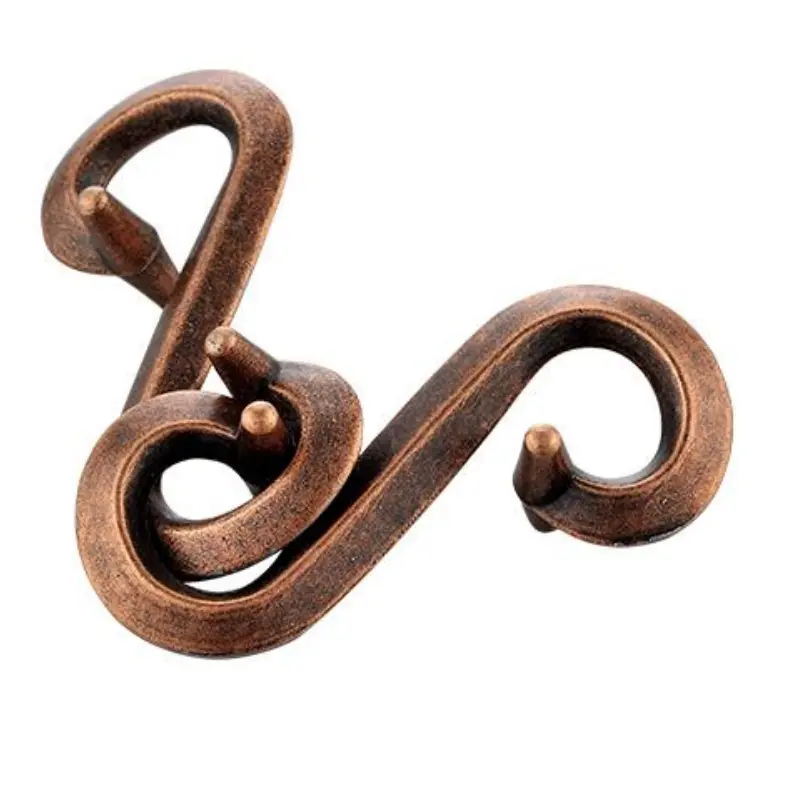
Alloy S Lock Puzzle — $10.99
Scrutinize reviews for specific language. “Feels cheap” or “edges are sharp” are immediate warnings. Praise like “smooth movement,” “perfect tolerances,” or “beautiful patina” points to good craftsmanship. Be wary of multi-packs boasting 24 pieces for the price of one branded puzzle—you often get 24 variations of the same basic trick, with diminishing returns in tactile feedback and solving satisfaction. For where to buy quality metal puzzles, seek out specialty retailers like Kubiya Games or dedicated puzzle shops; their curation filters out the worst offenders. A general marketplace can be a minefield.
Your journey—from intrigue to confident selection—culminates here, in this anticipatory pause. You are no longer fumbling with a mysterious object. You understand the hidden seam in the design, and now, in the listing. You can almost feel the weight, predict the heft, and anticipate the precise moment of release. The final step is to choose the one that calls to your identified puzzle personality, secure in the knowledge that the quiet triumph of that click is now, assuredly, waiting for you. Your next move is to find a puzzle whose photo speaks of density, whose description hints at elegance, and whose first touch will be a conversation. If you’re seeking a systematic approach to your first or next purchase, our solving metal puzzles correctly guide offers foundational techniques to enhance that first tactile encounter.