The first instinct is always wrong.
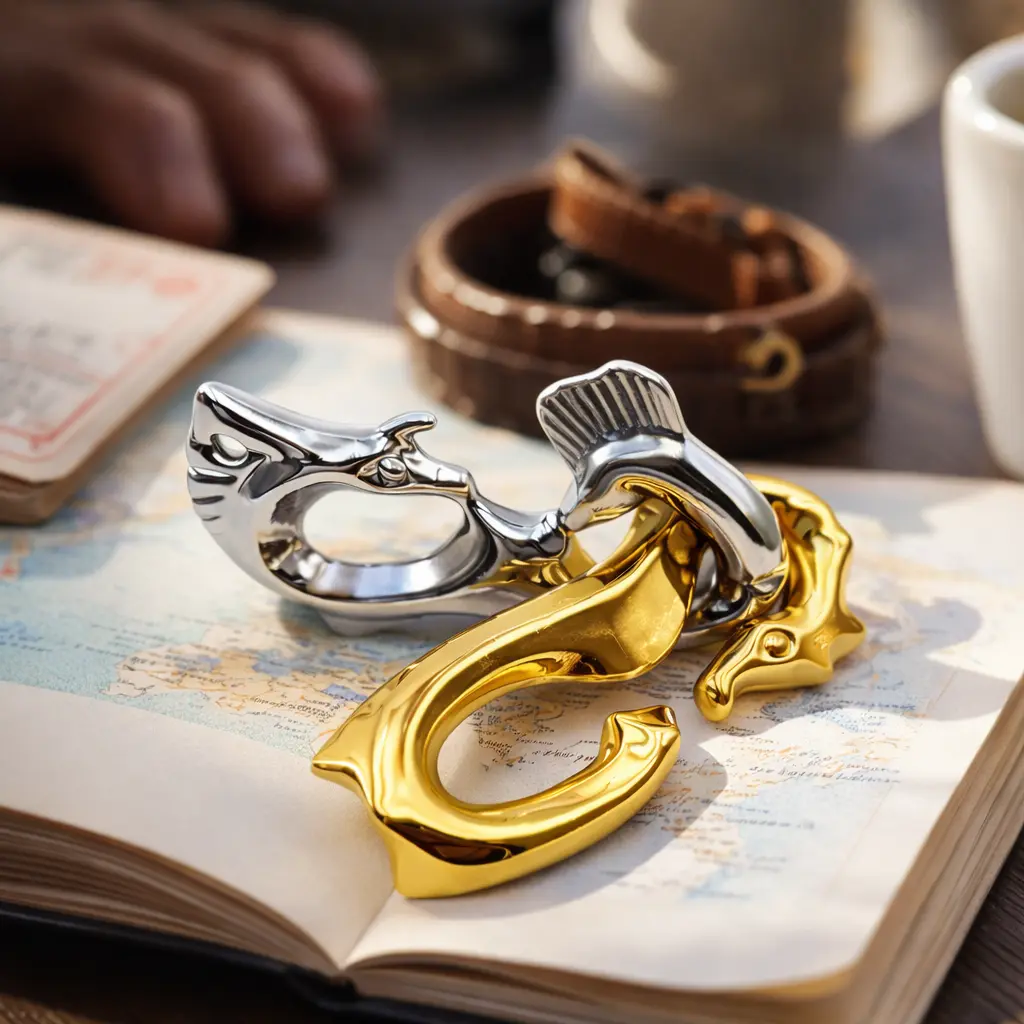
You pick up the Dual Seahorse Brain Teaser—one gold, one silver, their curved bodies intertwined like dancers frozen mid-embrace—and your hands do exactly what your hands always do with stuck objects. You pull.
Nothing happens.
You pull harder. The chrome surfaces, slick with the natural oils from your fingertips, offer no purchase. The seahorses remain locked. Not stuck, exactly. More like bonded—two separate creatures that have somehow become one through a mechanism you can’t see and a logic you haven’t yet understood.
This is the moment that separates puzzle solvers from puzzle abandoners. Because everything in the Dual Seahorse’s design is telling you something important: force is the wrong language. The puzzle doesn’t respond to strength. It responds to observation.
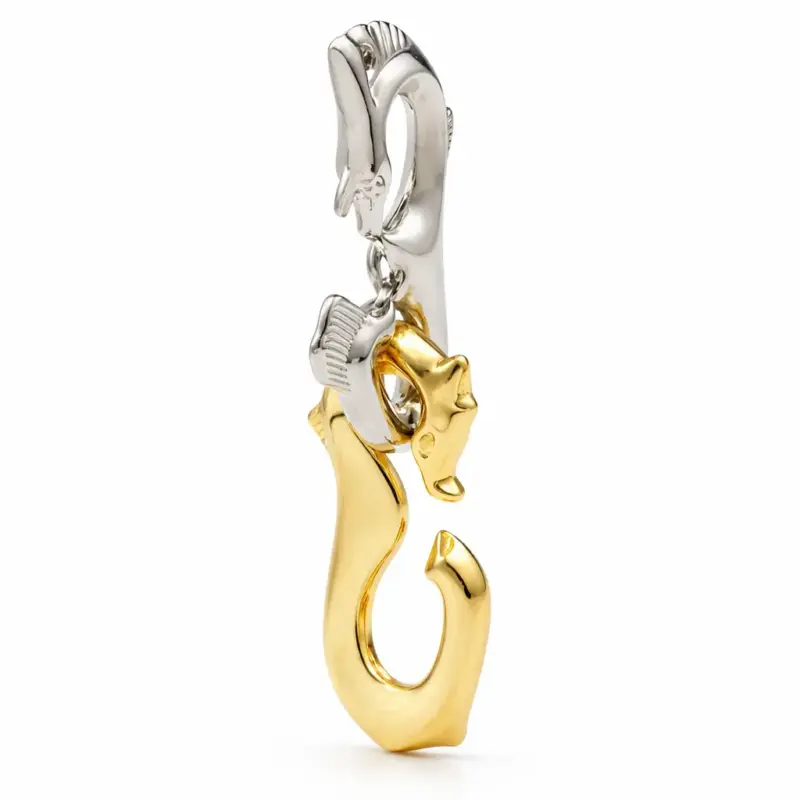
Dual Seahorse Gold & Silver Brain Teaser
Two seahorses swim together until you make them part. This dual seahorse metal puzzle connects through a hidden screw mechanism that looks simple but demands thoughtful manipulation. The mirror-polished gold and silver finish makes it as striking on display as it is satisfying in hand. For ages 14+, it rewards patience over force—exactly the kind of screen-free challenge that sharpens focus.
- Two interlocking pieces in contrasting gold and silver
- Hidden threaded mechanism for twist-based solving
- High-polish mirror finish feels premium
- Palm-sized for desk or travel use
- 14+ recommended; no force required
Somewhere inside that junction where gold meets silver, there’s a threaded screw path waiting to be discovered. Your job isn’t to overpower it. Your job is to find the rotation that aligns the internal grooves, releases the tension, and lets two seahorses swim apart with the kind of satisfying glide that makes the previous fifteen minutes of confusion worth it.
What Makes Screw Mechanism Puzzles Different
Most metal brain teasers fall into predictable categories. Wire disentanglements ask you to navigate loops and figure-eights. Burr puzzles demand sequential piece removal. Cast interlocks hide sliding planes beneath decorative surfaces.
The Dual Seahorse belongs to a more deceptive family: screw mechanism disentanglements. These puzzles look like simple two-piece separations but conceal threaded internal paths that only release when rotated at precise angles.
The challenge isn’t physical. A child could turn the pieces with enough hand strength. The challenge is perceptual—noticing the subtle resistance changes as you rotate, identifying the direction where friction decreases, and trusting that the path forward isn’t where your intuition says it should be.
Cognitive scientists describe this as functional fixedness: the mental block that prevents us from seeing objects beyond their obvious uses. When you see two interlocked shapes, your brain immediately categorizes them as “pull-apart” problems. Threaded mechanisms exploit this assumption. They hide in plain sight by looking like something they’re not.
A 2017 study published in the journal Trials examined how jigsaw puzzles affect visuospatial cognition in adults over 50. The researchers found that regular puzzle engagement improved not just spatial reasoning, but also processing speed, mental flexibility, and working memory. Metal brain teasers with hidden mechanisms likely activate similar cognitive circuits—forcing the brain to abandon assumptions, test hypotheses, and adapt strategies in real time.
The Dual Seahorse isn’t just a desk toy. It’s a diagnostic tool for how you respond when the obvious answer is wrong.
First Impressions: Weight, Finish, and the Deceptive Simplicity of Two Pieces
The puzzle arrives nestled in foam, two seahorses still embraced. You lift them as a unit and notice the weight immediately—not heavy enough to fatigue your hand during extended fidgeting, but substantial enough to feel like something engineered rather than something molded.
Each seahorse measures palm-sized, perhaps eight centimeters from snout to tail. The gold piece catches warm light; the silver reflects cooler tones. Together, they create the kind of visual contrast that makes display worthwhile even when you’re not actively solving.
Run your thumb along the surface. The mirror-polish electroplating feels seamless—no rough edges, no casting seams, no telltale bumps where mold halves met. This level of finish matters more than aesthetics. Smooth surfaces allow your fingers to detect subtle resistance changes during rotation. Rough finishes would mask the feedback that guides you toward the solution.
The bodies curve into each other at the central axis, where a hidden junction conceals the threaded mechanism. You can see where they meet, but you can’t see how they meet. That ambiguity is intentional. The puzzle teaches through discovery, not instruction.
Many buyers familiar with metal puzzles will recognize this design philosophy. The best cast brain teasers don’t explain themselves. They present a problem—two pieces that should separate but don’t—and let you work backward from observation to understanding.
The Solving Experience: From Confusion to Hypothesis to Breakthrough
Let’s be honest about the first ten minutes.
You’ll try pulling. Multiple times. From different angles. With varying grips. The seahorses won’t care. They’ll remain as locked as they were in the packaging, their bodies pressed together with the quiet stubbornness of objects that know something you don’t.
Then—maybe because frustration has eroded your assumptions, or because your fingers accidentally apply a slight twist while repositioning your grip—you’ll feel something different. A micro-shift. A thread engaging.
This is the moment cognitive researchers call insight: the sudden reconfiguration of mental models that allows previously invisible solutions to become obvious. In puzzle-solving contexts, insight usually follows a period of impasse where conscious effort produces nothing. The breakthrough emerges when you stop forcing and start noticing.
From here, the Dual Seahorse reveals its actual mechanism. The hidden screw thread requires multi-directional rotation—not just clockwise or counterclockwise, but a combination that navigates internal grooves. You’ll need to feel your way through, adjusting angle and pressure as resistance shifts.
Average first-solve times range from ten minutes to half an hour, depending on how quickly you abandon the pulling instinct. Subsequent solves go faster—five minutes, then three, then under a minute once muscle memory develops. But the puzzle never becomes trivial. Reassembly introduces its own challenges, often taking longer than separation. The thread path that releases the seahorses doesn’t reverse cleanly; you have to rediscover the engagement points from the opposite direction.
For solvers who enjoy mechanism-based challenges, the Grenade Lock Puzzle offers a similar experience with different internal geometry. Both reward patience over force, observation over assumption.
The Neuroscience of Why This Matters
Brain teasers aren’t just entertainment. They’re structured interventions that push cognitive systems beyond comfortable defaults.
When you engage with a screw mechanism puzzle, multiple neural networks activate simultaneously. The visuospatial system processes the object’s shape, orientation, and relationship between pieces. The motor system plans and executes rotation sequences. The prefrontal cortex monitors feedback, updates strategies, and inhibits the pull reflex that keeps failing.
This multi-system engagement is what researchers call cognitive enrichment—the use of challenging activities to maintain or enhance mental function. A randomized controlled trial published in 2018 found that adults who solved jigsaw puzzles daily for five weeks showed measurable improvements in visuospatial cognition compared to control groups. The improvements persisted even after the intervention ended.
Metal brain teasers likely offer similar benefits, though research specific to disentanglement puzzles remains limited. What we can infer from adjacent studies: activities that require spatial manipulation, hypothesis testing, and motor precision strengthen the neural circuits underlying problem-solving broadly.
The Dual Seahorse isn’t going to make you smarter in any single session. But incorporated into regular cognitive practice—alongside wooden brain teasers, logic games, and spatial challenges—it contributes to the kind of varied mental exercise that supports long-term cognitive health.
Who This Puzzle Actually Serves
Not everyone will appreciate the Dual Seahorse. That’s worth saying clearly, because the puzzle’s strengths are precisely what make it wrong for certain users.
You’ll appreciate this puzzle if:
You keep objects on your desk for tactile engagement during calls or thinking time. The seahorses’ size and weight make them ideal for one-handed fidgeting. The mirror finish stays cool against your palm, warming slowly with body heat in a way that some solvers find grounding.
You enjoy gifts that create shared experiences. Handing someone a Dual Seahorse and watching them discover the mechanism—through the same stages of confusion, hypothesis, and insight you experienced—offers a kind of collaborative satisfaction that passive gifts can’t match.
You’re building a collection of metal brain teasers and want variety in mechanism types. Screw-based disentanglements occupy a different cognitive niche than wire puzzles or sliding interlocks. The rotation-based solving process exercises different spatial reasoning skills.
You prefer puzzles that teach through discovery rather than instruction. No solution sheet accompanies the Dual Seahorse. The challenge isn’t just separation—it’s figuring out how separation works without external guidance.
This puzzle is NOT for you if:
You need visible progress indicators. The Dual Seahorse offers no intermediate states between “locked” and “solved.” Either the seahorses are connected or they’re not. If you find sustained ambiguity frustrating rather than motivating, this mechanism will irritate more than engage.
You’re shopping for children under fourteen. The screw mechanism requires patience that younger puzzlers typically haven’t developed. The frustration of repeated pulling failure can discourage rather than challenge. For younger solvers, simpler disentanglements or interlocking puzzle sets offer more appropriate entry points.
You expect complexity from piece count. Two-piece puzzles can feel “too simple” to solvers accustomed to multi-component challenges. The Dual Seahorse’s difficulty lies entirely in mechanism, not quantity. If you measure challenge by piece count, you’ll underestimate this puzzle.
You have limited hand mobility or grip strength. The rotation-based mechanism requires controlled movement across multiple axes. While no significant force is needed, fine motor precision matters.
Honest Assessment: What Works and What Doesn’t
The good:
The dual-tone finish serves function as well as form. Gold and silver differentiation helps you track which piece moved during solving attempts. This visual distinction accelerates the hypothesis-testing process—you can see the results of each rotation more clearly than with same-finish designs.
The mechanism provides consistent, repeatable challenge. Unlike some cast puzzles where manufacturing variation affects difficulty, the threaded screw in the Dual Seahorse engages reliably. The solving experience remains consistent across sessions.
The size optimizes for portability without sacrificing presence. Small enough for a coat pocket or desk drawer; large enough to feel substantial in hand. The seahorse forms are visually interesting even when displayed rather than actively solved.
The limitations:
Mirror finishes show fingerprints. If you value pristine display aesthetics, you’ll wipe the seahorses frequently. Some solvers consider this minor; others find it annoying.
Single-mechanism puzzles have finite replay value. Once you’ve mastered the screw path, the challenge shifts from discovery to speed—timing yourself, solving one-handed, solving by touch alone. These variations extend engagement but don’t fundamentally change the experience.
No solution guidance means genuine frustration risk. Some solvers will abandon the puzzle before discovering rotation as the key. Without hints, the learning curve can feel like a wall rather than a slope. For those who prefer structured challenge, puzzles with tiered difficulty or hint systems offer smoother progression.
Care, Maintenance, and Longevity
Electroplated finishes are durable but not indestructible. The mirror polish on the Dual Seahorse will survive years of normal handling. However, certain practices accelerate wear:
Avoid storage with abrasive items. Keys, coins, and loose hardware scratch electroplating. Store the seahorses in a soft pouch or dedicated drawer compartment to preserve the reflective surface.
Clean with soft, dry cloth. Fingerprints and handling oils wipe away easily. For stubborn marks, a slightly damp microfiber cloth works without risking finish damage. Avoid chemical cleaners, solvents, or abrasive pads.
Don’t force against the mechanism. The threaded screw is designed for controlled rotation, not brute-force separation. Forcing the pieces can theoretically damage threads over time, though normal solving applies nowhere near problematic stress levels.
The cast metal body itself is essentially permanent. Unlike wooden puzzles that can warp with humidity changes or plastic puzzles that degrade under UV exposure, metal brain teasers maintain structural integrity indefinitely under normal conditions.
The Seahorse as Desk Object: Beyond Puzzle Function
Not every puzzle needs to be actively solved to justify its presence.
The Dual Seahorse, when displayed on a desk or shelf, functions as a conversation piece and visual anchor. The gold-and-silver contrast catches light differently throughout the day. The curved forms suggest marine elegance without obvious puzzle connotations—visitors often pick them up without realizing they’re handling a brain teaser.
This dual function—display object and cognitive challenge—distinguishes quality cast puzzles from disposable novelties. The finish quality that enables smooth rotation during solving also creates aesthetic appeal during rest. You’re not hiding an ugly toy in a drawer between sessions; you’re placing a reflective sculpture somewhere visible.
For desk workers seeking screen-free activities that don’t broadcast “I’m playing with toys,” metal brain teasers occupy valuable middle ground. They look professional enough for office environments while offering genuine cognitive engagement during thinking breaks.
Frequently Asked Questions
How difficult is the Dual Seahorse compared to other metal puzzles?
Moderately challenging for screw mechanism puzzles, easier than multi-piece sequential designs. The difficulty lies in discovering the rotation principle rather than executing complex maneuvers. Most adults solve within ten to thirty minutes on first attempt; subsequent solves take under five minutes once the mechanism is understood.
Will the gold and silver finish wear off with regular use?
The electroplated finish is durable under normal handling. Heavy daily use over several years may show slight wear at high-contact points—where your fingers consistently grip during rotation. Storing the puzzle away from abrasive items and wiping with soft cloth between sessions preserves the mirror polish.
Is there a solution guide included?
No. The Dual Seahorse teaches through exploration rather than instruction. If you’re genuinely stuck after extended effort, video resources exist online for similar screw mechanism puzzles. However, the satisfaction of self-discovery significantly exceeds the satisfaction of following external guidance. Most solvers recommend persisting through confusion before seeking help.
Can children solve this puzzle?
The recommended age is fourteen and above. Younger children often lack patience for mechanism-based discovery and may become frustrated by the pull reflex repeatedly failing. For children interested in brain teasers, simpler disentanglements or wooden puzzle sets offer more developmentally appropriate challenges.
Why are the two seahorses different colors?
The gold-and-silver contrast serves practical as well as aesthetic function. During solving, you can track which piece moved and in which direction more clearly than with identical finishes. This visual feedback accelerates the hypothesis-testing process essential to discovering the screw path.
How do I clean fingerprints from the mirror surface?
A soft, dry cloth removes most handling marks. For stubborn fingerprints, slightly dampen a microfiber cloth with water—no soap or chemicals. The mirror finish is durable but can be scratched by abrasive materials; always use soft cloths rather than paper towels or rough fabric.
Does the mechanism ever wear out or become easier over time?
Quality threaded mechanisms resist wear from normal use. The screw path doesn’t loosen or become less precise with repeated solving. What changes is your familiarity—the puzzle feels easier because you’ve learned the rotation sequence, not because the mechanism has degraded.
What if I can’t solve it at all?
First, confirm you’re rotating rather than pulling. The seahorses separate through multi-axis rotation, not opposing force. If rotation isn’t working, try different angle combinations—the screw path may require orientation changes beyond simple clockwise/counterclockwise movement. Persistence usually rewards; most “unsolvable” experiences resolve with continued experimentation.
Is this a good gift for puzzle enthusiasts?
Yes, with one caveat: experienced puzzlers may solve it quickly and find limited replay value. For recipients building a collection, the Dual Seahorse offers mechanism variety alongside existing puzzles. For recipients new to metal brain teasers, it provides an accessible entry point with satisfying discovery moments.
How does this compare to Hanayama cast puzzles?
Hanayama puzzles are graded on a six-level difficulty scale and manufactured in Japan with premium attention to detail. The Dual Seahorse shares similar quality characteristics—smooth finish, precise mechanism, satisfying weight—at a more accessible price point. Direct comparisons are difficult because different puzzles target different mechanism types.
Placing the Seahorse in Your Puzzle Ecosystem
Single puzzles rarely satisfy the full range of cognitive challenges that puzzle enthusiasts seek. Most solvers build collections spanning mechanism types, difficulty levels, and material categories.
The Dual Seahorse fits naturally alongside:
Other screw and rotation puzzles that reward similar observation skills. The Metal Screw Interlock Riddle offers comparable mechanism type with different visual design. Solving one reinforces skills transferable to the other.
Wire disentanglements that exercise different spatial reasoning circuits. While the Dual Seahorse asks “which rotation releases the connection?”, wire puzzles ask “which path allows these loops to separate?” Alternating between mechanism types keeps cognitive engagement varied.
Wooden interlocking puzzles that provide tactile contrast. The cool metal of cast brain teasers feels different from warm wood; the precise threads differ from friction-fit joinery. Collections spanning materials offer richer sensory engagement than single-material libraries.
Higher-difficulty sequential puzzles for when the Dual Seahorse feels mastered. Once rotation-based solving becomes intuitive, multi-piece sequential challenges push spatial reasoning further. The skills developed on simpler mechanisms prepare you for complex designs.
For those just beginning puzzle collections, the Dual Seahorse offers appropriate entry difficulty without sacrificing mechanism sophistication. For established collectors, it fills the “screw-based two-piece” niche with quality execution and visual appeal.
The Verdict: Substance Disguised as Simplicity
Two pieces. One mechanism. Thirty minutes of confusion. One breakthrough moment.
The Dual Seahorse Brain Teaser isn’t trying to be the most complex puzzle you own. It’s trying to be the puzzle that reminds you how assumptions work—how the obvious approach (pull) fails while the counterintuitive approach (rotate) succeeds.
That lesson has value beyond puzzle solving. Every project that seems stuck might be stuck because you’re pulling when you should be rotating. Every problem that resists your effort might resist because you’re applying force in a direction the mechanism doesn’t recognize.
Fourteen dollars buys you a display-quality metal sculpture that happens to contain a cognitive challenge. The gold catches afternoon light on your desk. The silver reflects overhead fluorescents in conference rooms. And when your hands need something to do besides reach for your phone, two seahorses wait to remind you that patience outperforms force.
The mechanism isn’t complicated. But discovering it requires exactly the kind of observational persistence that most modern experiences have trained out of us. That’s the real product. The seahorses are just the delivery system.
Explore more cast metal brain teasers or browse the complete puzzle collection for challenges across all difficulty levels.