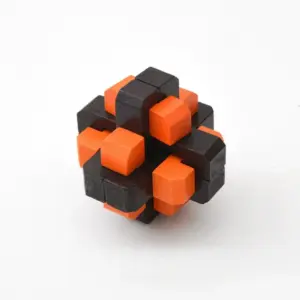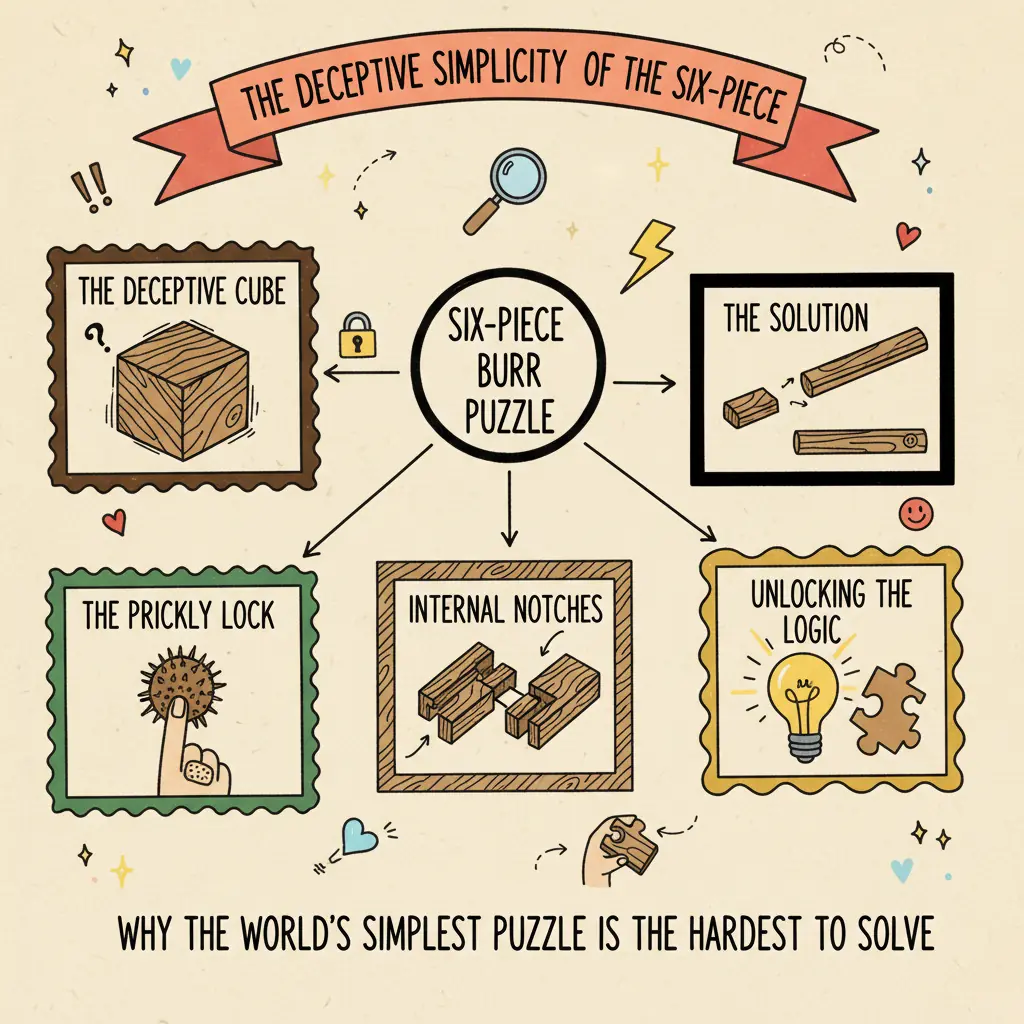
More Than Just Six Sticks: What Makes This Puzzle a Timeless Brain Teaser
At first glance, a six-piece burr puzzle looks like a simple, symmetrical block of wood, a tidy cube formed by six intersecting sticks. It’s only when you pick it up, feel its solid heft, and try to pull a piece free that you realize you’re holding a locked vault. Nothing budges. This is the elegant deception of the classic six-piece burr: a geometric solid that conceals a complex, interlocking mechanism within its clean lines. It’s not a jigsaw of images; it’s a three-dimensional logic problem made physical, and it’s one of the most foundational mechanical puzzles in history.
The name “burr” is itself a point of folklore. The most common theory, noted in sources like the Woodcraft blog, is that the assembled puzzle resembles the seed head of a burr plant—those stubborn, prickly balls that cling to your clothes. It’s a fitting metaphor. Just as a burr seed resists simple removal, the puzzle pieces tenaciously hold fast to one another. The design is ancient, with roots tracing back centuries to Chinese craftsmen and European cabinetmakers who created “secret” boxes and clever joints. The six-piece version became the standard bearer, the perfect balance of approachable piece count and devilish complexity.
What defines it technically? As detailed on resources like CRAFTSMANSPACE, it consists of six notched rods of square cross-section. They intersect at right angles in three mutually perpendicular pairs, forming that iconic cross-shaped solid. The genius is in the notches. All cutting is done within the internal regions where the pieces cross, so when fully assembled, the puzzle shows a flawless, unbroken surface. You can’t see the solution. The only clues are the subtle seams where the pieces meet. This creates what puzzle experts call “apparent symmetry”—it looks perfectly regular, but the internal configuration is almost always asymmetrical, a hidden key you must deduce.
This puzzle is foundational because it’s a gateway to an entire universe of interlocking puzzles. As the Wikipedia entry on Burr puzzles explains, the six-piece burr represents a massive combinatorial problem. Despite using just six pieces, there are thousands of possible internal notch arrangements, or “assemblies.” Some are simple, requiring just one or two slides to release the first piece. Others, like the notorious “Devil’s Burr” or “Coffin’s Improved Burr” (documented on Example Variations of 6-Piece Burrs), can require a dozen precise, sequential moves before a single piece can be extracted. This range makes it both an entry point for novices and a deep, unsolvable-feeling challenge for seasoned enthusiasts, all from the same basic set of sticks.
On forums like r/mechanicalpuzzles, you’ll find users oscillating between reverence and frustration. One might proudly post about mastering a classic burr in a minute, while another laments, “What’s the average time? It took me like 4 hours. I feel so dumb.” This emotional rollercoaster is core to its timeless appeal. It’s a tactile, silent teacher of spatial reasoning, patience, and the profound satisfaction of a click when things finally align. It’s not a video game you beat and forget; it’s a physical object whose secret logic, once learned, becomes a personal, lasting skill.
So, when you consider buying a six-piece burr puzzle, you’re not just buying a wooden toy. You’re acquiring a piece of puzzle history, a masterclass in mechanical design, and a personal benchmark for your problem-solving patience. The version we’re evaluating here, like the one from Tea Sip, embodies this classic form. It promises that iconic, deceptively simple cube that has baffled minds for generations, setting the stage for the deep dive into what makes a good burr, how to solve it, and whether it deserves a spot on your shelf. For a broader look at this fascinating world, our definitive guide to the six-piece burr offers even more context.
From Coffin’s Burr to the Devil’s Cross: A Look at Key Variations
If you think all six-piece burrs are the same, you’re in for a surprise. That solid-looking cube on your desk could be a gentle introductory riddle or a fiendish trap requiring a dozen precise slides before it even hints at coming apart. This is the world of burr variations, where subtle changes in notch patterns create entirely different puzzles. Understanding these differences is crucial, because buying the wrong one can lead to the exact frustration voiced on Reddit: “None of the pieces move. Any ideas on how to make it budge?”
The core metric here is “level,” or the number of moves required to remove the first piece. A “move” is defined as sliding a piece linearly, with even a tiny 1mm shift counting. A simple, common burr might be level 3. A notorious one, like the famous Coffin’s Improved Burr, is also level 3 but introduces a clever trick in its assembly sequence. Then there are true brain-melters that reach level 12—the highest possible for a six-piece burr with more than one solution, as detailed in puzzle theory resources like the analysis of Example Variations of 6-Piece Burrs. This “level” directly translates to your solving experience: a high-level burr isn’t about brute force; it’s about discovering a precise, non-obvious sequence of internal clearances.
Many classic burrs include a “key” piece. This is a piece that is not symmetrical and often has a unique notch pattern. It’s the linchpin of the assembly; find where it goes, and the rest of the solution often falls into place. In some designs, removing this key piece is the final goal, while in others, it must be positioned correctly early on to allow the interlocking of the remaining sticks. If you’re staring at a pile of pieces and one looks distinctly different, that’s your clue.
This brings us to specific names you’ll encounter. Coffin’s Improved Burr (named for puzzle designer Stewart Coffin) is a benchmark. It looks standard but has a specific, elegant solution that teaches the solver about internal space and sequential movement. The so-called “Devil’s Cross” (a name used in Spain, as noted by a Reddit user) often refers to a more challenging, high-level variant. The names hint at the experience: one is a clever teacher, the other a tormentor.
Why do some puzzles feel completely locked? It’s all in the notches. In a proper burr, all notches are internal—when assembled, the cube looks smooth and solid, with no visible cuts. The notches create an internal void structure. In a simple burr, this void is more accessible. In a complex one, the pieces block each other’s paths until a very specific series of micro-adjustments opens up the necessary channel. You’re not pulling; you’re navigating an invisible three-dimensional maze.
For those seeking a classic, approachable entry point, a puzzle like the 6 Piece Wooden Puzzle Key is a typical example. It likely represents a standard or low-level burr, perfect for learning the core concepts of notch interaction and the key piece without the despair of a multi-hour siege. It’s the puzzle you master before you graduate to the demons. If you’re intrigued by the diversity of this puzzle family, consider exploring variations beyond the classic burr.
It’s also worth noting that the burr’s design philosophy—creating a solid shape from interlocking notched pieces—influences other puzzles. The 7 Color Soma Cube Puzzle, while a distinct type of mechanical puzzle, shares that same satisfying “aha” moment of spatial assembly. It’s a different challenge (assembling seven irregular pieces into a cube), but it appeals to the same part of the brain that enjoys seeing a chaotic pile of sticks become a perfect, locked block.
Choosing a variation boils down to your appetite for punishment. Do you want a satisfying, solvable logic problem for your coffee table? Stick with a known, lower-level classic. Are you a seasoned puzzler who wants to be genuinely stumped for days, chasing the glory of solving a Devil’s Cross? Then seek out a high-level variant. The key is to know that the innocent-looking cube you pick could hold either a gentle introduction or a formidable gauntlet.
Hands-On Review: The Experience of Solving a Classic Six-Piece Burr
You pick up the assembled cube. It feels dense, surprisingly heavy for its size, a solid block of wood that seems to defy its own construction. The grain is smooth under your fingers, the corners slightly rounded from handling. There’s no obvious seam, no hint of where one piece ends and another begins. You give it a tentative shake. Nothing rattles. It’s silent, stoic, a perfect 3D cross that mocks your intention to take it apart. This is the moment of commitment. You’re not just looking at a puzzle; you’re holding a physical argument about geometry and patience.
The initial exploration is all tactile confusion. You push, pull, and slide pieces along imaginary axes, meeting only firm resistance. The infamous “first move” is hidden, a secret handshake known only to the puzzle. For the first thirty minutes, it feels less like solving and more like politely asking a locked door to open. This is where real user sentiment rings painfully true. As one Redditor lamented after a long struggle, “What s the avarage time for solving a 6 piece burr puzzle? It took me like 4 hours. I feel so dumb that i don t even belive in myself anymore.” That initial phase of zero progress is a universal rite of passage. You’re not dumb; you’re simply learning the language.
Then, it happens. A faint, almost imperceptible shift. One piece slides a millimeter—not out, but inward. It’s a counter-intuitive discovery, the first crack in the puzzle’s armor. The sound is a soft, gritty shhhhk of wood on wood, a profoundly satisfying auditory cue that you’ve found a vector. This is the “key” piece beginning its journey. The frustration evaporates, replaced by a laser-focused curiosity. You work the piece back and forth, learning its specific path. The puzzle, once a static cube, is now a dynamic machine with a precise sequence of motions.
Disassembly becomes a rhythmic, almost meditative process. Each piece follows the last in a logical procession, the internal notches and channels revealing themselves. You lay the pieces out in order, noting their unique shapes—some with deep notches, others with strategic protrusions. The “aha” moment isn’t singular; it’s a series of small revelations that build your internal model. You begin to see the negative space, understanding how the solid blocks create hollow channels for others to move through. This pattern recognition is the core of the mastery another user described: “I’ve learned and mastered the iconic 6 piece burr puzzle! I can now take it apart, shake up the pieces, and still solve it in about a minute.” The shift from blind fumbling to informed assembly is the puzzle’s greatest gift.
Reassembly is the true test. With the pieces scattered, the cube seems an impossible memory. You start trying to force two pieces together, only to find a third won’t fit. This is where the learning solidifies. You must mentally reverse the disassembly sequence, often starting from the internal “heart” of the burr. The tactile feel changes now; you’re building, not exploring. The clicks as pieces seat into their notches are sharper, more definitive. The final piece—often the same key that came out first—slides home with a firm, satisfying thud. The heft returns. The silent, solid cube is back in your hands, but it’s no longer a mystery. It’s a known entity, a mechanism you have decoded.
This entire sensory journey—from solid block to scattered parts and back again—is what you’re buying with a classic Six-Piece Burr Puzzle. The $17.99 price tag isn’t for six sticks of wood; it’s for this specific cycle of frustration, discovery, and deep satisfaction. It’s a lesson in spatial reasoning you feel in your hands. While the puzzle can feel brutally opaque at first, resources like our guide on cracking the six-piece wooden cube puzzle can provide a nudge without spoiling the fundamental joy of the tactile “aha.”
The experience is profoundly different from solving a puzzle on a screen. It’s weighty, quiet, and demands your full attention. It’s the difference between reading about a maze and being physically inside one. You’ll set it down and pick it up over days, your subconscious working on the problem. And when you finally solve it, the victory isn’t abstract. It’s in the solid, reassembled cube you can hold up and admire—a quiet trophy for your persistence.
Who Is This Puzzle Really For? Matching the Burr to Your Brain
The classic six-piece burr isn’t for everyone. Its deceptively simple appearance can lead to mismatched expectations and a puzzle gathering dust on a shelf. Based on the chatter from forums and real user experiences, your enjoyment hinges entirely on which of these four profiles you fit.
The Patient Logic-Puzzle Lover: You’re the core audience. You relish Sudoku, adore a good logic grid, and find satisfaction in methodical deduction. The burr is your perfect 3D extension. You understand that, as one Reddit user mastering the puzzle put it, the process involves “learning and mastering” a sequence, not random fumbling. You’ll appreciate the internal “move count” (like the 3-move Coffin’s Burr or 12-move monsters) as a measure of elegant complexity. The initial hours of struggle—like the user who took four hours and felt “so dumb”—are part of the appeal, a necessary prelude to the triumphant “aha!” This puzzle is a strong BUY for you. The challenge is the entire point.
The Woodworking Enthusiast / Display Seeker: You might be drawn to the beautiful walnut or maple versions shared on r/woodworking. For you, the puzzle is as much a tactile art object as a brain teaser. You appreciate the precision of the notches and the satisfying thunk of a well-made piece locking home. Your primary goal may be to craft or own a stunning “finished cube” for your desk. A word of caution: if you have no interest in the solving process, buying a pre-assembled one is fine. But if you want to experience the full cycle, know that taking it apart is the real puzzle. For a display piece with optional puzzling, it’s a conditional BUY—prioritize craftsmanship over cheap, splintery imports.
The Gift-Giver (Proceed with Extreme Caution): You see a handsome, intellectual-looking wooden cube and think “perfect gift!” This is the most common path to disappointment. Gifting a standard six-piece burr to a casual puzzle dabbler is like giving a calculus textbook to someone who enjoys light sudoku. The high frustration floor can lead to the gift being abandoned in a drawer, a symbol of mental defeat. If you must gift one, pair it with a clear note: “This is famously tricky. The first solve may take hours or days. Be patient with it—and yourself.” Better yet, for a gentler introduction, consider a more guided or accessible option.
For instance, the 6 Piece Wooden Puzzle Key at $12.99 serves this gifting role better. It offers a similar interlocking wooden aesthetic but often with a more intuitive, shape-based solution path. It’s a gateway puzzle that provides satisfaction without the same risk of profound frustration.
The Collector & Complexity Connoisseur: You know that “six-piece burr” is a category, not a single puzzle. You’re intrigued by the hundreds of possible internal arrangements documented on puzzle authority sites. You seek out specific named designs like “Coffin’s Improved Burr” or the so-called “Devil’s Cross.” Your objection isn’t that it’s too hard, but that the common market version might be too simple (the “boring” 3-piece burr’s more engaging sibling, but still basic). For you, the buying criteria are move level and uniqueness. You’ll seek out specialty makers or plans for burrs requiring 5, 6, or even 12 moves to release the first piece. This puzzle is a BUY, but you must research the specific variant.
Common Objections, Addressed:
- “It looks too simple to be hard.” This is its classic deception. The symmetry hides the internal logic. Remember, it’s not about strength; it’s about finding the one precise sequence of slides amidst the illusion of solidity.
- “It’s too fiddly and frustrating.” This is valid. If you have a low tolerance for non-linear progress, it will feel fiddly. The pieces only move a tiny amount before locking. This isn’t a flaw; it’s the precision of the mechanism. If this describes you, a different puzzle type (like a disentanglement or packing puzzle) is a better fit.
- “I solved it once and now it’s just a cube.” This misses half the fun. Mastery is in disassembly and reassembly from a scrambled state. Can you rebuild it without the initial trial-and-error? That’s the true test, turning a one-off victory into a repeatable skill.
Final Verdict: The classic six-piece burr is a specialist’s tool for spatial reasoning. It’s a brilliant, uncompromising BUY for the patient logician and the detail-obsessed collector. It’s a risky SKIP for the casual gift-giver or anyone seeking a quick, relaxing diversion. Your brain must want the particular kind of quiet, tactile struggle it provides. Match the puzzle to the person, not the aesthetics to the occasion, and you’ll unlock its timeless appeal instead of its frustrating reputation.
Common Pitfalls and How to Avoid Them: A Beginner’s Survival Guide
You’ve got the pieces in a pile, the instructions are vague, and the first wave of doubt is creeping in. This is the universal beginner experience with the six-piece burr. Based on countless forum posts and my own early failures, here are the traps you will almost certainly fall into—and how to crawl back out.
The Cardinal Sin: Forcing It
This isn’t a jammed drawer. If a piece won’t slide, it’s not supposed to. Forcing is the fastest way to damage the delicate notches or split the wood, turning a brain teaser into firewood. The puzzle’s entire logic is built on precise, tiny movements. When stuck, the rule is: If it doesn’t move, you’re pulling the wrong piece, or in the wrong direction. Back it up and reassess.
The Scrambled-Pile Despair
You finally got it apart! You triumphantly shake the box… and now face six identical-looking sticks. Panic. As one Reddit user lamented after a four-hour solve, “I don’t even know how I did it first time.” This is normal. The pieces are not identical; each has a unique notch pattern and orientation. Your first task upon disassembly is not to scramble, but to lay the pieces out in order and note their positions relative to each other. Mark one with a tiny pencil dot if you must. This transforms a random heap into a solvable starting state.
Losing Track of Orientation
This is the silent killer. You have the right piece in the right slot, but it’s flipped 90 or 180 degrees. It won’t seat. The burr’s symmetry is an illusion; every notch has a specific alignment. When testing a piece, consciously note which face has the deep cut or the long notch. Rotate methodically through all four possible orientations before concluding it’s the wrong piece. A clean, well-lit workspace is non-negotiable for this.
Chasing the Wrong “Move”
Beginners often yank pieces outward, expecting a dramatic release. In most classic burrs, the first moves are subtle slides along the internal axis, not pulls away from the center. You’re shifting internal geometry to create a gap elsewhere. Listen and feel for a tiny “click” or a millimeter of new play. If nothing budges, you might be working on the wrong axis entirely. Put it down, rotate the whole assembly, and try pressing on a different face.
The Frustration Spiral
You’ve been at it for an hour. Your brain is foggy, and you’re repeating the same fruitless moves. This is the signal to stop. The puzzle has won this round. Walk away. Mental fatigue actively destroys your spatial reasoning. When you return, often the solution path seems clearer. This isn’t magic; it’s how your subconscious works on the problem.
Practical Survival Tips
- Set Up Your Battle Station: Use a non-slip mat (a kitchen drawer liner works) on a flat table. Good, direct light is crucial to see shadow lines in the notches.
- Adopt a Detective’s Mindset: Instead of “solving,” start by “investigating.” How do the pieces feel? Which ones seem most restricted? This observational phase is critical.
- Embrace the “Level”: Know your puzzle’s “move level” (e.g., a 3-move burr requires three precise slides before the first piece is free). This tells you the complexity you’re facing and that you’re looking for sequential steps, not one big move. Resources like the Example Variations of 6-Piece Burrs page catalog these levels.
- Seek Conceptual Help, Not Just the Solution: If you must look something up, find a guide that explains the principle of the interlock, like the internal “key” piece concept. Understanding why it works will help you more than memorizing a sequence for one puzzle. Our internal guide on why your wooden puzzle solutions aren’t working dives into these foundational skills.
When to Try a Different Puzzle
If the precise, sequential logic of the burr is causing more misery than enlightenment, your brain might simply prefer a different style of spatial challenge. There’s no shame in this. A puzzle like the Soma Cube, while also a 3D assembly, offers a more open-ended, creative building experience with immediate visual feedback.
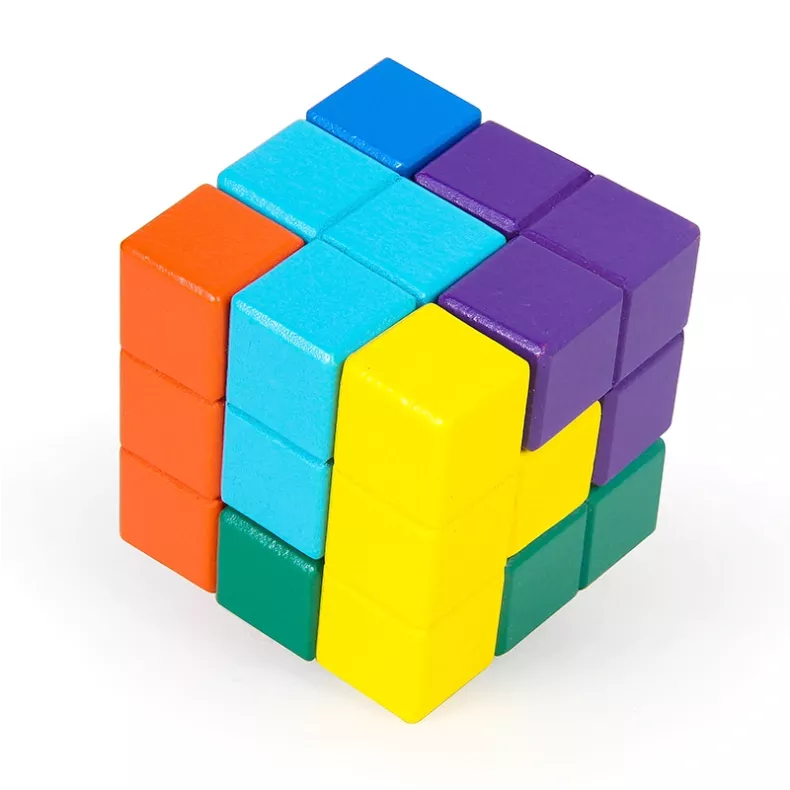
7 Color Soma Cube Puzzle — $21.88
The 7 Color Soma Cube Puzzle provides seven distinct, colorful pieces to build a cube (and dozens of other shapes). The frustration is different: it’s about visualizing combinations, not discovering a hidden sequence. It’s a fantastic, less rigid alternative that still trains spatial intelligence, perfect for when you need a break from the burr’s exacting demands. The principles in our article stop forcing the solution apply beautifully here, teaching patience and observation over brute force.
Remember, hitting these pitfalls doesn’t mean you’re bad at puzzles. It means you’re learning the specific language of the burr. The line between frustration and breakthrough is often just one small, correct insight. When that insight won’t come, seeking a nudge in the right direction isn’t cheating—it’s smart strategy. Let’s talk about where to find that help next.
Step-by-Step Solution Strategy: A Thinking Framework, Not Just a Cheat
You’re staring at the assembled cube, pieces locked in a silent, smug embrace. The temptation is to grab and wiggle everything, hoping for a miracle. This is brute force, and against a well-designed six-piece burr, it’s a losing battle. The real solution isn’t a memorized sequence of moves—it’s a way of seeing. This framework teaches you to think like the puzzle, turning a baffling object into a logical, solvable system.
First, understand the core geometry. A standard six-piece burr is not a solid block; it’s a framework of three intersecting pairs of sticks, each pair aligned to one of the three spatial axes (X, Y, Z). As noted in puzzle literature, the notches are cut only in the interior regions where these sticks cross. This is why the assembled puzzle looks deceptively solid and symmetrical—every piece’s function is hidden inside. Your job is to mentally map this internal lattice.
Your first practical step is to identify the key piece. Not all burrs have one, but most classic designs do. This is the linchpin, the only piece that can initiate movement. It’s often (but not always) distinguishable by a unique notch pattern or a slightly different end grain. If all pieces look identical, the “key” is a conceptual one: the piece with the most internal space around it, allowing it to slide first. Gently test each axis. Apply light pressure along one direction to the entire assembly. You’re not trying to force it; you’re listening and feeling for the tiniest give, a hair’s breadth of movement. The correct axis will yield a uniform, slight shift.
Once you’ve found the sliding axis, you must determine the sliding direction. This is where many get stuck. The first piece doesn’t pull straight out; it slides along its length, parallel to its grain, through a channel formed by the notches of the other pieces. It might only move a centimeter—often less—before it hits a stop or unlocks the next phase. This initial move is called the “first move,” and its distance is critical. In puzzle terminology, the “level” of a burr (like the 3-move Coffin’s Improved Burr) refers to how many of these discrete slides are needed to free the first piece.
After that first, crucial slide, stop. Do not try to pull the piece free. The puzzle is still interlocked. You have now changed the internal configuration. Re-examine the cube. A new axis of movement will have been unlocked, usually perpendicular to the first. Your goal is to repeat the process: identify the next piece that can now slide, find its axis and limited direction. This is a sequential unlocking, a cascade of precise, minimal movements. The methodology outlined on resources like Solving Burrs emphasizes this patient, state-by-state analysis over random manipulation.
A powerful mental model is to think in volumes and voids. Each piece occupies a specific set of imaginary 1x1x1 cubes within the larger 6x6x6 (or similar) grid of the assembled shape. The notches create empty spaces—voids—that allow movement. Your manipulations are essentially shifting pieces so their solid volumes align with these temporary voids. When you’re truly stuck, try to visualize this internal grid. Which piece currently blocks the potential void needed for another to move? This approach is at the heart of solving the wooden cube with geometry, not force.
This framework is transferable. It’s why someone who has mastered one six-piece burr can often solve another faster, even if the notch patterns differ. They’re not remembering moves; they’re applying the principle of sequential axis unlocking and void alignment.
If you enjoy this kind of structured spatial reasoning, where geometry dictates every action, you might appreciate the more complex dance of the Luban Lock puzzles.
The Luban Lock Set 9 Piece applies similar interlocking logic but in a more architectural, open-frame style. Solving it requires the same disciplined approach: identifying load-bearing pieces, understanding how shear planes work, and finding the precise order of operations. It’s a fantastic next step for honing the mechanical intuition you develop with the burr, and you can read more about it in our review of the Luban Lock Set as a next challenge.
Finally, document your own solve. When you finally crack it, don’t just scramble the pieces. Take it apart slowly, noting the order of removal and the direction each piece moved. This reverse-engineering is the fastest way to internalize the logic. Then, try reassembly, which is often a harder challenge than disassembly. This framework turns the puzzle from a closed secret into a readable, mechanical object. The satisfaction shifts from “I finally forced it” to “I finally understood it.”
Frequently Asked Questions About Six-Piece Burr Puzzles
After diving into the hands-on experience, strategy, and comparisons, a few core questions always pop up. Here are the straight answers, drawn from puzzle history, maker forums, and the collective sighs of relief from solvers.
Is there only one solution for a six-piece burr?
No, and this is a huge source of confusion. The classic “six-piece burr” is a family of puzzles, not a single design. There are hundreds of possible internal notch arrangements, each with its own unique solution path. Some have just one assembly, while others have multiple. The puzzle you buy or make will have one intended solution, but verifying that requires complex computational analysis. If you’re following a known plan or bought a commercial version, it’s designed to have a single, elegant solution.
What does the ‘level’ of a burr puzzle mean?
The “level” (or “move number”) refers to how many sequential moves are required to remove the first piece from the fully assembled puzzle. A move is defined as sliding a piece linearly in any direction. A “Level 3” burr requires three slides before a piece can be fully extracted. Higher levels (like Level 12, the theoretical maximum for a six-piece burr) are exponentially more difficult. This rating, formalized by puzzle analyst Bill Cutler, is a key metric for understanding a burr’s complexity before you buy.
Why is it called a ‘burr’ puzzle?
The name’s origin is debated, but the prevailing theory is that the completed puzzle resembles the spiky seed pod of the burr plant. The interlocking wooden pieces stick together as tenaciously as a burr sticks to clothing. For a detailed history of this and other mechanical puzzles, the Burr puzzle Wikipedia page is an excellent resource.
How long should it take a first-timer to solve one?
Anywhere from 20 minutes to several days, and both extremes are completely normal. Based on user reports, a first successful disassembly of a standard Level 3-6 burr often takes 1-4 hours of focused trial, error, and reasoning. If it takes you four hours, you’re in good company—many Reddit threads are filled with people sharing similar timelines. The variation depends heavily on the specific burr’s level, your spatial reasoning comfort, and whether you stubbornly resist a systematic approach.
Is it cheating to look up the solution?
This is a personal puzzle ethic question. For pure satisfaction, avoiding the solution is best. However, if you’re genuinely stuck and frustration is ruining the experience, looking at a guide can be a valuable learning tool. The key is to use it strategically: look just enough to get past your sticking point, then try to continue on your own. We offer a six-piece wooden puzzle solution for this exact scenario—to provide a nudge, not a full reveal.
Can I make a six-piece burr puzzle myself?
Absolutely. It’s a fantastic woodworking project. You need square stock (often 2×2 units), precise plans for notching, and patience for accurate cuts. Many free plans are available online for different designs. The challenge shifts from solving to precision craftsmanship. If you enjoy the interlocking concept but want a different building challenge, consider a related project.
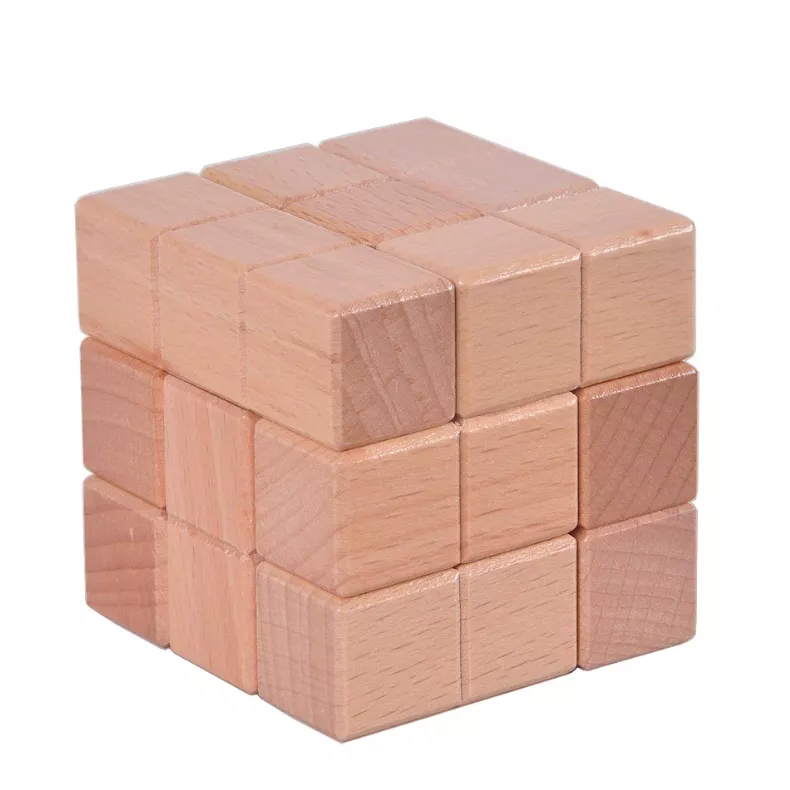
Luban Cube Puzzle — $21.99
The Luban Cube Puzzle is a modern, visually distinct take on the burr concept, using shaped pieces to form a perfect cube. Making it requires similar precision but with different angles and joints, offering a fresh creative and solving challenge after you’ve mastered a classic burr.
The Verdict: Is the Six-Piece Burr Puzzle Worth Your Time and Money?
In a word: yes. But not for everyone. The classic six-piece burr is the foundational text of 3D mechanical puzzles. Its value isn’t just in solving it once; it’s in the deep, tactile lesson it teaches about spatial reasoning, interlocking geometry, and patient problem-solving. If you enjoy a quiet, hands-on challenge that rewards logic over luck, this puzzle is an essential and enduring investment. It’s the puzzle you keep on your desk for years, not the one you solve and forget in a drawer.
For the curious newcomer, the recommendation is clear: start with a well-made commercial version. Skip the flimsy, poorly-milled cheap sets. A solid, sanded hardwood puzzle feels substantial, moves smoothly, and becomes a satisfying object in itself. This initial purchase is your tuition into a wider world. Once you’ve internalized its logic—once you can disassemble and reassemble it without that initial panic—you’ve earned your diploma. A dedicated six-piece wooden cube puzzle solution guide can be a helpful companion on this journey.
Your next steps depend on what hooked you. If you loved the precise, methodical process of finding the solution path, seek out higher-level burr variants. Remember, the “level” indicates moves to free the first piece, and puzzles like Coffin’s Improved Burr (level 3) or extreme 12-move designs offer a profound escalation of the same core principles. If you were captivated by the craftsmanship—the hidden notches and perfect symmetry—then the free plans on sites like CRAFTSMANSPACE offer a fantastic DIY project. Building your own transforms you from solver to creator, a deeply rewarding progression.
If your joy came from the interlocking concept but you crave more visual or complex intrigue, that’s where modern interpretations shine.
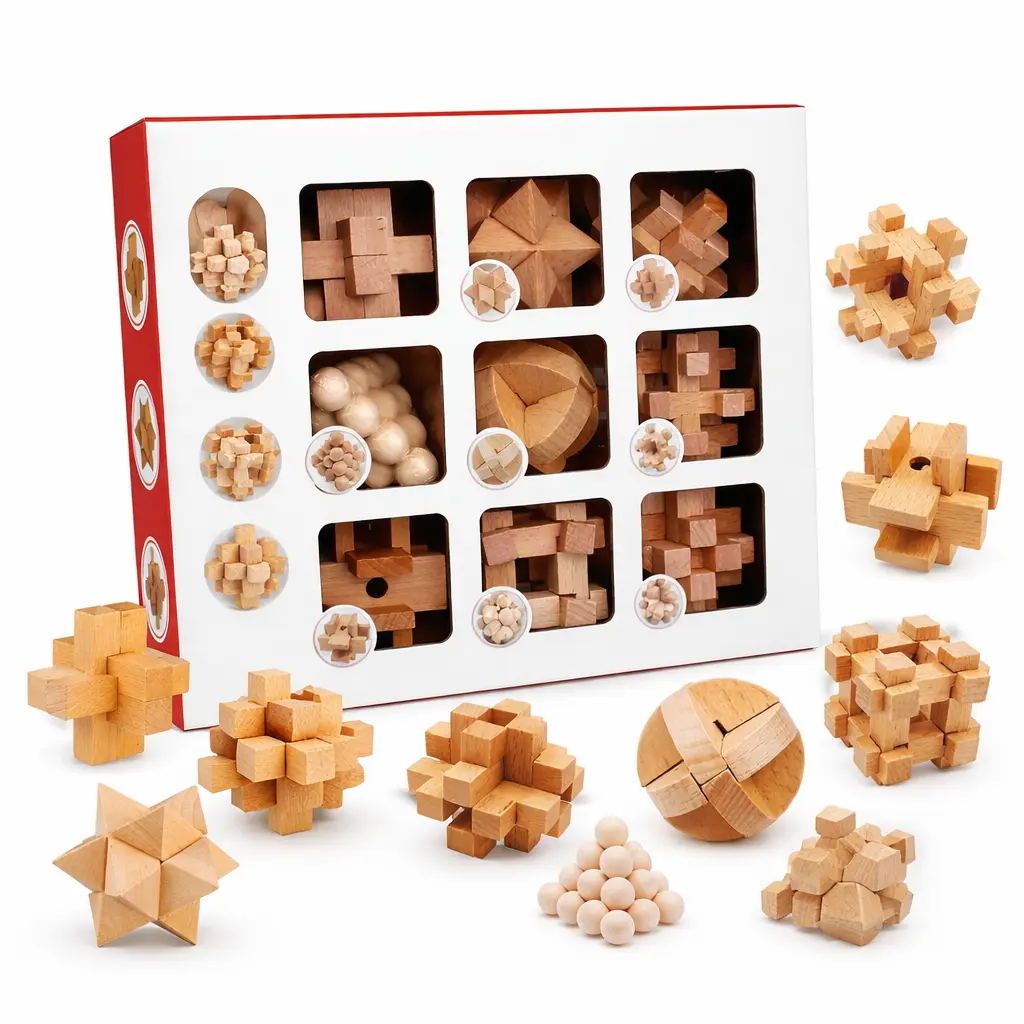
Luban Lock Set 9 Piece — $39.99
For a significant step up in complexity and artistry, consider the Luban Lock Set 9 Piece. It builds on the burr’s interlocking philosophy but with nine intricately carved pieces that form a stunning, solid cube. It’s less about hidden notches and more about beautifully shaped, puzzle-like joints, representing the next tier of collectible wooden puzzles.
Ultimately, the six-piece burr is worth it because it is a pure, timeless design. It has no flashy colors or cheap tricks. Its challenge is honest, its solution is elegant, and mastering it provides a genuine, quiet confidence. It’s not just a puzzle; it’s a benchmark. Buy one, solve it, and you’ll know—with absolute certainty—if this captivating world of mechanical puzzles is for you.