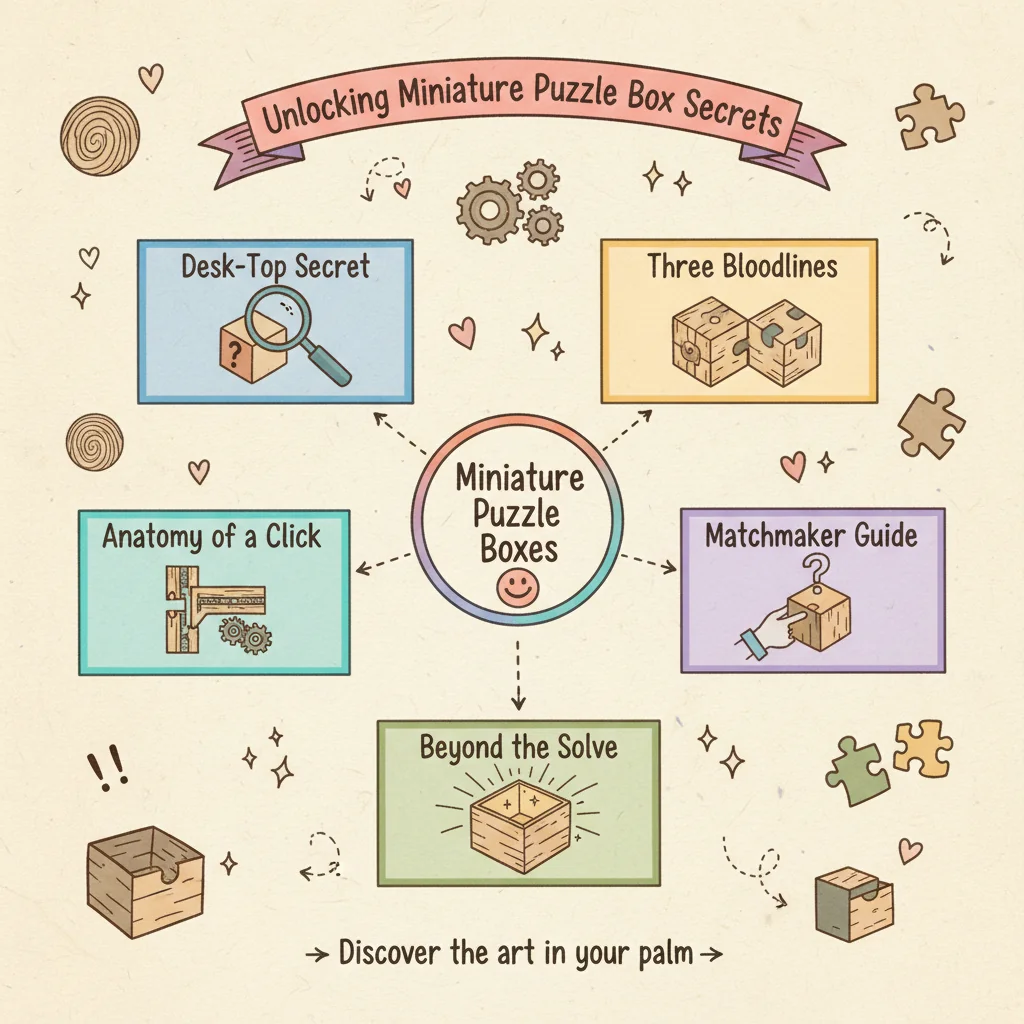
The Desk-Top Secret: Why ‘Small’ is the Real Challenge
It sits on my desk, a one-inch cube of walnut. The weight is surprising for its volume. The grain is a tight river delta, flowing over sharp edges and into seams so fine they vanish in certain light. To anyone else, it’s a paperweight. But my thumb finds the precise pressure point, a ghost of texture on an otherwise smooth face. A soft snick, a nearly imperceptible shift. The secret begins to reveal itself.
In a world of big, loud entertainment, what’s the appeal of a mystery so small it fits in your palm? It’s not about size. It’s about compression. A true small puzzle box is a feat of spatial and mechanical compression, where the challenge isn’t spread out over a table but concentrated into your fingertips. The scale transforms the experience. This isn’t a toy. It’s a mechanism in miniature.
Forget what you know about puzzle boxes for kids with simple trick lids. We’re talking about objects where the container is the puzzle. A secret compartment box is the goal, but the journey is a series of deliberate, often non-intuitive, manipulations. The opening mechanism is everything. In this compressed space, every millimeter of movement must earn its keep, every sliding panel or rotating piece must serve multiple functions. These constraints breed genius.
This leads to the three appeals that define the category for adults.
First, Mechanical Ingenuity (The “How”). How do you hide a functioning hidden drawer inside 16 cubic centimeters? The answer is often a step mechanism of sublime cleverness, where moves must be performed in exact sequence. (A 4-step box isn’t necessarily easy; a single, elusive step can be maddening.) This is the realm of the Impossible Dovetail, a style that looks mechanically inseparable yet slides apart with the right persuasion. The joy is in feeling the engineered intelligence in your hand.
Second, Spatial Efficiency (The “Why Small”). A mini puzzle box isn’t a scaled-down big box. It’s a different class of object. It lives on your desk, in your coat pocket, or on a shelf without demanding space. It becomes a desk puzzle box, a fidget-grade object of contemplation for moments between tasks. And yes, it can hold things: a single memory, a USB drive, a ring. Its utility is proportional to its discretion—a secret for a secret.
Third, Emotional Resonance (The “Gift”). A small, intricate object carries disproportionate weight. It implies trust. You are handing someone a self-contained mystery, a private accomplishment. It’s a conversation that happens entirely between their hands and the natural wood. This is where handcrafted pieces transcend; the maker’s patience is baked into the precision-cut parts. It’s anti-disposable.
This brings us to the natural apprehension: Aren’t small boxes too easy or fragile for adults? The inverse is often true. Mass-produced, poorly conceived boxes are indeed unsatisfying—their slides groan, their tolerances are sloppy, they “solve” themselves in a bag. A well-made box, however, uses its size to heighten tension. Every movement is crisp, every click definitive. The wood matters. Sheesham wood offers a warm, oily density; traditional Japanese Hinoki is lightweight and aromatic. The material is part of the tactile feedback.
Prices reflect this spectrum. You can find mass-produced small wooden puzzle boxes for under $20. They serve as a gateway. But intricate, hand-carved works from dedicated artisans command prices from $80 to over $200. You are not paying for material mass. You are paying for the hours of design, the test fits, the sanding of internals you’ll never see, the calibration of a hidden compartment that reveals itself only when earned. The size belies the labor.
So we begin here, with the cube on the desk. The challenge isn’t diminished by its scale. It’s purified by it. Your search isn’t for a brain teaser, but for a keyhole—and the quiet, precise key that fits it.
The Three Bloodlines: Mame Precision, Mechanical Minds, and Folk Art Souls
That cube on the desk, its hidden compartment a silent promise, belongs to a lineage. Not all small boxes are kin. To find the one that fits you, you must first learn the family traits. Broadly, they split into three distinct bloodlines, each with its own philosophy of concealment and its own answer to the central question of scale.
First, the Japanese Tradition: Mame and the Sun System.
This is where miniaturization became an art form. The most famous Japanese puzzle boxes from the Hakone region are measured not in inches, but in Sun, an old Japanese unit where 1 Sun equals about 3 cm (1.18 inches). This is the key to demystifying their sizing. A Mame box is the smallest standard size, translating to “bean”—typically under 1.5 inches. It is a marvel of compressed complexity, where a 4-step or 6-step mechanism operates in a space barely large enough to hold a single pea. A 2 Sun box is a common, palm-sized piece, while a 3 Sun box begins to feel more substantial. The mechanism here is often a step mechanism: a series of precise, sequential slides, sometimes requiring a magnetic slider or a specific order of presses. The beauty is in the restraint and the ritual. The external mosaic patterns, known as Yosegi, are more than decoration; they are a precise map of wood grains, often disguising the very seams you must manipulate. This isn’t a toy. It’s a crafted ritual object that happens to be a puzzle. For a deeper look into this world, explore our guide to Japanese puzzle boxes that humble your IQ.
Second, the Modern Mechanical Brain.
Born from the minds of puzzle designers, this family treats the box as a pure expression of mechanism. Forget serene slides. Think clicks, rotations, and sudden, satisfying releases. These are often cubic, made from dense hardwoods like Sheesham wood or aluminum, and prioritize the “aha!” moment of engineered deceit. A key distinction competitors miss is between a simple trick box and a sequential discovery puzzle. A trick box might have one clever catch. A sequential discovery box, however, requires you to find and use tools hidden within the puzzle itself to progress—a pin inside a compartment that unlocks a slider, which reveals a key. The complexity is internal, intellectual, and deeply layered. The Impossible Dovetail is a classic example of this school: a small cubic box that looks mechanically inseparable, its solution a lesson in perceptual shift. This family answers the user asking for a challenging small puzzle that is a true test of logic, not just dexterity.
Third, the Hand-Carved Folk Art Soul.
Emerging from traditions in Eastern Europe, the Baltics, and rustic American workshops, these boxes wear their craft on their sleeves. The puzzle here is often secondary to the storytelling of the hand-carved form. You might find a tiny treasure chest with a slider puzzle disguised as iron bands, or a carved animal where the secret lies in a twist of the head or a pressure point on the paw. The hidden drawer might be accessed by aligning a coin trick or manipulating a seemingly decorative panel. The mechanism can be simpler, often a single clever join or a spring-loaded catch, but the appeal lies in the natural wood and the artisan’s touch. It feels less like solving an equation and more like discovering the secret of a cherished heirloom. While some simpler versions are marketed as puzzle boxes for kids or charming stocking stuffers, the finest examples are sophisticated desk puzzle boxes, their charm rooted in warmth and whimsy rather than pure, cold precision.
Three bloodlines, then: one of measured tradition, one of engineered revelation, and one of storied craftsmanship. Understanding this is your first step toward a satisfying solve. It moves you from browsing generic boxes to seeking a specific kind of secret—one that resonates with how you think and what you find beautiful.
The Anatomy of a Satisfying Click: Mechanism, Material, Craft
Choosing a box from one of those three families is about resonance. But understanding what makes a good box—regardless of its origin—is about dissection. This is where we move from appreciation to evaluation. Let’s take it apart.
First, the mechanism. This is the heart. The difference between a satisfying secret and a disappointing trick often lies in the action. You must assess two things: the intelligence of the puzzle and the integrity of the movement. Step count is a common metric—a 4-step box, an 18-step Japanese puzzle box. But this is a misleading simplicity. Four steps of precise, interlocking slides that require specific pressure and sequence are infinitely more sophisticated than ten steps of loose, wobbly panels that solve themselves. True difficulty isn’t about number of moves; it’s about the logical (or illogical) bridge between them. This is the core of sequential discovery, where the act of solving reveals the tools or clues for the next step. A simple trick chest with a magnetic latch is not this.
Now, apply the Durability Test. A box is not a static sculpture; it is meant to be manipulated. Examine the joins. On a traditional Mame box, the Yosegi marquetry should be seamless, but the underlying sliding panels must have absolutely no lateral wiggle when the box is in its “locked” state. Press gently on various faces. A quality box will feel inert, a single solid block, until the precise sequence is initiated. For slider puzzle-based boxes, each slide should have a defined beginning and end, with a consistent, slight resistance. There should be no grinding of wood on wood. A vague, mushy slide or a panel that rattles is the hallmark of poor tolerances and a solve that feels like an accident, not an achievement. (A common failure point on mass-produced pieces is the internal guide rail, often a thin strip of wood that wears down or snaps. You can’t see it, but you’ll feel the resulting slop.)
This leads to material. The wood is not just aesthetics; it is a functional component. Soft woods dent and wear, degrading the mechanism. High-quality wood is hard, dense, and often self-lubricating. Hinoki (Japanese cypress) used in traditional boxes is aromatic, lightweight, and has a straight grain that allows for incredibly fine, precise cutting. It offers a soft, whisper-quiet slide. Sheesham (Indian Rosewood), common in modern wooden puzzle boxes, is harder, providing a more definitive snick with each movement. Its rich grain and natural oils contribute to durability and a warm, substantial feel. Walnut strikes a balance—hard enough for crisp opening mechanisms, beautiful, and stable. Each material imparts a different sound, weight, and tactile feedback. A satisfying solve engages more than your mind; it speaks to your hands and ears.
Finally, craft. This is where cost justifies itself. Why is a 2-inch cube worth $200? Because it represents fifty hours of a craftsperson’s life. It’s the micro-bevel on a hidden drawer lip that prevents catching. It’s the hand-rubbed oil finish that protects the wood without gumming up the works. It’s the hand-carved folk art box where the secret compartment is perfectly concealed within the sculpture’s form, not just glued onto it. This is heirloom quality. It’s the antithesis of a laser-cut, unfinished mini secret puzzle box that arrives with a puff of sawdust. Both can be puzzles, but only one is an object that endures—in function, form, and value.
Maintenance follows from craft. An heirloom-quality box needs care: keep it away from extreme humidity, dust it, and occasionally—very occasionally—apply a microscopically thin layer of camellia oil (for traditional Japanese boxes) or beeswax polish (for others) to the exterior only. Never force a mechanism. If it sticks, the problem is your sequence, not the box. A full exploration of this mindset is available in resources like our complete guide to opening a puzzle box.
So, you have your criteria. Mechanism: precise, intentional, and durable. Material: chosen for function as much as beauty. Craft: evident in every seam and slide. A desk puzzle box might be fidget-grade, designed for hundreds of cycles with robust, snappy actions. A collector’s piece is a preserved moment of ingenuity, to be solved with reverence. Knowing this anatomy lets you decode the marketplace, to see past marketing and understand what you’re truly buying. You’re not buying a brain teaser. You’re investing in a small, secret machine.
The Matchmaker: A Scenario Guide to Your First (or Next) Box
So you understand the anatomy. You can sense the difference between a well-oiled slide and a sloppy one. But a marketplace full of options is its own puzzle. The real question isn’t “what’s the best small puzzle box?” It’s “what’s the best small puzzle box for you?” Cast aside the generic rankings. Let’s match your intent—your fidgeting hands, your gifting dilemma, your collector’s itch—to the object that will truly satisfy it.
Here is your scenario-based chooser.
For The Fidgeter: The Tactile Metronome
You don’t just want to solve it once. You need a desk puzzle box that lives in your hand, a physical algorithm for your restless mind. Your primary metric is cycle durability.
Forget delicate inlays. You need a workhorse. Look for modern mechanical boxes designed for repeated solving: crisp magnetic clicks, robust polymer or hard maple components, and mechanisms that reset cleanly. The appeal is in the rhythm of the solve, not the reveal. A sequential discovery puzzle that requires tools (often hidden within the box itself) is perfect—it’s a multi-stage ritual you can perform daily. Avoid traditional thin-wood Japanese puzzle boxes for this role; their sliding panels aren’t meant for hundreds of aggressive cycles. Instead, seek out machined aluminum cubes or chunky wooden dovetail puzzle boxes with satisfying, positive-action slides. The mechanism is the entertainment.
(Insider tip: Many modern “fidget-grade” boxes are sold by puzzle designers on boutique sites or at puzzle conventions. They’re built for enthusiasts who solve on loop.)
For The Gift Giver: The Silent Conversation Starter
You’re not just giving an object; you’re offering an experience wrapped in intrigue. Your goals: immediate visual appeal, a non-frustrating entry point, and that “aha!” moment that makes the recipient text you in delight.
Presentation is paramount. A hand-carved folk art box from Eastern Europe, with its warm, natural wood and obvious secret compartment, has instant charm. Or, a sleek cubic modern box in rich Sheesham wood looks like a sophisticated secret jewelry compartment on a dresser. For a true beginner, the mechanism should be clever but logical—a 3 to 5-step process, often involving a visible but overlooked slider or a subtle coin trick. A classic “Impossible Dovetail” style box is a stellar gift; it looks like magic but solves with a satisfying, logical slide.
Crucially, pre-solve it. Ensure the action is smooth, then close it. Your gift is the journey, not the destination. Avoid anything labeled “challenging” or with a high step-count for this role. A 2 Sun or 3 Sun traditional box can work if explicitly marketed as “beginner-friendly.” The unboxing should feel like the start of a quiet conversation between them and the box.
For The Collector: The Hunt for Ingenuity
You have shelves of solved puzzles. You judge a box by the originality of its lock, the purity of its concept, the signature of its maker. You seek the handcrafted anomaly, the mechanism that makes you whisper, “How did they think of that?”
Your world is one of artisans and small-batch designers. You’re looking for sequential discovery puzzles that are also boxes—where the process of finding the tools is the puzzle. You appreciate rare woods, Yosegi marquetry on a true Mame-sized scale, and the whispered provenance of a box from a known craftsman in Hakone or the Czech Republic. Price is a secondary signal of time and skill. You understand why a 1-inch cube with a never-before-seen magnetic-latch sequence can cost $200. The hidden compartment is almost incidental; the prize is the mechanism itself.
Your hunt moves beyond e-commerce giants. You frequent puzzle exchange forums, artisan collectives, or direct-from-workshop websites. Your question isn’t “where to find a box,” but “where to find the box that hasn’t been seen before.” This journey often leads you to the kind of puzzle boxes for adults that reward patience with true mechanical depth.
For The Intimidated Beginner: The First Click
You’re curious but wary. The fear isn’t of cost, but of failure—of holding a sealed cube for weeks, feeling cleverness drain away. You need a clear win to fuel the addiction.
Start with a box that has a guided, almost inevitable, solution path. Look for beginner boxes from reputable puzzle companies. These often have a single, elegant trick—a magnetic latch, a gravity slide, a press-panel—that teaches you the language of puzzle boxes. The material should feel solid; a cheap, splintering box will only confirm your fears. A small, mass-produced money puzzle box or trick chest from a known brand can be a perfect, affordable puzzle box start. The goal is to experience that first click, the visceral proof that you interacted correctly with a hidden system.
(This is where that ‘Durability Test’ framework from earlier is vital. A beginner’s box must not feel broken or loose; it must respond with unambiguous feedback to correct inputs.)
Once you’ve solved it, the step-by-step guide (often provided or found online) will show you the logic. This demystifies the process. You’re not learning to open one box; you’re learning to think like a puzzle box. From here, the path opens to 5-step, then 10-step boxes, and the intricate puzzles of the collector’s world. If you’re unsure where to begin, our guide to choosing wooden puzzle boxes can help narrow the field.
Your Next Move: With your scenario in mind, the marketplace comes into focus. The fidgeter bypasses Amazon to find a modern machinist’s creation. The gift giver selects for story and feel. The collector stalks the artisan’s online store. The beginner seeks a trusted brand’s entry-level model.
This is how you find not just a puzzle box for adults, but your puzzle box. It turns a search into a quest. Now you know what to look for, and more importantly, why. The final step is knowing where to look—a shortlist of worthy contenders across these worlds, which is precisely what comes next.
A Curator’s Shortlist: Exemplars Across the Spectrum
This is where the quest becomes tangible. You have your scenario, your criteria. Now, we move from a decision matrix to a cabinet of curiosities. These are not just products; they are ambassadors from their respective worlds—Japanese, Modern, Folk Art—each selected because it embodies the principles we’ve dissected. Consider this a guided tour of my shelf.
Japanese Precision: The Mame & Sun Spectrum
Here, size is a language. A true Mame box (under 1.5 inches) is a marvel of miniaturization. The challenge isn’t brute-force moves, but the absolute precision required to manipulate pieces so small. For a 3 Sun box (roughly 4.5 inches), the mechanism can afford more complexity, often incorporating Yosegi marquetry—a patterned wood veneer that camouflages seams.
The Classic 2-Sun Step Box: Often the first true Japanese puzzle box a collector seeks. It’s a cubic, unadorned natural wood box, typically in Hinoki (Japanese cypress). The mechanism is pure step mechanism—a sequence of precise slides, often 4 to 6 moves. The tactile feedback is a soft, whispering click. Indicative Price: $45 – $80. Best For: The Purist. It teaches the foundational grammar of the craft.
The Yosegi Mame Box: This is jewelry. A tiny, intricate geometric pattern wraps a secret no larger than a hazelnut. The mechanism is usually simple (2-4 steps), but the artistry is the point. It’s a handcrafted heirloom, a secret jewelry compartment for a single pearl or a folded message. Indicative Price: $90 – $150+. Best For: The Gift Giver & The Collector. (Finding these requires sourcing from specialty artisans or trusted importers; they are seldom found on generic marketplaces.)
Modern Mechanical: The Engineer’s Playground
This family is defined by novel mechanisms and fidget-grade repeatability. They are desk toy and challenging small puzzle fused into one. The hidden compartment is often a satisfying bonus, not the sole purpose.
Here, we find boxes designed to hold small treasures. A modern design often integrates storage not as an afterthought, but as the core reward.
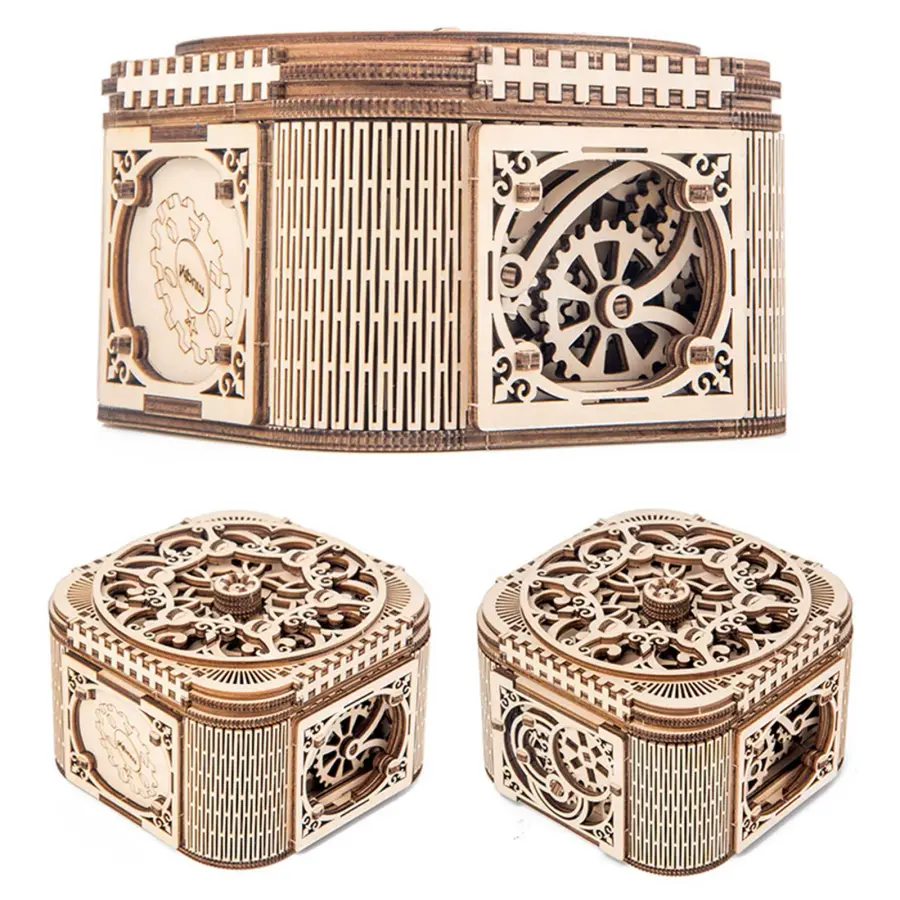
The Impossible Dovetail: The icon. This small dovetail puzzle box looks like a solid block of interlocking wood fingers with no apparent opening. The solution is a lesson in misdirection and leverage. Modern versions in Sheesham wood or walnut offer a warm, substantial feel. It’s a conversation piece that demands to be solved. Indicative Price: $25 – $60. Move Count: 3-5 (but mentally taxing). Best For: The Fidgeter & The Gift Giver.
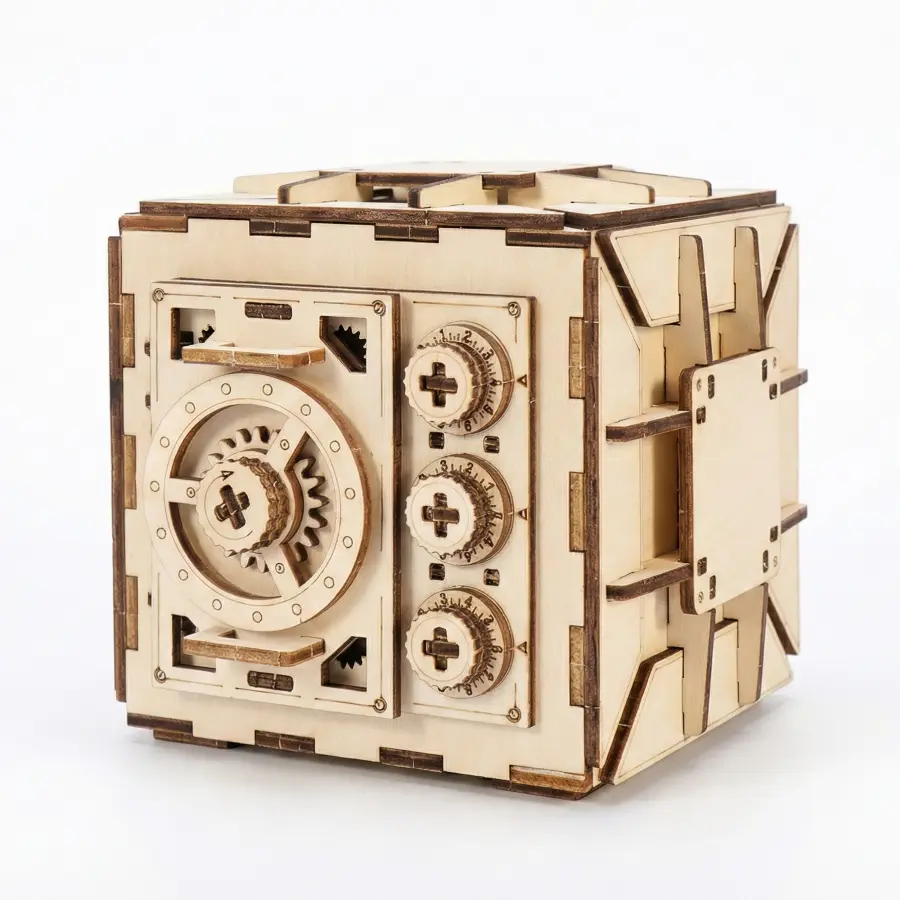
The Sequential Discovery Safe: A step beyond. This isn’t just sliding panels; it’s a mini secret puzzle box that requires you to discover tools within the puzzle to progress. It mimics a trick chest on a miniature scale. Often made from precision-cut plywood or MDF, the focus is purely on the opening mechanism. Indicative Price: $30 – $50. Move Count: 10+. Best For: The Collector & The Detail-Oriented Beginner. (It provides a tangible ‘aha!’ cascade.)
For those who enjoy the aesthetic of a classic safe, the modern mechanical approach offers a satisfying, tactile slider puzzle experience with a functional twist.
Hand-Carved Folk Art: The Storyteller
These are hand carved narratives. A small bird, a carved pumpkin, a tiny treasure chest. The mechanism is often a simple coin trick—a disguised sliding panel or rotating piece. The value is in the whimsy and the artisan’s touch.
- The Folk Art Animal Box: Perhaps a fat robin with a hidden drawer in its base. Made from a single piece of wood, sanded to a velvet finish. The mechanism is straightforward (1-2 steps), but the charm is immense. It’s a puzzle box for adults that doesn’t intimidate; it delights. Indicative Price: $30 – $75. Best For: The Gift Giver & The Casual Enthusiast.
- The ‘Money Puzzle Box’: A classic form, often a turned lidded box or a simple cube with intricate geometric carvings. The trick to opening is clever but not complex. It’s sold as a place to stash cash, making it a functional secret compartment box. Look for one in a solid, aromatic wood like cedar or cherry. Indicative Price: $20 – $50. Best For: The Beginner & The Function-Seeker.
Why are some so expensive when they’re so small? In the Japanese and Folk Art realms, you are paying for decades of honed skill, for the hand that aligns the Yosegi veneer to a thousandth of an inch, or the eye that gives a carved owl its personality. In the Modern realm, you pay for IP—the ingenuity of the mechanism itself. The best small puzzle box for you is the one where the cost aligns with the value you seek: raw ingenuity, cultural artifact, or personal fable. Now you know where to look. The final step is how to proceed. For more curated examples that pass rigorous tests, see our list of the best wooden box puzzles that actually deliver.
Beyond the First Solve: Sourcing, Care, and Deepening the Obsession
Now you know what to look for. The real search begins. The big-box marketplaces are minefields of loose-fitting, disappointing mechanisms. True quality lives elsewhere.
Start with dedicated puzzle shops—boutique retailers and enthusiast sites where the owners curate for mechanism integrity, not just SEO. For Japanese puzzle boxes, seek importers with direct artisan relationships; they’ll specify the Sun size and wood type. The modern handcrafted scene thrives on crowdfunding platforms and at puzzle designers’ own storefronts. Here, you’re buying directly from the mind that engineered the opening mechanism.
Your box has arrived. Dust it. That’s all. Wood is a living material; your skin’s natural oils are usually sufficient for a natural wood patina. Never use furniture polish. If the action feels dry or gritty, a microscopic dab of pure beeswax on a slide, wiped immediately, can work wonders. Store it away from direct sun and wild humidity swings. A stable environment is the true puzzle box storage solution.
The first open is a revelation. The tenth is a meditation. The hundredth makes the intricate puzzles part of your muscle memory. This is when you graduate. Move from a simple trick box to a true sequential discovery puzzle, where tools are hidden within the puzzle itself. The complexity isn’t in force, but in elegant, misdirecting logic.
Consider the journey of making. For the deeply curious, DIY project guides exist, but understand: crafting a reliable hidden compartment from raw wood is a lesson in profound humility. It will transform how you appreciate every dovetail and slide in a hand-carved piece you later acquire. (A worthy starting resource: how to build your own puzzle box.)
This isn’t merely collecting objects. It’s curating a library of tactile ingenuity. Each small box on your shelf is a conversation with its maker, a quiet rebellion against the obvious, a secret you are privileged to know. The next one is out there, waiting to fit perfectly in your palm.
Reader Friction and Quick Answer
That final note of quiet obsession—the curated library, the tactile conversation—is the destination. But the path here is often blocked by very practical, very reasonable friction. After absorbing the distinctions between Mame boxes and sequential discovery puzzles, after feeling that tactile longing, hesitation sets in. It’s the voice that asks, “But will this actually work for me?”
Let’s address the three core fears head-on.
“I’m worried I’ll get it, get stuck immediately, and feel foolish.”
This is the most common brake. The quick answer: Choose your first opening mechanism with intent. A beginner box isn’t about simplicity; it’s about clarity of feedback. Avoid a true sequential discovery puzzle for your first. Instead, opt for a trick chest with a defined, repeatable motion—a satisfying slider, a magnetic latch, a precise turn. The goal of the first box isn’t to stump you for weeks, but to teach you the language of pressure, sound, and alignment. The solve is in learning to listen with your fingers. (When you’re ready for the deep end, our guide on how to solve a puzzle box without losing your mind covers the mindset shift required.)
“It’s so small and seems delicate. Won’t it just wear out or break?”
A valid concern, born from experience with poorly made novelties. The durability test from earlier is your shield. For a daily desk puzzle box, seek out handcrafted boxes in woods like Sheesham or Walnut, known for their density and wear resistance. The mechanism should feel intentional, not sloppy. A precision-cut slide shouldn’t wobble; it should glide with a hushed, authoritative scrape. A dovetail puzzle box that looks impossible should have no play in its joints. This tactile feedback is the hallmark of something built to be manipulated for years, not just opened once.
“The price for a few cubic inches of wood seems… high.”
You are not paying for material volume. You are commissioning a miniature, functional machine, often assembled and finished by hand. The cost is in the engineering hours compressed into a 3 Sun space, in the tolerances finer than a paper’s thickness, in the Yosegi veneer pieced together from contrasting grains. A mass-produced mini secret puzzle box for $20 delivers a moment of surprise. A $150 Japanese puzzle box from a dedicated artisan delivers a lasting, heirloom-quality dialogue between mind and material. One is a transaction; the other is an acquisition.
The friction melts when you stop shopping for a product and start selecting a key—a key to a specific experience. The rest is just matching that key to the lock of your intent, which our scenario guide has already equipped you to do.
How We Evaluate Puzzle Toys
This is the final translation: how the abstract principles of mechanism and craft become concrete, actionable judgement in your hands. It’s the checklist we run in our workshop, distilled.
First, we dismiss the label “toy.” A good puzzle box is a device. Its purpose is not merely to conceal, but to reveal—its own ingenuity through your engagement. Therefore, our evaluation rests on three pillars, each a test it must pass.
1. The Authority Test (Mechanism). When you manipulate it, does it command respect? A step mechanism should feel deliberate and positive; each move should click into place with a clear, often inaudible, confirmation. There is no wiggle, no ambiguity. If a slide wobbles or a panel shifts without intention, the mechanism lacks authority. It’s solved by accident, not deduction. This is the core failure of cheap, mass-produced mini secret puzzle boxes—they feel anonymous. A proper box has a distinct, satisfying personality in its operation. (This is why we distinguish sequential discovery puzzles, where tools are found within, from simple trick chests; the former has a narrative in its mechanism.)
2. The Haptics Test (Material & Finish). Close your eyes. This is where natural wood types declare themselves. Sheesham wood offers a dense, almost oily warmth. A lacquered Yosegi surface is a cool, seamless mosaic under your thumb. The finish should protect, not obscure; you should feel the grain, not plastic. Edges must be crisp but never sharp. Weight is critical—it should have a dense, purposeful heft for its cubic dimensions. A box that feels like balsa wood is a box that won’t endure repeated solving.
3. The Legacy Test (Craft & Longevity). Will this object age with you, or disintegrate under scrutiny? We look at the joins, the seams. On a dovetail puzzle box, the interlocking should be flawless, with no gaps to catch a fingernail. We perform the Durability Test: apply gentle, twisting pressure. Does it creak or groan? A well-handcrafted box will remain silent and steadfast, its hidden drawer moving only when the precise sequence is followed. This test separates heirloom candidates from disposable novelties.
Our curated shortlist exists because those boxes passed these tests. They are not merely puzzles; they are benchmarks. For a broader understanding of the category, you can explore the Wikipedia entry for Mechanical puzzles or the specific history of the Puzzle box.
So your next step is not to buy. It is to apply. Take this framework to any listing, any description. Look past the marketing. Ask: Does the description speak to the mechanism’s authority? Does it name the wood and finish? Are the joins shown in detail? Your confidence now comes from knowing what to demand.
The ultimate evaluation, of course, happens on your desk. It starts with that first, tentative push of a panel, the search for purchase, the quiet focus that shrinks the world down to a single, challenging small puzzle in your palm. Your journey from intrigue to mastery is its own mechanism—and it begins with a single, well-chosen move.
For a deeper dive into specific mechanisms and advanced puzzle box challenges, continue your exploration with our dedicated guide: ultimate guide to puzzle box challenges. Your first box is just the initial step.