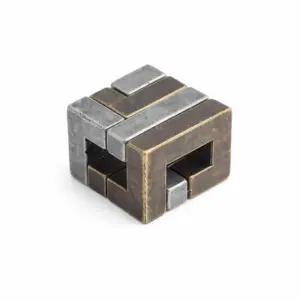
The Stump: That Maddening Click on the Tabletop
It starts with a sound. A distinct, hollow clack as pieces of wood tumble from a small box onto a worn tabletop. You’re at a friend’s house, or maybe a quiet bar with board games stacked in the corner. Someone slides the pieces toward you—a small, silent challenge. They form no recognizable picture. Just geometric shapes: L’s, T’s, squares, and odd little bars. The goal seems simple: assemble them into a perfect square.
You pick up a piece. The wood is smooth, cool to the touch. You can feel the subtle grain under the finish. It feels substantial, not like a child’s toy. You arrange a few pieces. They almost fit. There’s a gap. You rotate one. Click. It fits. Or it doesn’t. The frustration is immediate, delicious, and quiet. This is the hook of a true brain teaser. This is the moment you’re introduced to the world of hard wooden puzzles for adults.
You’ll try for ten minutes. Then twenty. The background conversation fades. Your entire universe is the 4×4 grid that exists only in your mind’s eye. This isn’t just a puzzle; it’s a mechanical puzzle, a physical argument between your spatial reasoning and an inanimate object. It’s frustratingly fun in the purest sense. The satisfaction is deferred, held hostage by the arrangement of a few precision-cut blocks of alder wood.
I found mine in my grandfather’s toolbox, nestled behind the wrenches. It was worn smooth by decades of fidgeting, its original solution lost to time. I spent a week reverse-engineering it, which is a polite way of saying I spent a week in a state of focused bewilderment. That was the transition—from seeing a trinket to understanding it as a engineered object, a packing problem made tangible. It sparked the obsession. Now, in my workshop, that same worn puzzle sits on my desk. It’s a reminder that the best challenges don’t shout; they just sit there, quietly confident.
This article is for you, in that moment at the table. Maybe you’ve just met the Impossible Square with its 16 pieces and that maddening red block. Perhaps you’ve been gifted a chunky Devil’s Square, a six-piece beast that feels like it should be solved by brute force (it shouldn’t). You’re searching not just for a solution, but for context. What is this species of puzzle? Why is it so hard? And where can I find more that provide this specific, tactile brand of torment?
You aren’t looking for a list of products. You’re looking for a taxonomy. A way to decode the quiet click on the tabletop and understand the entire family of square wooden puzzles it represents. Let’s start by diagnosing what you’re actually holding.
Puzzle Taxonomy: Identifying Your Square-Shaped Adversary
That initial bewilderment—the feeling that you’re holding an object that defies its own geometry—comes from not knowing your adversary’s species. Not all square wooden puzzles are the same. In fact, they belong to distinct families, each with its own internal logic, piece vocabulary, and type of satisfying click. Think of it like birdwatching: you need to know if you’re looking at a warbler or a woodpecker to understand its behavior. Let’s classify the three main genera you’ll encounter in the wild.
1. The Packing Problem: A Flat Jigsaw in Disguise
This is the family of the classic Impossible Square and its kin, like the wooden T puzzle square. The challenge is deceptively simple: arrange a set of flat, oddly-shaped pieces—often 16 of them—inside a square frame, sometimes with an extra block like a red square that must also fit. It’s a square packing puzzle in its purest form. The pieces are notched and angled, creating a landscape of false solutions where everything seems to fit until that one, stubborn piece remains. The frustration is quiet, geometric.
The Impossible Square is the archetype here. It typically comes with those 16 pieces and a separate red square, a tiny beacon of insolvability. The goal isn’t to build up, but to fill in. The wooden T puzzle is a close relative, using just a few T-shaped pieces to form a perfect square. The pleasure is in the silent, two-dimensional tessellation, the moment when spatial reasoning clicks into place. These are the puzzles you find yourself staring at from above, shifting pieces millimeter by millimeter.
2. The Interlocking Burr: A 3D Logic Lattice
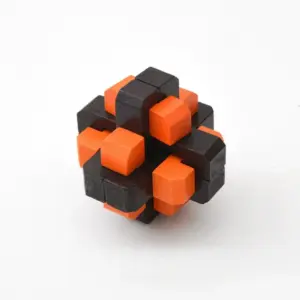
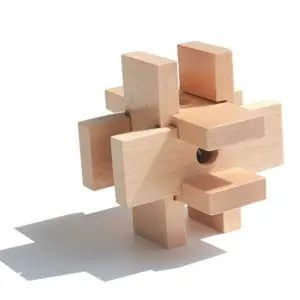
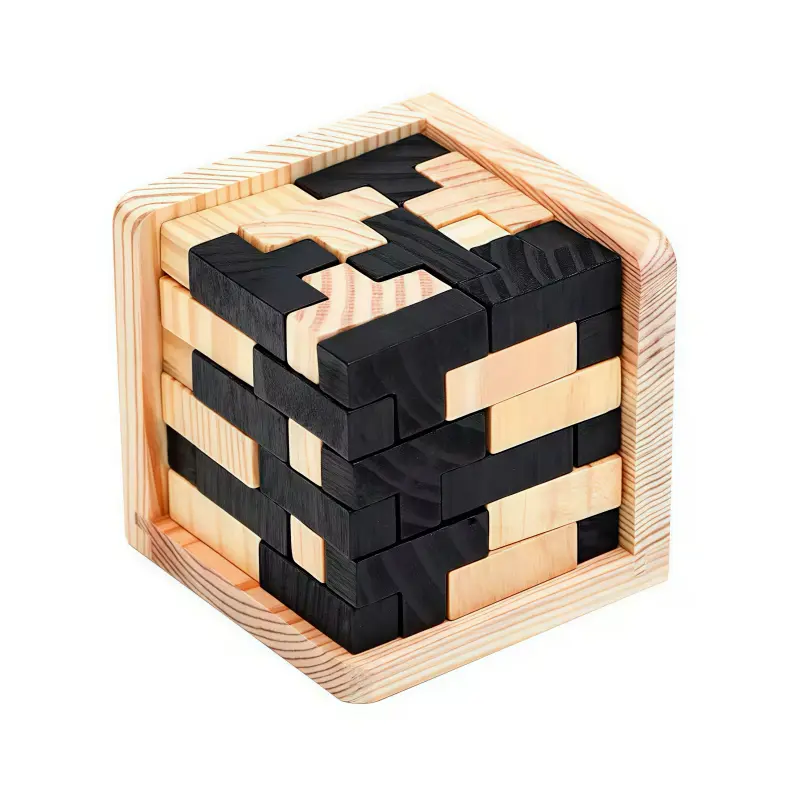
Now, meet the Devil’s Square. This is not a flat pack but a wooden burr puzzle square, a 3D wooden square puzzle built from notched sticks that intersect in three dimensions. The most common form is a six-piece burr, a compact cube that feels solid in your hand until you discover the secret of its assembly. This is a mechanical puzzle in the truest sense; the solution is a sequence of forced moves, a precise choreography of slides and rotations. Brute force is useless. It’s about understanding internal voids and key pieces. For a deep dive into the classic six-piece burr puzzle, its history and variations, our dedicated guide is an excellent resource.
The difference between the Devil’s Square and the Impossible Square is fundamental: dimension. One is a volumetric lock to be unpicked, the other a silhouette to be filled. The burr’s satisfaction is a deep, structural snick as pieces interlock, creating a stable cube from seeming chaos. It’s the difference between solving a maze on paper and navigating a dark room by touch.
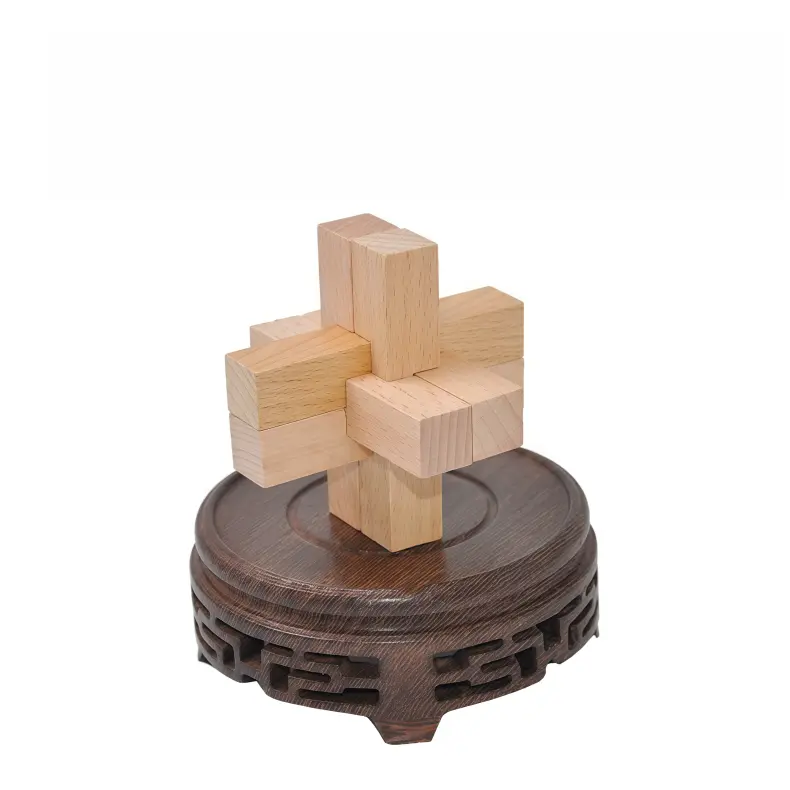
Six-Piece Burr — $17.99
3. The Educational Shape Puzzle: First Principles
This is the gateway. Often large, around 9 inches square, with thick, smooth rounded edges for small hands. These are educational square puzzles for kids, designed for shape recognition and critical thinking. They might involve fitting a set of colored blocks into a tray or arranging large geometric pieces into a square. The challenge is foundational, not fiendish. The pieces are few, the tolerances forgiving. Don’t dismiss them, though; they teach the spatial vocabulary that all other puzzles speak. They’re the scales before the symphony, a perfect educational tool for a family game.
The Diagnosis: What Are You Holding?
Lost? Use this simple flowchart. Look at your puzzle and ask:
Are the pieces mostly flat, like oddly-shaped tiles?
→ Yes. Do you have a square frame or boundary to fill?
→ → Yes, with many small pieces (like 16). You likely have an Impossible Square-style packing puzzle.
→ → Yes, with only 4-5 large pieces (like T-shapes). You likely have a T Puzzle variant.
→ No. The pieces are chunky, like notched sticks or blocks.
→ Do they interlock to form a solid cube?
→ → Yes, typically with 6 pieces. You have a burr puzzle, likely a Devil’s Square.
→ → No. They are large, simple shapes for a tray. You have an educational shape puzzle.
This taxonomy matters because the solving strategy for each family is different. The communal struggle you read about on Reddit for the double square wood brain teaser is distinct from the triumph shared over a handmade wooden brain teaser burr. One is a patient search for a unique arrangement on a plane. The other is a discovery of a hidden kinetic sequence. Now that you can name your adversary, you can begin to learn its language.
Grain & Geometry: The Anatomy of a Well-Made Brain Teaser
Understanding a puzzle’s family is learning its language. But to truly appreciate it, you must understand its physical dialect—the texture, weight, and sound of its pieces. The feel of a square wooden puzzle is not a luxury; it’s the medium through which you communicate with the problem. A poorly made brain teaser shouts. A well-made one whispers, guiding your hands with subtle cues.
Let’s start with the foundation: the wood itself. The common choices—maple, walnut, and alder—aren’t just about color. They fundamentally change the solving experience.
Maple is the mathematician of woods. Its tight, pale wood grain offers a neutral, uniform canvas. There are no visual distractions in its subtle pattern, forcing you to rely purely on geometry. It’s the choice for the purist, the solver who wants the puzzle to exist as a pure packing problem or interlocking puzzle. It feels cool, dense, and precise in the hand.
Walnut is the philosopher. Its rich, chocolate-brown streaks create a beautiful contrast, but that grain can play visual tricks. A shadow in the grain might look like a seam; a dark streak can disguise a critical notch. It adds a layer of gentle misdirection, making that final, satisfying click feel like a deeper revelation. It’s often used for handcrafted pieces where the craft is part of the display.
Alder is the practical workshop companion. Softer and lighter, it’s a common, cost-effective choice for many laser cut wooden puzzle blank kits and mass-market options. It gets the job done, but its softer edges can wear more quickly with repeated solving, and the fit may lack the authoritative snap of a harder wood.
The cut is where intention meets execution. You’ll often hear the term precision-cut, and it’s not marketing fluff. In a devil’s square or an impossible square, a discrepancy of a fraction of a millimeter isn’t a minor flaw—it’s the difference between a solution and a permanent impasse.
Laser cutting offers near-perfect geometric accuracy. The edges are crisp, sharp, and carbonized to a dark brown. For intricate, flat packing puzzles with 16 pieces, it’s ideal. But that laser edge can feel almost too sharp, a touch clinical. Hand-sanding afterwards is what transforms a laser-cut blank into a tactile object, softening those edges just enough to be pleasing without robbing the pieces of their definitive fit.
Then there’s the thickness. Most serious adult puzzles use wood around 1/4 inch thick. This isn’t arbitrary. It gives the pieces substantial heft—they feel deliberate when you pick them up and place them. They don’t skitter. They settle. That weight contributes to the acoustic feedback: a solid, low tock instead of a hollow tap. For more on the satisfying physics of a wooden puzzle’s click, from material to mechanics, we have a separate exploration.
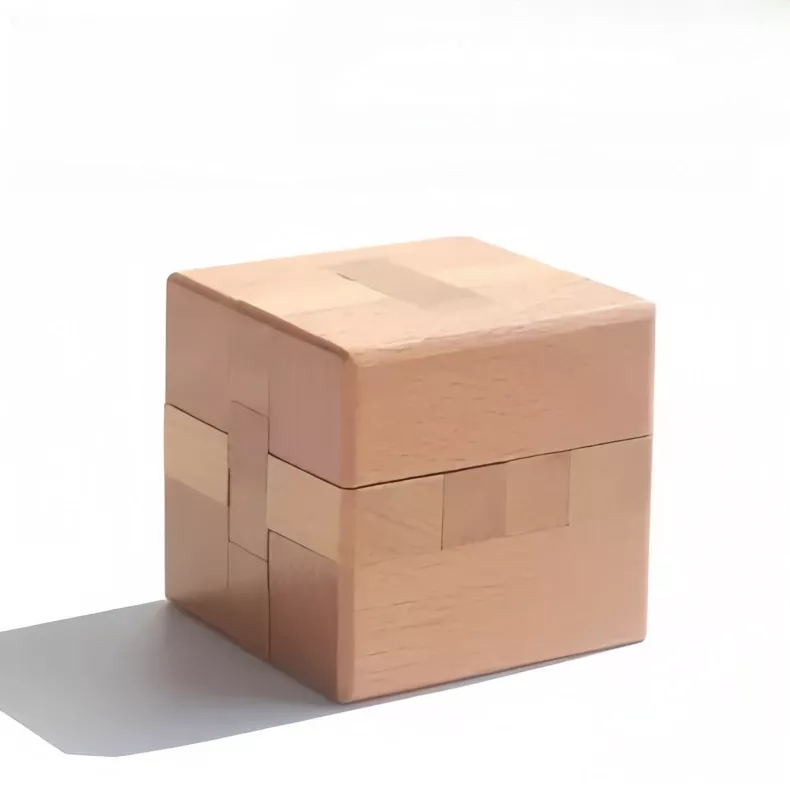
Now, apply this to the different families. For a burr puzzle like the Luban Square Lock, precision is kinetic. The internal notches and channels must be exact. The solve is a sequence of slides and pivots—a forced move—and a piece with even slight friction from a rough cut will turn the elegant dance into a frustrating grind. The final assembly should feel like a small, dense cube of wood, seamless and solid, held together by internal logic and perfect geometry.
For a flat packing puzzle, the finish on the faces matters. A glossy lacquer can create glare, making it hard to see the grain and seams. A simple oil or wax finish protects the wood while leaving it visually honest and pleasant to touch. You’re searching for a silhouette, a negative space. The pieces should slide against each other smoothly, without stickiness, allowing you to test a hundred configurations without friction becoming the enemy.
This is the anatomy of satisfaction. It’s the cumulative effect of these choices: the density of the wood resisting your initial push, the silent slide of a perfectly sanded edge along its neighbor, and the final, unmistakable click as everything aligns and drops into place. It fits. Or it doesn’t. A well-crafted puzzle tells you the truth, immediately. There’s no ambiguity, no “maybe it’s supposed to be that way.” The integrity of the material and the cut respects your time and your intelligence. It turns the act of solving from a struggle against the object into a conversation with it.
The Solver’s Mindset: Strategies Before Spoilers
So you have a well-crafted block of wood in your hands, its pieces speaking the tactile truth of good craftsmanship. Now what? The silence after the last clack of a scattered set of pieces can be deafening. This is the pivot point, where frustration either solidifies into resignation or transmutes into a different kind of energy: focused curiosity. As a former teacher, I can tell you the key isn’t brute force, but learning how to ask the puzzle better questions.
First, diagnose your adversary. The strategies for a flat packing problem like the Impossible Square and a 3D wooden square puzzle like the Devil’s Square are different species of thought. One is about layer management; the other is about negative space. For a broader look at the category, you can explore the definition of a mechanical puzzle.
For the packing puzzle, you’re working in two dimensions, even if the pieces are chunky. Your primary tool is symmetry. Look at your pieces—especially in a classic like the T-puzzle or a double square variant. How many are identical? Group them. Your brain wants to see a perfect square, so it will constantly propose false solutions that look square from one angle but leave a gap or an overhang when you check the edges. The puzzle is training you to see past the silhouette to the actual boundaries of each piece. A powerful trick is the forced move. Find the piece with the most unusual, asymmetric cut. It often has only one or two possible homes in the final frame, anchoring your entire configuration. Start there.
For the interlocking burr puzzle, like many wooden burr puzzle square types, you’re in the realm of 3D logic. Here, working backwards is your friend. If you can’t deduce how it goes together, try to understand how it comes apart. Which piece has the most freedom to move first? Often, the final piece to lock everything in place is the key. Apply gentle pressure to different faces, listening and feeling for the tiniest shift. The solution is usually a sequence, not a simultaneous fit. Mentally label your pieces (even if just “the notch” or “the fork”). This isn’t cheating; it’s systemization. A complete step-by-step guide to the six-piece burr can offer a structured approach once you’re ready for more direct help.
This leads to the universal mantra: Study the empty space. Whether it’s the square cavity of a box or the internal channel of a mechanical puzzle, the void defines the solid. What shape must the gap be? This is the core of critical thinking these objects teach.
Now, to your burning questions. “How do you solve the wooden square puzzle with the T-shaped pieces?” I won’t give you the puzzle solution, but I will give you the lens: The T’s are usually the red herrings. Their shape feels dominant, so you’ll try to make them the star. Instead, treat them as space-fillers for the oddly-shaped negative areas left by the simpler pieces. It’s a lesson in humility.
“How long does it take the average person to solve one?” A meaningless question, and here’s why. Time dissolves in this state of flow. The first sit-down with a difficult puzzle might last an hour of intense focus with no breakthrough. The real solving happens in the background, in the shower, or while washing dishes. Your subconscious chews on the geometry. A brain teaser of this caliber isn’t conquered in a single siege but in a series of engagements over days. This is normal. It’s part of the design. The satisfaction is proportional to the simmer time.
Embrace the false solution. That heart-dropping moment when everything seems to fit, only for you to find one piece leftover, is not failure. It’s data. The puzzle just told you a complete story about a wrong path. Remember it. The community on forums often celebrates these moments more than the eventual solve, because they’re where the real learning happens.
So before you search for a wooden puzzle cube solution, sit with the silence a little longer. Let your fingers trace the wood grain. Test fits without expectation. Listen for the satisfying click that signifies truth. You’re not just assembling wood; you’re training a pattern of thought—one that values process over product, that finds deep reward in the quiet conversation between your mind, your hands, and a few precise pieces of timber. The goal isn’t just to solve it. It’s to understand how you got there.
The Puzzle Matchmaker: Finding Your Perfect Mental Sparring Partner
Armed with general strategies, you now face the best kind of problem: which puzzle to choose. This isn’t about finding the “hardest” one, but the right fit for your mind and hands. Like matching a lock to a key, the deepest satisfaction comes when the challenge aligns with how you think. So, let’s find your mental sparring partner.
For the Patient, Methodical Thinker
You relish process. You find calm in meticulous steps, in testing hypotheses, in building a solution from foundational logic. Your ideal opponent isn’t just a scramble of pieces; it’s a structured problem with internal rules. Here, the interlocking puzzle reigns supreme.
Think of the classic Devil’s Square or its more intricate cousins. These burr puzzles are exercises in invisible architecture. You’re not just making a square; you’re constructing a stable, three-dimensional lattice where every piece simultaneously holds and is held. The challenge is sequential and deeply logical. There is a “key” piece, and a forced order of operations. It’s quiet, cerebral work that rewards patience and a systematic approach. For you, the satisfying click is the final, definitive sound of a perfect internal proof.
For the Spatial Visualizer & The Packing Problem Aficionado
You see shapes in negative space. You flip objects in your mind’s eye. Your frustration—and your joy—comes from that tantalizing gap that almost fits the remaining piece. Your domain is the packing problem.
This is the world of the Impossible Square (often with 16 pieces and that infuriatingly separate red square) and the Double Square. The goal is deceptively simple: arrange all the pieces flat within the square frame or wooden box. But the path is a wilderness of rotations and configurations. This is where false solutions abound—that heartbreaking moment where 15 pieces fit flawlessly, and the 16th just… doesn’t. It’s a pure test of spatial reasoning and persistence. These puzzles often have a “Eureka!” rather than a gradual-build solve, a sudden collapse into perfect, geometric harmony. If you enjoy complex 3D spatial challenges, you might appreciate a first-hand experience solving the 54-T cube puzzle, which shares this DNA of intricate assembly.
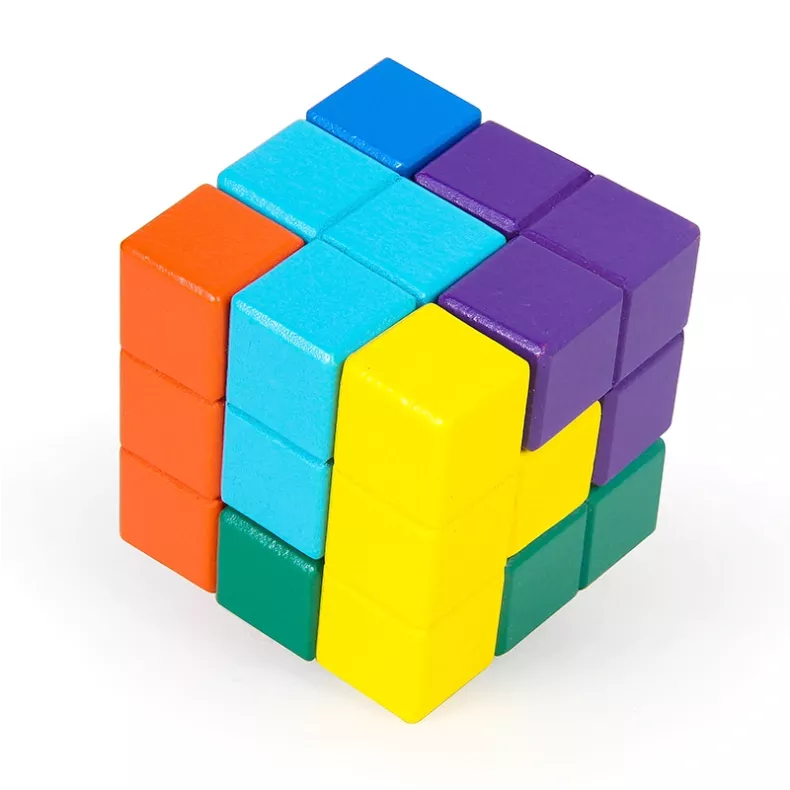
7 Color Soma Cube Puzzle — $21.88
For the Fidgeter Who Needs Tactile Feedback
You think with your fingers. The weight of the wood, the resistance of a fit, the texture of the grain—these aren’t just details; they are data. You need a puzzle that feels as engaging as it is mentally. You might prefer a 3D wooden puzzle with heft, something that occupies your hands completely.
Look for puzzles with thicker stock, perhaps 1/2 inch or more, made from a wood like walnut that has a substantial, warm feel. The precision-cut edges should be smooth but not slick, offering just enough friction to provide feedback. Interlocking puzzles like a six-piece burr are excellent here, as the process of manipulating the pieces involves a constant, physical dialogue. The act of solving is kinetic. It fits. Or it doesn’t. Your hands learn the truth before your eyes do.
For the Classroom or The Young Learner (Or the Young at Heart)
“Are these puzzles too hard for a 12-year-old?” It’s the right question, asked from the wrong angle. The better question is: which square wooden puzzle is built for a developing mind? This is where educational tools shine, distinct from the frustratingly fun adult brain teasers.
A true educational square puzzle for kids is designed for success and skill-building. Think larger pieces—perhaps a wooden square puzzle around 9 inches across—with smooth, rounded edges for small hands. The challenge is about shape recognition and basic spatial logic, not diabolical complexity. Puzzles where you make a square from chunky, recognizable shapes (like a wooden T puzzle square) are perfect. They offer a clear, achievable goal and build critical thinking without the despair. Brands like Creative Crafthouse often cater to this niche with thoughtful designs. The durable construction is key; it needs to survive the energetic, iterative process of learning.
The Gift-Giver’s Conundrum
You’re not just buying a wooden puzzle; you’re buying an experience for someone else. The safest bet is often a beautifully crafted packing puzzle like the Impossible Square. It has a clear, elegant goal, an impressive “solved” state for display, and a difficulty level that is engaging but not soul-crushing. It’s a mechanical puzzle that feels like a singular object, a piece of art that happens to be a problem.
For the person who has everything, seek out handcrafted pieces from small workshop makers on Etsy or specialty forums. Look for descriptions that mention specific wood types and laser cut precision. These puzzles often come with a story—the maker’s name, the wood’s origin—that adds to the gift. And always, always buy from a seller who provides the solution separately (or promises to email it upon request). It’s an act of mercy that will be remembered.
The match is made not by price or prestige, but by the silent question the puzzle asks. Does it ask you to see? To calculate? To feel? To learn? Find the question that your mind, or the mind of your giftee, is already yearning to answer. That’s where the real conversation begins.
Curious Craftsmen & Trusted Sources: Where to Look Beyond the Algorithm
So you’ve found your match—the type of challenge that calls to you. Now, where do you find a puzzle worthy of that mental sparring session? The search results will show you mass-produced options, but there’s a richer world beyond the algorithm. It’s a world where the choice isn’t just about a product, but about supporting a curious craftsman.
Your first fork in the road: the established brand or the boutique maker. Companies like Creative Crafthouse or Uncommon Goods offer consistent, well-designed brain teasers. They are reliable entry points, often with clear solutions available online. But if you seek a singular object, a puzzle with a story in its grain, you look to the workshops. Search Etsy for “handmade wooden brain teaser” and you’ll find individuals, often puzzle enthusiasts themselves, cutting burrs and packing problems in their garages. The product description is your first clue. Look for specifics: “precision-cut from 1/4” Baltic birch,” “hand-sanded edges,” “finished with food-grade mineral oil.” These aren’t just buzzwords; they’re promises of a tactile experience. As one Reddit user in r/mechanicalpuzzles noted, “You’re not just buying the puzzle, you’re buying the 20 hours of trial and error the maker spent perfecting the tolerance.”
Tolerance. That’s the insider term. It’s the hair’s-breadth gap between pieces that allows a smooth slide or creates a frustratingly fun sticking point. A laser cut puzzle can be perfect, but the best makers understand that wood breathes. They account for it. When evaluating a double square wood brain teaser or any interlocking puzzle, read reviews for mentions of fit. “Satisfying click” is what you want. “Requires a forceful shove” is a red flag.
Which brings us to the two most practical questions from any new solver: “Does it come assembled?” and “What if I lose a piece?” A true puzzle—not a display model—almost always arrives disassembled, often in a small drawstring bag. It’s the only honorable way. For replacement pieces, your relationship with the maker matters. A faceless corporation might offer nothing. A small-scale crafter will often have the CAD file saved and can usually laser-cut a new piece for a few dollars. It’s always worth asking before you buy. For those interested in traditional styles, exploring a set of traditional Luban lock puzzles can introduce you to a whole lineage of interlocking designs from skilled artisans.
What are you really paying for? The $15 puzzle and the $40 puzzle might share the same silhouette—a devil’s square or an impossible square—but the difference is in the silence. Cheap wood feels light, hollow. The cuts may have a burnt, fuzzy edge from a rushed laser job. A craftsman’s version has weight. The alder wood or maple is dense. Edges are cleaned, either by hand or with a superior laser that leaves a smooth, almost polished kerf. The finish isn’t a sticky varnish but an oil that lets you feel the wood grain. You are paying for quiet confidence in the object itself.
Start by finding the communities. Lurk in the forums and subreddits. The names of trusted makers—Wil Strijbos, Brian Young (Mr. Puzzle), Eric Fuller—are spoken with reverence. While their masterworks command high prices, they often inspire more accessible versions from the next generation of makers. Follow a trail of recommendations from one enthusiast to another. It’s a slower, more human way to shop, mirroring the deliberate pace of solving.
In the end, your source becomes part of your puzzle’s story. The mass-market find solves a momentary itch. The puzzle from a curious craftsman, however, is a collaborator. It came from someone who also stayed up late, listening to the quiet click of wood on wood, chasing the same elusive aha. You’re not just buying a product; you’re joining a quiet, scattered guild of patient thinkers.
From Stump to Showpiece: Care, Display, and the Lost Piece Dilemma
So, you’ve found your source, a piece from a curious craftsman. Its story is now partly yours. But this isn’t the end. A good square wooden puzzle transitions from a brain teaser to a tactile artifact, an object meant for a long life of contemplation and conversation. It deserves a little aftercare.
Start with the wood. That pleasing heft and visible grain are its character. To preserve them, keep it away from direct sunlight and drastic humidity changes—the same rules as for a fine guitar or a woodworker’s bench. Every few years, a single drop of food-grade mineral oil on a cloth, rubbed gently into the surface, will refresh the wood and keep it feeling vital in your hands. Avoid furniture polish or wax; they gum up the precise tolerances of an interlocking puzzle or the smooth channels of a packing problem.
It’s solved. Now what? Many leave theirs in a perpetual state of beautiful frustration on a coffee table. But a solved puzzle is a trophy. Consider displaying it. A simple shadow box frame turns a conquered Devil’s Square into minimalist wall art. For a 3D puzzle like a burr, a small acrylic display case keeps dust off and invites curiosity. Some makers even design their puzzles with a ‘solved’ form that is deliberately sculptural. If you’ve glued a simpler puzzle together permanently (a common practice for educational children’s puzzles), a guide on professional framing techniques for puzzle preservation can help you showcase it beautifully.
Then, the nightmare. The soft thud of a piece hitting the floor, the frantic search, the hollow dread. A piece is gone.
Don’t panic. First, retrace your steps with a flashlight—the low angle often catches the shadow of a precision-cut piece under furniture. If it’s truly vanished, your path depends on your source. This is where buying from a dedicated maker pays dividends. Many small workshops, understanding this heartbreak, will sell or even mail a single replacement piece for the cost of postage. For a mass-produced puzzle, customer service might help, but your odds are lower.
If all else fails, the DIY puzzle community is your haven. Those laser cut wooden puzzle blanks you can find online? They’re often standardized sizes. With some careful measuring (a digital caliper is your friend here), you can commission a local maker with a laser cutter to recreate the missing piece from the same alder wood or maple. It’s a project that honors the puzzle’s spirit—a new problem to solve in service of the old one. For a more permanent display solution, especially for complex 3D puzzles, you can learn how to permanently glue and display your solved puzzle.
A lost piece isn’t an end. It’s a forced move, directing you to engage with the object’s material reality on a deeper level. You learn its dimensions, its wood type, its exact thickness. In mending it, you become part of its history. The puzzle is no longer just a challenge; it’s a record of your patience, twice over.
Reader Friction and Quick Answer
So you’ve found a piece, or maybe you haven’t, but the core friction remains. You’re holding a box of wooden parts that promise a cube but deliver only confusion. The mental itch is familiar. You just want to know: What is this thing, and how do I make it work? The most common points of friction aren’t about the price or the wood—they’re about the gap between expectation and reality.
First, the overwhelm. You search for “square wooden puzzle” and are bombarded with the Devil’s Square, the Impossible Square, the Double Square, and a dozen others. They look similar in photos. How are you supposed to choose? Second, the solution anxiety. You’ve been stuck for an hour, a day, a week. The temptation to search for the wooden square puzzle solution is a palpable ache. Third, the gift-giver’s dilemma: “Is this too difficult for my clever niece?” or “Will my puzzle-loving friend have seen this before?”
Here are the direct answers, stripped bare.
On Overwhelm: Use the taxonomy. Count the pieces. Is it about 16 flat, geometric shapes? You have a packing problem (like the Impossible Square). Is it 6 or 9 chunky, notched blocks? You have an interlocking burr puzzle (like the Devil’s Square). This single filter cuts the noise in half. Your choice isn’t about which puzzle is “best,” but which type of mental friction you enjoy: spatial arrangement or 3D mechanical reasoning. The broader world of puzzles is vast, but this filter helps you navigate the square wooden corner of it.
On Solution Anxiety: Don’t Google it. Not yet. Set a timer. For a difficult puzzle, give yourself multiple sessions, days even. Walk away. Your subconscious works on packing problems in the background. For a burr puzzle, stop forcing pieces. If it requires pressure, you’re wrong. The solve should have a series of satisfying clicks, not a struggle. If you must seek help, look for “approach hints” or “first move hints” from the mechanical puzzle community, not the full solution. The ‘aha’ is the only prize. For cube-style puzzles, a veteran’s guide to solving wooden cube puzzles can offer strategic principles without spoiling the specific click.
On Gifting: For adults, the brain teaser is about the private triumph. For children (think 8-12), seek out the educational square puzzle with smooth rounded edges and fewer, larger pieces. The goal isn’t frustration, but shape recognition and confidence. When in doubt, describe the recipient’s personality to the puzzle maker. A good artisan will guide you.
The final, actionable step is this: Identify your puzzle. Lay the pieces out. Classify it. That simple act—naming the beast—dissolves the initial friction and turns aimless struggle into a focused engagement. You’re no longer just trying to solve a square wooden puzzle. You’re applying a principle. You’re part of the craft now.