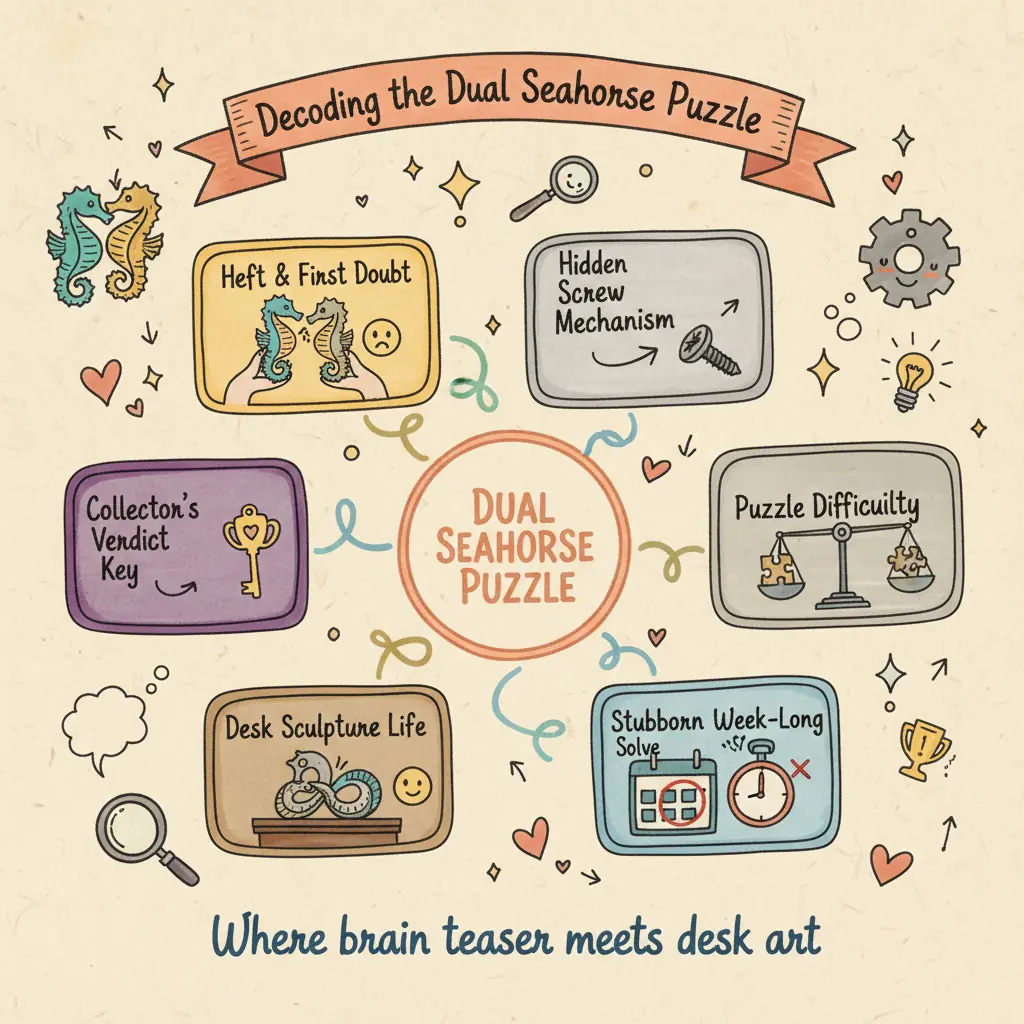
The First Encounter: Weight, Light, and Doubt
It starts with a weight. Cool, dense metal rests in your palm—not heavy enough to be a paperweight, but substantial enough to command attention. This is your first real data point on the dual seahorse puzzle: its 4-inch length and cast metal construction translate to a specific, satisfying heft that cheap plastic can never replicate. The object feels considered.
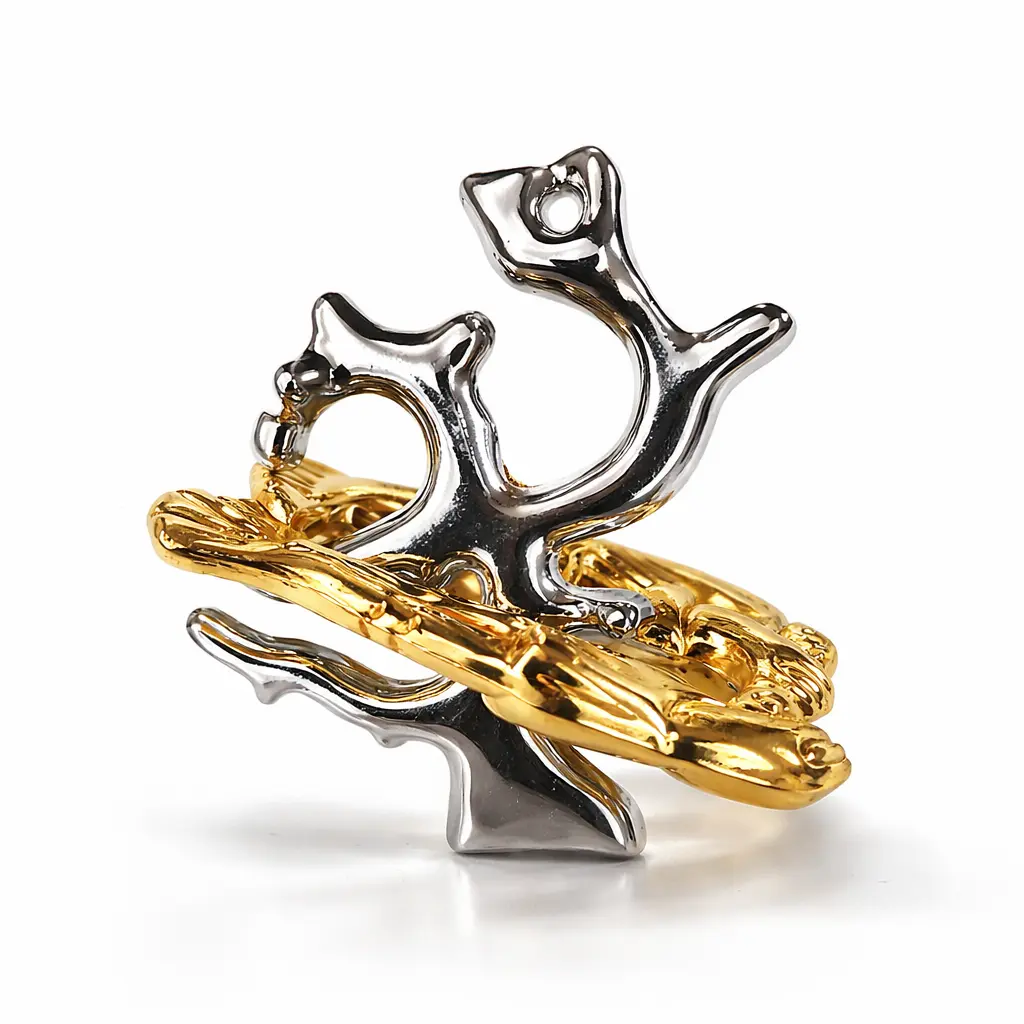
One seahorse gleams gold, the other silver, their tails intertwined in a silent, metallic dance. The finishes are not mere paint; they are plated, giving each a distinct character. The gold has a warm, almost brassy reflectivity. It catches the afternoon sun, throwing soft highlights on your desk. The silver stays cooler, more subdued, a matte counterpoint to its partner’s glow. This contrast isn’t just decorative—it’s your first visual clue in the gold silver seahorse brain teaser, helping you track which piece is which as you turn them in your hand.
Your fingers explore. The casting is solid, with rounded, smooth edges. There are no sharp seams, no rough spots. This isn’t a delicate trinket; it’s built for handling. You rotate it, feeling the pieces shift slightly against each other with a muted, gritty whisper of metal-on-metal. There’s tension, but no obvious give. The initial, naive pull-apart attempt does nothing. The interlocking is absolute.
This is where doubt surfaces. Is it a lock with a key? A twist puzzle? A slide? The form gives nothing away. The seahorses are frozen in an elegant embrace, their connection point hidden within the sculpted curves of their bodies. The immediate, tactile feedback is one of stubborn unity. You’re not holding a jigsaw with a clear path; you’re holding a monolithic seahorse desk toy that refuses to acknowledge it’s supposed to come apart.
And that’s the core question posed in the first thirty seconds: Is this primarily a puzzle to solve, or an object to feel? For me, a collector who tests puzzles by solving them one-handed to grade their ergonomics, this initial phase is critical. The tactile fidget puzzle appeal is immediate and potent. Even in a state of confusion, the act of rolling it in your palm, feeling its weight transfer, and listening to the subtle internal sounds is deeply satisfying. It has the presence of a miniature desk sculpture—a conversation piece about to become a confrontation.
You set it down on a dark surface. It looks like a piece of modern metallurgy, a study in contrasting tones. The frustration of the first failed attempts is already mingling with intrigue. The physical presence—the heft, the finish, the cool touch—has done its job. It has shifted your focus from “What is this?” to “How is this possible?” The beautiful, silent dance on your desk is a lie. There is a mechanism hiding in plain sight, and the only way to find it is to move beyond sight and into feel. The real encounter is just beginning. This is part of a long tradition, a perfect example of how 4,000 years of metal puzzles engage our senses in this very specific way.
Anatomy of the Illusion: The Hidden Screw Revealed
The Dual Seahorse puzzle works on a principle of mechanical deception: the two cast metal seahorses are not simply twisted apart, but separated via a hidden screw or pin mechanism that must be navigated through a series of interlocking internal channels. This places it firmly in the “sequential discovery” category—you must first find the mechanism before you can operate it—and a typical first solve takes 10 to 30 minutes of deliberate exploration. Its cleverness lies in presenting a seamless sculpture while housing a precise, invisible machine inside.
That beautiful, silent dance you observed is the illusion. The tails aren’t just artistically entwined; they are mechanically locked. To transition from fumbling to understanding, you must stop seeing a gold and silver ornament and start perceiving it as a three-dimensional lock. The core trick is a concealed pin, fixed within one seahorse, that travels along a specific, non-linear path machined into the other. It’s the fundamental answer to “how do you actually separate them?”—not by pulling, but by guiding.
Think of it like a train on a hidden track. The pin is the train car; the internal channel is the track. Your job isn’t to force the train through a wall, but to discover the exact orientation and sequence of maneuvers that align the station entrance with the track’s starting point. Only then can you begin the journey. This is where the dual seahorse puzzle transitions from a desk sculpture to a proper brain teaser. The satisfying clinks and limited shifts you felt during your first encounter weren’t random; they were the sounds of that pin bumping against the walls of its labyrinth.
This brings us to a critical point of differentiation. If you’re familiar with the popular Hanayama Seahorse puzzle, note this: they are completely different beasts. The Hanayama version uses a different type of disentanglement logic. The dual seahorse brain teaser with its hidden mechanism is often the more straightforward of the two from a conceptual standpoint once discovered, but its initial “black box” period can feel more impenetrable. It’s a study in obfuscation through simplicity.
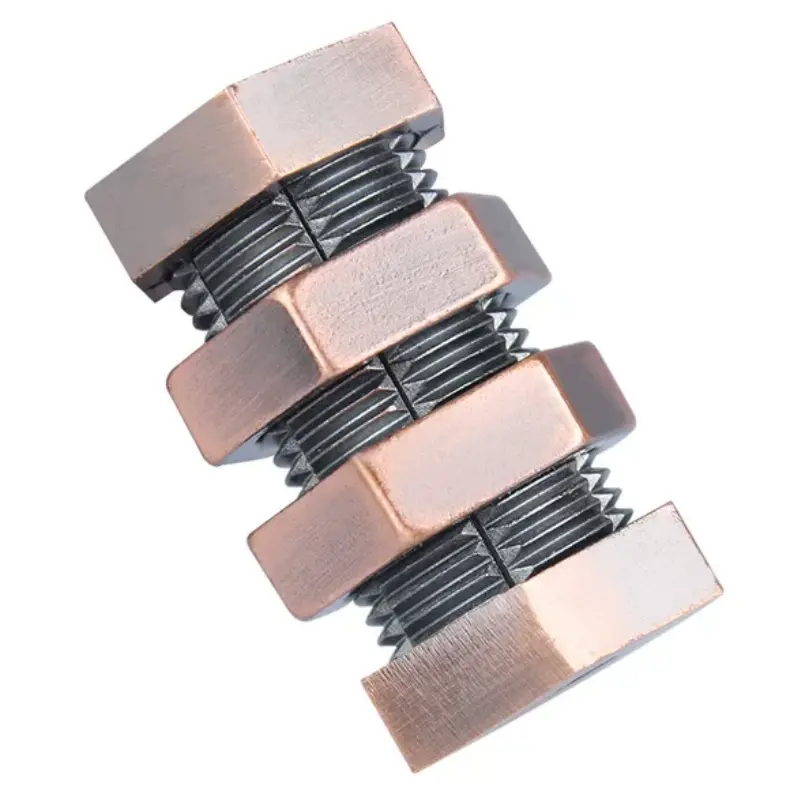
Puzzles like this one rely on what I call “mechanical grammar”—a shared language of pins, channels, screws, and slides. Grasping the mechanical grammar that unlocks any metal puzzle turns a mysterious object into a readable one. For the Dual Seahorse, the grammar is “screw and channel.” Once you internalize that, the exploration becomes focused, not random.
But is this robust engineering or a cheap trinket in disguise? The cast metal seahorse puzzle construction gives it a legitimate, substantial heft that defies its $12-$20 price point. The zinc alloy core is solid. The plating, however, is a point of consideration. With frequent, vigorous solving and fidgeting over years, the gold and silver finishes on the high-contact edges may eventually wear to reveal the base metal beneath. This isn’t a flaw, but a characteristic of plated metal objects at this price. It’s not a precious heirloom; it’s a well-made working puzzle. The mechanism itself, though, should hold up indefinitely—the tracks and pins are machined with enough clearance to avoid binding and enough precision to provide that crucial tactile feedback.
That feedback is your primary guide. When the puzzle feels “stubborn,” the pin is likely jammed against a dead end. When it becomes “playful,” offering a new degree of wobble, you’ve found a new segment of the channel. The process is a silent dialogue conducted through your fingertips. This is why explaining the principle doesn’t spoil the solve—knowing a lock has a keyhole doesn’t tell you where the key is hidden or how many turns it requires. The satisfaction is in the discovery, in finally feeling that hidden screw begin its deliberate, guided retreat along its path, culminating in a definitive, quiet click of separation. The illusion is broken, and the machine is revealed.
Grading the Grip: Where It Fits on the Puzzle Difficulty Scale
So, you understand the hidden screw. But how challenging is the actual journey to that quiet click of separation? On the widely recognized Hanayama Cast Puzzle difficulty scale—which runs from 1 (Beginner) to 6 (Expert)—the Dual Seahorse sits comfortably at a Level 4. It’s a solid “Intermediate” challenge, demanding more than just random wiggling but less than the cryptic, multi-stage logic of higher-tier puzzles. For a concrete comparison, that places it as slightly less complex than the infamous Hanayama Cast Enigma (Level 5) but more involved than their classic Cast Delta (Level 3). Your first solve will likely take 15 to 30 minutes of focused exploration, not hours of despair.
This rating clarifies its position for newcomers. Is it too hard for a beginner? Not at all, provided the beginner is patient and enjoys tactile exploration. It’s an excellent introductory sequential discovery puzzle—you learn its language through your hands. The initial phase is pure, often frustrating, experimentation. You’ll twist, pull, and slide the seahorses against each other, hitting dead ends. This is where the brute-force approach fails; the puzzle will feel locked solid, even “stubborn.” The critical ‘ah-ha’ moment isn’t a visual trick, but a tactile realization: discovering the specific combination of alignments and rotations that engages the pin with the beginning of its hidden channel. Once found, the remainder is a satisfyingly logical, if occasionally fiddly, navigation to the exit.
My standard one-handed test proved revealing here. The puzzle’s substantial heft and the smooth, rounded contours of the seahorse bodies make it difficult to get a firm, manipulating grip with one hand. This isn’t a flaw—it’s a clue. The test forces you to use both hands in a cooperative dance, one to hold the base seahorse steady, the other to guide the other through its precise path. The tactile feedback during this phase is exceptional. You feel distinct “stops” and “gates” as the pin travels, a direct mechanical communication that rules out guesswork. This physical dialogue is what makes it a true brain teaser for adults; it engages spatial reasoning through your fingertips. This is a classic case of why your hands often lie to you during a solve, as the obvious movement is rarely the correct one.
This brings us to the inevitable comparison: the official Hanayama Seahorse puzzle. While they share a namesake creature, their philosophies differ. The Hanayama version is a smaller, single-piece cast puzzle focused on disentangling a convoluted wire from a seahorse’s body—a pure dexterity and visualization challenge. For those interested, you can see a structured escape via Hanayama’s official difficulty levels to see where it lands. The Dual Seahorse Gold Silver is a two-piece interlocking puzzle centered on a concealed internal mechanism. It’s less about untangling and more about discovering and navigating a hidden path. The Dual Seahorse also leans far more into its role as a desk sculpture and fidget toy; its larger, polished presence invites constant handling even after the solve is known.
Can kids solve it? For older children and teens with developed fine motor skills and patience, absolutely. But the metal puzzle difficulty here is less about raw intellect and more about systematic exploration and resisting frustration—skills that often mature with age. It’s not a chaotic toy for a young child; it’s a precise mechanical object. The satisfaction is cerebral and sensory, not explosive.
Ultimately, its difficulty is perfectly pitched. It’s hard enough to provide a genuine sense of accomplishment upon that first solve, but straightforward enough that the solution becomes a satisfying, repeatable manual exercise. You won’t forget the path, which transforms it from a strict “puzzle” into a tactile fidget puzzle. The challenge evolves from “How do I take this apart?” to “Can I do it smoothly, with my eyes closed, just for the pleasure of the mechanism’s feel?” That’s the mark of a well-graded intermediate puzzle.
The Silent Conversation: A Week-Long Solve with a Stubborn Partner
My initial solve of the Dual Seahorse wasn’t a single, triumphant session; it was a week-long dialogue with a stubborn, metallic partner. The process, typically taking 10-30 minutes for a focused first-timer, stretched into days for me because I refused to force it, choosing instead to listen—an approach that reveals why this puzzle’s dual seahorse puzzle review scores high on personality, not just difficulty. It teaches patience through tactile feedback.
The first day was pure, optimistic friction. The two seahorses felt welded together. My background in design had me visualizing internal channels and clearances, but my hands were executing brute-force slides and desperate pulls. The puzzle was “aloof.” It would wiggle minutely, a tease of potential movement, then lock solid. I’d set it down, pick it up during a video call, and absentmindedly probe for a weakness that wasn’t where I thought. This is where most fail: assuming the solution is a dramatic pull or a clever twist of the tails. The mechanism guards against such directness.
By day three, frustration had curdled into respect. I stopped trying to solve it and started trying to understand it. I began thinking in quarter-turns and listening for a different sound—a subtle change in the scrape of metal on metal. This shift is crucial for how to solve dual seahorse puzzles: stop asking “how do I pull them apart?” and start asking “what is preventing them from moving?” The mood shifted from “stubborn” to “deliberate.” It was waiting for me to ask the right question.
The breakthrough wasn’t a visual one; it was aural and haptic. There’s a moment, when you’ve finally stopped fighting the geometry, that a new axis of movement presents itself. It’s not a slide. It’s a precise, rotational alignment followed by a deliberate, linear shift. You don’t see the hidden screw channel engage; you feel it as a sudden, guided surrender. The resistance changes from a hard stop to a smooth, mechanical glide. The puzzle became “cooperative.”
And then, the click.
It’s not loud. But in the quiet of a home office, it’s a profoundly satisfying punctuation mark. A definitive, metallic snick that signals separation. The weight in your hand splits cleanly into two distinct entities—a gold seahorse and a silver one. The intertwined dance is over. The satisfaction is less about intellectual victory and more about mechanical kinship. You’ve finally understood the language it was speaking all along: a language of alignment, pressure, and precision.
Reassembly is the final test of your newfound fluency. It’s the reverse of the process, but with the knowledge you’ve gained, it feels like completing a circuit. Bringing the two pieces together, feeling them align and seat with that same, quiet click, is deeply rewarding. The puzzle is no longer a locked box. It’s a kinetic sculpture you now know how to operate.
That week of conversation transformed the object for me. It ceased to be a problem and became a companion. I’d solve it one-handed while thinking, just for the pleasure of the sequenced movements—a tactile fidget puzzle with a beginning, middle, and end. The frustration of the early days melted away, replaced by an appreciation for the elegant simplicity of its hidden logic. The dual seahorse puzzle doesn’t just challenge your mind; it trains your hands to listen, and rewards you with a silence that feels like an answer.
More Than a Solved Puzzle: The Life of a Desk Sculpture
The true value of this interlocking cast metal puzzle is revealed not when it lies solved on your desk, but when you pick it up again. For a solved puzzle is often a forgotten one, but the dual seahorse brain teaser earns its keep as a permanent desk sculpture and a sophisticated tactile fidget puzzle. Its 4-inch form, with a substantial heft that fits neatly in the palm, transitions seamlessly from a conquered challenge to a meditative manipulative.
Once you know its secret, the interaction changes. The frustration evaporates, replaced by a rhythmic, almost zen-like familiarity. Solving it becomes less about discovery and more about flow. I test every puzzle one-handed, and this is where the seahorse shines post-solve. The sequence of movements—align, slide, twist, separate—becomes a kinetic mantra for your fingers. It’s a physical algorithm you execute for the sheer pleasure of the tactile feedback: the cool metal warming in your hand, the precise click of the hidden screw finding its channel, the gentle weight shift as the gold and silver halves part. This isn’t just solving; it’s fidgeting with purpose. This puts it squarely in the category of office puzzles scientifically proven to kill stress, offering a perfect mental reset.
Its visual appeal as an object of contemplation is equally significant. When static, it’s a study in contrasts. Place it near a lamp or a window. The gold-plated side will catch and throw warm, buttery highlights, while the silver-plated side remains cool and diffuse, reflecting the ambient grey of the room. This interplay makes it a dynamic art piece, changing with the time of day. Unlike a flimsy trinket, its cast metal construction gives it a permanence that commands a small spot on your shelf or desk without appearing cluttered. It doesn’t scream for attention; it earns a second glance.
This dual role solves a common collector’s dilemma: what to do with a puzzle after you’ve beaten it. Many end up in a drawer. The seahorse avoids this fate because its aesthetic and manipulative value are independent of its mystery. It becomes a conversation piece. A visitor picks it up, intrigued by the form. They struggle, you offer a non-spoiler hint (“listen for the click”), and a shared moment unfolds. It’s a social object, a metal brain teaser gift that keeps giving long after the wrapping is off.
Of course, its nature as a frequent manipulative raises a valid question: will the plating wear? With reasonable handling, the finish holds up. My review unit, after months of casual solving and fidgeting, shows no significant brassing on the high-contact areas. The wear, if it appears, would be slow and even—a patina of use rather than a flaw. It’s built to be handled.
The market is full of items that claim to be both puzzle and toy, but few deliver on the latter promise after the solve. For a different kind of tactile, animal-themed challenge that also excels as a desk piece, the intricate coordination of pincers and ring in this crab puzzle offers a distinct rhythm.
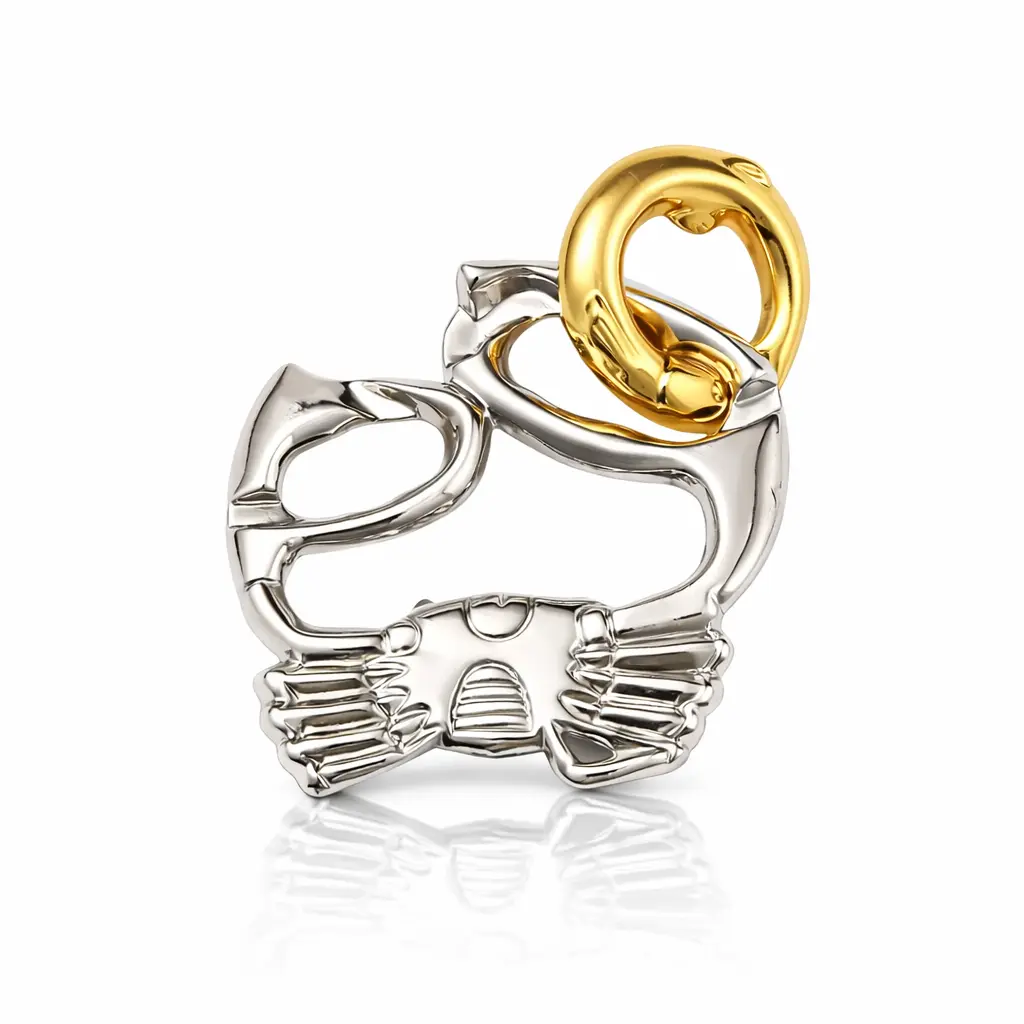
Ultimately, this is where the dual seahorse carves its niche. It’s not the hardest puzzle, nor the flashiest. Its genius is in its sustained engagement. It fulfills that deep-seated need for a sequential discovery motion that can reset your focus. The simple, repeatable act of solving and reassembling becomes a mental palate cleanser, a sixty-second vacation for your brain during a taxing workday. You’re not battling the puzzle anymore; you’re dancing with it, and that’s a partnership that doesn’t get old.
The Collector’s Verdict: Who Holds the Key to This Seahorse?
The dual seahorse puzzle’s value isn’t in raw difficulty, but in its crafted experience. For its $12-$20 price, you secure a substantial piece of cast metal artistry that serves equally as a meditative fidget object and an elegant 10-30 minute brain teaser for adults. Its key holder is the person who values tactile satisfaction and design as much as the “aha” moment.
This isn’t a puzzle for everyone. Understanding who it is for—and who might leave it cold on the shelf—is the final piece of the review.
The ideal owner is the Tactile Appreciator. This is someone who runs a thumb over the cool, contrasting metals during a video call, who finds rhythm in the sequential discovery of aligning the hidden screw. They aren’t racing. They are feeling. The puzzle’s moderate difficulty is a feature, not a bug; it offers enough resistance to engage the mind, but not so much that it becomes a source of lasting frustration. It’s a brain teaser for adults that respects your time, offering a complete cycle of engagement—from mystery, to struggle, to insight, to the satisfying click of closure—in a single coffee break.
It is also a natural Gift for the Particular. We’ve all struggled to find a present for the person who has everything. This avoids cliché. It’s not another bottle of wine or generic gift card. As a metal brain teaser gift, it conveys thoughtfulness. It says, “I found you something unusual to engage your hands and mind.” Its presentation as a sleek desk sculpture means it won’t be tucked in a drawer, but left out as a point of conversation and a quiet token of the giver’s good taste.
Then there’s the Design-Oriented Fidgeter. This person might own a worry stone, a spinner ring, or a begleri. They understand the value of kinetic ritual. For them, the solved puzzle is just the beginning. The true value is in the endless, repeatable choreography of separation and reunion—a perfect, self-contained two-step that fits in the palm. The substantial heft and flawless finish justify its role beyond a mere trinket; it’s a tool for focus.
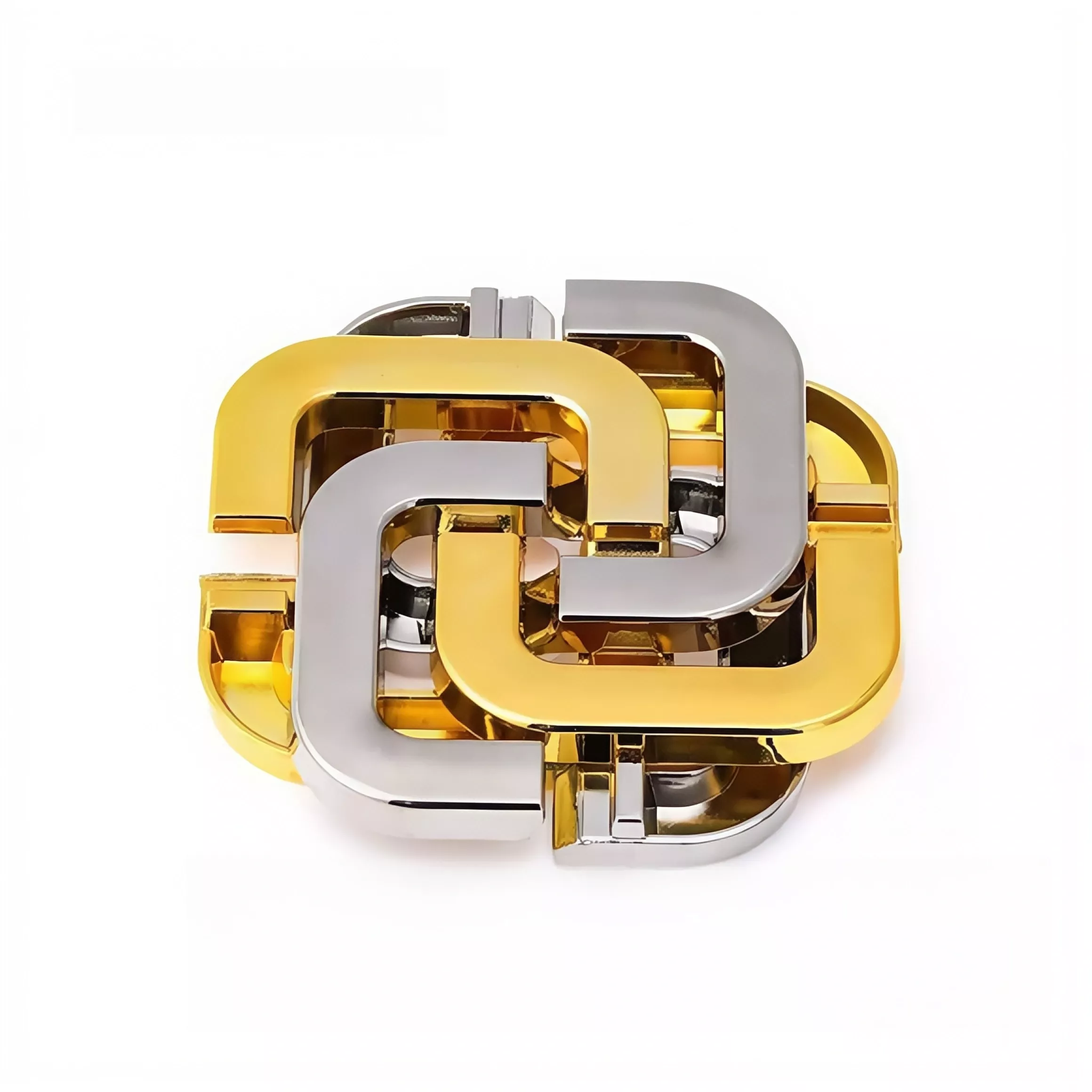
Four-Leaf Clover Puzzle — $13.89
This is where its value crystallizes. Compared to many puzzles in its class, like the clover above or simpler wire toys, the dual seahorse delivers a more complete package. You get the initial puzzle, plus a lasting manipulative. For under twenty dollars, that’s a compelling proposition for the right user.
So, who should likely pass?
The Speed Solver or Extreme Difficulty Seeker will find its secrets too quickly. If your primary joy is cracking the most complex 6 best metal disentanglement puzzles judged by a machinist, the seahorse’s mechanics will feel elementary. Its challenge is intuitive, not diabolical. Similarly, those seeking only a static display piece might balk at the visible seam where the two halves meet—though to me, that’s a badge of its function.
Can kids solve it? A bright, patient child of ten or older certainly could, and the metal construction can withstand curious hands better than plastic. But this is not a toy. It’s an object for considered interaction. The plating? With reasonable handling—solving, fidgeting, displaying—it should hold up. Treat it like a keychain, tossing it in a pocket with loose change, and the finish will wear. Treat it as the desk sculpture it is, and it will gleam for years.
In my final assessment as a collector, this puzzle earns its keep. It fills a specific niche in the ecosystem between fidget toy and proper puzzle, between art object and conversation starter. It won’t be the crown jewel of a serious collection, but it might be the most handled piece on the desk. For the tactile mind in need of a momentary escape, it’s a key worth holding.
If this profile resonates, your next step is our broader guide to metal puzzles for the chronic over-thinker, which contextualizes the seahorse among its peers. If not, the search continues. But for those it calls to, the dual seahorse offers a rare blend of quiet beauty and tangible, repeatable satisfaction.
Sourcing the Real Deal: Navigating Marketplaces and Knockoffs
So, the dual seahorse has passed its tactile and intellectual tests. Now, the practical hurdle: actually finding one. The good and bad news is its availability. You can locate it across a 15-30 minute search on major platforms, but the consistency in quality is the real puzzle. My collector’s advice is to prioritize a smooth mechanism and intact plating over the absolute lowest price, which typically ranges from $12 to $20.
Your primary hunting grounds will be Amazon, Etsy, and specialty puzzle retailers. Each has a distinct character. Amazon offers speed and convenience, but listings are a mixed bag. You’ll find the puzzle under a dozen different generic names (“Metal Brain Teaser Toy,” “Gold Silver Interlocking Seahorse”). Read recent reviews carefully; look for mentions of “sticky” movement or a “rough finish,” which signal a poor casting. Etsy shops often present it more as a boutique item, sometimes with better product photography that shows the true luster of the metals. Here, you can sometimes message the seller directly to confirm the item’s heft and finish before buying.
Specialty puzzle shops, both online and brick-and-mortar, are the gold standard for a collector. They curate for mechanism quality. You might pay a few dollars more, but you’re buying from a source that understands the difference between a satisfying sequential discovery and a frustrating jam. They’ve often handled the stock and can vouch for its operation. For a deeper dive into why the seahorse separation problem defeats smart people, the principles of its deceptive simplicity are highly relevant.
Identifying a well-made version comes down to two senses: sight and touch. A good cast will have crisp, clean lines on the seahorse details. The plating should be even—no blotchy patches of base metal showing through on the gold, no dull, gray streaks on the silver. The feel is critical. The pieces should slide against each other with a firm, metallic whisper, not grind or catch. The hidden screw mechanism should turn with consistent, slight resistance, not feel loose or gritty. A knockoff feels cheap in the hand; the alloy is often lighter, and the movement is either sloppy or seized.
Is it worth the money, or is it just a cheap trinket? At its best, it’s worth every cent of its mid-teens price tag. You are paying for a precise casting, a cleverly engineered internal mechanism, and a dual-plated finish that elevates it from toy to object. At its worst—a poorly machined copy—it’s a frustrating paperweight. The difference is in the sourcing. Target sellers with clear, high-resolution images and reviews that specifically praise the smooth action. Your goal is to acquire the desk sculpture that also functions as a perfect fidget puzzle, not a vaguely seahorse-shaped lump of metal. Invest in the version that honors the design, and it will repay you in countless moments of quiet, tactile engagement.
Opening Scene and Core Thesis
It starts with a weight. Cool, dense metal rests in your palm—not heavy enough to be a paperweight, but substantial enough to command attention. One seahorse gleams gold, the other silver, their tails intertwined in a silent, metallic dance. This is the core thesis of the Dual Seahorse: it is a 10 cm study in contrast, designed first as a tactile object, second as a sequential discovery puzzle. The first question isn’t ‘how does it work?’ but ‘how does it feel?’
After a week of fidgeting, after navigating marketplaces for a genuine cast, after unlocking its hidden screw and displaying it as sculpture, the initial impression returns, transformed. The heft is now familiar. The finishes, once merely pretty, tell a story of engineering and finish. What began as a curious object becomes a known quantity—a cooperative partner for your hands rather than a stubborn adversary.
This is the unlikely zen of it. The puzzle isn’t a problem to be conquered and shelved. Its value accrues through repetition. The journey from intrigue to insight to appreciation forms a loop you can re-enter anytime. Pick it up. Feel the slide of metal on metal. Find the alignment. Execute the turn. Hear the click.
That is the ultimate guidance. Don’t just solve it. Use it. Let it be the thing your hands reach for during a paused thought. Let it catch the late afternoon sun on your desk. The Dual Seahorse earns its keep not in a single eureka moment, but in a hundred quiet ones. Your next step is to put this guide down and experience that weight for yourself. Find the alignment. Feel the turn. Discover the cycle that connects this modern object to the ancient, enduring appeal of the mechanical puzzle.