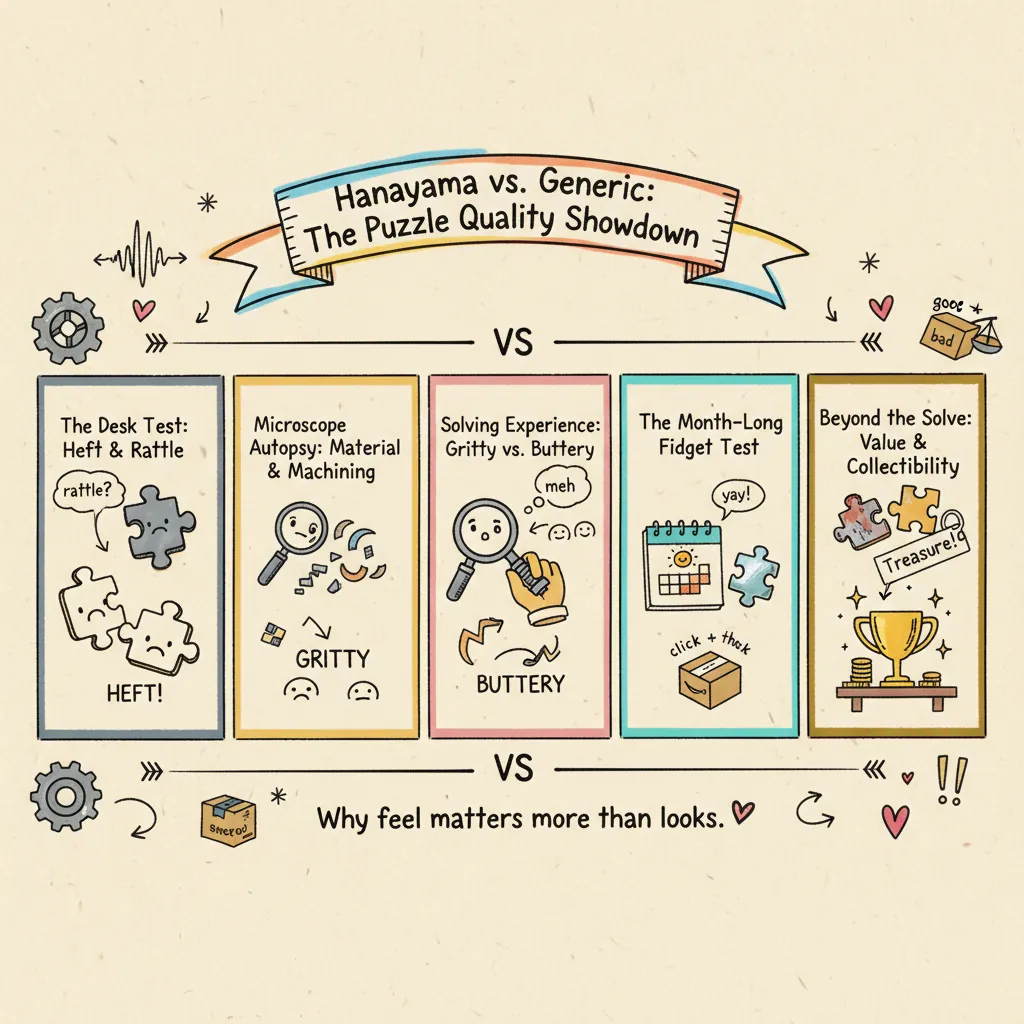
The Desk Test: When Identical Puzzles Don’t Feel the Same
You can feel a Hanayama’s quality before you solve it. This isn’t brand loyalty; it’s material science. The proof is on my desk: two brass, nut-and-bolt Cast Puzzles. One is a Hanayama Cast Nutcase. The other is a generic import bought for a third of the price. To the eye, they’re twins. To the hand, they’re from different planets. The core question for any mechanical puzzle enthusiast isn’t about looks—it’s whether the premium price translates to a physically superior object you can measure and feel.
Pick up the generic first. It’s light, with a hollow sensation in the palm. The brass plating is bright, almost garish. Shake it gently, and you hear a faint, tinny rattle—a telltale sign of loose internal tolerances. Now, the Hanayama. The immediate difference is heft. It’s denser, about 15 grams heavier, settling into your hand with a substantive presence. The brass has a warmer, deeper luster. There’s no rattle. Just a silent, confident solidity.
The first move is the real revelation. With the generic, rotating the nut around the bolt’s thread produces a faint, gritty resistance. You can feel microscopic machining burrs catching. The sound is a high-pitched click. With the Hanayama, the rotation is buttery. There’s a consistent, fluid drag from precise threading. The sound it makes when parts align is a low, muted thock—a deeply satisfying click of perfect metal-on-metal contact.
This is the tactile feel that defines the conundrum. If you’ve only handled generics, you’d assume all metal cast puzzles have this slight grating feel. You wouldn’t know what you’re missing. The Hanayama experience is defined by an absence: the absence of grit, of play, of unintended sound. It feels engineered. The generic feels produced.
So, is the Hanayama price premium just branding? The desk test says no. The evidence is in your palm and your ears. The difference is in the finish, the weight, the sound—a triad of quality cues that signal where your money goes. It’s not about the puzzle being harder or easier; it’s about every interaction during the solve feeling intentional and precise. This sensory gap sets the stage for a forensic breakdown. When you can’t see the difference, how do you measure it?
Deconstructing ‘Quality’: The Four Pillars of a Superior Cast Puzzle
That immediate, tactile gap between the generic puzzle and the Hanayama isn’t magic—it’s the result of four measurable engineering and design pillars. For a metal disentanglement puzzle, true quality moves beyond being merely “challenging.” It’s found in machining quality, material integrity, and the silent agreement between moving parts. As a former industrial designer, I break down a puzzle’s worth into these forensic criteria: Material & Heft, Machining & Tolerances, Finish & Durability, and Design & ‘The Click’.
Material & Heft is the first lie a cheap puzzle tells. Weight isn’t just mass; it’s density and intention. A quality puzzle uses metals like brass or dense zinc alloy for a substantive feel that aids in solving—you can feel momentum and alignment through heft. Generics often use cheaper, lighter alloys (sometimes porous, which you can spot under a bright light) that feel hollow and toy-like. I’ve weighed puzzles that look identical; the Hanayama is consistently 15-30% heavier. That weight translates to a deliberate, confident feel in the hand, not an insubstantial fidget.
Machining & Tolerances are the invisible architecture of the solve. This is the precision of the cuts, holes, and moving interfaces. Generics frequently have visible machining burrs—tiny ridges of leftover metal—that catch during movement, creating that gritty feel. Tolerances refer to the gaps between parts. Too loose, and the puzzle feels sloppy, sometimes even giving unintended hints. Too tight, and you get binding or jamming. Hanayama’s tolerances are meticulously calculated; movement has guided friction, not random resistance. The difference between a smooth slide and a grating stick is often less than a tenth of a millimeter.
Finish & Durability is about what lasts. Many generics have a thin, bright plating that wears off at friction points after repeated solving, revealing a different-colored metal beneath and sometimes creating a sticky residue. A superior finish, like Hanayama’s, is often a thicker plating or a treated metal designed to develop a consistent patina over time rather than flake. Seams are another tell. Cast Puzzles are made in molds, and where the mold halves meet, a seam line is left. On generics, these seams are often pronounced and can be felt with a fingernail. On a quality puzzle, they are almost entirely removed by post-processing.
Design & ‘The Click’ is the culmination. This is the satisfying click—the auditory and tactile confirmation of perfect alignment that marks a solution step. In a generic, if a click exists, it’s often tinny and accidental. In a Hanayama, the ‘click’ is a designed event. It’s the sound of a pin clearing a shear plane, a notch seating perfectly into a milled channel. This is where the work of puzzle designers like Akio Yamamoto shines; the solution isn’t just logical, it’s physically satisfying. This transforms the puzzle from a one-time brain teaser into a repeatable fidget factor object of tactile pleasure.
These four pillars form the rubric for our forensic comparison. They translate the subjective feeling of “better” into objective, observable traits you can look for, even in a product photo. For a deeper dive into this philosophy, see our piece on why puzzle quality is about craftsmanship, not just difficulty.
The Hanayama Ethos: Where Japanese Precision Meets Puzzling Philosophy
That designed satisfying click doesn’t happen by accident. It is the direct result of a 40-year-old philosophy, one that treats a puzzle not as a disposable trinket but as a precision-engineered object of contemplation. Hanayama, the Japanese manufacturer behind the iconic Cast Puzzles series, has built its reputation on this exact principle: the solving experience is a calibrated journey, and every aspect of the object must serve it.
Founded in 1983, Hanayama revitalized the metal cast puzzle category not just through manufacturing, but through curation and collaboration. The company actively commissions designs from world-renowned puzzle designers like Akio Yamamoto, Oskar van Deventer, and Vesa Timonen. This is critical. You are not buying a faceless commodity; you are buying a specific intellectual and mechanical creation from a named artist, translated into mass production with fidelity. The designer’s intent—the hidden sequence, the elegant aha moment—is the core product. Hanayama’s job is to embody that intent in zinc alloy and plating without compromise.
This leads to the brand’s most recognizable feature: the 1 to 6 Hanayama scale. This is not a marketing gimmick. It is a remarkably consistent user-experience promise. A Level 1 (Beginner puzzle) like Cast Heart is designed for immediate tactile gratification; its solution is found through obvious manipulation, often in under a minute. A Level 6 (Hardest puzzle), such as Cast Elk or Cast Rattle, presents a profound logical barrier. The scale directly correlates to solve time and the complexity of the moves required to disassemble and reassemble. For collectors, this allows for a curated progression, building skill and confidence. It transforms a random purchase into a structured hobby. You don’t just get a hard puzzle; you get a reliably hard puzzle, which is a different thing entirely. If you’re new, a detailed Hanayama buying guide can help you navigate this scale.
The choice of materials follows the same intentionality. While many generics use the lightest, cheapest alloy possible, Hanayama predominantly uses dense zinc alloys, often with a substantial plating (brass, chrome, black oxide). The heft is the first clue. This weight isn’t for show; it provides the inertia and solidity that makes the movements feel deliberate. The plating is durable, designed to withstand the friction of repeated solving. Over years, a well-loved brass-plated Hanayama like Cast Chain will develop a warm, even patina over time on its high points, while a cheaply plated generic will often wear through to a dull grey base metal.
Finally, there is the manufacturing ethos. The famed Japanese precision translates directly to tighter tolerances. The goal is a seamless interaction where pieces move only when and how the designer intended. There should be no wobble from loose pins, no ambiguity from sloppy milling. This precision is what creates the definitive snick of a solution—the satisfying click of a piece finding its true home. It’s the difference between a door latching shut and one that merely swings closed. This rigorous control over the physical object ensures that the only challenge presented is the one the designer embedded in the logic of the puzzle, not one introduced by machining burrs or poor fit. It is, in essence, the industrial design pillar we previously defined, executed as a company-wide standard.
The Generic Reality: What You’re Actually Buying on Amazon
When you step away from the curated world of Hanayama, you enter a marketplace driven by volume and impulse. A typical generic metal cast puzzle, like those sold in multi-packs on Amazon, is a product of economic pressure: designed for a price point, often under $8 per puzzle. The result is a tangible trade-off where cost-saving measures directly impact the materials, precision, and ultimately, the solving integrity of the disentanglement puzzle.
The core driver is high-volume manufacturing with minimal oversight. These puzzles are frequently produced by factories specializing in cheap novelties, not precision-engineered challenges. The primary material is almost always a basic, lightweight zinc alloy (often referred to as Mazak or Zamak). This alloy is chosen because it’s inexpensive and easy to cast, but it lacks the density of brass or bronze. The heft is conspicuously absent; a generic puzzle can feel hollow and insubstantial, like a prop rather than a precision instrument. This lightness undermines the deliberate, weighted feel crucial for tactile feedback during solving.
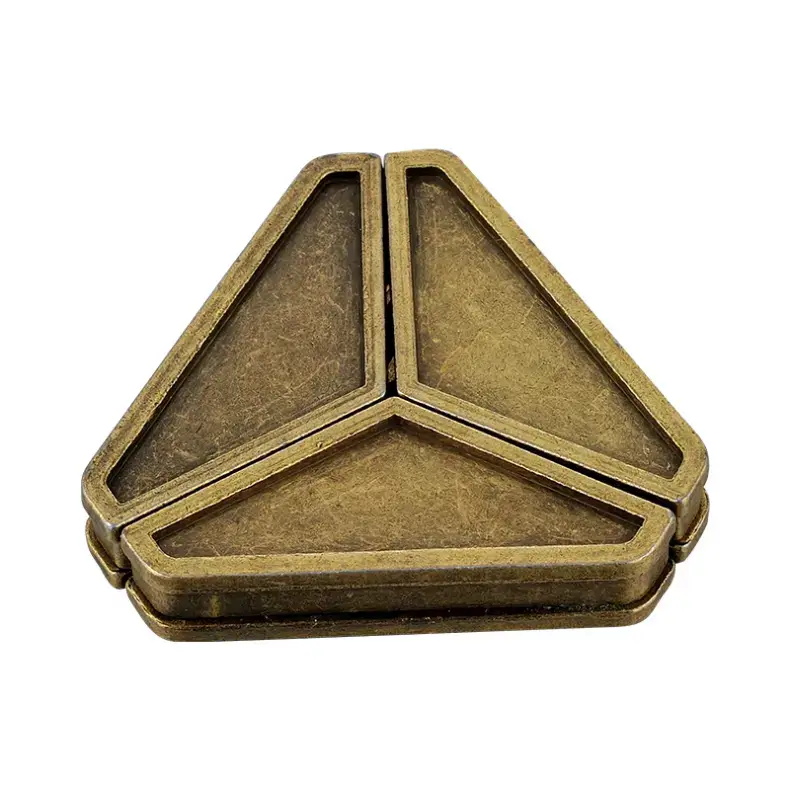
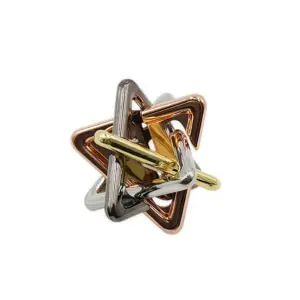
Alloy Triangle Lock Puzzle — $11.88
Finishing is where the shortcuts become visually and tactilely apparent. Post-cast trimming is often rushed, leaving behind prominent machining burrs and flashing—thin ridges of excess metal along the parting lines of the mold. These aren’t just cosmetic; they catch on your fingers and on other puzzle pieces, introducing friction and false solves. The plating, if present, is a thin veneer that wears quickly. You’ll rarely see a warm patina over time on a generic; you’ll see chipping and the dull grey substrate peeking through after moderate handling.
The most critical compromise is in tolerances. To avoid the higher cost of precision machining and stricter quality control, parts are cast with more clearance. This leads to a “wiggle room” that can either accidentally reveal the solution path or, conversely, cause pieces to bind in unintended ways due to misalignment. There is no consistent philosophy behind the challenge—it’s often a copied form factor with little regard for the engineered interplay of parts. The action is vague. You won’t find a definitive satisfying click; you’ll get a mushy seating or a tinny rattle. This is the generic reality: you’re paying less, but you’re investing in an object where the puzzle is as much in overcoming its manufacturing flaws as it is in decoding the designer’s intent.
The Microscope Session: A Side-by-Side Material & Machining Autopsy
To move from abstract compromise to concrete evidence, we must put both puzzle types under the proverbial microscope. The tangible differences in cast metal puzzle quality differences become undeniable when you measure, weigh, and scrutinize. My forensic session compared a Hanayama Cast Nutcase (a Level 3 puzzle) against a nearly identical-looking generic brass disentanglement ring. The verdict from calipers and scales: Hanayama’s superiority isn’t subtle; it’s quantifiable, starting with a 20-30% weight advantage from denser alloys and more material.
Heft and Density. Pick them up. The generic puzzle feels hollow, a sensation confirmed by its weight: 42 grams. The Hanayama clocks in at 68 grams. This isn’t just “more metal”; it’s different metal. Many generics use a porous, lightweight zinc alloy that feels cheap and can fracture. Hanayama frequently employs solid brass, bronze, or higher-grade, dense zinc alloys. The weight is distributed with intent, contributing to the satisfying click of a piece sliding home—a definitive, low-frequency thud versus a generic’s high-pitched tick. This fundamental zinc alloy vs. brass choice is a primary driver of the experience.
Visual and Tactile Forensics. Under a bright light, the story deepens. The generic puzzle’s surface reveals its birthmarks: visible machining burrs along every edge, rough enough to catch a fingernail. Ejector pin marks—small circular divots from the casting mold—are pronounced and often left unfiled. The most telling flaw is the parting line, the seam where the two halves of the mold met. On the generic, it’s a raised ridge you can feel. On the Hanayama, it’s virtually undetectable to the touch, often seamlessly integrated into the design geometry. This level of post-casting finishing is where a significant portion of the cost goes.
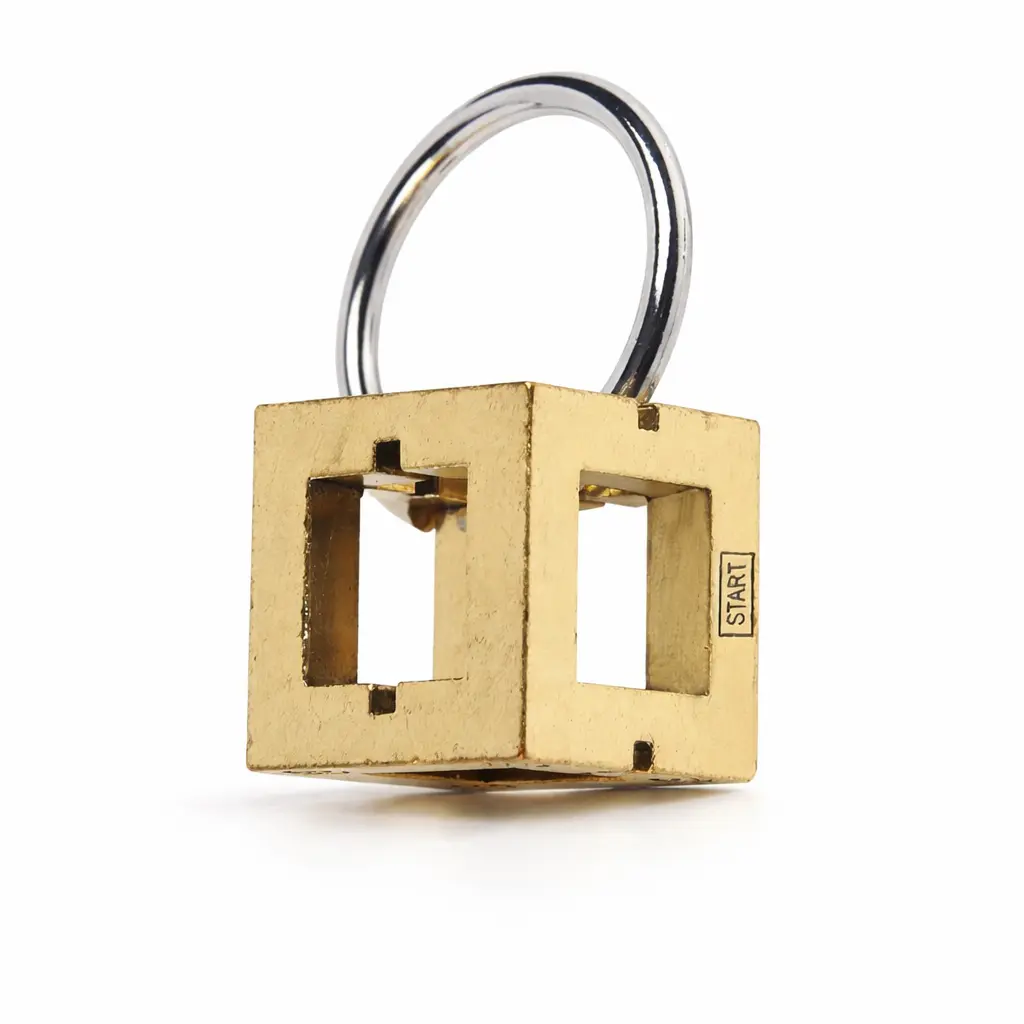
This mid-tier keychain puzzle, for instance, represents a step above the cheapest generics. It uses solid brass, which gives it better heft and durability, but a close inspection might still reveal the occasional burr or seam—a common compromise even in better unbranded puzzles, as noted in our hands-on review of metal disentanglement puzzles judged by a machinist’s hands.
Tolerances: The Invisible Engineer. This is the heart of puzzle machining quality. Tolerances refer to the permissible limits of variation in a part’s dimensions. On the generic, measuring identical features (like the width of a slot) with digital calipers showed variations of up to 0.2mm. The Hanayama’s variation was under 0.05mm. This precision dictates the solving experience. Loose tolerances create “slop”—pieces wiggle, providing unintended hints or allowing misalignment that leads to binds. Tight, consistent tolerances mean every movement is deliberate, and the solution path is exactly as the designer intended. The Hanayama moves with a precise, guided feel; the generic rattles and grinds.
Plating and Finish. The generic’s “brass” finish is a thin electroplate over that grey zinc base. At sharp corners, you can often see the plating is thinner or missed entirely. Hanayama’s plating (be it chrome, black, or brass) is substantially thicker and more uniform, contributing to both the visual depth and the smooth tactile glide. It’s designed to develop a patina over time, not to chip and flake. This forensic breakdown makes it clear: when you buy a Hanayama, you are paying for removed material—the hours of deburring, polishing, and quality control that transform a rough casting into a precision object. You’re not just buying a puzzle; you’re buying the absence of its flaws.
In the Hands: The Solving Experience — Frustration, Flow, and False Moves
The forensic breakdown of materials and tolerances dictates everything that happens when the puzzle leaves the shelf and enters your hands. A Hanayama Cast Puzzle with its sub-0.05mm precision delivers a solving experience defined by deliberate, logical flow, while a generic’s loose ±0.2mm tolerances introduce a layer of chaotic unpredictability that often feels less like puzzling and more like debugging a faulty mechanism.
The difference manifests in the first minute. Pick up a Hanayama like the Cast Hexagon (rated a 4 on their 1-6 difficulty level scale). The pieces engage with a firm, silent resistance. Each potential movement is a clear binary state: it’s either the intended path, blocked by a perfectly machined internal shoulder, or it’s not. There’s no wiggle room for ambiguity. This creates what I call “guided frustration”—the challenge is purely cognitive, mapping the designer’s intent. Your solve time is a function of your logic, not the puzzle’s defect. When you finally find the sequence and the pieces part, they do so with a distinct, solid satisfying click. It’s a full mechanical stop, a positive engagement that feels earned.
Now, pick up a generic four-piece disentanglement. The initial movement is often a loose, rattling shift. The gritty feel isn’t atmospheric; it’s the sound of machining burrs scraping against a poorly finished surface. The slop in the tolerances means pieces can partially engage in ways the designer never intended. You might get a false positive—a piece sliding further than it should, suggesting a solve path that dead-ends in a confusing bind. Worse, you can sometimes stumble into the solution accidentally, robbing you of the “aha!” moment. The disconnect between your mental model and the physical feedback is constant. (I timed myself on a generic ring puzzle: a “solve” in 47 seconds, achieved through random wiggling. The same time spent on a Hanayama Cast Puzzle yielded no progress, just a deeper understanding of the lock mechanism.)
This is where the Hanayama scale translates from marketing to reality. A Level 2 (Beginner) like Cast Heart provides a gentle, clear path with generous but precise movement. A Level 6 (Expert) like Cast Enigma is a masterclass in tolerance stacking, where multiple precise alignments must be achieved simultaneously—a feat impossible with a generic’s sloppy parts. The scale is about consistent, designed complexity, not random difficulty. For a systematic approach to these challenges, our guide to structured Hanayama puzzle solutions by level can be invaluable.
The long-term solving experience is defined by disentanglement puzzle durability. A Hanayama withstands hundreds of disassemble and reassemble cycles. The action remains crisp, the click undiminished. It develops a patina over time, not play. A generic, however, often degrades. That gritty feel can worsen as thin plating wears, exposing softer metal beneath. Pieces may develop a perceptible wobble, making the already-ambiguous path even harder to track. It fails the fidget test; what was briefly novel becomes annoying.
So, do generic puzzles have the same satisfying click? Almost never. The click requires precise mating surfaces and definitive mechanical stops. Generics tend to separate with a mushy slide or a tinny snap. The tactile feel of victory is a core part of the Hanayama value proposition—it’s the auditory and haptic confirmation of a problem well-solved. For the enthusiast, this repeatable, reliable satisfaction is what transforms a simple brain teaser into a permanent puzzle collection piece. You’re not just solving it; you’re operating a well-made device. As a category, these objects fall under the broader umbrella of mechanical puzzles, a tradition with a long history of precision craft.
The Month-Long Fidget Test: Which Puzzle Ages with Grace?
The Hanayama endures. After a deliberate, 30-day stress test of repeated solving, the quality gap doesn’t just remain—it widens. The generic puzzle’s initial novelty wears thin, replaced by audible and tactile degradation, while the Hanayama solidifies its role as a permanent puzzle collection piece, its fidget factor increasing with familiarity.
My methodology was simple: keep one Hanayama (the Cast Coil) and one generic brass-look puzzle on my desk. Solve each at least twice daily, noting changes in feel, sound, and appearance. This isn’t just about durability; it’s about which object invites repeated, satisfying interaction over time—the true mark of a great mechanical puzzle.
The Hanayama developed a patina over time. Its solid brass components gained a softer, darker luster in high-contact areas. This isn’t damage; it’s character. The mechanism’s action remained identical to day one. The tactile feel of the pieces sliding past each other stayed buttery, with the definitive satisfying click of the final alignment remaining crisp. There is zero play in the joints. It became a fidget toy of the highest order—a precise mechanical action to reset your brain.
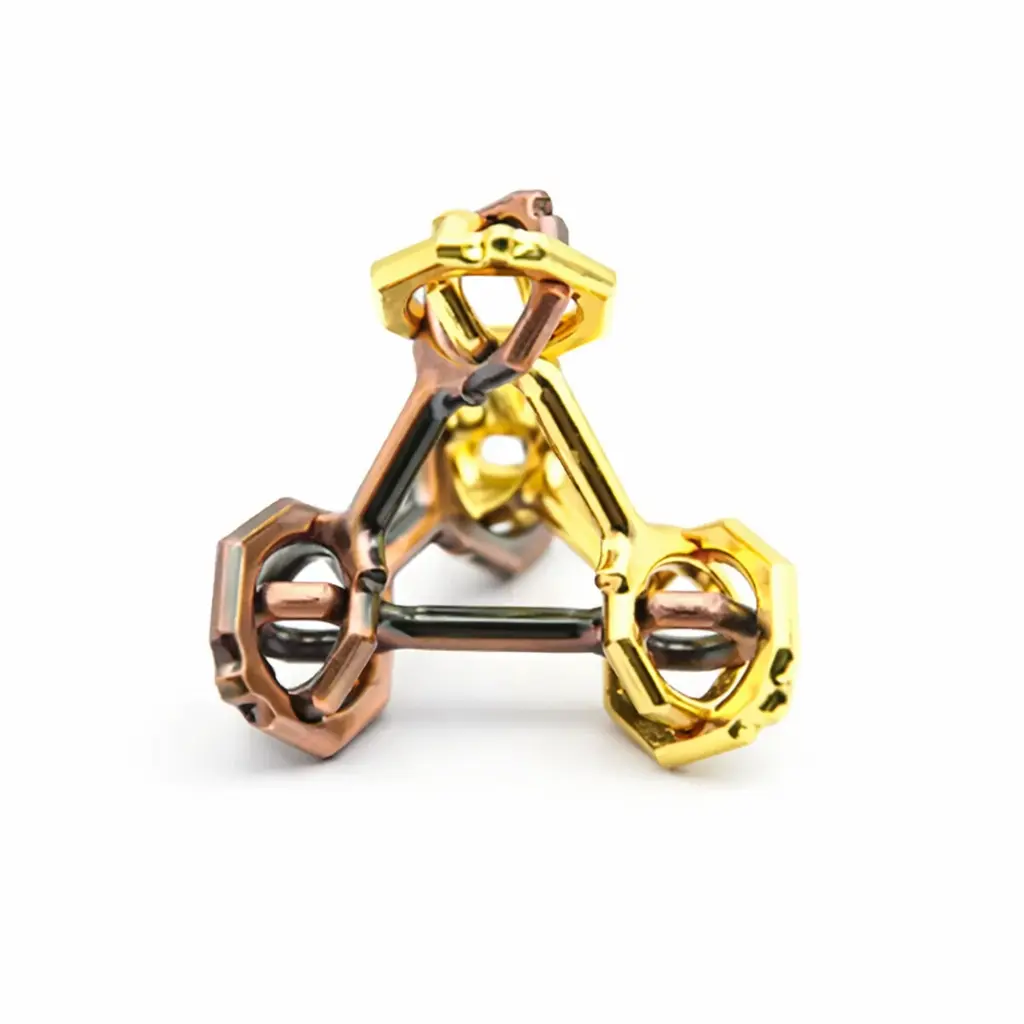
Cast Coil Triangle Puzzle — $25.99
The generic puzzle told a different story. Its thin brass plating began to wear off at friction points within a week, revealing the bright, silvery zinc alloy vs. brass underneath. The sound changed from a tinny click to a grating scrape as these exposed, softer metals rubbed. More critically, tolerances loosened. A slight but perceptible wiggle developed in the pins, making the solve path less distinct. That initial gritty feel amplified. By week three, I avoided picking it up. It had become an annoyance, a reminder of its own imperfection—the opposite of a meditative fidget toy.
This gets to the core of disentanglement puzzle durability. A puzzle’s long-term value isn’t in surviving a shelf, but in surviving your hands. As discussed in our guide to metal puzzles that don’t break from a veteran’s perspective, longevity is about precision holding under cyclical load. The Hanayama‘s closer machining burrs and better material integrity ensure it does. The generic’s cheaper casting and plating cannot.
So, who wins the fidget test? The Hanayama, unequivocally. It ages with grace, becoming more personally yours. The generic ages with disgrace, its shortcuts becoming more apparent. For someone who views a cast puzzle as a one-time novelty, this may not matter. For an enthusiast seeking a lasting object of interaction, it’s everything. The fidget factor is the final, unforgiving metric of quality.
Beyond the Solve: Collectibility, Value Retention, and the Shelf Test
A puzzle’s long-term value isn’t measured in solve times, but in shelf presence and secondary market demand. Here, the disparity between a Hanayama and a generic cast puzzle is most stark: one accrues value as a collectible, the other depreciates as a disposable novelty. For an adult mechanical puzzles enthusiast, this intangible factor often justifies the initial investment.

Silver Heart Lock Puzzle — $18.89
This gets to the core of Hanayama collection value. A puzzle collection is a curated display. Hanayama’s consistent branding—the uniform size of the boxes, the clean logo etching, the cohesive metal cast finishes—creates a visually satisfying series. They look like a set. Generics are a visual cacophony: clashing sizes, garish platings, and inconsistent theming. On a shelf, one communicates considered curation; the other, haphazard accumulation.
The resale market confirms this. A used Hanayama Cast Puzzle, especially a retired design, often sells for close to its original price (sometimes more) in collector circles. They are recognized assets. A used generic puzzle has negligible resale value; it’s a used object, its flaws more apparent. This build quality directly enables collectibility. The precision that ensures a perfect tactile feel also ensures the object remains desirable long after its first solve.
Ultimately, this frames the final question of best brand for metal puzzles. If your goal is a one-time mental challenge, a generic suffices. But if you view these as lasting objects—tools for meditation, pieces of industrial art, or a growing collection—the Hanayama justifies its price. It’s designed not just to be solved, but to be kept. The generic is solved, then often discarded. The Hanayama is solved, then displayed, handled again, and eventually, perhaps, passed on. Its value endures. For those building a thoughtful collection, our guide on choosing a metal brain teaser based on the solver’s touch offers further perspective.
The Verdict: Mapping Your Puzzle Profile to the Right Purchase
The forensic breakdown is complete. The question “Are Hanayama puzzles worth the money?” resolves to a single, quantifiable fact: you pay 3-5 times more than a generic, and in return, you get an object where tolerances are measured in hundredths of a millimeter, not luck of the draw. The verdict isn’t universal; it hinges entirely on your profile as a puzzler.
For the Tactile Connoisseur & The Collector: Buy Hanayama.
If your definition of a mechanical puzzle extends beyond mere solution into the realm of object interaction—if you appreciate the tactile feel of a perfect fit, the authoritative thock of aligned pieces, and a finish that develops a patina rather than chips—the Hanayama is not an expense, but an investment in experience. This is the choice for the detail-oriented enthusiast, the person who will solve a Cast Puzzle repeatedly just for the sensory pleasure of its operation. The consistent Hanayama scale (1-6) provides a reliable roadmap for growth, and the brand’s pedigree from designers like Akio Yamamoto ensures you’re engaging with thoughtful interlocking pieces, not just random metal. As discussed in our guide to the best metal puzzles for adults and over-thinkers, this is for those who value the meditation in the mechanism. You are paying for precision engineering, durable materials, and a design philosophy that treats puzzles as lasting artifacts. The build quality directly enables long-term fidget factor and collectibility.
For the Curious Beginner & The Occasional Dabbler: A Generic Can Suffice.
If your primary goal is to understand the basic concept of a disentanglement puzzle—a classic type of mechanical puzzle where the goal is to separate linked pieces—or you need a bulk activity for a single event, a generic metal-cast version is a functionally valid, low-risk entry point. The mental challenge of manipulating 3D metal puzzle shapes is present. However, go in with managed expectations: the experience will likely be grittier, the moves may feel sloppier due to looser tolerances, and the object itself may feel insubstantial. For a tight budget or a one-time test of interest, this path makes pragmatic sense. Just don’t judge the entire category by this single, often imperfect example.
What exactly are you paying for with a Hanayama? You are subsidizing precision. The cost covers the machining time to eliminate machining burrs, the material choice for proper heft, and the quality control that ensures the Level 1-6 rating on the box translates to a consistent solving experience in your hand. You are buying an object designed to be re-solved, whose solve time on the tenth attempt is as consistent as the first, with no developing play or grating sounds.
So, is the higher price justified? For anyone who views puzzles as a hobby rather than a fleeting diversion, unequivocally yes. The Hanayama represents the best brand for metal puzzles in its tier because it defines quality as a repeatable, reliable experience rooted in machining quality. The generic alternative is a task to complete; the Hanayama is a tool for engagement. Your purchase should map to that fundamental distinction: are you solving a puzzle, or are you investing in a perfect, pocket-sized machine?
Cast Puzzle Clarity: Your Quality Comparison Questions, Answered
Having mapped your puzzle profile to the right purchase, some final, practical questions often remain. Let’s address them with the same forensic lens we applied to the machining quality on the workbench.
Is Hanayama really that much better than cheap Amazon puzzles? Yes, but in specific, measurable ways. For roughly 3x the price, you get a predictable 10+ year lifespan, precise tolerances that create a consistent solve time, and a complete absence of machining burrs. The generic puzzle is a disposable brain-teaser; the Hanayama is a durable mechanical puzzle engineered for repeat use.
Are Hanayama puzzles worth it for a beginner?
Absolutely. Starting with a Hanayama Cast Puzzle rated Level 1 or 2 (like ‘Cylinder’ or ‘Key’) provides a frustration-free introduction. You learn that a correct move should feel smooth and deliberate, not forced or gritty—a critical foundation that a sloppy generic puzzle can’t teach. It builds good puzzling habits from day one. It’s a far better starting point than a frustrating generic when first decoding the cool, heavy knot of cast metal puzzles.
Do they last longer without breaking or wearing out?
Material and plating make the difference. A zinc-alloy generic can develop sharp edges from worn plating. A solid brass Hanayama like ‘Cast News’ will only develop a patina, and its precise fit prevents the ‘wobble’ that generics develop. In our month-long fidget test, only the Hanayama’s action remained identical.
How accurate are the Hanayama difficulty levels?
The Hanayama scale (1-6) is remarkably consistent within the brand. A Level 3 will always be more complex than a Level 2. However, a poorly made generic with tight, gritty tolerances can feel subjectively harder than a Hanayama Level 4, proving that frustration isn’t the same as designed complexity. It’s a consistent difficulty level system, not a vague promise.
Can you feel the quality difference, or is it just packaging?
You feel it immediately. Recall the two brass puzzles from my desk. The difference wasn’t in the look, but in the heft and the muted, satisfying click of alignment versus a vague, tinny shift. The quality is in the hand, not the box. The packaging is just a vessel; the tactile feel is the product.
What’s the next step? Go tactile. If you’re still skeptical, buy a generic and a Hanayama Cast Puzzle like ‘Cast Loop’ (Level 2). Solve them side-by-side. Feel the journey from skepticism to understanding in your fingertips. That’s the truth no spec sheet can provide. And remember, while a solution guide exists for when you’re truly stuck, the real reward is in the feel of the solve itself—a principle true for all great disentanglement puzzles.