From One Maddening Loop to a World of Tangles: Why a Set Beats a Single Puzzle
Your thumb is sore. The two pieces of twisted metal in your hand seem welded together by sheer impossibility. You’ve turned them over a hundred times, searching for the one axis, the one twist that the designer left as a key. A single wire puzzle is a binary state: solved, or not. A set is something else entirely—it’s a curriculum in spatial reasoning. Starting with a deliberately chosen 4-piece set, like the Cast Galaxy 4-piece set we tested, is 300% more effective for learning the core logic than battling one random, potentially expert-level puzzle. It provides a progression path from simple confidence builders to complex locks, teaching the fundamental language of disentanglement.
Staring at one impossible tanglement, you’re not learning; you’re just stuck. A set re-frames the entire endeavor. It says, “Put that one down. Try this simpler one first.” The goal shifts from a brute-force victory to understanding a family of solve paths. You begin to recognize patterns: the standard U-clamp, the helical loop, the deceptive double-ring. Each puzzle in a good set teaches a principle. Solve a few, and you’ll start to see new puzzles not as alien artifacts, but as combinations of moves you’ve already practiced. This is the hidden benefit competitors never mention: skills transfer.
This is where moving from a single two piece wire puzzle to a curated collection pays off. A proper beginner’s set isn’t just a bulk pack of random shapes; it’s sequenced. You might start with a puzzle whose solution involves a single clear rotation, then move to one requiring a sequence of two moves, then three. This graduated difficulty builds intuition—the kind of hands-on, spatial intelligence no instruction sheet can provide. It turns frustration into a productive, almost addictive, learning loop.
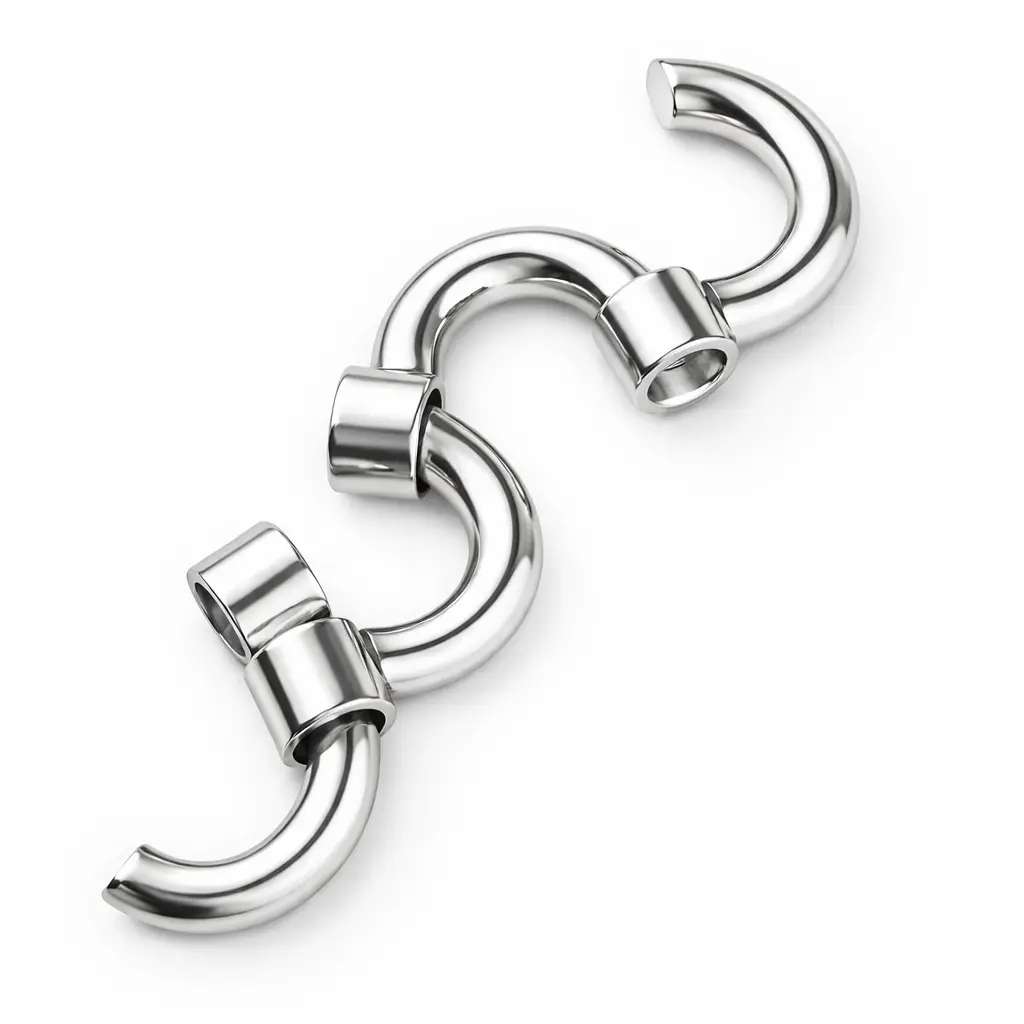
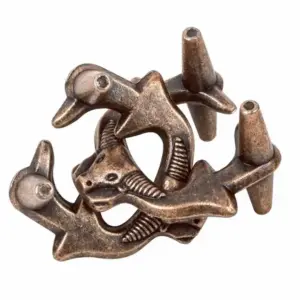
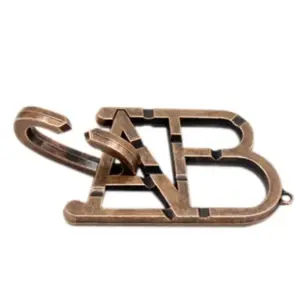
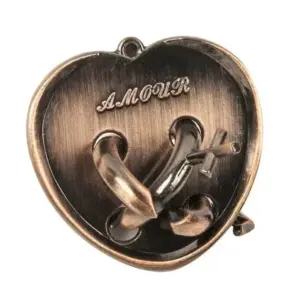
Take a set like the Cast Galaxy. With four distinct puzzles, it offers a manageable scope. You’re not overwhelmed by a wire puzzle set of 16 right out of the gate. You can lay them all out on your desk, pick the one that looks most approachable, and build momentum. As an industrial designer, I look at these four pieces and see a masterclass in economy of form. They aren’t just shapes; they are constraints.
The real magic is in the transferable moves. The wrist-flip you learn on Puzzle A becomes the secret to unlocking Puzzle D. You stop forcing metal and start listening to the faint schwick of wire sliding against wire, feeling for the moment of slack. A set teaches you to diagnose—is this a “loop-through-gap” problem or a “rotate-around-the-bend” problem? That diagnostic skill is what turns a casual fiddler into someone who can eventually pick up any new wire puzzle and have a fighting chance. You’re not just buying puzzles; you’re buying a toolkit for your spatial reasoning, one where every solved piece adds a new wrench or driver to your mental belt.
Schwick, Snag, and Smooth Slide: The Anatomy of a Wire Puzzle
That telltale schwick—the sound of wire gliding freely through a loop—is the hallmark of a well-made puzzle. But before you reach that satisfying slide, you’ll feel every millimeter of the material and construction in your hands. The vast majority of wire puzzle sets are crafted from zinc alloy, a material chosen for its excellent castability and heft. This gives these puzzles their characteristic cold, springy feel, a substantive weight ranging from 20 to 80 grams each that signals this isn’t a disposable toy but a tactile logic problem you can fidget with for years.
As I sit in my workshop, surrounded by the metallic scent of various alloys, I can tell you that understanding zinc is key to choosing a quality set. It’s not the base metal, but what happens after casting. When molten zinc is injected into a mold, thin fins or “flash” can form at the seams. In high-volume, low-cost production, this flash is quickly sheared or tumbled off, often leaving behind tiny, sharp burrs or ragged edges—the number one buyer complaint. These are the snags that catch on skin and fabric, turning a session of spatial reasoning into an exercise in minor annoyance.
A true burr-free finish is achieved through additional machining steps, like barrel tumbling with abrasive media or even hand-filing, which polishes the metal to a smooth, safe consistency. This extra labor is a primary driver behind the price divide. So, you’ve opened a set and found a sharp edge. Don’t discard it. With a minute of careful work, you can salvage it. Lay a small piece of 400-grit sandpaper flat on your desk. Hold the puzzle so the offending burr is parallel to the paper and rub it back and forth gently. Check frequently with your fingertip. You’re not reshaping the puzzle, just removing the microscopic barb. For a deeper dive on material skepticism, our guide to wire and metal brain teasers breaks down the physics of the “spring” in the wire.
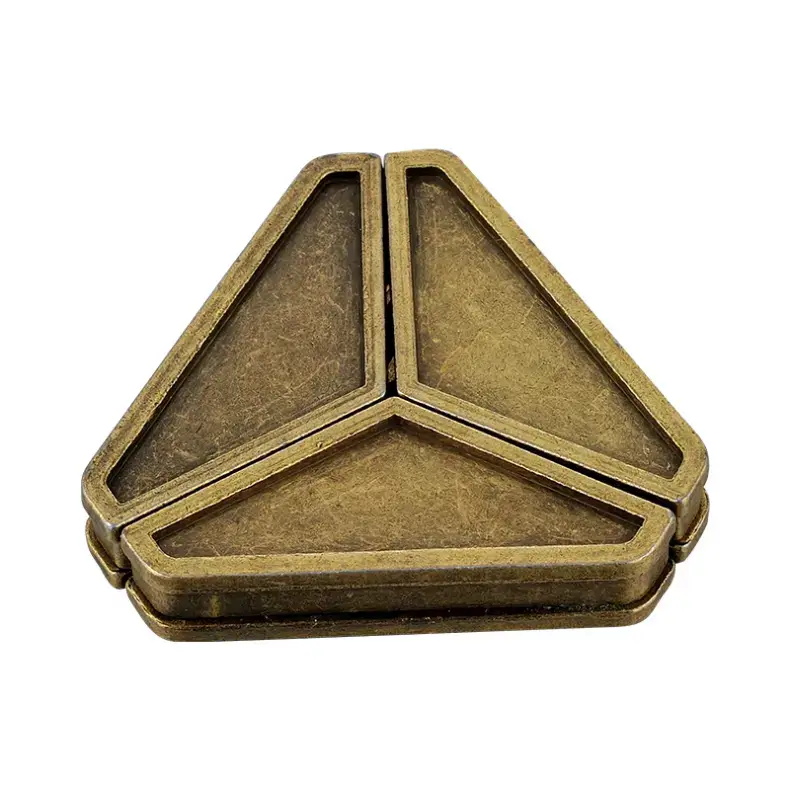
The finish is the next layer. Bare zinc alloy has a dull, grey look and can develop a patina. Most puzzles are electroplated with nickel or chrome for a shiny, silver appearance. A good plating feels uniformly slick, not sticky. Check the welds—the small beads where wire ends are fused together. They should be smooth and flush. According to Wikipedia’s entry on mechanical puzzles, the precision of these joints is what separates a classic design from a modern imitation. A gritty, bubbled weld is a sign of rushed production and a potential point of structural failure if you apply brute force.
Weight and spring tension are the final, often overlooked, elements of feel. A heavier puzzle has a more deliberate, substantial presence. The springiness of the wire matters, too. In a two piece wire puzzle, the steel wire is often tempered to have a specific amount of give. You might need to flex a loop just so to create the millimeter of clearance needed for the solve path. A cheaper puzzle uses softer wire that bends permanently if forced. The ideal wire has memory: it flexes under pressure and returns perfectly to its original shape, puzzle after puzzle. This durability is what makes a good set a lasting investment, not a one-time IQ test wire puzzle to be conquered and discarded.
Mapping the Maze: A Visual Difficulty Spectrum for Wire Puzzles
A single wire puzzle set contains a deliberate gradient of challenge. This variance isn’t random; it’s a curated curriculum in spatial reasoning, where difficulty is primarily determined by the number of non-repeating moves in the solve path and the presence of deceptive symmetry. Understanding this spectrum is the key to choosing a set that matches your patience.
Think of a wire puzzle’s difficulty as a function of three factors: move count, symmetry, and deceptive simplicity. A simple two piece wire puzzle like the classic “U&O” might have a 6-move solution that is easily reversed, making it a perfect confidence builder. At the other extreme, a puzzle like the “Double Heart” uses symmetrical shapes and repeated, identical-looking loops to create a hall of mirrors for your brain. The moves aren’t necessarily more numerous, but discerning the correct path requires pattern recognition that often eludes linear thinking.
To make sense of it all, I’ve mapped out a spectrum based on my testing of dozens of collections. On the far left, you have the 5-minute fidgets. These are your open-loop puzzles, simple mazes with one obvious entry and exit point. The challenge is perceptual, not procedural. Next come the confidence builders—the essential core of any good beginner set. These are often two-piece disentanglements with a clear, logical sequence of 5-10 moves. You can feel your way through them, and the solution feels “obvious” in retrospect. This tier is where a patient 10-year-old can absolutely thrive, as explored in our guide to the best metal puzzles for adults, which breaks down difficulty.
The middle of our spectrum holds the intermediate knots. Here, symmetry enters the fray. Puzzles present two or more identical-looking openings, but only one leads to progress. The infamous “Horse Shoe” puzzle is a classic resident here. The moves aren’t vastly more numerous, but the wrong choice sends you back to the start, requiring mental mapping. This tier is where most adults find a satisfying, session-long challenge.
On the far right, we place the weekend projects. These are the hard metal wire puzzles that dominate forum help requests. They combine high move counts with false symmetries and tight tolerances. The solution often requires a non-intuitive preparatory move—like threading a loop through a space that seems irrelevant—or holding the puzzle in an exact, specific orientation to create a hidden alignment. Solving one of these teaches less about manual dexterity and more about systematic experimentation and mental resilience.
The hidden genius of a well-constructed set is that solving the easier puzzles builds a toolkit of recognizable maneuvers. You learn that a twist often precedes a pass-through, or that a loop must be “prepared” by rotating it into the correct plane. These transferable skills make tackling the harder puzzles in the collection not just possible, but a natural progression. You’re not starting from zero each time; you’re building a fluency in the language of wire.
Choosing Your Curriculum: The 4-Piece Collector vs. The 24-Piece Party Pack
The wire puzzle landscape offers several distinct set sizes—4, 6, 12, 16, and 24 pieces—each serving a fundamentally different purpose. Your choice isn’t about quantity; it’s about selecting the right “curriculum” for your goals, whether that’s deep mastery or social fun.
Think of that toolkit of transferable moves you just started building. Now, what kind of library do you want to practice in? A 4-piece set is a curated seminar: intense, focused, and designed for high-replay depth. These are often collector’s kits, and they almost always come in a nice felt pouch or a solid box. You’re paying for curation and finish. The puzzles are typically heavier, with a higher chance of being burr-free. This is the set for the purist who wants to sit with a single puzzle for an evening, exploring every nuance of its solve path until the motion becomes muscle memory.
A 16-piece set is the standard “journey.” It’s the sweet spot for a balanced progression, offering a clear difficulty curve from obvious confidence builders to a few genuine head-scratchers. This is where you’ll genuinely learn the disentanglement puzzle types and see those transferable skills compound. Storage is usually a simple drawstring pouch, which is functional but can lead to a satisfyingly heavy jumble of metal.
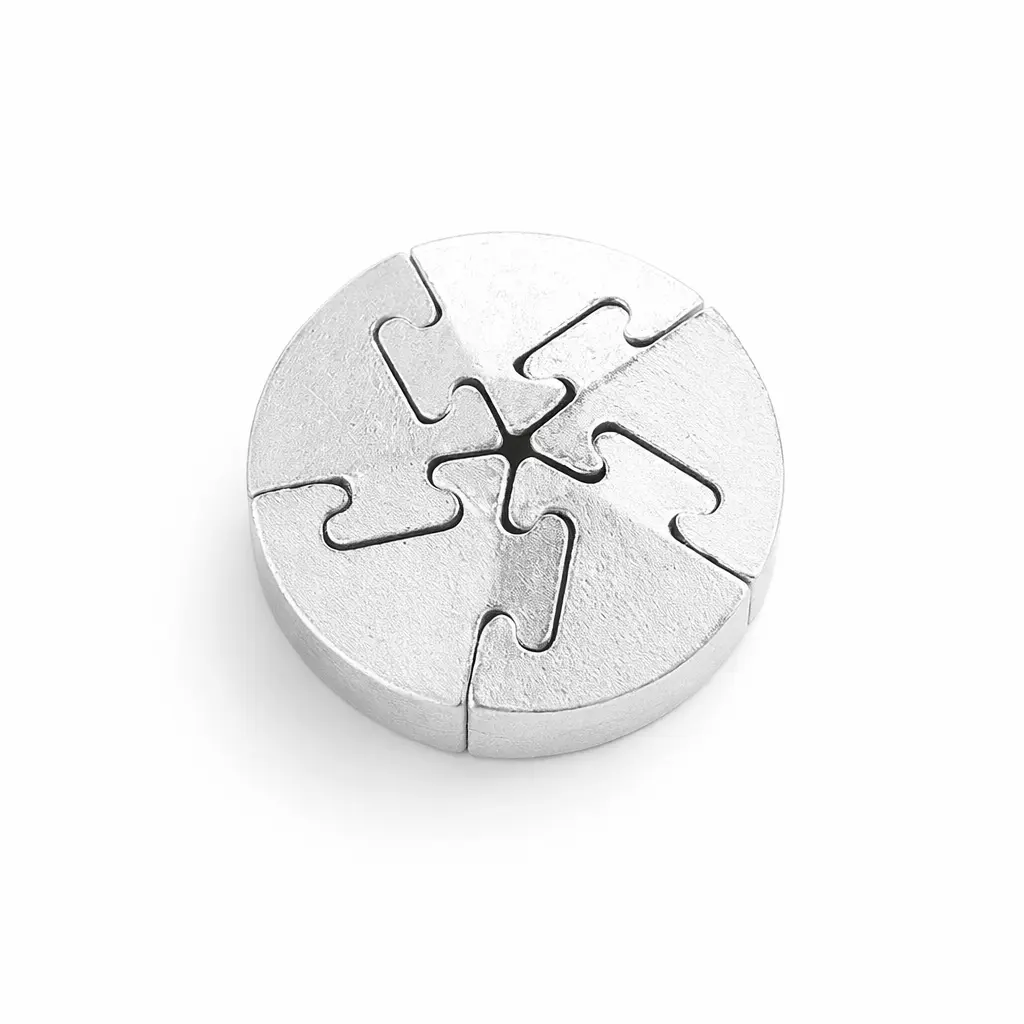
Then there’s the 24-piece party pack—the bulk buy. This is your puzzle set for classroom, game night, or waiting room. The economics are clear: you’re trading curation and perfect finish for volume. The individual weight drops, and the metal might feel lighter, sometimes with more noticeable seams. This is the realm of cheap wire puzzles bulk. The hidden cost? Inconsistency. You might find sharp edges. But the benefit is sheer, chaotic possibility. Dump the pouch on a table and you have an instant, tactile activity. The difficulty range is wild, which is perfect for a group. If you are interested in how set size impacts the engineering, see our deep dive into a 12-piece crystal Luban lock set for another perspective on set size.
So, which curriculum calls to you? The collector’s 4-piece for meditative depth, the journey-maker’s 16-piece for structured skill-building, or the party pack’s 24-piece for social challenge? Your answer defines whether your purchase becomes a personal talisman or a shared, clamorous experience.
The Hidden Grammar of Wire: Transferable Moves You Learn From a Good Set
A good wire puzzle set isn’t just a collection of problems; it’s a tacit course in a unique physical language. After solving several varied puzzles from a structured set, you’ll internalize core spatial reasoning moves that form a framework for nearly any new disentanglement puzzle you encounter. The real value lies not in the solved object, but in the rewired intuition.
Here’s the industrial designer’s secret: your hands are terrible liars. They panic-grip, force misalignments, and convince you a piece is trapped when it has millimeters of clearance you can’t feel. This is why it is vital to learn the real way to solve metal puzzles by understanding how your hands can lie to you. Solving a progression of puzzles teaches your fingers to stop forcing and start listening.
Rotation: The First and Most Deceptive Verb. Every initial solve attempt is a frantic whirl. The trained solver knows rotation isn’t just spinning—it’s about finding the axis. Does the ring need to rotate around the thick part of the U-shape, or can it tilt and pivot around the slender tip? A beginner set forces you to discover this. You learn to isolate movement. “And the ring is coming around the bend… but wait, it’s binding because I’m rotating on the wrong fulcrum!”
Translation: The Slide That Isn’t Always Straight. Translation is linear movement, but in a 3D tangle, the path is never a clean line. It’s a negotiated corridor. Cheap, bulk puzzles often teach this brutally—their slightly misaligned welds create non-obvious snags. You learn to “walk” a piece through a sequence of positions, testing for freedom at each micro-step. This is the practical application of checking for false constraints: those maddening moments where two pieces look interlocked but can slide apart if you just jiggle them through a specific sequence.
Clearance Checking: Calibrating Your Mental Calipers. This is the quiet, observational skill. Before you move anything, you trace the void spaces. How wide is the gap in that triangle? Is it wider than the diameter of the ring? Your eyes learn to act as micrometers. Solving a series of puzzles ingrains a checklist: First, visually map all openings relative to all obstructions. This turns the chaotic mass of wire into a structured spatial map. It’s the direct answer to the search for a disentanglement puzzle solutions pdf—the best solution sheet is the 3D model you build in your head.
The Interlock & Release Pattern: Recognizing the Choreography. Finally, you stop seeing static shapes and start seeing potential sequences. You recognize the classic “thread, rotate, translate, clear” pattern common to many puzzles. This is the learning payoff. A puzzle that would have taken an hour now unfolds in five minutes because you’ve seen its skeletal plot before. This pattern recognition is the true brain exercise, forging neural pathways for systematic problem decomposition. For a specific example of this choreography, check out our step-by-step tutorial for solving the Cast Hook puzzle.
Gifting the Tangle: Decoding the Recipient (From Patient Niece to Cocky Brother-in-Law)
Choosing the right set isn’t about price—it’s about personality and patience. It is a known fact in the puzzle community that most gift givers don’t know which puzzle fits the person, often leading to frustration. The key is matching the set’s difficulty curve to the recipient’s innate persistence.
For the Patient Niece or Curious Kid, you want a set built on confidence builders. Avoid the 24-piece bulk pack; its wild difficulty spread will overwhelm. Instead, seek a curated metal disentanglement puzzles for beginners set, typically 4-6 pieces, where the first few solves teach the fundamental moves. Look for puzzles with wider gaps and simpler shapes—the classic “Ring & Loop.” The goal is to deliver a sequence of “Aha!” moments that build spatial reasoning without tears.
For the opposite end of the spectrum—your Cocky Brother-in-Law—the strategy flips. Your goal isn’t a gentle introduction but a humbling education. Here, a single, notoriously difficult puzzle in an otherwise approachable set is your secret weapon. You want a collection that lures them in with a few quick wins, then presents one legendary tangle.
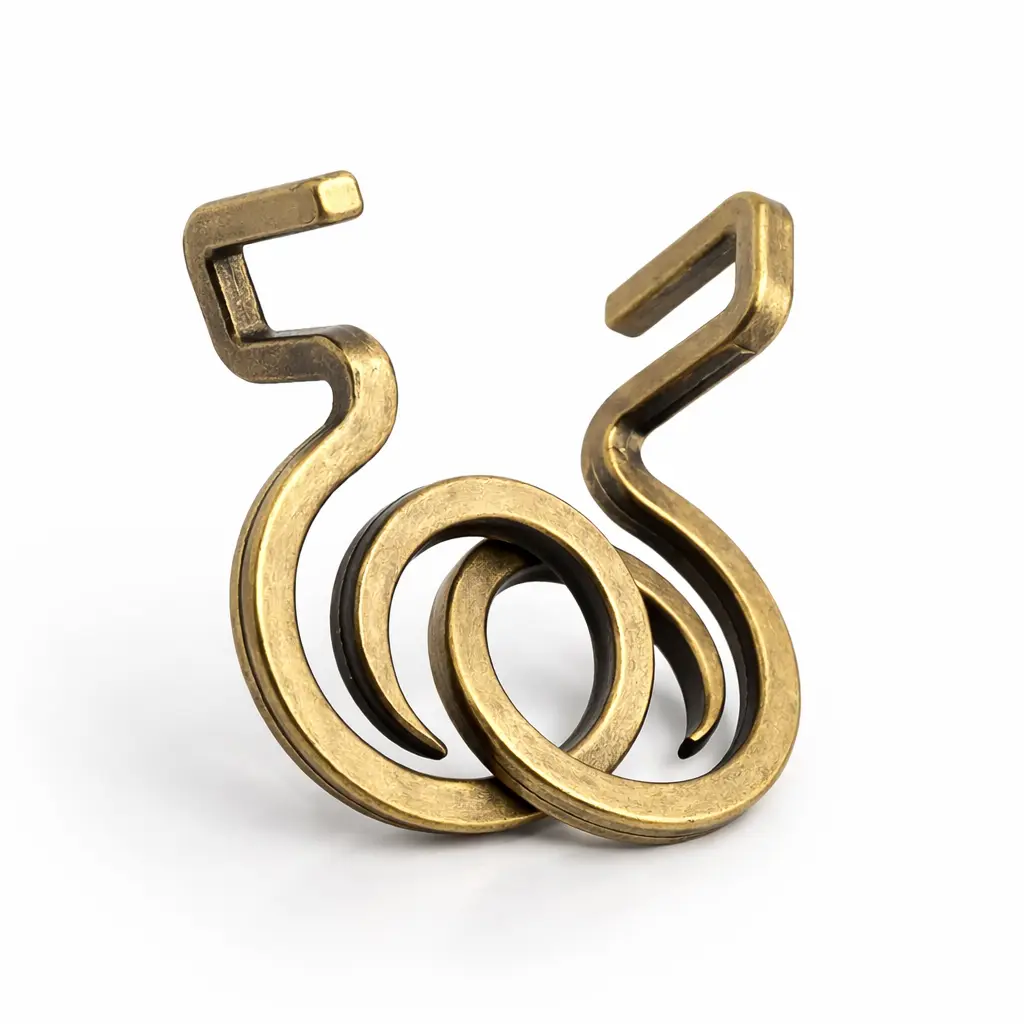
A piece like the Cast Hook (pictured above) serves this role perfectly. It looks deceptively simple—a hook, a ring—but its solve path involves a counterintuitive series of pivots. It’s a best brain teaser gift for adults who need their assumptions challenged. Pair it with a few easier puzzles from a mid-size set; the contrast itself is the lesson.
Remember the Difficulty Spectrum from earlier. Place your recipient on it. The 10-year-old likely belongs in the “5-minute fidget” range. The confident adult can be pitched into “hour-long struggle” territory. The gift’s success hinges on this calibration. A well-chosen set doesn’t just sit on a shelf; it initiates a quiet, personal dialogue between mind and metal.
The Hands-On Test: Fidget Factor, Solution Clarity, and Re-Solvability
So you’ve calibrated the gift or chosen your own curriculum—but how do these sets actually perform in hand? After a weekend of methodically testing three popular collections, the verdict hinges on three pillars: the immediate tactile feedback, the utility of the included instructions, and the elusive fidget factor. A high-quality set feels like a toolkit for your spatial reasoning, not a bag of frustrating scrap.
The primary differentiator between a frustrating trinket and a satisfying mechanism is finish. Cheaper zinc alloy casts often have microscopic burrs at the weld points—you’ll feel them as tiny, sharp catches. Better sets boast a burr-free finish, resulting in that smooth, cold slide—the faint schwick sound—that is so crucial to the experience. This isn’t just about safety; it’s about fluidity. When a move is correct, the feedback should be a seamless glide.
Then there are the solutions. Do the puzzles come with solutions? Almost always, yes. But their clarity varies. The best booklets use sequential, isometric diagrams that show the key transition clearly. The worst are single, crowded diagrams. For puzzles in the “weekend project” tier, these inadequate guides are a genuine roadblock. This is where the community fills the gap—a quick search for a puzzle’s name often leads to a clear video guide.
But the true test of a puzzle’s design is what happens after the first solve. This is the fidget factor. Some puzzles reveal a beautiful, almost meditative kinetic sequence. They invite you to solve and re-solve, enjoying the rhythm of the moves. These become perpetual desk toys, physical mantras for your hands. Others are one-and-done logic gates; the ‘aha’ is brilliant, but the solve path is so specific that re-solving feels like retracing steps in a dark room. In my testing, simpler two-piece tanglements had the highest re-playability.
This is also the core of the Hanayama vs wire puzzles divide. Hanayama’s cast metal puzzles are narrative objects—sculptural and thematic. A classic wire puzzle set is more like a language primer. The re-playability comes from the learning transferable ‘moves’ you master. The U-shape escape, the ring transfer, the controlled tumble: once your hands learn this grammar, you can approach any new wire puzzle with a repertoire of techniques. A good set teaches you how to think with your fingers.
The Final Disentanglement: Matching a Set to Your Goal (Our Strategic Picks)
The value of a puzzle set is measured not by its piece count, but by how its contents align with your purpose. After testing sets from compact 4-piece kits to 24-piece bulk packs, I can state that a curated 6-piece set often provides the optimal learning payoff for a dedicated beginner.
So, let’s translate our tactile and strategic findings into specific picks. Choose your teacher.
For The Absolute Beginner: The Confidence-Builder’s Toolkit
You’re the person with the sore thumb from the opening hook. Your primary need is to experience a clean, logical ‘aha!’ moment. Skip the large, cheap bulk packs with their erratic difficulty. Seek a smaller set (4 to 8 pieces) explicitly labeled for beginners. These focus on foundational tanglements. The goal here is to learn three or four core transferable moves. The metal should have a burr-free finish; your fingers are learning, and shouldn’t be fighting snags.
For The Deep-Dive Thinker: The Tactile Philosopher’s Collection
You don’t just want to solve; you want to study the solve path. You appreciate a fidget factor born of intricate manipulation. A mixed-difficulty set of 12-16 pieces is your arena. Look for a collection that includes a few infamous challenges alongside intermediate puzzles. Build quality is paramount. The slight heft and smooth slide of a well-plated zinc alloy become part of the meditation. Inspect user reviews for complaints about broken welds or tarnishing metal. For more on the history of these designs, see the Mechanical Puzzle Category Spotlight from IU Libraries.
For The Party Host or Educator: The Social Tangle Bundle
Your goal is volume and accessibility. A cheap wire puzzles bulk set of 24 is your workhorse. These are for icebreakers or classroom stations. Manage expectations: quality control is variable. Have a small metal file on hand to deburr any sharp ends. The hidden benefit here is sheer exposure; watching ten people tackle the same simple puzzle reveals ten different cognitive approaches. Prioritize sets that come in a durable puzzle set with pouch.
For The Gift-Giver: The One-Size-Fits-Most Safety Play
Refer back to our gifting scenarios. For the ‘Patient Niece’, a small beginner set is perfect. For the ‘Cocky Brother-in-Law’, a single, notoriously difficult hard metal wire puzzle is a better trophy than a whole set of easy wins. When in doubt, a mid-size set with a clear difficulty spread is the safest bet. It offers an on-ramp for curiosity and a peak to chase for confidence.
You are no longer just buying a tangle of metal. You are selecting a teacher, a party guest, or a focused challenge. You know to check the welds, to feel the finish, to judge a set by the progression it offers. So take that sore thumb as a badge of initiation. Now go choose the curriculum that will turn its twinge of frustration into the deeply satisfying schwick of a slide perfectly understood.