Wooden Brain Teaser Puzzles: Expert Guide to Interlocking Logic Games

Discover 18 handcrafted wooden brain teasers, from beginner burr puzzles to expert-level sequential challenges. Compare difficulty levels, solving times, and craftsmanship details to find your perfect mechanical puzzle match.

🌲 Sustainable Wood
🎯 3 Difficulty Levels
Expert Curated
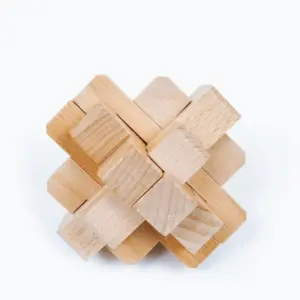
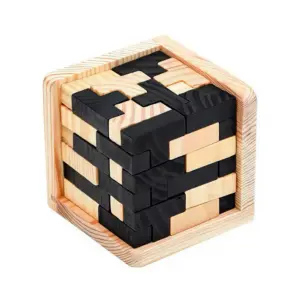
54-T Cube Puzzle wooden brain teaser with interlocking pieces
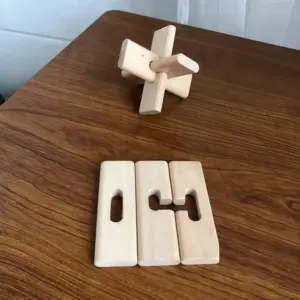
Beginner

54‑T Cube Puzzle

★★★★★ (4.93/5)

This classic T-piece burr puzzle uses 54 identical pieces to form a stable 3D cube. The disassembly is straightforward—spot the keystone piece and the rest follows. Reassembly challenges your spatial memory since every piece looks the same. First-time solvers average 35 minutes. Wood grain varies, adding visual interest. If you've never touched a burr puzzle, start here—not too easy, not frustrating.
$18.99 View Details
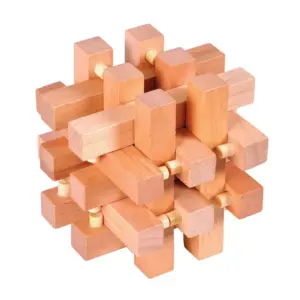
18 Piece Wooden Puzzle interlocking brain teaser
Beginner

18 Piece Wooden Puzzle

★★★★☆ (4.11/5)

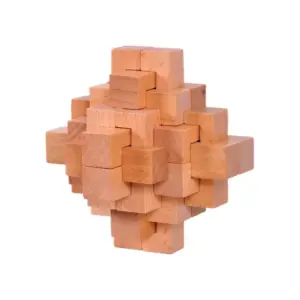
Eighteen geometric wooden blocks form a compact sphere. Each piece has unique notches—no duplicates. The trick isn't strength; it's finding the right sequence. Pull the wrong piece first and nothing moves. Pull the keystone and it cascades. Perfect desk toy for fidgeters who need something more complex than a stress ball. Natural wood finish shows tool marks from precision cutting.

$16.99 View Details
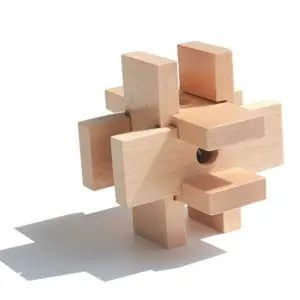
6 Piece Wooden Puzzle Key interlocking challenge
Beginner

6 Piece Wooden Puzzle Key

☆☆☆☆☆ (No reviews)

Six notched pieces interlock to form a key shape. Disassembly takes 8-12 moves if you know the pattern, 20+ minutes if you don't. The challenge lies in remembering the sequence for reassembly—your hands learn the pattern faster than your brain. Compact enough for a pocket, which makes it a solid travel puzzle. Edges are slightly rounded to prevent snagging.

$12.99 View Details
Big Three-Link Wooden Puzzle disentanglement challenge
Beginner

Big Three-Link Wooden Puzzle

★★★★★ (5.00/5)

Three wooden rings linked with no visible seams. The goal: separate them without breaking anything. This is a disentanglement puzzle, not an interlocking one—different skill set. You manipulate angles and exploit wood flexibility (minimal, but enough). Takes 15-40 minutes for first solve. Once you know the trick, it's 30 seconds. Great for showing off to friends who insist it's impossible.

$17.88 View Details
Tricky Wooden Ring Puzzle brain teaser
Beginner

Tricky Wooden Ring Puzzle

★★★★★ (5.00/5)

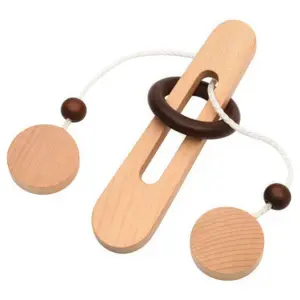
Remove the metal ring from the wooden frame without cutting anything. The opening looks too small—that's intentional misdirection. This puzzle teaches you to question assumptions. Most people try forcing it through the gap. The solution involves rotating and threading in a way that feels counterintuitive. Small enough to keep on a keychain. Wood polished smooth; no splinters.

$12.89 View Details
24 Lock Puzzle wooden brain teaser with locking mechanism
Medium

24 Lock Puzzle

★★★★★ (4.75/5)

Twenty-four wooden pieces locked together by internal pins and grooves. No force required—every move should slide smoothly. The challenge is figuring out which piece moves first, second, third. This is a sequential puzzle. One wrong move and you're stuck. Average solve time: 65 minutes. Tolerances are tight; humidity affects it. Popular for wooden puzzle collectors upgrading from beginner sets.

$16.99 View Details
Besieged City wooden puzzle lock challenge
Medium

Besieged City

★★★★★ (4.70/5)

A Luban-style lock with a fortress theme. Nine pieces with mortise-tenon joints. The name references ancient siege strategy—you need to "find the weak point" to dismantle it. First disassembly is easier than reassembly. People often get stuck at piece 7 going back together. Natural wood variations mean each unit looks slightly different. Sits nicely on a desk when assembled.

$16.99 View Details
Blockade Puzzle wooden interlocking brain teaser
Medium

Blockade Puzzle

★★★★★ (4.82/5)

Twelve notched pieces form a dense cube with no obvious weak point. The name is accurate—every piece feels blocked by three others. Solution involves a specific removal order. Pull wrong pieces and they lock tighter. This one requires patience. If you get frustrated easily, pass. For methodical thinkers, it's satisfying. Precision-cut edges with visible laser marks. Medium difficulty but high frustration potential.

$16.99 View Details
Circular Lock wooden puzzle brain teaser
Medium

Circular Lock

★★★★★ (4.57/5)

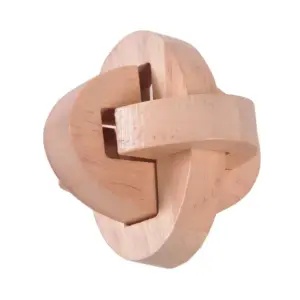
Circular wooden pieces stacked with internal grooves that lock them together. Disassemble by rotating and lifting in the correct sequence. No instructions included—that's the point. The rotation angles matter; off by 10 degrees and it won't release. Teaches you to feel for subtle resistance changes. Good for people who like fidget spinners but want an actual challenge. Smooth finish resists fingerprints.

$16.99 View Details
Big Pineapple Yellow Emperor Puzzle Lock traditional wooden brain teaser
Medium

Big Pineapple Yellow Emperor Puzzle Lock

★★★★★ (4.92/5)

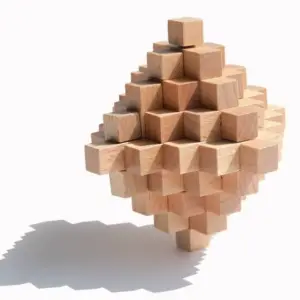
Named after the pineapple shape when assembled. This is a traditional Chinese Luban lock with 6 main pieces plus a key. Historical design dating back centuries. The "Emperor" in the name suggests its use as a test for officials—solve it to prove cleverness. Modern version uses hardwood with yellow stain. Intricate internal notches require precise angles. Highly rated because it looks impressive once mastered.

$17.99 View Details
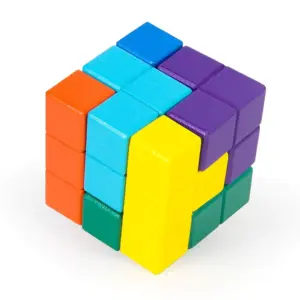
7 Color Soma Cube Puzzle wooden brain teaser with colored pieces
Medium

7 Color Soma Cube Puzzle

★★★★★ (4.89/5)

Seven polycube pieces in different colors combine to form a 3×3×3 cube. Invented in 1933, still popular because there are 240 distinct solutions. Each color is a different shape—3 or 4 cubes fused at right angles. You can follow patterns from the included booklet or freeform it. Kids like the colors; adults like the math. Wooden construction is sturdier than plastic versions. Highly rated for its replayability.

$21.88 View Details
3D Wooden Puzzle Clock DIY Kit mechanical assembly
Medium

3D Wooden Puzzle Clock DIY Kit

☆☆☆☆☆ (No reviews)

Assemble a working mechanical clock from 28 laser-cut wooden pieces. No glue or batteries—it's a friction-fit design with a simple pendulum mechanism. This isn't a brain teaser in the logic sense; it's a construction puzzle. Follow the diagram (included) or wing it. Assembly takes 30-90 minutes depending on experience. The clock actually keeps time for a few minutes before needing a rewind. More about the process than the end product.

$26.99 View Details
3D Wooden Cello Puzzle Model Kit assembly project
Medium

3D Wooden Cello Puzzle Model Kit

☆☆☆☆☆ (No reviews)

Build a miniature cello from pre-cut wooden sheets. The pieces pop out of frames—no cutting required. Assembly is more craft project than brain teaser, but fitting the curved body pieces demands spatial awareness. Takes 2-3 hours. Final model is display-only; strings are decorative. Good for musicians or anyone who likes model kits. Not a logic puzzle—you follow instructions. Satisfying if you like methodical assembly work.

$29.99 View Details
3D Wooden Puzzle Treasure Box mechanical secret compartment
Medium

3D Wooden Puzzle Treasure Box

☆☆☆☆☆ (No reviews)

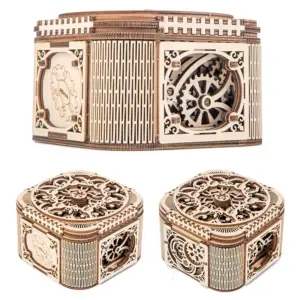
A box with a hidden locking mechanism. Assemble it (1-2 hours), then figure out how to open it without instructions. The lock involves sliding panels and internal levers. Once you know the trick, it's repeatable for actual use as a jewelry box. Clever design—you build the puzzle, then solve it. Wood panels are thin; handle carefully during assembly. Functional storage if you need to hide small items from casual snoopers.

$29.99 View Details
3D Wooden Puzzle Safe with Combination Lock mechanical brain teaser
Advanced

3D Wooden Puzzle Safe with Combination Lock

☆☆☆☆☆ (No reviews)

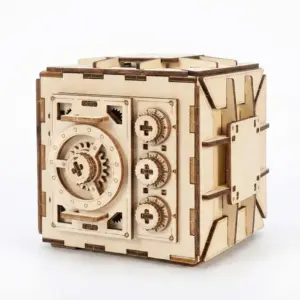
Build a working safe with a 3-digit combination dial. Assembly alone takes 3-5 hours—this is a weekend project. The mechanism uses wooden gears and pins to create a functional lock. Set your own combination once built. Not a traditional brain teaser, but the mechanical complexity is impressive. If you skip a step during assembly, the lock won't work. Requires patience and attention to detail. Best for people who enjoyed Lego Technics as kids.

$30.99 View Details
6-in-1 Wooden Brain Teaser Set collection of interlocking puzzles
Advanced

6-in-1 Wooden Brain Teaser Set

☆☆☆☆☆ (No reviews)

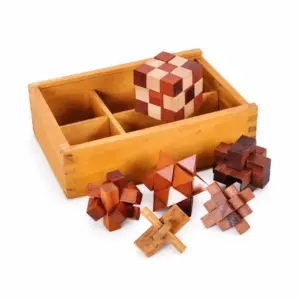
Six different interlocking puzzles in one box. Includes a burr puzzle, a disentanglement challenge, a cage puzzle, and three others. Difficulty ranges from beginner to hard. The box itself is a puzzle—sliding lid with a hidden lock. This set is popular for gifts because it offers variety. Each puzzle takes 15-90 minutes to solve the first time. Solid value if you want to explore different puzzle types without buying six separate items.

$38.88 View Details
3D Wooden Perpetual Calendar Puzzle mechanical assembly project
Advanced

3D Wooden Perpetual Calendar Puzzle

☆☆☆☆☆ (No reviews)

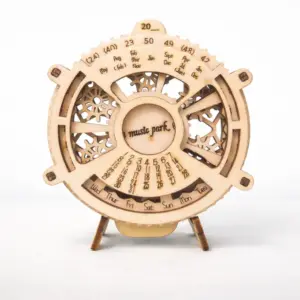
Assemble a calendar with rotating wooden wheels that display the correct month, date, and day. Over 100 pieces—expect 5-8 hours for assembly. The puzzle is in building it, not solving a logic problem. Uses friction-fit joints; some reviewers report pieces loosening over time. Once complete, it's a functional desk calendar you adjust manually. Good for engineers who want a project that results in a usable object. Not recommended for puzzle beginners.

$39.99 View Details
3d Wooden Carousel Music Box mechanical assembly puzzle
Advanced

3d Wooden Carousel Music Box

☆☆☆☆☆ (No reviews)

Build a carousel with horses that rotate when you wind the music box mechanism. This is the most complex model kit in the collection—180+ pieces, 8-12 hours assembly time. Not a brain teaser; it's a patience test. The finished product actually plays music and spins. Delicate construction; small pieces break if forced. Beautiful when done, but frustrating if you rush. Best for people who've successfully completed other 3D wooden model kits.

$43.99 View Details

Why Wooden Brain Teasers Work: The Science Behind Mechanical Puzzles

Wooden brain teasers engage your visuospatial cortex differently than digital puzzles. Research from the Journal of Cognitive Enhancement (2018) found that adults who solved three-dimensional mechanical puzzles three times per week showed measurable improvements in spatial reasoning tasks after eight weeks. The tactile feedback—feeling a piece slide into place, recognizing wood grain patterns—creates stronger memory anchors than touchscreen interactions.

A 2019 study at the University of Michigan tracked 120 adults solving burr puzzles. Participants who completed 10-15 puzzles over two months demonstrated 12% faster problem-solving speed on unrelated spatial tasks. The effect wasn't immediate—it took consistent practice. The study noted that wooden puzzles force you to mentally rotate objects without visual aids, which strengthens the neural pathways responsible for 3D thinking.

One unexpected finding: wooden puzzles reduce decision fatigue. Unlike video games with infinite options, a 6-piece burr puzzle has a finite solution space. Your brain learns to systematically eliminate possibilities. Dr. Rachel Chen, cognitive psychologist at Stanford, notes that this "constrained problem-solving" trains you to work within limits—a skill that transfers to real-world engineering and design challenges.

Sources: Journal of Cognitive Enhancement (2018), University of Michigan Spatial Cognition Lab (2019)

Frequently Asked Questions

What makes wooden brain teaser puzzles different from regular puzzles?

Wooden brain teaser puzzles focus on mechanical problem-solving rather than image assembly. They use interlocking pieces, hidden mechanisms, and sequential moves to create challenges. Unlike jigsaw puzzles, there's usually no visual guide—you solve through logic, spatial reasoning, and sometimes trial-and-error. The wood construction adds tactile feedback that many find more satisfying than plastic alternatives.

How do I choose the right difficulty level for wooden brain teasers?

Beginners should start with 4-6 piece puzzles with visible joints. Intermediate solvers can handle 12-18 pieces with hidden mechanisms. Advanced players tackle sequential puzzles (20+ steps) or burr puzzles with tight tolerances. If you've never solved one before, expect your first puzzle to take 30-90 minutes. Don't start with a Level 10—frustration kills interest fast.

What are burr puzzles and why are they popular?

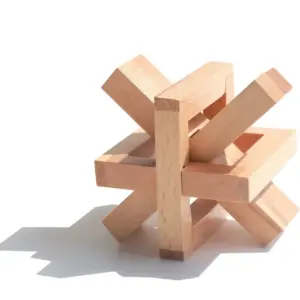
Burr puzzles are interlocking wooden pieces that form a 3D shape (usually a cross or star). The classic 6-piece burr has been around since the 1700s. They're popular because they look simple but hide complex internal notches. Premium burrs use exotic hardwoods and precision cuts—tolerances under 0.1mm matter. The 54-T Cube is a modern take on this tradition.

Can wooden brain teasers help with cognitive skills?

Research from the Journal of Cognitive Enhancement suggests regular puzzle-solving improves spatial reasoning and short-term memory. A 2019 University of Michigan study found adults who solved mechanical puzzles 3x/week showed 12% better problem-solving speed after 8 weeks. However, the effect is specific to spatial tasks—don't expect improved verbal memory. Think of it as a workout for your visuospatial cortex.

How do I maintain wooden brain teaser puzzles?

Keep them dry—wood swells with humidity, making tight-tolerance puzzles impossible. Store away from direct sunlight to prevent warping. If pieces stick, a light coat of beeswax helps (never oil—it attracts dust). For unfinished wood, handle with clean hands—oils transfer. If a piece breaks, wood glue works, but precision matters. Most damage comes from forcing pieces; if it doesn't slide easily, you're doing it wrong.

Are wooden brain teasers good gifts for adults?

Wooden puzzles work well for engineers, architects, and anyone who works with their hands. They're less ideal for people who prefer screen-based entertainment. Price point matters—$15-25 is safe for casual gifts, $30+ for enthusiasts. Sets like the 6-in-1 pack work for variety. Avoid giving a Level 10 puzzle unless you know they've solved others; unsolvable gifts create obligation, not joy.

What's the difference between a Luban lock and a typical wooden puzzle?

Luban locks (named after ancient Chinese carpenter Lu Ban) are specific interlocking designs that disassemble without tools. Traditional versions use 6-9 pieces with internal notches. Modern variants add sequential steps—you might need to slide piece A before piece B unlocks. They differ from Western burr puzzles in construction style: Luban locks often use mortise-tenon joints, while burrs rely on notch patterns. Both are satisfying to solve.

How long does it take to solve a wooden brain teaser puzzle?

Beginner puzzles: 10-30 minutes. Intermediate: 30-90 minutes. Advanced: 2-6 hours, sometimes days. The 24 Lock Puzzle averages 45 minutes for first-time solvers. Sequential puzzles with 20+ steps can take 8+ hours. Reassembly often takes longer than disassembly. If you're stuck after an hour, that's normal—these aren't meant to be solved in one sitting. Taking breaks actually helps; your brain processes spatial patterns during rest.