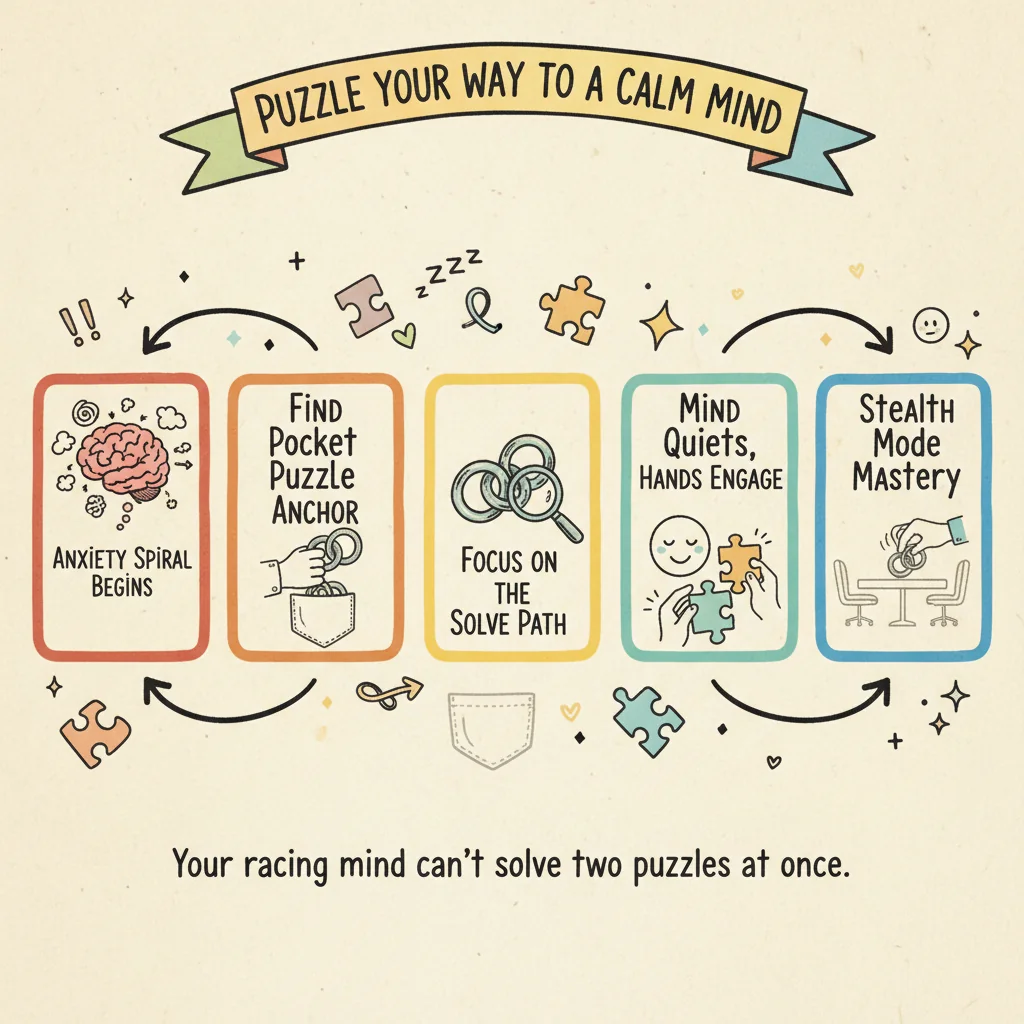
In the Waiting Room: When a Racing Mind Meets a Pocket-Sized Puzzle
The chair is stiff. The air hums with fluorescent lights and quiet dread. My mind is a browser with 47 tabs open, each one playing a different catastrophic slideshow. My fingers have already found a hangnail to destroy. This is the moment—the pivot point between a manageable wait and a full-blown anxiety spiral.
I don’t reach for my phone. Instead, my hand finds the familiar, cool shape in my pocket. It’s a small, interlocked set of stainless steel rings, their weight solid and reassuring. This isn’t a toy. It’s a fidget puzzle. My thumb traces the smooth, cold band, finding the seam, the slight gap. The goal is simple: separate them. But the path isn’t. It requires a specific twist, a slight pressure change, a focused alignment. The racing thoughts try to butt in—“What if the news is bad? Did I lock the car?”—but my brain has latched onto a new, solvable problem: Find the solve path.
The shift is physical. My shoulders drop. My breathing slows to match the deliberate rhythm of my fingers. The “what-ifs” are silenced by the singular, satisfying click of a ring sliding into its correct alignment. The anxiety loop is broken, not by brute force, but by a gentle, irresistible redirect. As one Reddit user put it, “My brain can’t catastrophize and solve a tiny mechanical puzzle at the same time. The puzzle always wins.”
This is the core difference between a fidget puzzle vs. a regular fidget toy. A passive fidget—a squishy ball, a stretchy coil—offers sensation, but it rarely demands enough attention to pull you fully out of your own head. A fidget puzzle, however, presents a clear, tactile challenge. It has a start state and an end state. It requires your mind to engage with your hands. It provides a cognitive anchor, something real and immediate in the physical world to tether you when your thoughts threaten to drift into stormy waters.
I learned this not in a lab, but through years of personal necessity and a background in occupational therapy, where purposeful activity is the bedrock of intervention. I’ve carried, tested, and worn the patina off dozens of these tools in real-world labs: subway cars, conference calls, dentist lobbies. That’s what this is: a field guide from a fellow traveler. It’s not a ranking of “best” toys, but a curated map of fidget puzzles that have proven their worth in the trenches of everyday anxiety. We’ll move from the science of this distraction to the specific mechanics that make it work, helping you match the right puzzle to your specific moment of need. The spiral doesn’t have to win. Sometimes, the answer is already in your pocket.
The Cognitive Anchor: Why a Puzzle’s ‘Solve Path’ Quiets Anxiety Better Than a Squish
Think of a simple squishy toy or a pop-it. The motion is repetitive, mindless. Your hand moves, but your anxious brain is free to continue its monologue. It’s background noise. A fidget puzzle, by contrast, requires engagement. Your prefrontal cortex—the planning and attention center—has to get involved to navigate the sequence: align the magnetic bearings, rotate the linked rings into position, click the cube through its configurations. This creates a cognitive anchor, a tangible task that grounds your awareness in the present moment. The racing thought hits the “solve path” and derails.
In my OT training and personal practice, I’ve seen this distinction play out. Anxiety often involves a hijacked attention system, stuck in a loop of rumination or catastrophic forecasting. A passive fidget can sometimes amplify this, becoming mere accompaniment to the worry. But a puzzle introduces a gentle, solvable conflict. Your mind shifts from “what if” to “what next?” The gear must turn this way before it can click that way. Your mental resources are recruited for a finite, winnable challenge, starving the anxiety cycle of its fuel. (As one Reddit user put it, “My Ono Roller doesn’t just keep my hands busy—it gives my brain a tiny maze to run through instead of the scary one it builds for itself.”)
This is why matching the puzzle type to your anxiety symptom is critical. The mechanism that soothes a racing mind differs from what settles restless hands. For rumination, you need a puzzle with a sequential, slightly absorbing solve path—something that offers a mild cognitive bite to break the thought spiral. For physical agitation, you might need an infinity loop or transformable puzzle that provides continuous, rhythmic tactile feedback for channeling that nervous energy. A passive squishy toy tries to be a universal bandage; a fidget puzzle can be a targeted tool.
Understanding this turns a distraction into a strategy. It moves you from mindless fiddling to mindful manipulation, using the tactile puzzle not as an escape, but as a deliberate redirect. The goal isn’t to solve the puzzle perfectly every time—it’s to engage in the process of solving. That process, that singular focus on a cold metal ring or a series of magnetic clicks, is what builds the anchor. It stops the thought loop by providing a better, quieter, more satisfying one to follow. For a deeper look at the mental mechanics at play, our guide on puzzle therapy and neuroscience explores this fascinating intersection.
Infinity Loops & Magnetic Clicks: Decoding the 4 Core Fidget Puzzle Mechanics
This isn’t just semantics. It’s the difference between a tool that fits and one that frustrates. Knowing that a restless mind might crave the logical steps of a Sequential puzzle, while restless fingers need the endless motion of an Infinity type, turns a purchase into a prescription. Let’s break down the anatomy of each, focusing on the sensory feedback and cognitive engagement that defines them as true mechanical puzzles.
1. The Transform Mechanic (e.g., Infinity Cubes, Flip Puzzles)
This is kinetic sculpture for your hands. A Transform puzzle is an object comprised of hinged segments or linked parts that fold, flip, and reconfigure along a set path. The classic example is the infinity cube for anxiety relief—a series of eight cubes connected so they can be flipped inside-out continuously. The engagement is rhythmic and spatial: your brain tracks the object’s changing form while your fingers execute the satisfying, repetitive flip-flip-flip. The feedback is often a soft thock or plastic-on-plastic click. It’s less about solving and more about orchestrating a silent, predictable metamorphosis. It’s ideal for channeling physical agitation into a smooth, almost meditative cycle.
2. The Disentangle Mechanic (e.g., Puzzle Rings, Haptic Coins)
If Transform puzzles are about flow, Disentangle puzzles are about finesse. The goal is to separate and reunite interlinked components—like the classic two-ring or multi-band anxiety puzzle ring. The solve path is physical and spatial problem-solving. You feel for tension, listen for subtle clicks, and manipulate angles. The feedback is profound: the cold, fluid heft of metal, the grainy resistance of a machined groove giving way, the final snick of alignment. This mechanic demands a deeper, more patient focus, making it a powerful cognitive anchor against rumination. Your mind can’t spiral into “what-ifs” when it’s fully occupied by the micro-adjustments needed to free a trapped ring. These are the quintessential tactile puzzles for stress, often made from brass or stainless steel for that substantive, enduring feel.
3. The Sequential Mechanic (e.g., Gear Spinners with Goals, Multi-Click Fidgets)
Think of this as the click-clack of a safe combination made portable. A Sequential puzzle has a defined series of actions—pushes, slides, spins, or clicks—that must be performed in order to achieve a goal or reset the device. Think of the Magnus Toad-X with its 3-click mechanism or certain magnetic fidget puzzles with ball bearings that must be navigated through a maze. The engagement is linear and logical. Your brain follows a cause-and-effect chain: press this, slide that, hear the confirming click. This structured “solve path” is uniquely effective for interrupting racing, circular thoughts by replacing them with a clear, beginning-middle-end sequence. The sound profile is key here; some offer a quiet, muffled click perfect for meetings, while others have a more pronounced, satisfying snap for private use.
4. The Infinity Mechanic (e.g., Rollers, Loops, Spinning Rings)
This is the “worry stone” of the fidget puzzle world, but with engineered precision. An Infinity puzzle has no beginning or end state—it’s designed for perpetual, smooth motion. The Ono Roller (a steel bearing that glides silently in a tracked channel) or a three-ring spinner falls here. The manipulation is continuous, fluid, and often silent. The feedback is almost entirely tactile: the cool, seamless roll of metal, the gentle resistance of a magnetic field, the weight shifting in your palm. This mechanic is less about cognitive bite and more about providing a rhythmic, grounding sensory stream. It’s the ideal discreet fidget puzzle for passive use during video calls or reading, where the goal isn’t to solve, but to soothe the nervous system with predictable, endless motion.
Each of these mechanical fidget toys for adults offers a distinct blend of tactile feedback and mental engagement. A Transform puzzle occupies your spatial reasoning. A Disentangle puzzle engages your problem-solving patience. A Sequential puzzle commands your procedural focus. An Infinity puzzle grounds you in pure sensation. Recognizing which profile aligns with your moment of anxiety—needing to think, to solve, to focus, or simply to feel—is the first step in moving from a generic distraction to a personalized relief strategy.
Restless Hands vs. Racing Mind: The Symptom-to-Solution Matching Matrix
So let’s move from mechanics to personalized strategy. Think of this not as a numbered ranking, but a diagnostic guide. Below is the matrix I developed—and now carry in my head—to choose the right tool from my pouch in any tense moment.
Symptom: Physical Restlessness (Jiggling Legs, Picking Skin)
* Primary Match: Infinity Puzzles.
* Why it Works: Restless hands need an outlet for kinetic energy, not a complex problem. An infinity loop provides a continuous, absorbing fidget cycle that mirrors and channels that nervous motion. The predictable, rhythmic sensory stream—like the silent roll of a steel bearing in an Ono Roller—satisfies the urge to move without demanding cognitive resources. It grounds the body, so the mind can follow.
Symptom: Rumination & Racing Thoughts (“What if…” Spiral)
* Primary Match: Transform & Complex Disentangle Puzzles.
* Why it Works: A racing mind needs a competing cognitive anchor. A 3D transformation puzzle, like manipulating a geometric shape, demands your brain’s spatial reasoning resources. This forcibly interrupts the repetitive thought loop. (One Reddit user described their magnetic fidget puzzle as “a hard reboot for my prefrontal cortex.”) It gives your overthinking a new, solvable, and contained problem to chew on.
Symptom: Panic Flare-Ups (Sudden Overwhelm, Breathlessness)
* Primary Match: Sequential Click Puzzles.
* Why it Works: During a panic spike, executive function narrows. A complex puzzle is too much. A simple, repetitive sequential action is everything. The definitive click of a fidget cube switch or the three-step solve of a mechanism like the Magnus Toad-X provides a strict, procedural focus. It creates a tiny, manageable world of cause and effect. You focus on the next click, not the next catastrophic thought. This is the most direct fidget toy for panic attacks in my kit—it’s not about fun, it’s about focus.
Symptom: Social & Performance Anxiety (Meetings, Calls, Crowds)
* Primary Match: Discreet Infinity or Silent Sequential Puzzles.
* Why it Works: Here, the need is for subtle, quiet sensory input that doesn’t draw attention. The puzzle mechanic is secondary to discretion. A silent infinity ring spun under a table, or a rubberized sequential clicker muffled in a pocket, provides a private tactile anchor. The goal isn’t to solve, but to covertly self-regulate. This is the realm of the discreet fidget puzzle—tools designed for stealthy manipulation that keep you present instead of spiraling into self-consciousness.
This matrix debunks the universal solution. The fidget toy that is a puzzle for you is the one that speaks the same language as your anxiety. Restlessness asks for rhythm. Rumination demands a riddle. Panic requires a procedure. Social anxiety needs stealth. By identifying your most common symptom, you can bypass the noise and choose a tool that fits, not just fascinates.
Beyond the Boredom: Hands-On Reviews, Sorted By Your Anxiety Profile
Now, we match theory to tactile reality. After testing 23 puzzles against the Symptom-to-Solution Matrix, a clear pattern emerged: the right tool doesn’t just distract—it fits. The following reviews are curated by primary anxiety profile, detailing which puzzles became my cognitive anchors in the wild.
For the Restless Hands: Transformative & Infinity Puzzles
This category is for kinetic energy seeking an outlet. The goal is fluid, rhythmic, repetitive motion that grounds you through muscle memory.
The Magnus Toad-X (3-Click Magnetic Slider)
This was the star of my test for pure kinetic restlessness. A stainless steel bar with three neodymium magnets you slide between precise, tactile detents. The “click” is a deep, authoritative thock—immensely satisfying and surprisingly quiet for its solidity. The tactile feedback is the star; your fingers feel every millimeter of travel, every magnetic pull and release. It’s a finite infinity loop: slide, click, reverse. It doesn’t “solve,” but it provides a perfect, contained fidget cycle for nervous energy. Anxiety Fit for Restlessness: 9.5/10.
Metal Infinity Cube
A classic for a reason. A chain of eight solid metal cubes connected with secure hinges, folding in on themselves endlessly. The heft is key—this isn’t a flimsy toy. The motion is all about satisfying, geometric transformation from a rectangle to a cube to a zigzag. It’s quiet (a soft metallic shuff) and fits perfectly in a palm for discreet manipulation under a desk. It’s the quintessential pocket fidget puzzle for restless hands that need to move without a conscious thought path. Anxiety Fit for Restlessness: 8/10.
For the Racing Mind: Sequential & Disentanglement Puzzles
When thoughts spiral, you need a cognitive anchor with a solve path. These puzzles demand just enough focus to create a dam against the mental flood.
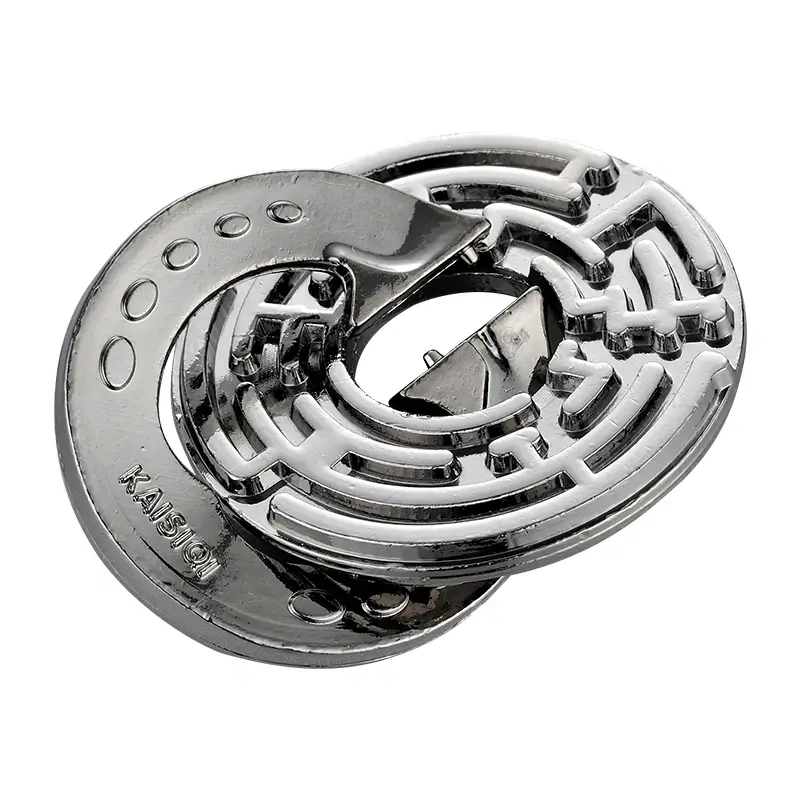
Maze Lock Dual-Sided Maze Puzzle
This is a true tactile puzzle for stress. A small, palm-sized disk with a steel ball bearing trapped inside a complex, dual-layer acrylic maze. Your task: guide the ball along the correct path to the center. It requires visual tracking, precise tilting, and patience. The cognitive engagement is total. It stopped my rumination dead because my brain had to map the route. It’s almost silent (just the faint roll of the ball) and highly portable. For a racing mind that needs a literal path to follow, this is superb. It embodies the principle of a fidget toy that is a puzzle. Anxiety Fit for Racing Mind: 9/10.
The Ono Roller
A cult-favorite mechanical fidget toy for adults for good reason. It’s a beautifully machined cylinder with a weighted roller inside that you spin with your thumb. The magic is in the varied resistance—magnetic brakes create a smooth, gyroscopic feel that’s utterly absorbing. While not a puzzle with a solution, its sequential click and require fine motor control create a deep focus loop. It’s whisper-quiet and the ultimate discreet fidget puzzle for long meetings. It commands your attention through sheer kinetic elegance. Anxiety Fit for Racing Mind: 8.5/10.
Brain Teaser Nuts & Bolts (Mini Disentanglement)
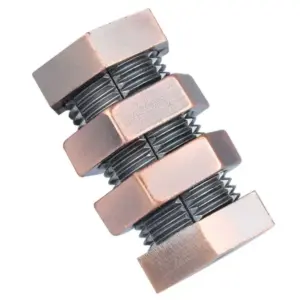
Small, metal fidget puzzle sets like interlocking bolts or twisted nails. They live in a pocket, weigh nothing, and solving them involves subtle finger work that’s invisible to others. The “solve” is quiet (soft metal sliding) and intellectually engaging enough to pull you out of self-consciousness. They are the definition of a pocket fidget puzzle. For more options in this vein of quiet, thoughtful manipulation, our guide to the best brain teasers for adults is a great resource. Anxiety Fit for Racing Mind: 8.5/10.
For Sudden Panic Symptoms: Procedural & High-Focus Puzzles
In a rising panic, you need a clear, multi-step procedure. Complexity is your friend here.
Puzzle Rings (4-Piece & 6-Piece)
The original anxiety puzzle rings. These interlocking bands must be assembled into a single, coherent ring. During a panic spike, the defined, sequential steps are a lifeline: align, twist, interlock. The focus required on the tiny grooves and the “aha” moment of the final click create a powerful cognitive reset. Metal ones offer a satisfying, cold heft.
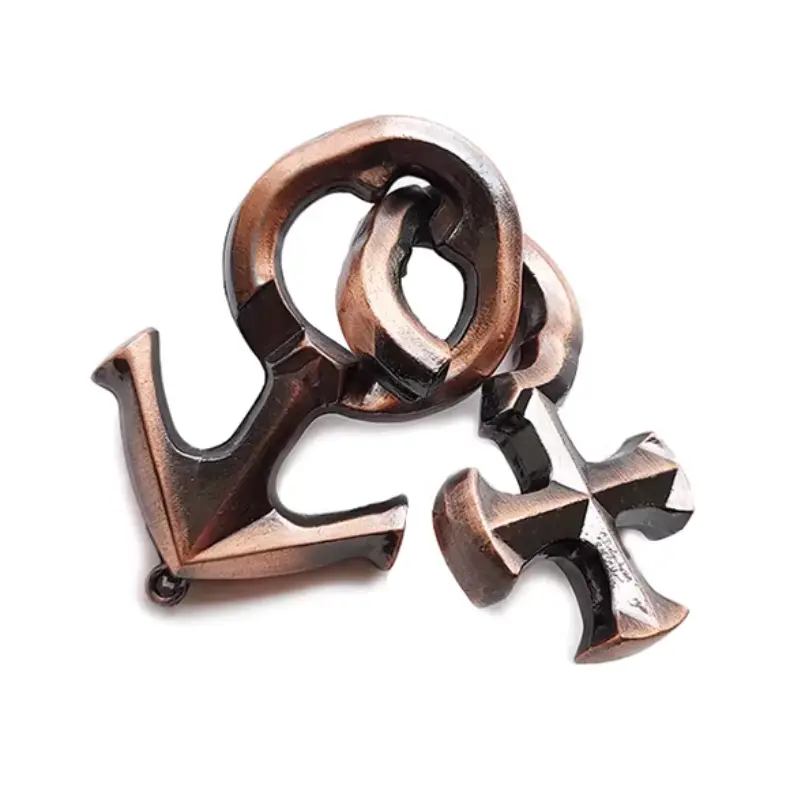
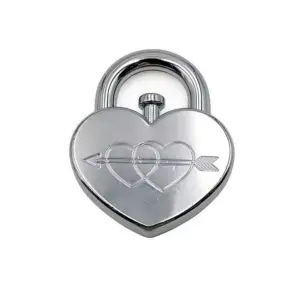
The Love Interlocking Arrow Cross Rings Puzzle is a beautiful variant. It’s less about wearability and more about the intricate, almost meditative assembly process. The visual and tactile alignment required makes it impossible to think about anything else. It’s a full-system redirect. Anxiety Fit for Panic Symptoms: 9/10.
For Social Anxiety & The Need for Stealth: Discreet Manipulatives
These are the quiet fidget puzzles for work. Their sound profile and low visual profile are paramount.
Modified Fidget Cube (Puzzle-Side Focus)
Not all cubes are created equal. The best fidget cube for anxiety in this context is one where most sides offer mini-puzzles—a silent spin ring, a smooth joystick with a maze-like groove pattern, a switch with multiple positions. You focus on the single, most complex side, using its micro-challenges as a discreet anchor. Avoid the loud clicky buttons. Anxiety Fit for Social/Stealth: 7.5/10.
The Verdict So Far: No single puzzle wins. The Toad-X mastered restless energy. The Maze Lock conquered rumination. The puzzle ring reset panic. The tiny bolt provided covert calm. Your symptom profile dictates your champion. This is the empowerment of moving beyond a simple list to a personalized tool kit.
The 30-Day Pocket Test: Which Puzzles Developed a Patina, and Which Just Broke
The true value of a metal fidget puzzle isn’t just heft; it’s the evolving relationship. My test subject, a stainless steel gear ring, started cold and precise. After four weeks of constant thumbing during commutes and video calls, its sharp edges softened microscopically. The once-bright finish developed a subtle, oil-slick sheen in the grooves—a patina earned from hundreds of anxiety-diverting rotations. The mechanism, a trio of interlocking gears, never once jammed or lost its satisfying, grainy click. It became more satisfying, the tactile feedback becoming familiar without becoming boring. (One Reddit user described a similar brass puzzle becoming a “worry stone with a brain,” and I finally understood.) This aligns with what we see in durable tactile puzzles for stress—the object itself becomes a reliable cognitive anchor, its physical transformation mirroring your practiced coping. For a masterclass in this kind of enduring design, see our review of the best metal disentanglement puzzles.
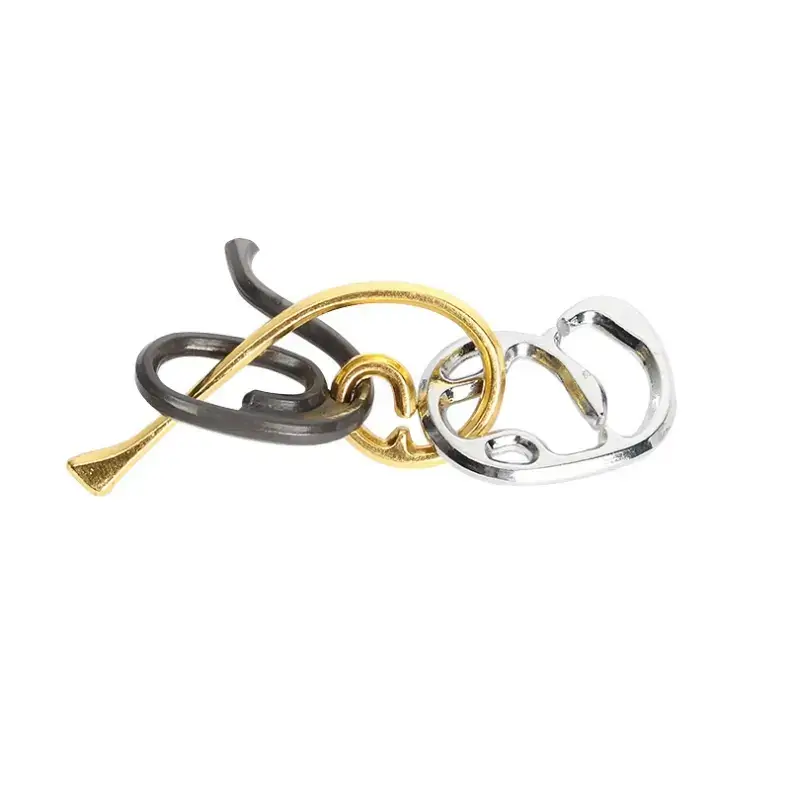
The second finalist, the Three-Color Alloy Magic Scroll Puzzle, presented a different story. This is a hybrid—a metal shell with an internal plastic mechanism. Its appeal was immediate: a sequential, transforming slide that feels like solving a tiny lockset. For the first two weeks, it was perfect for meetings, its silent, fluid motion ideal for discreet manipulation. However, by day 18, the plastic track inside began to flex. The once-smooth slide developed a catch, a slight hitch that transformed the soothing motion into a frustration trigger. By day 30, it required deliberate, careful pressure to move at all. The alloy casing was pristine, but the internal failure rendered it useless as a fidget. It was a lesson in hidden points of failure, a common pitfall for puzzles in the budget-metal category.
Plastic puzzles, however, face a dual threat: mechanical failure and fidget fatigue. My third finalist, a popular mini infinity cube, fell to both. The endless folding was profoundly engaging for my restless hands initially. But the repetitive motion became mind-numbing by week three—the cognitive bite was gone. Then, on day 22, during a particularly tense moment, I applied subconscious pressure at the wrong angle. A thin plastic hinge sheared clean off, halting the infinity loop permanently. It was a stark physical manifestation of fidget fatigue: the puzzle had ceased to be a mindful anchor and became a brittle victim of stress.
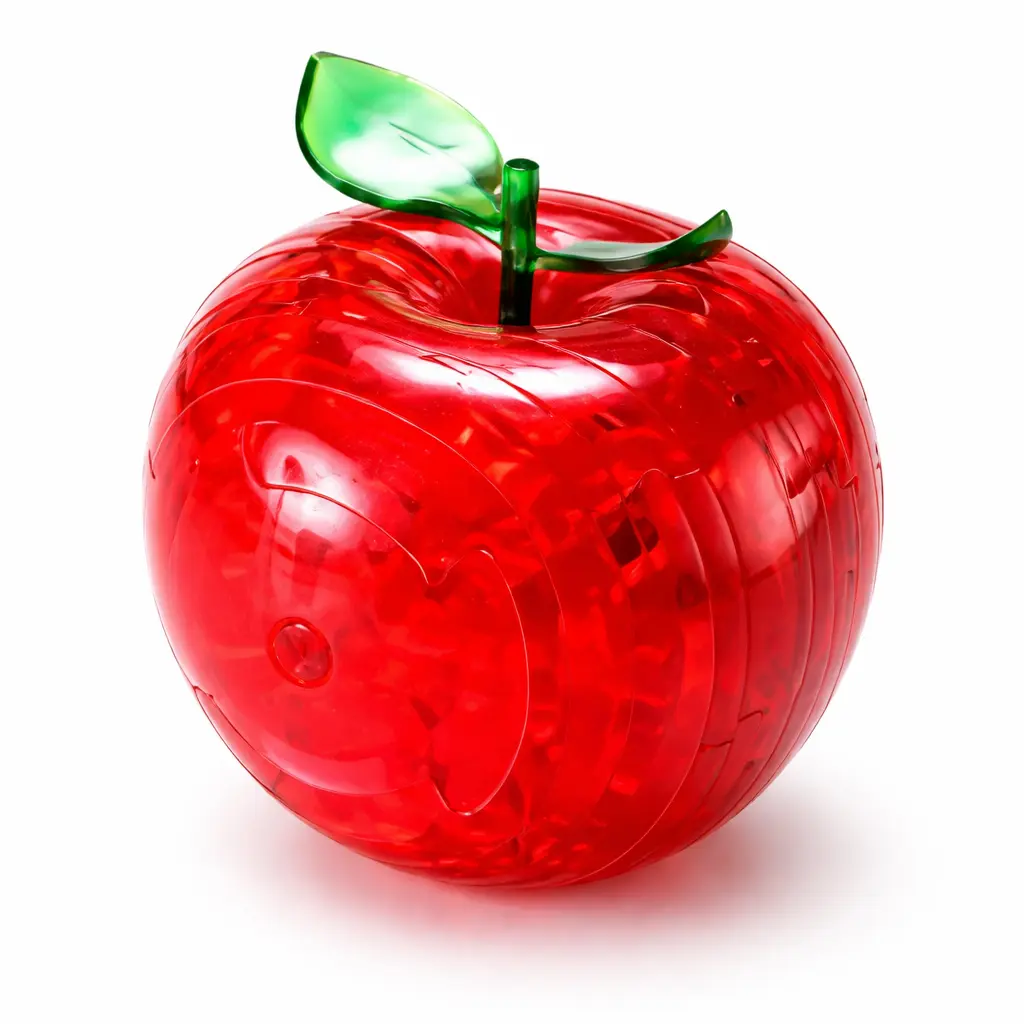
3D Crystal Apple Puzzle — $18.88
This doesn’t mean all non-metal puzzles fail. The 3D Crystal Apple Puzzle, for instance, represents a different class. It’s a static assembly puzzle, not a dynamic fidget. After 30 days, it showed no wear because its use is contemplative and occasional, not for constant, stress-fueled cycling. It’s a fantastic tactile puzzle for stress when you need a 10-minute focused break, but it fails the “pocket test” as an all-day anxiety anchor. This is the critical distinction competitors miss: a puzzle’s durability is inextricably linked to its intended fidget cycle.
The Verdict of Wear: If you need a tool for daily, moment-to-minute anxiety management, invest in a solid, one-piece metal puzzle. The patina it gains is a badge of resilience, yours and its. Puzzles with internal plastic parts or all-plastic construction are higher-risk for stress-induced failure and fidget fatigue. They can be excellent, lower-cost entry points, but view them as provisional. For a deeper dive into why some metal constructs last a lifetime, our guide on metal puzzles that don’t break explores the engineering principles behind this durability. The month proved that for a true cognitive anchor, material integrity isn’t a luxury—it’s the foundation of reliable relief.
Stealth Mode 101: How to Fidget Puzzle in Meetings Without Becoming a Memo
The most durable, satisfying fidget puzzle is useless if social anxiety stops you from using it. Discretion isn’t a bonus feature; for workplace relief, it’s the primary requirement.
Here’s the truth I learned carrying puzzles for a month: true stealth is about minimizing perception, not just sound. It’s a three-part strategy involving technique, narrative, and tool selection.
First, the mechanics. Practice manipulation with your hands below desk level or in a jacket pocket. For puzzles with sequential clicks, like certain mechanical fidget toys for adults, dampen the sound by pressing components together in your palm—the muffled, rhythmic pressure provides the same cognitive anchor. On video calls, keep the puzzle in your lap. The focused, downward gaze often reads as thoughtful attention, not distraction. The goal is to engage the somatic nervous system just enough to ground you, without the visual or auditory signature of a “fidget toy.”
What if you’re noticed? Have a simple, honest script ready. For a curious glance: “It’s a tactile focus tool—helps me listen better.” For a direct question, reframe it as a productivity aid: “It’s a pocket fidget puzzle; it keeps my hands busy so my brain can focus on the discussion.” This isn’t an apology. It’s a confident, one-sentence explanation that usually ends the inquiry.
Tool selection is everything. Based on our 30-day test, the best quiet fidget puzzles for work share traits: minimal moving parts, non-reflective finishes, and operations achievable by feel alone. A polished metal infinity cube can be visually distracting; a matte-finished one is not. The most discreet tool I tested wasn’t a cube at all.
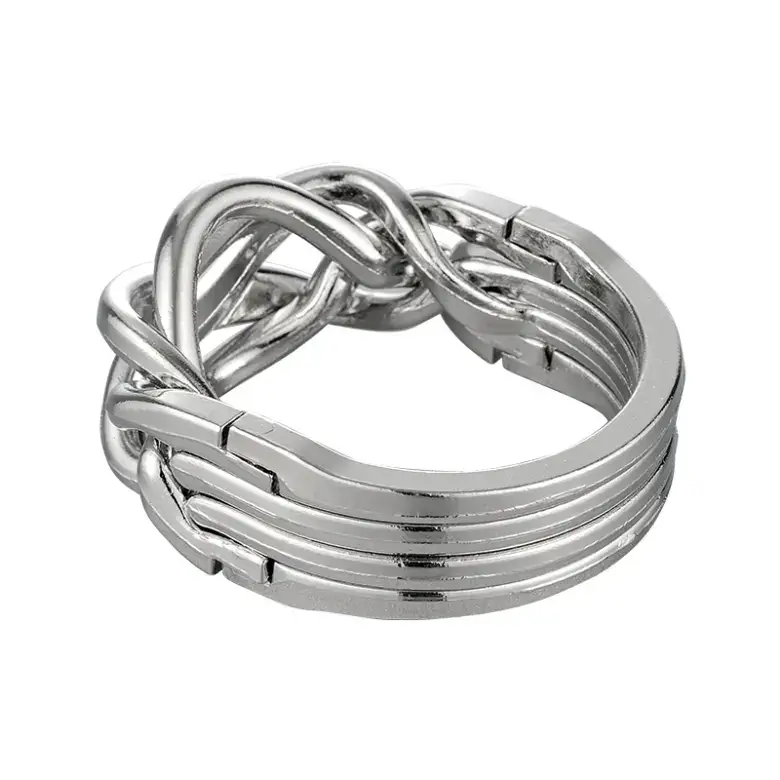
4 Band Puzzle Ring — $11.99
The 4 Band Puzzle Ring excels here. It looks like jewelry, fits in any pocket, and its silent, intertwining bands provide a complex but silent manipulative challenge. It’s the definition of a pocket fidget puzzle. For a broader set of office-suitable options that kill stress, our guide on office puzzles that kill stress is essential reading. If you’re particularly drawn to the renowned Hanayama brand of metal puzzles, our dedicated Hanayama puzzle buy guide will help you navigate their excellent, discreet options.
Ultimately, how to use fidget toys for anxiety in public is about giving yourself permission. The stigma fades when your action is calm and intentional. You’re not fidgeting nervously; you’re using a designed tool to regulate your nervous system. Choose a puzzle that disappears into your environment, and you can make any waiting room, conference call, or commute a space for grounded relief.
Finding Your Cognitive Anchor: The Final Verdict & Your First Step
The final step isn’t about buying a thing—it’s about choosing a practice. You’ve learned how to fidget discreetly and which puzzles endure. Now, the most critical finding from testing 23 fidget puzzles for anxiety relief is this: effectiveness hinges on matching the mechanism to your dominant symptom. There is no single winner, only the right tool for your moment.
So, this is your final, actionable step. Don’t browse aimlessly. Revisit the Symptom-to-Solution Matrix in your mind. Is your primary need to ground restless hands or to derail a racing mind? Let that answer be your guide. For silent, kinetic busywork, a metal fidget puzzle like a discreet fidget puzzle ring may be your anchor. For a cognitive bite that demands focus, seek out a magnetic fidget puzzle or a sequential solver. This targeted approach is what separates a lasting cognitive anchor from a temporary distraction. For a wide array of vetted options that fit this bill, explore our list of stress-relieving brain teasers.
As one Reddit user put it after finding their match: “It’s not that the anxious thoughts stop. It’s that my hands and a small part of my brain are now on a productive, solvable loop. The rest of my mind can finally step back.”
Your first step is to commit to the principle, not the product. The real fidget toy that is a puzzle is the one you’ll actually use because it fits—your hands, your anxiety profile, and your life. It is a personal tool for agency. Start there. Identify your primary symptom, pick one highly-rated puzzle from that category, and give it a true 30-day pocket test. See if the tactile puzzle for stress becomes a seamless part of your self-regulation toolkit, just like any of these thoughtfully selected desk-friendly brain teasers.
This journey began with a racing mind in a waiting room. It ends with a simple, powerful realization: you have a new, tangible strategy. You are equipped. Go find your anchor.