In the West, “yin-yang” often gets filed under the same mental folder as fortune cookies, incense, and vague “good vibes.” That’s understandable—pop culture tends to treat it like mystical décor. But if you strip away the spooky soundtrack, yin-yang is basically a systems model: a way to describe how opposing forces interact, stabilize, and eventually transform. Think of it as an early, human-friendly version of what we now call homeostasis, feedback loops, and energy management.
And here’s the part that lands in 2026: most of our modern stress comes from running a high-performance life with a low-quality “operating system.” We push “always-on” work weeks, doom-scroll at night, and then act surprised when the system crashes. Yin-yang doesn’t fix your boss. It does give you a clean, practical framework for (1) noticing what’s out of balance, (2) choosing the right move at the right time, and (3) preventing the classic “I was fine…until I wasn’t” meltdown.
This guide translates a traditional four-layer model—Yin-Yang → Two Modes (Action/Stillness) → Four Seasons (Timing) → Four Human Tendencies (Personality)—into plain, modern English. Along the way, we’ll use a surprisingly effective “training tool” that fits Western routines: short, tactile puzzle sessions. Not app-based. Not a productivity hack with 17 steps. Just the kind of hands-on focus that gives your mind a clean reset.
If you want a quick place to browse examples, start with Tea-sip’s Puzzle Toys collection or the Tea-sip blog (lots of practical breakdowns by difficulty and mood).
Quick Takeaways (If You’re Reading This Between Meetings)
- Yin-Yang isn’t “spiritual.” It’s a balance model: opposition + interdependence + waxing/waning + transformation.
- Two Modes: you need both action and stillness. Too much of either becomes self-sabotage.
- Four Seasons: timing matters. The same move is brilliant in “spring” and disastrous in “winter.”
- Four tendencies: people lean different ways under stress. Your “type” isn’t a label—it’s a calibration tool.
- Micro-practice: a 7–12 minute screen-free puzzle break can interrupt stress spirals and restore focus. (Try the “10-minute brain teaser” challenge.)
Layer 1: Yin-Yang — Not “Good vs. Bad,” but How Balance Actually Works
Most people learn yin-yang as “dark/light” or “female/male.” That’s not wrong, but it’s shallow. The useful version has four rules you can apply on a Tuesday afternoon:
Rule 1: Opposites exist (and you can’t outsource them)
Every system has opposing forces: effort and recovery, ambition and restraint, speed and accuracy, novelty and stability. If you pretend one side shouldn’t exist, it doesn’t disappear—it just shows up later as chaos. In Western terms, this is what happens when we ignore basic constraints and then blame “bad luck.”
Rule 2: Opposites depend on each other (interdependence)
Here’s the counterintuitive part: the “annoying” opposite is often what keeps you alive. In business, the most common failure story isn’t “we didn’t work hard enough.” It’s “we pushed growth and ignored risk.” Sales (expansion) needs finance (constraint). Vision needs operations. Creators need editors. If you delete the “boring” side, you don’t become freer—you become fragile.
Real-life example: The founder who treats compliance and finance like speed bumps. Growth looks heroic…until cash flow snaps, regulators show up, or a single bad contract wipes out a quarter. That’s yin-yang “separation” in plain English: you turned off the stabilizers because they slowed the rocket.
If your life is currently all “go,” you’ll get a lot of momentum. You’ll also get a higher chance of a very expensive crash. If you’re all “caution,” you’ll get safety. You’ll also get stagnation. Balance is not a vibe; it’s a mechanism.
Rule 3: Balance is dynamic (waxing and waning)
Balance doesn’t mean “50/50 forever.” It means you adjust based on season, workload, health, and context. Some weeks are push-weeks. Some weeks are recovery-weeks. The mistake is forgetting to switch.
That’s why public health guidance keeps repeating the same boring point: adults generally do better with adequate sleep. If you’re running on 5–6 hours because your calendar is loud, you’re not “built different.” You’re running an energy deficit, and the brain eventually charges interest.
Rule 4: When one side goes extreme, it flips (transformation)
Yin-yang’s most brutal lesson is transformation: when something hits an extreme, it turns into its opposite. Overdrive becomes burnout. “I don’t need rest” becomes “I can’t get out of bed.” Constant positivity becomes emotional numbness. Avoiding conflict becomes relationship resentment.
Modern life has a signature transformation pattern: sleep revenge procrastination. You spend the day in pure “yang” mode—deadlines, notifications, pressure—then at night you try to reclaim autonomy by staying up scrolling. You get your “me time,” but it’s borrowed from your future energy. Eventually, the bill arrives.
If you want a fast, non-mystical checkpoint, ask two questions:
- What am I pushing too hard right now?
- What am I neglecting that keeps the system stable?
Layer 2: Two Modes — Action vs. Stillness (Why Smart People Burn Out)
Once you grasp yin-yang, the next layer is incredibly practical: Two Modes. Call them action and stillness. Doing and pausing. Pushing and absorbing.
Western culture often glorifies motion: hustle, grind, “just do it.” Stillness gets treated like laziness. But high performers don’t win because they move nonstop. They win because they switch modes on purpose. Great athletes train and recover. Great leaders decide and then review. Great creatives ship and then edit.
The most common imbalance: “Action addiction”
Action addiction looks like productivity. It’s actually avoidance. When people are anxious, they often default to motion because motion feels like control. The problem is: action without reflection repeats the same mistake faster. If you’ve ever watched a team sprint into the same wall three quarters in a row, you’ve seen this in the wild.
The other imbalance: “Stillness paralysis”
Stillness paralysis looks like being thoughtful. It’s actually fear wearing a blazer. You research, you plan, you optimize… and then you never launch. Stillness without action becomes a fancy form of procrastination.
A simple Two-Mode operating rule
- When you don’t know what’s true: pause, collect data, run small tests (stillness).
- When you know what matters: commit, execute, and protect focus (action).
You can practice the mode-switch in a low-stakes way: use a short, tactile problem that forces focused attention without emotional drama. That’s exactly why puzzles work as “training wheels” for modern brains.
Tea-sip has a helpful breakdown on why the point isn’t speed—it’s persistence: Brain Teasers Aren’t About Speed—They’re About Persistence. If you’re the type who turns everything into a competition, read that once before you time yourself.
Why Puzzles Belong in a Yin-Yang Lifestyle (Yes, Really)
Let’s make the Western case. A good physical puzzle is:
- Screen-free (no blue-light doom spiral)
- Tactile (hands + eyes + spatial reasoning)
- Finite (you can stop at any point without a “feed” pulling you back)
- Absorbing (attention locks onto the problem instead of your inbox)
That combination makes puzzles a practical “stillness-in-motion” habit: you’re doing something with your hands, but your mind is forced into a calmer, single-thread mode. Tea-sip captured this vibe well in Wooden Puzzles Aren’t About Solutions. They’re About Focus.
And if you want evidence that focused, cognitively engaging activities can matter for long-term brain health, you’ll find consistent themes across major medical and academic sources. Harvard Health, for example, has repeatedly emphasized that brain “training” isn’t magic, but low-tech mental stimulation (including puzzles) can be a meaningful part of keeping your mind sharp over time.
Translation: puzzles won’t turn you into Sherlock. But they can become a reliable way to practice attention, patience, and mode-switching—skills most of us are losing to constant digital interruption.
Layer 3: The Four Seasons — Timing Is a Skill, Not a Personality Trait
The next layer is the one most people skip: timing. In yin-yang logic, everything has seasons. There’s a “spring” phase when energy rises, a “summer” phase when it peaks, an “autumn” phase when it consolidates, and a “winter” phase when it rests and stores.
You don’t have to believe in anything mystical to see this. Your day has seasons. Your career has seasons. Even your relationship has seasons. Problems explode when you do the right action in the wrong season.
Spring: Start, experiment, learn
Spring energy is curious and messy. You try things, you meet people, you build skill. This is not the season for perfection. It’s the season for reps.
Summer: Build, perform, commit
Summer is execution season. You ship. You take responsibility. You accept that saying “yes” to your big goal also means saying “no” to distractions.
Autumn: Edit, refine, harvest
Autumn is where grown-ups win. You review what worked, cut what didn’t, and turn experience into systems. In work terms: documentation, process, and clean handoffs. In life terms: boundaries.
Winter: Rest, recover, store energy
Winter is not a failure. It’s a strategy. It’s the season for sleep, health, reflection, and quiet skill-building. When people crash, it’s often because they tried to “run summer” through winter.
Public health sources are blunt about the costs of chronic stress and poor recovery. The World Health Organization describes burnout (in ICD-11) as an occupational phenomenon linked to chronic workplace stress that hasn’t been successfully managed. If you feel the classic burnout pattern—exhaustion + cynicism + reduced efficacy—it’s a sign your seasons are broken.
A fast “Season Check” for your current life decision
- Am I in a growth season (spring/summer) or a consolidation season (autumn/winter)?
- Is this decision asking for risk-taking or risk-control?
- What would “one season earlier” or “one season later” look like?
Once you start thinking in seasons, you stop panicking that your energy isn’t constant. It was never supposed to be constant.
Layer 4: Four Human Tendencies — Your “Type” Is Your Default Under Stress
Now we get to the part that makes the whole model feel like an operating system: people have default tendencies. Under pressure, we don’t become “pure logic.” We become our habits. Yin-yang logic splits those habits into four broad patterns. Don’t treat these as boxes; treat them as calibration knobs.
Below are four “types” written in the same practical format you can copy/paste into a team doc. Each type includes a puzzle “prescription” with Tea-sip links so you can pick something that fits your lifestyle.
Type 1: The High-Drive Achiever (Fast, Bold, Easily Overheated)
Characteristics: ambitious, competitive, high energy, quick decisions, hates waiting, often “wins” by outworking everyone.
Stress pattern: runs hot until they crash; ignores sleep; gets irritable; mistakes exhaustion for weakness; says “I’m fine” while living on caffeine.
Ideal puzzles: puzzles that slow you down without humiliating you—medium-to-hard challenges with clear mechanics, so you can build patience without feeling stuck forever.
Recommendations:
- 6-in-1 Wooden Brain Teaser Set – multiple difficulty paths; great for short breaks or travel.
- Luban Square Lock – classic interlocking geometry that rewards calm, step-by-step thinking.
- Alloy Triangle Lock Puzzle – a satisfying “take apart / put back” sequence that trains restraint.
- Desk puzzle picks for focus – a curated list aimed at office resets.
Why it works: Achievers usually have plenty of yang (drive). Their missing skill is controlled switching: going from sprint mode to deliberate mode on purpose. A 10-minute puzzle break is a “micro winter” that prevents the big winter crash.
Try this: Set a timer for 10 minutes, solve without rushing, stop even if you’re mid-attempt, and come back later. The discipline is stopping, not finishing.
Type 2: The Social Connector (Warm, Relationship-Focused)
Characteristics: extroverted but empathetic; thrives on collaboration; loves shared experiences; feels flat or anxious when isolated too long.
Stress pattern: loneliness, disconnection, overthinking social interactions; seeking validation; filling silence with noise.
Ideal puzzles: puzzles that invite conversation—beautiful pieces you can leave on a coffee table, bring to a gathering, or gift to start a shared story.
Recommendations:
- Curated gifting guide – a clean shortlist if you’re buying for someone else.
- Gift-giving collection (2025) – great for birthdays, housewarmings, and “I saw this and thought of you.”
- Kongming Ball Lock – looks like a sculpture; works like a cooperative challenge.
- Ancient puzzle locks for mindful problem-solving – a story-rich read you can share over dinner.
Why it works: Social connectors don’t need more “self-improvement.” They need bridges. A tactile puzzle on the table becomes a low-pressure invitation: “want to try this?” It creates interaction without forcing small talk.
Hosting tip: Put one puzzle out with no instructions and a second one with a simple “goal” card. People love the choice.
Type 3: The Strategic Thinker (Analytical, Cautious, Detail-Oriented)
Characteristics: introverted or selective; patient; loves planning; skeptical of quick fixes; prefers deep understanding over speed.
Stress pattern: analysis paralysis; mental fatigue from constant vigilance; difficulty turning the brain “off.”
Ideal puzzles: complex, multi-step puzzles where the solution isn’t obvious and requires real problem-solving—especially 3D disentanglement or sequence-based locks.
Recommendations:
- Four-Square Lock Puzzle – high-difficulty disentanglement that rewards methodical exploration.
- How the Four-Square Lock works (deep dive) – if you enjoy the mechanics as much as the solve.
- Precision-crafted puzzles for logic & focus – a curated list with difficulty notes.
- Why puzzle attempts fail (and how to win) – practical strategy for overthinkers who still want progress.
Why it works: Strategic thinkers often have too much “stillness” stuck in their head—planning, modeling, rehearsing. A physical puzzle forces externalization: you test hypotheses with your hands. It’s analysis with feedback, not analysis in a loop.
One rule: Don’t memorize solutions from videos. The value is the iteration.
Type 4: The Quiet Specialist (Independent, Deep Focused, Easily Drained by Noise)
Characteristics: enjoys solitude; hates performative meetings; learns deeply; often becomes an expert in narrow domains; calm on the outside, intense on the inside.
Stress pattern: overstimulation; social exhaustion; feeling “used up” after too much interaction; retreating hard when depleted.
Ideal puzzles: long-form, calm builds that reward immersion—mechanical models, functional desk pieces, or slow, satisfying assemblies.
Recommendations:
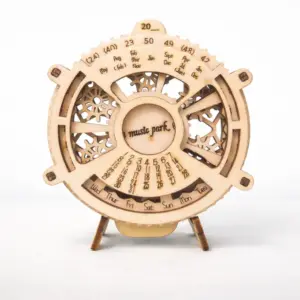
- 3D Wooden Perpetual Calendar Puzzle – a functional build that turns focus into something you can keep on your desk.
- Wooden Desk Organizer with Perpetual Calendar – practical + calming; ideal if your desk is your home base.
- Galleon Ship 3D Wooden Puzzle Model Kit – a longer “deep work” session with a beautiful finish.
- Light-Up Gothic Wooden Lantern 3D Puzzle – a cozy evening build that literally ends in light.
Why it works: Quiet specialists don’t need “more stimulation.” They need better stimulation: an activity that absorbs attention without social noise. A build kit becomes a private retreat that still feels productive.
Bonus: Pair your build with music or silence—skip podcasts. Your brain deserves a break from words.
How to Use This Model in Daily Western Life (Without Turning Into “That Person”)
Here’s the part people love: you don’t have to become a monk. You just have to stop pretending you’re a machine.
1) Run a weekly balance audit (10 minutes, Sunday night)
- Where did I push (yang) this week?
- Where did I recover (yin) this week?
- What did I keep doing that clearly wasn’t working?
- What’s one tiny change that restores the stabilizers?
2) Protect “winter” habits as non-negotiable
For most adults, sleep is the first stabilizer to break. If your schedule is chaotic, aim for consistency and adequate duration. Major sleep organizations and the CDC converge on the idea that adults generally benefit from around 7+ hours per night. If you’re chronically under that, your “yang” life is running on debt.
3) Use a 10-minute puzzle reset instead of scrolling
If your default stress behavior is grabbing your phone, try swapping in a small puzzle. Tea-sip’s Stress-Busting Brain Teasers list is a good “menu” for desk-friendly options.
Start with something that matches your tolerance:
- Low frustration: browse Wooden Puzzles.
- Higher precision and challenge: browse Metal Puzzles.
4) Make decisions with seasons in mind
Before you quit your job, move cities, or start a company, ask: “Is this a spring move or a winter move?” Starting a huge new project while you’re exhausted isn’t bravery. It’s mis-timed ambition.
A Practical “Starter Kit” Based on Your Goal
- I want a calm desk ritual: try the desk organizer + perpetual calendar.
- I want a travel-friendly brain reset: try the 6-in-1 set.
- I want something I can show friends: try the Kongming Ball Lock (sculptural, shareable).
- I want a cultural conversation piece: try the Bagua Lock Puzzle (yin-yang symbolism in a modern metal lock).
- I want a serious challenge: try the Four-Square Lock Puzzle.
Credible Reading (So This Doesn’t Feel Like “Just a Vibe”)
If you want a few reputable starting points for the modern science behind recovery, stress, and brain health:
- CDC: About Sleep (recommended hours by age)
- NIH NINDS: Brain Basics—Understanding Sleep
- AASM: 7+ Hours of Sleep Is a Health Necessity (Adults)
- WHO: Burn-out in ICD-11 (occupational phenomenon)
- APA: Mindfulness meditation (overview)
- NIH NCCIH: Meditation & Mindfulness (effectiveness & safety)
- Harvard Health: Simple, low-cost, low-tech brain training
Build Your “Yin-Yang Team” (Work and Home)
One underrated use of this framework is people management—at work and in relationships. Most conflicts aren’t “personality clashes.” They’re role conflicts caused by too much of one energy in the system.
- All Achievers, no stabilizers: huge momentum, sloppy risk control, constant firefighting.
- All Strategists, no movers: excellent plans, painfully slow shipping, missed windows.
- All Social Connectors: great culture, fuzzy accountability, decisions by consensus.
- All Quiet Specialists: deep craft, low visibility, bottlenecks because nobody wants to “sell” the work.
A healthier system pairs opposites. The Achiever needs a Strategist to pressure-test. The Strategist needs an Achiever to ship. The Social Connector keeps trust high so feedback can land without drama. The Quiet Specialist keeps the actual quality from collapsing under noise.
If you want a fun, low-stakes way to see this dynamic, bring a puzzle to a meeting or family night and watch what happens. Some people jump in and try to brute-force (Achiever). Some step back and map the structure (Strategist). Some narrate and invite others (Social Connector). Some quietly solve a corner in silence (Quiet Specialist). It’s basically a personality lab—without the awkward questionnaire.
Tea-sip has a helpful perspective on why different people approach the same puzzle differently (collecting, solving, displaying): How Collectors and Solvers Use Wooden Puzzles Differently. If you’re buying for someone, that post is gold.
Choosing the Right Puzzle Difficulty (So Your “Yin Break” Doesn’t Become Rage)
In a perfect world, you’d pick the “optimal challenge” every time. In the real world, you’re tired. So here’s the simple rule:
- If you’re stressed: choose a puzzle you can make progress on quickly. The goal is regulation, not ego.
- If you’re bored: choose a puzzle that stretches you and demands strategy.
- If you’re lonely: choose a puzzle that looks good on a table and invites others.
If you don’t want to guess, start with a mixed set so you can “scale” the challenge depending on your day. The 6-in-1 Wooden Brain Teaser Set is designed exactly for that. And if you want the cultural backstory behind that set (why it’s connected to traditional joinery), Tea-sip’s feature The 6-in-1 Luban Lock Set: 2,500 Years of Engineering in Your Palm is an easy read.
For a broader browse, you can filter by vibe:
- Warm, tactile, “slow living” energy: Wooden Puzzles
- Cool, precise, mechanical energy: Metal Puzzles
- Classic cultural forms: Traditional Wooden Puzzles
FAQ (Because Your Brain Will Try to Overcomplicate This)
Is yin-yang a religion?
It doesn’t have to be. You can treat it as a descriptive model: opposing forces, interdependence, and change over time. If you’re comfortable with spirituality, great. If you’re not, you can still use the framework as a practical way to spot imbalance and choose better timing.
What if my job makes balance impossible?
Some seasons are legitimately intense. The question is whether you’re building recovery into the system. Even during peak workload, you can protect “micro winter” moments—short breaks that prevent a bigger crash later. If you can’t protect any recovery at all, that’s not a personal failure; it’s a structural problem to address.
How long should a “puzzle reset” be?
Short enough to be repeatable, long enough to feel your attention settle. For most people, 7–12 minutes is a practical sweet spot. Tea-sip’s 10-minute brain teaser challenge is a simple starting ritual.
Do puzzles really help with stress?
They’re not therapy, but they can be a strong state-change tool: shifting your mind from rumination to focused problem-solving. If you’re burned out, combine puzzle breaks with real recovery: sleep, boundaries, movement, and support.
What’s the easiest way to start tonight?
Pick one object. Put it within reach. Replace one scroll session with one solve session. If you want a ready-made shortlist, Tea-sip’s Stress-Busting Brain Teasers post is built for exactly that.
Closing: The Calm Power Move Is Knowing When to Switch
The point of yin-yang isn’t to become “balanced” like a perfect Zen statue. The point is to understand the rules your life already follows—whether you acknowledge them or not. When you can read your own energy, switch modes deliberately, respect seasons, and work with your tendencies instead of fighting them, you stop living like an app that keeps crashing.
Start small: tonight, replace 10 minutes of scrolling with 10 minutes of tactile focus. If you want an easy on-ramp, pick one item from Tea-sip’s Puzzle Toys and try the “stop before you finish” rule. Balance isn’t a destination. It’s a practice.
Disclaimer: This article is for educational purposes and does not replace medical advice. If you’re experiencing severe stress, sleep problems, or mental health symptoms, consider speaking with a qualified professional.