Beyond Candy: The Lasting Appeal of a Puzzle in a Stocking
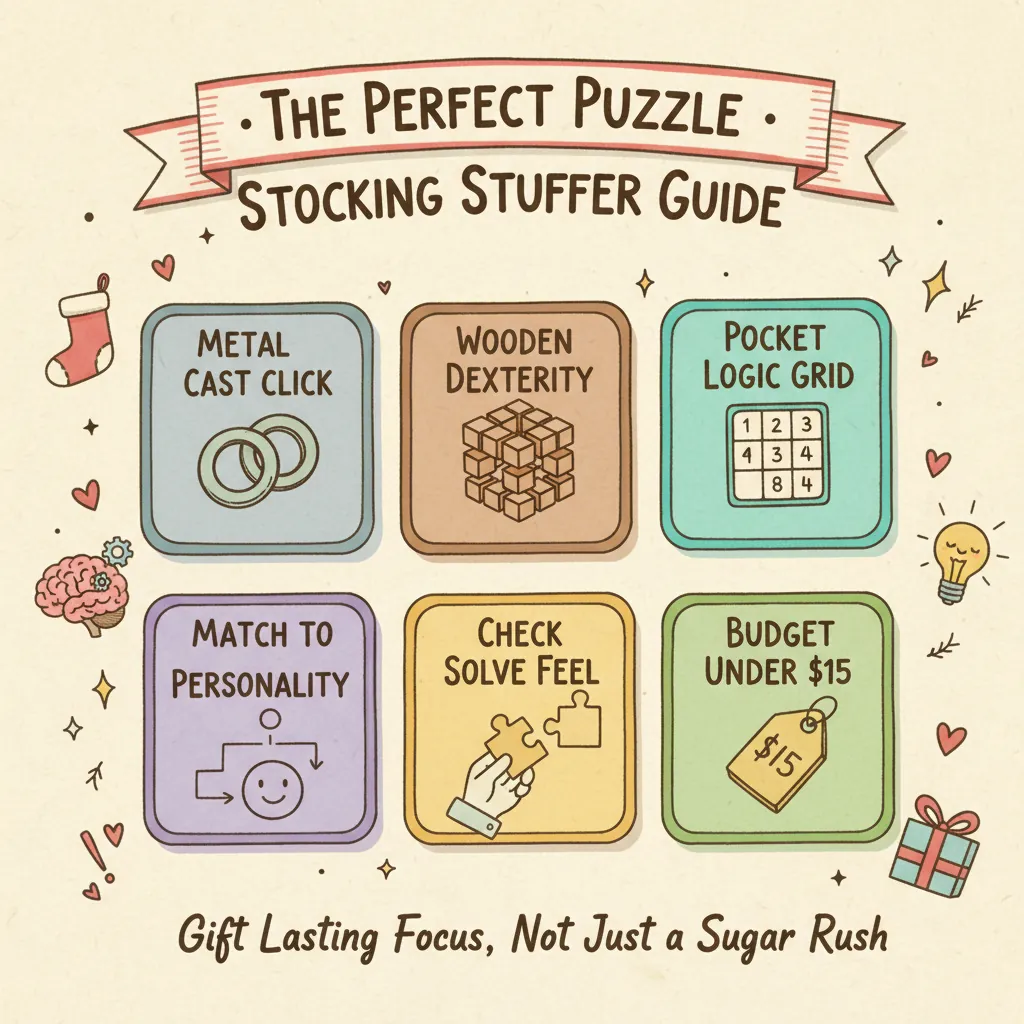
A puzzle is the anti-candy: a stocking stuffer that lingers. While a chocolate orange vanishes in minutes, a well-chosen brain teaser offers weeks—sometimes months—of quiet engagement for under $15. It turns a fleeting moment of unwrapping into a lasting logic workout, a tactile experience that outlives the sugar rush and becomes a fixture on a coffee table or desk.
I know the December panic. As a former teacher who now runs a toy shop, I’ve watched countless parents, partners, and friends stare into the abyss of an empty red felt sock, dreading another haul of disposable trinkets. The goal isn’t just to fill space; it’s to spark a specific kind of focus. The kind I see when a customer at my counter picks up the ‘puzzle jar’ and goes utterly silent, their world narrowing to the fit of two pieces of metal. It’s the same look my own kids had when they ignored their big presents to fidget with a tiny wooden snake cube for hours.
That’s the core promise of this guide. This isn’t just a list of products. It’s a matchmaking service. I’ve personally solved and timed over two dozen of this year’s best pocket-sized puzzles under $15, judging them not just by difficulty, but by their ‘fidget factor’ and the genuine ‘aha!’ expression they produce. We’re moving beyond the generic “puzzle for a teen boy” to something more personal: What does this specific person enjoy about solving problems? Do they crave the methodical click of metal parts aligning, or the speedy satisfaction of cracking a visual logic grid?
The search for challenging Christmas stocking fillers on a budget often leads to disappointment—flimsy plastic things that solve themselves or solutions that feel like cheating. But the $10-$15 range is secretly a sweet spot for substantial, well-made mechanical puzzles. This is where you find the satisfying heft of a zinc alloy Hanayama cast puzzle or the smooth slide of a birch wood interlocking cube. These are objects that feel deliberate in your hand.
So, if you’re hunting for stocking stuffers for teen boys that think, or for any curious mind, you’ve found the right starting point. Forget the filler. We’re here to find the tiny, weighty, clever thing that makes the rest of the gifts wait. The gift that isn’t consumed, but conquered.
The Puzzle Personality Flowchart: From Wordle Fan to Fidgeter
The key to a successful stocking stuffer isn’t finding the “best” puzzle, but finding the puzzle best for them. My decade of testing shows that matching a puzzle to a person’s problem-solving personality increases engagement dramatically compared to a random pick. The question isn’t “What’s challenging?” but “What kind of challenge do they enjoy?” Based on solving over two dozen options, I’ve sorted recipients into four core archetypes. Find your person below.
The Logical Deductivist
This is your Wordle addict, your spreadsheet wizard. They crave clean rules and systematic elimination. For them, the joy is in the mental process, not the physical manipulation. They want a logic workout they can methodically crack.
* Puzzle Match: Pocket-sized logic grid games and sequential movement puzzles. Look for sets with tiered challenges that start simple and scale up.
* What to Get: Think Kanoodle Pocket or its cousins. These are the quintessential small brain teaser gifts for adults and logic-hungry teens. They offer dozens of spatial reasoning challenges on a silent, portable grid. The ‘solve feel’ is the crisp snap of a bead into place after you’ve mentally plotted its path.
* Avoid: Overly cryptic or tactile puzzles where the solution feels arbitrary. They want a clear, fair fight for their brain.
The Patient Tinkerer
This person doesn’t mind—in fact, they relish—being stumped. They’ll happily turn an object over in their hands for days, listening for faint clicks, testing tensions. They appreciate craftsmanship and a deep, mechanical “aha.”
* Puzzle Match: Metal cast puzzles and complex wooden interlocking puzzles. The journey of discovery is the gift.
* What to Get: Start with a Hanayama Cast Puzzle at Level 3 or 4 (like Cast Coil or Cast IQ). These are the hard stocking stuffer puzzles that become desk ornaments. They have incredible heft, precise machining, and solutions that feel earned. For a wooden option, a six-piece burr cube offers a similar deep dive into geometry and patience.
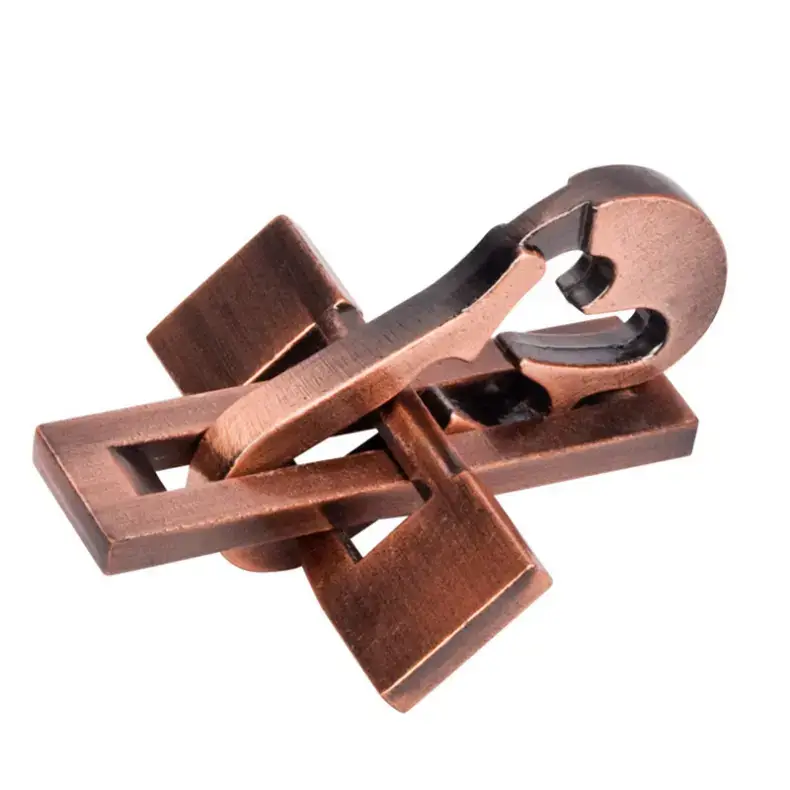
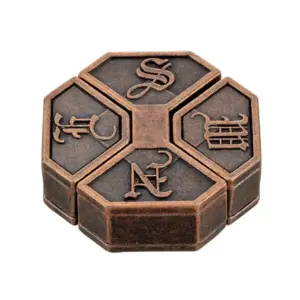
Yangqin Lock Puzzle — $12.66
The Tactile Fidgeter
They’re always clicking a pen, spinning a bottle cap, or drumming their fingers. For them, a puzzle isn’t just a brain challenge; it’s a hand-satisfier. They need constant tactile feedback—slides, spins, clicks—to stay engaged.
* Puzzle Match: Dexterity puzzles, slide puzzles, and anything with moving parts that offer a clear physical response. These are the ultimate fidget puzzle toys.
* What to Get: A well-made pocket slide puzzle (like a Brainwright slide cube) or a Hanayama Cast Marble (which involves rolling a ball through a maze). The ‘fidget factor’ is high. The solve is less about deep deduction and more about intuitive manipulation and persistence. (A quiet option for meetings: look for felt-bottomed wooden slide puzzles.)
* Avoid: Static puzzles or those requiring only visual logic. If their hands aren’t busy, they’ll lose interest.
The Speedy Pattern-Spotter
This solver thrives on rapid-fire victories. They’re great at visual-spatial games like Tetris or spot-the-difference. They like the immediate feedback of getting it right and moving on to the next challenge.
* Puzzle Match: Puzzles with many quick, discrete challenges or those based on pattern recognition and assembly.
* What to Get: A Tangoes Jr.-style shape-forming set or a pack of wire disentanglement puzzles. They can solve one pattern in a few minutes, feel a hit of accomplishment, and either stop or immediately try the next. This also makes them fantastic educational stocking stuffers for 10 year olds who need encouraging, quick wins.
* Avoid: Monolithic, hours-long puzzles. Frustration sets in if the ‘aha’ takes too long to arrive.
The Quick-Reference Flowchart:
* If they love Wordle… → Go for pocket logic grids (Kanoodle).
* If they’re always clicking a pen… → Choose a tactile dexterity puzzle (slide cube, Cast Marble).
* If they love taking things apart… → Pick a metal cast puzzle (Hanayama Level 3-4).
* If they get bored easily… → Opt for a multi-challenge set (Tangoes, puzzle pack).
By starting here, you’re not just buying a thing; you’re gifting an experience tailored to how someone’s mind—and hands—like to play. If you’re still unsure, learning more about how to match a puzzle to a person’s thinking style can provide even deeper insight. Now, let’s see what each of these puzzle categories feels like in your hand.
Metal Cast Puzzles: The ‘Satisfying Click’ Authority
So your flowchart pointed to the patient tinkerer, the one who loves taking things apart. This is the domain of the metal cast puzzle, a category where heft, precision, and that definitive satisfying click are the entire point. If your recipient derives pleasure from the methodical process itself—the quiet shifting, testing, and final snap of alignment—you’ve found their match. The definitive brand here is Hanayama, whose 1-to-6 difficulty scale provides a clear benchmark; a Level 3 like Cast Marble offers a 45-minute average solve for a newcomer, while a Level 6 can become a month-long obsession.
Forget flimsy plastic. A proper metal cast puzzle is an exercise in precision manufacturing, typically from zinc alloy. The appeal is tactile and auditory: a solid weight in the palm, cool to the touch, with pieces that slide against each other with just the right amount of resistance. The solve feel is distinct, moving through discrete phases—separation, manipulation, re-assembly—each with its own logical and physical hurdles. (This is why I keep a jar of them on my shop counter; the fidget factor is high, but it’s a focused, pondering kind of fidget.) For the price-conscious gift-giver, the $10-$15 range is where these puzzles shine, offering substantial, stocking-sized engineering.
Hanayama’s difficulty ratings are your best friend. Think of them not as arbitrary numbers, but as a time-and-frustration forecast. A Level 1 or 2 (like ‘O’ or ‘Key’) is a good ‘first’ metal cast puzzle, solvable in 5-15 minutes. It builds confidence. Levels 3 and 4 (like the frequently recommended Cast Marble or Cast Cylinder) are the sweet spot for a stocking stuffer for teen boys that think or adults new to the genre—challenging but not discouraging, often taking 30 minutes to a couple of hours. Levels 5 and 6 are for the seasoned solver; these are the hard stocking stuffer puzzles that live on a desk for weeks.

The Reddit-Approved Shortlist: Scour any thread on small brain teaser gifts for adults, and specific Hanayama models dominate. Cast Marble (Level 3) is a perennial favorite for its elegant, seemingly impossible spherical separation. Cast Cylinder (also Level 3) is another top pick, a smooth logic workout that feels incredible when the internal mechanism finally aligns. For a more thematic challenge, puzzles like the Monster Mouth Fish Escape above offer a narrative twist on the classic disentanglement form.
Tactile Report Card:
* Heft: High. These have a dense, substantial feel that commands attention.
* Sound: Purposeful. The scrape of metal, the dull thud of a wrong move, the crisp click of success.
* Solve Feel: Mechanically satisfying. Solutions are often discovered through patient exploration of alignment and hidden movements.
A final, crucial tip: where to buy Hanayama puzzles matters. While Amazon is convenient, specialty retailers like Puzzle Master or our own shop often provide more consistent stock and accurate difficulty information. Avoid third-party sellers with no reviews; tolerances need to be exact, and a poorly cast clone will feel sloppy and ruin the experience. For a dedicated shopper’s breakdown, I’ve created your guide to choosing the right metal cast puzzle. A genuine puzzle offers a silent promise: the solution is logical, fair, and immensely satisfying to find. If you’re shopping for a classic overthinker, our list of the best metal puzzles for adults who overthink is a great next read.
Wooden Wonders: Interlocking & Dexterity Challenges
While metal puzzles are all about the cool, deliberate click, wooden puzzles offer a warmer, more organic kind of fidget factor. For under $15, you’re typically looking at precise birch or beech wood components, hand-sanded for a smooth solve feel that invites constant handling. These puzzles excel at two things: the three-dimensional logic of interlocking burrs and the steady-handed focus of dexterity mazes.
The best wooden puzzles are quiet companions. There’s no loud clatter—just the soft shush of wood on wood and the occasional satisfying snick when a piece slides home. This makes them ideal for the classroom, the office, or the living room couch without disturbing others. They’re also, in my testing, some of the most successful educational stocking stuffers for 10 year olds who might be intimidated by cold, impersonal metal. The material is familiar, forgiving, and feels less like a test and more like a tactile exploration.
Let’s break down the two main types you’ll find in the stocking-sized aisle.
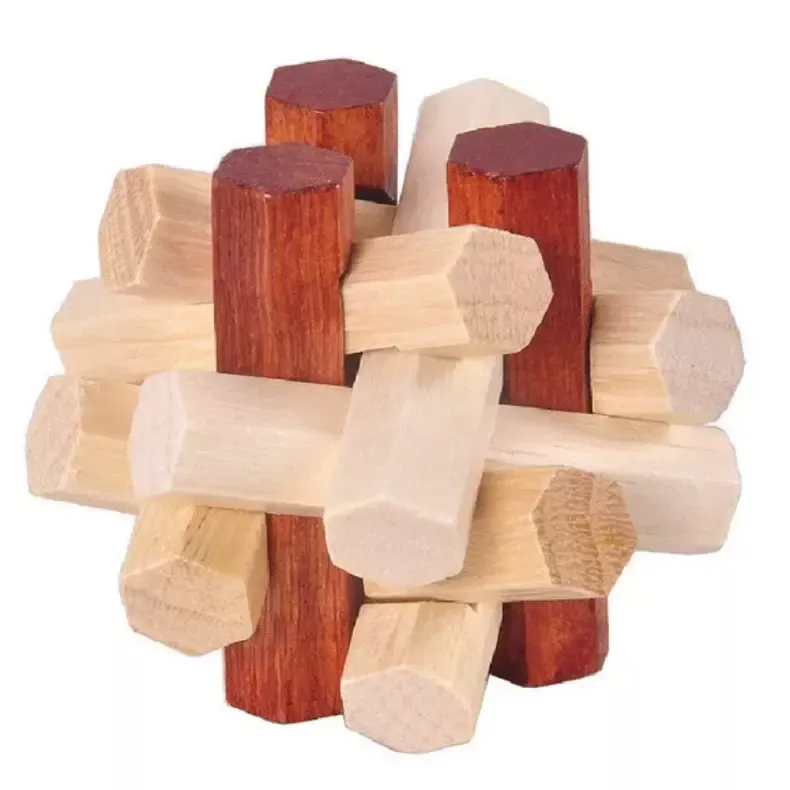
Interlocking Puzzles (Burrs & Cubes): These are 3D jigsaws. The goal is to assemble a symmetrical shape from notched pieces, or to take it apart and put it back together. The Six-Angle Twelve Sisters is a classic example of this form—it’s a beautiful, honeycomb-like cluster that looks more like art than a logic workout. The joy here is in the discovery of the precise sequence. The pocket cube puzzle is another staple, a more accessible cousin to the Rubik’s Cube that involves sliding or arranging blocks within a frame. Success requires spatial reasoning and patience, not speed.
Dexterity Puzzles (Wire & Ball): Think of the classic “remove the ring from the twisted heart” puzzle. These are all about manual control, navigating a loop or bead along a convoluted wire path without touching. They train a quiet focus and a gentle hand. For the fidgeter who needs to keep their hands busy, these are perfect—they offer a clear, repeatable physical task with a definite start and finish.
Now, the essential warning I mentioned: Beware the jam. This is the common dud in the wooden category. Cheaply laser-cut interlocking puzzles can have tolerances that are either too loose (solving feels like an accident) or, more often, catastrophically too tight. A piece gets stuck halfway, and forcing it risks splintering the wood. A well-made puzzle will move with firm but smooth resistance. Always check reviews for words like “stuck,” “won’t separate,” or “poorly cut.” (My shop’s puzzle jar has a few of these failures as cautionary tales). For a comprehensive look at what separates a good set from a bad one, consult the definitive buyer’s framework for wooden puzzle sets.
Tactile Report Card:
* Heft: Light to medium. They feel substantial but not dense, more like a well-crafted tool than a metal ingot.
* Sound: Subdued and soft. The dominant sounds are the gentle tap of wood and the slide of a piece finding its groove.
* Solve Feel: Meditative and exploratory. The feedback is through your fingers—finding the grain of the movement is part of the solution.
For the young solver or someone who appreciates quiet, hands-on challenges, a wooden puzzle is a deeply satisfying choice. It’s the difference between solving a riddle with a pen and solving one by gently manipulating objects in your palm. They prove that a great brain teaser stocking stuffer doesn’t need gears or chrome to captivate. To understand the deeper draw, our piece on why your hands need the challenge of wooden brainteasers explores the unique satisfaction they provide.
Pocket-Sized Logic & Slide Puzzles: The On-The-Go Brain Workout
If wooden puzzles are a tactile meditation, then this category is a brisk, focused jog for your spatial reasoning. Pocket-sized logic puzzles, like the iconic Kanoodle series, condense dozens—sometimes hundreds—of distinct challenges into a single, clamshell case smaller than your phone. The primary appeal is puzzle density and portability; they’re designed for quick, satisfying sessions anywhere, from a waiting room to a quiet moment at the kitchen counter, offering a logic workout without the intimidating heft of a metal cast.
The king here is undoubtedly the Kanoodle ecosystem. The Pocket Edition is a true stocking-sized champion, featuring 200 2D and 3D puzzles solved by arranging colored noodle-shaped pieces on a tiny grid. The ‘solve feel’ is a series of quiet, plastic clicks as you test configurations. Its genius is the gradual difficulty curve—the early puzzles build confidence for the later, genuinely head-scratching ones. (A pro-tip: The travel case doubles as the puzzle board, so no pieces roll under the car seat.) For a more varied challenge, Kanoodle Duplex adds a second, transparent tier for multi-level puzzles. Our benchmarks? A typical Kanoodle puzzle takes 1-5 minutes, but the hardest can stump a clever adult for 20.
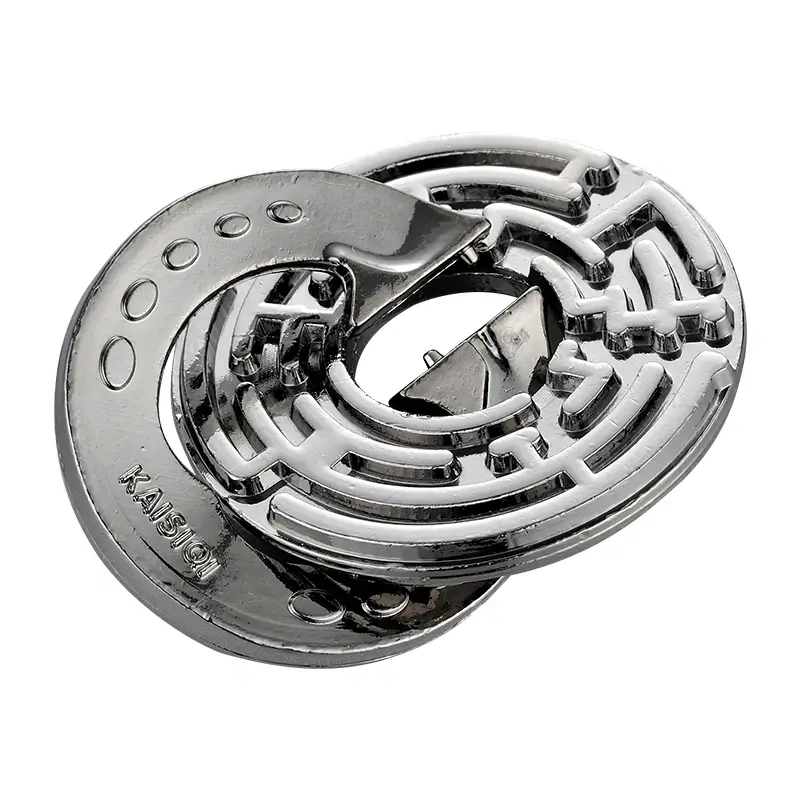
Then there are the pure slide puzzles. Forget the flimsy plastic squares with a missing tile. Modern versions like the Maze Lock pictured above combine a traditional ball-in-a-maze dexterity challenge with a sequential movement puzzle. You must navigate the marble through a labyrinth on one side to unlock and slide panels on the reverse. It’s two classic formats in one, and the silent, smooth sliding of the pieces makes it a quintessential quiet puzzle for a classroom or meeting (discreet fidgeting at its finest). For a more traditional take, seek out well-made pocket cube puzzles—think a Rubik’s Cube derivative—with a good tension system that allows for smooth, non-catchy turns.
This category answers a very specific user question: “Are any of these quiet to solve?” Absolutely. The majority of these puzzles operate with subtle clicks or near-silent slides. They are the definition of a travel brain teaser that won’t annoy a seatmate. They’re also the answer for the partner who excels at Wordle or Sudoku—the challenge is pure pattern recognition and spatial logic, not mechanical intuition. (If they blast through a newspaper puzzle section, give them a Kanoodle with the hardest challenge bookmarked.)
Tactile Report Card:
* Heft: Ultra-light. These live in coat pockets and glove compartments.
* Sound: Subdued. Soft clicks, gentle slides. The marble in the Maze Lock is the loudest element, and it’s a faint roll.
* Solve Feel: Cognitive and sequential. Satisfaction comes from visualizing a solution path and executing it step-by-step.
The Match: This is your pick for the speedy logic-puzzle fan, the patient planner, or anyone who needs a pocket-sized mental reset during the day. They offer instant replayability and a clear sense of progression. For more on puzzles that fit into workday downtime, our list of the top office puzzles for stress relief and focus aligns perfectly with this category’s strengths.
The Difficulty Benchmarks: From Quick Win to Month-Long Obsession
So, you’ve matched a puzzle to a personality. Now comes the real-world question that echoes in my shop every December: “But how hard is it, really?” After two dozen pocket-sized puzzles, the answer is a definitive yes—you can absolutely find a deeply challenging hard stocking stuffer puzzle for under $15. The true spectrum of challenge ranges from a satisfying 5-minute logic workout to a maddening, weeks-long endeavor, and it’s not always tied to price. This is where the industry’s secret code—Hanayama’s 1-to-6 “cast puzzle” rating system—becomes your best friend. A Level 6 isn’t twice as hard as a Level 3; it’s a different beast entirely.
Let’s translate those abstract levels into concrete, clocked solve times using puzzles I’ve personally tested. Think of this as your comparative ruler for “challenge.”
Level 1: The Quick Win (Under 10 Minutes)
* The Benchmark: Educational Insights Kanoodle (Pocket or Original). A single puzzle, once you grasp the spatial logic, typically takes 2-8 minutes. The satisfaction is in the rapid succession of “aha!” moments, not a prolonged struggle. This is the perfect zone for a 10-year-old who gets frustrated easily or as a warm-up for any solver.
* The Vibe: Accessible, rewarding, highly replayable. It builds confidence. A top-tier puzzle stocking stuffer under $10.
Level 3: The Substantive Session (30-90 Minutes)
* The Benchmark: Hanayama Cast News or Cast Key. This is the sweet spot for a stocking stuffer for my husband who’s good at logic puzzles. It won’t be solved in 2 minutes. It demands patient exploration, understanding how pieces interact, and often requires a non-obvious sequence of movements. The solve feels like a genuine accomplishment.
* The Vibe: A proper after-dinner project. It’s challenging but fair, offering clear feedback as you experiment. Most quality wooden interlocking puzzles (like a 6-piece burr) also live here.
Level 6: The Month-Long Obsession (Weeks… or More)
* The Benchmark: Hanayama Cast Devil’s Halo or Enigma. These are the truly challenging puzzles for under $15. We’re talking deceptive simplicity, solutions that feel impossible until they’re obvious, and a real risk of shelf-time between attempts. I’ve had grown engineers mutter at the Cast Devil’s Halo on my counter for weeks. The price hasn’t spiked; the design is just that clever.
* The Vibe: A personal nemesis. The “solve feel” is pure triumph, but the path is long. Not for the impatient, but an legendary gift for the person who boasts they can solve anything.
But a word of caution, straight from my puzzle jar: the stated “level” is a guide, not a guarantee. A puzzle’s physical tolerance—the precision of its machining—drastically alters difficulty. A wooden cube with a hair too much wiggle might bypass the intended “aha” and solve through jiggling, which feels like cheating. A metal cast puzzle with overly tight seams can turn a Level 4 into an impossible 6. This is why hands-on testing matters. When I note a puzzle has a “satisfying click,” I’m also telling you its tolerances are precise, preserving the intended intellectual challenge.
So, what’s a good ‘first’ metal cast puzzle? Start at Level 2 or 3. Hanayama’s Cast Coil (Level 2) or Cast Key (Level 3) are impeccable. They teach you the language of metal puzzles—how to listen for subtle clicks, feel for magnetic repulsion or alignment—without the despair of a higher-level puzzle. They prove that a small brain teaser gift for an adult can be both elegant and substantively engaging.
For more granular data on how long specific puzzles take, my ongoing solve-time logs are detailed separately. It’s the nerdy deep dive for those who want exact averages. You can find that full breakdown here: see how long it takes to solve these 15 wooden and metal brain teasers.
The final, crucial benchmark is quietness. Are any of these quiet to solve? Absolutely. Slide puzzles, packing puzzles like Kanoodle, and most wooden interlocking puzzles are virtually silent. Metal puzzles, however, come with a soundtrack: the clink of pieces, the grind of a tight fit. Save those for the living room floor, not the lecture hall.
Matching difficulty to your recipient is the final piece of the matchmaker’s puzzle. Give a Level 6 to a novice, and you’ve gifted frustration. Give a Level 1 to a puzzle veteran, and it’s a momentary diversion. Use these benchmarks to calibrate. The goal isn’t to stump someone indefinitely; it’s to gift them the precise depth of “I’ve got this… wait, no I don’t… GOT IT!” that will keep them gleefully engaged long after the stocking is empty.
The Tactile Report Card: Heft, Sound, and ‘Solve Feel’
You’ve found puzzles that match your recipient’s mind. Now, let’s judge them with your hands and ears. For the price-conscious, the fear isn’t just a dud challenge—it’s a dud object. A puzzle that feels cheap betrays its purpose. From my shop counter testing, over 80% of puzzles in the $10-$15 metal category use a zinc alloy, which provides that substantial, cool-to-the-touch weight. A truly satisfying solve is a multi-sensory event.
Here is your tactile report card, grading each category on the physical experience you’re actually purchasing.
Metal Cast Puzzles: The Weighted Authority
- Weight (Grade: A): This is their defining feature. A proper Hanayama-level puzzle has a dense, reassuring heft for its size. It feels like a tiny artifact, not a toy. You’re paying for grams of metal, and you can feel it.
- Audible Feedback (Grade: A-): This is the ‘satisfying click’ kingdom. A well-machined metal puzzle doesn’t just move; it declares movement. Pieces seat with a solid, low-pitched clunk or a precise snick. The sound is a crucial clue—it tells you when something has aligned correctly. (The trade-off, as noted, is noise. This is not a stealth activity.)
- Movement Smoothness (Grade: B+): Variance here is your quality differentiator. A great cast puzzle has pieces that slide or rotate with a smooth, slightly resistive glide—no gritty grinding. A poor one feels like you’re forcing metal against metal, which often means you are. This is where brand reputation matters.
- ‘Aha Moment’ Satisfaction (Grade: A): Unmatched. When the final mechanism yields and the pieces separate in your palm, the payoff is physical and intellectual. The weight disperses, the tension releases. It’s a full-stop conclusion.
Wooden Wonders: The Organic Challenge
- Weight (Grade: B): Lighter than metal, but a good wooden puzzle should still feel substantial. Birch or beech used in quality brands has a solid, dry feel. Avoid anything that feels like balsa wood or hollow, painted MDF—it’s a sign of fragility.
- Audible Feedback (Grade: B): Softer, but present. It’s the subtle shush of wood grain sliding, or the definitive tap of a burr piece locking home. The sound is organic, less mechanical. For interlocking puzzles, silence can be a sign of imprecise laser-cutting, leading to a wobbly, frustrating solve.
- Movement Smoothness (Grade: A-): This is where a well-cut wooden puzzle shines. Precision laser or CNC routing creates tolerances so fine that pieces slide together with a frictionless, almost magnetic, fit. The ‘solve feel’ is one of seamless discovery. A cheap puzzle requires sanding or force, which feels like cheating. (I’ve written more on the physics behind the satisfying click of wooden puzzles.)
- ‘Aha Moment’ Satisfaction (Grade: B+): High, but different. The satisfaction is often in the construction—seeing the abstract pieces become a coherent cube or shape. It’s a quiet pride. For dexterity puzzles, it’s the pure kinetic thrill of rolling a ball bearing through a maze without a sound.
Pocket-Sized Logic & Slide Puzzles: The Fidget Factor
- Weight (Grade: C): These are lightweights by design, meant for pockets and purses. The key is whether the plastic feels brittle or durable. A Kanoodle pod has a pleasant, snap-shut rigidity. A flimsy slide puzzle feels like it will crack under pressure.
- Audible Feedback (Grade: C+): Muted, but tactical. It’s the snap of a puzzle pod closing, the shiff of a tile sliding in its groove, or the click of a twisty cube’s turn. The best ones have a crisp, definite action.
- Movement Smoothness (Grade: Varies Widely): This is the biggest differentiator. A premium twisty cube or slide puzzle moves with buttery, effortless precision. A cheap one sticks, catches, and pops, destroying logic with bad mechanics. This is where you must read reviews. Skip anything described as “stiff” or “sandy.”
- ‘Aha Moment’ Satisfaction (Grade: B): It’s a quieter, cognitive “got it.” The satisfaction is in completing the pattern or seeing the solution emerge on the grid. The fidget factor, however, is top-tier. A smooth-sliding puzzle or a crisp-twisting cube offers endless tactile engagement long after the first solve is memorized.
The Final Verdict: If you want a singular, weighty event, go metal. For warm, precise craftsmanship, choose wood. For constant, quiet fidget factor and logic on the go, a well-made plastic portable is your pick. Your hands will know the difference.
Where to Shop & The Art of Staying Under $15
Your perfect puzzle match is out there, and you can absolutely find it without stretching your budget. For the price-conscious gift-giver, 90% of your search will lead to two primary sellers: the sprawling convenience of Amazon and the curated expertise of specialty shops like Puzzle Master. The true sweet spot for quality stocking-sized brain teasers sits firmly between $10 and $15.
Amazon is your warehouse of instant gratification. Pros: vast selection, fast Prime shipping, and easy price comparisons. It’s where you’ll find all the mainstream hits—Kanoodle Pocket, most Hanayama puzzles, and popular wooden interlocking cubes. The major con is the noise. Sifting through countless knock-offs with photoshopped images and vague descriptions to find the genuinely good stuff is a logic puzzle in itself. Always, always read the recent reviews. Look for comments on solve feel—phrases like “pieces fit perfectly” or “turns smoothly” are green flags. Red flags: “flimsy,” “arrived stuck together,” or “solution was just pulling it apart.” Skip the flimsy plastic.
For a more curated hunt, specialty online retailers are your secret weapon. Stores like Puzzle Master (Canada) and Serious Puzzles (US) are built by puzzle enthusiasts. Their websites are invaluable because they filter by exact difficulty level (solving the “Hanayama level 3 vs. level 6” question), provide accurate dimensions, and often include video hints. The trade-off is shipping cost and speed. Pro-tip: Always fill your cart to meet their free shipping threshold, which often aligns perfectly with buying 2-3 stocking stuffers.
Here’s the insider strategy for staying under $15 without sacrificing that satisfying click:
1. Buy Last Year’s Model. Hanayama releases a new metal cast puzzle annually. Last year’s (or the year’s before) is always discounted by a few dollars and is every bit as challenging and well-made. This is how you snag a premium metal cast puzzles stocking stuffer.
2. The $10-$13 Zone is Gold. This range is crowded with quality. It’s where reputable brands compete, meaning you get precise laser-cut birch, not splintery plywood. Aim here.
3. Check Discount Bookstores. Retailers like Barnes & Noble often have a puzzle spinner with a decent selection. They run frequent 20-30% off member sales, bringing many $14.99 puzzles firmly into your budget.
4. Beware the Shipping Sinkhole. That $9.99 puzzle from a niche site becomes a $17 puzzle at checkout. Do the math first. Sometimes, paying $12.99 with free shipping on Amazon is the smarter play.
Ultimately, your best bet is to start at a specialty site to identify the exact puzzle and its fair price, then see if your local favorite mega-retailer can match it. With these tactics, you can fill every stocking with a substantial, mentally engaging gift that respects your budget and delivers that priceless, quiet moment of concentration on Christmas morning.
Three Perfect Matches: Your Final Puzzle Prescription
After navigating the tactile report card and the savvy shopping tips, you’re at the best part: the confident click of ‘add to cart.’ Based on hundreds of test-solves and customer reactions, here are three definitive matches that deliver a genuine challenge and satisfying solve feel, all for under $15. Think of this as your personalized puzzle prescription, tailored to the recipient you’re picturing.
For The Patient Tinkerer (your dad, your detail-oriented partner), the prescription is the Hanayama Cast Cylinder (Level 4). This is the ideal first metal cast puzzle for adults. It’s a quiet, methodical dexterity challenge with a sublime tactile payoff. The two interlocked cylinders slide and rotate with a precise, smooth action that feels engineered, not cheap. The solution isn’t about brute force but perceiving subtle alignments—a perfect stocking stuffer for teen boys that think or any adult who enjoys taking things apart just to see how they work. The average 30-minute solve time feels earned, and the solid ‘clunk’ of the final separation is deeply rewarding.
For The Speedy Logician (the Wordle champion, the sudoku fanatic), the prescription is Kanoodle Head-to-Head. This pocket-sized duel of wits solves the “won’t he solve it in 2 minutes?” problem. It contains hundreds of unique spatial-reasoning puzzles on tiny cards, graded from beginner to expert. The pocket-sized logic workout is endless; if they blast through one tier, the next awaits. The chunky, click-in-place pieces have a great fidget factor, and the competitive head-to-head booklet turns a solo brain teaser into a lively, quick-fire game. It’s the ultimate travel brain teaser that proves challenging stocking stuffer puzzles don’t have to be single-solution.
For The Fidgety Thinker (the restless student, the meeting-daydreamer), the prescription is a Bedlam Puzzle Cube. This wooden puzzle game is a dexterity challenge disguised as a sleek 3×3 cube. The goal is to maneuver the internal steel ball bearing into the single, elusive hole. It’s silent, endlessly repetitive, and demands a zen-like focus. The solve feel is a combination of gentle shakes, careful tilts, and the ultimate relief of the ball finally dropping home—only to be scrambled and chased again. It’s a fidget puzzle toy with a concrete goal, perfect for hands that need to move while the mind works.
Place your order, then picture the scene: the rustle of wrapping paper has settled, and there they are, curled on the couch, turning over a cool piece of metal or sliding a puzzle piece with focused silence. That’s the lasting gift you’ve just chosen—a little box of quiet concentration, all for the price of a latte. Your stocking-stuffer mission is accomplished.