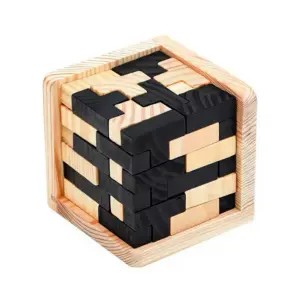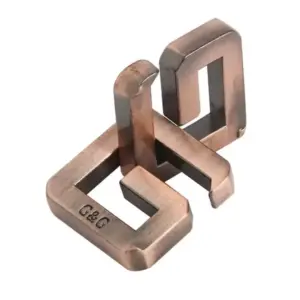
The third time the notched beechwood pin slipped past my thumb and clattered onto the hardwood floor, I didn’t swear. I didn’t even sigh. I just set the unfinished cluster of wood on my desk, walked to the kitchen, and made a double espresso. In the world of mechanical puzzles—or more specifically, when you’re wrestling with a 2,500-year-old design—impatience is the only thing that actually breaks the mechanism.
I’ve spent the better part of a decade testing over 200 mechanical puzzles. My shelves are a graveyard of “unsolvable” brass rings and half-finished laser-cut ships. But I keep coming back to the 3d wooden puzzle brain twister category because wood has a soul that plastic and metal lack. There is a specific, muffled thunk when a wooden joint seats perfectly that provides a hit of dopamine no smartphone game can replicate.
My thesis after thousands of hours of fiddling: The best wooden brain twisters aren’t just about spatial reasoning; they are lessons in observation. We live in a world of “brute force” solutions, but a wooden puzzle rewards the person who stops pushing and starts looking. If you’re trying to find a gift that won’t be forgotten in a drawer by Tuesday, or you’re looking to reclaim your own attention span from the scroll, you’re in the right place.
The 2,500-Year-Old “Click” and Why It Still Matters
Most people think of 3D puzzles as a modern hobby, something born from the invention of the laser cutter. That’s a mistake. The “brain twister” lineage goes back to Lu Ban, a legendary Chinese structural engineer from 500 BCE. He didn’t have glue or nails; he had geometry. He developed mortise-and-tenon joints that could hold a palace together through an earthquake, and then he shrunk that logic down into handheld puzzles to challenge his family.
When you hold a modern interlocking puzzle, you are holding the same engineering DNA that supports the Forbidden City. This isn’t marketing fluff; it’s a structural reality. If you look at the history of mechanical puzzles, you’ll see that the “interlocking” category is one of the oldest and most respected. It’s a pure test of how pieces can coexist in three-dimensional space without any external fasteners.
I’ve noticed that people who are “good” at these puzzles usually share one trait: they don’t use their fingernails to pry things apart. They use their eyes to find the “key” piece. In almost every high-quality wooden twister, there is one piece that must move first. Find that, and the rest follows. It’s a perfect metaphor for how your brain stalls and how to fix it when facing complex problems in real life.
Product Spotlight: The Master Class in Interlocking Logic
Luban Lock Set 9 Piece
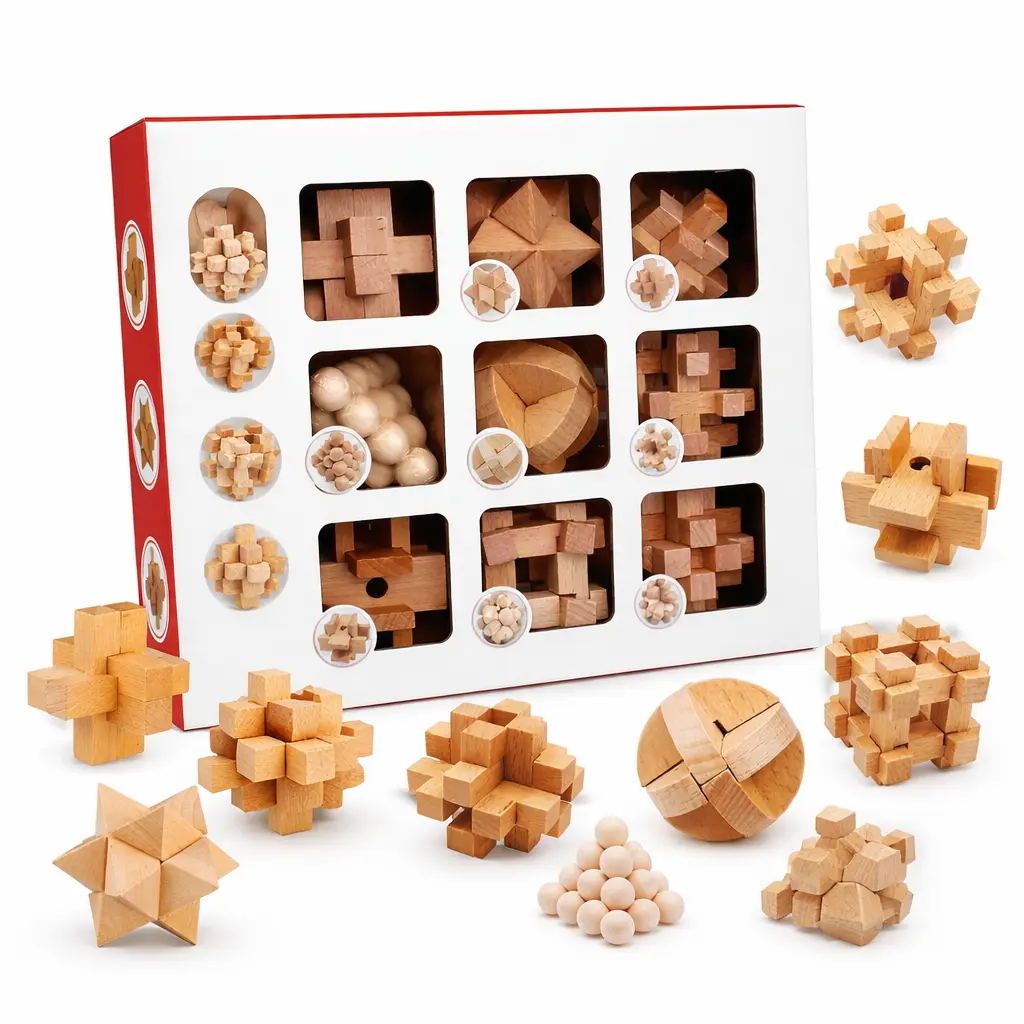
Luban Lock Set 9 Piece — $39.99
If you want to understand the roots of this hobby, you start here. The Luban Lock Set 9 Piece is essentially a boxed set of “frustration and triumph.” Priced at $39.99, it offers nine distinct challenges that range from “I figured this out in five minutes” to “I am questioning my college degree.”
I spent a rainy Saturday with the third puzzle in this set—the ball-shaped one. It looks like a solid mass of wood, but it’s actually a tightly woven cage. The beauty of the Luban set is the variety. You aren’t just solving the same trick nine times. Each one uses a slightly different variation of the mortise-tenon joint. I found the wood quality to be surprisingly consistent; the pieces are smooth enough to slide without being so loose that they fall apart prematurely. If you have a friend who claims they are “good at puzzles,” hand them the nine-piece star from this set and watch their confidence evaporate. It’s the ultimate litmus test for spatial patience.
6-in-1 Wooden Brain Teaser Set
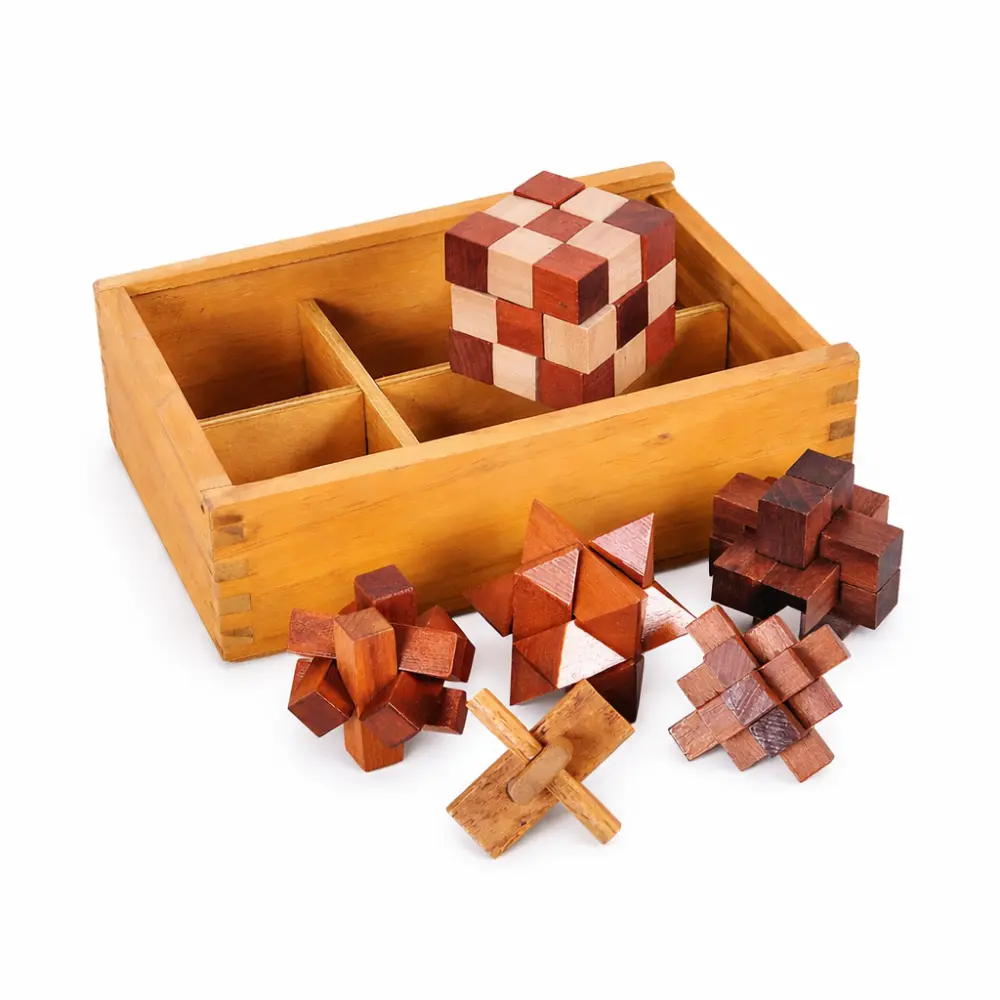
For those who need something to do with their hands during long Zoom calls, the 6-in-1 Wooden Brain Teaser Set is my top recommendation for a “desk toy” collection. At $38.88, these are palm-sized versions of the classics.
I keep two of these on my coffee table. What I love about this specific set is that they are carved from solid beechwood. There’s a weight to them that feels premium. The challenge here isn’t just taking them apart—that’s the easy bit. The real “twister” is getting those six notched sticks back into a perfect cube or star. I’ve seen engineers get genuinely angry at the “key piece” in these. It’s a great example of locking puzzle logic where the solution is hidden in plain sight. One honest negative: because they are solid wood, they can be slightly affected by humidity. If you live in a very humid climate, a piece might stick. Don’t force it; just give it a minute in a dry room.
The Anatomy of the “Twist”: Plywood vs. Solid Wood
In my decade of reviewing, I’ve categorized 3D wooden puzzles into two distinct camps: the Interlocking Solids and the Mechanical Assemblies.
Interlocking solids, like the Luban locks, are about the “solve.” You take them apart, you put them together. The challenge is the logic. Mechanical assemblies, often made of laser-cut plywood, are about the “build.” These are kits where you assemble 100+ pieces to create something that actually works—a clock, a safe, or a globe.
Both are “brain twisters,” but they tickle different parts of the gray matter. The interlocking solid is a sprint of logic; the mechanical assembly is a marathon of precision. I’ve found that your brain craves the click of a perfectly fitted gear just as much as it enjoys solving a riddle.
Product Spotlight: The Engineering Marvels
Mechanical 3D Wooden Globe Puzzle

This is where the hobby gets sophisticated. The Mechanical 3D Wooden Globe Puzzle ($28.88) is less of a “riddle” and more of a mechanical journey. It uses a gear-drive system that allows the finished globe to actually rotate.
When I built this, I was struck by the precision of the laser cuts. With these DIY kits, the “twister” element comes from following complex instructions and ensuring the gears are sanded and waxed properly. If you rush the assembly of the gear-drive, the globe won’t spin smoothly. It’s an intermediate-level project that rewards the meticulous. It’s also one of the few puzzles that looks genuinely “adult” on a bookshelf once finished. It’s a perfect bridge for someone who enjoys 3D crystal puzzles but wants something more tactile and mechanical.
3D Wooden Puzzle Safe with Combination Lock
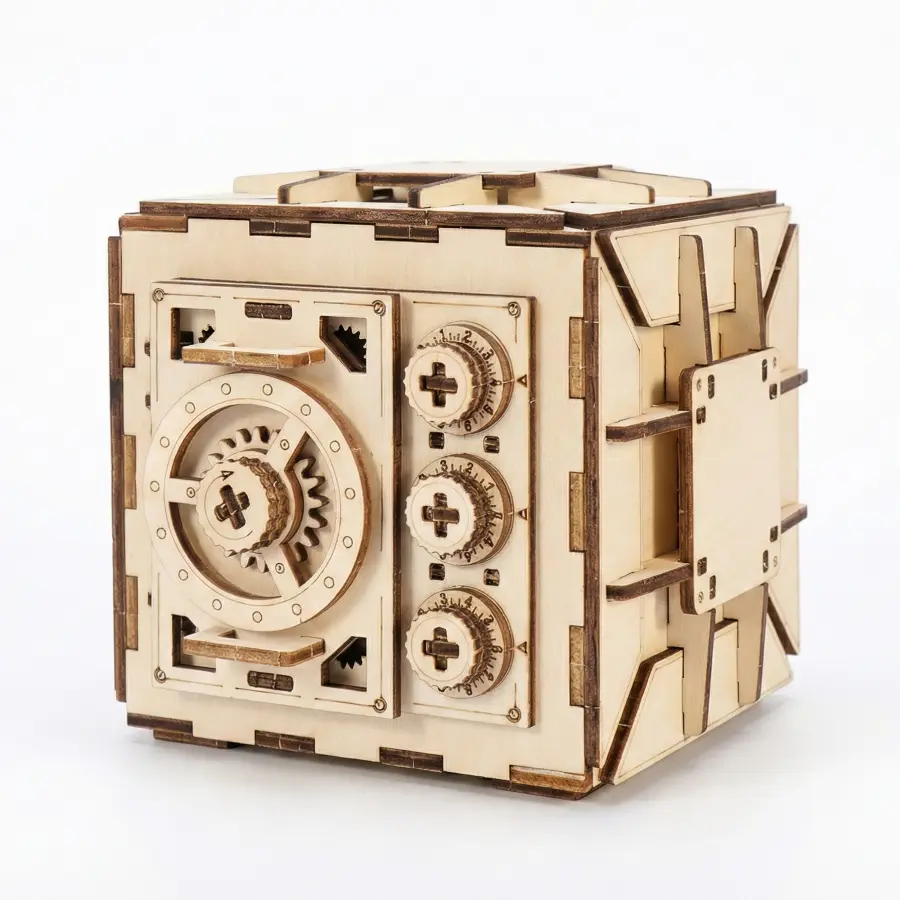
If you want to feel like a master locksmith, the 3D Wooden Puzzle Safe with Combination Lock is the gold standard. Priced at $30.99, this 111-piece kit creates a functional safe with a 3-digit combination.
The “brain twister” here is the internal gear system. You aren’t just snapping wood together; you are building a tumbler mechanism. I’ve built a few of these, and the moment you set your code and hear that first “click” of the lock engaging, it’s incredibly satisfying. It takes about 90 minutes to two hours for an adult. I’d say this is the brain-boosting gift your friends will actually thank you for because it results in a useful object. Just a tip from my workbench: use a bit of candle wax on the moving parts of the lock. It makes the “twist” much smoother.
The Peak: Why the 10-Year-Old Beats the Engineer
About three years ago, I conducted an informal experiment. I took a classic Six-Piece Burr—a notorious interlocking brain twister—and gave it to two people. One was a mechanical engineer with 20 years of experience. The other was my 10-year-old nephew.
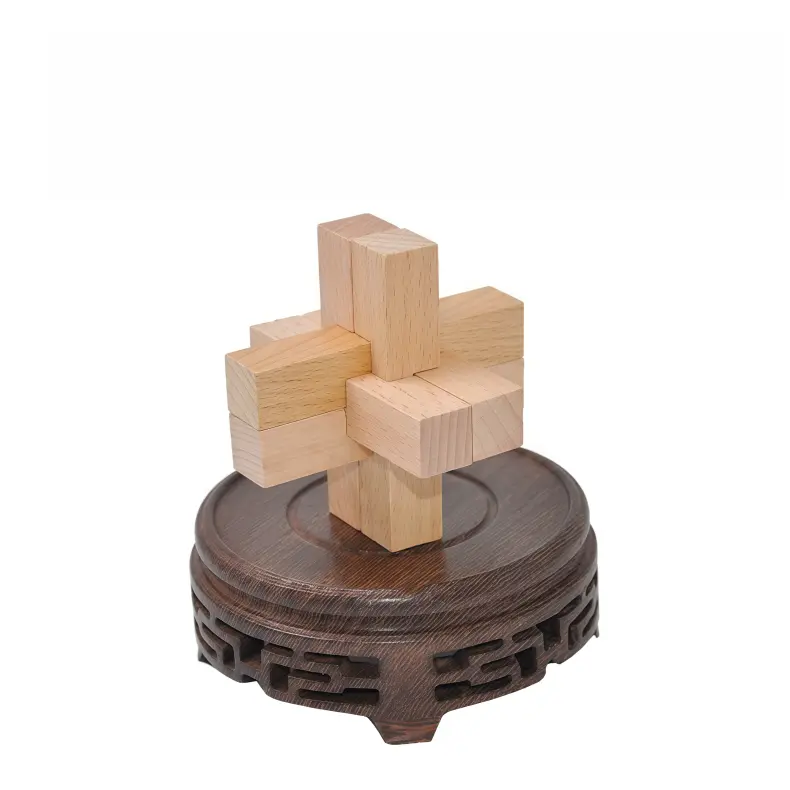
Six-Piece Burr — $17.99
The engineer (priced at $17.99 for the puzzle, not the engineer) immediately started looking for symmetry. He was trying to reverse-engineer the math of the notches. He was thinking in terms of X, Y, and Z axes. He was “working” the puzzle.
My nephew just started wiggling things. He wasn’t looking for a formula; he was looking for looseness. He felt the wood. He listened for the slight rattle of a piece that had a millimeter of play. Within four minutes, he had the “key” piece out. The engineer was still talking about structural integrity.
This is the “Peak” insight of the 3D wooden puzzle world: Overthinking is a handicap. These puzzles are designed by humans, for humans. They rely on tactile feedback. If you are struggling with a “twister,” stop looking at it like a math problem and start looking at it like a physical conversation. The wood will tell you where it wants to go.
The Six-Piece Burr is the perfect embodiment of this. It’s simple, elegant, and rewards those who seek understanding over force. It’s the “Wu Wei” of the puzzle world—solving through non-striving.
Expanding the Collection: Aesthetic Enigmas
Sometimes you want a puzzle that doubles as art. As someone who has a lot of “junk” on my desk, I’ve learned to appreciate the kits that look good even when you aren’t touching them.
3D Wooden Cello Puzzle Model Kit

The 3D Wooden Cello Puzzle Model Kit ($29.99) is a prime example. It blends steampunk aesthetics with musical history. While it’s marketed as a model kit, the “twister” aspect lies in the intricate engravings and the way the gears integrate into the cello’s body.
I found this build to be particularly relaxing. It’s not as “aggressive” as a 9-piece Luban lock. It’s more of a slow-burn project for a Sunday afternoon. Research actually shows that these types of activities enhance visuospatial cognition, which is a fancy way of saying it keeps your brain from turning into mush while you watch Netflix.
Steampunk Airship 3D Wooden Puzzle
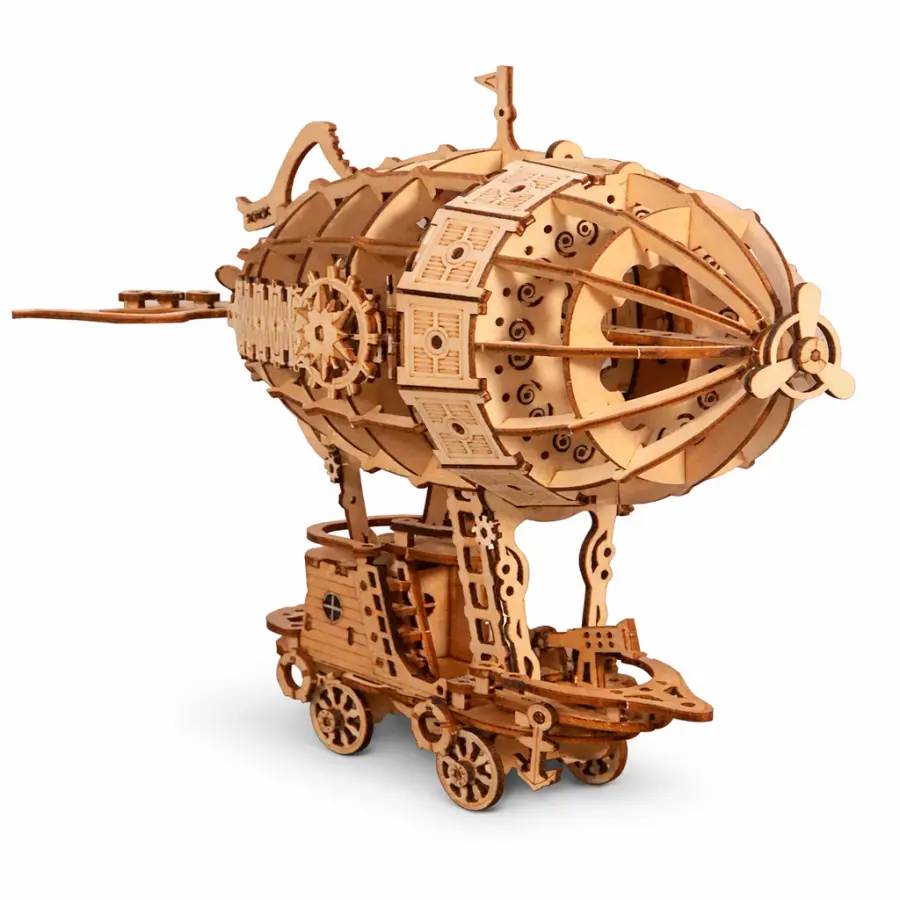
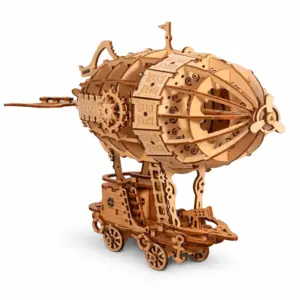
If you prefer something with a bit more “fantasy” flair, the Steampunk Airship 3D Wooden Puzzle ($26.66) is a fun, one-hour build. It’s got spinning propellers and rolling wheels.
I’ve had this one on my office shelf for six months. It’s a great conversation starter. When people ask “did you build that?” and you can say “yeah, in about an hour,” it feels good. It’s a low-barrier-to-entry “twister” that focuses more on the joy of assembly than the agony of the solve. If you’re feeling mentally drained, skip the high-difficulty locks and take a break with a quick game of 2048 before tackling this airship.
The Subtle Art of Maintenance: Why Your Puzzle Might Be “Lying” to You
One thing the instructions never tell you: Wood is a living material. Unlike a metal cast puzzle, a wooden brain twister can change based on the weather.
I once thought a puzzle was unsolvable because a piece wouldn’t slide. I spent two hours trying to find the “trick.” It turns out, my office was just too damp, and the wood had swollen by half a millimeter. If you encounter a piece that feels like it should move but won’t, don’t reach for the pliers. Try moving it to a drier room or, if it’s a DIY kit, use a tiny bit of fine-grit sandpaper on the joints.
Even a simple 6-piece key puzzle can benefit from a little “wearing in.” The more you solve it, the smoother the “twist” becomes.
6 Piece Wooden Puzzle Key
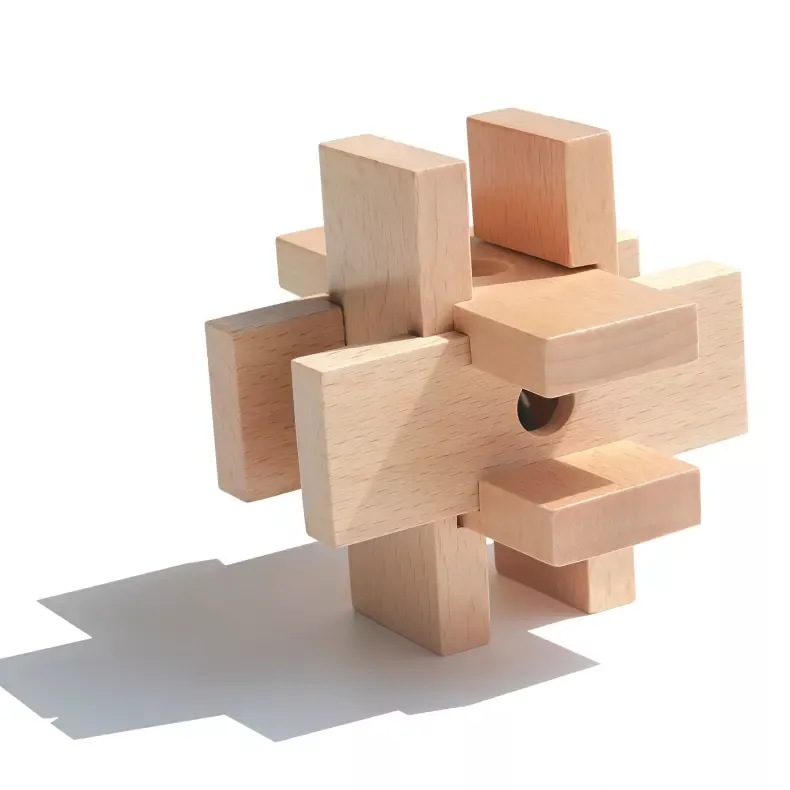
Speaking of the 6 Piece Wooden Puzzle Key ($12.99), this is the “budget king” of the category. It’s small, hardwood, and teaches the exact “Wu Wei” principle I mentioned earlier. It’s the kind of thing you throw in a backpack for a long flight. It proves that you don’t need 500 pieces to have a deep engagement. Sometimes, six pieces are more than enough to keep you occupied for an hour.
Galleon Ship 3D Wooden Puzzle Model Kit

For those who want a history lesson with their hobby, the Galleon Ship 3D Wooden Puzzle Model Kit is a standout. It’s a deep dive into the age of exploration in miniature form.
I love the rigging on this ship. Most wooden ship puzzles are either too simple (looking like a child’s toy) or too complex (requiring tweezers and a magnifying glass). This one hits the sweet spot. The snap-fit plywood is forgiving, and the resulting model has a decent amount of detail for the price. It’s less of a “twister” in the sense of a riddle, and more of a “twister” in the sense of spatial assembly.
3D Wooden Puzzle Clock DIY Kit
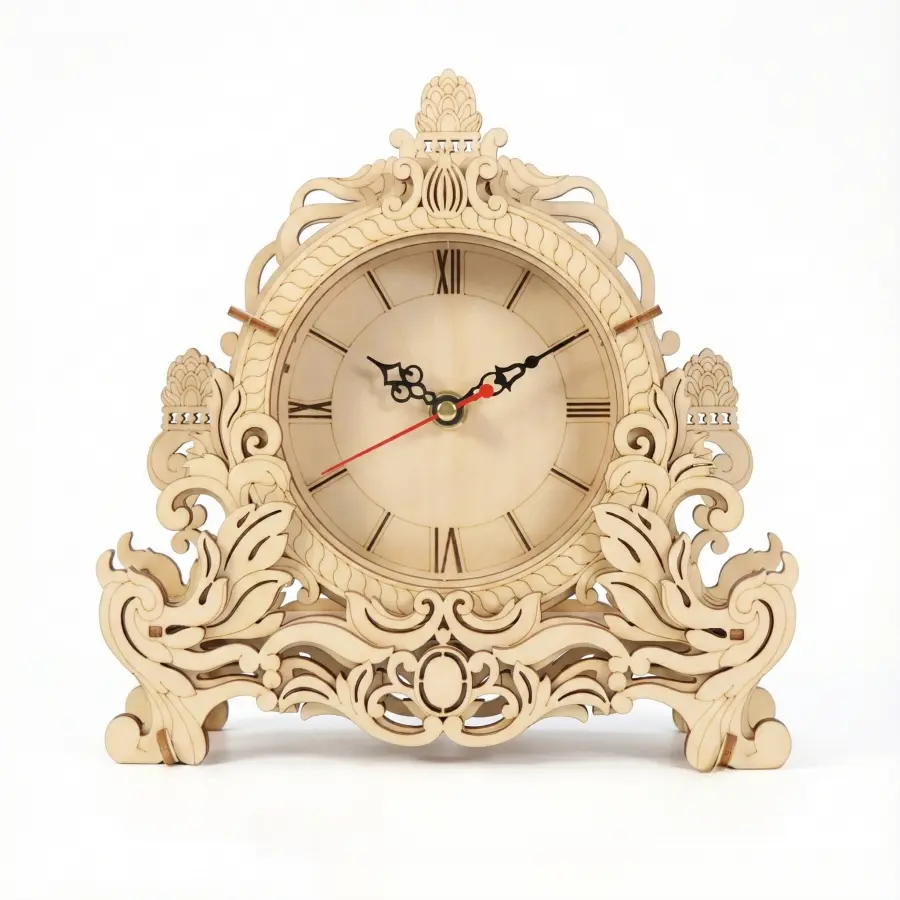
Finally, if you want something functional, the 3D Wooden Puzzle Clock DIY Kit ($26.99) is a 30-minute win. It’s only 28 pieces, making it the “easy mode” of the mechanical assembly world.
I often recommend this as a “gateway drug” for people who are intimidated by the 100+ piece kits. It’s a baroque-style clock that actually works. It’s a great way to experience the “click” without the four-hour commitment. If you find this too easy, you might want to move on to more complex puzzle trick boxes.
Quick-Reference Comparison Table
FAQ: Everything You Wanted to Know About Wooden Brain Twisters
How do I solve a 3D wooden puzzle without the instructions?
The first rule is to find the “looseness.” In almost every interlocking wooden puzzle, one piece has more “play” than the others. This is your key piece. If you’re stuck, try rotating the entire puzzle in your hands; gravity can sometimes reveal a sliding mechanism that isn’t obvious when the puzzle is stationary. If you really hit a wall, there are countless computerized video solutions online, but I recommend trying the “overnight method” first. Put it down, sleep, and look at it again in the morning. Your subconscious often solves the spatial problem while you sleep.
Do I need glue for these 3D wooden puzzles?
Most modern high-quality kits, like those from ROKR or the ones we’ve discussed here, are designed to be “snap-fit.” They use precision laser cutting to create friction joints. You shouldn’t need glue for structural integrity. In fact, using glue can often ruin a “brain twister” because it prevents the moving parts from sliding. If a piece is slightly loose, a tiny bit of wood glue on a toothpick can help, but it’s rarely necessary.
What is the best age for these puzzles?
While many are rated 14+, I’ve found that kids as young as 8 or 10 can handle them if they have good fine motor skills. However, the “interlocking solids” (like the Luban locks) can be frustrating for younger children who haven’t developed the patience for trial-and-error. For adults, there is no upper limit. I know 80-year-olds who use these to keep their cognitive health sharp.
Why are they called Luban locks?
They are named after Lu Ban, a legendary Chinese carpenter and inventor from the 5th century BCE. He is often credited with inventing the saw, the umbrella, and these interlocking puzzles. The puzzles were originally a way for carpenters to demonstrate their skill with joinery. If you could make a set of joints that held together without nails, you were a master.
Are wooden puzzles better than metal ones?
It’s a matter of preference. Metal puzzles (like the Hanayama series) are often more durable and have tighter tolerances. Wooden puzzles, however, have a tactile warmth and a “give” that metal lacks. Wood also allows for larger, more complex mechanical kits like safes and clocks that would be too heavy or expensive in metal. If you want a pocket-sized challenge, go metal. If you want a desk centerpiece or a long build, go wood.
How do I fix a broken piece in a wooden puzzle?
Most laser-cut kits come with a few “spare” parts for the most delicate pieces. If you snap a piece that doesn’t have a spare, a small amount of wood glue and a clamp (or a clothespin) will usually do the trick. Let it cure for 24 hours before trying to fit it back into the puzzle. Wood is surprisingly forgiving.
Can these puzzles help with anxiety or stress?
Absolutely. Many people use them as a form of “active meditation.” Because they require your full attention, they force your brain to stop looping on stressful thoughts. It’s hard to worry about your mortgage when you’re trying to figure out which of six notched sticks needs to slide left. If you need a digital detox, switching to a physical challenge is one of the most effective ways to reset your focus.
What’s the hardest wooden puzzle in this list?
The Luban Lock Set 9 Piece is the clear winner for difficulty. Because it contains nine different puzzles, you’re bound to hit at least two or three that will leave you stumped for days. The “star” and “ball” shapes are notorious for being easy to take apart and nearly impossible to reassemble without a guide.
Do I need special tools to build the DIY kits?
Usually, no. Most kits come with a small piece of sandpaper and a bit of wax. You might want a pair of small pliers or a hobby knife to help pop the pieces out of the plywood sheets, but it’s not strictly necessary. Your hands are your best tools here.
How do I keep the gears from sticking in mechanical puzzles?
Wax is your best friend. Use a plain white candle and rub it onto the teeth of any gears and into the slots where pieces slide against each other. It reduces friction significantly and prevents the wood-on-wood “binding” that can happen with laser-cut kits.
Are these puzzles eco-friendly?
Most are made from sustainable plywood or solid hardwoods like beech and maple. Compared to plastic toys, they are much better for the environment. They are also durable enough to be passed down through generations rather than ending up in a landfill.
Can I paint my 3D wooden puzzle?
Yes, but be careful. Paint adds thickness to the wood. If you paint the joints or the gears, the puzzle will no longer fit together or move. If you want to customize your build, use wood stains or light watercolor washes that soak into the wood rather than sitting on top of it.
Why does the price vary so much?
You’re usually paying for two things: the quality of the wood and the complexity of the design. A $12 puzzle is likely a simple interlocking design, while a $40 set or kit involves more material, precision laser cutting, and mechanical engineering.
What should I do if I lose a piece?
For the interlocking solids, a missing piece usually means the puzzle is unsolvable. For the DIY kits, you can sometimes “scavenge” a piece of scrap wood from the sheets and carve a replacement if you’re handy. Always open your kits on a clean, flat surface to avoid the “carpet monster” eating your parts.
Is there a “right” way to start?
Start with the Six-Piece Burr. It’s the foundational logic of almost all 3D wooden brain twisters. Once you understand how those six pieces interact, your brain will be “primed” for more complex challenges. If you get bored, you can always try a quick round of Retro Arcade to clear your head before jumping back into the wood.
Start Here, Then See Where the Rabbit Hole Goes
If I could go back to the start of my collection, I wouldn’t buy the most expensive, 500-piece mechanical clock first. I’d start with something that teaches the fundamental “click.”
The Luban Lock Set 9 Piece ($39.99) is the smartest investment for a beginner or an intermediate solver. It’s not just one puzzle; it’s a curriculum. It takes you through the history of human engineering and forces you to slow down. It taught me more about patience than any self-help book ever could.
The beauty of the 3d wooden puzzle brain twister is that it doesn’t require electricity, it doesn’t have a subscription fee, and it doesn’t care about your notifications. It just sits there, a silent, wooden enigma, waiting for you to find the “key.”
If you find that your brain thrives on these mechanical challenges, your next step should be digging into the world of sequential discovery boxes. They take the logic you’ve learned here and hide it behind secret panels and hidden compartments. But for now, just pick up a piece of wood, feel for the looseness, and remember: don’t force it. The solution is already there; you just have to let it emerge.