The third time the crimson center sphere of the Twelve Sisters puzzle rolled off my mahogany desk and under the radiator, I didn’t swear. I didn’t even sigh. I simply leaned back, took a long sip of cold Oolong, and stared at the twelve notched sticks scattered across my blotter like a game of high-stakes pick-up sticks gone wrong. I had been at it for three hours. My thumb was slightly sore from pressing against the grain, and my mental map of the 25-piece assembly was a tangled mess of “if-then” statements that led nowhere.
Most people approach a mechanical challenge with the assumption that if they just fiddle with it long enough, the solution will present itself. They treat it like a lottery. But after my extensive testing of over two hundred adult puzzles, I’ve realized that wood, unlike metal or plastic, requires a specific kind of psychological surrender. You aren’t fighting the object; you’re fighting your own impatience.
The thesis of this review is simple: the secret to any solve wooden puzzle attempt isn’t found in your fingers, but in your ability to stop looking at the parts and start seeing the voids between them. Whether you are tackling a 2,500-year-old Chinese design or a modern mechanical kit, the wood will tell you exactly what it wants to do—if you’re quiet enough to listen.
The Geometry of Frustration: Why Wood is Different
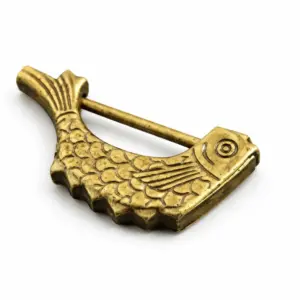
When you handle a Cast Keyhole Puzzle, the feedback is binary. It either moves or it doesn’t. There’s a clink of metal on metal, a hard stop, and a clear boundary. Wood is organic. It breathes. It has friction that changes with the humidity in your room. This makes “the solve” a much more intimate experience.
Most wooden brain teasers fall into the category of “interlocking puzzles,” often referred to as Burr puzzles. The history of these objects stretches back centuries, appearing in both European and Asian traditions as tests of joinery and spatial logic. In China, they are often linked to the legendary carpenter Lu Ban, who used mortise-and-tenon joints to create structures that required no nails or glue.
If you’re struggling right now, you’re likely falling into the “Force Trap.” You think that because wood is slightly soft, you can nudge a piece into place. You can’t. If it doesn’t slide with the grace of a piston, you’re doing it wrong. This is the first lesson of the Luban Lock Set 9 Piece: geometry is absolute, and your desire to be finished is irrelevant.
The Interlocking Legends: Five Puzzles to Master
If you want to truly understand the “solve wooden puzzle” experience, you have to start with the classics. These aren’t just toys; they are physical manifestations of mathematical group theory.
Luban Lock Set 9 Piece
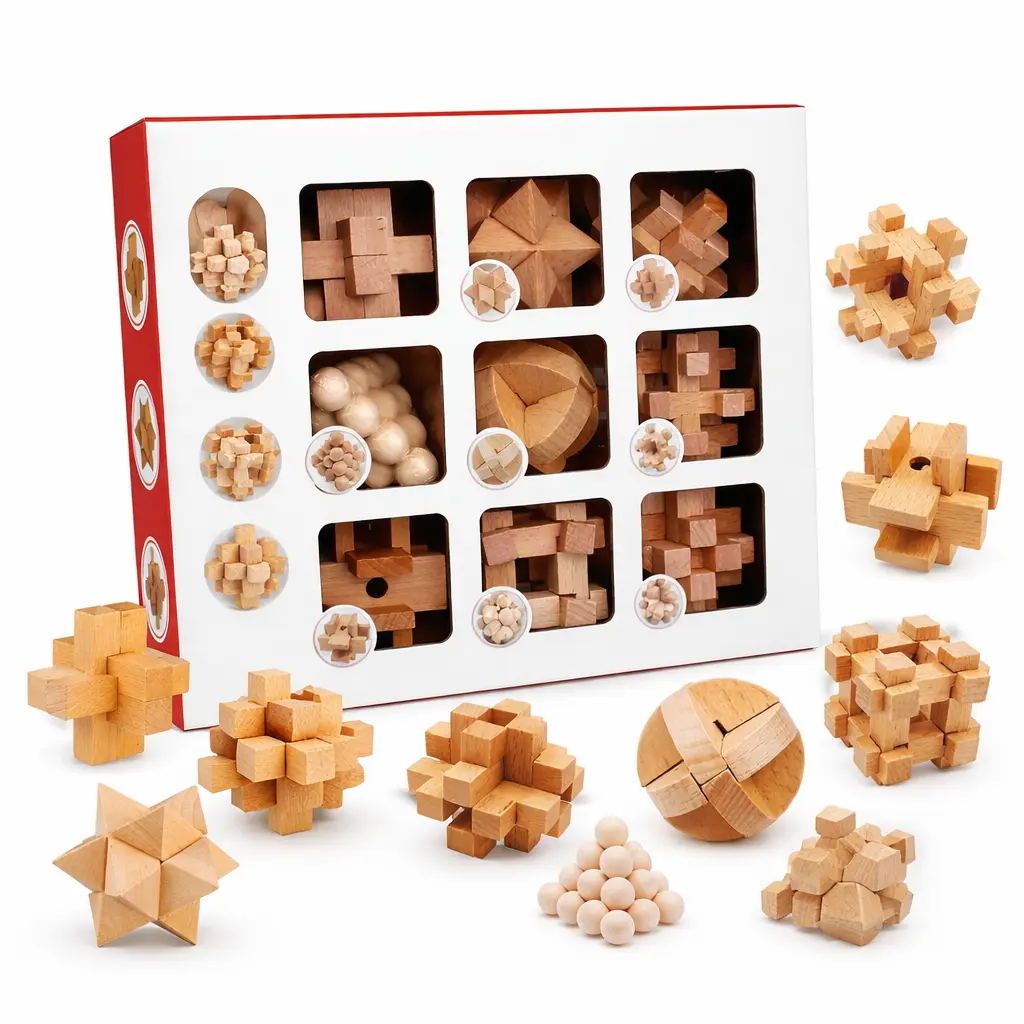
This $39.99 set is the ultimate curriculum for anyone serious about mechanical enigmas. It contains nine distinct challenges, each recreating the joinery that Lu Ban allegedly used to test his son’s intelligence around 500 BCE. When you first dump these out of the box, you’ll feel a sense of overwhelming simplicity. “It’s just wood,” you’ll think.
Then you try to put the first one back together.
Each piece in the Luban Lock Set 9 Piece relies on the others for structural integrity. It is a lesson in mutual dependence. I spent an entire Saturday morning on the “Ball in Cage” variant included in this set. The specs are precise—the mortise-tenon joints are cut with enough tolerance to move, but not enough to cheat. My verdict? This is the best value-for-money purchase for a beginner because it scales. You start with the three-piece crosses and work your way up to the nine-piece monsters. It’s a masterclass in how certain wooden and metal locks actually function without needing a single screw.
Twelve Sisters Puzzle
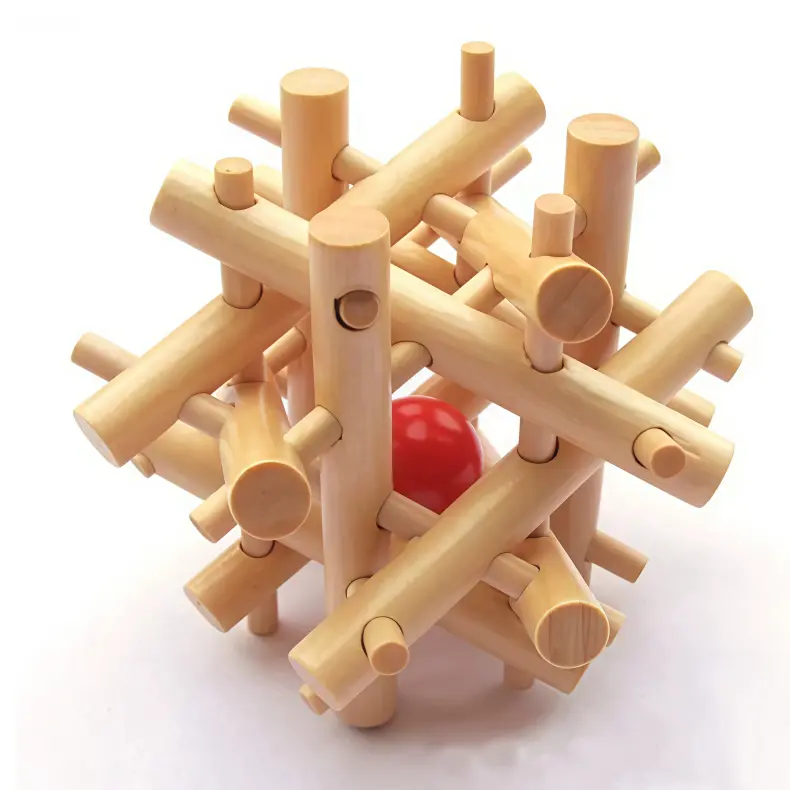
The Twelve Sisters Puzzle, priced at $19.99, is where things get personal. It consists of twelve thick rods, twelve interlocking sticks, and a single crimson sphere that sits at the heart of the chaos. This is what we call a “high-order” interlocking puzzle.
What I love about this particular model is the sensory feedback. The rods have five precision-drilled holes each, and the “solve” requires you to build a cage that traps the sphere. It’s a test of sequential discovery. If you place rod #4 before rod #7, the whole thing will eventually collapse inward. I’ve found that the best way to tackle this is to work from the center out. It teaches you that true strength comes from flexibility; if you hold the pieces too tightly, you can’t see the path forward. It’s a beautiful desk piece, but be warned: if you have a cat, that red ball will become their new favorite toy the moment you drop it.
Wood Knot Puzzle
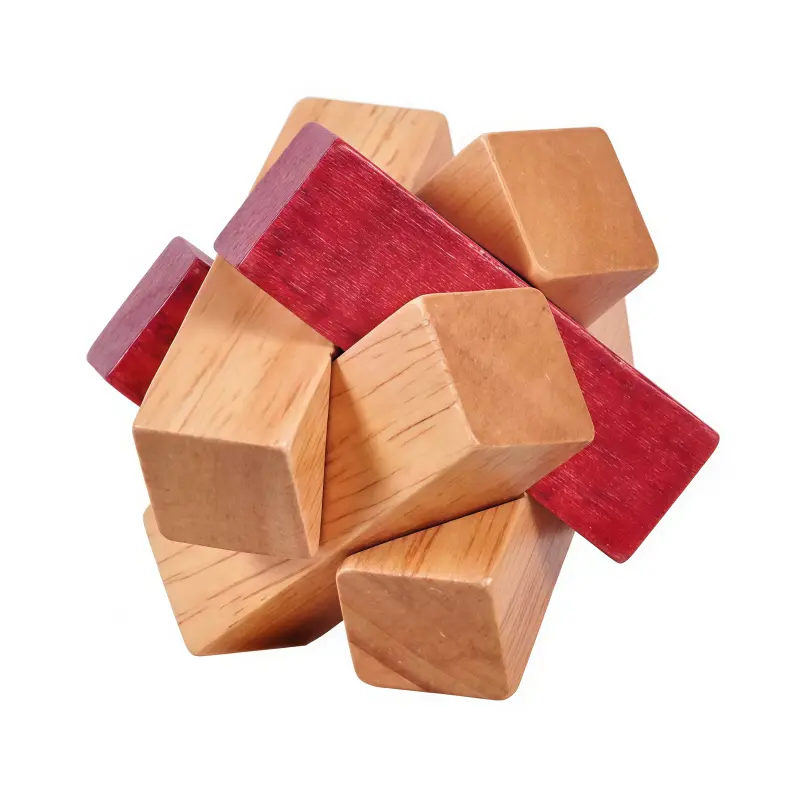
At $16.99, the Wood Knot Puzzle is the minimalist’s dream. It only has six pieces. You’d think that would make it easy. It doesn’t. This puzzle is an embodiment of Taoist philosophy—specifically the idea that “great form has no shape.”
When I first unboxed this, I was struck by the quality of the hardwood. There’s no glue, no varnish to hide imperfections, just raw geometric harmony. The “Aha!” moment with the Wood Knot Puzzle usually comes when you realize that the final piece doesn’t slide in from the side, but drops in from a diagonal you didn’t know existed. It’s a perfect “fidget” solve. I keep one on my coffee table, and it’s fascinating to watch guests pick it up. They usually give up within five minutes, but the ones who stick with it always have the same expression of stunned delight when the knot finally cinches shut.
Treasure in a Cage
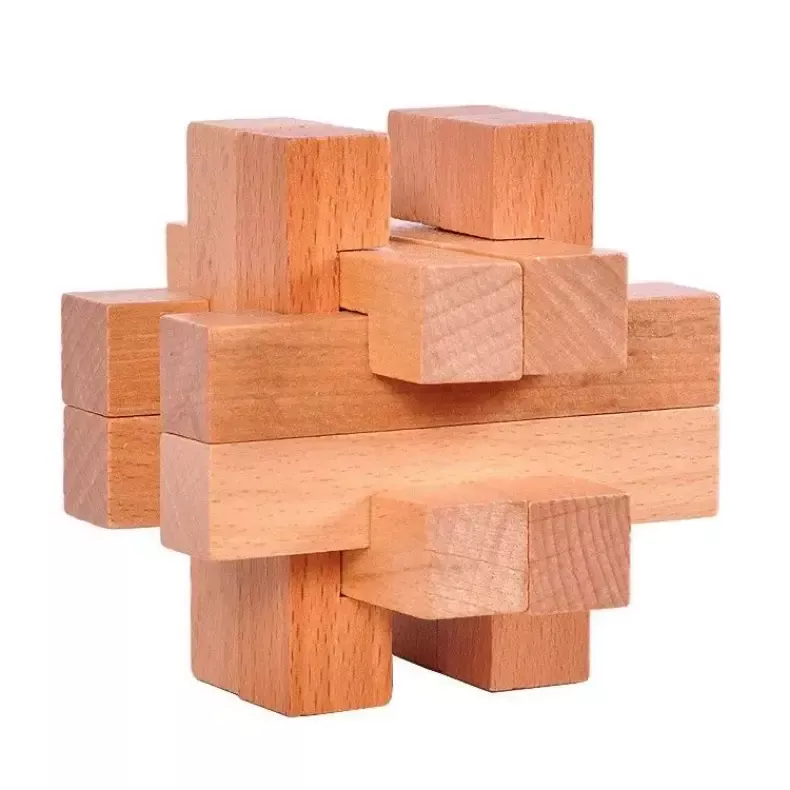
This $16.99 Luban-style teaser is a bit of a trickster. The Treasure in a Cage features twelve interlocking bars hiding a single rattling bead. It’s similar to the Twelve Sisters but feels more like a traditional “lock.”
The challenge here isn’t just assembly; it’s the disassembly. You have to find the “key” piece—the one bar that has just enough wiggle room to slide out and unlock the rest. I’ve noticed that people who are good at the deductive reasoning found in Kurodoko tend to excel here. You have to eliminate the impossible moves until only the truth remains. The wood grain on this one is particularly warm, and the sound of the bead rattling inside is a constant, mocking reminder that you haven’t solved it yet. It rewards depth and patience over quick tricks.
6 Piece Wooden Puzzle Key
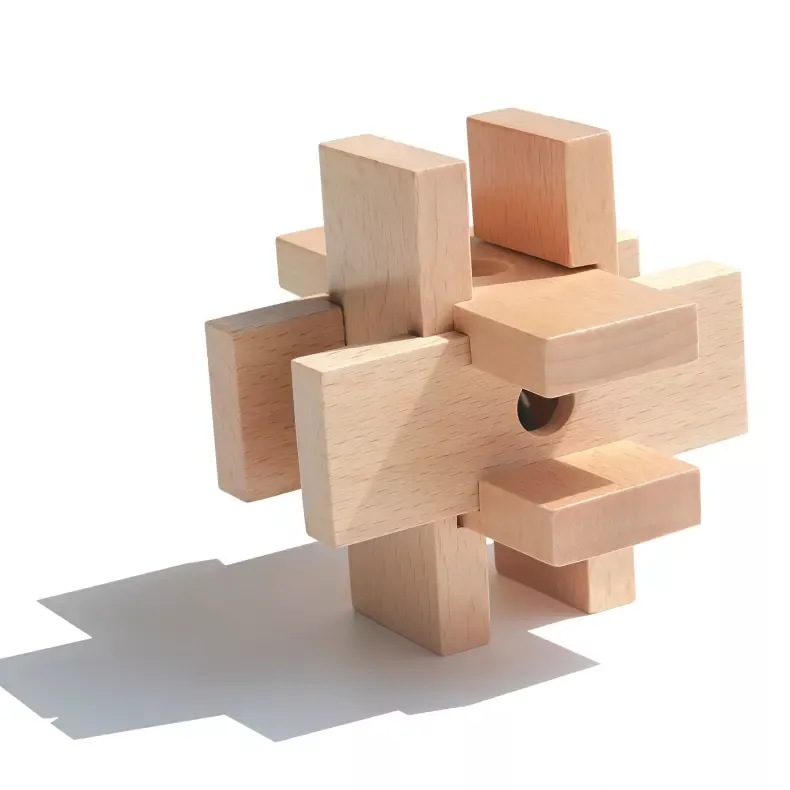
If you are looking for a “pocket solve,” the 6 Piece Wooden Puzzle Key is your best bet for $12.99. It’s small, elegant, and fits in the palm of your hand. It’s essentially a 3D version of a logic gate.
This puzzle teaches “Wu Wei,” or the art of effortless action. When you stop forcing the pieces and let your hands find the natural grooves, the complexity dissolves. I’ve used this as a “palate cleanser” between more difficult sequential discovery boxes. It’s not going to take you all afternoon, but it provides that hit of dopamine that only a perfect fit can provide. It’s the kind of object that proves less is often more.
The Peak Moment: The “Ghost” Piece and the Blind Solve
After years of doing this, I’ve noticed a phenomenon I call the “Ghost Piece.” You’re sitting there with the Tricky Wooden Ring Puzzle ($12.89), and you swear you’ve tried every rotation. You’ve moved the ring left, right, through the loop, and back again. You are convinced the puzzle is physically impossible.
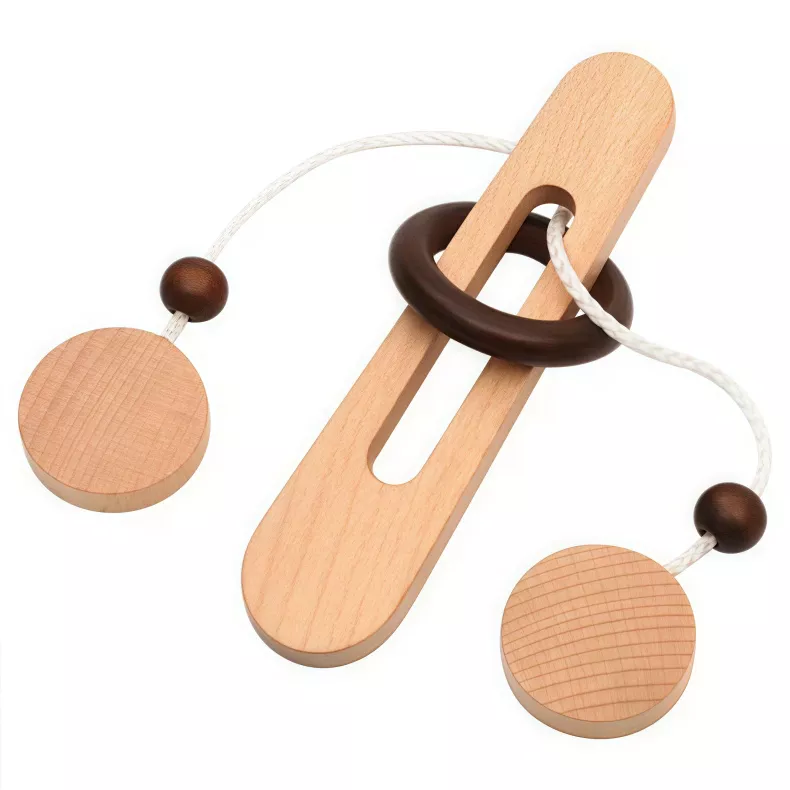
Tricky Wooden Ring Puzzle — $12.89
Then, you stop looking at the puzzle. You look out the window, or you listen to the person talking to you in the room, and your hands—operating on a subterranean level of spatial awareness—just do it. The ring falls free.
This is the peak of the “solve wooden puzzle” experience. It’s the moment your brain stops trying to use linguistic logic (“If I move this here…”) and starts using pure spatial intuition. I once watched a mechanical engineer struggle with a simple 3-piece burr for twenty minutes, only for his 10-year-old daughter to pick it up and solve it in thirty seconds. Why? Because the engineer was looking for a mechanical latch, while the child was just looking for where the wood wasn’t.
This shift in perspective is why we do this. It’s a mental reset. It’s why 3D crystal puzzles are so popular—they force you to look through the object, not just at it. When you finally hit that “flow state,” the frustration vanishes, replaced by a profound sense of order.
From Solving to Building: The Mechanical Kit Evolution
Sometimes, the “solve” isn’t about taking something apart, but about the 500 tiny steps required to bring it to life. This is a different kind of mental endurance.
If the interlocking puzzles are a sprint, these kits are a marathon. Take the Steampunk Airship 3D Wooden Puzzle ($26.66). You aren’t just fitting six pieces together; you’re managing 160 laser-cut parts.
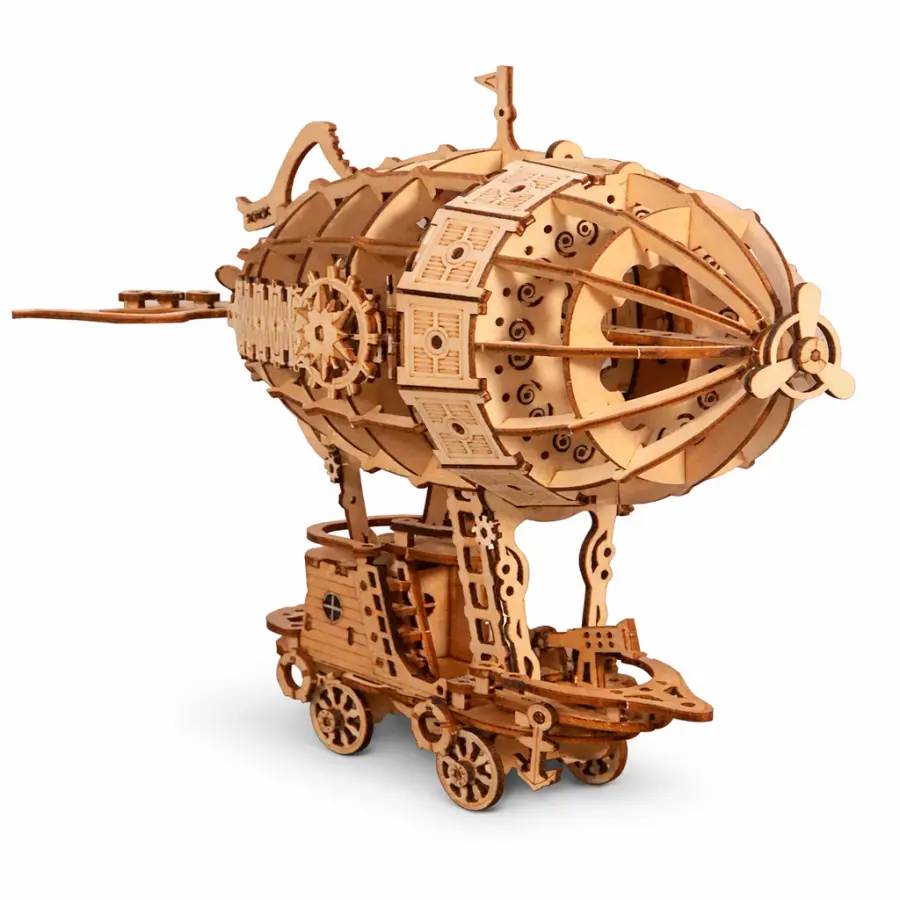
What makes the Steampunk Airship 3D Wooden Puzzle so satisfying is the mechanical payoff. You have spinning propellers and rolling wheels that actually work once the assembly is complete. It’s a Victorian-inspired dream that takes about an hour to solve. The “solve” here is in the instructions—following the logic of the designer to ensure the gears don’t bind. I’ve found that using a bit of paraffin wax on the moving parts makes a world of difference, a tip I picked up during my breakdown of various wooden storage puzzles.
Similarly, the 3D Wooden Cello Puzzle Model Kit ($29.99) offers a tribute to musical history.
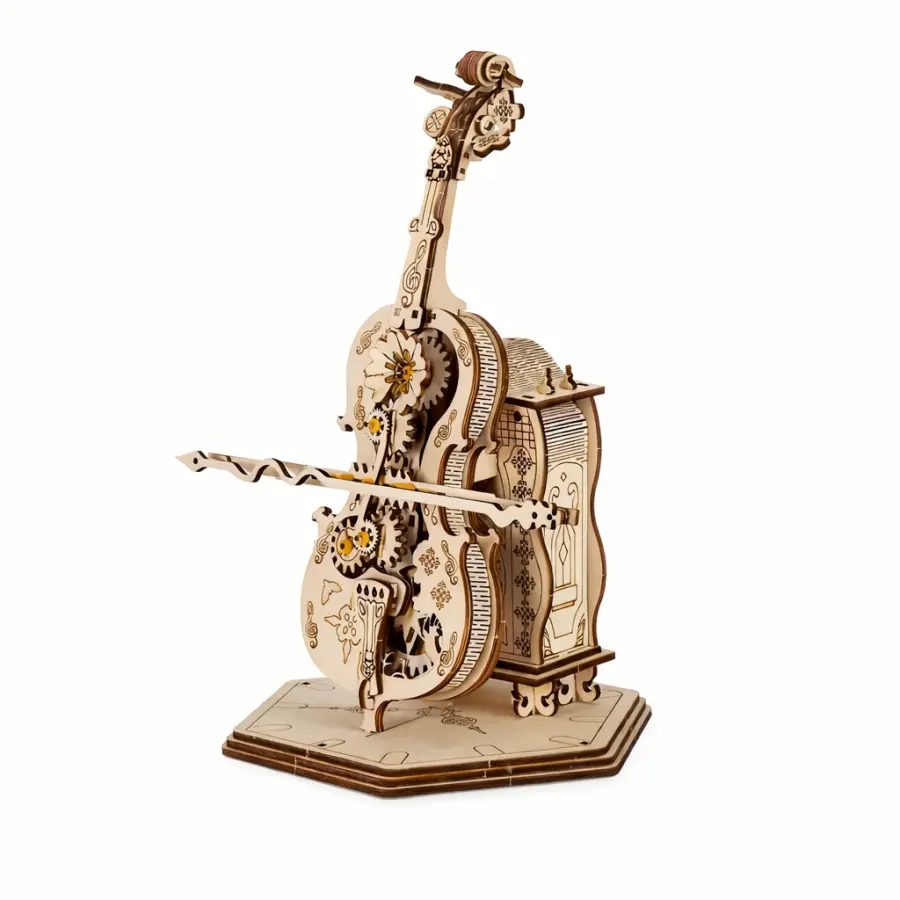
The “solve” here is about structural delicacy. You are recreating 16th-century Italian curves with flat sheets of plywood. It’s a beautiful exercise in how 2D shapes become 3D volumes. Unlike the burr puzzles, which you can do over and over, these kits are usually a one-time solve, but the result is something you’ll want to permanently display in your home.
For those who want a bit of atmosphere with their assembly, the DIY Castle Music Box Night Light Shadow Box Kit ($33.99) adds layers of electronics and light.

This isn’t just a puzzle; it’s a 28-piece theatrical set. The “solve” involves layering panels to create depth, a technique used in professional shadow boxes. It’s therapeutic and significantly less stressful than the Twelve Sisters. If you’re feeling burned out by the “impossible” interlocking puzzles, a kit like this is a great way to remind yourself that you can actually finish things.
Finally, for the nautical fans, the Galleon Ship 3D Wooden Puzzle Model Kit (check current pricing) is a fantastic desk-sized replica of the ships that dominated the Atlantic.

The snap-fit construction means no glue is required, which is a blessing for those of us with messy desks. It’s an engineering marvel in miniature, showing how the elongated hulls of the Age of Exploration were a precursor to modern naval design. It’s a different kind of “solve wooden puzzle” experience—one rooted in history and architecture rather than pure abstract logic.
Comparison Table: Finding Your Perfect Solve
FAQ: Everything You Need to Know About the Solve
How do I start a wooden puzzle if I’m stuck?
The best way to start is to categorize the pieces. Look for the “outliers”—pieces with unique notches or different weights. In a burr puzzle, there is almost always one “key” piece that has fewer internal cuts, allowing it to slide out first. If you can’t find it, try gently applying pressure to each piece in every direction. Don’t force it; if it’s the right piece, it will move with minimal effort. This process is very similar to the logic required for cast metal riddles, where one move unlocks the next.
Are wooden puzzles better than plastic or metal?
“Better” is subjective, but wood has a unique durability. Unlike plastic, which can warp or snap, high-quality wood maintains its friction and “fit” for decades. According to Britannica’s history of puzzles, wooden puzzles were the original standard for elite hobbyists. There’s also a sensory component—the smell of the wood and the warmth of the material make for a much more relaxing experience than the cold click of metal.
Can these puzzles help with cognitive health?
Yes. Research, including studies cited by the National Institutes of Health, suggests that engaging in spatial reasoning tasks like 3D puzzles can enhance visuospatial cognition. It’s a workout for your brain’s frontal lobe. If you find yourself getting bored with digital games, switching to a physical object like the Luban Lock Set 9 Piece provides a different kind of neurological stimulation.
What if I lose a piece?
This is the nightmare of every enthusiast. Because these are interlocking, a single missing piece usually makes the puzzle unsolvable and unstable. I recommend always working on a felt mat or a dedicated puzzle tray. If you do lose a piece of a model kit, you can sometimes fabricate a replacement with balsa wood and a hobby knife, but for precision burr puzzles, it’s much harder. If you’re worried about losing parts, consider starting with digital logic games like the 2048 tile challenge to build your skills before moving to physical objects.
Are these puzzles suitable for children?
Most of the puzzles mentioned here are rated for ages 12 and up due to the complexity and small parts. However, a bright 8-year-old can certainly handle the Wood Knot Puzzle with some guidance. It’s a fantastic way to teach patience and fine motor skills. Just avoid the more delicate model kits for younger kids, as the laser-cut plywood can be brittle if handled roughly.
How do I clean or maintain my wooden puzzles?
Never use water or harsh chemicals. A dry, soft microfiber cloth is usually enough. If a puzzle becomes too “tight” due to humidity, you can lightly sand the contact points with high-grit sandpaper (400+) or apply a tiny amount of beeswax. This is a common trick used by those who maintain a personal collection of wooden trick boxes.
Why is the Twelve Sisters puzzle so much harder than others?
It’s the sheer number of possible orientations. With 24 sticks and a center sphere, the mathematical permutations are astronomical. Unlike a 6-piece burr where you can eventually “brute force” the solution by trying every combination, the Twelve Sisters requires you to understand the pattern of the cage. It’s less about trial and error and more about structural engineering.
Do I need tools for the model kits?
For the kits like the Steampunk Airship, you generally don’t need glue, but a pair of tweezers and a small hobby knife can be helpful for removing stubborn pieces from the laser-cut sheets. A bit of sandpaper is usually included in the box to smooth out any burrs (the wooden kind, not the puzzle kind!).
What is “Wu Wei” in puzzle solving?
It’s a concept from Chinese philosophy often translated as “non-action” or “effortless action.” In the context of the 6 Piece Wooden Puzzle Key, it means not fighting the wood. If you find yourself gritting your teeth or squeezing the puzzle, you’ve lost the “Wu Wei.” The solution usually appears when you relax your grip and let the pieces find their own way.
Are instructions included?
Most of our products include a solution guide, but I strongly advise you to throw it in a drawer and forget about it for at least forty-eight hours. The joy of the “solve wooden puzzle” journey is the discovery. If you look at the solution immediately, you’ve essentially paid for a 30-second experience rather than a 5-hour one.
How do I store my puzzles?
Keep them out of direct sunlight and away from heat vents. Wood can fade and warp if exposed to extreme temperature swings. If you’ve completed a particularly beautiful one, like the DIY Castle Music Box, it makes a great nightlight or shelf piece.
Can I finish a puzzle and then take it apart again?
Absolutely. In fact, for interlocking puzzles, the real test is whether you can solve it a second time a week later. You’ll be surprised how quickly the brain forgets the specific sequence, forcing you to re-learn the logic.
Is the “Treasure in a Cage” a good gift for an engineer?
It’s the perfect gift for an engineer. Engineers tend to look for mechanical shortcuts, and this puzzle punishes that line of thinking. It forces them to slow down and appreciate the “low-tech” genius of ancient joinery. It’s a humbling and rewarding experience.
What is the difference between a “burr” and a “sequential discovery” puzzle?
A burr puzzle is primarily about how pieces interlock to form a solid shape. A sequential discovery puzzle, like the frustrating beauty of Japanese-style trick boxes, often involves finding hidden tools or sliding panels in a specific order to reach a goal (like finding the bead in the cage).
Why do some puzzles have a “crimson sphere” or a bead?
These act as “anchors.” They provide a physical goal for the solve and often add a layer of difficulty because they can interfere with the movement of the internal pieces. They also add a nice splash of color to the natural wood grain.
The Final Click: Why We Keep Coming Back
I eventually found that crimson sphere. It was tucked behind the leg of my desk, mocking me with its perfect, un-notched roundness. I picked it up, wiped off the dust, and returned to the Twelve Sisters. This time, I didn’t try to build the cage around the ball. I built the cage first, leaving just enough space for the final rod to lock the sphere in place.
It clicked. Not a loud, mechanical snap, but a soft, wooden “thump” that felt like a secret being shared.
Solving a wooden puzzle isn’t about proving how smart you are. It’s about proving how patient you can be. In a world that demands instant results and 15-second videos, these objects demand your time. They demand that you sit still, breathe, and think in three dimensions. They are a bridge to a slower way of living.
If you’re ready to start your own collection, I cannot recommend the 6 Piece Wooden Puzzle Key ($12.99) highly enough. It’s the one that taught me more about patience than any book ever could. It’s small enough to carry with you, but deep enough to keep you occupied during a long flight or a quiet evening.
Next, explore the translucent world of acrylic brain teasers to see how the logic of wood translates to the clarity of crystal. Just remember: the wood isn’t the problem; your hurry is. Let the grain guide you, and the solve will follow.