The third time the brass pin slipped past my thumb and retreated into the mahogany housing, I didn’t swear. I didn’t throw the box. I simply set it down, walked to the kitchen, and made a very strong cup of coffee. It was February of last year, and I was deep into a “weekend project” that had stretched into its third week. I had downloaded what I thought were foolproof Japanese puzzle box plans, but I was learning a hard lesson: in the world of precision joinery, a printer and a table saw are rarely enough.
The search for “Japanese puzzle box plans” usually starts as a DIY dream of creating a secret heirloom, but it often ends in a pile of expensive sawdust. My thesis, after testing over 200 mechanical puzzles and attempting a dozen builds, is simple: the best puzzle boxes punish impatience and reward observation. If you are looking to build or buy one, you aren’t just looking for a container; you are looking for a physical manifestation of logic. Most plans fail because they focus on the “how” of the cuts without explaining the “why” of the tolerances.
In this guide, I’m going to break down why those 0.1mm measurements matter, which mechanical structures actually work for beginners, and which ready-made challenges will teach you more about joinery than any PDF ever could.
The Geometry of Frustration: Why Plans Aren’t Enough
When you look at a traditional Himitsu-Bako (secret box) from the Hakone region, you’re looking at more than just wood. You’re looking at a centuries-old tradition called Yosegi-zaiku, where complex parquetry patterns are sliced into paper-thin veneers. But the real magic is the internal “slop”—or lack thereof.
Most hobbyist plans you find online are designed for standard lumber sizes. The problem? Wood is a living material. It breathes. It expands in the humidity of a basement workshop and shrinks in the dry air of a living room. A Japanese puzzle box relies on friction-fit sliding panels. If your plan doesn’t account for the seasonal movement of grain, your “secret” box will either rattle like a spray-paint can or become a permanent wooden brick that requires a hammer to open.
Before you commit to a scratch build, you need to understand the fundamental mechanics of interlocking parts. I often tell people that navigating the world of trick boxes requires a baseline understanding of how wood interacts with wood. Without that, you’re just making a box that’s broken by design.
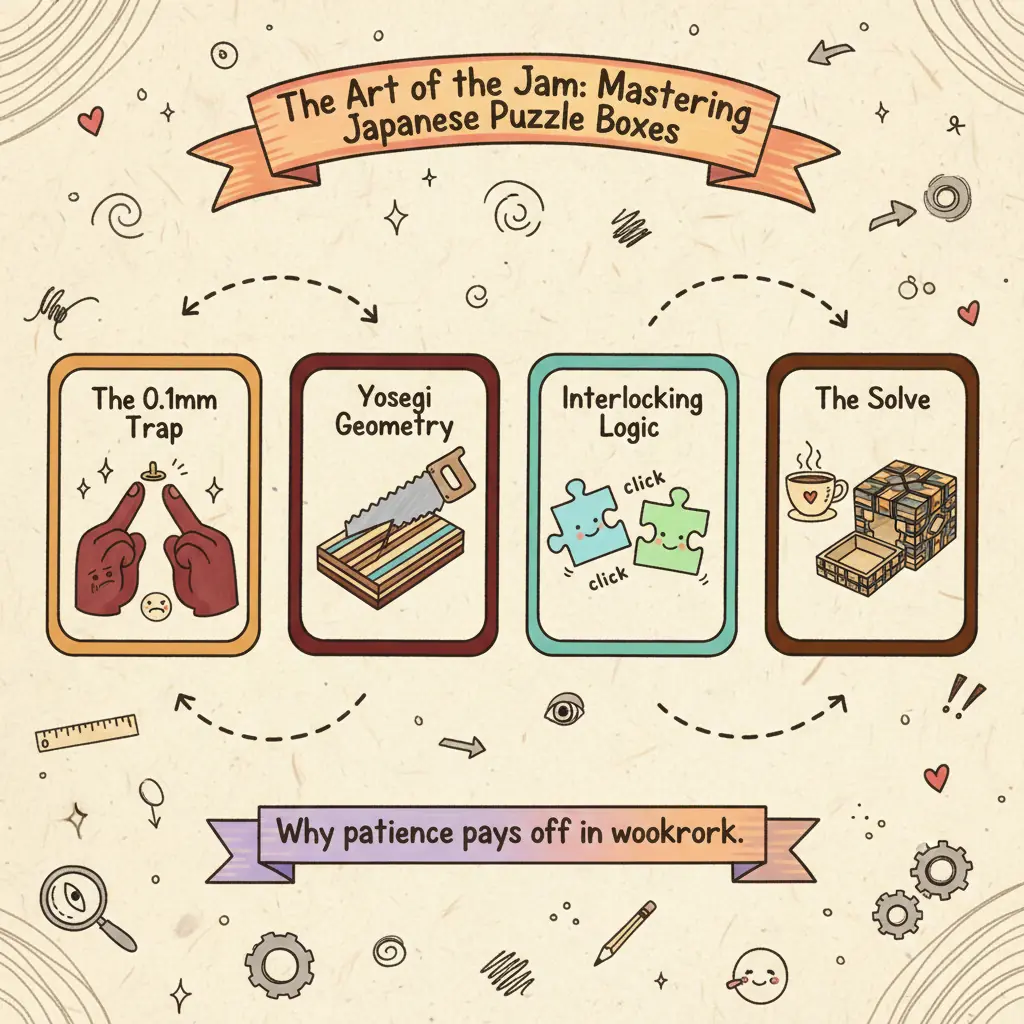
The 0.1mm Trap: Why Your DIY Box Probably Jams
Here is the peak insight I’ve gained after three years of failed builds and successful solves: The secret isn’t the sequence; it’s the friction.
In a professional-grade puzzle box, the panels are held in place by “keys”—internal wooden tabs that must align perfectly with grooves in the neighboring panels. If you are working from plans, you might see a measurement for a 3mm groove. In reality, that groove needs to be 3.1mm, and the tab needs to be 2.95mm. That 0.15mm of “air” is what allows the box to glide.
Most people assume that tighter is better for a “hidden” seam. They are wrong. If you make it too tight, the natural oils from your skin will cause the wood fibers to swell just enough to lock the mechanism forever. I’ve seen $200 boxes ruined because the owner lived in a humid climate and the tolerances were too ambitious. When you’re engaging the whole family in a solve session, the last thing you want is a panel that requires a pair of pliers to move.
Mastery Through Interlocking: The Luban Foundation
Before you can build a six-sided box with ten moving parts, you have to master the “burr.” In Chinese and Japanese woodworking, the Luban Lock (or Kongming Lock) is the ancestor of the modern puzzle box. These are 3D interlocking structures that stay together without glue or nails.
Luban Lock Set 9 Piece
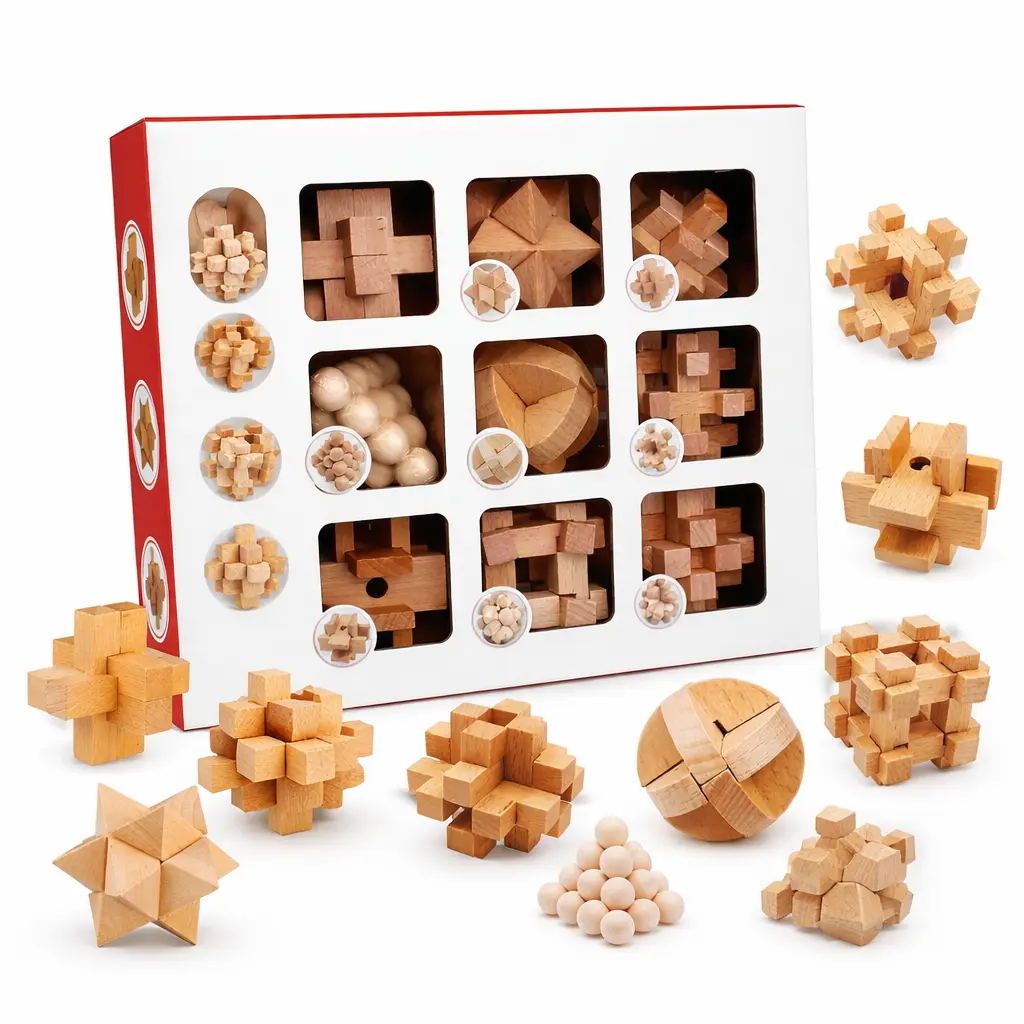
The Luban Lock Set 9 Piece ($39.99) is essentially a masterclass in the very joinery you’ll need for a puzzle box. When I first handled this set, I was struck by the weight of the wood. These aren’t flimsy balsa wood toys; they are dense, precision-cut challenges that use mortise-and-tenon geometry to defy gravity.
What happens when you hand someone a perfectly assembled wooden shape and say “take it apart, then put it back together”? You get to watch 2,500 years of engineering humor at work. This 9-piece set recreates the puzzles that Lu Ban—the godfather of Chinese carpentry—allegedly invented to test his son’s spatial reasoning around 500 BCE. Each puzzle in this set teaches you a different lesson about how pieces can “trap” one another. If you’re looking for the most complex wooden enigmas available, you have to start here to understand how a single “key” piece can hold an entire structure together. My personal favorite in this set is the ball-shaped lock; the way the final piece slides home with a soft thunk is more satisfying than any digital achievement.
18 Piece Wooden Puzzle
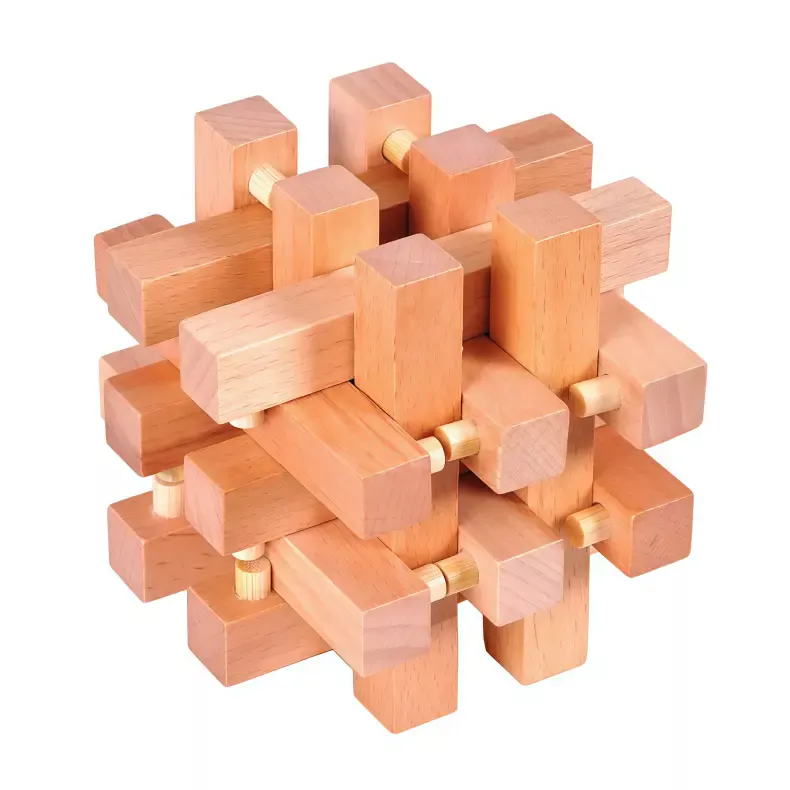
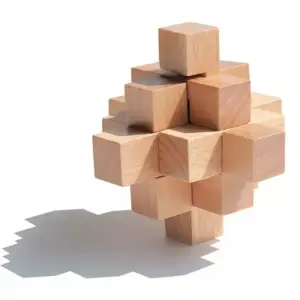
If the 9-piece set is the introductory course, the 18 Piece Wooden Puzzle ($16.99) is the final exam. This is what I call “silent mastery.” You have seventeen identical-looking pieces and one “key” piece. There is zero wiggle room here. If your alignment is off by even a fraction of a degree, the entire sphere refuses to close.
I’ve had this specific puzzle on my desk for three months, and I still use it as a fidget toy during long calls. It teaches you that harmony emerges when individual strength bows to collective balance. For a woodworker looking for plans, studying this object is vital. It shows you how to create strength through repetition. At just under seventeen dollars, it’s a cheaper education in tolerances than a single board of walnut. It’s the kind of challenge that respects your intelligence rather than insulting it with obvious solutions.
The Transparency of Logic: Breaking the “Black Box” Mentality
The biggest hurdle for beginners is that puzzle boxes are “black boxes”—you can’t see what’s happening inside. This is why so many people get frustrated with plans; they can’t visualize the internal collision of the sliding parts.
12 Piece Crystal Luban Lock Set
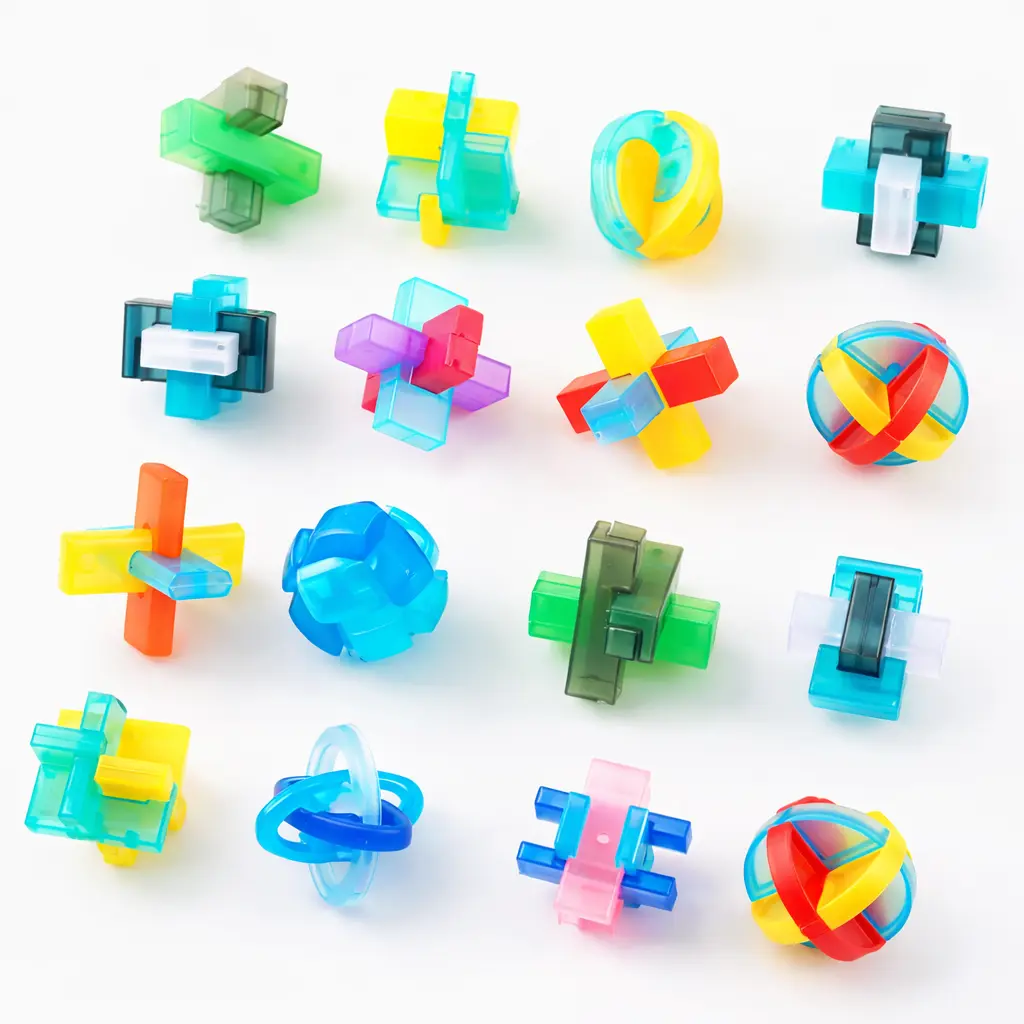
This is where the 12 Piece Crystal Luban Lock Set ($28.88) becomes an essential tool. Ever tried to solve a puzzle you can see straight through—and still couldn’t crack it? These mini crystal locks put ancient joinery wisdom into a transparent medium.
The acrylic is surprisingly high-quality; it has a density that feels more like glass than plastic. Because they are transparent, you can actually see the notches and grooves engaging. It’s like having X-ray vision for mechanical engineering. I found that after spending an afternoon with these, my ability to “see” the internal movements of my wooden boxes improved drastically. If you’re feeling mentally taxed, I recommend engaging in a quick mental palate cleanser before tackling these, as the visual feedback can actually be more distracting than helpful if you aren’t focused. These are perfect desk toys because they don’t leave sawdust on your keyboard, and at roughly $2.40 per puzzle, the value is unbeatable.
When to Yield: The Philosophy of the Solve
There is a concept in Daoism called Wu Wei, or effortless action. It’s the idea that you should stop forcing solutions and let patterns emerge naturally. In the world of mechanical puzzles, this translates to: If you have to pull hard, you’re doing it wrong.
I learned this the hard way with the Twelve Sisters Puzzle ($19.99).
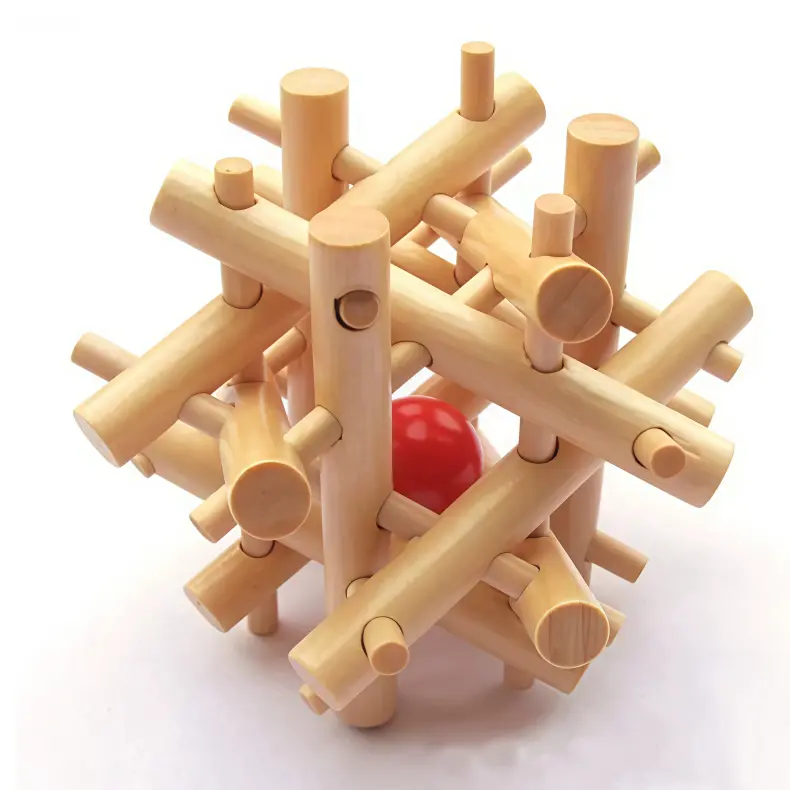
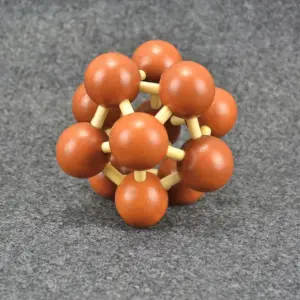
Twelve Sisters Puzzle — $19.99
It’s a 25-piece challenge featuring 12 thick rods and 12 interlocking sticks. If you try to force the crimson center sphere into place, you’ll likely snap a precision-drilled hole. But if you align the rods with a gentle touch, they fall into place with a grace that feels like it shouldn’t be possible. It proves that true strength comes from flexibility.
The same applies to the 6 Piece Wooden Puzzle Key ($12.99).
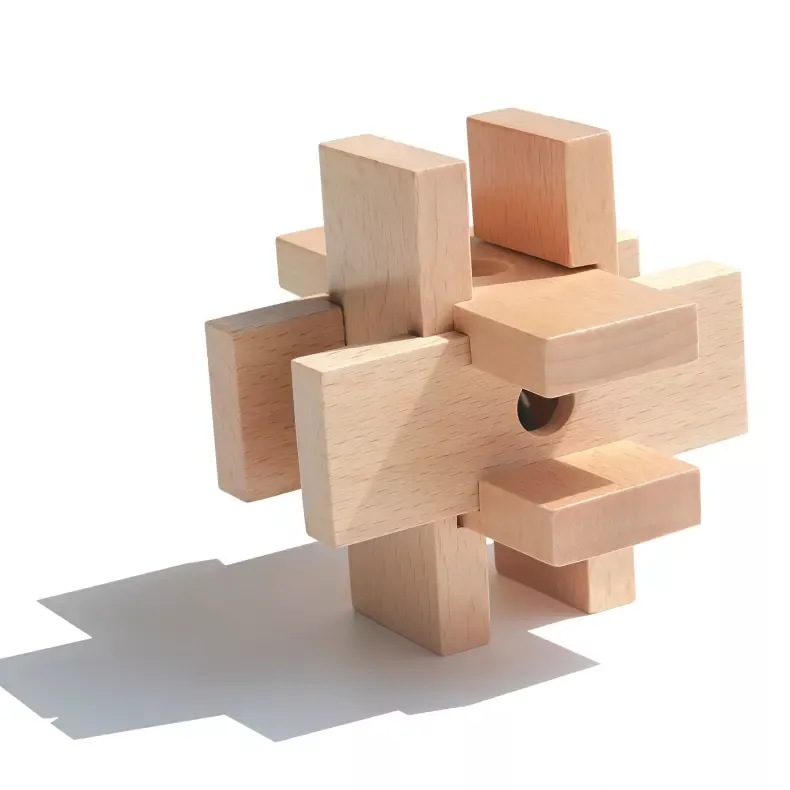
6 Piece Wooden Puzzle Key — $12.99
This is a “minimalist” brain teaser. Six hardwood pieces, zero electronics, and infinite replayability. It’s the kind of puzzle that makes you realize fewer parts often lead to deeper engagement. When you’re exploring the balance of opposites in your own life, a simple object like this key can be a tactile meditation. It’s about finding the “place where death cannot enter”—the hidden vulnerability that unlocks the entire structure.
The Engineering of Elegance: Spotlight on Advanced Joinery
If you are serious about moving beyond basic plans and into the realm of professional-grade enigmas, you need to look at puzzles that utilize non-linear movement.
Double Cross Cage Puzzle
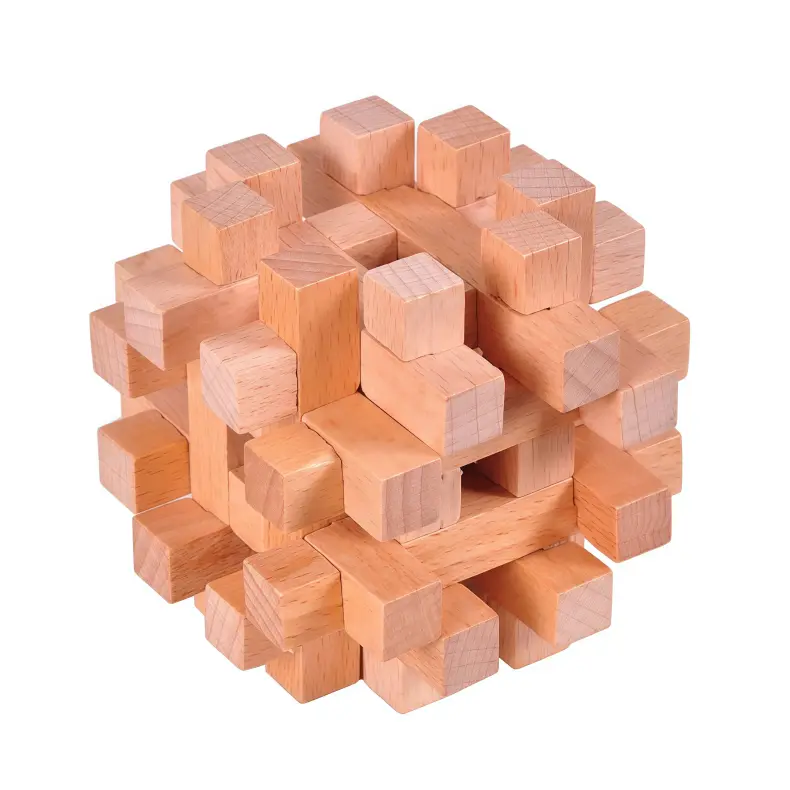
The Double Cross Cage Puzzle ($18.88) is a beast. It consists of twenty-four identical pieces that create an impossibly strong geometric cage. When I first saw this, I thought it was glued. It’s not. It’s held together by the collective tension of two dozen interlocking crosses.
This puzzle is a masterclass in “yielding to succeed.” You have to find the one piece that has just enough “give” to allow the others to shift. For a woodworker, this is the ultimate inspiration. It shows how you can create a massive, rigid structure using nothing but small, repeatable parts. The finish on the wood is smooth, and the fit is tight enough that you can’t see the seams until you start the disassembly. At eighteen dollars and change, it’s a steal for the sheer amount of “aha!” moments it provides.
Six-Piece Burr
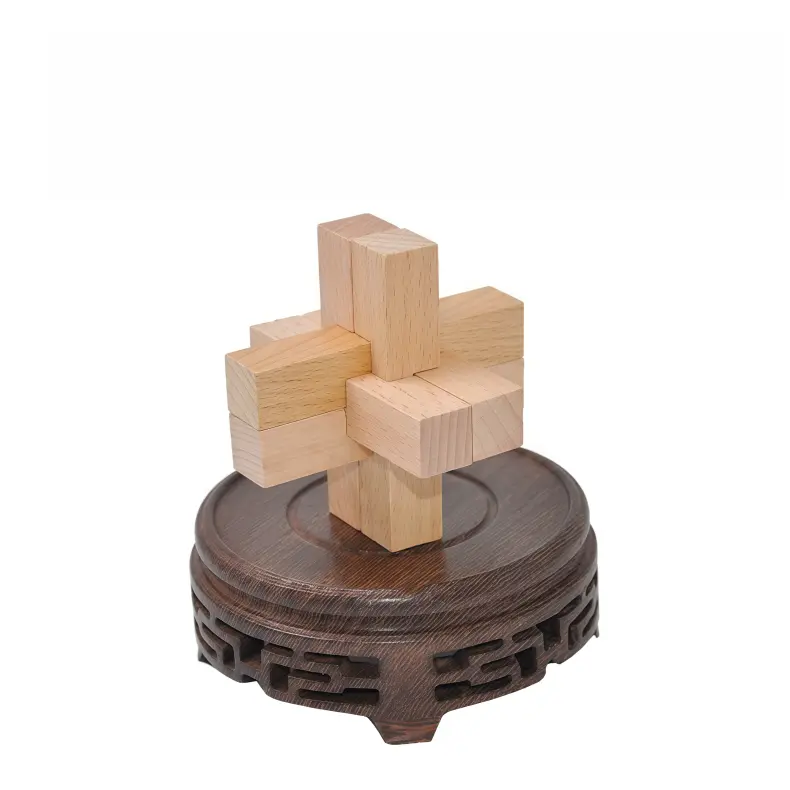
The Six-Piece Burr ($17.99) is the “standard” by which all other interlocking puzzles are measured. If you can’t solve a standard six-piece burr, you have no business trying to build a Japanese puzzle box. Each piece plays a vital role—there is no excess, no shortcuts.
I’ve carried one of these in my bag for years. It’s the perfect “intro” puzzle to hand to a skeptical friend. It looks simple—just six notched sticks—but the logic required to find the “key” piece is non-intuitive. It rewards those who seek understanding over force. In a world of flashy distractions, this burr whispers timeless wisdom: real mastery lives in simplicity.
Comparison of Mechanical Challenges
Before we get into the FAQ, let’s look at how these foundational puzzles compare. If you’re looking for “plans,” these are the mechanisms you are actually trying to replicate.
Frequently Asked Questions
How do I make a Japanese puzzle box with 10 steps?
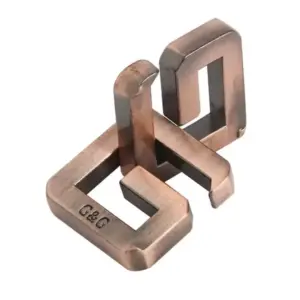
Making a 10-step box from scratch requires a table saw with a very fine-toothed blade (ideally a Japanese pull saw) and a set of chisels that are sharp enough to shave with. The “10 steps” refer to the sequence of sliding panels. You start by building the inner frame, then the side panels with internal rails. The “trick” is that each panel blocks the next one in the sequence. If you’re a beginner, I recommend starting with a kit or studying the Circular Lock ($16.99)
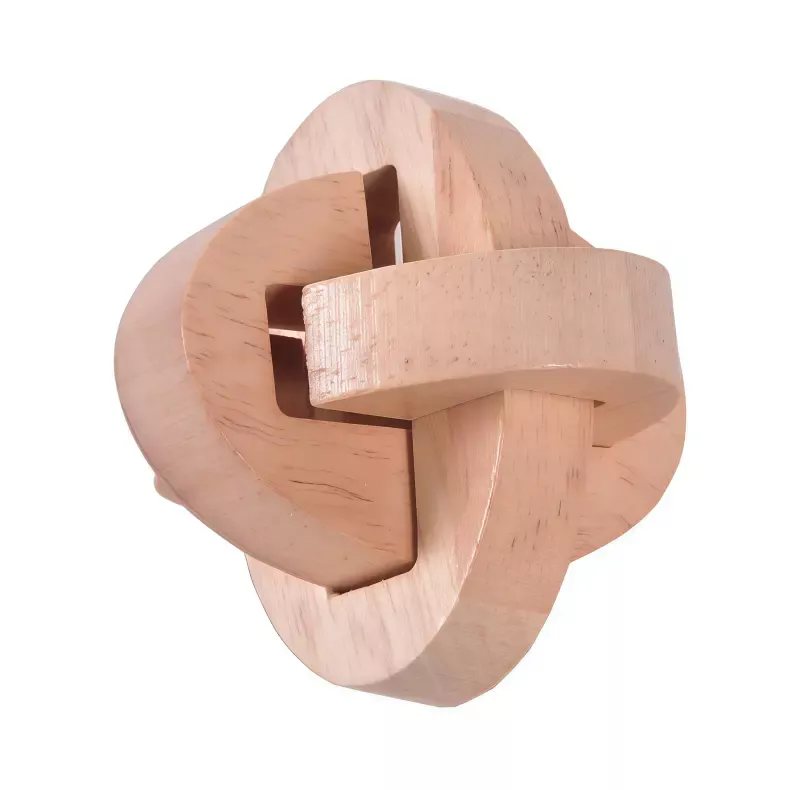
Circular Lock — $16.99
to see how three precision-cut pieces can lock each other in a circular motion. It’s a smaller-scale version of the same logic.
Where can I find reliable Japanese puzzle box plans?
Reliable plans are hard to find because they often don’t account for wood species. A plan for pine will not work for oak due to the different expansion rates. Look for plans from established woodworking magazines like Woodsmith, but be prepared to “shim” your pieces. If you want to understand the complexity without the sawdust, the The Twin Star Puzzle ($17.88)
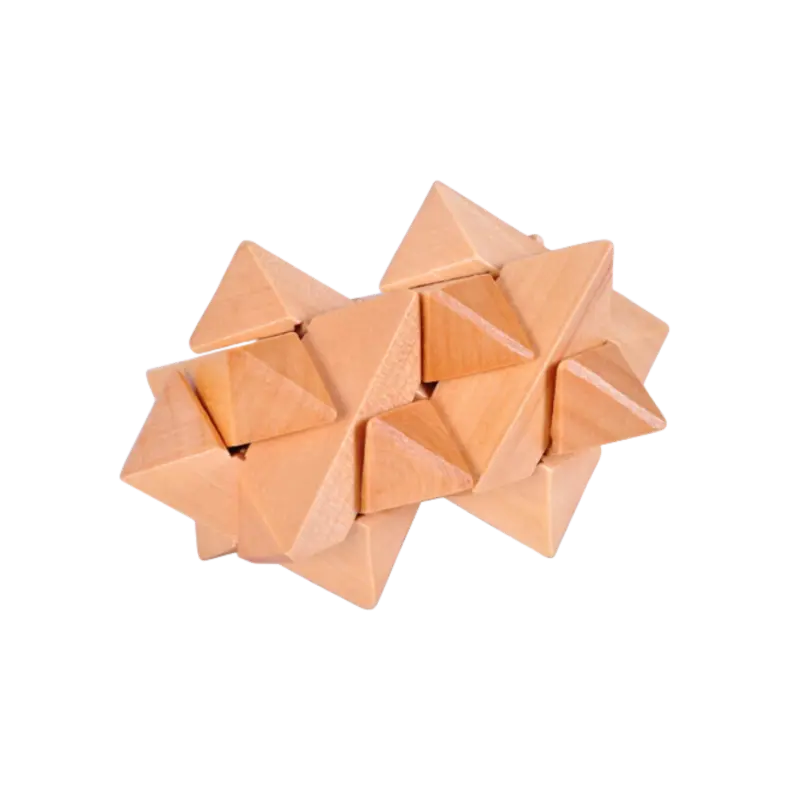
The Twin Star Puzzle — $17.88
is a great example of using three distinct block types to create a core. It’s a physical blueprint of advanced interlocking.
I’m stuck on a Japanese Puzzle Box. How do I solve and close it?
The golden rule: Never use force. If a panel doesn’t slide, it’s because another panel is blocking it. Try sliding panels in pairs, or “rolling” the box toward you as you slide. Many 21-step boxes require you to move a panel, then move a different one to “unlock” the next move of the first panel. If you’ve taken one apart and can’t get it back together, you’ve likely missed the orientation of the “key” piece. This is why I love the The Mystic Orb Lock ($16.99)
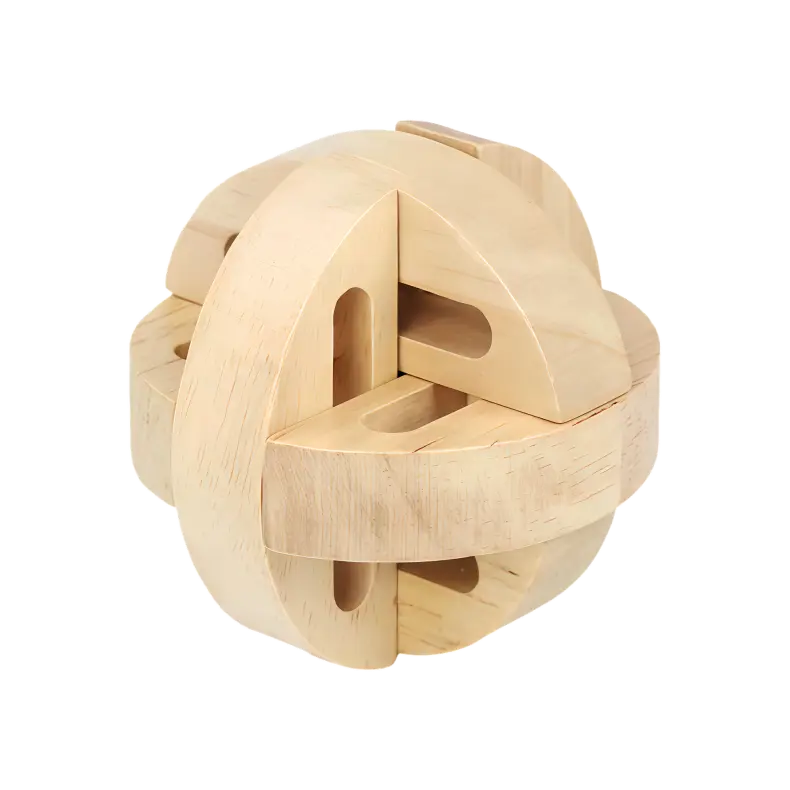
The Mystic Orb Lock — $16.99
; it uses two special locking pieces that control the entire structure. Once you find them, the assembly becomes intuitive.
Are Japanese puzzle boxes a good project for beginners?
Honestly? No. They are incredibly frustrating for a first-time woodworker because the margin for error is zero. A 1mm mistake on step two will make step ten impossible. I suggest starting with simpler brain teasers that teach patience before moving to full-scale box construction. Mastering a burr puzzle first will save you hours of heartache in the workshop.
What wood is best for building puzzle boxes?
In Japan, they use Katsura or Spindle wood because they have very fine grain and are dimensionally stable. For Western builders, Cherry or Maple are your best bets. Avoid open-grained woods like Oak or Ash, as the “sliding” panels will feel gritty and might catch on the grain.
How do I maintain my puzzle box?
Keep it out of direct sunlight and away from humidifiers. If the panels become sticky, a tiny amount of dry Teflon spray or furniture wax on the sliding rails can help. Never use oil, as it will soak into the wood and cause it to swell.
Why are some boxes so much more expensive than others?
You’re paying for the “step count” and the veneer work. A 4-step box is relatively easy to mass-produce. A 72-step box requires a master craftsman to hand-fit every single internal rail. It’s the difference between a quartz watch and a mechanical Swiss movement.
Can I 3D print a Japanese puzzle box?
Yes, and it’s a great way to test the mechanics! 3D printing allows for much tighter tolerances than most amateur woodworkers can achieve. However, you lose the tactile “soul” of the wood. Many people use 3D prints as a “proof of concept” before committing to expensive hardwoods.
What is the most famous type of Japanese puzzle box?
The Himitsu-Bako from Hakone is the gold standard. They are famous for their Yosegi-zaiku patterns. If you see a box with a complex, colorful geometric pattern, it’s likely from this tradition.
Are these puzzles safe for kids?
Most are fine for ages 8 and up, but the smaller pieces (like in the crystal set) can be a choking hazard for toddlers. More importantly, kids tend to use force when they get frustrated. I always supervise “solve sessions” to ensure nobody tries to “pry” a box open.
Do I need special tools to solve these?
No. If a puzzle requires a tool, it’s usually hidden inside the puzzle itself. This is called “sequential discovery.” If you find yourself reaching for a screwdriver, stop immediately.
How long does a typical solve take?
For a standard 12-step box, a beginner usually takes 20-30 minutes. An 18-piece burr can take hours if you don’t have a systematic approach. It’s not about speed; it’s about the “flow state” you enter while working on it.
What’s the difference between a “trick box” and a “puzzle box”?
The terms are often used interchangeably, but a “trick box” usually has one hidden latch or a “gimmick” (like a magnet or a hidden gravity pin). A “puzzle box” usually requires a sequence of logical moves.
Why does my puzzle box rattle?
A slight rattle is normal—it means the wood has shrunk slightly. It’s actually better than a box that is too tight. If it bothers you, moving the box to a slightly more humid room will often “tighten” it back up within a few days.
Can I design my own puzzle box?
Absolutely. I recommend starting with a “sliding tile” concept. If you can make a 3×3 sliding tile puzzle, you have the basic skills to make a single-panel puzzle box.
What 40 Hours of Sawdust and Frustration Actually Taught Me
The coffee I made that afternoon last February didn’t help me solve my jammed box. What helped was walking away and realizing that I was fighting the wood instead of listening to it. I had followed the plans to the letter, but I hadn’t accounted for the soul of the material.
If you’re looking for Japanese puzzle box plans, my best advice is to first hold the logic in your hands. Don’t start with a saw; start with a solve. The Luban Lock Set 9 Piece ($39.99) taught me more about the relationship between a mortise and a tenon than any YouTube tutorial ever could. It’s a foundational investment in your own spatial reasoning.
Once you understand how these pieces interlock, the “plans” you find online will finally make sense. You’ll stop seeing them as a list of cuts and start seeing them as a map of hidden spaces. Start with the 12 Piece Crystal Luban Lock Set ($28.88)—it’s the only way to truly see the “ghost in the machine” before you try to build one yourself. The path to mastery isn’t found in the perfect cut, but in the perfect understanding of why that cut needs to exist.