The twenty-fifth piece of the Twelve Sisters Puzzle has been sitting on the corner of my mahogany desk for three days. It is a small, precision-drilled rod that looks identical to the twenty-four others currently locked into a rigid, geometric starburst, yet it refuses to seat. I know, intellectually, that the tolerances are correct. I’ve felt the smooth slide of the other interlocking sticks. But this final piece is a silent judge of my impatience.
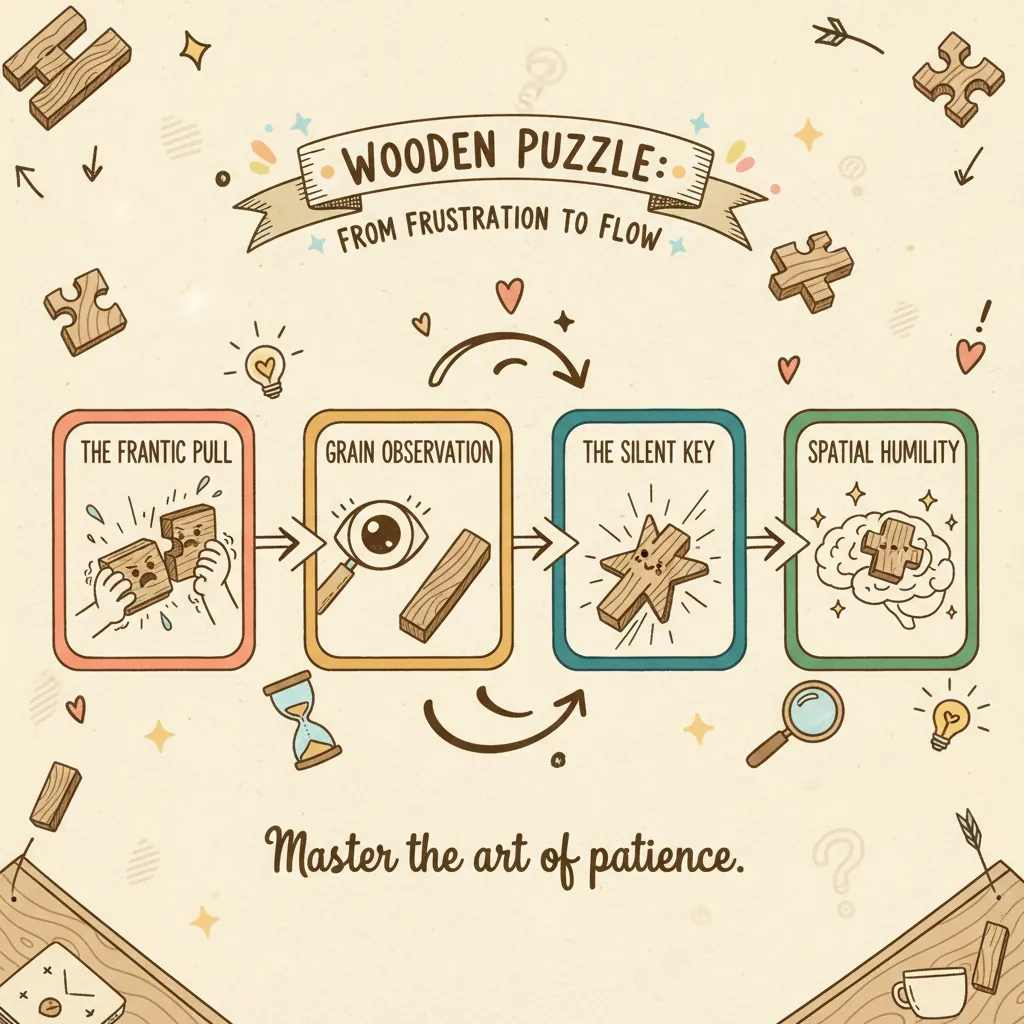
Most people approach a 3D brain teaser wooden puzzle as a conquest—a thing to be beaten, dismantled, and shoved back together. After testing over 200 of these objects, I’ve realized that the puzzle isn’t the wood; the puzzle is your own internal rhythm. These objects punish the frantic. They reward the observer who can sit with a handful of timber and wait for the grain to tell them where the hidden “key” piece lives.
My thesis is simple: The best wooden brain teasers are tactile lessons in spatial humility. They force a transition from “brute force” thinking to “structural” thinking. If you try to win by pulling harder, you lose. If you win by looking closer, you gain more than just a solved object; you gain a recalibrated mind.
The Architecture of the Interlock
We often categorize these as “toys,” but that’s a disservice to the engineering involved. Most 3D wooden puzzles belong to the “burr” family—interlocking joints where at least one piece (the key) must be slid out to allow the others to move. This isn’t just a gimmick; it’s a centuries-old tradition of joinery that predates modern fasteners.
When you hold a well-made wooden puzzle, you’re feeling the tension of friction. Unlike plastic, which has a uniform “snap,” wood has a “grab.” It breathes. On a humid afternoon in my office, some of my tighter puzzles, like the 18 Piece Wooden Puzzle, become noticeably more stubborn as the fibers swell. This variability makes the solve feel alive.
The Twelve Sisters Puzzle
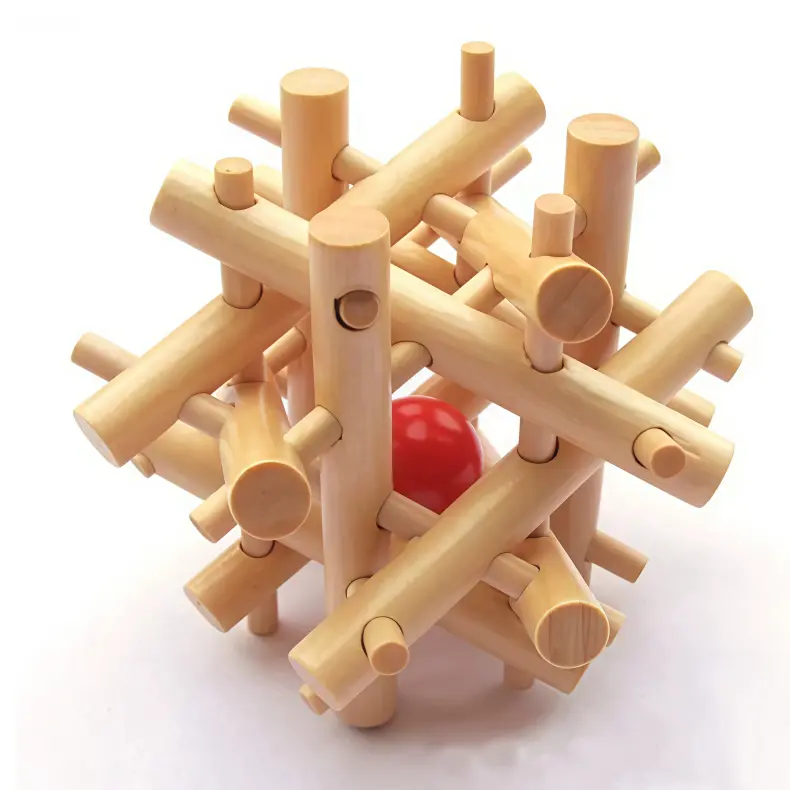
The Twelve Sisters Puzzle ($19.99) is perhaps the most honest introduction to this “living” architecture. It consists of 12 thick rods, 12 interlocking sticks, and a single crimson center sphere that acts as the heart of the structure.
What I love about this particular challenge is the transparency of the problem. You can see every piece. There are no hidden magnets or trick compartments. Yet, because of the way the 5 precision holes in each rod align, the assembly becomes a dance of three-dimensional coordinates. I spent nearly an hour just figuring out how to cradle the center sphere while getting the first four rods to bite. It’s a $19.99 masterclass in the principle that complexity is often just a collection of simple parts behaving in a coordinated way. If you can master the fundamental structure, the pattern reveals itself.
The Twin Star Puzzle
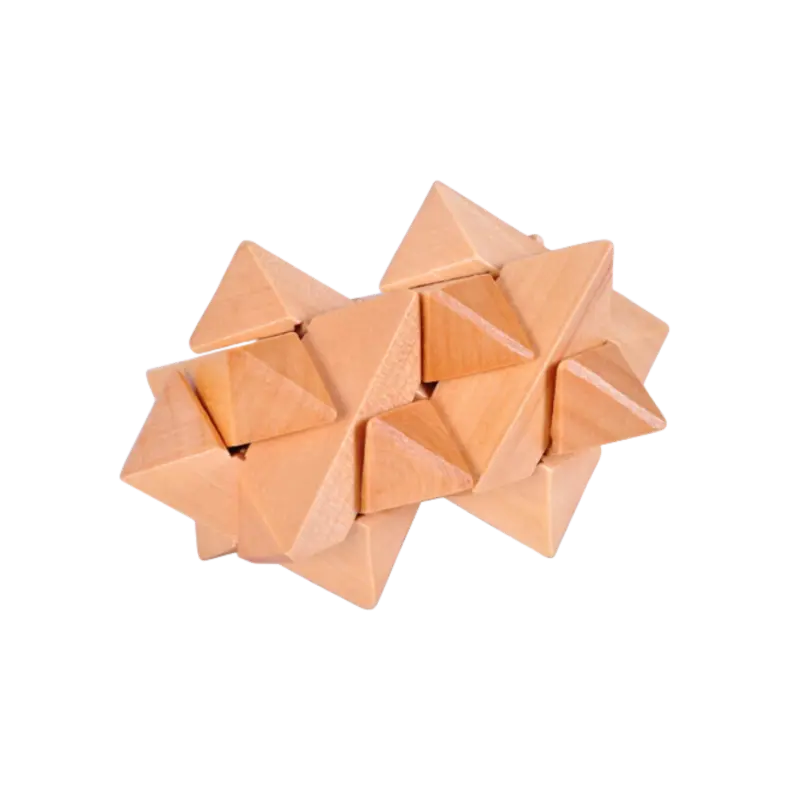
If the Twelve Sisters is about coordination, The Twin Star Puzzle ($17.88) is about deception. At first glance, it looks like a standard star burr, but the internal geometry is far more sinister. It uses three distinct block types: a core, diamond double-pyramids, and two “twisted” pieces that require a rotational move most solvers never see coming.
I handed this to a mechanical engineer friend last month. He spent twenty minutes trying to slide the pieces along X and Y axes, growing increasingly frustrated. The “Aha!” moment when he realized the twisted pieces required a subtle pivot was worth the $17.88 price tag alone. It embodies a philosophy of balance; the pieces support each other so perfectly that the complete form only exists through mutual cooperation.
Why Your First Solve Will Be an Accident
There is a specific phenomenon in mechanical puzzling: the “Accidental Solve.” You’re fiddling with a piece, your mind wanders to your grocery list, and suddenly—click—the key piece slides home.
This happens because our conscious brain is often too rigid. We look for right angles and logical progressions. But 3D wooden puzzles often operate on “Wu Wei,” or effortless action. When you stop forcing a solution, your hands often find the path that your eyes missed. This is why many wooden brain teaser puzzles feel so meditative; they require you to turn off the “loud” part of your brain.
6 Piece Wooden Puzzle Key
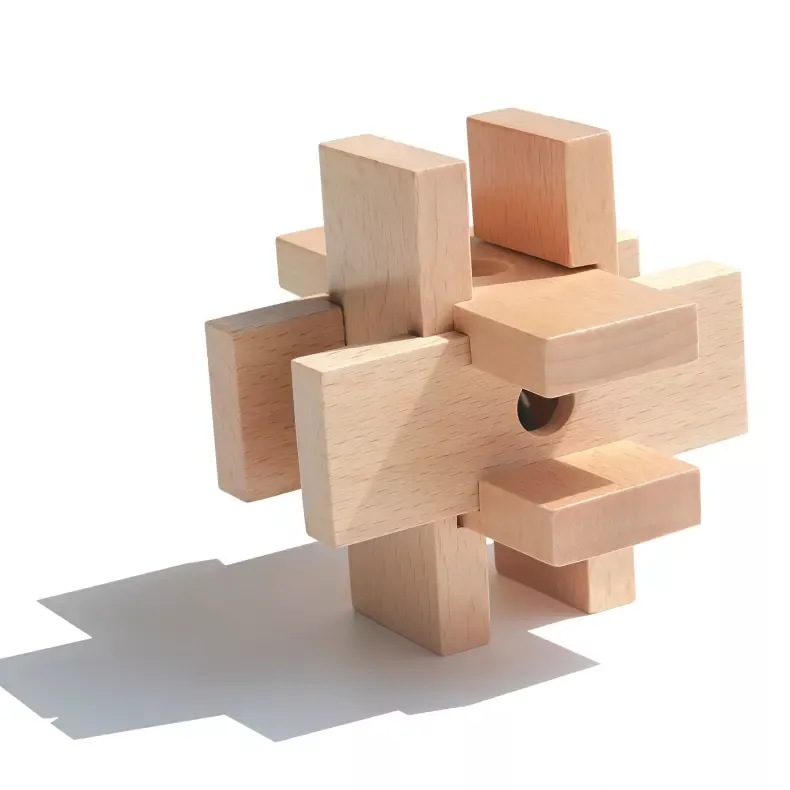
The 6 Piece Wooden Puzzle Key ($12.99) is the purest expression of this. It’s a minimalist design—six hardwood pieces, no electronics, no fluff. It’s a desk toy that I find myself picking up during long conference calls.
The beauty of this $12.99 puzzle is its replayability. Even after you know the solution, the tactile feedback of the wood sliding against wood is grounding. It’s a reminder that less creates more. Fewer parts mean you have to be more precise with your engagement. I’ve found that the foundational principles of wooden mechanical challenges are best learned on a 6-piece burr like this before moving on to the 18 or 24-piece monsters.
The Peak: The “Blind Solve” Experiment
About two years ago, I decided to test a theory. I took two identical interlocking puzzles. I gave one to a ten-year-old child and the other to a high-level software architect. I told the child to “play with it until it falls apart.” I told the architect to “solve it.”
The child had the puzzle disassembled in under three minutes. The architect was still staring at it, trying to visualize the internal lattice, after ten.
This is the “Peak Moment” of my years of reviewing: The realization that visual information is often a distraction in 3D puzzling.
The child used their fingertips. They felt for the wiggle. They felt for the one piece that had a millimeter more “give” than the others. The architect was trying to solve a 3D physical object using 2D logical patterns.
If you want to truly experience a 3d brain teaser wooden puzzle, try solving the disassembly phase with your eyes closed. You will notice things the eyes miss: the slight temperature difference in a piece that has been handled more, the subtle “click” of a dry joint, the way the weight shifts as the center of gravity moves. This tactile memory is what separates a hobbyist from a veteran.
The Geometry of the Cage
While burr puzzles are about pieces that interlock, “cage” puzzles are about containment. You are trying to navigate a complex shape out of a restrictive environment. It’s the difference between a jigsaw and a jailbreak.
Double Cross Cage Puzzle
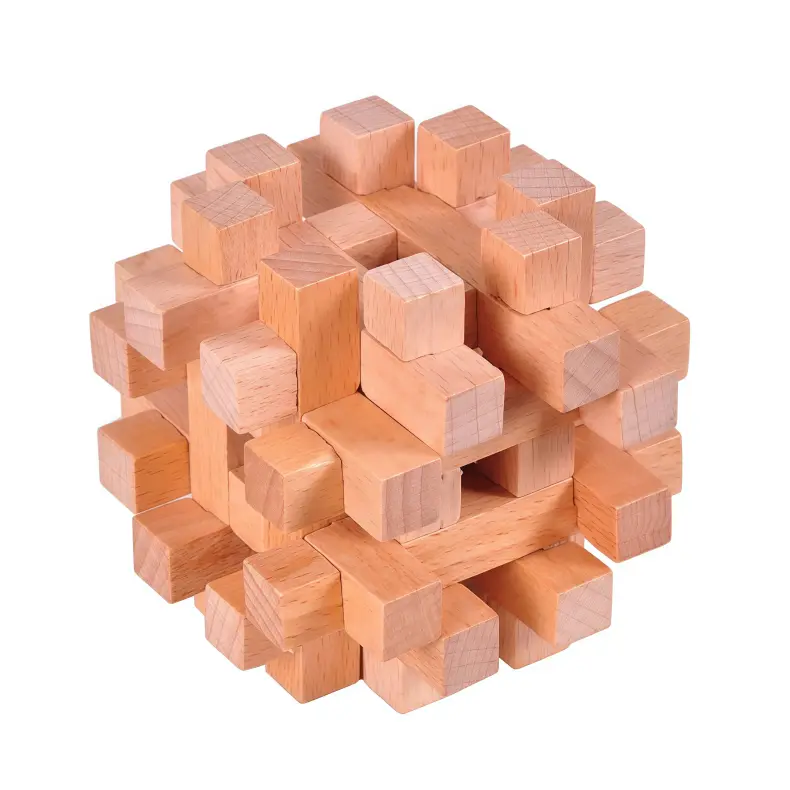
The Double Cross Cage Puzzle ($18.88) uses twenty-four identical pieces to create a structure of seemingly impossible strength. It’s a tactile meditation on ancient wisdom. The puzzle teaches that true mastery comes from alignment, not force.
When I first held this, I tried to pull the crosses apart. The wood didn’t budge. It felt like a solid block of oak. But once you find the alignment—the moment where the tension of the twenty-four pieces yields—it practically melts in your hands. At $18.88, it’s a stunning example of how geometric balance can create strength. If you’re coming from the world of translucent 3D crystal alternatives, the opacity of the wood here adds a layer of “hidden” difficulty that is deeply rewarding.
Wooden Bead Pyramid
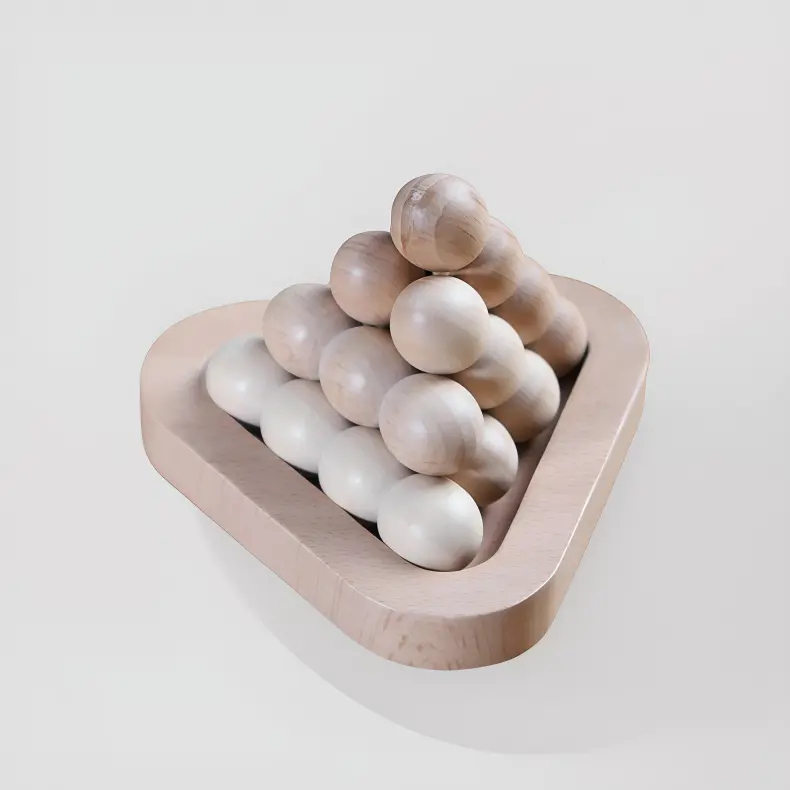
For something that feels completely different, the Wooden Bead Pyramid ($18.88) moves away from the “stick and notch” mechanics. It consists of 6 precision-crafted bead strands that must be layered into a perfect tetrahedron.
This is a spatial reasoning test. Most adults struggle with it because we think in cubes. We try to build the pyramid from the bottom up, layer by layer. But the bead strands don’t work that way; they overlap and weave. It rewards “patient insight” over brute force. I’ve had this on my coffee table for months, and it’s the one puzzle that guests always gravitate toward because it looks “easy.” They are usually still sitting there forty minutes later, beads scattered, wondering how six simple strands can be so defiant.
The Taxonomy of the Lock
Not all 3D puzzles are burrs. Some are “locks”—objects that require a specific sequence of moves to open or close, often mimicking traditional Chinese joinery.
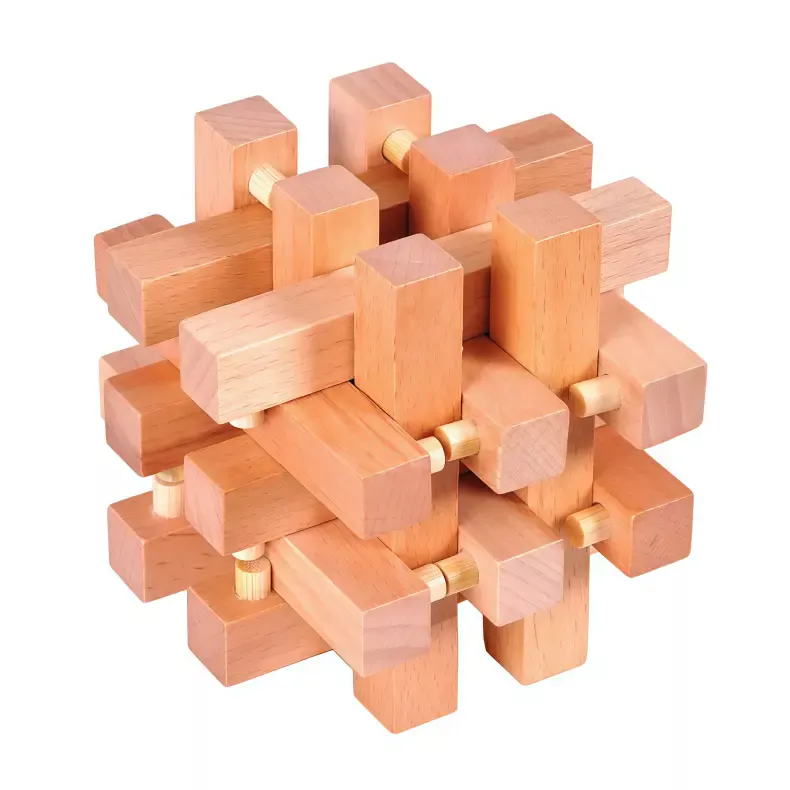
18 Piece Wooden Puzzle — $16.99
The 18 Piece Wooden Puzzle ($16.99) is a classic example. It features seventeen identical pieces and one “key” piece. There is zero wiggle room. It’s a silent, wooden testament to the idea that harmony emerges when individual strength bows to collective balance. If you’ve ever felt the digital simplicity of retro arcade titles is too detached, the physical resistance of these 18 pieces will bring you right back to the physical world.
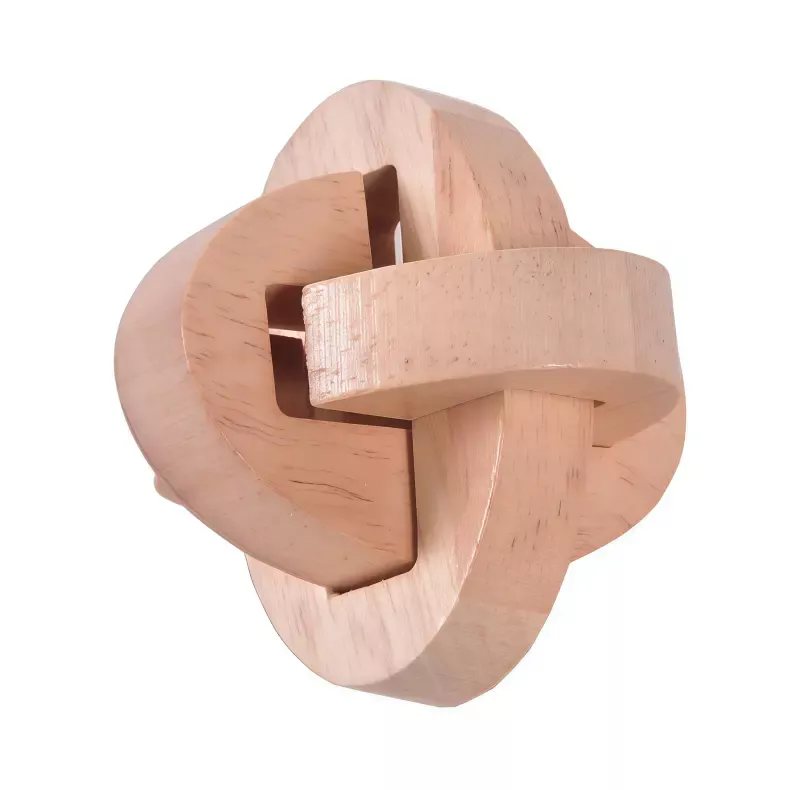
Circular Lock — $16.99
Then there is the Circular Lock ($16.99). It’s only three pieces, but they interlock with a smooth, satisfying motion that feels more like a machined tool than a toy. It’s a “meditation in motion.” I use this one when I need to clear my head between writing sessions. The solve is short—maybe five minutes once you know it—but the process of sliding those three arcs into a perfect circle is incredibly grounding.
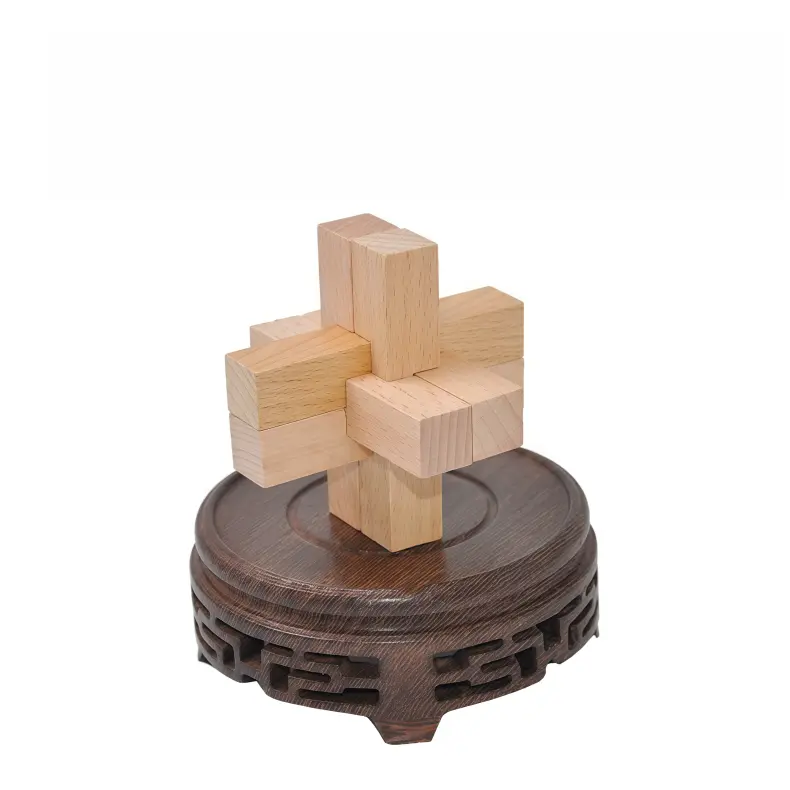
Six-Piece Burr — $17.99
Of course, you can’t talk about wood puzzles without mentioning the Six-Piece Burr ($17.99). This is the “standard” by which all others are measured. It’s a screen-free challenge that teaches patience. In my collection, the six-piece burr is the one I use to gauge a person’s temperament. If they start yanking on the wood within thirty seconds, I know they’ll struggle with the more complex kits.
The Hidden Complexity of Spheres
Spheres are the final boss of the wooden puzzle world. Without corners or flat edges to act as reference points, your brain has to work twice as hard to maintain a sense of orientation.
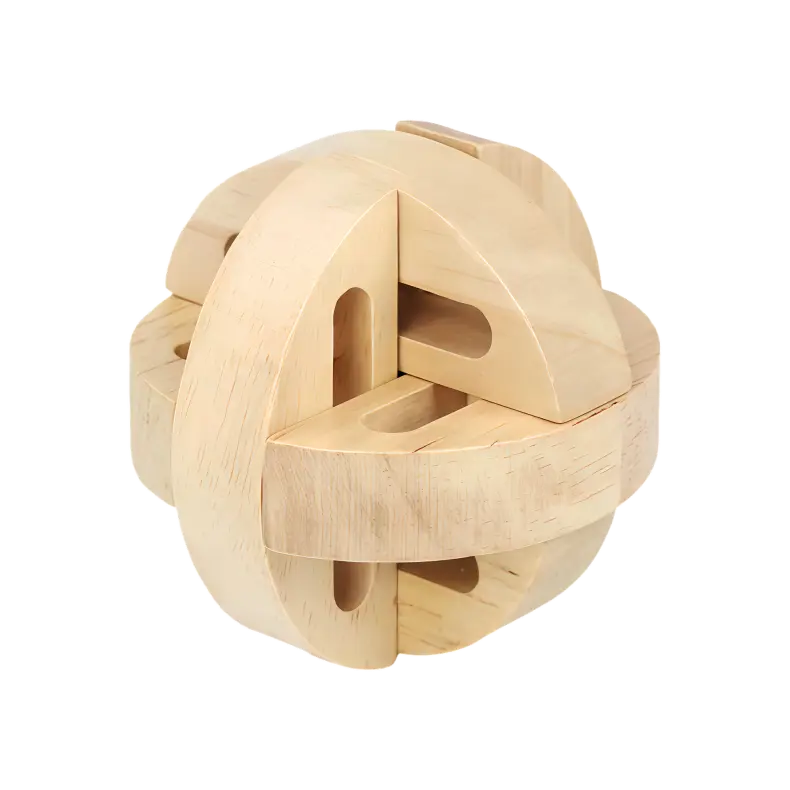
The Mystic Orb Lock — $16.99
The Mystic Orb Lock ($16.99) uses six semi-circular interlocking pieces. It embodies the Taoist art of yielding to succeed. You have to find “the gap where death cannot enter”—the one tiny vulnerability in the sphere’s surface that allows the whole thing to breathe. It’s a $16.99 lesson in observation.
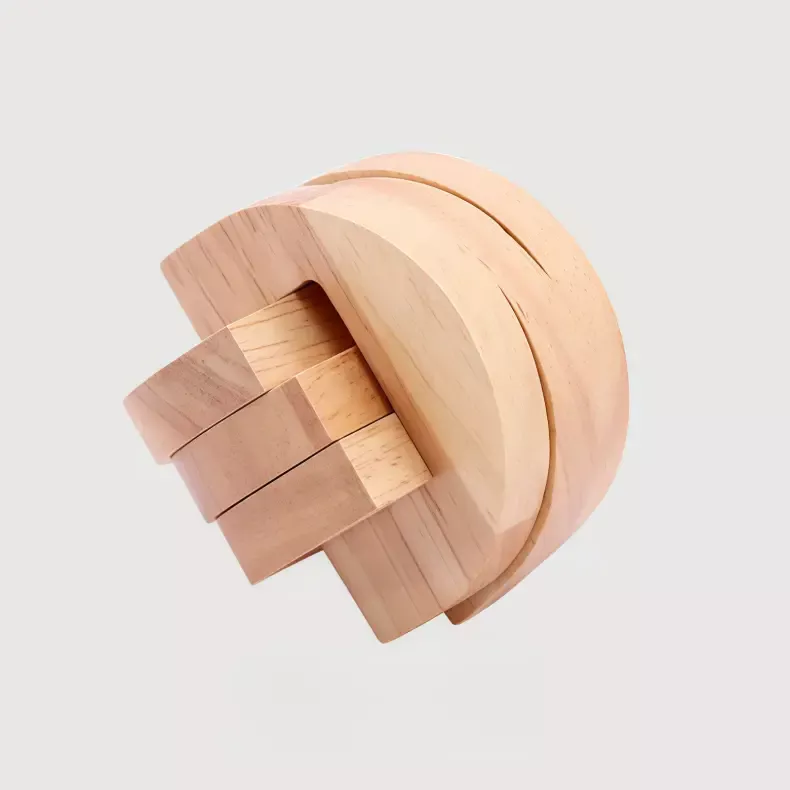
Interlock Puzzle Sphere — $17.99
Similarly, the Interlock Puzzle Sphere ($17.99) transforms the brain teaser into a meditative practice. The tactile feedback of the curved wood is distinct from the sharp edges of a burr. It feels more organic. When you finally find the key piece and the sphere disassembles in your palm, there’s a sense of release that is hard to find in other hobbies. For those who enjoy logic-heavy grid games like Kurodoko, the sphere offers a physical manifestation of that same “deductive” logic.
Comparison of Top 3D Wooden Brain Teasers
Frequently Asked Questions
How do I solve a 3D wooden puzzle if I get completely stuck?
The most important rule is to never use force. If a piece isn’t moving, it’s because another piece is blocking its path. Start by “wiggling” every piece with a light touch. Look for the “key” piece—this is usually the only piece that can move when the puzzle is fully assembled. If you are truly lost, many enthusiasts use the “coordinate method,” where they map the puzzle on a grid, but I find that the tactile world of timber-based riddles is best navigated by feel. There are also computerized solution videos available for most classic burrs.
Are these puzzles made of real wood or a composite?
All the puzzles mentioned here are crafted from solid wood. This is crucial because a mechanical puzzle relies on the natural friction and structural integrity of the material. Composite woods or plastics lack the “bite” that makes a wooden solve so satisfying. Real wood also develops a patina over time, making the puzzle smoother the more you solve it.
What is the best way to clean and maintain a wooden puzzle?
Never use water or harsh chemicals. Wood is porous and will swell, potentially ruining the tolerances of the puzzle. A dry, soft microfiber cloth is usually enough. If the pieces become too “grabby,” a tiny amount of high-quality beeswax or mineral oil can be applied to the sliding joints. I’ve had some of my puzzles for over five years, and a little wax keeps the mechanism feeling like new.
Is theTwelve Sisters Puzzle too hard for a beginner?
I wouldn’t recommend it as a first puzzle. With 25 pieces, the sheer number of variables can be overwhelming. A beginner should start with something like the 6 Piece Wooden Puzzle Key ($12.99) to understand how notches and grooves interact. The Twelve Sisters is a “level 2” challenge that requires a more developed sense of spatial mapping.
Why do some wooden puzzles have different colored pieces?
Usually, the colors aren’t just for aesthetics; they indicate different types of pieces or “stations” within the puzzle. For example, in the Twelve Sisters Puzzle, the crimson sphere is the structural anchor. In other puzzles, different woods (like rosewood vs. maple) might be used to provide contrasting friction levels or to highlight the “key” piece.
Can these puzzles help with cognitive decline or ADHD?
While I’m a reviewer and not a doctor, many users find that the tactile engagement of a puzzle helps with focus. For ADHD, the “fidget” factor of a wooden burr provides a productive outlet for restless energy. For older adults, the spatial reasoning required to visualize the internal structure is excellent “brain gymnastics.” It’s certainly a better alternative to mindless scrolling.
What should I do if a piece of my wooden puzzle breaks?
Wood is durable but not indestructible. If a notch snaps, a small amount of wood glue (PVA glue) is usually a permanent fix. Clamp the piece for at least 24 hours to ensure the bond is stronger than the wood itself. Avoid “super glue,” as it dries too brittle and can create a ridge that interferes with the puzzle’s sliding action.
Are these suitable for children?
Most 3D wooden brain teasers are rated for ages 8 and up. The main concern isn’t the difficulty, but the small parts. For younger children, the Wooden Bead Pyramid ($18.88) is often a better choice because the pieces are larger and more durable than the thin sticks of a complex burr.
How do I know if I’ve found the “key” piece?
The key piece is the only piece that moves without requiring another piece to move first. It often has a simpler internal geometry—fewer notches or a smoother sliding path. If you find a piece that moves even a millimeter, focus your attention there. That is the “vulnerability” that unlocks the rest of the structure.
Why are some wooden puzzles more expensive than others?
It comes down to tolerances. A $10 puzzle might have loose joints and “wiggle,” whereas a premium puzzle like the Twin Star ($17.88) is machined to sub-millimeter precision. The more pieces a puzzle has, the harder it is to maintain those tolerances across the entire batch. You’re paying for the engineering and the quality of the wood.
Do these puzzles come with instructions?
Most include a “solution sheet,” but I always tell people to throw it away immediately. The value of a brain teaser is the “Aha!” moment. If you follow a diagram, you’ve just performed a chore. If you figure it out yourself, you’ve solved a riddle. If you truly get stuck, you can always find a video, but try to avoid the “cheat sheet” for at least the first week.
What is a “Luban Lock”?
The Luban Lock (or Kongming Lock) is the traditional name for Chinese interlocking puzzles. They are named after Lu Ban, a legendary carpenter from the Spring and Autumn period. The 18 Piece Wooden Puzzle is a direct descendant of this ancient architectural tradition, which used these joints to build houses and bridges without a single nail.
How long should a solve take?
It varies wildly. A simple burr might take 15 minutes. The Twelve Sisters can take an entire afternoon. I suggest working in 20-minute bursts. If you feel yourself getting frustrated or starting to “pull” on the wood, set it down and walk away. Your subconscious will keep working on the geometry while you’re doing other things.
Can I finish the wood myself?
Some hobbyists like to sand and oil their puzzles to a high gloss. While this looks beautiful, be careful. Even a thin layer of varnish can change the thickness of the pieces enough to make the puzzle impossible to assemble. If you must finish it, use a very light oil and wipe off all excess immediately.
What’s the best “desk toy” version?
For a desk, you want something that can be solved and reset quickly. The Circular Lock ($16.99) is my favorite for this. It’s small, quiet, and satisfying to fiddle with during a meeting without being a major distraction.
Start Here, Then See Where the Rabbit Hole Goes
The first time I successfully reassembled the Twelve Sisters, I didn’t feel like a genius. I felt like I had finally stopped arguing with the wood. I had stopped trying to make the pieces go where I wanted them to be and started putting them where they belonged.
This is the ultimate lesson of the 3d brain teaser wooden puzzle. It is a physical manifestation of the idea that most problems aren’t solved by force, but by understanding the underlying structure. If you’re looking to start your own collection, I cannot recommend the 6 Piece Wooden Puzzle Key ($12.99) highly enough. It is the baseline—the Rosetta Stone—for everything else in the genre. It taught me more about patience and spatial reasoning than any textbook ever could.
Once you’ve mastered the 6-piece, your hands will start to recognize the patterns in larger sets. You’ll find yourself looking at the world a little differently—noticing the joinery in a chair or the way the beams in a ceiling support one another. And when you need a break from the physical world, the logic-heavy grid games like Kurodoko provide a similar mental workout in a digital space.
Pick up a puzzle, set your phone in another room, and let the grain of the wood dictate your pace. The “Aha!” moment is waiting, but only if you’re willing to listen for it.