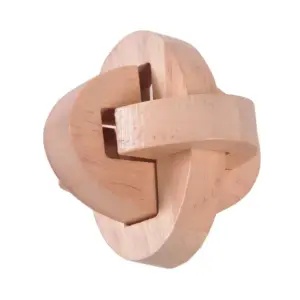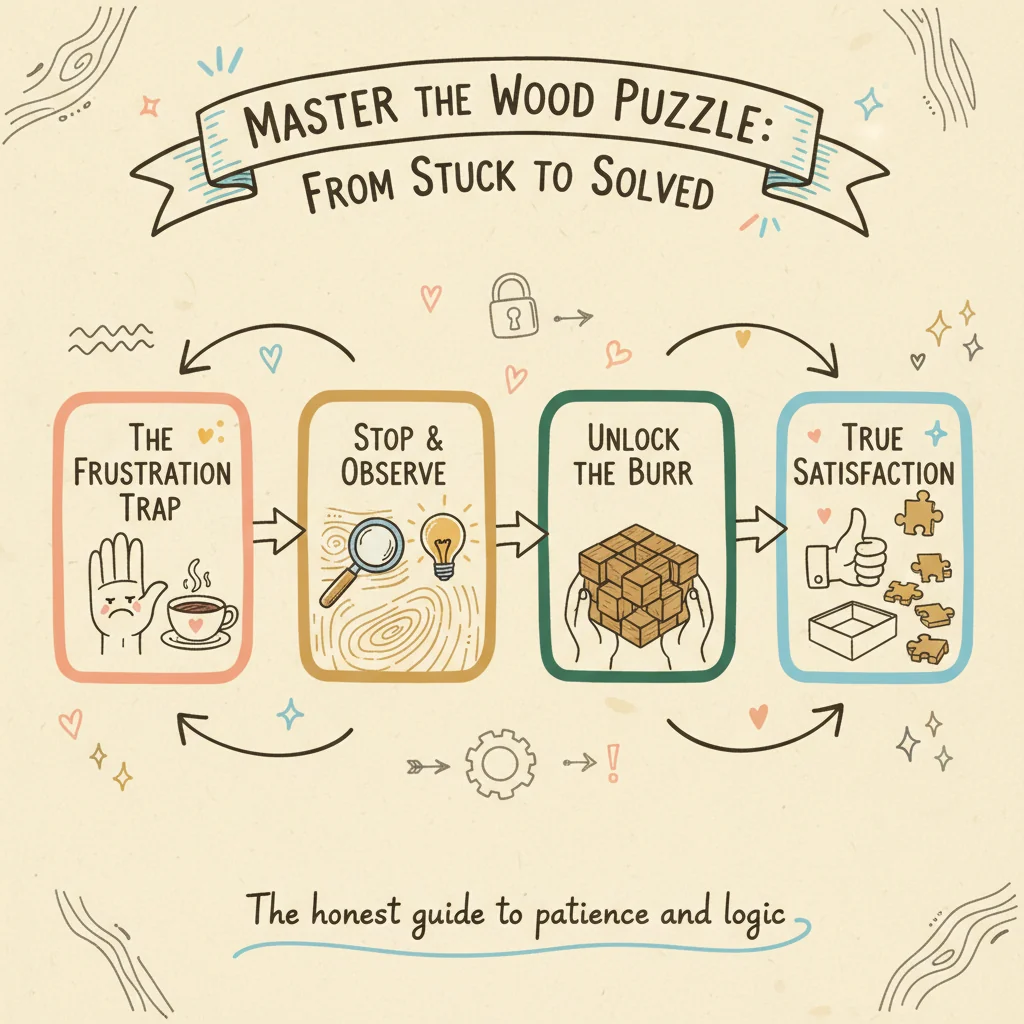
The third time the brass pin slipped past my thumb, I set the box down and made coffee. My hands were shaking slightly—not from caffeine, but from the specific, low-simmering irritation that only a five-inch cube of polished walnut can provoke. I had been “solving” this wooden puzzle for two hours, which is to say I had been repeating the same three incorrect moves while expecting a different result. That is the trap. We approach these objects with the same frantic energy we use to clear our inboxes, and the wood simply waits for us to calm down.
Solving a wood puzzle is less about manual dexterity and more about a fundamental shift in perception. After testing over 200 mechanical challenges, from $5 flea market finds to $500 limited editions, I’ve realized that the wood always wins if you try to outmuscle it. The grain doesn’t care about your schedule. The joinery doesn’t respond to force. To truly master these objects, you have to stop looking for the solution and start looking at the construction.
The Psychology of the “Stuck” (And Why We Fail)
Most people fail at wooden puzzles because they treat them like locks to be picked rather than stories to be read. When you pick up a Six-Piece Burr, your brain immediately looks for the “loose” piece. You wiggle, you tug, and when nothing moves, you tug harder. This is the “brute force” phase, and it’s where 90% of beginners give up or, worse, break the puzzle.
Wooden puzzles are living things—or they were. They expand with humidity and contract in the winter. They have friction coefficients that metal puzzles lack. If you’re struggling to solve wood puzzle designs, the first step is to realize that the “stuckness” is often the clue itself. A piece that won’t move horizontally might be a deadbolt for a piece that needs to move vertically.
I’ve spent years observing how different people approach my collection. Engineers tend to look for symmetry. Artists look for patterns in the wood grain. Children, interestingly, often solve them fastest because they haven’t yet learned that objects “should” work a certain way. They flip, they tilt, and they listen. They treat the object as a mechanical puzzle rather than a math problem.
The Anatomy of the Burr: 2,500 Years of Hidden Geometry
To understand how to solve these, you have to understand where they come from. The foundation of almost all modern interlocking wooden puzzles is the Luban lock. Legend says Lu Ban, the patron saint of Chinese carpenters, created these around 500 BCE to test his son. It wasn’t just a toy; it was a masterclass in mortise-and-tenon joinery—the same technique used to build temples that have stood for millennia without a single nail.
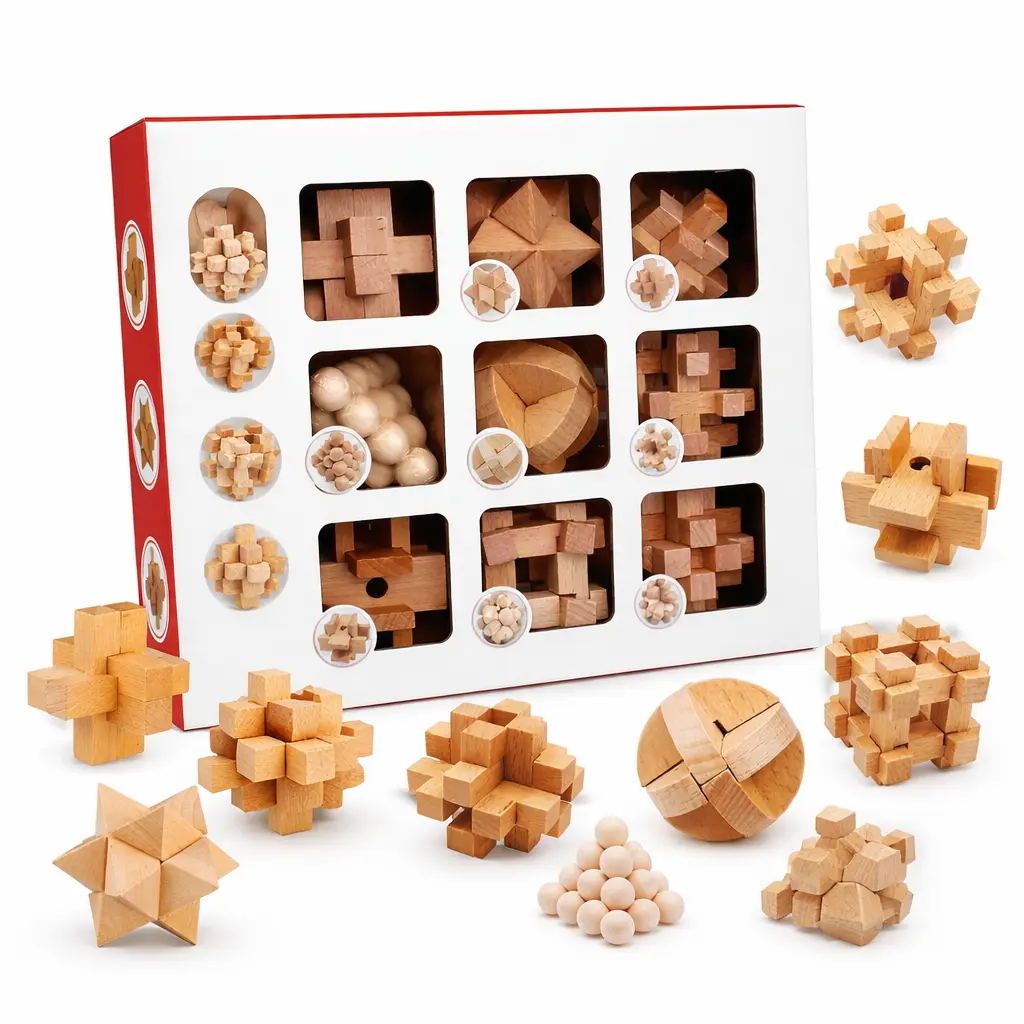
Luban Lock Set 9 Piece
The Luban Lock Set 9 Piece is the definitive starting point for anyone serious about this hobby. For $39.99, you get nine distinct challenges that range from “I figured that out in five minutes” to “I am going to throw this across the room.”
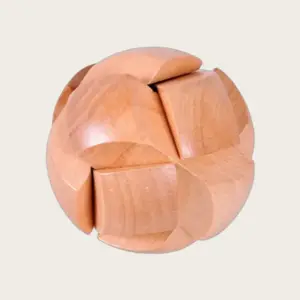
What I love about this set is the progression. You start with the basic cross and move into shapes that look like solid spheres or stars. Each one relies on the same principle: geometry alone holds the pieces together. When you finally find the “key” piece—the one that slides out with zero resistance—the entire structure collapses into a pile of timber. It’s a moment of pure, unadulterated clarity. I’ve had this set on my shelf for two years, and even now, reassembling the more complex stars requires a level of focus that feels like meditation. If you’re looking to understand traditional locking mechanisms, this is your textbook.
Essential Techniques: Slide, Spin, and Shiver
In my experience, 80% of wooden puzzles can be solved using one of four “hidden” moves that beginners rarely consider. If you’re staring at a block of wood that seems solid, try these:
- The Centrifugal Spin: Some puzzles contain internal pins that only retract when the puzzle is spun rapidly on a flat surface. If there’s a rattle but no movement, give it a whirl.
- The Gravity Drop: Hold the puzzle in one hand and tap it firmly against your other palm. Sometimes a internal peg is held in place by friction and just needs a little kinetic encouragement to drop.
- The Grain-Match: On higher-end puzzles, the “seam” where pieces meet is hidden by the wood grain. If you can’t find a move, look at the lines of the wood. If the grain suddenly shifts direction or breaks unnaturally, that’s your seam.
- The Sequential Slide: This is the most common. Piece A won’t move until Piece B is moved halfway, which then allows Piece C to move fully. It’s a dance of millimeters.
While you’re practicing these physical moves, it helps to keep your mind sharp with logic-based grid games to train your brain to see multiple steps ahead. The mental discipline required for a grid puzzle is surprisingly similar to the spatial reasoning needed for a 3D burr.
The Peak: The Tale of the Two Solvers
I once hosted a dinner party where I placed a single Six-Piece Burr in the center of the table. Two of my friends—one a mechanical engineer and the other a kindergarten teacher—spent the evening competing to solve it.
The engineer was methodical. He tried to visualize the internal voids. He talked about tolerances and load-bearing joints. He didn’t move a single piece for twenty minutes; he just stared at it. The teacher, meanwhile, was constantly “fiddling.” She turned it over, shook it near her ear, and tried every possible slide.
The teacher solved it in twelve minutes. The engineer took forty.
When I asked her how she did it, she said, “I just waited for the wood to tell me where it wanted to go.” That sounds like hippie nonsense until you’ve held enough of these. You can feel the minute “give” in a piece that is ready to move. It’s a tactile conversation. The engineer was trying to dictate to the puzzle; the teacher was listening to it. This is the “Peak Insight” of the hobby: The solution isn’t a destination you reach through logic; it’s a permission the puzzle gives you once you stop fighting it.
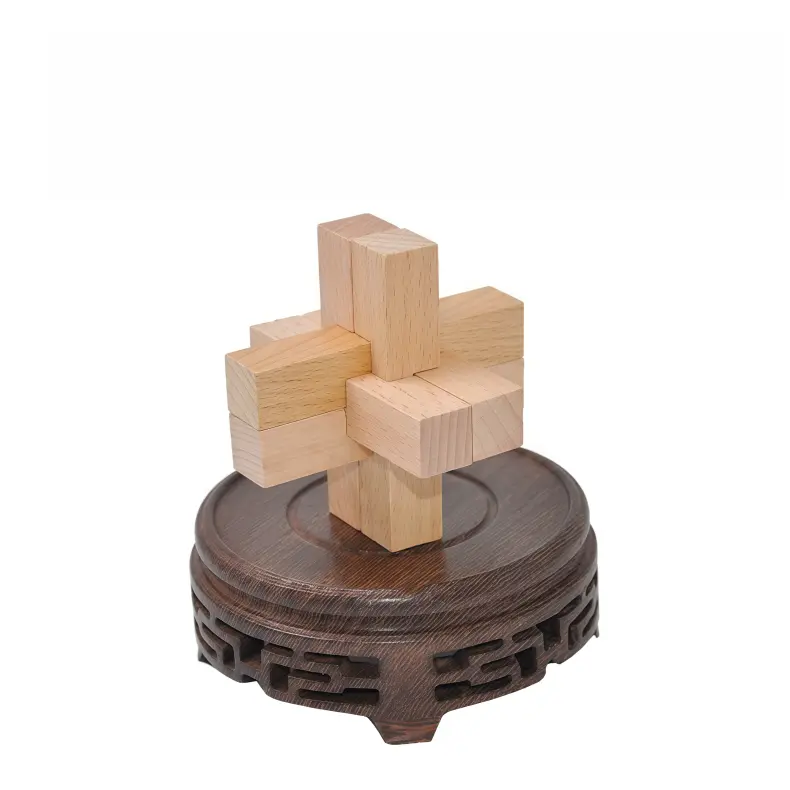
Six-Piece Burr
Priced at $17.99, the Six-Piece Burr is the “Hello World” of mechanical puzzles. It is deceptively simple: six notched sticks that interlock to form a cross. But within that simplicity lies the entire philosophy of the Burr puzzle.
Every piece is vital. If you remove one, the integrity of the whole is lost. I often recommend this to people who say they “aren’t puzzle people.” It’s small enough to fit in a pocket but complex enough to stump a Ph.D. for half an hour. The finish on this specific model is smooth enough that you won’t get splinters, but it retains enough texture that you can feel the pieces “locking” into place. It’s a screen-free way to reset your brain after a long day of staring at spreadsheets.
Beyond Disassembly: The Rise of the Mechanical Kit
While the traditional burr is about taking things apart, a new category has dominated the market lately: the 3D mechanical assembly kit. These aren’t puzzles in the “trick” sense, but they are puzzles in the engineering sense. You start with a flat sheet of laser-cut plywood and end with a functioning machine.
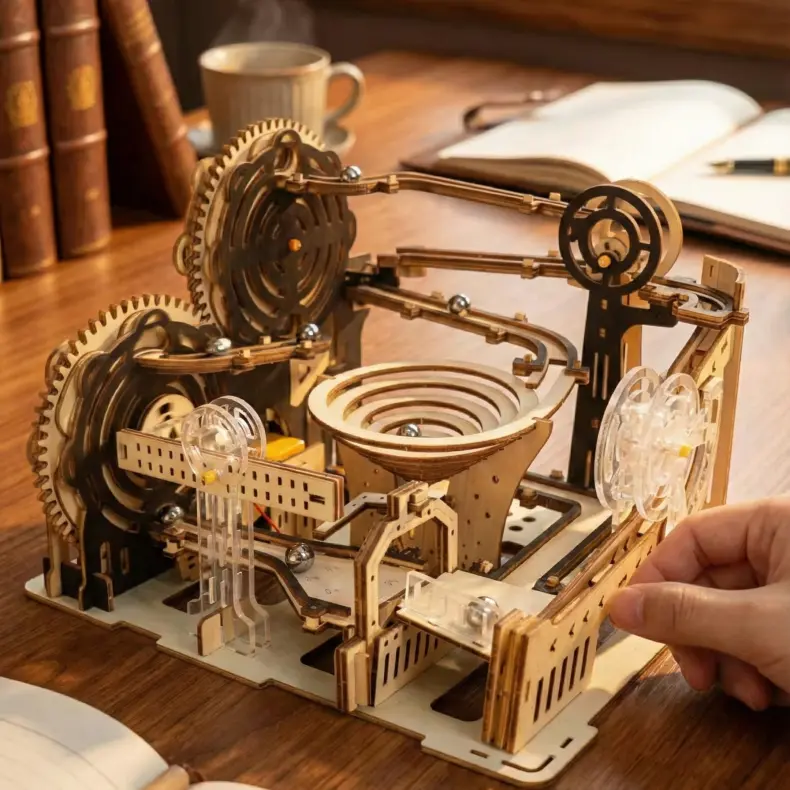
Electric Wooden Marble Run Kit
The Electric Wooden Marble Run Kit ($51.99) is a beast. With 168 pieces, this isn’t a “thirty-minute afternoon project.” It’s a weekend-long immersion into the world of gears, cams, and spiral tracks.
The “solve” here is in the assembly. If you misalign a gear by even a millimeter, the marbles will stall. I’ve built several of these, and there is a specific kind of “aha!” moment when you flip the switch and the electric motor carries the first marble up the lift. It’s pure ASMR. The click of the marbles on the wood is incredibly soothing. It’s the kind of desk toy that makes people stop in their tracks when they walk into your office. If you’ve already mastered entry-level magnetic geometric sets, this is the logical next step into 3D engineering.

Mechanical 3D Wooden Globe Puzzle
If the marble run is about motion, the Mechanical 3D Wooden Globe Puzzle is about aesthetics. For $28.88, it’s one of the best values in the “sophisticated decor” category.
I’ll be honest: the first time I built a globe puzzle, I messed up the gear-drive system and it wouldn’t rotate. I had to backtrack ten steps. That’s the “skeptical consumer” warning: read the diagrams twice. But once it’s finished, the way the laser-cut continents wrap around the sphere is genuinely impressive. It has a vintage, “explorer’s study” vibe that looks much more expensive than it actually is. It’s an intermediate build—perfect for a teenager who needs to get off their phone or an adult who misses shop class.
The Honest Truth: When to Walk Away
I’ve seen people get genuinely angry at a piece of wood. I’ve seen them reach for pliers (never do this) or hammers (definitely never do this). The most important skill in your “solve wood puzzle” toolkit is knowing when to put it down.
Wood reacts to the heat of your hands. If you’ve been gripping a puzzle for an hour, the wood might have expanded just enough to make the tolerances even tighter. Set it on a cool coaster, walk away, and come back tomorrow. More often than not, the piece that was “stuck” will slide perfectly on the first try the next morning.
If you find yourself getting bored rather than challenged, you might need a change of pace. I often switch to classic digital dexterity games for a few minutes just to reset my hand-eye coordination before going back to the tactile world.
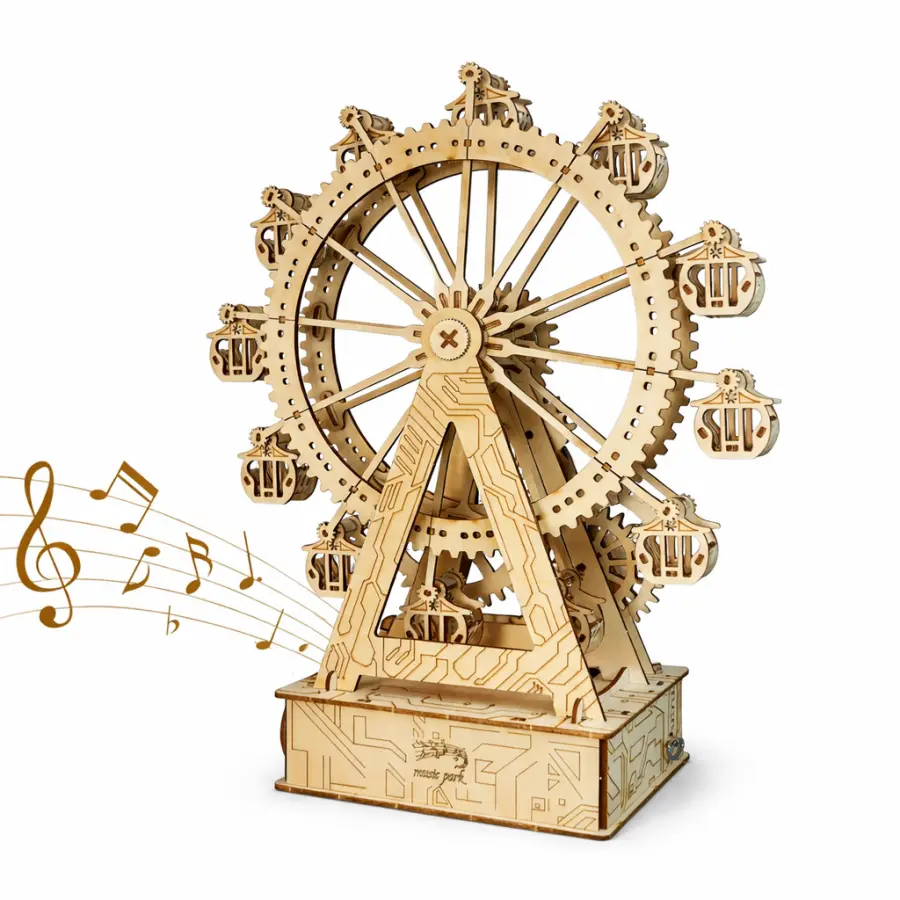
Wooden Ferris Wheel Music Box Kit
The Wooden Ferris Wheel Music Box Kit ($59.99) is a bit of an outlier because it includes two music movements. Most of these kits use a single, tinny-sounding crank. This one has a much richer, layered sound.
Construction-wise, it’s a delight. You’re essentially recreating George Ferris’s 1893 masterpiece in miniature. The hidden drawer in the base is a nice touch—I use mine to store extra puzzle pins. It’s a “showpiece” puzzle. You don’t just build it and put it in a drawer; you put it on the mantle. It’s a reminder that engineering can be beautiful.
Why Wood Beats Metal for the Long Haul
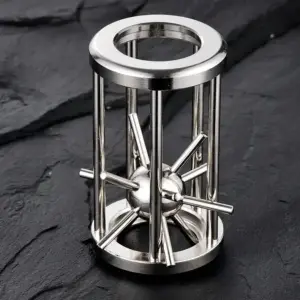
I love a good Klotski or a heavy brass Hanayama, but wood has a soul that metal lacks. There’s a warmth to it. As you solve a wooden puzzle over the years, the oils from your hands actually season the wood, making the slides smoother and the “click” more resonant. It becomes a customized tool.
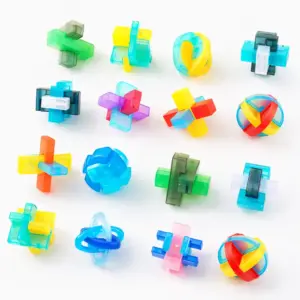
For those just starting, I recommend looking into the intricacies of translucent brain teasers if you want a visual challenge, but for the tactile experience, nothing beats the grain.
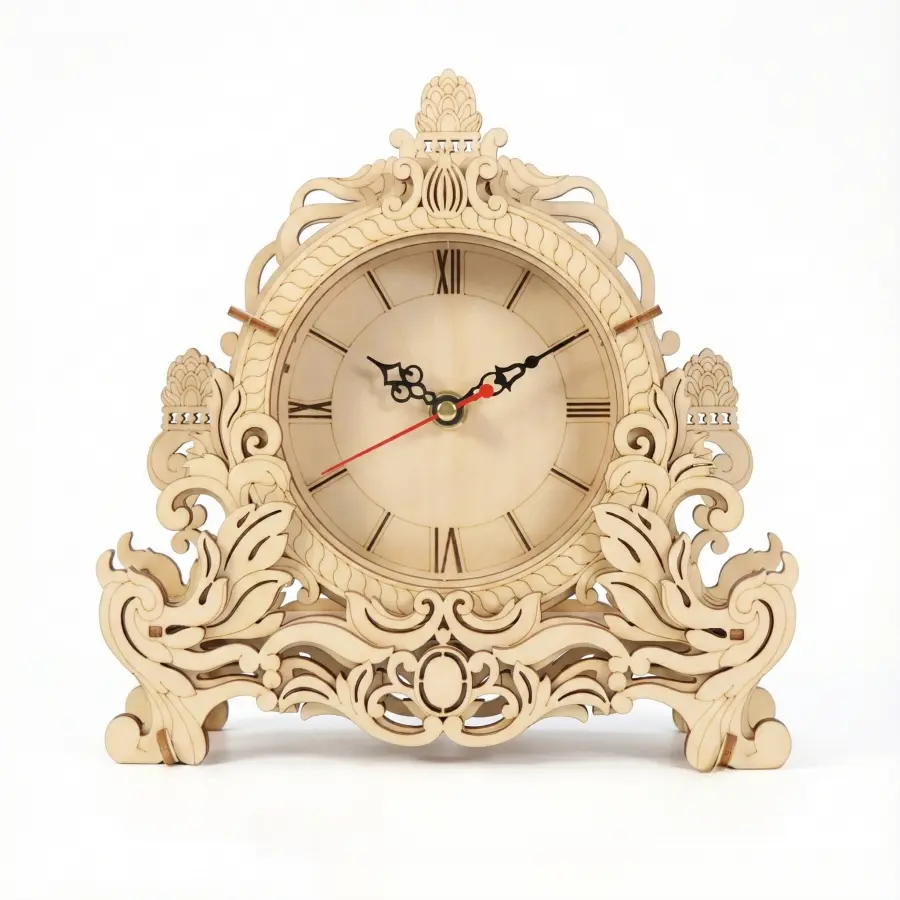
The 3D Wooden Puzzle Clock DIY Kit ($26.99) is a great example of this. It’s a 30-minute build that results in a working baroque-style clock. It’s not a “perpetual” machine—it’s a craft project that happens to tell time. It’s the perfect “gateway” puzzle for someone who thinks they aren’t handy.

If you prefer history over horology, the Galleon Ship 3D Wooden Puzzle Model Kit is a stunning desktop replica. It’s not just a puzzle; it’s a lesson in naval architecture. You can see how the lower forecastle made these ships faster than their predecessors. It’s a lot of detail for a very reasonable price.

For the fidgeters, the 3D Wooden Mechanical Pistol Kit ($29.99) is a revelation. It’s not a weapon; it’s a 68-piece mechanical feedback loop. The rack of the slide and the snap of the trigger are incredibly satisfying. I keep one on my desk for long Zoom calls. It’s much more engaging than a standard fidget spinner.

If you want something more atmospheric, the DIY Castle Music Box Night Light Shadow Box Kit ($33.99) uses laser-cut layers to create depth. It’s more of a “buildable art piece” than a traditional puzzle, but the assembly of the LED components and the music box adds a layer of complexity that keeps it interesting.
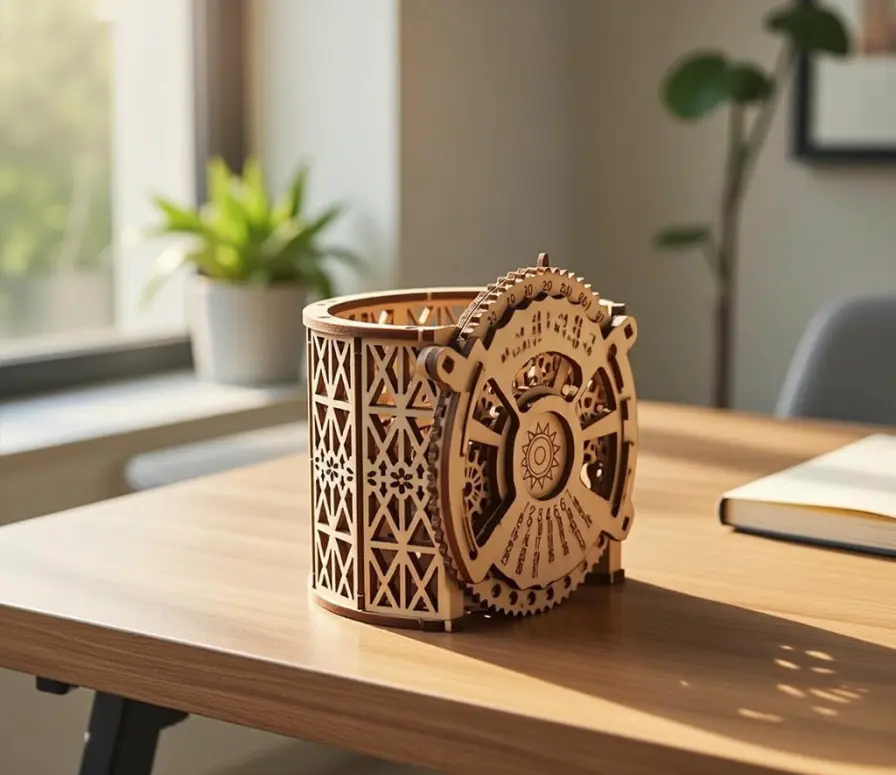
Finally, for the practical solver, the Wooden Desk Organizer with Perpetual Calendar ($19.99) is a brilliant fusion. It’s a pen holder that requires you to understand the mechanics of a calendar spanning 2023 to 2050. It’s a small, functional “solve” that you’ll actually use every day.
Quick-Reference Comparison Table
Frequently Asked Questions
What is the best way to solve a wooden packing puzzle?
The most effective approach for a packing puzzle (where you must fit irregular shapes into a box) is to identify the “constraining” pieces first. These are usually the pieces with the most awkward angles or largest volumes. Try to place them in the corners or along the edges where they have the fewest possible orientations. Many people make the mistake of starting with the “easy” pieces, only to find they’ve left a hole that no remaining piece can fill. It’s also helpful to realize that jigsaw puzzle logic doesn’t always apply; sometimes the “finished” look of a packing puzzle includes intentional gaps inside the box.
How do I fix a wooden puzzle piece that is stuck?
First, do not use tools. Wood is soft and will scar easily. If a piece is stuck, it’s usually due to humidity or a slight misalignment. Try placing the puzzle in a dry, cool environment for 24 hours to let the wood fibers contract. If that doesn’t work, use a “shiver” technique: hold the puzzle firmly and vibrate it rapidly with your hand. This can often settle internal pins or components that have tilted off-axis. I once spent three days thinking a puzzle was broken, only to realize I was holding it upside down, preventing a gravity-fed pin from dropping.
Are wooden puzzles harder than metal ones?
Harder? Not necessarily. Different? Absolutely. Metal puzzles often rely on precision machining and “tricks” like magnets or hidden ball bearings. Wooden puzzles rely more on friction, fit, and complex interlocking geometry. Wood is more forgiving of “near-miss” moves, but it also requires more “feeling.” If you enjoy the cold, clinical logic of a safe, go with metal. If you want a tactile, organic challenge that feels like you’re working with a living material, wood is the way to go.
Can I use sandpaper to make a wooden puzzle easier to solve?
I generally advise against this unless you are building a DIY kit and a specific gear is catching. In a pre-made “solve” puzzle, the tight tolerances are part of the challenge. Sanding down a piece can change the “feel” of the solve and might even make the puzzle unsolvable by removing the friction needed to hold internal pieces in place. If you must sand a kit, use a very high grit (400 or higher) and only remove the bare minimum.
What is the best age for wooden mechanical puzzles?
While many kits are labeled “14+,” I’ve seen 10-year-olds with good focus excel at them. The main concern isn’t the complexity, but the fragility of the laser-cut pieces. Younger children tend to apply too much force when a piece doesn’t “snap” immediately, which can lead to snapping the plywood. For adults, there is no upper limit—I know several retirees who use these kits to maintain their fine motor skills and spatial reasoning.
Do I need glue for 3D wooden puzzle kits?
Most modern kits, including the ones mentioned here, are “snap-fit.” They use precisely calculated joinery to stay together without adhesives. However, I always keep a small bottle of wood glue nearby for “emergencies.” If you accidentally snap a small decorative piece during assembly, a tiny dab of glue will fix it. Just be careful not to get glue on the moving parts or gears, or you’ll turn your mechanical model into a static sculpture.
How do I store my wooden puzzle collection?
Keep them out of direct sunlight and away from high-humidity areas like bathrooms or basements. Sunlight can fade the wood and make it brittle, while humidity will cause the pieces to swell, potentially locking the puzzle permanently. A simple bookshelf in a climate-controlled room is perfect. If you have a particularly valuable or complex burr, consider storing it in its “solved” (assembled) state to ensure the pieces don’t warp over time.
Why are some wooden puzzles so expensive?
You’re paying for two things: design and tolerance. A master puzzle designer might spend months or years perfecting a new interlocking shape. Then, that shape must be cut with a laser or CNC machine to within a fraction of a millimeter. If the cut is too loose, the puzzle feels cheap and falls apart; if it’s too tight, it’s unsolvable. The higher the price, usually the better the “fit and finish” of the wood.
Are these puzzles good for people with ADHD or anxiety?
As someone who can’t sit still, I find them incredibly therapeutic. They provide what psychologists call “just-manageable difficulty.” They are hard enough to require your full attention—which quiets the “background noise” of a busy mind—but they aren’t so hard that they feel impossible. The tactile nature of the wood is also very grounding. It’s a form of “productive fidgeting.”
What should I do if I lose the instructions?
Don’t panic. For assembly kits, most manufacturers provide PDF versions of their manuals online. For “trick” puzzles or burrs, the lack of instructions is often considered part of the challenge. If you’re truly stuck, there is a massive community of “puzzlers” on YouTube and Reddit who post solution videos. However, I recommend trying to solve it yourself for at least a week before looking. The “aha!” moment is worth the frustration.
How long does a typical 3D wooden puzzle take to build?
It varies wildly. The 3D Wooden Puzzle Clock DIY Kit is a quick 30-minute win. The Electric Wooden Marble Run Kit can easily take 6 hours or more. I always tell people to double the time listed on the box. You want to take your time, enjoy the process, and ensure every gear is perfectly seated.
Can I paint my wooden puzzles?
Yes, but be extremely careful. Paint adds a layer of thickness to the wood. If you paint the interlocking surfaces of a burr puzzle, it will no longer fit together. If you want to customize your puzzle, I recommend using wood stains or watercolors, which soak into the fibers rather than sitting on top of them. Always test on a scrap piece of the plywood frame first.
What’s the difference between a “3D puzzle” and a “model kit”?
The lines are blurry, but generally, a 3D puzzle (like a burr) is about the challenge of disassembly and reassembly. A model kit (like the Galleon) is about the challenge of the initial build. However, many modern wooden kits combine both—you build a complex machine that then requires you to “solve” how it operates.
Are these puzzles eco-friendly?
Most reputable brands use FSC-certified plywood or natural hardwoods. Compared to plastic toys that end up in landfills, wooden puzzles are much more sustainable. They are durable enough to be passed down through generations, and if they ever do reach the end of their life, they are biodegradable.
What is the “holy grail” of wooden puzzles?
For many, it’s the “Sequential Discovery” box—a puzzle that hides tools inside itself which you must find and use to progress further. These are often handmade and can cost hundreds of dollars. But for most of us, the holy grail is simply that one puzzle on our shelf that we haven’t solved yet.
Start Here, Then See Where the Rabbit Hole Goes
If I’ve learned anything from my years of testing, it’s that the “best” puzzle isn’t the most expensive one or the most complex one. It’s the one that makes you forget to check your phone. It’s the one that makes you feel like a master carpenter for twenty minutes on a Tuesday evening.
If you’re ready to move past the plastic distractions of the modern world and get your hands on something real, start with the Six-Piece Burr. At $17.99, it’s a low-stakes investment that taught me more about patience and observation than any self-help book ever could. It’s a humble object that hides a 2,500-year-old secret.
Once that clicks for you—and it will, eventually—you’ll find that the world looks a little different. You’ll start seeing the “joinery” in everything around you. If you find yourself craving more, the traditional locking mechanisms found in our full collection offer a lifetime of challenges. Just remember: when the wood stops moving, don’t push harder. Breathe, look at the grain, and wait for the permission to move.
The solution is already there; you’re just the one who has to find the rhythm.