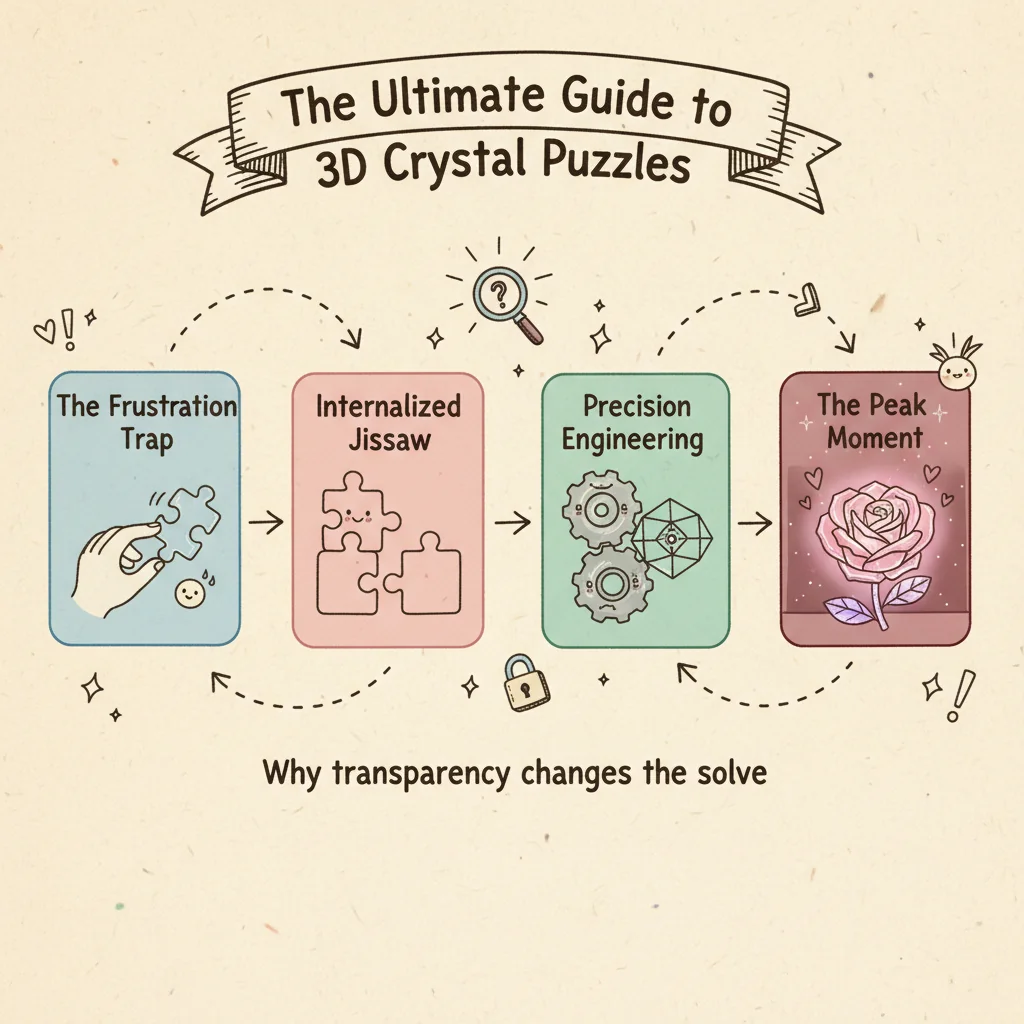
The third time the translucent plastic petal of the rose slipped from my fingers and vanished into the beige abyss of my living room rug, I realized I wasn’t just building a toy. I was engaged in a high-stakes negotiation with physics. Most people look at a “deluxe” 3D crystal puzzle and see a pretty desk ornament. They see the shimmering light catching the edges of a faux-ruby flower or a crystalline apple and think, “That looks like a relaxing Sunday afternoon.” They are wrong. These puzzles are essentially “internalized” jigsaws where the traditional rules of edge-finding and color-matching are replaced by a brutal demand for spatial reasoning and structural integrity.
After testing over 200 mechanical puzzles, from the heaviest brass locks to the lightest laser-cut wood, I’ve developed a healthy skepticism toward anything that looks too much like jewelry. But the deluxe 3D crystal category is a rare beast. It bridges the gap between the mindless fidgeting of a stress ball and the intense mechanical engineering of a mechanical puzzle. The “deluxe” designation isn’t just marketing fluff; it usually refers to a higher piece count—often exceeding 40 or 50 pieces—and a more complex interlocking mechanism that requires a central locking pin to keep the whole sculpture from exploding at the slightest touch.
My thesis is simple: the best 3D crystal puzzles are those that weaponize their own transparency. They allow you to see the solution, yet they obscure the path to getting there through light refraction and overlapping seams. They reward the patient observer and punish the “force-it-until-it-clicks” amateur. If you’ve ever felt the hollow victory of finishing a 1,000-piece flat jigsaw only to realize you have nowhere to put it, the 3D crystal puzzle offers a compelling alternative: a solve that results in a legitimate piece of desk art.
The Geometry of Frustration: Why Transparency Changes the Solve
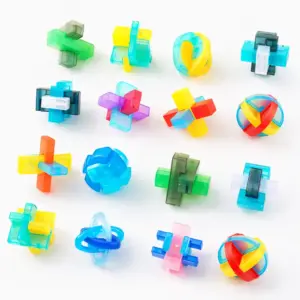
In a standard three-dimensional jigsaw puzzle, you often have foam backing or opaque plastic to guide your eyes. You look for patterns, colors, and the familiar “tabs and blanks.” Deluxe crystal puzzles throw that playbook out the window. Because the pieces are translucent, your brain has to work twice as hard to distinguish between the front of a piece and the back of the piece behind it. It is a masterclass in visual noise.
I spent forty-five minutes on a single section of a crystal sculpture last week simply because I couldn’t tell if I was looking at a notch or the shadow of a notch. This is where the “deluxe” experience differs from the cheaper, 10-piece versions you find in gift shop bins. In a 40+ piece build, the internal structure is just as important as the external aesthetic. You aren’t just stacking; you are weaving plastic.
The real challenge—and the reason many people end up searching for tips on mastering the nuances of translucent assembly—is that these puzzles are often non-linear. You might have the entire base of a rose assembled, but if you haven’t aligned the internal channel for the stem, you’ll never get the final locking rod to slide through. It’s a lesson in foresight. You have to build with the end-game in mind, or you’ll find yourself disassembling twenty minutes of work to fix one internal misalignment.
The Floral Enigma: A Deep Dive into the Rose
Most people buy the rose as a gift. It’s the “safe” choice for Valentine’s Day or an anniversary when real flowers feel a bit too transient. But as a puzzle reviewer, I look at it through a different lens: structural tension.
3D Crystal Rose Puzzle
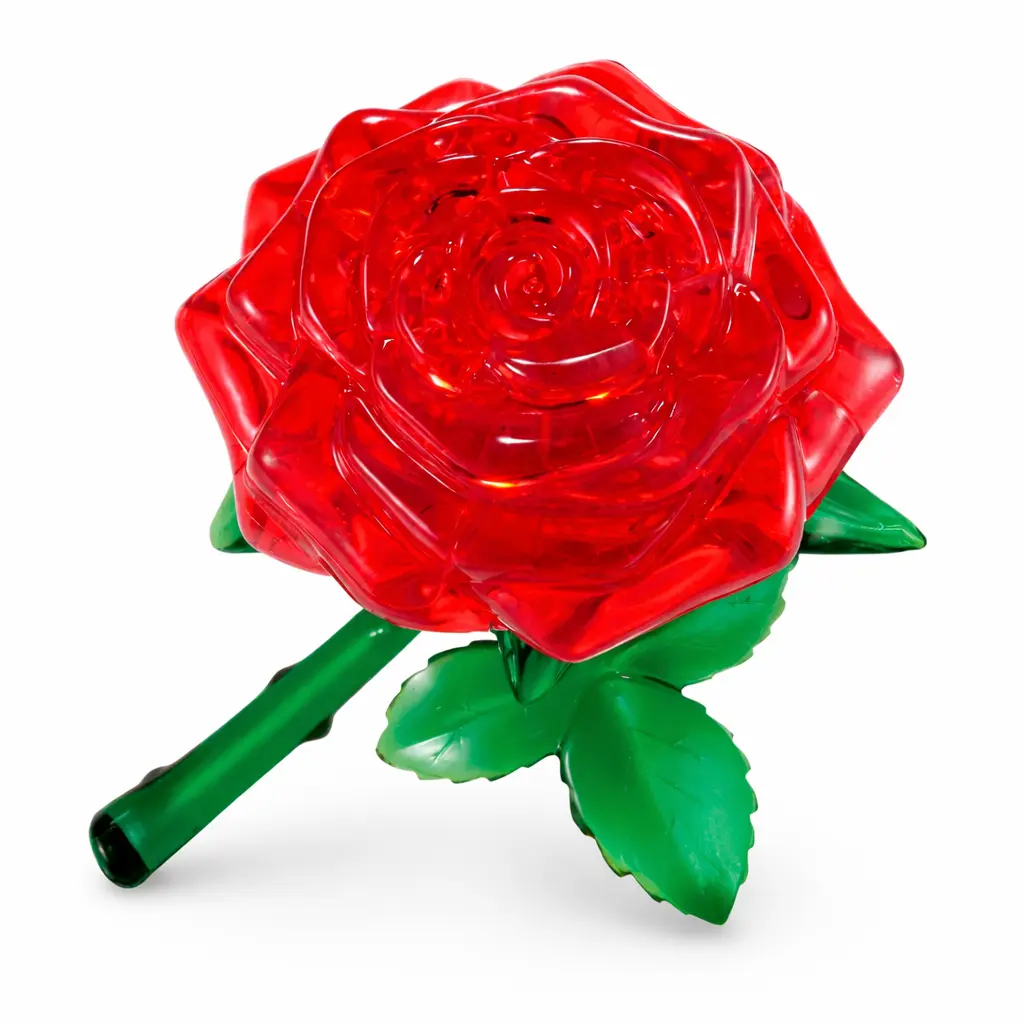
3D Crystal Rose Puzzle — $19.99
3D Crystal Rose Puzzle ($19.99) is a 44-piece exercise in organic geometry. Unlike a sphere or a cube, a rose has irregular, sweeping curves that don’t immediately suggest where the next piece should go. When I first cracked open the box, I was struck by the deep, ruby-red tint of the polycarbonate. It doesn’t feel like the cheap, brittle plastic of a model airplane kit; it has a weight to it that mimics heavy glass.
The build itself took me about 55 minutes, though I suspect a beginner might push toward the two-hour mark. The difficulty lies in the petals. Each one looks nearly identical to the last, but the notches are offset by mere millimeters. If you force a piece that almost fits, you’ll find that the subsequent three pieces won’t lock in. My advice? Don’t use the instructions unless you’re truly stuck. There’s a specific “click” when the pieces align perfectly—a tactile feedback that tells you the geometry is sound. The finished product stands as a palm-sized sculpture that catches the light beautifully on a windowsill. It’s the kind of object that makes people ask, “Wait, you actually built that?”
The Fruit of Your Labor: The Crystalline Apple
If the rose is about organic curves, the apple is about spherical layers. It’s a more intuitive solve, but it introduces a different kind of mechanical hurdle: the core.
3D Crystal Apple Puzzle
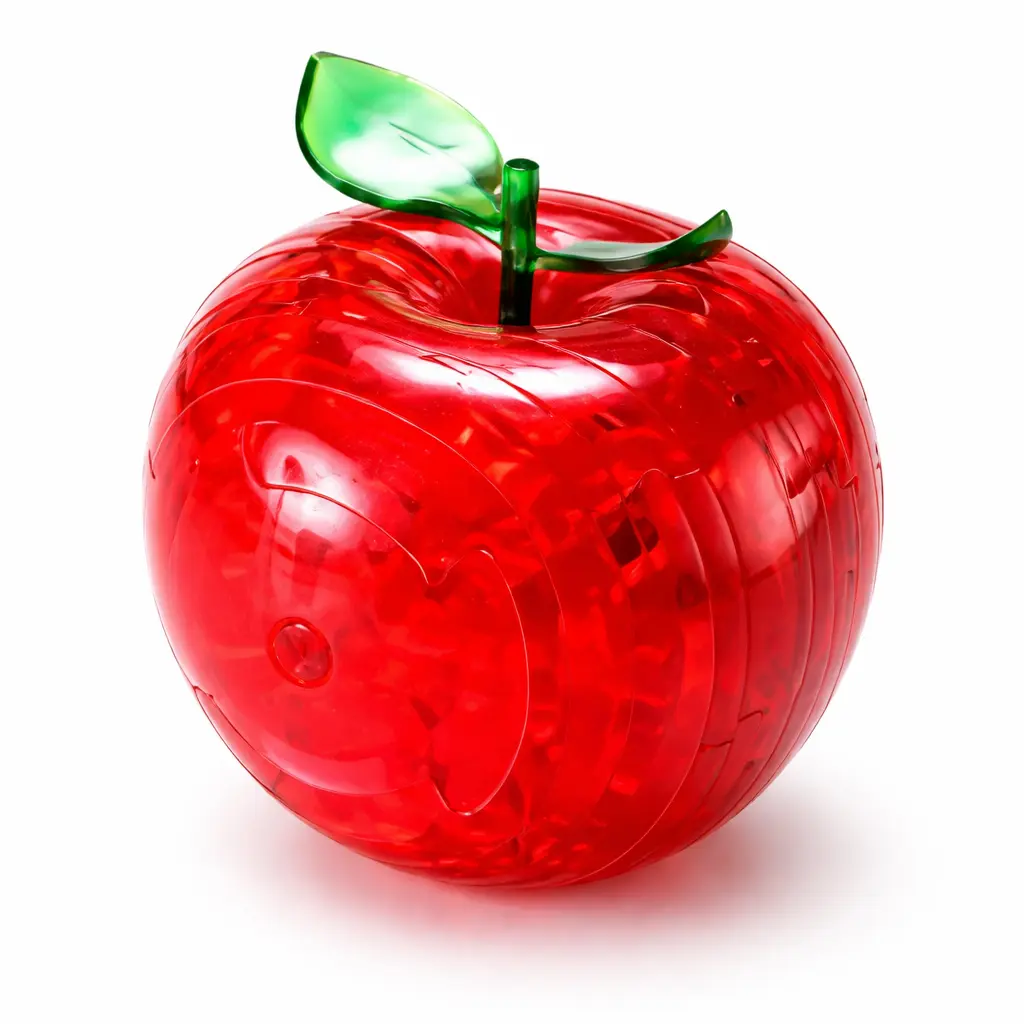
3D Crystal Apple Puzzle ($18.88) consists of 44 pieces that assemble into a life-sized translucent fruit. I’ve had one of these on my office desk for three weeks, and it is the ultimate “guest trap.” People cannot resist picking it up. The build is satisfying because it progresses in clear, horizontal “slices,” but the challenge ramps up as you reach the equator of the apple.
The green stem isn’t just decorative; it’s the final key. Many builders make the mistake of trying to jam the stem in at the end without realizing that the internal pieces have to be perfectly centered to allow the rod to pass through. I noticed a slight seam on piece #22 that required a bit of fingernail pressure to seat properly—a minor manufacturing tolerance issue, but nothing that ruins the experience. For under twenty dollars, it’s a far more impressive desk piece than a standard paperweight. It’s especially popular as a “thank you” for teachers who have already received enough “World’s Best Teacher” mugs to fill a landfill.
The Metal Alternative: Why Precision Over Plastic?
While crystal puzzles satisfy the visual and artistic itch, some solvers crave the cold, unforgiving precision of metal. If crystal is about light, metal is about weight and friction. When I need a break from the “visual noise” of translucent plastic, I turn to cast alloy.
Among the 200+ puzzles I’ve tested, the transition from crystal to metal feels like moving from watercolor painting to blacksmithing. There is no “seeing through” the problem here. You have to rely entirely on your sense of touch and your ability to visualize hidden internal paths. This is where strategic spatial planning games can actually help train your brain to see three moves ahead in a physical space.
Cast Keyhole Gold & Silver

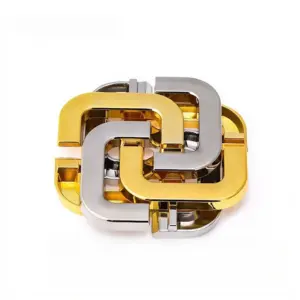
Cast Keyhole Gold & Silver ($13.99) is a masterclass in deceptive simplicity. It consists of two interlocking pieces—one gold-toned, one silver-toned—that look like flat, notched keys. The goal is to separate them. When you first hold it, the pieces feel loose, almost as if they should just fall apart. They don’t.
The “keyhole” name refers to the 3D maze hidden within the flat surfaces. You have to slide, twist, and pivot the pieces through a series of angled notches. It took me about 15 minutes to take it apart and nearly 40 minutes to put it back together. That “return solve” is where the real value lies. It’s a pocket-sized challenge that I often carry during commutes. The polished finish is high-quality, though it does pick up fingerprints quickly. If you’re the type who enjoys digital logic breaks but wants something tactile for your hands, this is a top-tier choice.
Dual Seahorse Gold & Silver Brain Teaser
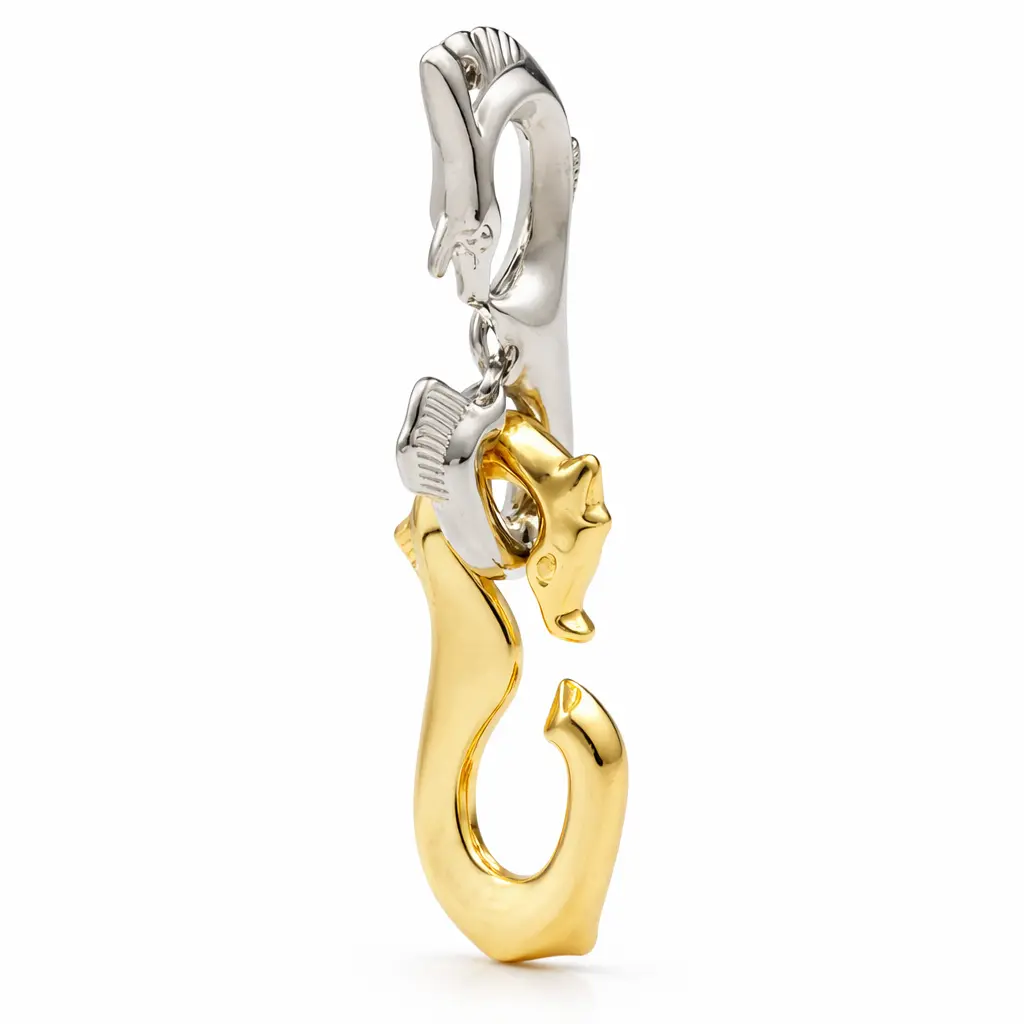
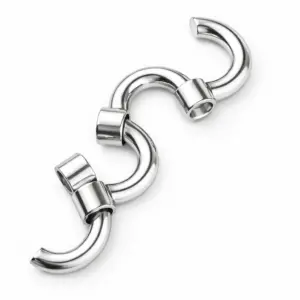
Dual Seahorse Gold & Silver Brain Teaser ($14.99) is arguably the most beautiful metal puzzle in this price bracket. The two seahorses are intertwined in a way that suggests a screw mechanism, but the “thread” is hidden. You have to find the exact rhythm of rotation to make them part.
This is a “low-stress” puzzle compared to the Keyhole. It rewards a gentle touch. If you try to force the seahorses apart, the metal will bind, and you’ll get nowhere. It’s a great introductory piece for someone who thinks they “aren’t good at puzzles.” The solve is logical and repeatable. I’ve used this as a fidget toy during long Zoom calls; the weight of the alloy provides a grounding sensory experience that plastic just can’t match.
The Peak Moment: The Illusion of Transparency
Here is the secret that no marketing copy will tell you: the hardest part of a deluxe 3D crystal puzzle isn’t the number of pieces. It’s the fact that your brain thinks it knows what’s happening because it can see through the object.
I call this the “Refraction Trap.” In a solid wooden puzzle, you accept that you are working blind. You feel for the movement. In a crystal puzzle, you see the internal locking mechanism, but the light bending through the facets makes it look like it’s two millimeters to the left of where it actually is. I once spent ten minutes trying to slide a locking pin into what I thought was a hole, only to realize I was aiming at a reflection of the hole on the opposite wall of the puzzle.
This is the “Peak Moment” of the hobby. It’s that split second when you stop trusting your eyes and start trusting the mechanical feedback of the plastic. It’s the moment you realize that “clear” does not mean “obvious.” When the final piece of a 50-piece set finally slides home and the entire structure suddenly becomes rigid—transforming from a wobbly pile of shards into a solid, light-refracting gem—it’s one of the most satisfying clicks in the entire world of mechanical objects. This transition from “fragile” to “indestructible” is unique to the 3D crystal category.
Ancient Engineering: The Wooden “Crystal” Logic
To truly understand why these puzzles work, we have to look back about 2,500 years. Long before we had polycarbonate, we had the “Luban Lock.” Invented by the legendary Chinese carpenter Lu Ban, these puzzles use mortise-and-tenon joinery to create complex shapes that stay together without a single nail or drop of glue.
The logic of a deluxe crystal puzzle is almost identical to a Luban Lock: multiple pieces that rely on a single “key” piece to maintain structural integrity. If you want to understand the ancient joinery techniques for modern collectors, you have to go back to the source.
Luban Lock Set 9 Piece
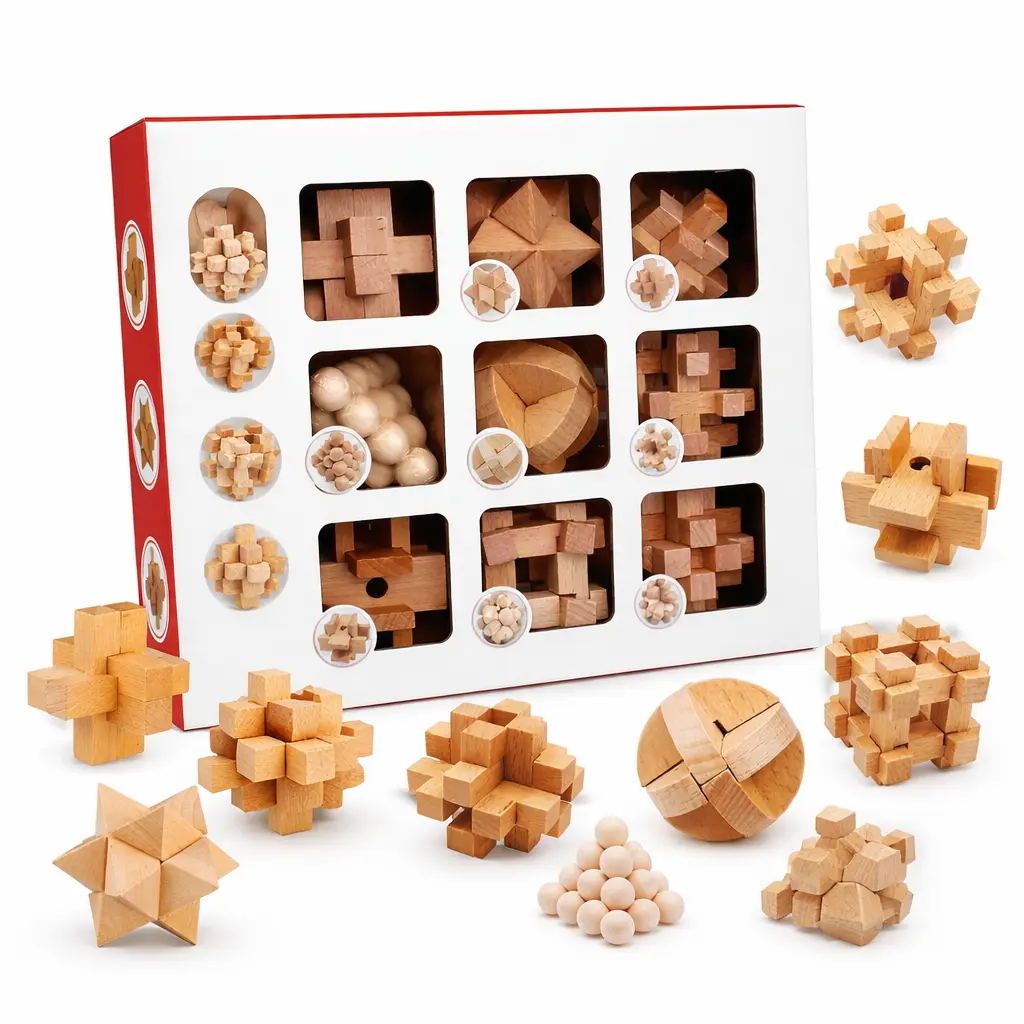
Luban Lock Set 9 Piece ($39.99) is the “graduate level” version of the 3D crystal experience. While the crystal puzzles are beautiful, these wooden enigmas are educational. This set includes nine different designs, each testing a different aspect of spatial reasoning.
The wood has a warmth that metal and plastic lack. There’s a certain smell to the seasoned timber and a soft thud when the pieces lock. My favorite in the set is the classic “six-piece burr,” which looks like a simple cross but requires a specific sequence of five moves to unlock. If you find yourself breezing through the crystal apple, these wooden locks will provide the humbling experience you’re looking for. They are essentially the ancestors of the Puzz 3D phenomenon that took over the 1990s.
The Hybrid Challenge: When Light Meets Mechanism
Sometimes, a puzzle isn’t just a shape; it’s a machine. The “deluxe” end of the market has recently moved toward kits that combine the assembly of a 3D puzzle with the functionality of a music box or a night light. These are for the builders who want a longer “solve time”—typically 3 to 5 hours—and a functional reward at the end.
For those who enjoy the physics of rotating mechanical objects, these kits offer a glimpse into gear ratios and tension-based assembly.
DIY Castle Music Box Night Light Shadow Box Kit
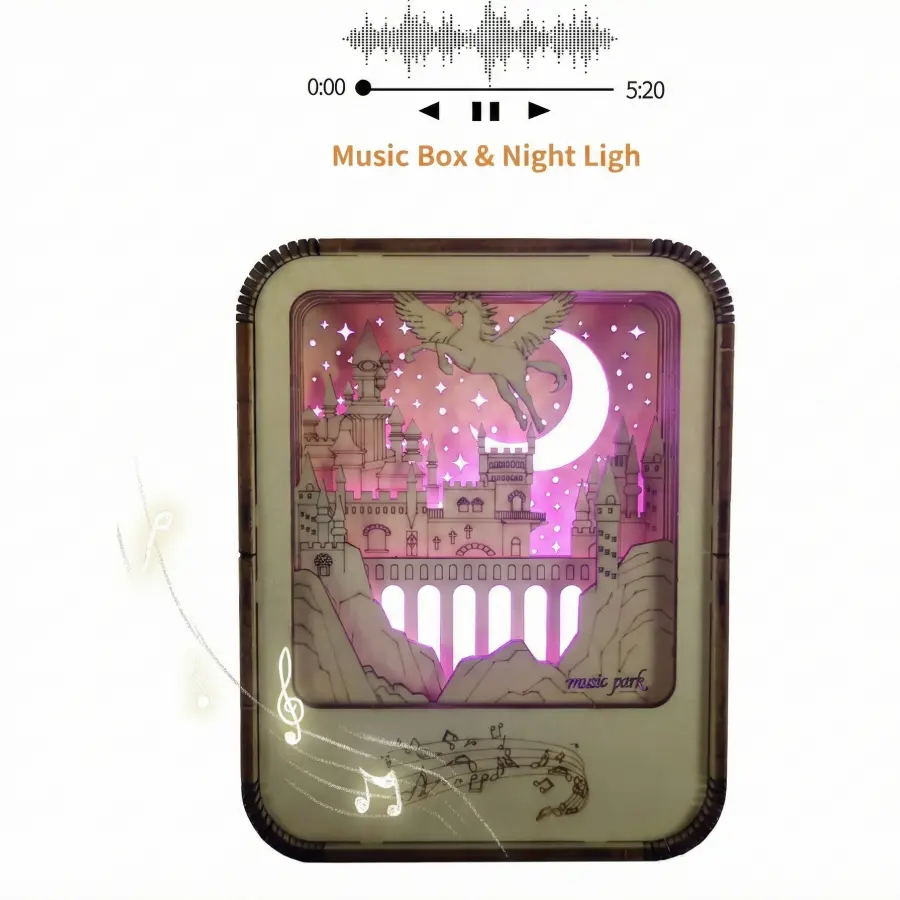
DIY Castle Music Box Night Light Shadow Box Kit ($33.99) is a 28-piece hybrid that feels like a theater set in a box. It uses laser-cut wood to create depth, much like the layered pieces of a crystal puzzle. What makes this “deluxe” is the integration of electronics and mechanics. You aren’t just fitting shapes together; you’re ensuring that the music box mechanism has enough clearance to spin and that the LED leads aren’t pinched by the wooden panels.
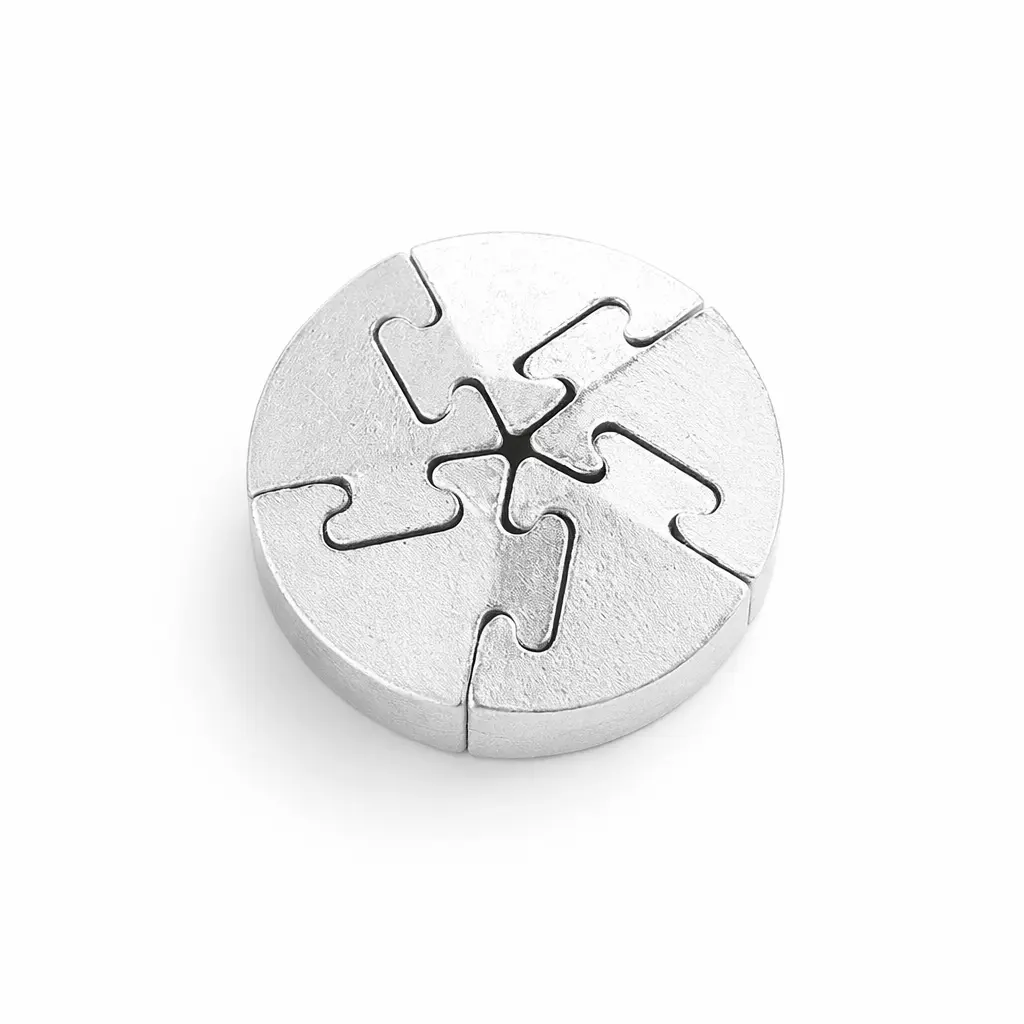
It’s a therapeutic build. I put this together over two evenings with a glass of wine, and the result is a stunning shadow box that cycles through six LED colors. It’s less of a “brain teaser” in the sense of the 5 Piece Cast Spiral Metal Puzzle and more of a “craft-puzzle” hybrid. If you have a teenager who is hard to buy for, this is a win—it’s screen-free, creative, and actually looks cool on a bookshelf.
Comparing the Top Contenders
To help you decide which “flavor” of frustration suits you best, I’ve broken down the top spotlight products by their mechanical “vibe.”
Addressing the Skeptics: FAQ
Are these puzzles actually solvable, or do I need to be a math genius?
You don’t need a PhD in geometry, but you do need a high tolerance for trial and error. Most deluxe 3D crystal puzzles are designed to be intuitive once you find the “anchor” piece. The biggest mistake beginners make is trying to force two pieces together. If it doesn’t click with light pressure, it’s wrong. It’s about pattern recognition, not brute force.
What should I do if a piece is missing or the locking rod doesn’t fit?
This is a common concern on hobbyist forums. Before you assume a manufacturing defect, check your alignment. If the internal pieces are off by even half a millimeter, the locking rod (the central screw or pin) will refuse to turn. I’ve seen Reddit threads where people recommend using clear glue to hold pieces together, but I strongly advise against this. It ruins the ability to take it apart and re-solve it. If you’re stuck, shine a bright light through the pieces; sometimes the numbers are embossed on the plastic, though you’ll need a magnifying glass to see them.
Are crystal puzzles durable enough for kids?
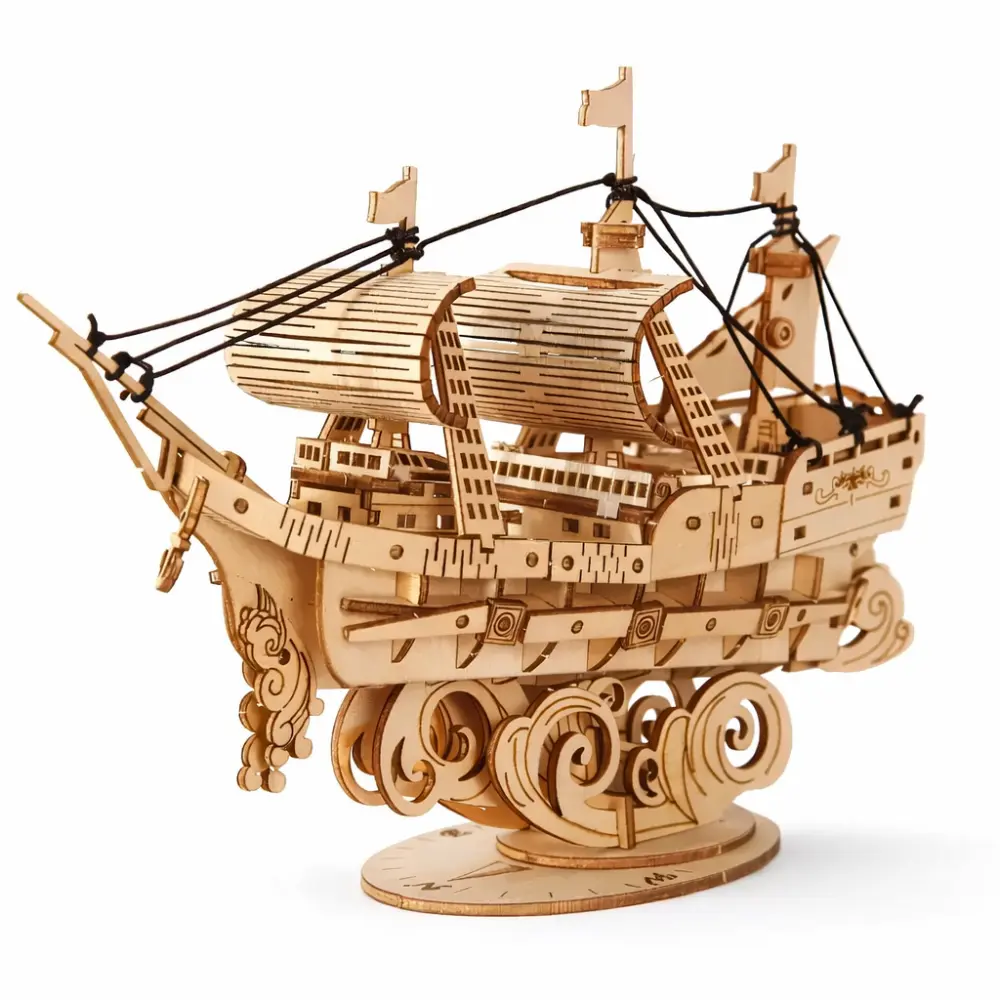
“Deluxe” usually means “more pieces,” which also means “more choking hazards.” I’d stick to the manufacturer’s age rating of 12+ or 14+. The plastic is sturdy, but if you drop a half-finished rose onto a hardwood floor, it will shatter into its component parts. For younger kids or those who are a bit more “handsy,” I’d recommend starting with the Galleon Ship 3D Wooden Puzzle Model Kit or the Steampunk Airship 3D Wooden Puzzle ($26.66). These wooden kits are more forgiving of “enthusiastic” assembly.
How do I clean a crystal puzzle once it’s assembled?
Since they are made of polycarbonate, they are magnets for dust and fingerprints. I use a can of compressed air for the crevices and a microfiber cloth for the surfaces. Never use harsh chemicals or window cleaners, as they can cloud the plastic over time. A simple damp cloth is usually enough to restore the “glass-like” shine.
Why are some 3D puzzles so much more expensive than others?
You’re paying for two things: piece count and licensing. A generic “Crystal Apple” is cheaper than a licensed “Disney Castle” or “Deluxe Carousel.” Additionally, the “deluxe” versions often include a display base or internal LED lights. If you’re just starting out, don’t feel like you need to spend fifty dollars. A solid $15-$20 puzzle like the Metal Starfish Puzzle Ring ($13.99) can offer just as much challenge as a larger kit.
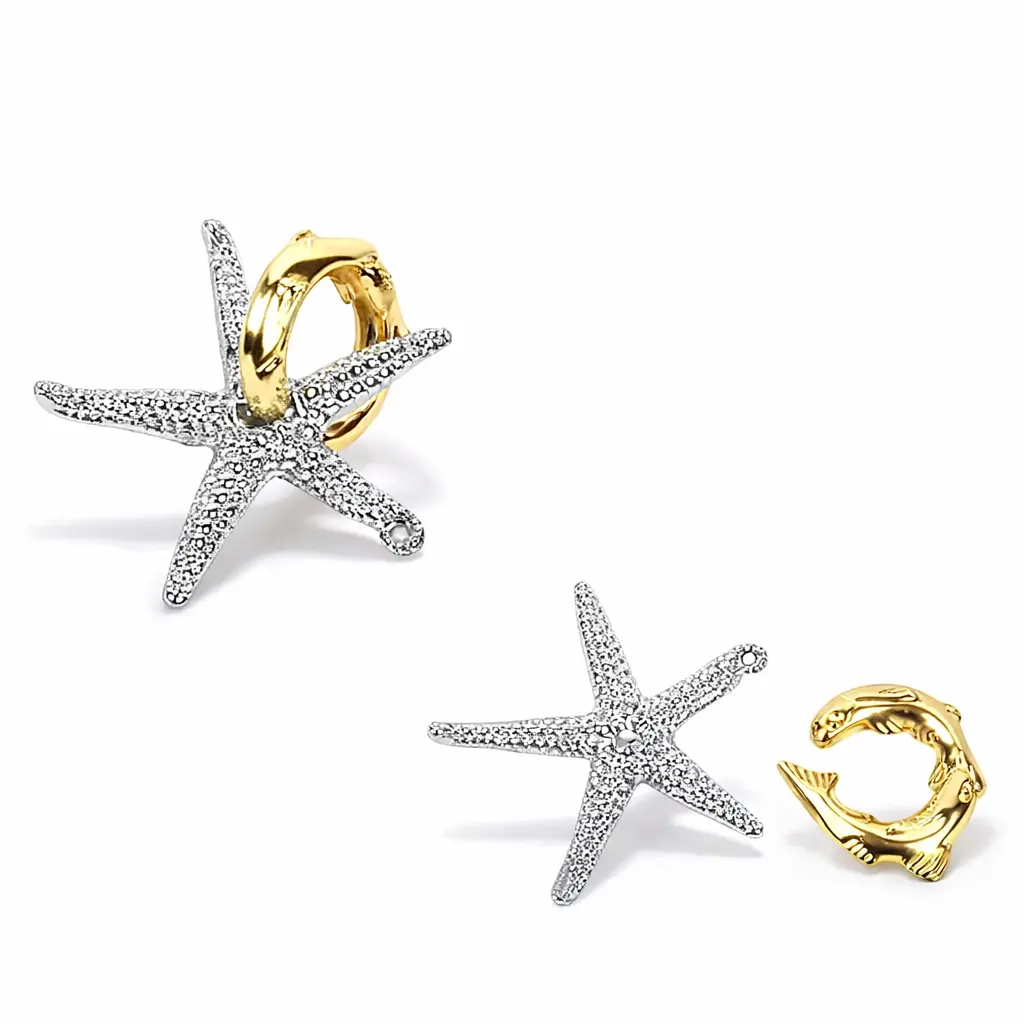
Metal Starfish Puzzle Ring — $13.99
Can I take them apart and do them again?
Yes, and you should! The first solve is often an accident—you’re just fumbling until things fit. The second solve is where you actually learn the mechanics. To disassemble a crystal puzzle, you simply unscrew or slide out the locking pin, and the whole thing will gently (or not so gently) fall apart. It’s like a “reset” button for your brain.
Is there a specific order I should follow when building?
Always start with the base. If you try to build from the top down, gravity will be your enemy. Most deluxe sets are designed to be built in layers. Think of it like building a house: if the foundation isn’t square, the roof will never fit.
Do these puzzles help with anxiety or focus?
Many users find the tactile nature of mechanical puzzles to be a form of “active meditation.” It forces you to stop scrolling and focus on a single, tangible problem. It’s a great way to wind down after a day of staring at spreadsheets. If you want something even more rhythmic, you might enjoy the physics of rotating mechanical objects found in high-end kinetic toys.
What is the “locking rod” everyone talks about?
Most 3D crystal puzzles aren’t held together by friction alone. They have a central channel. Once all the pieces are in place, you slide a long plastic rod through the center and twist it (using a provided plastic key) to lock everything into a solid unit. If that rod doesn’t turn, your internal pieces aren’t aligned.
Are the instructions helpful?
Honestly? Usually not. Most of these puzzles come with a “map” that shows the pieces numbered, but the fun is in figuring it out without the map. Using the instructions is like looking at the answer key of a crossword before you’ve even picked up a pen. Try it blind first.
What’s the difference between “Level 1” and “Level 2” puzzles?
It’s usually about the symmetry. A symmetrical object (like a sphere) is often easier because the pieces are repetitive. An asymmetrical object (like a dragon or a rose) is harder because every piece is unique.
Can I use these as actual home decor?
Absolutely. The deluxe versions, especially the ones with high piece counts, look like expensive glass sculptures from a distance. I have the 3D Crystal Rose Puzzle ($19.99) on my bookshelf, and people always assume it’s a boutique find rather than a $20 puzzle.
The One Puzzle That Teaches You How All the Others Work
If you’ve read this far, you’re likely looking for a place to start. If I could only recommend one object to help you understand the marriage of aesthetics and mechanics, it would be the Cast Keyhole Gold & Silver ($13.99). It is the purest expression of what a mechanical puzzle should be: a simple object that reveals a complex secret. It taught me more about patience and observation than any 1,000-piece jigsaw ever could.
The first time you solve a deluxe puzzle—whether it’s the translucent petals of a rose or the interlocking keys of a metal maze—you experience a shift in perspective. You stop seeing the object as a “thing” and start seeing it as a series of decisions made by a designer. You begin to appreciate the millimetric tolerances and the clever ways that light can be used to hide a seam.
Start with the 3D Crystal Apple Puzzle ($18.88). It’s the perfect entry point into the “deluxe” world—challenging enough to be rewarding, but logical enough to prevent a total meltdown. Once you’ve mastered the apple, the entire world of mechanical challenges opens up. You might find yourself graduating to ancient joinery techniques for modern collectors or exploring the intricate world of wooden model kits.
The beauty of this hobby is that there is always another layer to peel back, another “impossible” shape to deconstruct. Just remember: don’t trust your eyes, trust the click. The most rewarding solutions are usually hiding in plain sight, right behind the refraction of the light.