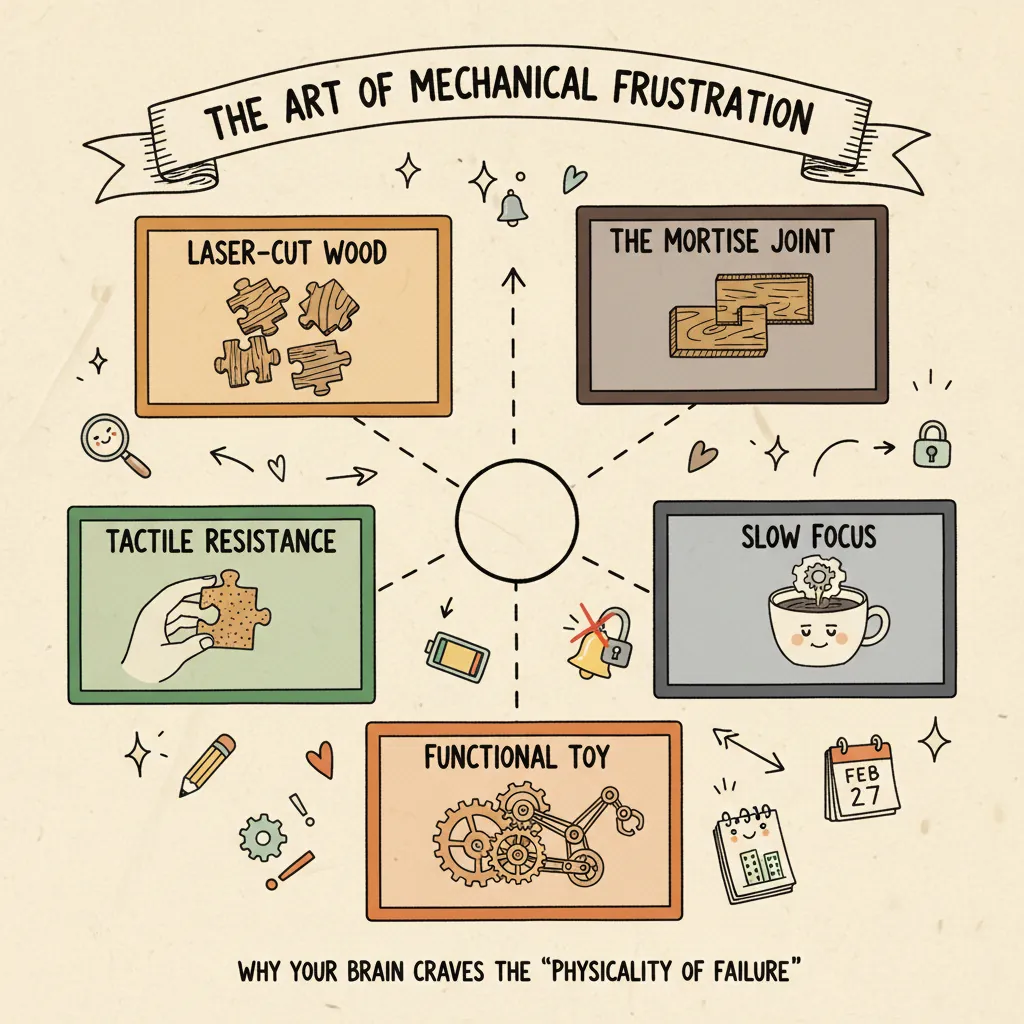
The smell of laser-cut birch is the first thing that hits you. It’s a campfire-adjacent scent, slightly sweet and charred, that signals you’re about to spend the next three hours in a state of productive frustration. I’m sitting at my desk on this rainy February 27, 2026, staring at a pile of sixty-eight precision-cut pieces that are supposed to become a functional mechanical toy. My coffee is cold, my phone is in another room, and for the first time today, my brain isn’t worrying about emails or interest rates. It’s worrying about why Tab A won’t fit into Slot B without a bit of sandpaper and a lot of humility.
This is the fundamental appeal of the wooden puzzle. It is a physical dialogue between your hands and a material that has been the backbone of human civilization since we first climbed down from the trees. Unlike plastic puzzles that feel disposable or metal ones that can feel clinical, wood has a “give” to it. It has grain, it has warmth, and it has a history that stretches back to the master carpenters of the Zhou Dynasty.
My thesis is simple: the best wooden puzzles aren’t just toys; they are mechanical teachers. They punish impatience, reward observation, and provide a tactile resistance that our digital lives have almost entirely erased. If you can’t sit still for twenty minutes without checking a notification, a complex wooden assembly is the exact medicine you need. It forces a slow-motion problem-solving that re-wires your focus.
The Geometry of Ancient Frustration
Before we had CAD software and laser cutters, we had the mortise-and-tenon joint. This is the “secret sauce” of traditional Chinese architecture—the reason buildings in the Forbidden City have stood for centuries without a single iron nail. When you hold a traditional interlocking puzzle, you aren’t just playing with a toy; you’re holding a miniature masterclass in structural engineering.
Luban Lock Set 9 Piece
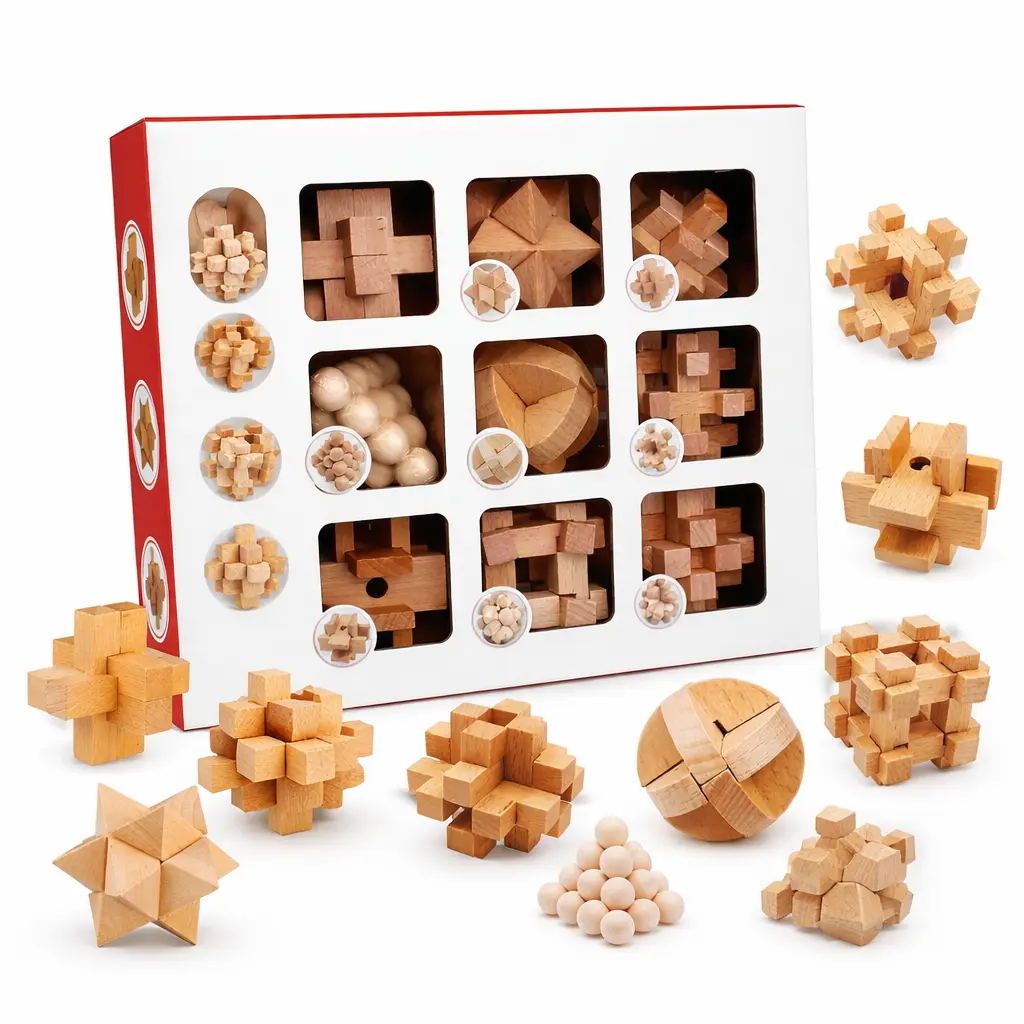
Luban Lock Set 9 Piece — $39.99
The Luban Lock Set 9 Piece ($39.99) is the definitive starting point for anyone serious about this hobby. I’ve handed these to engineers who thought they’d “solve” them in five minutes, only to see them still sweating over the “Ball in the Cage” an hour later. Each of these nine puzzles relies on the principles attributed to Lu Ban, the legendary carpenter of 500 BCE.
What I love about this set is the lack of “cheating” points. There are no magnets or hidden springs. It is pure geometry. The wood is finished well enough that the pieces slide with a satisfying “thwack,” but tight enough that you have to be precise. If you’re off by a millimeter, the lock won’t budge. It teaches you that force is never the answer; alignment is. I’ve found that the “Six-Piece Cross” in this set is particularly humbling. You think you’ve memorized the sequence, you take a phone call, and suddenly you’re looking at a pile of notched sticks like they’re alien artifacts.
6-in-1 Wooden Brain Teaser Set
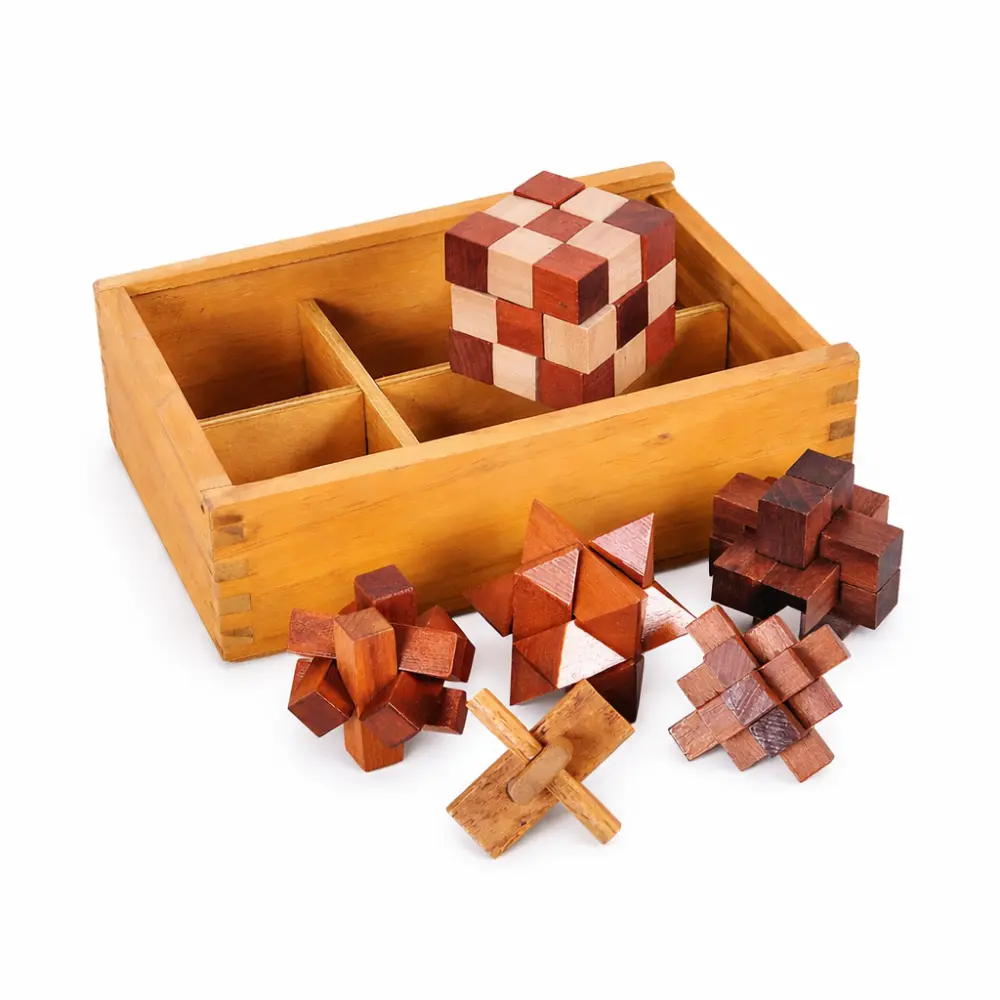
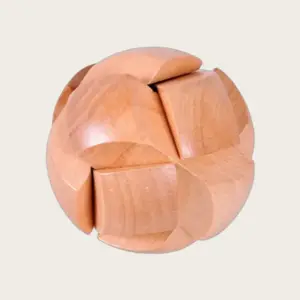
If the 9-piece set feels like a commitment, the 6-in-1 Wooden Brain Teaser Set ($38.88) is the perfect “meeting fidget.” I keep one of these on my desk specifically for long Zoom calls. These are palm-sized, carved from solid beechwood, and they focus on the “key piece” mechanic.
In these burr puzzles, five pieces are usually held captive by a single, sliding sixth piece. Finding that “key” is a moment of pure dopamine. The beechwood used here is denser than the plywood used in kits, giving it a weight that feels premium. My only gripe? The “Star” puzzle in this set is notoriously difficult to reassemble once the pieces fall in a heap. It’s the kind of thing that makes you realize how much we rely on visual memory versus actual spatial understanding.
The Rise of the Mechanical Kit
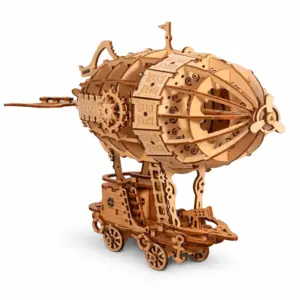
In the last few years, the “wooden puzzle” category has evolved. We’ve moved beyond the static burr puzzle and into the realm of kinetic sculpture. These are the “3D kits” that dominate modern hobbyist forums. They aren’t just about taking something apart; they’re about building a machine that actually does something.
Wooden Ferris Wheel Music Box Kit
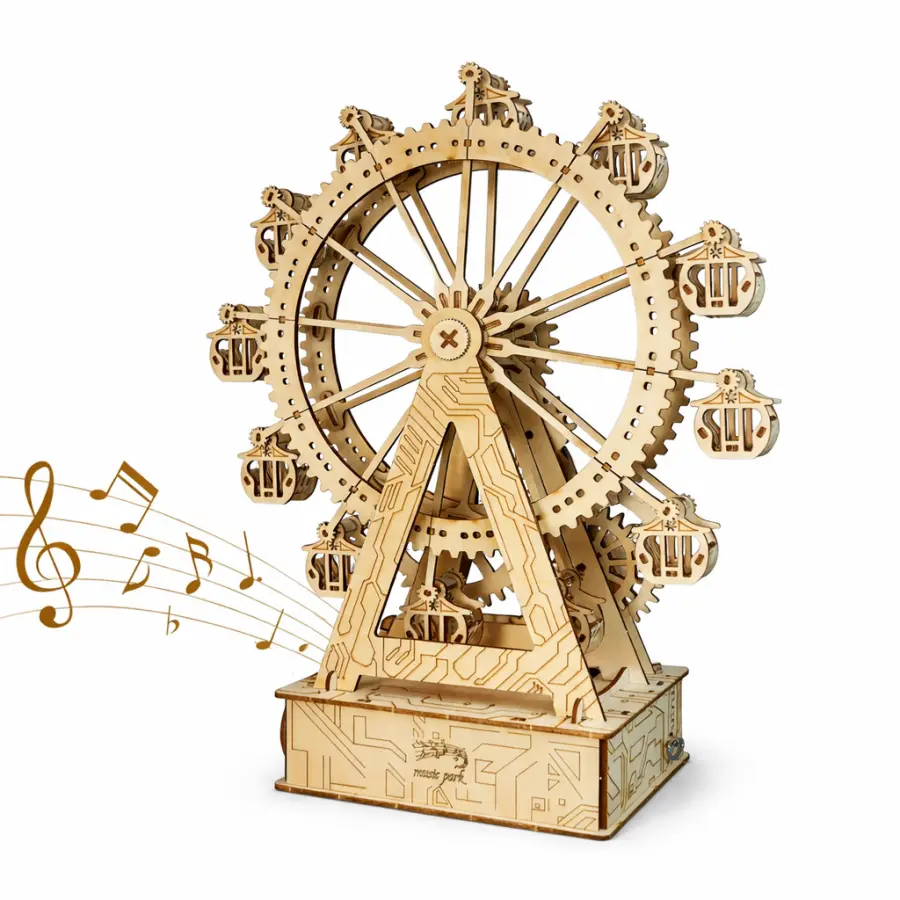
The Wooden Ferris Wheel Music Box Kit ($59.99) is a beast of a project, and I mean that in the best way possible. While most music boxes use a single movement, this one uses two to create a layered melody that sounds surprisingly rich for something made of wood.
The build took me about four hours. The “aha!” moment comes when you connect the hand crank to the gear train that rotates the wheel. Watching those tiny wooden gondolas stay upright as the wheel turns is a lesson in center-of-gravity physics. This isn’t for kids—the tolerances are tight, and you’ll need a steady hand to avoid snapping the delicate struts. But once it’s done? It’s a centerpiece. It’s far more impressive than the translucent 3D crystal puzzles that were popular a few years ago because it has a heartbeat. It moves. It sings.
3D Wooden Mechanical Pistol Kit

For those who prefer a “click” over a “melody,” the 3D Wooden Mechanical Pistol Kit ($29.99) is a fascinating study in internal mechanics. It’s a 68-piece build that uses rubber bands to simulate the action of a semi-automatic.
I was skeptical at first—wooden guns can feel like cheap carnival prizes—but the “click-clack” of the slide on this model is incredibly addictive. It doesn’t fire projectiles, which I actually prefer; it’s a pure tactile fidget toy. The way the trigger resets via a wooden leaf-spring mechanism is clever as hell. I did find that a tiny dab of candle wax on the sliding parts made the action much smoother. If you’re the type of person who can’t stop clicking a retractable pen, this will be your new best friend.
Why Your Brain Craves the “Physicality of Failure”
Here is the Peak Moment of this entire hobby, and it’s something most reviewers won’t tell you: The value of a wooden puzzle is directly proportional to how much it makes you feel like an idiot.
We live in an era of “frictionless” experiences. Our apps predict what we want to type; our GPS tells us exactly when to turn. We are losing the ability to be wrong and sit with it. When you are working on a sequential discovery box and you realize that the piece you’ve been pulling for ten minutes actually needs to be pushed, you experience a “cognitive snap.”
I remember testing a particularly nasty Japanese trick box last year. I spent three nights trying to find the first move. I was convinced it was broken. I was ready to write a scathing email. Then, while I was absent-mindedly rotating it during a podcast, a panel slid open because of centrifugal force. The “click” wasn’t just in the wood; it was in my head. That moment of discovery is a neurological reward that you simply cannot get from a digital game. It’s why the history of jigsaw puzzles is so enduring—we need to see the chaos turn into order through our own physical effort.
The Functional Enigma: Puzzles for the Productive
Not every puzzle needs to sit on a shelf gathering dust once it’s solved. Some of the best designs I’ve tested in 2026 are those that earn their “desk real estate” by actually being useful.
3D Wooden Perpetual Calendar Puzzle
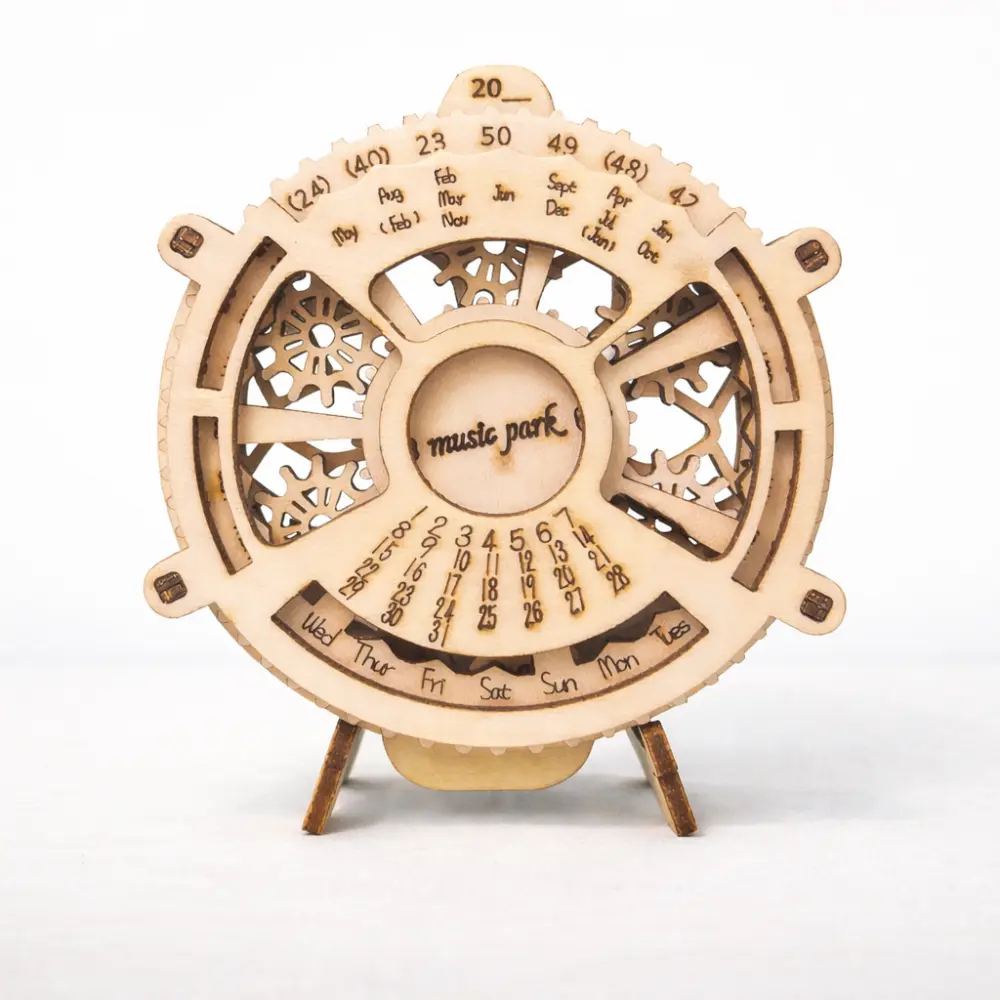
The 3D Wooden Perpetual Calendar Puzzle ($39.99) is a brilliant piece of functional art. It uses a series of interlocking gears to calculate any date from 2023 to 2050.
Building it is a lesson in the scientific history of mechanical puzzles and how early astronomers used similar gear ratios to track the heavens. It’s not a difficult build—maybe ninety minutes—but the result is something you’ll actually use. I’ve found myself checking what day of the week my birthday falls on in 2040 (it’s a Wednesday, apparently) just for the excuse to spin the gears. It feels like something that belongs in a 19th-century study, right next to a brass telescope.
Wooden Desk Organizer with Perpetual Calendar | Puzzle Pen Holder
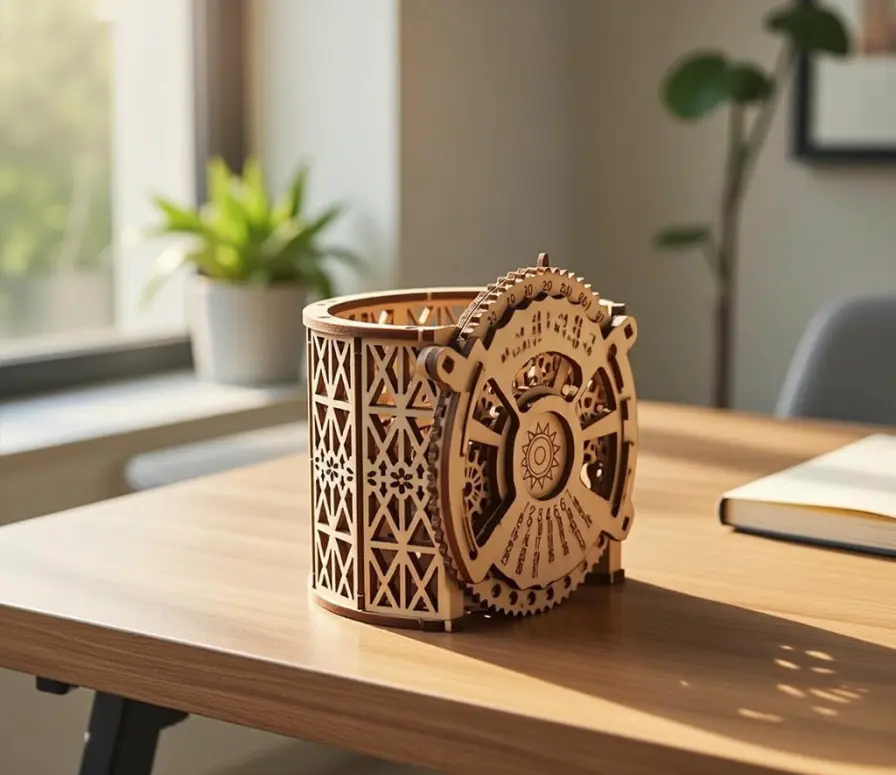
If you want something even more practical, the Wooden Desk Organizer with Perpetual Calendar | Puzzle Pen Holder ($19.99) is the “entry drug” for this hobby. It’s a simple, laser-cut assembly that combines a pen cup with a sliding calendar.
I’ll be honest: this isn’t going to stump a veteran puzzler. It’s a 15-minute build. But as a gift for a coworker or a way to organize a messy workspace, it’s far superior to anything you’d buy at a big-box office store. The geometric openwork design casts great shadows under a desk lamp, which brings me to my next favorite category: atmosphere.
Atmosphere and Aesthetic: The “Vibe” Solve
Sometimes, the “puzzle” is just an excuse to build something beautiful. In the 2020s, we saw a massive surge in “book nooks” and miniature dioramas. In 2026, the trend has shifted toward functional lighting and musical instruments.
Light-Up Gothic Wooden Lantern 3D Puzzle

The Light-Up Gothic Wooden Lantern 3D Puzzle (check current pricing) is less about logic and more about precision. With 154 pieces, it’s a moderately complex build that results in a stunning piece of tabletop decor.
The way the laser-cut arches mimic traditional Gothic architecture is impressive. When you flip the switch on the internal LED, the “wick” light throws these elongated, dramatic shadows across the room. It’s the perfect project for a Sunday afternoon. One tip: be very careful with the filigree sections. They are thin, and if you’re too aggressive with the punch-outs, you’ll be reaching for the wood glue.
3D Wooden Cello Puzzle Model Kit
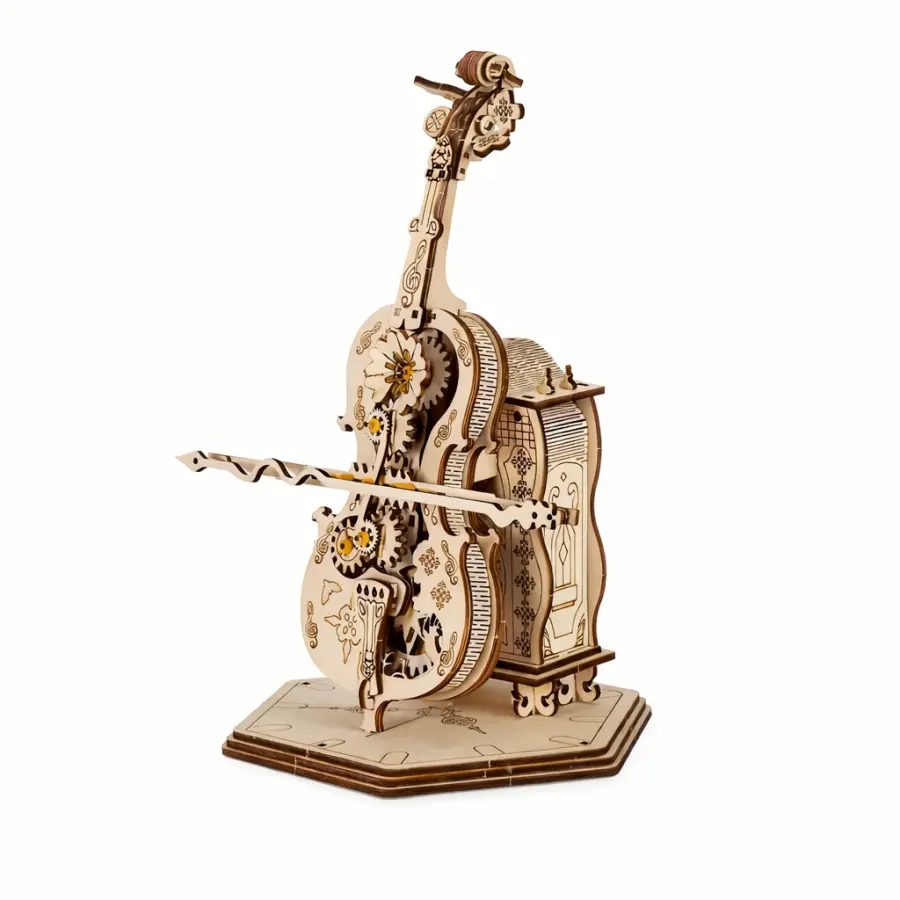
Then there’s the 3D Wooden Cello Puzzle Model Kit ($29.99). This is a pure aesthetic play. It mixes Victorian engravings with steampunk-style gears.
It doesn’t play music, which is a bit of a missed opportunity, but as a model, it’s gorgeous. The “strings” are made of thin wooden strips that you have to tension correctly. It’s a great example of how modern laser-cutting can achieve detail that would have been impossible for a hobbyist thirty years ago. If you’re a fan of interactive math-based puzzles but want something that looks more “adult” on a bookshelf, this is a solid choice.
Layered Butterfly Wooden Music Box
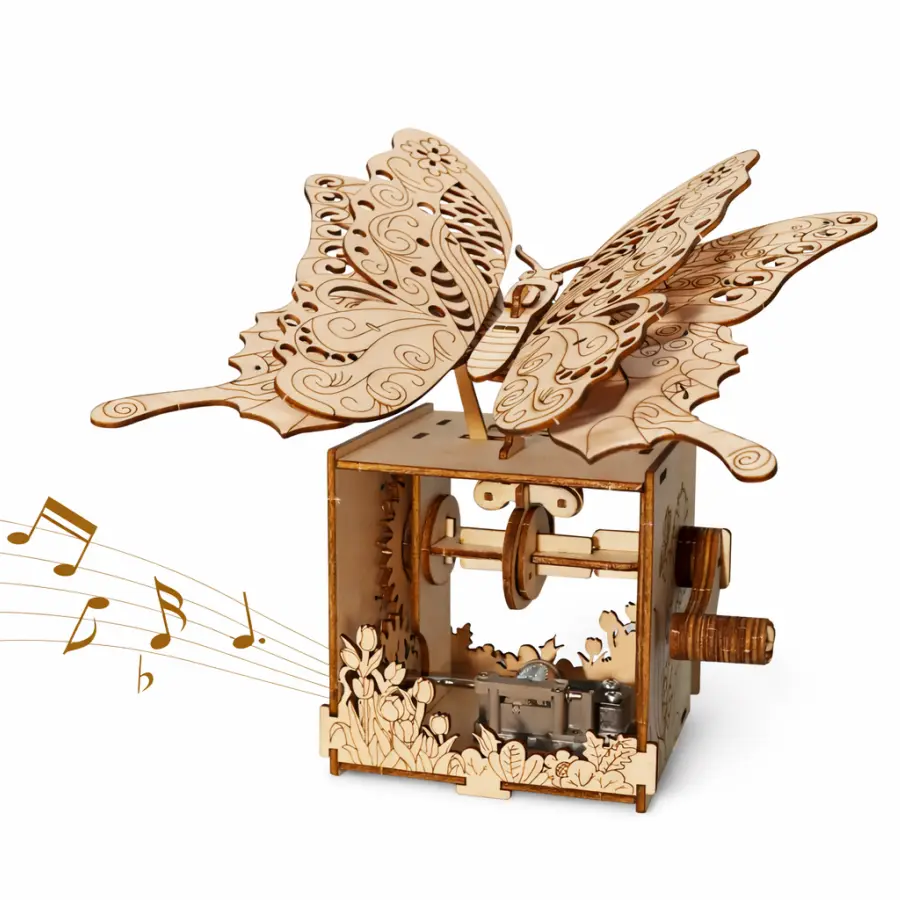
For a more whimsical take, the Layered Butterfly Wooden Music Box ($28.99) is a delight. It’s a hand-cranked model where the gears are fully visible.
The best part? As you turn the handle, the butterfly’s wings actually flutter. It’s a simple cam-and-lever mechanism, but seeing it work in wood is incredibly satisfying. It’s a much more engaging experience than the logic-heavy grid games I usually play on my tablet. It reminds you that “mechanical” doesn’t have to mean “cold.”
Galleon Ship 3D Wooden Puzzle Model Kit

Finally, we have the Galleon Ship 3D Wooden Puzzle Model Kit (check current pricing). This is a classic for a reason. Ships have always been the ultimate test for model builders.
This kit uses a snap-fit design, meaning no glue is required. The hull construction is the highlight here—seeing flat sheets of plywood curve into a seaworthy shape is a minor miracle of engineering. It’s a great “bridge” puzzle for someone who likes history but isn’t ready for the frustration of a 9-piece Luban lock.
Quick-Reference Comparison Table
Frequently Asked Questions
Are wooden puzzles more difficult than metal ones?
It’s a different kind of difficulty. Metal puzzles, like the Hanayama series, often rely on tight tolerances and “hidden” internal paths. A wooden puzzle, particularly a traditional interlocking burr, is more about spatial visualization. You can see almost everything, but your brain struggles to process how the notches interact. Wood also has more friction than metal, which means you have to be more deliberate with your movements. If you’re looking for a comprehensive guide to wooden box mechanisms, you’ll find that wood allows for much larger, more complex internal structures than metal.
How do I stop the pieces from sticking?
Humidity is the enemy of wood. If your puzzle is “grabbing,” don’t force it. I always keep a piece of plain paraffin wax (a tea light candle works) in my puzzle kit. Rubbing a tiny bit on the contact points or gear teeth makes a world of difference. Never use oil-based lubricants—they’ll soak into the grain and swell the wood, making the problem ten times worse.
My kit didn’t come with instructions. Is it a mistake?
In the world of high-end mechanical puzzles, “no instructions” is often a feature, not a bug. The goal is discovery. However, for 3D assembly kits like the music boxes, instructions are mandatory. If you’re stuck on a traditional burr, the best approach is to document the disassembly with your phone camera. Putting it back together is usually three times harder than taking it apart.
What’s the best age for these puzzles?
Most 3D wooden kits are rated 14+. This isn’t because a 10-year-old isn’t smart enough; it’s because the pieces are fragile. Laser-cut plywood can snap if you apply pressure at the wrong angle. For younger kids, I usually recommend starting with something like the multiplication table puzzle to build the habit of physical problem-solving before moving on to delicate gears.
Are laser-cut puzzles “cheating” compared to hand-cut ones?
Purists will tell you that hand-cut puzzles have more “soul,” but laser-cutting allows for a level of complexity that hand-sawing simply can’t match. A laser can cut a gear tooth with 0.1mm precision. That’s what allows us to have functional music boxes and mechanical pistols at a consumer price point. If you want the “hand-cut” feel, look for solid wood sets like the 6-in-1 Brain Teaser Set.
How do I fix a snapped piece?
It happens to the best of us. A tiny drop of wood glue (PVA) and a toothpick is your best bet. Apply the glue, hold the piece in place for 60 seconds, and then—this is the hard part—leave it alone for 24 hours. Don’t try to continue the build while the glue is wet.
Why are some wooden puzzles so expensive?
You’re paying for two things: material and design. A puzzle made from exotic hardwoods like padauk or purpleheart will always cost more than plywood. More importantly, you’re paying for the designer’s brain. Creating a puzzle that is difficult but logical is an incredibly hard engineering feat.
Can these puzzles help with cognitive health?
There is significant research suggesting that spatial reasoning tasks—like those found in hidden compartments in traditional trick boxes—help maintain neuroplasticity. It’s the “use it or lose it” principle. Engaging your hands and eyes in a 3D space is far more stimulating for the brain than scrolling through a 2D feed.
Do I need tools for these kits?
Most modern kits are “press-fit,” but I always keep a few essentials handy: a hobby knife for stubborn punch-outs, a small piece of 220-grit sandpaper, and a pair of tweezers for tiny gear pins. A little bit of prep work makes the “solve” much more enjoyable.
What should I do with the puzzle once it’s solved?
This is the great debate. Some people solve once and display. Others take it apart and put it in a “puzzle library” to revisit in a year. Personally, I like to leave a difficult puzzle on my coffee table when guests come over. There is nothing more entertaining than watching a “confident” friend struggle with a 6-piece wooden cross for twenty minutes.
Is plywood better than solid wood?
Plywood is more stable. It doesn’t warp as much with temperature changes. Solid wood (like beech or maple) feels better in the hand and has a more satisfying sound. For mechanical kits with gears, plywood is actually superior because it’s stronger in multiple directions. For interlocking burrs, solid wood is king.
How do I know if a puzzle is too hard for me?
If you’ve never done a mechanical puzzle, don’t start with a 9-piece Luban lock. Start with a 3-piece or a simple 3D kit. The goal is “flow,” not “misery.” If you’re not having fun after thirty minutes, set it down. The solution often comes when you’re not looking for it.
The One Puzzle That Teaches You How All the Others Work
If you’ve read this far, you’re likely looking for a place to start. If I had to pick one object that encapsulates everything great about this hobby, it would be the Luban Lock Set 9 Piece ($39.99). It is a direct link to the past, a brutal test of the present, and a beautiful object for the future.
I remember the first time I finally reassembled the “Pineapple” lock in that set. I had been working on it for three days. I was sitting on my porch, the sun was going down, and suddenly, the last piece just… slid. There was no click, no flash of light, just the perfect, silent union of two pieces of wood that were destined to fit together. In that moment, the 2,500 years of history behind that design felt very, very close.
Start with that set. It will teach you more about patience, geometry, and the “physicality of failure” than any book or video ever could. And once you’ve mastered the ancient locks, the modern mechanical kits will feel like a victory lap. The “click” is waiting for you; you just have to be patient enough to find it.