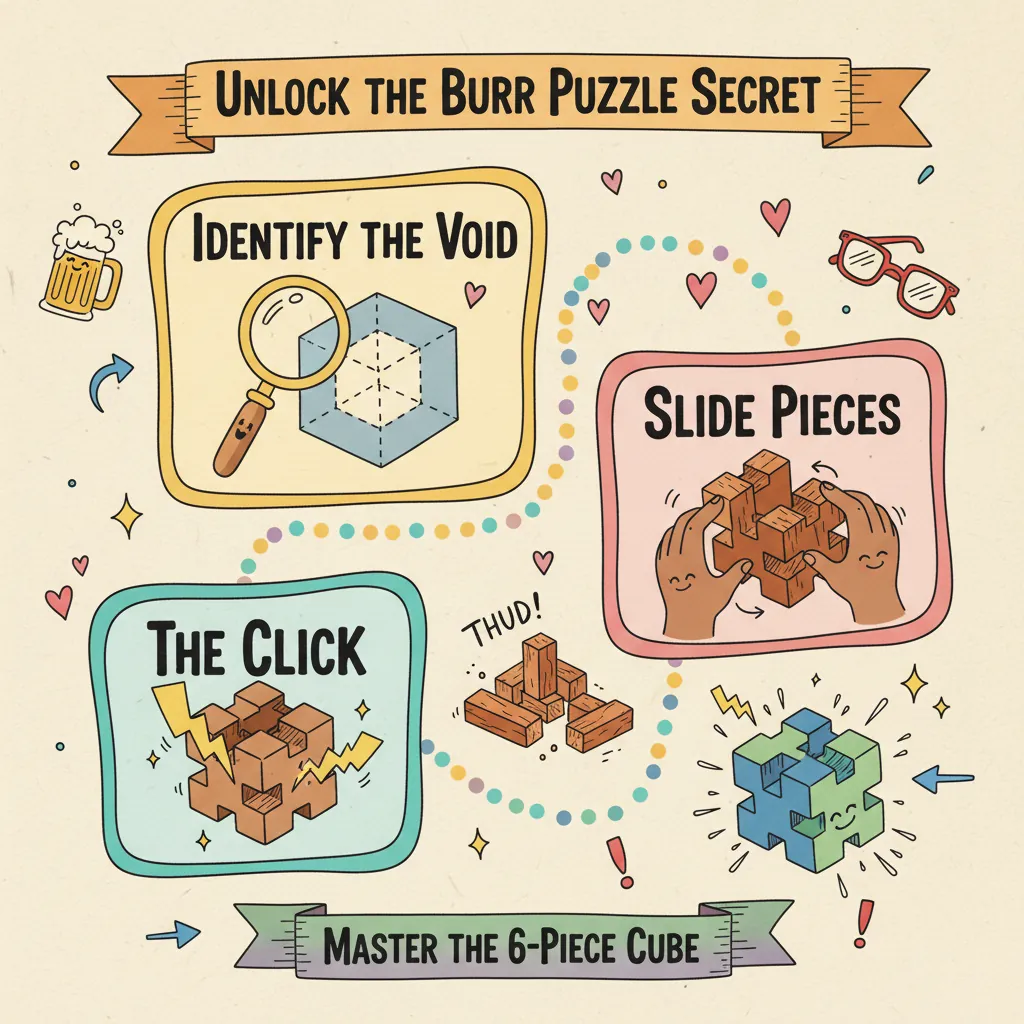
The third time the notched beechwood pin slipped past my thumb and clattered onto the hardwood floor, I set the pieces down and went to find my reading glasses. It was 11:30 PM on a Tuesday. I had six pieces of wood that, according to the box, should form a perfect 3×3 cube. Instead, I had a pile of geometric frustrations that looked more like a failed birdhouse than a masterpiece of ancient engineering.
If you’ve found yourself staring at a “six piece wooden cube puzzle solution” search result, you’re likely in the same boat. You’ve probably reached the “angry fiddling” stage, where you try to force two pieces together that clearly aren’t meant to share the same physical space. My thesis for this deep dive is simple: the best wooden puzzles punish impatience and reward observation. If you try to outmuscle a burr puzzle, the wood wins every time. But if you stop and look at the “voids”—the empty spaces inside the mechanism—the solution reveals itself with a click that is more satisfying than a cold beer on a Friday afternoon.
The Anatomy of the Interlock: Why Cubes Are Harder Than They Look
Most people assume a six-piece cube is a beginner’s toy. They are wrong. While a Mechanical puzzle can take many forms, the six-piece interlocking cube (often called a “Burr” puzzle) relies on a principle of three-dimensional parity. Each piece has notches cut out of it. To solve it, you aren’t just stacking blocks; you are sliding them into each other in a specific sequence where the last piece “locks” the entire structure into place.
In my twenty years of collecting, I’ve seen hundreds of these. The challenge usually stems from the fact that the pieces often look identical at a glance. It’s only when you examine the internal notches—the “negative space”—that you realize Piece A and Piece B have slightly different offsets. This is why many people get 80% of the way through the assembly only to find that the final piece won’t slide in because a single internal notch is facing the wrong direction.
The “Internal Void” Theory: My Secret for Solving Any Burr
After testing over 200 mechanical challenges, I noticed a pattern that most solution guides miss. We tend to focus on the solid parts of the wood. Instead, you should focus on the air. Every interlocking puzzle has a “key” move. This is often a sliding motion that requires one piece to move through an internal cavity before another can drop into place.
I remember testing a particularly stubborn version where I spent forty minutes trying to fit the last piece from the top. It wasn’t until I realized that the middle four pieces had to be slightly “loosened” or slid outward by 2mm that the final piece could drop through the center. This “expansion” move is common in high-quality wooden engineering. If you’re struggling with a 6-Piece Wooden Puzzle Key, remember that the solution rarely involves a straight drop-in; it usually involves a slide, a drop, and a return slide.
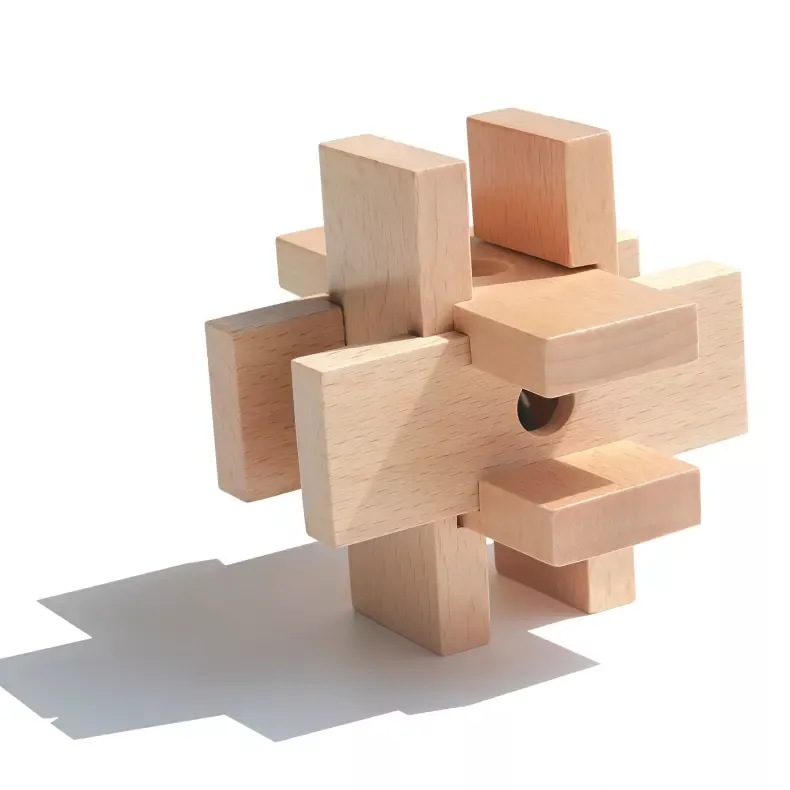
6 Piece Wooden Puzzle Key
The 6 Piece Wooden Puzzle Key ($12.99) is what I call a “desk-top diplomat.” It’s small enough to sit next to your monitor but complex enough to derail a productive afternoon. What I love about this specific model is the tactile feedback of the hardwood. Unlike cheaper pine versions that feel “mushy” when the pieces meet, these pieces have a crispness to them. It teaches what the designers call “Wu Wei” problem-solving—the art of effortless action. When I first tried this, I was forcing the pieces, and the friction was unbearable. The moment I relaxed my grip and let the pieces “find” each other, the cube practically assembled itself. It’s a fantastic entry point for someone who wants to understand the spatial reasoning required for magnetic alternatives without the help of magnets to snap things into place.
The History of the Luban Lock: More Than Just a Toy
To understand the six-piece cube, you have to look back at the Burr puzzle history, specifically the Luban Lock (or Kongming Lock). Legend attributes these to Lu Ban, a carpenter from the Spring and Autumn period in China, or to the strategist Zhuge Liang. The genius of these designs is that they require no glue, no nails, and no screws. They rely entirely on the friction and geometry of the wood itself.
When you hold a Luban Cube Puzzle, you aren’t just holding a toy; you’re holding a piece of architectural history. The same joinery principles used in these puzzles were used to build temples that have stood for a thousand years. This is why I always tell beginners to start with wood. Metal is precise, yes, but wood has “give.” It has a grain. It has a soul. You can feel the history in the notches.
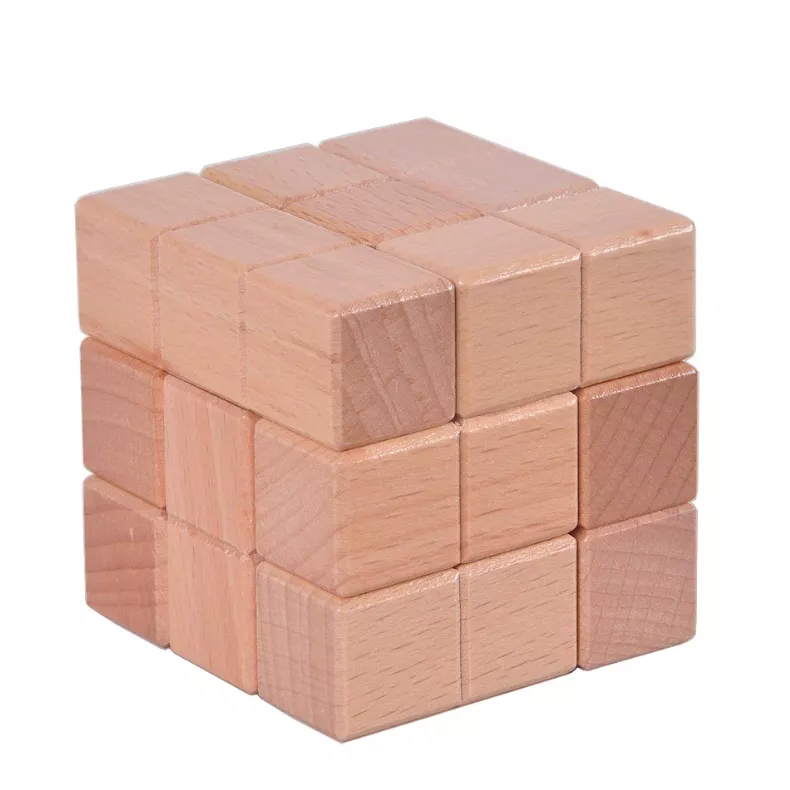
Luban Cube Puzzle
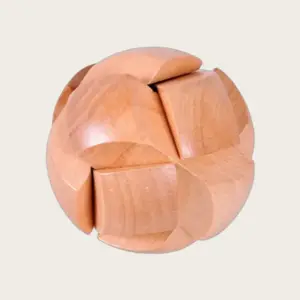
The Luban Cube Puzzle ($21.99) is a bit of a beast compared to standard six-piece sets. While it uses the classic interlocking design, the precision of the notches is much tighter. I’ve had this on my shelf for three years, and the beechwood hasn’t warped—a common issue with cheaper sets. This puzzle is essentially a 3x3x3 challenge where every piece has exactly one home. If you’re off by a millimeter, the “magic” lock won’t engage. It’s a mindful challenge that forces you to slow down. I’ve noticed that if I try to solve this while watching TV, I fail. It requires your full visual field. It’s the perfect gift for someone who appreciates traditional craftsmanship and hidden mechanisms.
Why Your First Solve Will Probably Be an Accident
Here is an honest truth from someone who has solved thousands of these: your first successful assembly will likely happen by fluke. You’ll be fiddling with the pieces, they’ll slip into a certain orientation, and—click—the cube is whole.
The real challenge isn’t the first solve; it’s the second. Can you replicate what you just did? This is where the “skeptical consumer” in me comes out. Many people buy a puzzle, solve it once by accident, and put it on a shelf. To truly master the six-piece cube, you need to be able to identify each piece by its notches. I like to lay them out on a table and categorize them: “The Key Piece” (usually solid or with the fewest notches), “The Rails” (long notches), and “The Crosses.”
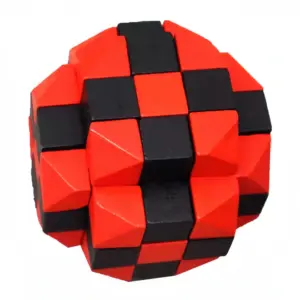
If you find the traditional burr too repetitive, you might enjoy something that breaks the mold, like the Sphere Morphs Into Cube ($12.00). It’s a modern twist that uses interlocking modules to hide a moving sphere inside, which adds a layer of kinetic feedback that traditional wooden blocks lack.
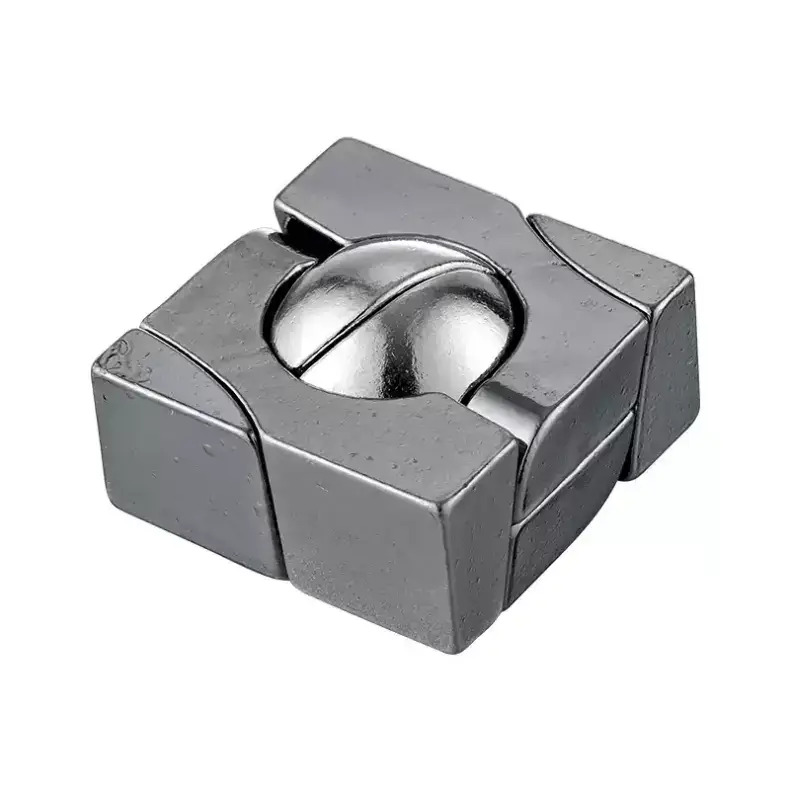
Sphere Morphs Into Cube — $12.00
The Peak Moment: The “Impossible” Rotation
Most people think puzzle pieces only move in straight lines—up, down, left, right. But the “Peak” of puzzle design—the moment that separates the amateurs from the veterans—is the Rotational Move.
In some advanced six-piece cubes, you will reach a point where the last two pieces seem physically impossible to fit. They overlap in a way that prevents them from sliding. The “Aha!” moment comes when you realize that you have to hold three pieces in a half-open state and rotate the entire assembly 90 degrees to allow a hidden notch to clear a corner.
I remember demonstrating this to a mechanical engineer friend. He was convinced my Six-Piece Burr was broken. He kept trying to slide the final bar through the center. I took it from him, pulled two side bars out by exactly 5mm, twisted the core, and the final piece fell into place like it was magnetized. He stared at it for a full minute before asking where he could buy one. That is the power of the rotational solve—it defies your brain’s basic understanding of how solid objects should behave.
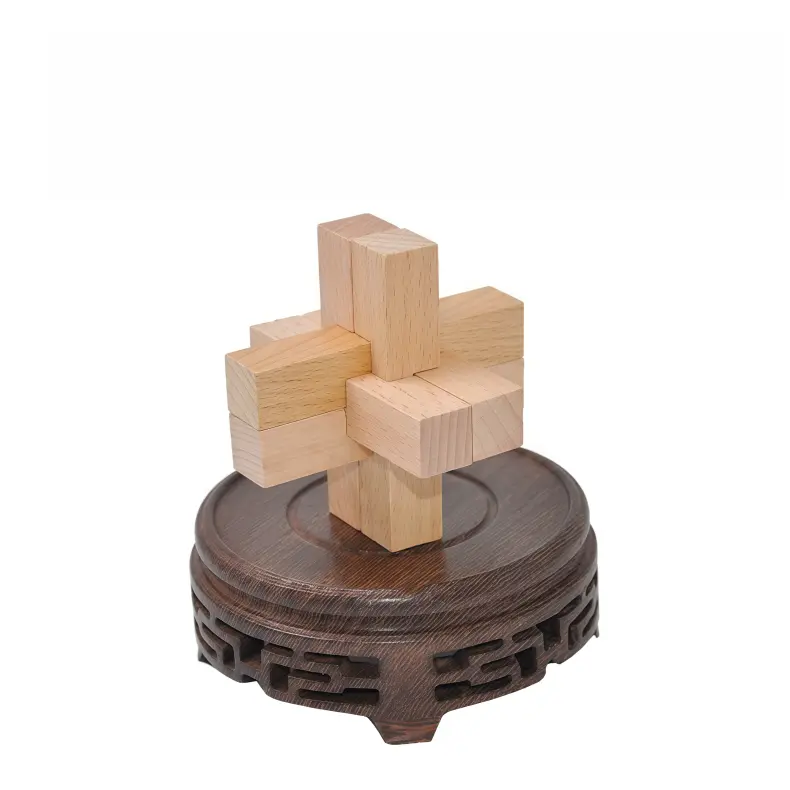
Six-Piece Burr
The Six-Piece Burr ($17.99) is the “gold standard” of this category. If you only ever buy one wooden puzzle, make it this one. It embodies the Daoist principle of “walking the smooth path.” There are no shortcuts here. I’ve used this in workshops to teach patience, and it’s always the most popular item on the table. The wood is finished well enough that you won’t get splinters, but it maintains enough friction that the puzzle won’t fall apart if you set it down mid-solve. It’s a screen-free way to reset your brain after a long day of staring at spreadsheets. If you find yourself needing a break from the logic of wood, you can always pivot to pattern-matching digital games to keep your mind sharp in a different way.
Comparing the “Cubes”: Which One Fits Your Style?
Not all cubes are created equal. Some are about interlocking geometry (Burr), some are about packing (Soma), and some are about sheer volume (54-T). Choosing the right one depends on what kind of frustration you enjoy most.
- The Interlocker: Best for those who like “Aha!” moments and mechanical tricks. (e.g., the Wood Knot Puzzle at $16.99).
- The Packer: Best for those who enjoy spatial reasoning and “filling the void.” (e.g., the Soma Cube).
- The Mass-Assembler: Best for those who find repetitive, meditative stacking relaxing. (e.g., the 54-T).
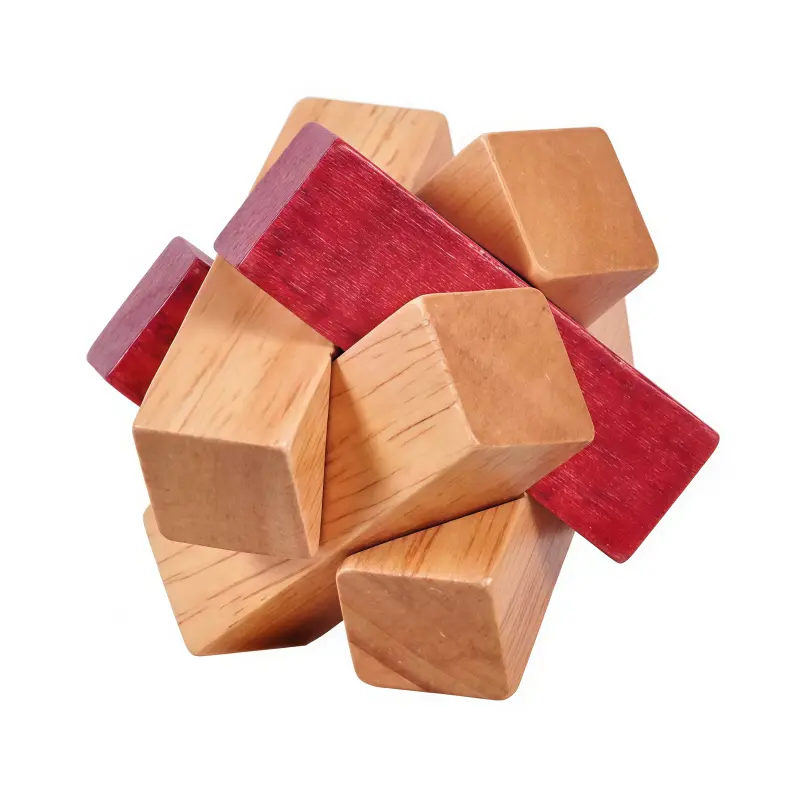
Wood Knot Puzzle — $16.99
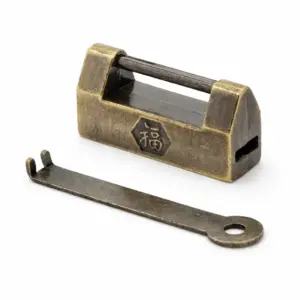
If you’re looking for a gift, the Silver Heart Lock Puzzle ($18.89) offers a similar interlocking challenge but in a more decorative, metal format. It’s less about the “cube” and more about the “clasp,” but the logic of how pieces bypass each other remains the same.
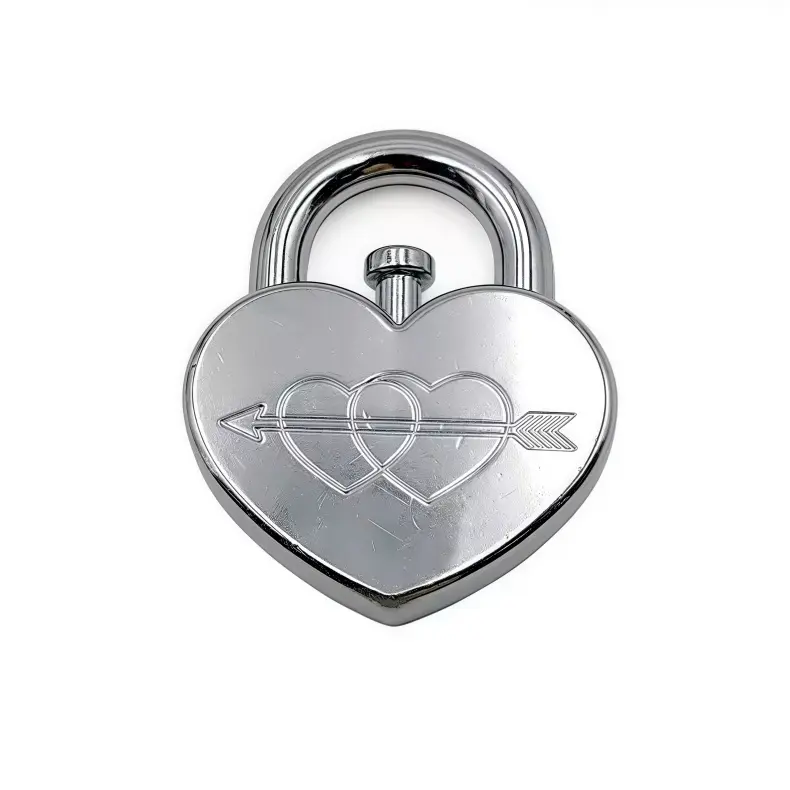
Silver Heart Lock Puzzle — $18.89
The Soma Cube: A Colorful Alternative to the Burr
If the traditional brown-on-brown wood of a Luban lock feels too “antique” for your desk, the Soma Cube is the answer. Invented by Piet Hein in 1933, the Soma cube consists of seven different pieces made of unit cubes that must be assembled into a 3x3x3 cube. Unlike the Burr puzzle, which has one specific solution, the Soma cube – Wikipedia has 240 distinct ways to form a cube (excluding rotations and reflections).
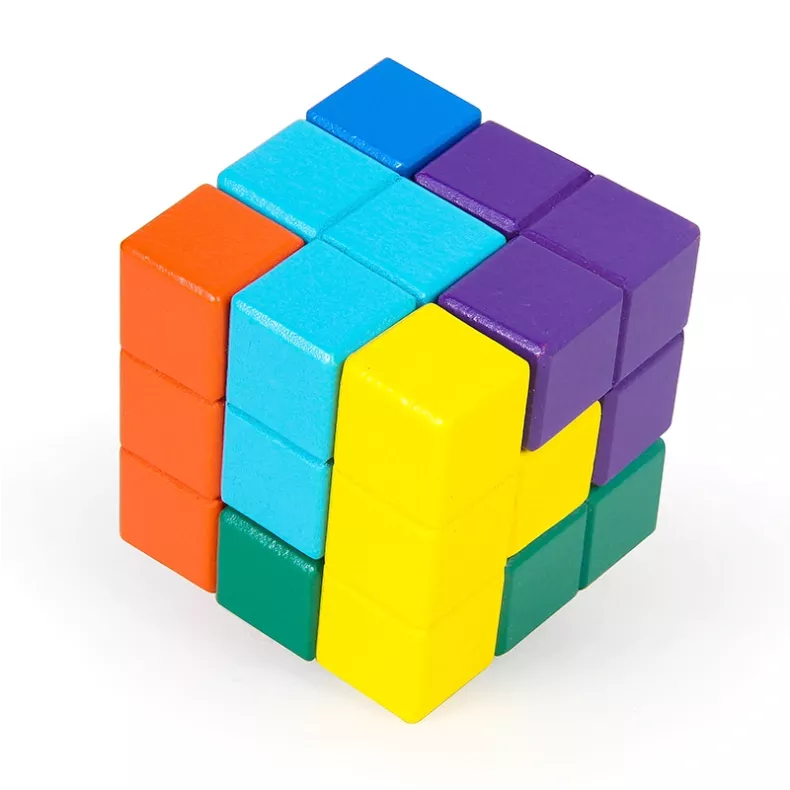
7 Color Soma Cube Puzzle
The 7 Color Soma Cube Puzzle ($21.88) is my favorite “fidget” puzzle. Because there are so many solutions, it’s much less punishing than a Burr. I often keep this on my coffee table. It’s bright, tactile, and great for kids who are just starting to develop their 3D spatial skills. The smooth wooden blocks are travel-friendly, and honestly, even if you don’t form the cube, making weird “sculptures” with the pieces is half the fun. It’s a great bridge to more complex educational puzzles that focus on math and logic.
When 6 Pieces Aren’t Enough: The 54-T Challenge
Some people find six pieces too easy. If you’re one of those people who can solve a Rubik’s Cube – Wikipedia in under a minute, you might need more “bits” to keep your brain occupied. Enter the 54-T. Instead of notched bars, you are dealing with dozens of T-shaped blocks. It’s less about a “trick” and more about sheer persistence and spatial mapping.
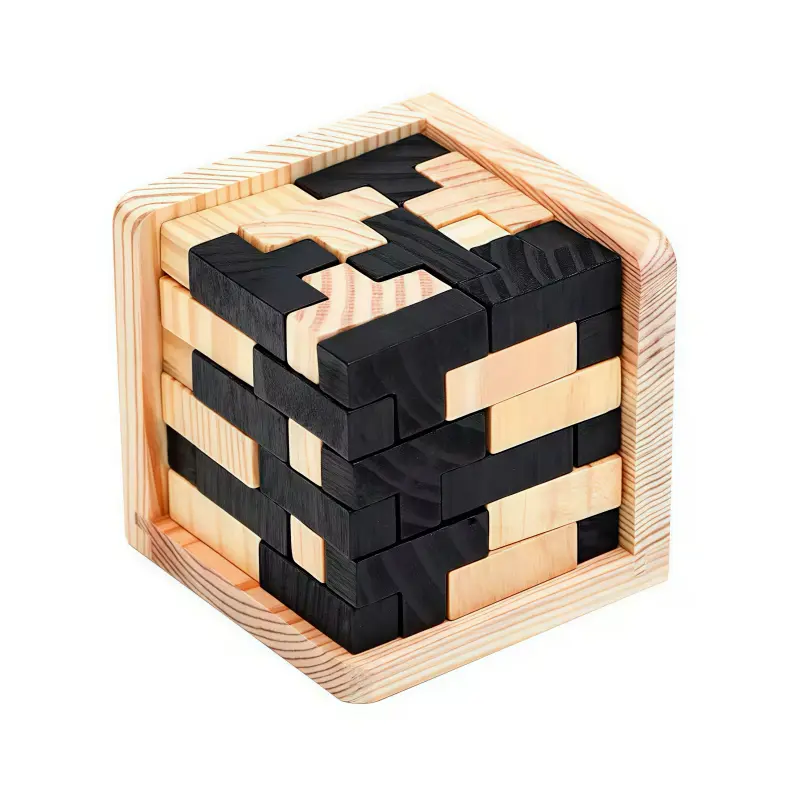
54‑T Cube Puzzle
The 54‑T Cube Puzzle ($18.99) is what I give to people who say they are “good at puzzles.” It usually shuts them up for at least an hour. Made from eco-friendly beechwood, this set is about building focus. It’s not an interlocking puzzle in the traditional sense; it’s a packing puzzle. You are trying to fit 54 identical T-shapes into a perfect cube. It sounds easy until you realize that one misplaced “T” at the bottom layer will make the top layer impossible to finish. It’s a fantastic lesson in “foundation first”—a principle I often discuss when reviewing sequential discovery boxes.
The Oddballs: Cube Logic in Different Forms
Sometimes the “six-piece solution” isn’t a cube at all, but the logic remains identical. I’ve tested a few “lock” style puzzles that use the same mortise-and-tenon principles found in the Luban Lock.
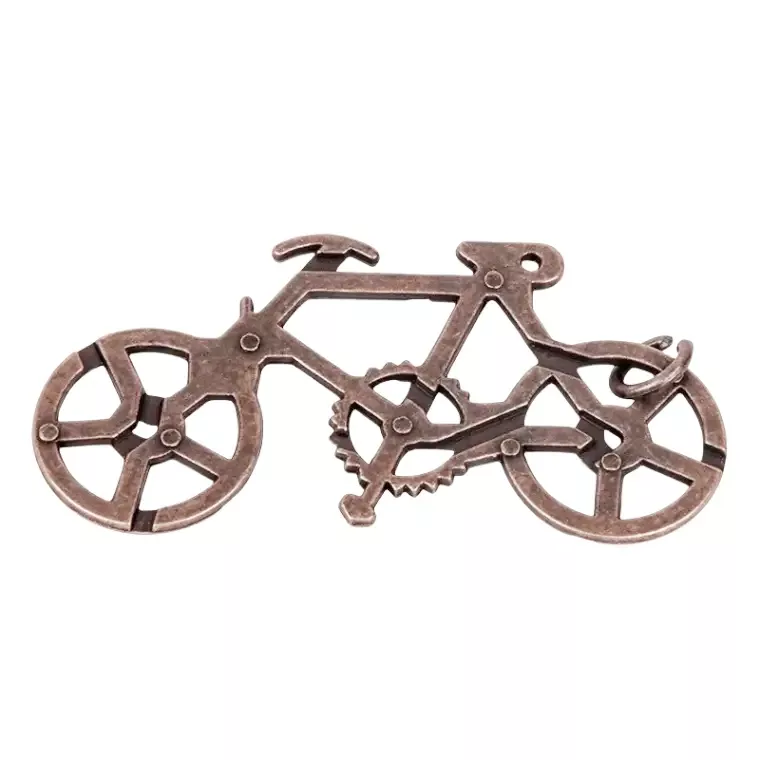
Take the Intelligent Bike Lock Puzzle ($11.99), for example. It’s a metal brain teaser that mimics a bicycle lock but requires the same “slide and find the void” logic we’ve been discussing. Or the ABC Maze Lock ($12.99), which uses three interlocking letter-shaped pieces. It’s deceptively simple looking, but because the pieces are curved, the “voids” are much harder to track than in a square-edged wooden cube.
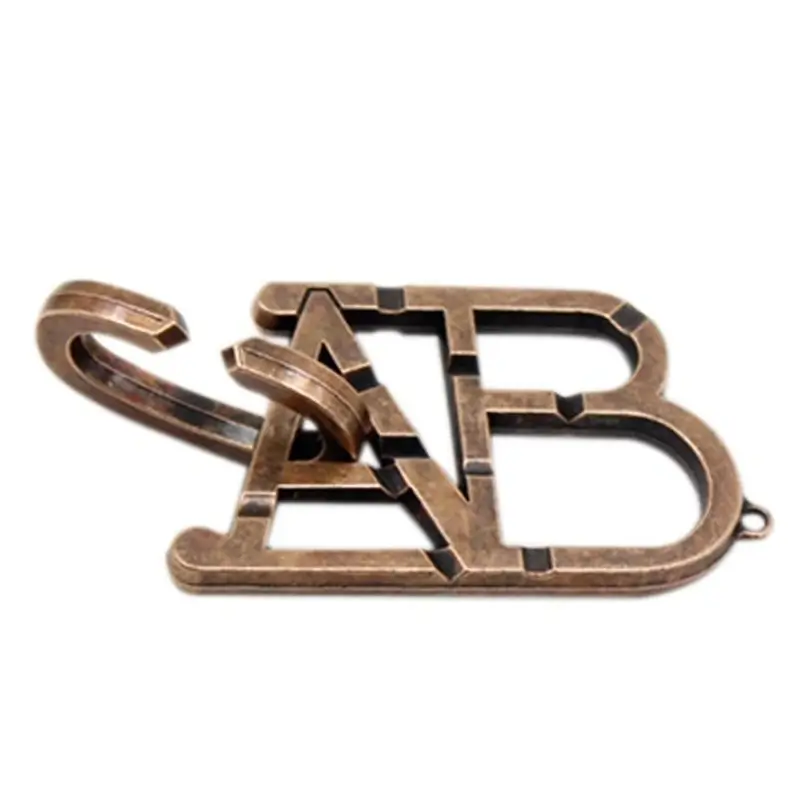
ABC Maze Lock — $12.99
FAQ: Everything You Wanted to Ask While Stuck on Step 5
How do I identify the “Key” piece in a six-piece wooden cube?
The “Key” piece is the only piece that can slide out without moving any other pieces. In most six-piece burr puzzles, one bar is completely solid (no notches) or has a very shallow notch that allows it to bypass the others once the internal structure is slightly shifted. If you’re stuck, look for the piece that has the most “wiggle room.” That’s usually your starting point for disassembly—and your final piece for assembly.
Why won’t the last piece of my wooden cube slide into place?
This is almost always due to “parity error.” You likely have one of the internal pieces flipped 180 degrees. While the cube looks correct from the outside, the internal notches aren’t aligned to create the final “tunnel” for the key piece. I recommend taking it apart and checking the grain of the wood; often, the grain pattern can help you realize if a piece is upside down.
My wooden puzzle is stuck and won’t budge. Should I use force?
Never. If you’re using force, you’re doing it wrong. Wooden puzzles are sensitive to humidity. If you live in a damp climate, the wood can swell by a fraction of a millimeter, which is enough to lock a high-precision puzzle like the Luban Cube ($21.99). If it’s truly stuck, try putting it in a dry area or near a dehumidifier for 24 hours. Brute force will just snap the delicate “tenon” joints.
What is the difference between a Burr puzzle and a Soma cube?
A Burr puzzle is interlocking—the pieces support each other and “lock” together so the puzzle doesn’t fall apart when picked up. A Soma cube is a “packing” puzzle. The pieces sit next to each other to form a cube shape, but they don’t lock. If you pick up a Soma cube by one piece, the rest will fall away. Beginners often find Soma cubes more forgiving because there are hundreds of solutions.
Are these puzzles suitable for children, or are they too frustrating?
It depends on the child. For kids under 8, I recommend the 7 Color Soma Cube ($21.88). The colors provide visual cues that help them map the 3D space. For teenagers, a six-piece burr is a great way to build focus. It’s a much better “brain break” than scrolling through TikTok.
How do I clean and maintain my wooden puzzles?
Avoid water at all costs. If the wood looks dull, a tiny amount of beeswax or mineral oil on a soft cloth will bring back the luster and make the pieces slide more smoothly. I’ve had some puzzles in my collection for over a decade that still look brand new because of a yearly “waxing.”
What do I do if I lose the solution instructions?
Welcome to the club. Most of us toss the instructions immediately. The best way to find a “six piece wooden cube puzzle solution” is to look for the “piece profiles.” Lay your pieces out and compare them to diagrams online. Site like BurrTools are great resources for the truly obsessed.
Is beechwood better than bamboo for puzzles?
In my experience, yes. Beechwood is a hardwood with very tight grain, which allows for more precise notches. Bamboo is a grass and can sometimes splinter along the grain lines if the notches are cut too thin. All the premium wooden enigmas I recommend are made from high-quality hardwoods for this reason.
Can solving these actually improve my brain function?
While I’m not a doctor, I can tell you that my spatial reasoning has improved significantly since I started collecting. There is actually research suggesting that fitting 3D pieces helps with “mental rotation” skills—the ability to rotate an object in your mind’s eye. It’s the same skill used by pilots and surgeons.
What’s the hardest 6-piece puzzle you’ve ever solved?
There is a version of the 6-piece burr called the “Altekruse” puzzle where all pieces are identical. Because there is no “key” piece, you have to assemble two halves and slide them together simultaneously. It’s maddening. For most people, the standard Six-Piece Burr ($17.99) provides plenty of challenge without the existential crisis.
Why do some puzzles have 54 pieces but still call themselves a “cube”?
That’s usually the 54-T Cube ($18.99). It’s a volume challenge. You’re filling a 3x3x3 space with smaller units. It’s a different kind of “puzzle brain”—it’s more like playing a 3D version of Tetris than solving a mechanical lock.
Where should I start if I’ve never solved a wooden puzzle before?
Start with the 6 Piece Wooden Puzzle Key ($12.99). It’s affordable, the logic is clear, and it gives you that “Aha!” moment relatively quickly. Once you’ve mastered that, move on to the more complex interlocking sets.
What 40 Hours of Beechwood and Frustration Actually Taught Me
The coffee I made at 11:30 PM was cold by the time the Six-Piece Burr ($17.99) finally clicked together. But as I sat there in the quiet of my office, holding that solid, perfect cube, I realized something. These puzzles aren’t about the “solution.” If they were, we’d just look up a YouTube video and be done in thirty seconds.
They are about the conversation between your hands and your brain. They are about that moment of frustration where you want to quit, and the moment of clarity that follows when you finally “see” the internal void. The six-piece cube is a masterclass in perspective. If you look at it as a pile of wood, it’s a mess. If you look at it as a series of potential movements, it’s a dance.
If you’re ready to start your own collection, I genuinely recommend starting with the 6 Piece Wooden Puzzle Key ($12.99). It’s the most honest introduction to the hobby I know. It doesn’t rely on tricks or magnets—just pure, beautiful geometry. And once you’ve mastered the cube, the advanced sequential discovery challenges are waiting to show you just how deep this rabbit hole really goes.
Patience is a muscle. Start lifting.