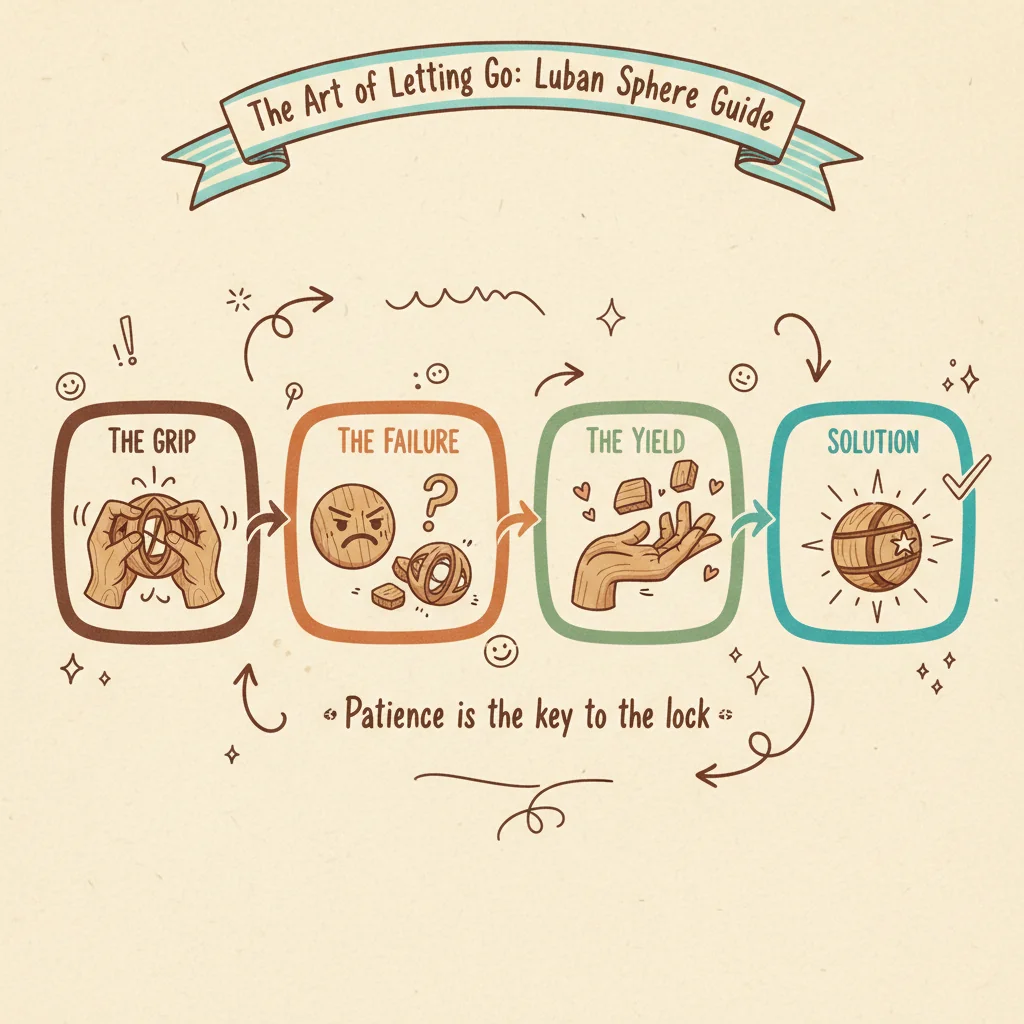
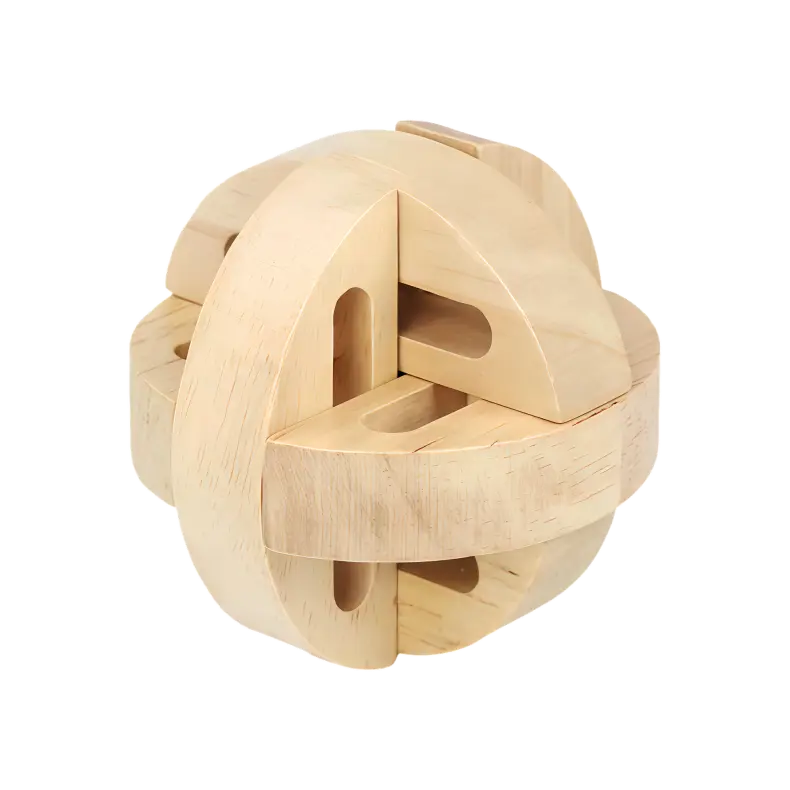
The first thing you notice when you pick up this wooden orb is the weight—or rather, the lack of it. It’s light, almost airy, but the way the six pieces of wood sit together feels impossibly dense. There are no seams to grab, no obvious “start here” button, and certainly no instructions that make a lick of sense upon first glance. I sat at my desk on a Tuesday afternoon, the sun hitting the grain of the wood, and I made the classic mistake: I tried to pull it apart.
Thirty seconds in, my assumption was proven wrong. This isn’t a game of strength. If you pull, the Luban Sphere Puzzle ($16.99) simply tightens its grip. It’s a physical manifestation of a paradox. The harder you fight it, the more it resists. It wasn’t until I stopped trying to “solve” it and started just feeling for the one piece that had a fraction of a millimeter more play than the others that the sphere finally gave up its secrets.
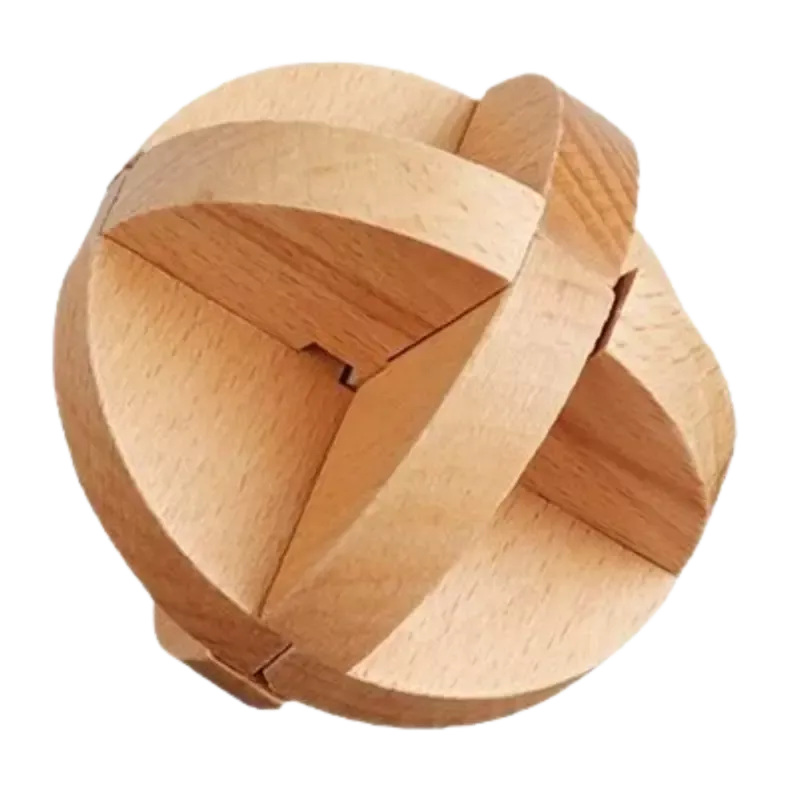
Luban Sphere Puzzle — $16.99
The Luban Sphere Puzzle is a test of ego as much as spatial reasoning. Priced at just $16.99, it’s an entry-level investment that offers a masterclass in the ancient Chinese philosophy of yielding. Most people buy these as desk toys, but after testing over 200 mechanical puzzles, I’ve realized this specific design is the ultimate litmus test for a person’s patience. If you can’t handle five minutes of a wooden ball refusing to budge, you’re going to have a very hard time with the more complex Mechanical 3D Wooden Globe Puzzle ($28.88) or any high-level burr.

What You’re Looking At: Geometry Without Gimmicks
This isn’t a plastic toy that’s going to snap if you drop it. The sphere is composed of six interlocking wooden bars, each precision-cut with notches that allow them to occupy the same central space. This is a classic burr puzzle, a category of mechanical challenges that rely on interlocking segments. While many modern puzzles use magnets or hidden springs, the Luban Sphere relies entirely on the friction and fit of the wood itself.
The finish is a natural, smooth wood that feels warm in the hand. Unlike the Interlock Puzzle Sphere ($17.99), which has a similar aesthetic but a slightly different internal locking mechanism, the Luban Sphere feels more like a traditional artifact. It’s about the size of a large plum, making it the perfect size for one-handed fidgeting once you’ve mastered the disassembly.
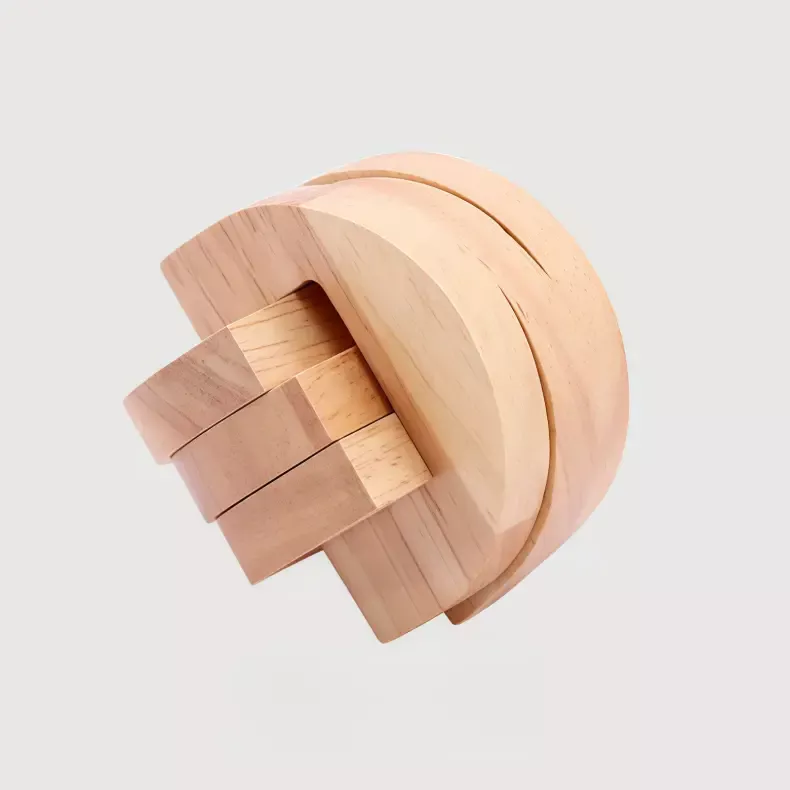
Interlock Puzzle Sphere — $17.99
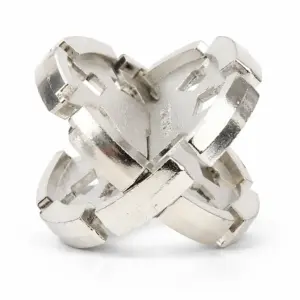
I’ll be honest: my first impression was skeptical. I’ve seen cheap versions of these at big-box retailers where the wood is rough and the pieces are so loose the puzzle practically solves itself. This version, however, has tight tolerances. You can feel the quality in the “shuck” sound the pieces make when they finally slide past one another. It lacks the clinical, cold feeling of the 12 Piece Crystal Luban Lock Set ($28.88), opting instead for a tactile experience that feels grounded and old-world.
One minor gripe: because it’s natural wood, it’s susceptible to humidity. If you live in a swampy climate, the pieces might swell slightly, making the “key” piece harder to find. Conversely, in a dry office in February, it might feel a bit rattle-y. It’s a living object, which is part of the charm, but something to keep in mind if you’re a stickler for perfection. If you want something that remains identical regardless of the weather, you might prefer visualizing internal structures through transparent puzzle guides before committing to a crystal-style set.
The Solving Experience: A Narrative of Failure and “Aha!”
Solving the Luban Sphere isn’t a linear process. It’s a cycle of frustration followed by a sudden, jarring moment of clarity.
Minute 1-5: The False Confidence Phase.
I started by rotating the sphere in my palms, looking for the “key” piece. In burr puzzle terminology, the key is the one piece that can move without any other pieces moving first. I poked. I prodded. I even tried the “centrifugal force” trick where you spin it on the table to see if a piece slides out. Nothing. The pieces are notched so effectively that they create a self-locking cage.
Minute 15: The “I Think It’s Broken” Phase.
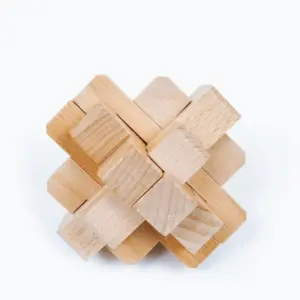
This is where most people quit. I found myself staring at the seams, convinced that maybe the manufacturer had accidentally glued one of the joints. I compared it to the Luban Square Lock ($21.99) I had on my shelf, which uses a similar 6-bar logic but in a cube format. The cube is easier to read because the lines are straight. The sphere’s curves hide the exit points of the bars, making it a much more effective optical illusion.
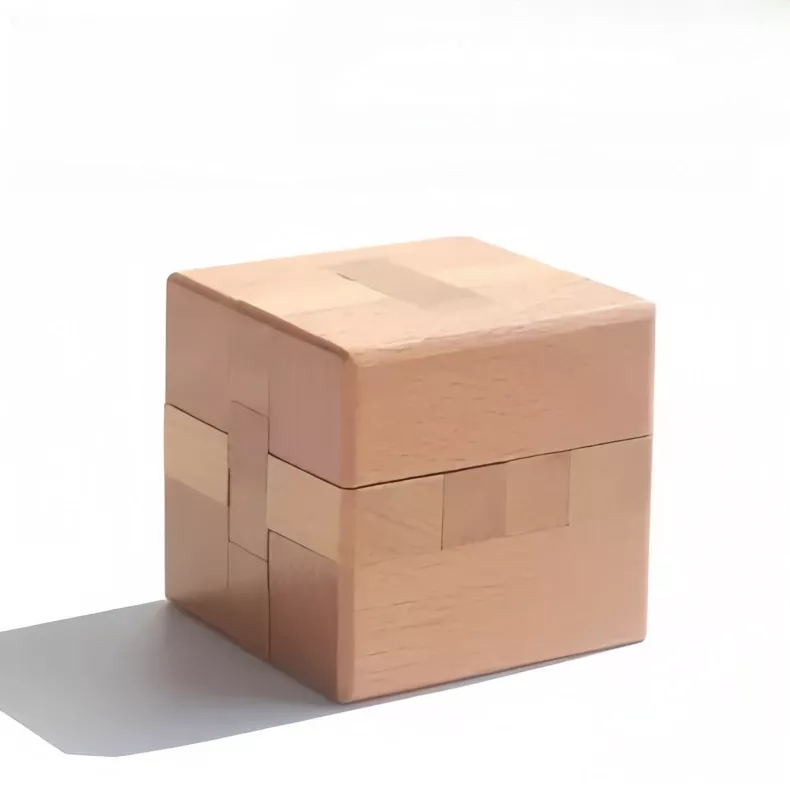
Luban Square Lock — $21.99
Minute 30: The Breakthrough.
I stopped looking and started feeling. By applying gentle pressure to two opposite “poles” of the sphere and sliding my thumb across the equator, I felt a microscopic shift. It wasn’t a “click”—wood doesn’t click. It was a sigh. One piece slid back about three millimeters. That was all I needed. Once that first piece moved, the structural integrity of the sphere vanished. The second and third pieces fell away, and suddenly I was holding six strangely notched sticks.
The Reassembly (The Real Challenge).
Taking it apart is only 20% of the battle. Putting it back together is where the “mindfulness” the description mentions actually kicks in. You have to hold four pieces in a specific orientation—a sort of wooden claw—while sliding the fifth piece through the center. If your grip slips, the whole thing collapses like a house of cards.
I spent 45 minutes trying to get the final piece in, only to realize I had the fourth piece upside down. The notches look symmetrical, but they aren’t. This is where curating a sophisticated shelf of tactile challenges pays off; you start to recognize the “language” of the wood. When the final piece finally slid home and the sphere became solid again, the emotional payoff was immense. It’s a quiet, private victory.
Who This Is For (and Who Should Skip It)
I’ve gifted these to everyone from my 70-year-old father to my tech-obsessed nephew. It hits a specific sweet spot, but it isn’t for everyone.
Buy this if:
* You have a high-stress job and need a “reset” tool. The focus required to reassemble the sphere forces your brain to drop whatever spreadsheet or email chain you’re obsessing over.
* You appreciate “fidget” objects that don’t look like toys. This looks like a piece of mid-century modern decor when it’s sitting on a bookshelf.
* You’re interested in exploring ancient numerical riddles or geometry but want something physical rather than paper-based.
Don’t buy this if:
* You have very large hands or issues with fine motor skills. The pieces are small, and the reassembly requires a “delicate touch” that can be infuriating if your fingers aren’t nimble.
* You want a “project” that takes days to complete. If you’re looking for a long-term build, the Electric Wooden Marble Run Kit ($51.99) is a much better use of your time. The Luban Sphere is a 30-minute solve once you know the trick.
At $16.99, the price-to-value ratio is high. It’s cheaper than a steak dinner and lasts significantly longer. It’s the kind of object that invites people to pick it up off your coffee table, immediately fail to solve it, and then ask you where you got it.
Tips, Tricks, and What I Wish I Knew
After several dozen “solves” (mostly to show off to friends), I’ve picked up a few nuances that the packaging doesn’t mention.
- Gravity is your enemy during reassembly. Don’t try to build the sphere in mid-air. Use a flat surface to steady the base pieces. If you try to hold all six pieces at once, you’ll end up chasing them across the floor.
- Identify the “Master Piece.” Before you scatter the pieces, look at them closely. One piece is usually “cleaner” than the others—meaning it has fewer notches. This is your key. It’s the last one in and the first one out.
- Don’t force the wood. If a piece won’t slide, it’s not because it’s stuck; it’s because you’re out of alignment. Forcing it will only lead to splinters or a broken notch.
- The “Y-Axis” Secret. If you’re stuck, try gently shaking the sphere along its vertical axis while applying light pressure to the sides. Sometimes the internal pieces need a little rattle to find their exit path.
- Clean your hands. Natural oils from your skin are fine, but if you’ve just eaten a sandwich, the crumbs and oils can gum up the tight tolerances of the wood.
If you find the sphere too easy, your next step should be the Luban Lock Set 9 Piece ($39.99). It moves from a single shape to a variety of geometries, each testing a different aspect of your spatial awareness.
Related Picks: Building Your Collection
If the Luban Sphere has piqued your interest, there are several other paths you can take within the world of mechanical puzzles.
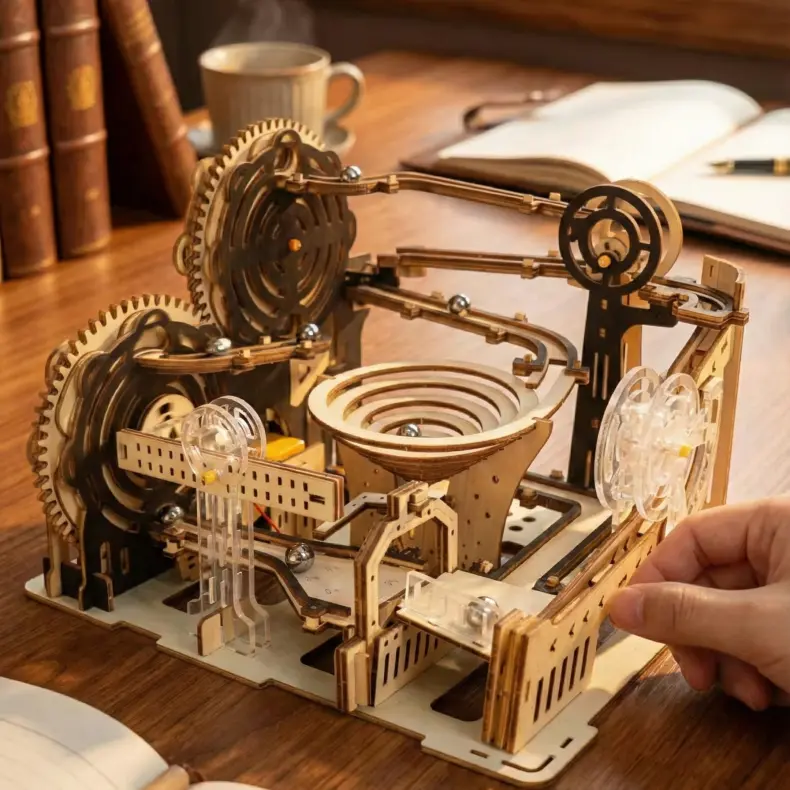
For those who loved the interlocking aspect but want something more “gadgety,” the Electric Wooden Marble Run Kit ($51.99) offers a completely different payoff. Instead of a solid object, you’re building a machine. It’s less about the “aha” moment of a solve and more about the satisfaction of engineering.
If you prefer the aesthetic of the sphere but want a higher difficulty ceiling, the Double Cross Cage Puzzle ($18.88) is a fantastic follow-up. It uses 24 pieces instead of six, creating a much more complex lattice that feels like a professional-grade brain teaser.
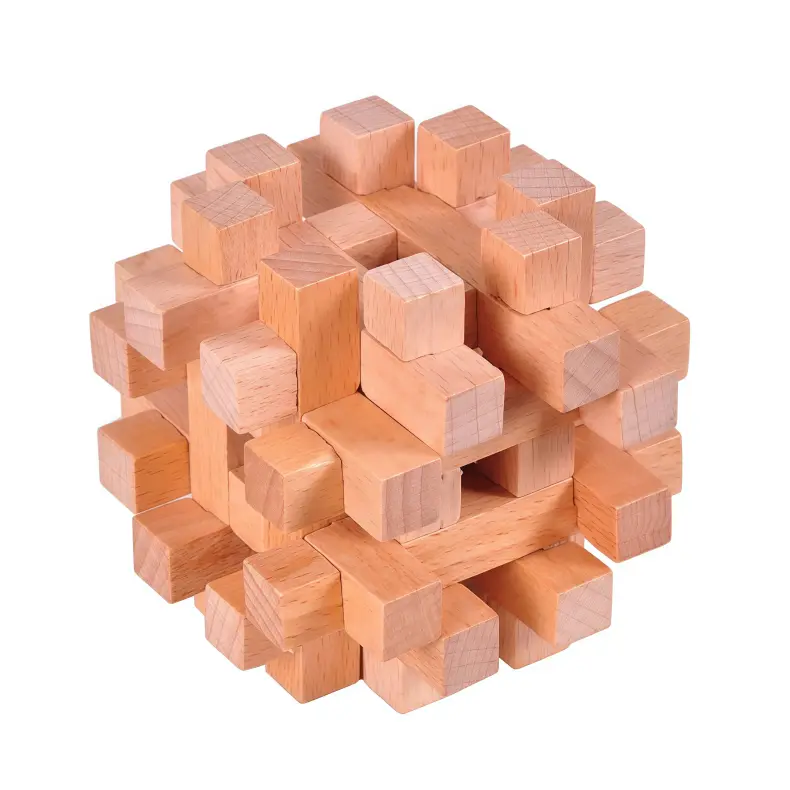
Double Cross Cage Puzzle — $18.88
For the travelers or those with limited desk space, the 12 Piece Crystal Luban Lock Set ($28.88) is the logical choice. These are miniature versions that you can keep in a bag, and the transparent material allows you to actually see how the mortise-and-tenon joints interact.

If you’re looking for something to do with your kids that isn’t quite as frustrating, I often suggest teaching children via mathematical play boards. It builds the same foundational logic skills without the risk of a wooden sphere being thrown across the room in frustration.
FAQ: Everything You’re Afraid to Ask
How long does it actually take to solve the Luban Sphere?
For a total beginner, expect 20 to 40 minutes for the first disassembly. Reassembly usually takes twice as long because you have to fight gravity and your own memory. Once you know the “trick,” you can do it in under 30 seconds. It becomes a rhythmic, meditative motion.
Is it too hard for a 10-year-old?
It depends on the kid. If they enjoy Legos or Minecraft, they’ll have the spatial awareness for it. However, the frustration tolerance of a 10-year-old varies wildly. I’d say it’s perfect for ages 12 and up, but a bright younger child could certainly handle it with a bit of guidance.
What is the difference between a Luban Lock and a KongMing Lock?
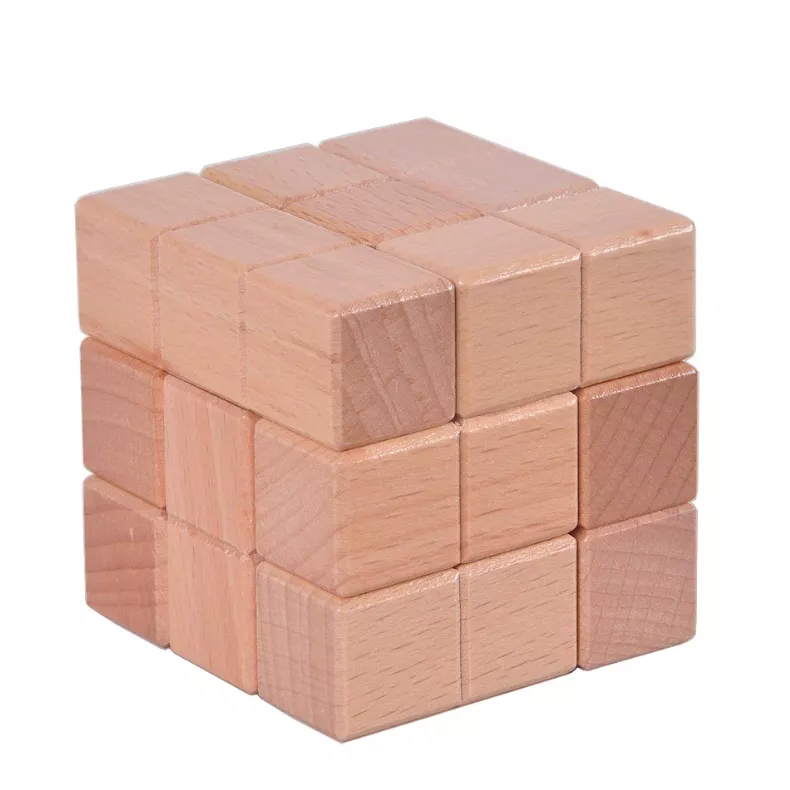
Effectively, nothing. They are two names for the same tradition of Chinese joinery puzzles. Lu Ban was a legendary carpenter, and Kong Ming was a famous strategist. Both are credited with inventing these puzzles to test intelligence and spatial reasoning. Whether you call it a Luban Cube Puzzle ($21.99) or a KongMing ball, you’re dealing with the same 2,500-year-old engineering.
Does the wood require any maintenance?
Not really. If the pieces become too tight over the years, a tiny bit of beeswax or mineral oil on the notches can help them slide. Avoid using WD-40 or any harsh chemicals, as they will soak into the wood and potentially ruin the fit.
Can I solve this by just spinning it?
There’s a popular TikTok “hack” where people spin spherical puzzles to get the pieces to fly out. While this works on some cheaply made plastic versions, the Luban Sphere Puzzle ($16.99) has enough internal friction that spinning usually won’t work. It requires intentional, manual manipulation.
Are there instructions included?
Most of these come with a small diagram, but I’ll be honest: the instructions are usually terrible. They are often poorly translated or use diagrams that are harder to solve than the puzzle itself. My advice? Throw them away. The whole point of a mechanical puzzle is the discovery. If you get truly stuck, there are thousands of YouTube tutorials, but you’ll rob yourself of the “aha!” moment.
What happens if I lose a piece?
Unfortunately, the puzzle is useless without all six pieces. Because they are precision-cut to fit together, you can’t really “fudge” a replacement piece out of a dowel rod. Keep it in a small tray or on a dedicated shelf. If you’re prone to losing things, you might prefer graduating to hidden compartment boxes where the pieces stay attached to the main body.
Is this the same as a Chinese Puzzle Ball?
No. A Chinese puzzle ball is usually carved from a single piece of material (like ivory or resin) with concentric spheres inside one another. The Luban Sphere is a “burr” puzzle, meaning it’s made of separate pieces that interlock. One is a feat of carving; the other is a feat of joinery.
How does this compare to the Luban Lock Set 9 Piece?
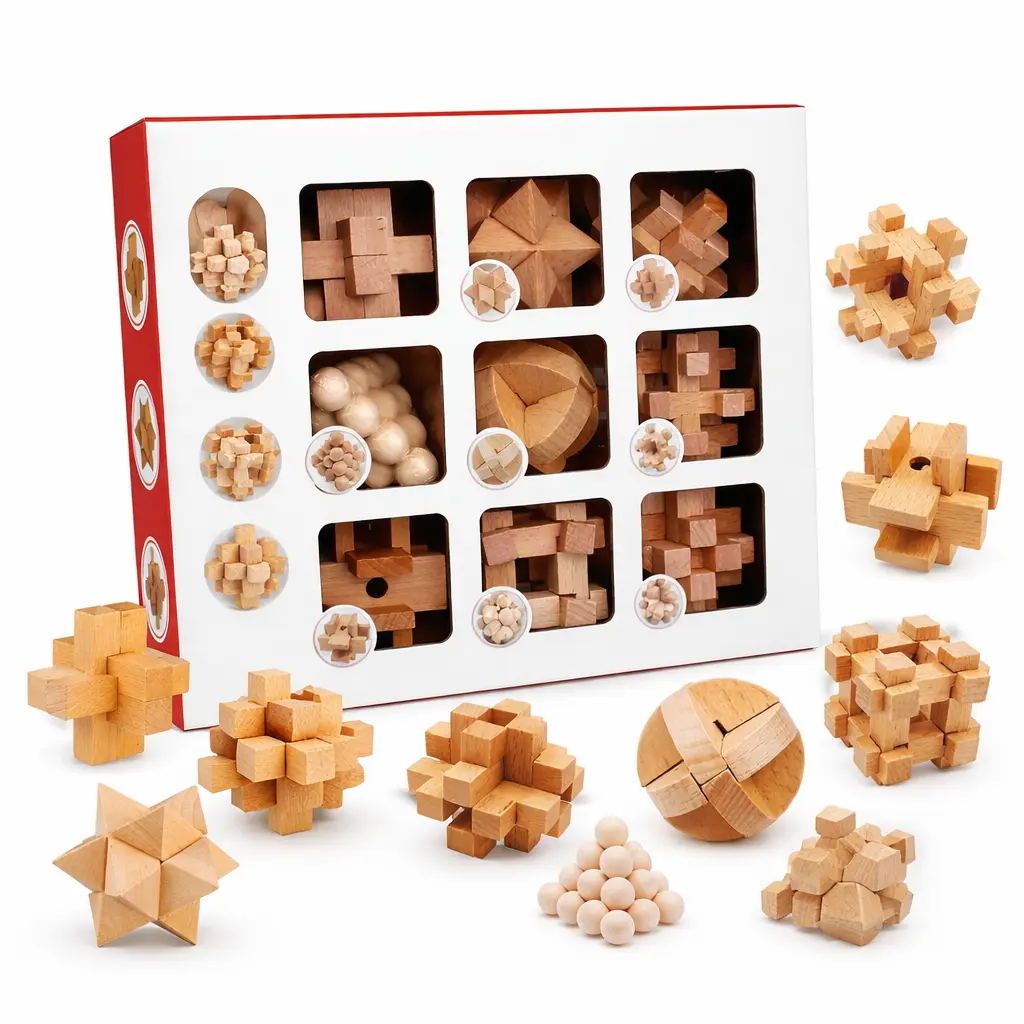
The Luban Lock Set 9 Piece ($39.99) is essentially a “starter kit” for the whole hobby. It includes the sphere, but also cubes, stars, and cages. If you’re buying a gift and aren’t sure which shape they’ll like, the set is a safer bet. If you want a single, elegant object for a desk, the sphere stands alone better.
Why is it called a “lock” if there’s no key?
In ancient Chinese architecture, “locks” referred to the joinery that held buildings together without nails. These puzzles are models of those structural locks. You are “unlocking” the geometry. If you want a literal lock, you might look into the The Mystic Orb Lock ($16.99), which uses a similar spherical design but with a more specific “locking” piece.
The Verdict: A Small Orb with a Big Lesson
I went back to that sphere a week after I first solved it. I knew the trick, I knew which piece moved first, and I knew how to hold the “claw” during reassembly. Yet, it still took me a minute to get it right. There’s something deeply grounding about an object that doesn’t care how fast your internet is or how many unread emails you have. It only cares about the alignment of wood and the patience of the person holding it.
The Luban Sphere Puzzle isn’t the hardest puzzle in my collection, nor is it the most expensive. But it is the one I find myself picking up most often when I’m stuck on a writing project or a difficult phone call. It’s a physical reminder that most problems aren’t solved by force; they’re solved by finding the one piece that’s ready to move.
Final Verdict: An essential desk accessory for anyone who values tactile problem-solving over digital distractions.
Start your collection with the Luban Sphere Puzzle for $16.99 and then consider understanding the nuances of interlocking wooden joinery as you expand your hobby.