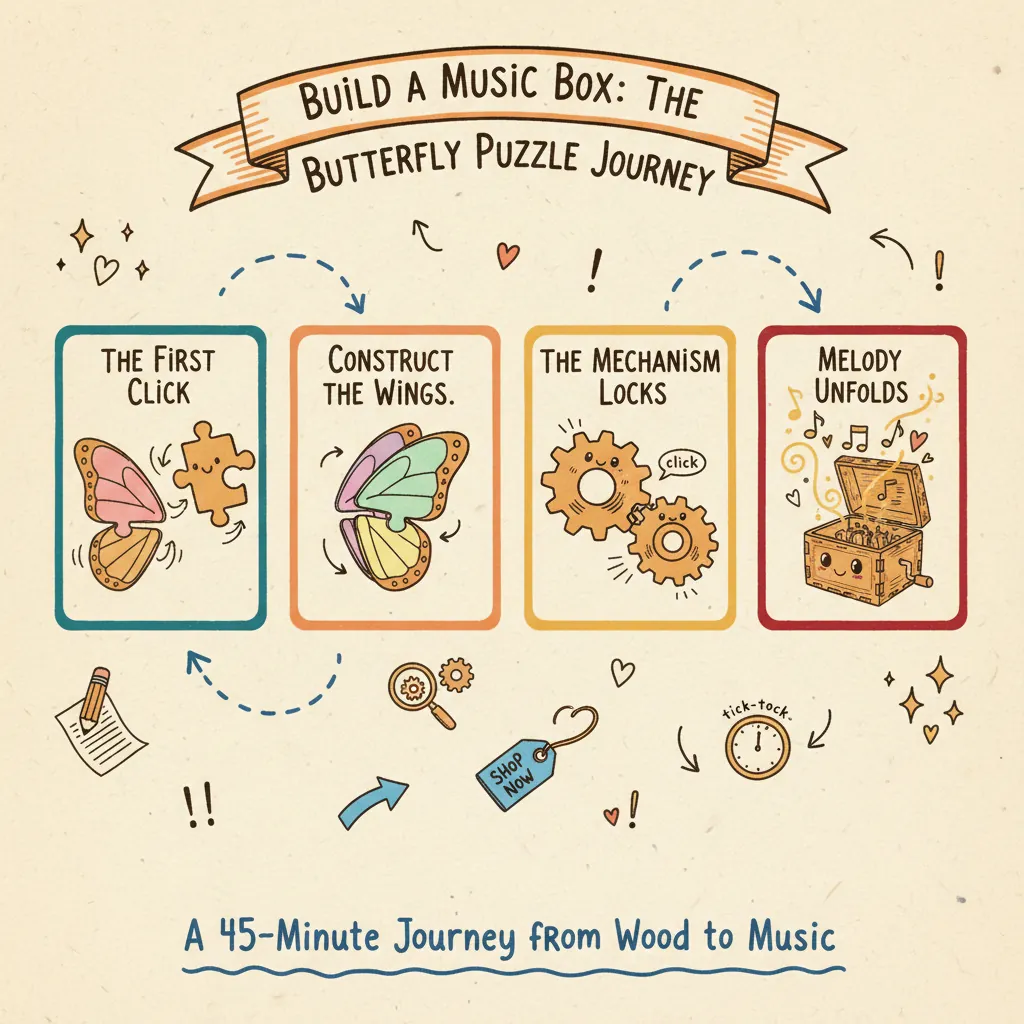
Opening: The First Click That Changes Everything
The first thing you notice isn’t the puzzle. It’s the silence. You’re holding a flat, unassuming package of laser-cut wood sheets, and the only sound is the rustle of the instruction manual. There’s no app to open, no battery to charge. For a moment, you’re back in a pre-digital world where focus is a physical act. Then you press out the first piece—a delicate, layered butterfly wing—and hear the soft snap of the plywood releasing. That’s the first click. It’s the sound of committing to a process that can’t be rushed, a ritual that demands your hands and your full attention.
This is the core thesis of the Layered Butterfly Wooden Music Box: it’s not just a puzzle to solve, but a mechanical artifact to build and then operate. It’s a locking puzzle box in reverse. Instead of finding a hidden trick to open a container, you are constructing the container itself, piece by precise piece, to create the mechanism that locks a melody inside a beautiful form. The challenge isn’t merely spatial reasoning; it’s following a sequence to its satisfying, audible conclusion. If you’ve ever felt the mindless pull of scrolling for a “break,” this $28.99 kit offers a radically different kind of reset—one you power with your own hand.
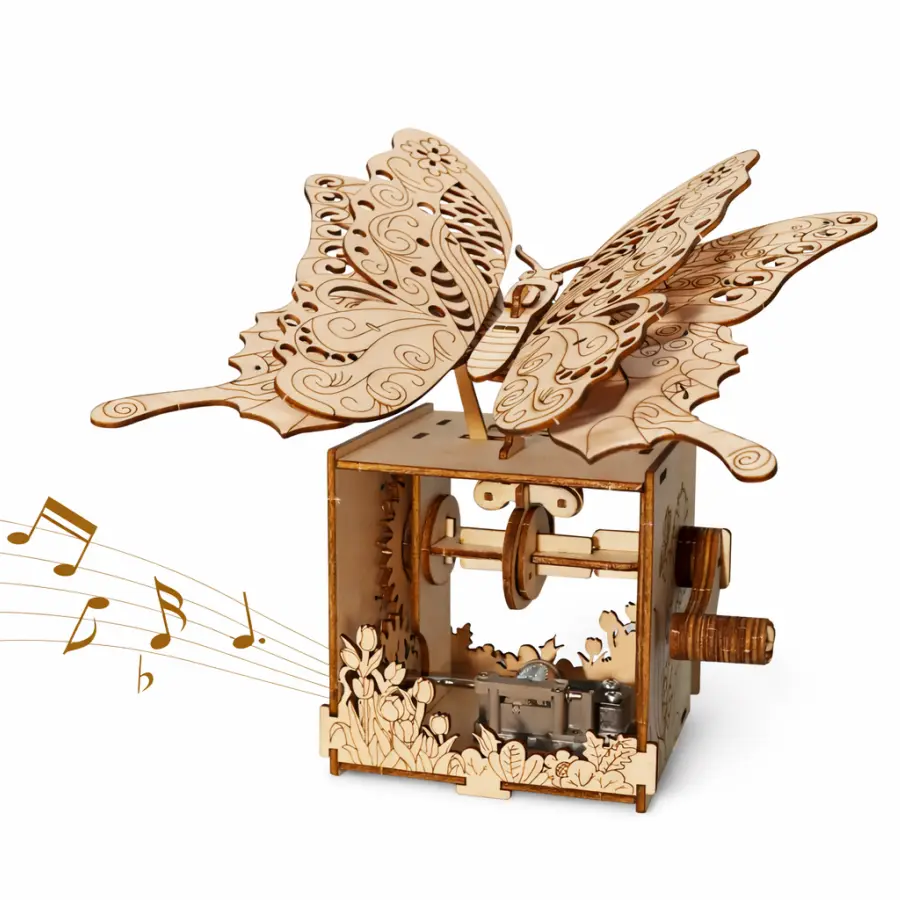
What You’re Actually Getting: Unboxing the Butterfly
Open the box and you’re greeted not with a pre-assembled trinket, but with a project. The contents are organized and purposeful: several sheets of laser-cut birch plywood, a small bag containing the brass music movement and hardware, a winding key, and an instruction booklet. The first tactile impression is the wood itself. It’s not the cheap, fuzzy-edged balsa you might expect; it’s 3mm birch plywood with a smooth, sanded finish. Each piece pops out of its frame with a clean, satisfying crick—no splintering, no need for excessive force. This matters, because the precision of these pieces is the foundation of the entire build.
The Layered Butterfly is compact, with a finished footprint about the size of a large smartphone. The “layered” design is its defining visual feature. Once built, the butterfly’s wings and the floral base aren’t flat decals; they are constructed from multiple, offset sheets of wood, creating a subtle 3D shadow-box effect that gives it depth and sophistication. It feels substantial, not toy-like. The core mechanical heart is the 18-note music movement. This isn’t a digital chip; it’s a real, miniature wind-up mechanism with a pinned brass cylinder and a steel comb. You’ll be assembling a visible gear train that connects the side crank to this movement, a detail that transforms it from a simple craft kit into a true mechanical puzzle.
My honest first impression? The instructions gave me pause. They’re diagram-based, not photo-realistic, and require you to cross-reference part numbers from the wood sheets. For a split second, it felt intimidating—like reading an IKEA manual for a delicate clock. This is the first friction point, and it’s intentional. It forces you to slow down, to identify each piece (marked with tiny etched numbers) before you press it out. The negative here is that if you’re the type who dives in and starts snapping pieces out willy-nilly, you will get confused. Discipline is part of the puzzle. The positive is that this method ensures a glue-free, friction-fit assembly. When parts align correctly, they lock together with a quiet, definitive snugness that’s incredibly rewarding.
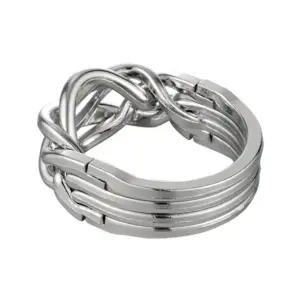
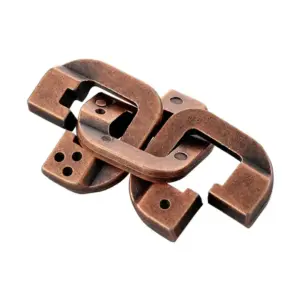
How does this compare to other hands-on puzzles? It occupies a unique middle ground. It’s more involved and yields a more functional keepsake than a pure disentanglement puzzle like the Four-Leaf Clover Puzzle or the 5 Piece Cast Spiral Metal Puzzle. Those are brilliant for pocket-sized, abstract logic challenges. The Butterfly, however, is a sequential construction puzzle. The “Aha!” moment isn’t about finding a hidden trick to take something apart, but about correctly following a logical, mechanical sequence to build something up. It shares more DNA with our larger mechanical kits, but on a more accessible scale.
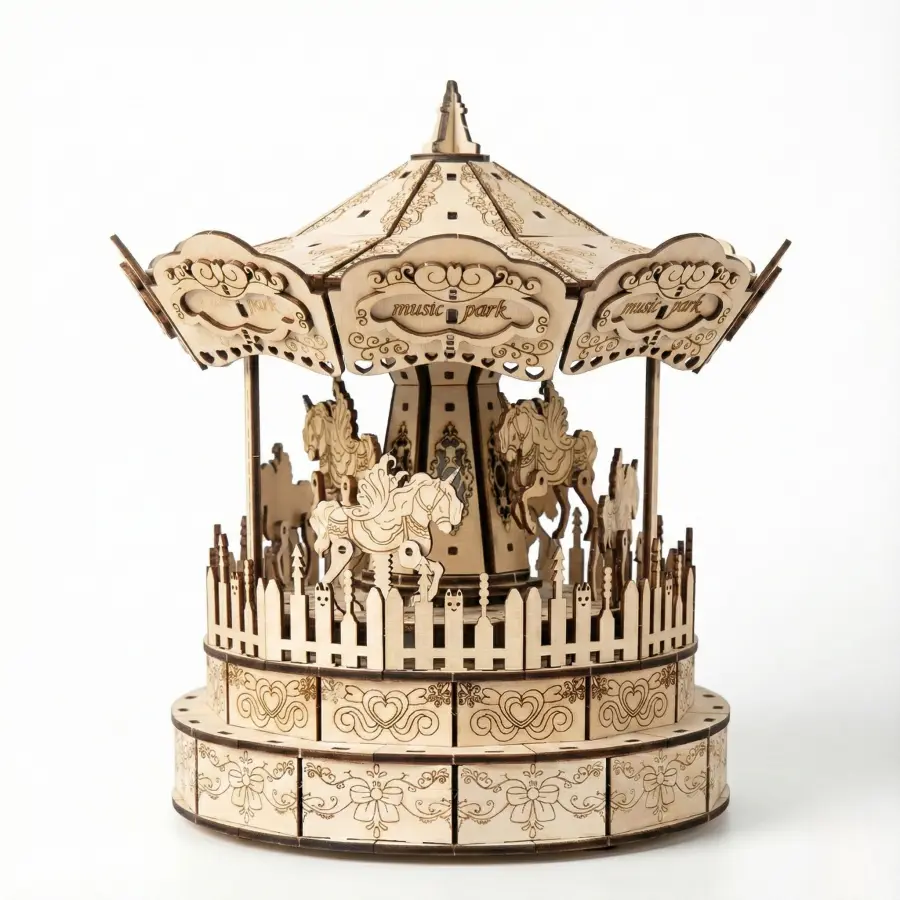
For instance, the majestic 3D Wooden Carousel Music Box ($43.99) is the grand evolution of this concept—a multi-hour project resulting in a stunning, kinetic sculpture. The Butterfly is its gateway. It teaches you the same language of gears, axles, and careful sequencing, but in a 2-3 hour timeframe for under $30. If the Carousel is a novel, the Butterfly is a perfectly crafted short story. You’re not just solving for the sake of solving; you’re engineering a machine that will deliver a payoff—a melody you’ve literally built the instrument for.
What’s in your hand, then, is a kit that respects your intelligence and your time. It assumes you want to understand the why, not just the what. The materials feel worthy of the final product. There’s no plastic in sight. The potential downside is the initial learning curve of the instruction style, but that’s also the source of its depth. This isn’t a snap-together model; it’s a blueprint for a wooden machine, and unboxing it is the first step in learning to read it.
The Build: Where “Locking Puzzle” Meets “Mechanical Kit”
This is where the magic—and the mild, productive frustration—begins. You’ve unboxed the components, admired the laser-cut precision, and now you’re faced with the instruction manual. It’s not a simple, numbered list. It’s a series of exploded diagrams, a visual language you must learn. For the first ten minutes, you’ll feel like you’re deciphering a code. This is the core of the experience: the build is the puzzle. Each step is a lock you must pick with logic and observation before you can proceed to the next.
My first attempt was a lesson in humility. I assumed the small, identical-looking gears were interchangeable. They are not. The manual’s diagram showed a specific tooth count and orientation. I placed one backwards. The result? A gear train that bound up after two turns, a silent reproach from the unfinished mechanism. This is the critical lesson: every piece has a singular correct position and orientation. The “aha” moment comes not from a sudden flash of insight, but from the slow, deliberate practice of matching the physical piece in your hand to the two-dimensional schematic. It trains a different kind of spatial reasoning than a pure disentanglement puzzle.
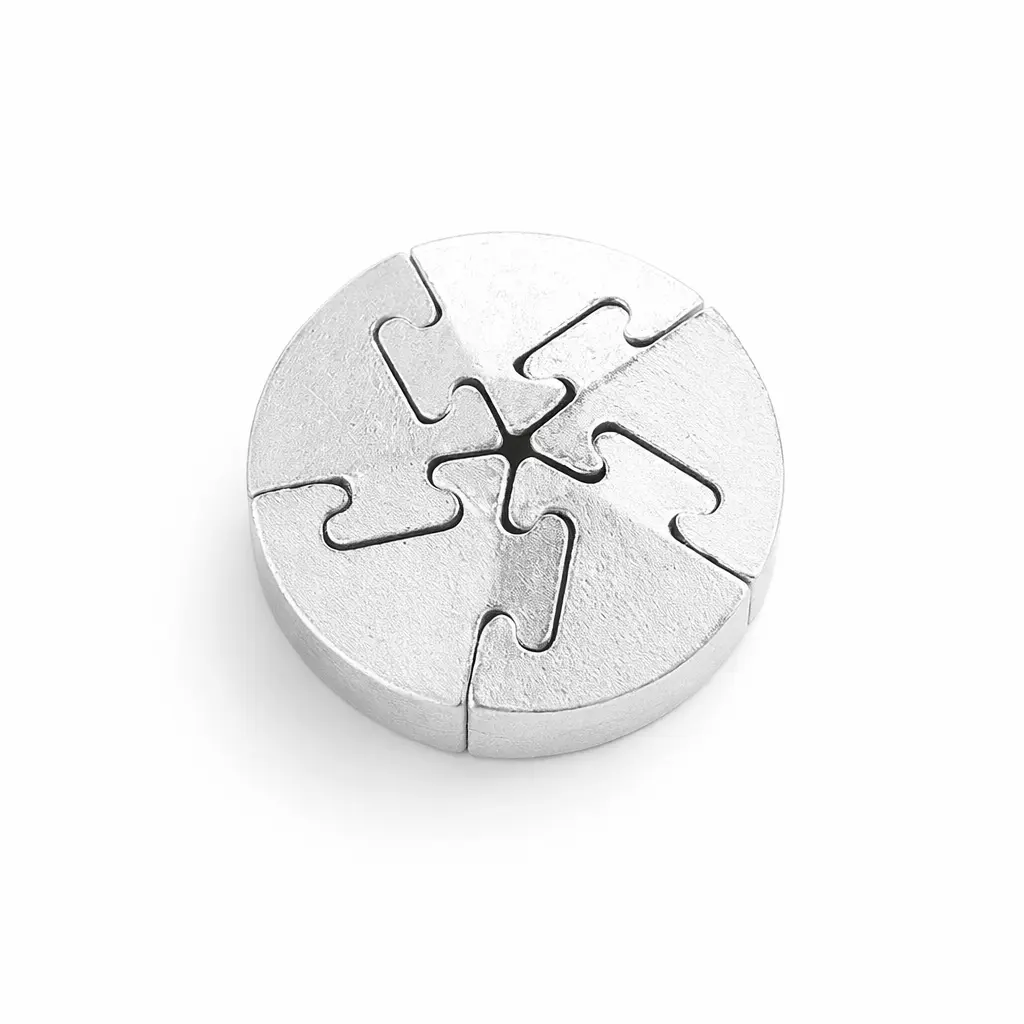
Contrast this with a pure locking puzzle like the 5 Piece Cast Spiral Metal Puzzle. That challenge is about finding the one hidden pressure point, the single piece with a micron of play. It’s a search for a secret. The Butterfly’s build is the opposite: the sequence is laid out for you in the manual, but executing it requires meticulous precision. There is no hidden trick, only the requirement of perfect alignment. It’s the difference between picking a lock and assembling a watch.
The process unfolds in distinct, satisfying phases. First, you build the central gearbox—the heart of the machine. This is where you learn the fundamental rules: how axles pass through bearing holes, how gears must mesh with just the right amount of engagement (too tight and they bind, too loose and they slip). You’ll use the provided wooden mallet for gentle taps, hearing the soft thock as pieces seat home. There’s no glue; the structure relies on precise friction fits and interlocking joints. When the primary gear train is complete and you give the drive axle an experimental turn, seeing all the tiny cogs spin in unison is a profound reward. You’ve built a functional system from a pile of parts.
Next comes the butterfly mechanism itself. This is where the “layered” name becomes beautifully clear. You assemble the wing frames, attach the delicate, translucent wing panels, and connect them to a clever cam system. This phase feels more artistic, as the aesthetic form of the butterfly takes shape. But it’s still deeply mechanical. You must ensure the cam followers—tiny nubs on the wing arms—ride smoothly in the grooves of the rotating cam disc. A misalignment here means the wings will stutter instead of flutter. The manual’s diagrams for this section are crucial; you learn to trace the motion path on paper before committing to the assembly.
Finally, you integrate the music movement. This pre-assembled unit—a steel comb and a pinned cylinder—is the soul of the box. Installing it is straightforward, but it represents the culmination of your work. You are connecting your handmade gearbox to a device that will produce music. The moment of integration, when you slide the movement into its slot and mesh its drive gear with your final gear, is tense. You’re handing off control of your machine to a centuries-old technology.
The total build time for me was just under three hours, spread over two evenings. This wasn’t a rushed job; it was a deliberate, immersive practice. I’d recommend the same approach. Don’t try to marathon it. Build the gearbox one night, then tackle the butterfly and final assembly the next. This gives your brain time to absorb the logic of the system. You’ll return with fresh eyes, often spotting a minor misalignment you’d missed before.
What I wish I’d known from minute one: light and magnification are your best friends. A good desk lamp is non-negotiable. The laser-cut chaff (the fine, smoky residue in the piece slots) can obscure tiny alignment marks. A quick pass with the provided sandpaper or a dry toothbrush cleans this up. Also, when the manual shows a “test fit” step—like checking gear rotation before final assembly—do not skip it. That’s your quality control checkpoint.
This build bridges two worlds perfectly. It has the step-by-step sequential discovery of a high-end mechanical puzzle, where each new piece unlocks understanding of the next. And it has the tangible, lasting-creation payoff of a model kit. When you finally turn the handle and the gears whir, the butterfly dances, and the melody plays, you’re not just a solver. You’re the engineer. That emotional payoff—the pride of creation—is what sets this apart from any static puzzle you simply take apart and reassemble. You haven’t just unlocked a box; you’ve built the key, the lock, and the treasure inside.
The Solve: A 45-Minute Journey from Confusion to Melody
I’d just finished the build. The layered butterfly was assembled, its gears visible behind the wooden frame. I held it in my hands, a complete object. Now came the real test: was it a music box, or was it a locking puzzle box? The answer, I discovered, was both—and the journey from my first confused turn of the handle to the final, flawless melody was a masterclass in sequential discovery.
Minute 0-5: The Assumption of Simplicity.
My first move was predictable. I turned the side crank clockwise. The central gear turned, the connected rods moved, and the butterfly’s wings fluttered down. A soft, pleasant plink-plink sound emerged, but it was random, discordant—not a tune. I reversed direction. The wings lifted, another disjointed series of notes. This wasn’t a “music box” in the plug-and-play sense. The mechanism was alive, but the song was locked away. I realized the build was only half the puzzle. I had constructed the lock. Now I had to find the combination. This immediate friction is the genius pivot; it transforms you from assembler to cryptographer.
Minute 5-20: Mapping the Mechanism.
I put the box down and just observed. Turning the handle moved the main drive gear. That gear engaged a smaller pinion, which turned the music movement’s cylinder—the pinned drum that plucks the steel comb. So far, so standard. But the sound was wrong. Leaning in, I noticed something critical: the butterfly wing assembly wasn’t just decorative. Its vertical motion, controlled by a clever cam system, seemed to interact with nothing. Or did it? I began to suspect it was a decoy—a satisfying mechanical red herring that consumed my attention while the real secret lay elsewhere. I was treating it as the star of the show when it was merely a supporting actor. This is a classic trope in high-end puzzle box design, where the most obvious movement is often a distraction.
Frustrated, I re-examined the gear train. That’s when I saw it: a slight, almost imperceptible lag. When I turned the handle smoothly, the music cylinder seemed to hesitate for a fraction of a second every full rotation. It wasn’t broken; it was clue. Something was regulating its motion. I gently pressed a finger against the side of the cylinder spindle. It had a tiny amount of lateral play. My assumption that all components were fixed was false. This was the first “aha” moment: the system had a variable state I hadn’t engaged.
Minute 20-35: The Failed Experiments.
Armed with this new clue, I began experimenting—and failing spectacularly. I tried turning the handle at different speeds. Too fast just made a cacophonous jumble; too slow produced single, sad notes. I tried applying slight pressure to the butterfly wings mid-turn, thinking they might trigger a shift. Nothing. I even, somewhat desperately, looked for a hidden slide or button on the wooden casing, a vestigial thought from cheaper trick boxes. Each dead end was a lesson. It taught me that the solution was inherent to the mechanism I’d built, not a hidden gimmick. The truth was in the direct relationship between the handle, the gears, and the cylinder. I had to listen and feel, not just look.
The breakthrough came when I stopped trying to force a melody and started diagnosing the discord. I turned the handle one single, complete revolution while focusing only on the sound. The notes were: G, C, G, clunk, A, D, A, clunk. The clunk wasn’t a note—it was the cylinder skipping. The pins on the cylinder weren’t plucking the comb’s teeth because the cylinder itself was shifting out of alignment at two specific points. Why? Because it was being allowed to. I needed to lock it into the correct position. But with what?
Minute 35-45: The “Key” and the Unlocking.
My eyes darted back to the butterfly wing assembly. Its cam follower rode in a grooved wheel. That wheel was fixed to a shaft that… I traced it with my finger… ran parallel to the music cylinder. They weren’t directly connected, but their axles were linked by the frame I had built. What if the vertical position of the wings changed the alignment of the entire gear train? It was a long shot. I held the wings in their uppermost position and turned the handle. The clunks were gone, replaced by a smooth run of notes, but still no recognizable tune. I held them in their lowest position. The cylinder bound up and barely turned. I let them sit in the middle, their neutral resting place. The clunks returned.
Then it hit me. What if it wasn’t a static position, but a timed one? The wings moved through a cycle as the handle turned. I needed to intervene in that cycle at the precise moment the cylinder needed to be stabilized. On the next revolution, as the handle approached where I knew the first clunk would happen, I used my free hand to gently resist the butterfly’s descent, holding it slightly above its natural path. The handle turned past the point—no clunk. A clear sequence of notes rang out: the opening phrase of “You Are My Sunshine.” My heart jumped. I repeated the process for the second clunk, and the melody played through perfectly, bright and nostalgic. The butterfly mechanism wasn’t a decoy; it was the literal key. The puzzle box wasn’t about finding a hidden compartment; it was about discovering the correct sequence of interactions to release the intended function. I had to play the butterfly to play the song.
The Emotional Payoff.
Solving it wasn’t a shout of triumph; it was a slow, swelling smile. The satisfaction was deep and layered, much like the puzzle itself. First, there was the relief of the cognitive click, the pieces of the mental model snapping into place. Then, the tactile joy of executing the solution—feeling the slight tension in the wing mechanism, hearing the gears purr without obstruction. Finally, the aesthetic reward: a charming, hand-built object performing its designed purpose, a melody I’d earned. This 45-minute journey from confusion to harmony is the core value. It’s not a difficulty of sheer complexity, but of perception. It teaches you to interrogate your assumptions about how things “should” work.
Difficulty in Context.
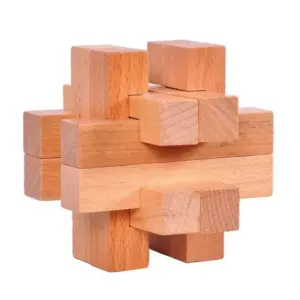
Where does this sit on the challenge spectrum? It’s more accessible than a pure, abstract disentanglement like the 5 Piece Cast Spiral Metal Puzzle, which offers zero narrative clues and relies entirely on spatial reasoning. Yet, it’s more conceptually demanding than a standard interlocking ring puzzle like the Four-Leaf Clover Puzzle ($13.89), which has a more linear solution path. Its closest kin is actually the 3D Wooden Puzzle Treasure Box ($29.99). Both are functional objects where the “solve” is learning the secret to their operation. The music box is arguably more forgiving; the feedback is immediate (discordant vs. harmonious sound), whereas with a locked treasure box, you might not know you’re close until it springs open.
The final proof of its elegance is in the reset. Once you know the sequence, you can demonstrate it effortlessly. But watch a newcomer try, and you’ll see your own confusion mirrored. You’re not just handing them a music box; you’re handing them a 45-minute story where they are the protagonist. That’s the magic no product photo can capture.
Who This Puzzle Box Is For (And Who It Will Frustrate)
The Layered Butterfly Music Box isn’t a universal gift. Its value is unlocked only by the right person in the right context. After building and solving it, I can map its ideal owner with precision—and warn away those who will find it a $28.99 paperweight.
Buy this if your scenario matches one of these:
First, the Mindful Breaker. You feel the itch to scroll during a work lull or after dinner. You want a tangible, screen-free ritual that occupies your hands and just enough of your brain to quiet the noise. This box is perfect. The 2-3 hour build is a meditative project, and the subsequent “solve” to play the tune becomes a 45-second mindful reset. It’s a physical object that rewards presence. Unlike pulling out your phone, you end the interaction feeling accomplished, not drained.
Second, the Curious Tinkerer (Not the Expert Engineer). You love seeing how things work. You’ve maybe assembled a piece of flat-pack furniture and felt a spark of satisfaction from the process. This music box is your next step. It reveals its mechanics proudly—the gear train, the pinned cylinder, the comb. You get the joy of construction and the intellectual payoff of a locking mechanism, without needing specialized tools or advanced skills. It’s a gateway into the world of mechanical puzzles and kits.
Third, the Gift-Giver Seeking an “Experience.” You’re tired of giving another candle or gift card. For a birthday, graduation, or holiday, you want to give an activity and a lasting keepsake. This fits a specific recipient: perhaps a teenager with budding patience, a partner who enjoys hands-on projects, or a retiree looking for a engaging new hobby. It says, “I think you’re clever enough to enjoy this.” It’s a shared experience waiting to happen; you can build it together or listen proudly as they demonstrate their solve.
Fourth, the Puzzle Enthusiast Exploring a New Genre. If your shelf is full of cast metal disentanglements or burr puzzles, this offers a different flavor of challenge. It’s a sequential discovery puzzle with a glorious, melodic payoff. The “aha” moment isn’t silent; it’s accompanied by a bright melody. It’s less abstract than a pure metal puzzle and more interactive than a static model. For a deep dive into this category, our guide on the principles of sequential discovery and trick boxes explores this fascinating puzzle family.

Now, who should absolutely skip it?
Don’t buy this if you crave instant, repeated solving gratification. This is not the Two Bull Head lock Puzzle ($14.99). That cast metal puzzle is designed for hundreds of rapid solves—a fidget toy for logicians. Once you know the Butterfly’s secret sequence, the “puzzle” is gone. The lasting value is in the built object and the occasional wind-up. If you want a challenge you can solve daily in 30 seconds, look elsewhere.
Don’t buy this if you have zero tolerance for minor friction in assembly. The pieces are high-quality, but you will need to carefully punch them out of laser-cut boards and follow diagrams. A few parts are delicate. If the idea of gently sanding a tight-fitting dowel or double-checking an orientation step sounds like frustrating hassle, not part of the journey, this will annoy you. You are paying partly for the labor of assembly. If you only want the finished product, buy a pre-assembled music box.
Don’t buy this for a young child without committed adult help. The recommended age of 14+ is accurate. Smaller children will be frustrated by the fine motor skills required and will likely break delicate parts. This is not a toy; it’s a project.
Is it worth $28.99? My verdict is a conditional yes. You are not buying a mass-produced trinket. You’re buying a mid-complexity mechanical kit, a functional wooden music box, and a legitimate locking puzzle, all in one. The materials feel substantial, the mechanism is genuine, and the finished piece is display-worthy. When you break down the cost per hour of engaged, focused enjoyment, it outperforms most entertainment. However, if you value only the end result, the price may feel steep compared to a simpler, pre-made box. The value is inextricably linked to your enjoyment of the process. For the right person, it’s not an expense; it’s an investment in dozens of hours of curious, satisfying engagement.
Five Things I Wish I Knew Before Starting
This isn’t a puzzle you just open and solve. It’s a layered experience, and a few key insights would have saved me from minor frustration and amplified the enjoyment from the very first gear. Here’s the tactical knowledge I gained the hard way.
1. The “Locking” Mechanism Isn’t What You Think. I went in expecting a traditional trick box with hidden slides or a cryptic combination. The “lock” here is the assembly itself. The puzzle is figuring out how the layered plates, gears, and drive shaft interlock to create a functional mechanism. The final step—turning the handle to see if it works—is the “unlocking.” This reframes the entire challenge. You’re not searching for a secret; you’re reverse-engineering a machine. If you’re craving a pure, traditional sequential discovery box where you hunt for hidden compartments, you might prefer exploring our dedicated guide to the principles of puzzle trick boxes.
2. Organization is Half the Battle. Dumping all 100+ pieces onto the table is a recipe for confusion. The laser-cut plywood sheets (called “plates”) are numbered. Keep them in order. I didn’t, and spent ten minutes comparing nearly identical gear arms. Separate the pieces for each major sub-assembly: the base/frame, the layered butterfly plates, the gear train, and the music movement. A couple of small bowls or cups are invaluable. This simple act transforms a chaotic pile into a logical, manageable project.
3. The Music Movement is Pre-Assembled, But Not Pre-Tested. The heart of the box—the metal comb and pinned cylinder—comes as one unit. I assumed it was guaranteed to work. On my first test crank, it was silent. Panic ensued. The issue was simple: the drive shaft wasn’t fully engaged with the movement’s winding mechanism. The fix required a slight disassembly to reseat it. Before you close up the final layers, always do a function test. Assemble the core frame, install the music movement and drive shaft, and give the handle a few turns. Hearing that first, clear note before the final assembly is a massive relief and prevents having to backtrack.
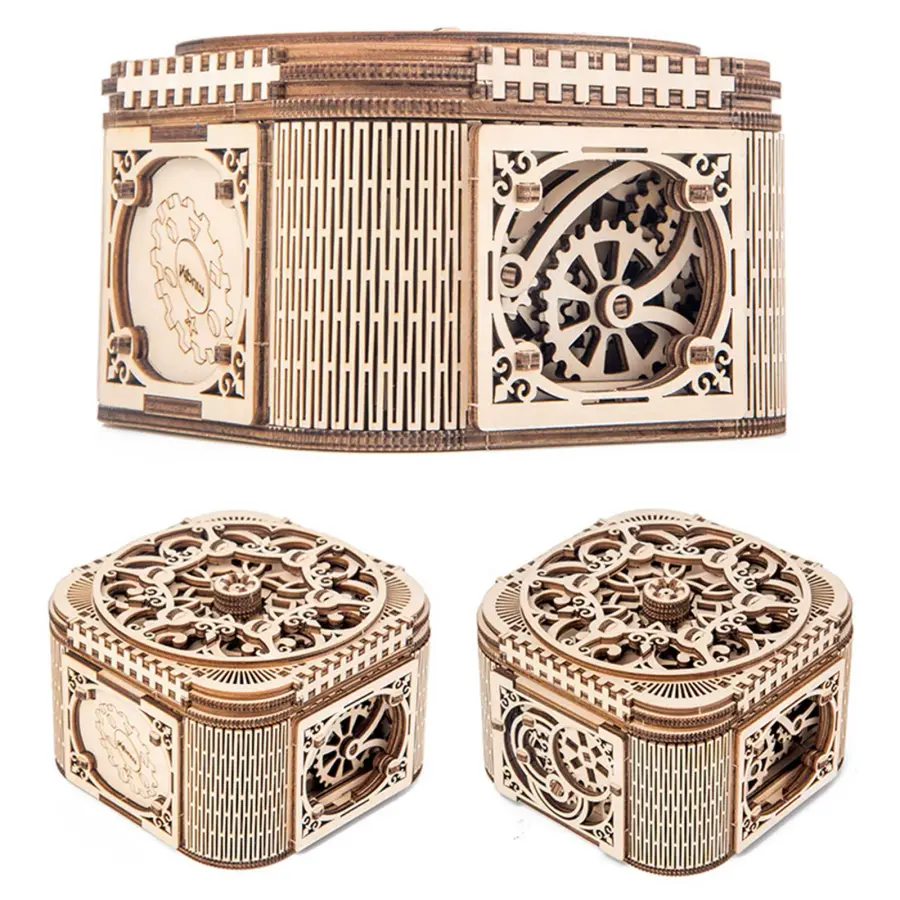
4. “No Glue Required” Doesn’t Mean “No Friction Fit.” Unlike some simpler 3D puzzles, this model relies on precise, sometimes snug, press-fit connections. You will need to apply firm, even pressure. Don’t be afraid to push, but always ensure pieces are aligned correctly. A misaligned gear post forced into a hole can split the delicate wood. If something feels like it’s resisting crookedly, stop. Re-check the diagram. This is a hallmark of quality mechanical kits like the 3D Wooden Puzzle Treasure Box ($29.99), where the satisfaction comes from the precision of the fit itself.
5. The Instructions Are Visual, Not Verbal—Learn Their Language. The manual uses exploded-view diagrams with arrows. There is minimal text. This is common in this niche, but it requires a shift in how you read. Don’t just look at the picture of the finished step; trace the arrows from the previous step. They show trajectory and orientation. The most common mistake I made was installing a piece facing the wrong direction because I glanced at the endpoint, not the path to get there. When stuck, I found it helpful to study the diagrams for our money puzzle box concepts, which often rely on similar visual-spatial reasoning for their hidden mechanisms.
If You Liked This Mechanism, Try These Next
The Layered Butterfly Music Box sits at a fascinating crossroads: it’s a locking puzzle you build, a mechanical kit you solve, and a decorative object you activate. If that specific blend of hands-on assembly and tactile problem-solving clicked for you, your next step isn’t a random puzzle—it’s finding another experience that matches the particular itch this one scratched. Based on what you enjoyed most, here are three curated paths forward, each using another exceptional puzzle from our collection.
If the joy was in building a complex, beautiful mechanism that you can watch work, then your logical progression is the 3D Wooden Carousel Music Box ($43.99). This is the Butterfly’s bigger, more ornate sibling. You’re still in the realm of laser-cut wood and gear assembly, but the complexity and payoff are amplified. With 281 pieces, it’s a more substantial weekend project. The reward is a stunning, fully functional carousel with rotating horses powered by the same type of wind-up music movement. It trades the Butterfly’s intimate, palm-sized puzzle for a grander, 8.6-inch tall display piece. The “lock” here is in the precise sequencing of the build itself; getting the multi-level gear train to mesh perfectly is its own deeply satisfying puzzle.

Four-Leaf Clover Puzzle — $13.89
Perhaps, however, the puzzle aspect—the “locking” and subsequent “aha!” of release—was your favorite part, and you’d like to focus purely on that challenge without the construction phase. In that case, move from wood to metal with the Four-Leaf Clover Puzzle ($13.89). This is a classic interlocking ring puzzle, a direct descendant of ancient puzzle locks where the goal is disentanglement through logic, not force. It distills the “solve” of the Butterfly’s final mechanism into a pure, portable brain teaser. There’s no building, just a immediate, elegant challenge that fits in your pocket. It’s perfect for the same kind of focused, screen-free breaks, offering a similar tactile “click” of success when the rings finally separate.
Finally, if what you loved was the sequential discovery—the feeling of progressing step-by-step through a physical problem where each action reveals the next—you’re ready for a deeper dive into pure mechanical puzzling. The next level isn’t necessarily more pieces, but more refined deception. Explore our guides on the principles behind sequential discovery puzzle boxes and trick locks, which delve into the history and mechanics that make these objects so compelling. For a hands-on step up, consider a dedicated locking puzzle brain teaser like the Two Bull Head, which presents a self-contained, machined-metal challenge that focuses entirely on the logic of the lock, removing the decorative and construction elements to hone in on pure problem-solving prowess.
Frequently Asked Questions About Locking Puzzles & Music Boxes
How long does it take to assemble and solve the Layered Butterfly Music Box?
For most people, the full experience—assembly and then solving the final locking mechanism—takes between 2 to 4 hours. The assembly of the wooden layers and gear train is the bulk of the time, requiring careful attention to the instructions. The final “puzzle box” lock mechanism, which involves aligning the butterfly to release the music box key, is a shorter challenge nested at the end. If you’re experienced with 3D wooden kits, you might finish in 90 minutes. For a first-timer taking a relaxed pace, plan for a satisfying afternoon project. The time investment is part of the appeal, transforming a simple object into a personal accomplishment.
Is the Layered Butterfly too difficult for a beginner?
It depends on your definition of “beginner.” If you’re new to wooden model kits but patient and enjoy following visual instructions, it’s an excellent, manageable first project. The pieces are laser-cut and fit together precisely without glue. However, if you’re looking for a quick, 10-minute brain teaser to solve and reset, this is not it. The challenge is in careful construction, not abstract logic. For a true beginner to puzzle-solving, a simpler interlocking or disentanglement puzzle, like the Four-Leaf Clover Puzzle ($13.89), offers immediate engagement with a lower time commitment before you tackle a build.
What’s the difference between a puzzle box, a locking puzzle, and a music box?
These terms often overlap, but they have distinct cores. A puzzle box (like many secret compartment boxes) is a container that requires a sequence of non-obvious manipulations to open. A locking puzzle is a broader category, often a single object or mechanism designed to be unlocked, disassembled, or disentangled through logic; the final lock on the Butterfly is a simple example. A music box is a device that plays a melody via a pinned cylinder plucking a tuned metal comb. The Layered Butterfly is a hybrid: a buildable music box mechanism housed within a wooden structure that concludes with a small locking puzzle to access the winding key. For a deeper look at how these categories evolved, the history of mechanical puzzles provides fascinating context.
I’ve seen “sequential discovery” puzzles mentioned. What does that mean?
Sequential discovery is a premium sub-genre of mechanical puzzles where solving one step literally provides the tool (a pin, a key, a slider) you need to solve the next. It’s a narrative in physical form. The Layered Butterfly incorporates a tiny element of this—solving the butterfly alignment “discovers” the key—but true sequential discovery puzzles are far more complex and self-contained. They are the pinnacle of the craft, where the puzzle itself teaches you its own rules as you go. If the idea intrigues you, our resource on advanced puzzle box challenges and why they stump adults explores the psychology behind these multi-stage brain teasers.
Are these kinds of puzzles good for your brain?
While we don’t make medical claims, engaging with mechanical puzzles is widely recognized as a focused cognitive activity. It requires spatial reasoning, fine motor skills, logical deduction, and patience—all of which are healthy mental exercises. The process can provide a state of “flow,” a deep focus that acts as a mental reset from digital distractions. Research into cognitive aging often cites engaging, novel problem-solving as a positive factor. Think of it less as a “brain workout” and more as a dedicated practice in focused attention and procedural learning, which many find relaxing and rewarding.
Why are some puzzles made of metal and others of wood?
Material dictates the experience. Metal puzzles, like cast brain teasers, are about precision, weight, and a cool, industrial feel. They’re often durable, pocket-sized challenges focused purely on the solve (e.g., the 5 Piece Cast Spiral). Wooden puzzles, especially kits, are about construction, warmth, and creating a functional or decorative object. The challenge is in the build and the solve. Wood allows for larger, more intricate mechanisms like gear trains. Metal offers the satisfying “click” and heft of machined parts. Your choice depends on whether you want to build a display piece or conquer a pocket-sized logic problem.
Can the music box mechanism be replaced or the song changed?
The Layered Butterfly uses a standard 18-note music box movement that is permanently installed during assembly. The song is pre-set (typically a classic like “You Are My Sunshine” or a similar melody) and cannot be changed. The movement is not designed to be user-replaceable without disassembling the wooden frame. This is standard for this price point and style of kit. The value is in the integrated experience, not a modular music system. If a customizable or higher-fidelity music mechanism is your goal, you’d need to look into more advanced, hobbyist-grade music box building.
Is the finished product sturdy, or is it fragile decor?
Once fully assembled, it’s surprisingly sturdy for a decorative object. The layered plywood construction is rigid, and the gear train is protected inside. You can confidently wind it and place it on a shelf. However, it is not a toy. It shouldn’t be dropped, subjected to moisture, or handled roughly. The delicate butterfly wings and protruding crank require a bit of care. Think of it as you would a nice clock or a detailed model ship—durable for its purpose, but not indestructible.
What if I get stuck during assembly?
First, don’t force anything. The pieces are precision-cut and should fit together with firm but gentle pressure. Go back to the instruction step and ensure you have the correct piece orientation (look for laser-cut numbers or subtle grain differences). Online video tutorials for similar 3D wooden music box kits can be immensely helpful for visualizing tricky steps. If you’re truly stuck, setting it aside for a few hours often brings fresh perspective. The community around puzzle box solving and assembly often shares tips and solutions for common sticking points.
Are puzzles like this good gifts?
Absolutely, but with careful selection. The Layered Butterfly is a stellar gift for a patient, crafty person who appreciates a hands-on project and a beautiful result. It’s a “gift of an experience.” For someone who prefers an immediate intellectual challenge, a pure metal or wood locking puzzle brain teaser is better. The key is matching the gift to the recipient’s tolerance for process versus instant gratification. For more ideas on using puzzles as memorable gifts, our exploration of why the best gift wraps punish impatience delves into the psychology of gifting puzzles.
How old should someone be for this puzzle?
The manufacturer suggests 14+, and that’s a good guideline. It requires fine motor skills,