If you’re reading this, you’ve likely felt the magnetic pull of a puzzle box. Maybe you’ve solved one and wondered, “How on earth was this made?” Or perhaps you’re a maker at heart, itching to craft not just an object, but an experience—a sequence of delightful frustration and ultimate revelation. This guide is for you. We’ll move beyond vague inspiration and generic tutorials to deliver a first-principles manual for creating a functional, satisfying puzzle box. Whether you end up building from raw lumber or assembling a precision-engineered kit, you’ll finish with a deep understanding of the mechanics, psychology, and craft behind these timeless brain teasers.
The Puzzle Box Maker’s Mindset
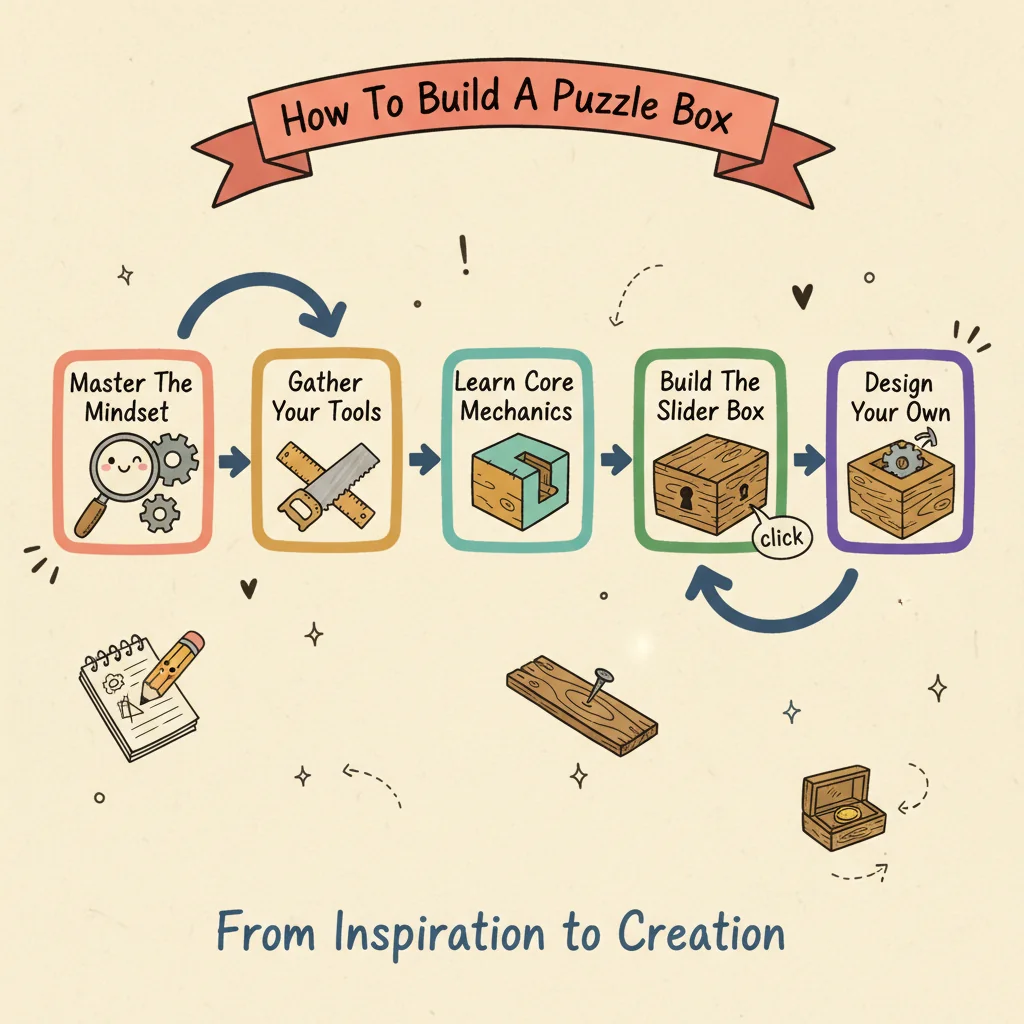
Before you touch a single piece of wood or metal, the most critical tool you need isn’t a saw or a file—it’s a shift in perspective. Making a puzzle box isn’t just carpentry; it’s a deliberate act of reverse-engineering delight and frustration. You are not building a container; you are designing an experience. The goal is to create a sequence of discovery, where each correct action feels earned and each dead end is a lesson, not a failure.
This mindset draws from a centuries-old tradition. The intricate Japanese Himitsu-Bako (secret boxes), with their precise sliding panels, weren’t just storage; they were protectors of valuables and tests of patience and intellect. As noted in resources on the history of puzzle boxes, these objects blend artistry with mechanical cunning. Your job as a maker is to channel that same intent: to hide a function (opening) behind a series of logical or deceptive steps.
Forget the idea of a single “trick.” A compelling puzzle box operates on principles. The most common is sequential discovery—where solving one step reveals the tool or clue for the next. Another is misleading affordances; a piece that looks like a decorative inlay might be a sliding panel, and a seemingly fixed joint might pivot. Your first task is to observe the finished object not as a user, but as a detective. Ask: What moves? What looks like it should move but doesn’t? Where is the tension or alignment that suggests an interlock?
If you’re coming from solving puzzles, this is the flip side. Solvers deconstruct a sequence; makers construct a narrative. Start by understanding this fundamental duality. A great resource for seeing this principle in action is our guide on the mechanics and secrets of trick boxes, which breaks down common mechanisms. This foundational shift—from passive solver to active architect—is what separates a frustrating craft project from the creation of a timeless brain teaser.
What You Actually Need to Get Started
Let’s move from philosophy to practicality. The good news is that you don’t need a fully-equipped woodshop or a degree in mechanical engineering to create your first functional puzzle box. The goal is to build a working prototype that challenges and delights, not a museum-quality heirloom on the first try. We’ll break down needs into two categories: the physical toolkit and the mental framework.
The Physical Toolkit: Less Is More
Start simple. For a basic sliding-panel or sequential-move box, your core materials are:
* Primary Material: 1/4″ or 3/8″ basswood or birch plywood is ideal. It’s affordable, readily available at craft stores, and cuts cleanly with hand tools. Avoid warped wood.
* Cutting Tool: A sharp hobby knife with replaceable blades and a metal straightedge is sufficient for thin sheets. For more precision or thicker stock, a small hand saw or a rotary tool with a cutting wheel works.
* Adhesive: Wood glue (PVA) for permanent bonds. For temporary, non-marring holds during dry-fitting, use low-tack painter’s tape.
* Measuring & Marking: A fine mechanical pencil, a quality ruler/combination square, and a sharp awl or pin for marking precise pivot points.
* Finishing: Fine-grit sandpaper (220+ grit) to smooth edges and ensure sliding parts move freely without catching. A small bottle of mineral oil or a simple beeswax polish can protect the wood and act as a lubricant for moving parts.
What you don’t initially need: routers, table saws, or laser cutters. As one Reddit user in r/woodworking noted, a common beginner mistake is making parts too tight. It’s better to fit pieces “a little loose” and use wax as a lubricant than to create a beautiful box that’s permanently stuck. The PBS Parents guide on creating a simple secret compartment box is a fantastic example of starting with cardboard and tape to test mechanisms before committing to wood.
The Mental Framework: Planning Beats Power Tools
Your most important tool is your plan. Jumping in with a vague idea leads to frustration. Before making a single cut, you must:
1. Define the Secret: What are you hiding? A small object, a note, or just the satisfaction of opening? This determines the internal cavity size.
2. Choose Your Mechanism: Start with one simple, reliable mechanism. A single sliding panel locked by a hidden pin or a lid that only releases when two side pieces are aligned is a perfect first project. Avoid combining multiple complex interactions initially.
3. Storyboard the Solution: Literally draw or write the steps a solver must take, in reverse. If the final step is lifting the lid, what unlocks it? If that’s a sliding pin, what movement reveals the pin? This backward planning is the essence of puzzle box design.
4. Prototype in Cardboard: Cut your design from cereal box cardboard first. This takes an hour and reveals flaws in geometry and movement that aren’t obvious on paper. Does the panel bind? Is the locking pin accessible? Fix it here, not in your final material.
This process mirrors the shift from solver to maker. If you’re feeling stuck on the “designing boxes” phase, exploring the history and evolution of these clever containers can provide a wealth of inspirational mechanisms. Remember, the aim of this first box isn’t perfection—it’s a proof of concept. A box that works, however crude, is a monumental success that teaches you more than any tutorial.
The Core Mechanics: Understanding How Puzzle Boxes Work
With your design storyboarded and a cardboard prototype in hand, it’s time to translate those ideas into the physical language of mechanisms. At their heart, puzzle boxes are simple machines—levers, slides, and pins—arranged to obscure a straightforward function. Understanding these core interactions demystifies the entire building process.
The most fundamental mechanism is the sliding panel lock. Imagine a panel that must slide sideways to reveal a compartment or release another piece. To lock it, you need a pin or block that prevents that sliding motion. The puzzle is finding the hidden sequence to retract that pin. This could be as simple as pressing a disguised button on the opposite side of the box, which pushes a rod to withdraw the pin. This direct, one-step interaction is the building block for more complex sequences.
From there, complexity builds through sequential discovery. This is where your storyboard pays off. In a sequential puzzle, solving one step reveals the tool or access point needed for the next. For example, sliding panel A might reveal a small hole. Using a rod found elsewhere (perhaps under panel B), you can poke through that hole to release a catch holding panel C. Each action is dependent on the last, creating a satisfying “aha” chain. The key is ensuring each step is logical but not obvious; the solver should feel clever, not tricked by randomness.
Another classic mechanic is the rotational alignment lock. This is often seen in cylindrical boxes or those with rotating bands. Internal pins or gates only line up to allow opening when external markers are in a specific, non-intuitive orientation. The challenge isn’t force, but precise positioning.
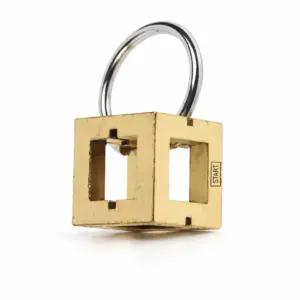
The Divine Power Puzzle Lock ($12.98) is a masterclass in this principle, using a rotating center column and deceptive keyways to teach your hands the feel of rotational alignment through pure, hands-on experimentation.

Divine Power Puzzle Lock — $12.98
Finally, consider false solutions and misdirection. A great puzzle box has red herrings—pieces that wiggle but don’t move, seams that look like panels but are fixed, or obvious features that are purely decorative. These exploit the solver’s assumptions and slow them down, making the true solution more rewarding. When prototyping, ask yourself: “What is the first thing someone will try?” Then, consider making that action possible but ultimately fruitless. This layer of psychological design is what separates a simple locked box from a true brain teaser.
Grasping these mechanics turns abstract design into executable engineering. If the theory feels dense, sometimes the best teacher is solving a professionally made box to see these principles in action. For a clear, tactile example of interlocking sequential moves, our guide on opening trick boxes without damaging them breaks down the solver’s experience, which is invaluable for understanding the maker’s responsibilities.
Step-by-Step: Building a Simple Slider Puzzle Box
Now, we move from theory to practice. This guide will walk you through constructing a classic three-step slider puzzle box—a perfect first project that embodies the core principles of sequential movement and misdirection. You’ll end up with a functional, satisfying box that opens only after three specific panels are slid in the correct order. We’ll use common tools and materials to keep it accessible.
Project Overview: We are building a 4″ x 3″ x 2″ lidded box where the top panel is locked by three sliding side panels (front, left, and right). The back panel is fixed. The solver must discover the correct sequence (e.g., Front → Right → Left) to release the top. Incorrect sequences will block the mechanism. The build time is roughly 4-6 hours, spread over a couple of days to allow for glue drying.
Step 1: Cutting the Primary Box Pieces
Start with 1/2″ thick poplar or birch plywood for stability. You’ll need six pieces:
* Top & Bottom: Two pieces at 4″ x 3″.
* Fixed Back: One piece at 4″ (height) x 2″ (depth).
* Three Sliders (Front, Left, Right):
* Front/Rear Sliders: Two pieces at 3″ (width) x 2″ (depth).
* Side Sliders: Two pieces at 4″ (height) x 2″ (depth).
Cut these as precisely as possible. A table saw with a miter gauge or a good-quality miter box and hand saw is essential. Sand all edges smooth with 220-grit sandpaper. Any imperfection here will cause friction or visible gaps later.
Step 2: Creating the Internal Track System
This is the heart of the puzzle. The sliders move within a track formed by internal rails. From 1/4″ square dowel stock, cut four rails to 4″ long and four rails to 2.75″ long.
- Assemble the Fixed Box: Glue and clamp the Bottom piece to the Fixed Back piece, forming a perfect 90-degree corner. Use a square to check alignment. This is your foundation.
- Install the Lower Rails: Once the bottom-back joint is dry, glue the long 4″ rails to the inside faces of the Bottom piece. Position them 1/4″ in from the front and side edges. They should run parallel to the sides. These rails create the channel that the Front and Side sliders will sit on and slide across.
- Install the Upper Rails: Now, glue the shorter 2.75″ rails to the inside of the Top piece. Position them identically: 1/4″ in from the edges. These rails will hang down and create the upper part of the track. Crucially, leave a 1/8″ gap at the back of each short rail where it meets the Fixed Back. This gap is your first piece of misdirection—it looks like a mistake or a potential catch, but it’s just a dead end.
Let this assembly dry completely under weight or clamps to ensure the rails are perfectly vertical.
Step 3: Designing the Locking Lugs
The sliders lock the top via small wooden lugs that interact with notches in the top’s rails. This is where you program the solution sequence.
- Create the Lugs: From scrap 1/4″ stock, cut three small blocks: one about 3/8″ long for the first step in your sequence, and two about 1/2″ long for the subsequent steps. Round the top edges slightly with sandpaper.
- Glue Lugs to Sliders: Decide your secret sequence. Let’s use Front (Step 1) → Right Side (Step 2) → Left Side (Step 3).
- On the Front Slider, glue the 3/8″ lug to its top, inner edge, centered left-to-right. This is the initiator.
- On the Right Side Slider, glue a 1/2″ lug about 1″ from its rear edge.
- On the Left Side Slider, glue the final 1/2″ lug about 1″ from its front edge.
The varying positions mean each slider can only move when the previous slider has cleared a path.
Step 4: Dry-Fit and Sequence Test
DO NOT GLUE THE SLIDERS OR TOP YET. This is your critical debugging phase.
- Place the Bottom/Back assembly on your bench. Slot the three sliders into place on their lower rails.
- Carefully lower the Top assembly (with its upper rails) onto the box. The sliders should now be captured between the upper and lower rails.
- Test the Wrong Paths: Try moving sliders out of sequence. The lugs should collide with the top’s rails, preventing the top from being lifted. You should feel a firm block.
- Test the Solution Path: Now, follow your sequence. Slide the Front panel. You should feel and hear its small lug pass through a notch or clear a path. Next, slide the Right Side panel. Its rear-positioned lug should now align with a gap created by moving the Front. Finally, slide the Left Side panel. If all three have moved correctly, all locking lugs should be disengaged. The top should now lift freely. If it doesn’t, examine where lugs are catching and adjust their size or position with a file or sandpaper.
Step 5: Final Assembly and Finishing
Once the mechanism works smoothly in dry-fit:
- Permanent Assembly: Apply a thin bead of wood glue to the joining edges of the Fixed Back and Bottom (already done) and the Top and its rails. Carefully reassemble the box in its solved state (all sliders moved, top seated). Clamp gently but firmly, ensuring the box remains square. Wipe away any squeeze-out with a damp cloth immediately.
- Let it Cure: Allow the glue to dry for at least 12 hours with the clamps on. The sliders will be temporarily glued in place—this is intentional.
- Release the Sliders: After the glue is rock-solid, use a flat-head screwdriver or a thin palette knife to gently break the dried glue bond holding each slider to the top/bottom rails. Work them free until they slide smoothly again. This step ensures the box is perfectly aligned when permanently fixed, eliminating any warp or shift that could occur if you’d glued it while open.
- Sanding and Finish: Sand the entire exterior with progressively finer grits up to 320. Apply a finish like Danish oil or paste wax. Avoid thick polyurethane, as it can gum up the fine tolerances in the sliding tracks.
Step 6: The Final Check and “The Tell”
Your box is complete. Test the solution sequence five more times. Consistency is key. Now, add “the tell”—a subtle, intentional clue for the solver. Perhaps a tiny, almost imperceptible chamfer on the edge of the first slider to be moved, or a slightly different wood grain alignment. This isn’t a flaw; it’s advanced design, giving a mindful solver a starting point without revealing the sequence. It transforms frustration into a guided discovery.
Common Pitfall: The most frequent failure is glue seepage into the sliding tracks during final assembly. To avoid this, use glue sparingly and keep it away from the inner edges where the sliders run. If a slider sticks, don’t force it. Use a razor saw to carefully cut through any glue bridge in the track.
This simple slider box teaches you everything about tolerances, sequential logic, and user experience. For your next challenge, consider integrating a rotational element. Studying a pre-made puzzle that uses a rotating column, like the Divine Power Puzzle Lock, can provide brilliant inspiration for how to translate a rotary motion into a linear release, a classic mechanism for your next, more complex build.
Troubleshooting Your Build: When Things Don’t Slide or Fit
You’ve cut, sanded, and assembled, but the slider won’t budge, or the lid sits crooked. Welcome to the most critical phase of puzzle box making: debugging. This is where you move from theory to tactile problem-solving. The most common issues stem from three areas: friction, alignment, and hidden obstructions. Your first instinct—to apply more force—is almost always wrong. Instead, diagnose systematically.
Start with the most frequent culprit: wood movement and swelling. If your workshop or assembly area is humid, thin wood parts can absorb moisture and expand just enough to lock everything up. If a slider worked during a dry fit but is now stuck, place the entire box near a gentle heat source (like a radiator on low or in a sunny, dry room) for a few hours. This often shrinks the wood back to its machined dimensions. Conversely, if your wood was extremely dry during cutting and you’re in a humid climate, applying a very light coat of paste wax or dry lubricant (like graphite powder) to the sliding tracks can work wonders. Never use liquid oils, as they can attract dust and gum up over time.
If swelling isn’t the issue, investigate alignment and squareness. Remove any non-structural panels if possible. Place the box on a perfectly flat surface and sight down the corners. Are the sides truly perpendicular? A box that’s even slightly out of square creates binding forces across the entire mechanism. This is often a result of clamping pressure during gluing. The fix may involve carefully disassembling and re-gluing with better clamping cauls, or for a less invasive approach, you can use a fine rasp to subtly adjust the inside of the track where the binding occurs. Work in tiny increments, test frequently, and remember: you can’t add material back.
Listen and feel for grit and debris. A single speck of sawdust or a tiny bead of hardened glue in the track will halt progress. Use a bright flashlight to peer into the channels. Often, you’ll see a shiny spot—a high point created by debris or a glue bridge. Carefully run a razor blade or a thin, rigid card (like a playing card) through the track to scrape it clean. For glue, a hobby knife or a razor saw blade (without the handle) can be gently worked into the gap to sever the bond. If you suspect a rough interior surface is the problem, wrap fine-grit sandpaper (220-grit or higher) around a thin, flat piece of wood and polish the track with a few light passes.
What if the mechanism works, but the sequence feels “mushy” or inconsistent? This usually points to excessive tolerance. The gaps between moving parts are too large, allowing pieces to wiggle and lose the precise engagement needed for a satisfying solve. While harder to fix post-build, you can sometimes shim the tracks. Glue a sliver of veneer or a strip of masking tape to the non-moving side of a channel to take up the slack. Test after each micro-adjustment. This process is finicky but teaches you more about precision than a perfect first build ever could.
Finally, consider design feedback. Is the puzzle simply too difficult because the clues are nonexistent? A box that feels “broken” might just be incomprehensible. Walk away, then come back and try to solve it as a naive user. If you can’t, you may need to add the subtle visual or tactile “tell” discussed earlier. Sometimes, the fix isn’t mechanical but psychological. For inspiration on elegant, user-friendly clues, studying a finished product is invaluable.
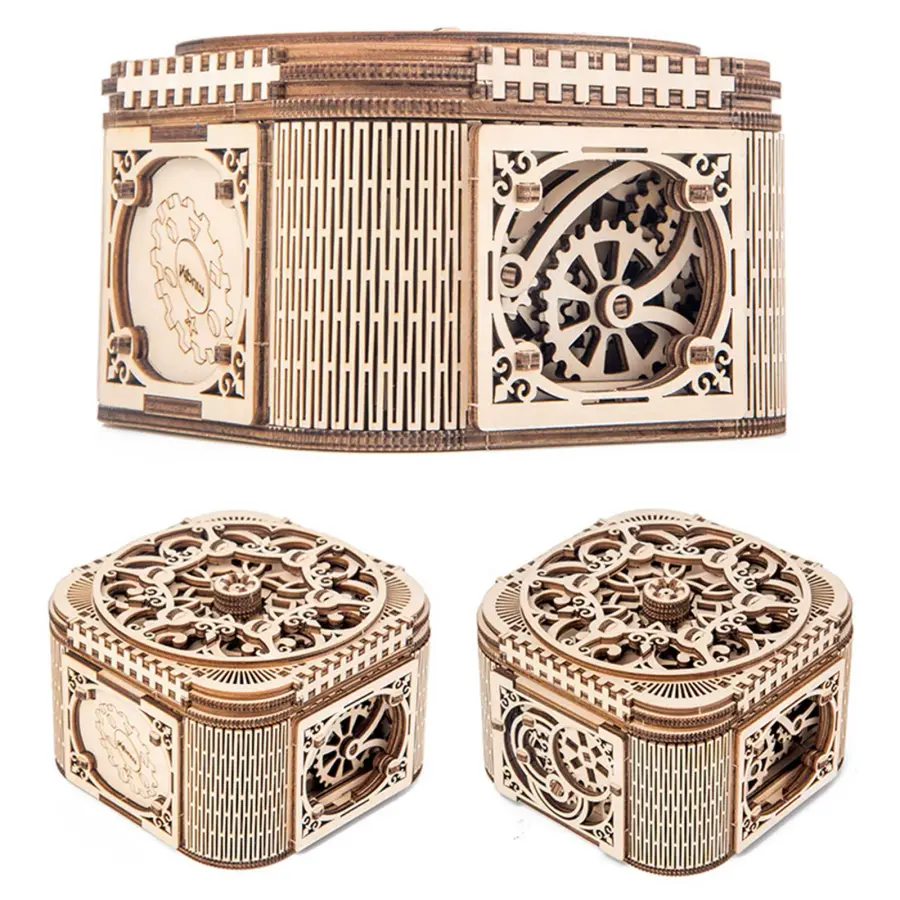
The 3D Wooden Puzzle Treasure Box ($29.99) provides a logical hint about its internal mechanism through visible gears, a principle you can adapt by leaving a purposeful sight line or an intentional sound clue in your own design.
When all else fails, walk away. Let the puzzle—and your frustration—sit overnight. Fresh eyes and hands often detect the issue immediately. This troubleshooting process isn’t a failure; it’s the deepest form of learning. Every stuck slider teaches you more about material behavior and precision than a dozen perfect builds.
Leveling Up: Designing Your Own Unique Mechanism
Once you’ve mastered a basic slider box, the real creative journey begins: designing your own unique locking mechanism. This is where you transition from builder to inventor, and it’s the most rewarding—and challenging—phase. The goal is to move beyond replicating known patterns to creating a novel interaction that delights and confounds the solver.
Start by studying the classics for inspiration, not for copying. Analyze why certain mechanisms are satisfying. The Divine Power Puzzle Lock, for instance, employs a brilliant sequence of misdirection with its rotating column and deceptive key trap. The satisfaction comes from the “aha!” moment when the solver realizes the obvious path is a dead end. Your design should aim for a similar moment of revelation. Ask yourself: What false assumption will my solver make? How can I subvert it elegantly?
Next, explore abstract mechanical principles. The Alloy S Lock Puzzle ($10.99) is a masterclass in spatial reasoning with a deceptively simple S-shaped path. Designing for a puzzle box, you might translate this into a three-dimensional maze inside a drawer, where a token must be maneuvered through a hidden channel to release a catch. The key is to isolate a single, clean mechanical idea—like a rotating cam, a shifting counterweight, or a sequential gear train—and build your entire box around it. Complexity for its own sake leads to frustration; elegant complexity feels like magic.

Alloy S Lock Puzzle — $10.99
Begin your design process on paper. Sketch the internal cavity and the movement path of every component. Use arrows to indicate direction, and shade areas that must remain solid. This forces you to think in three dimensions and spot interferences before you cut wood. A common rookie mistake is designing a mechanism that works in theory but is impossible to assemble because a screwdriver can’t reach a critical joint. Always plan your assembly sequence alongside your mechanism.
Finally, prototype in cheap material. Cardboard, foam board, or even layered cereal box cardboard is perfect for testing kinematics. Build a rough, full-scale model to verify movements, clearances, and the overall “feel” of the solve. Does the sequence have a logical flow? Is the final opening gesture satisfyingly distinct from the intermediate steps? This low-fidelity stage is where you’ll catch 90% of your design flaws. Only after your cardboard prototype solves smoothly should you commit to precision cuts in your final wood. This iterative, hands-on design process transforms a clever idea into a tactile, solvable reality.
The Assembly Alternative: When Building from Scratch Isn’t for You
Let’s be honest: the journey from a pile of raw lumber to a finished, trick-laden puzzle box is a massive commitment. It demands specialized tools, a dedicated workspace, and dozens of hours of patient trial and error. For many enthusiasts, the deep satisfaction is in the solving, not the sawing. If you’re nodding along, your ideal path isn’t building from scratch—it’s curated assembly. This approach gives you all the hands-on joy of creation and the intellectual reward of a complex mechanism, but with the precision engineering and guaranteed solvability that comes from a professional kit.
Think of it like the difference between forging your own sword and expertly assembling a legendary katana from master-crafted parts. One is a blacksmith’s art; the other is a focused, deeply engaging craft that delivers a flawless functional artifact. Kits eliminate the variables of material warping, imprecise cuts, and mechanism dead-ends. Your focus shifts entirely to the logic of construction and the beauty of the finished piece. This is where our selection of premium wooden puzzle kits shines, offering graduated challenges that respect your time and intelligence.
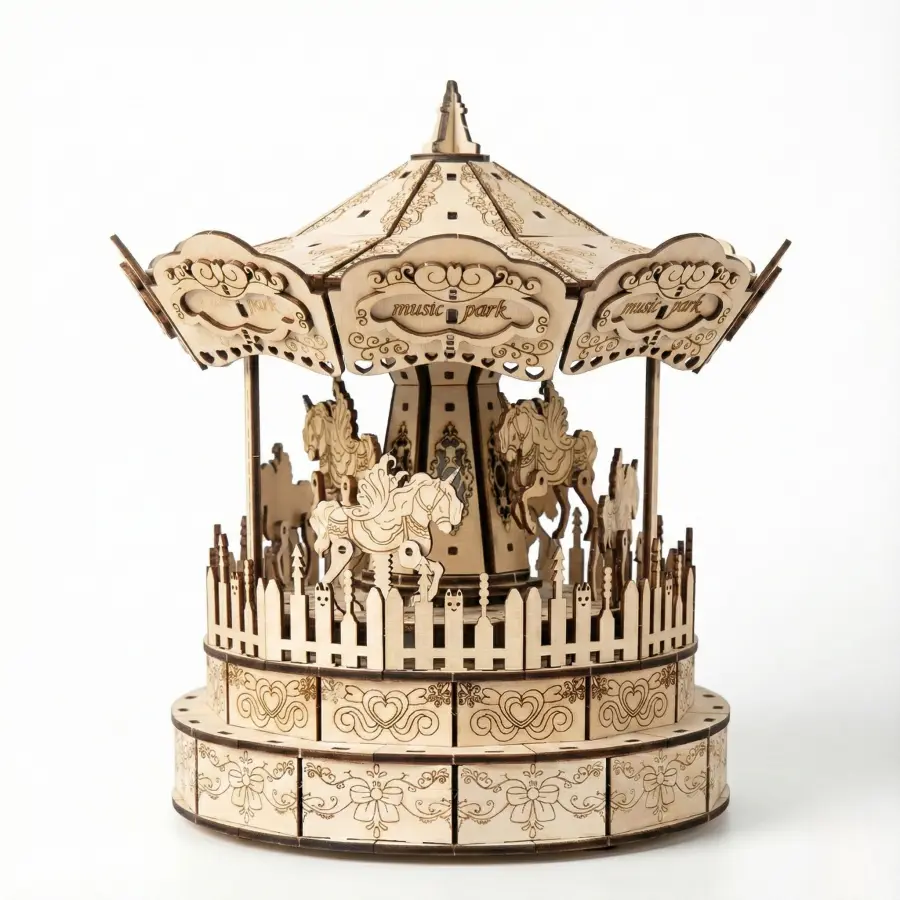
For the ultimate entry into this world, start with the 3D Wooden Carousel Music Box ($43.99). This isn’t just a puzzle box; it’s a kinetic sculpture you build. The 281 laser-cut pieces fit together without glue, following a logical assembly sequence that teaches core principles of gears, axles, and cam mechanisms. As you snap each piece into place, you’re literally constructing the puzzle’s solution from the inside out. The final “aha” moment isn’t a hidden catch, but the wind of the key and the magical rotation of the carousel to a classic melody. It’s a 2-4 hour project that results in a stunning display piece, perfect for understanding how mechanical puzzles feel in motion. If you’ve ever wondered about the clockwork inside a music box, this kit lets you build it with your own hands.
Once you’ve mastered that mechanical foundation, level up to a true secret-keeping challenge.

The DIY Castle Music Box Night Light Shadow Box Kit ($33.99) combines layered puzzle-building with atmospheric design. Here, the “puzzle” is in the meticulous, three-dimensional assembly of the castle facade, which conceals the music box mechanism and LED light array. Following the layered plans requires spatial reasoning and patience, as you create depth and shadow play. The reward is dual: the satisfaction of completing a complex architectural model and a functional, enchanting night light that brings your puzzle-solving effort into your daily decor. It bridges the gap between a pure logic challenge and a tangible art project.
For those whose primary love is the pure, tactile “click” of discovery, a dedicated puzzle box is the grail.
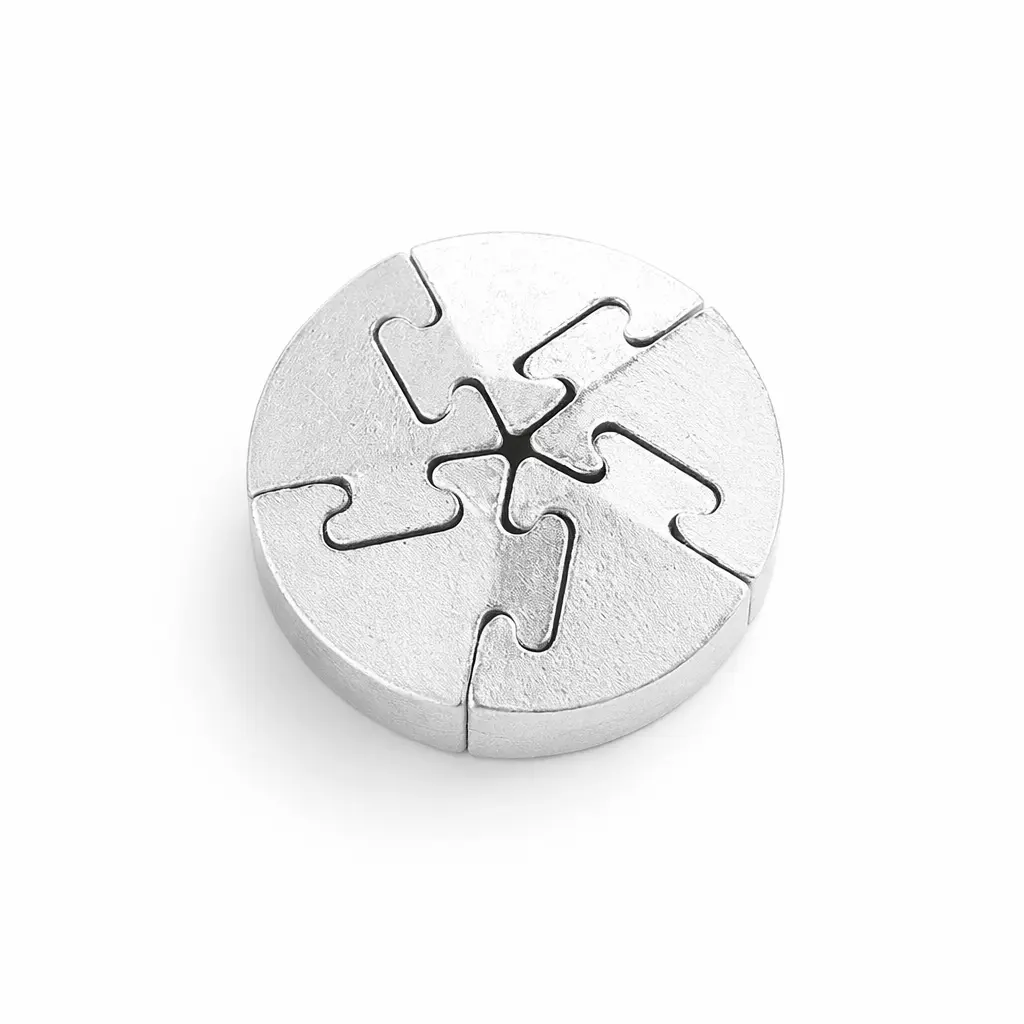
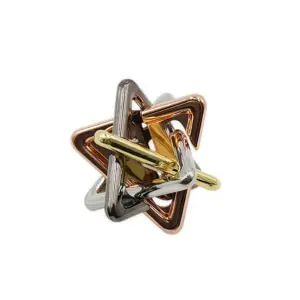
While not a box, mastering the 5 Piece Cast Spiral Metal Puzzle trains the exact deductive reasoning you need. This compact, all-metal brain teaser teaches you to analyze subtle asymmetries and sequential dependencies—the very heart of any good puzzle box mechanism. Its solution relies on finding the one piece with a different movement property and then discovering the single correct rotational sequence to reassemble it. Keeping this on your desk is like daily calisthenics for the puzzle-solving part of your brain. When you later encounter a wooden trick box with sliding panels, you’ll be primed to search for similar hidden sequences and dependencies.
So, who is the build-from-scratch path actually for? It’s for the tinkerer with a fully-equipped workshop for whom the process of fabrication is as rewarding as the solved puzzle. If your goal is to spend weekend afternoons deeply engaged in a single, gorgeous project that ends with a solvable treasure, then a high-quality kit is your most rewarding and reliable route. You bypass the frustration of flawed prototypes and invest your time directly into the joy of guided creation and the guaranteed payoff of a perfect, puzzling finish.
Your Next Challenge: From Builder to Solver
The journey from building a puzzle box to solving one is a natural and deeply satisfying progression. You’ve learned the principles of hidden movement and sequential logic from the inside out. Now, it’s time to experience that same cleverness from the other side—as a solver, where the mystery is complete and the revelation is earned. This shift in perspective is where you truly appreciate the artistry of a well-designed mechanism, feeling the same “aha!” moment you engineered for someone else.
To bridge this gap, start with a puzzle that rewards observation and patience over sheer dexterity. The Divine Power Puzzle Lock is a perfect first step. This isn’t a box, but its soul is identical: a series of interlocking parts that must be manipulated in a precise, often non-obvious, sequence. Solving it teaches you to think like a designer, feeling for internal catches and visualizing how rotations affect hidden alignments. The moment the lock handle finally releases is the same cathartic click you built into your sliding panels.
Once you’ve honed that sequential logic, graduate to a true container puzzle. The 3D Wooden Puzzle Treasure Box is your ideal next challenge. Assembling this kit—which requires no glue and results in a beautiful, functional box with visible gears—is a masterclass in mechanism assembly. More importantly, once built, it becomes a traditional puzzle box for you (and anyone you gift it to) to solve. You’ll recognize the design principles you studied earlier, like interlocking sliders and gear-driven latches, but now they are a complete, polished mystery to crack. For detailed techniques on approaching these beautiful wooden enigmas, our guide on opening trick wooden boxes without damage is an essential companion.
Finally, for the purest, most refined test of your newfound solver’s intuition, seek out a puzzle that strips everything back to flawless mechanics. This is where the Alloy S Lock Puzzle shines. With no decorative frills, its challenge is absolute. Solving it feels like listening to a master designer speak directly through geometry and friction. The satisfaction is profound because the interaction is so pure. When you solve a puzzle of this caliber, you’re not just moving pieces; you’re completing a conversation started by its creator, a dialogue built on logic, surprise, and elegant resolution. It’s the full-circle moment for anyone who has journeyed from making a puzzle to mastering one.
Frequently Asked Questions for Aspiring Makers
I’ve never built anything before. Is this a realistic first project?
It depends on the path you choose. Building a puzzle box from raw lumber using plans like those from Woodsmith is a significant undertaking that requires intermediate woodworking skills and tools. A much more accessible and highly recommended starting point is a precision laser-cut kit. These kits, like the 3D Wooden Carousel Music Box, provide all the pre-cut pieces and clear instructions. You focus on the logic of assembly and the joy of seeing a complex mechanism come to life, without needing a workshop full of tools. It’s the perfect way to build confidence and understand fundamental mechanisms before ever picking up a saw.
What’s the most common mistake beginners make when designing their first box?
Overcomplicating the mechanism. The urge to add five sliders, two rotating panels, and a hidden magnet latch is strong, but it almost always leads to a box that binds up and fails. Start with a single, reliable mechanism. A classic two-step slider or a simple pin-and-groove lock is far more impressive when it works smoothly than a complex one that doesn’t. Focus on perfecting the fit and feel of that one interaction. For inspiration on elegant, functional mechanisms, browsing the history of Yosegi puzzle boxes on Wikipedia reveals how masters achieve depth through artistry, not just mechanical complexity.
How do I make the moving parts slide smoothly without getting stuck?
This is the craftsman’s secret. Even with laser-cut precision, a light sanding of all mating edges with fine-grit sandpaper (220 grit or higher) is non-negotiable. It removes the microscopic laser char that causes friction. For wooden builds from scratch, the fit should be “snug” but not “forced.” As noted by a woodworker on Reddit, it’s better to be a hair loose and use a dry lubricant like paraffin wax or graphite powder on the contact surfaces than to have parts fit too tightly. The wax fills minor imperfections and creates a silky-smooth action.
Can I use a hot glue gun to assemble a wooden puzzle kit?
Absolutely not. Hot glue creates thick, inflexible seams that will throw off critical tolerances and prevent parts from moving. It’s also not durable. All quality wooden puzzle kits are designed for a press-fit or interlocking assembly, sometimes using wood glue only on static, structural joints (and the instructions will specify where). The moving parts must remain glue-free. If you feel you must secure a piece, use a tiny drop of PVA (white) wood glue and wipe away any excess immediately.
What’s the difference between a puzzle box and a regular box with a lock?
The core difference is intellectual versus physical access. A locked box requires a key or a code—an external secret. A puzzle box is the lock; the solution is discovered through direct manipulation of the box itself. The mechanism is integrated and often disguised. You don’t open it, you solve it. The satisfaction comes from the “Aha!” moment of discovering the hidden sequence, not from inserting a key. For a deep dive into how these clever mechanisms work, HowStuffWorks has an excellent primer on the principles behind them.
Are metal puzzles and wooden puzzle boxes solved the same way?
The logical principles are similar—looking for hidden moves, understanding spatial relationships—but the tactile experience and design philosophy differ. Metal cast puzzles like the Divine Power Puzzle Lock are often about discovering a single, counterintuitive disassembly path. Wooden puzzle boxes usually involve a sequence of moves (slides, presses, rotations) to release a latch. Working on both types cross-trains your brain. The tactile feedback from a metal brain teaser hones your feel for precise movement, which directly helps you diagnose when a wooden slider is binding or has a hidden release point.
I want to make a puzzle box as a gift. How do I make it meaningful?
Incorporate a personal “secret.” This could be designing the solution sequence to match a special date (e.g., slide right 3 times for March, then left 12 times for the 12th), using wood from a meaningful source, or laser-engraving a hidden message inside the compartment. The gift becomes a story and an experience, not just an object. For a stunning pre-designed gift that feels deeply personal, the DIY Castle Music Box Night Light offers a shared building experience and becomes a permanent, magical heirloom with light and music.
How can I test my puzzle box design before committing to final materials?
Prototype, prototype, prototype. Use cheap, easy-to-work materials like foam board, cardboard, or even layered cereal box cardboard. This allows you to test the mechanism’s logic, sequence, and tolerances rapidly. You’ll quickly see if a slider path is too long or a latch doesn’t engage properly. It’s far less frustrating to adjust a cardboard prototype than to remake a piece of walnut. This iterative design process is used by professionals and hobbyists alike, as discussed in communities like r/PuzzleBox.
Where can I find plans or ideas for my next build?
Beyond commercial plans, look to historical and cultural sources. The Japanese Himitsu-Bako (secret box) tradition is a rich well of inspiration. Museums with decorative arts collections often have examples online. Books like Puzzles Old and New detail classic mechanisms. For a modern, hands-on exploration of different puzzle types that can spark design ideas, our resource on puzzle box mechanisms and family fun connects the dots between play, history, and design.
Is puzzle-making an expensive hobby?
It can be scaled to any budget. Starting with a sub-$15 metal puzzle or a $30 wooden kit requires only your time and attention. Scaling up to full woodworking involves tool costs. However, the core of the hobby—the design thinking, the problem-solving, the joy of creation—is free. You can sketch mechanisms forever. The real investment is patience and curiosity, not money.
Where to Go from Here: Tools, Kits, and Community
The journey from solving to making is a deeply personal one. Whether you’re now inspired to pick up a chisel or simply want to appreciate the craft on a deeper level, here are concrete next steps.
For the Aspiring Maker: Start with a dedicated, small-scale project. A great bridge between solving and building is a kit that focuses on mechanism over mass. The DIY Castle Music Box Night Light Shadow Box Kit is a perfect example. It’s less about raw woodworking and more about assembling a beautiful, functional mechanism with