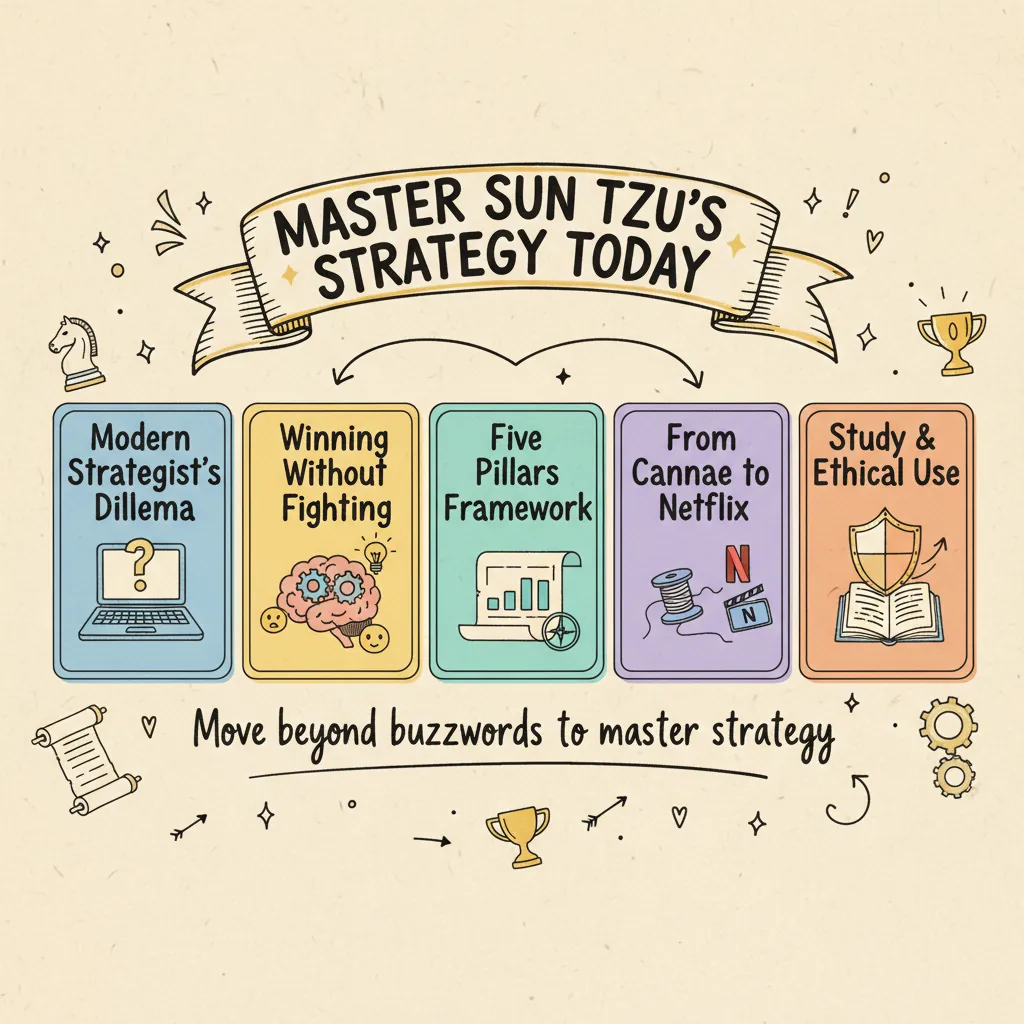
The Laptop Strategist’s Dilemma: An Ancient Text in a Modern Feed
The silence in the boardroom is a physical thing. Across the table, the lead investor’s fingers are steepled. Your startup’s future, the work of three years, hinges on the next ninety seconds of your pitch. You’ve modeled every scenario, prepped for every objection, but the terrain has shifted. An unexpected question hangs in the air. This isn’t about features; it’s a test of your systemic view. Do you attack directly, defend your position, or feint and redirect?
Over 2,500 years ago, a Chinese general named Sun Tzu argued the core principles behind this moment were already timeless.
You’ve likely seen his book’s title float through your digital feeds—sandwiched between leadership hacks and productivity tips. The Art of War. It’s invoked in NFL locker rooms, Silicon Valley boardrooms, and political war rooms. Its phrases—“know your enemy,” “win without fighting”—have been worn smooth into corporate buzzwords, often stripped of their deadly serious context. This creates a modern dilemma. You sense there’s profound strategy here, a key to navigating your own professional and personal conflicts. But between the ancient prose and the pop-culture noise, how do you move from recognizing the title to wielding its insight?
Is a military treatise from the 5th century BC still relevant today to a project manager, a founder, or a coach? Or is it, as some dismiss, just elegant common sense?
This article starts from a simple premise: most people get Sun Tzu backwards. They mine the text for clever tactical tricks—the equivalent of memorizing chess openings without understanding positional play. The true power of The Art of War isn’t in its maxims but in its philosophy—a complete framework for strategic thinking that separates victory from violent struggle. It is less a book about conflict and more a manual on making conflict unnecessary.
We will move beyond the myth and the jargon. We’ll deconstruct its central, radical idea of winning through strategic leverage rather than force. We’ll translate its five strategic pillars into a modern context you can apply, whether your battlefield is a quarterly review, a competitive market, or a personal goal. And, crucially, we’ll provide a map for the journey itself: how to choose among the best translation of The Art of War, how to read it, and how to avoid its common misuses.
The journey begins not in a war chariot, but in that quiet, tense room where strategy is born. Let’s lay our plans.
Sun Tzu and the Silent Army: Separating Man from Manual
So, if the true power lies not in a collection of tricks but in a foundational philosophy, where does this philosophy come from? The figure of Sun Tzu himself is a perfect opening gambit in the art of strategic deception. We think we know him: the ancient, all-knowing general, author of the ultimate playbook. The historical reality is more fragmentary—and far more interesting.
Traditionally attributed to Master Sun (Sun Tzu), a strategist of China’s fractious Eastern Zhou period (c. 5th century BCE), the text likely crystallized over centuries. Think of it less as a solitary genius’s manifesto and more as the refined voice of a silent army—generations of military thought, logistics, and hard-won experience distilled into 13 stark chapters. The man, if he existed as a single figure, vanishes into the manual. This is crucial: it frees us from seeking biographical secrets and directs us to the systemic wisdom itself.
The textual journey mirrors this mystery. Our oldest physical fragments are the Yinqueshan Han slips, bamboo strips unearthed in 1972 and dating to about 140-118 BCE. These reveal a text already in circulation, being studied and annotated. Centuries later, in 1080 CE, Emperor Shenzong of Song formalized it as one of the essential Seven Military Classics, cementing its doctrinal authority. Each discovery and endorsement acts not as a revelation of a lone author, but as a waypoint in the text’s long campaign across history.

Engaging with The Art of War, therefore, is akin to solving an intricate ancient Chinese puzzle lock—a concept familiar to collectors of historical mechanisms. You are not handed a key, but a system of interrelated pressures and constraints. The text functions similarly; its power emerges from the interaction of its parts, not from a single “secret” chapter. You must feel for the tension points, much like the artisans who followed texts like the Lu Ban Jing for ancient carpentry to create complex joinery without a single nail.
So, we set aside the fruitless hunt for the “real” Sun Tzu. The enduring figure is the synthesized strategist, a persona built for one purpose: to communicate, with ruthless clarity, a complete system for approaching conflict. This shifts our question from “Who wrote this?” to “What does this voice, hardened in the crucible of the 5th century BC and refined over millennia, insist we understand about the nature of competition itself?” The answer begins with the most radical idea in the entire military treatise: winning without a fight.
The Central Riddle: What ‘Winning Without Fighting’ Actually Means
That voice from the ancient Chinese military treatise, hardened and refined, does not begin with tactics. It begins with an audacious, counterintuitive ideal that redefines what victory even is: “The supreme art of war is to subdue the enemy without fighting.” This is not an opening flourish. It is the book’s thesis statement, the gravitational center around which all 13 chapters orbit. Yet, it is also the most frequently misunderstood of all The Art of War principles, often mistaken for a plea for pacifism or a mere clever trick. It is neither. It is the ultimate expression of strategic leverage.
Think of it not as avoiding conflict, but as rendering direct, bloody confrontation obsolete. Why waste precious resources—your energy, morale, and time—in a chaotic clash when you can engineer the conditions for victory beforehand? Sun Tzu frames war not as an event, but as the final, often unnecessary, step in a long process of positioning. To “win without fighting” is to cultivate such overwhelming advantage in the preparation, understanding, and shaping of the situation that your opponent’s defeat becomes a foregone conclusion. The actual battle is just the paperwork.
How does this work in practice? Let’s use the consultant’s favorite metaphor: gardening. You don’t fight weeds head-on every day. You shape the terrain. You nourish the soil for your desired plants, you lay mulch to suppress competitors, and you position your garden to receive optimal sunlight. By the time a weed sprouts, the ecosystem is already stacked against it. Your victory was secured months earlier, through systemic design. In Sun Tzu military strategy, this “gardening” is the relentless work of understanding the political, moral, and physical landscape—the “shi” or strategic power—and arranging it so your forces flow like water through the path of least resistance, while your opponent is left struggling uphill.
This is where the board game Go provides a perfect analogy. In Go, you do not “kill” your opponent’s pieces directly. You encircle them. You gradually expand your influence, control key intersections, and shape the board’s emerging territories. A group of stones dies not in a fiery clash, but when it is silently suffocated, its liberties removed by your prior, superior positioning. The capture is merely the acknowledgment of a strategic death that occurred moves ago. This is “winning without fighting”: the systemic creation of inevitability.
So, what are the practical levers for creating this inevitability? They are the core tools in the strategist’s kit, all aimed at the opponent’s will and capacity to resist.
- Morale: This is the first and most fragile terrain. “Attack the enemy’s strategy,” Sun Tzu advises, before armies even meet. Undermine alliances, spread dissonance, present a vision of the future so bleak or futile that resistance seems pointless. History is littered with armies that surrendered intact because their will to fight was systematically eroded. In a modern boardroom, this translates to shaping the narrative before a negotiation even starts, aligning stakeholders, and making your preferred outcome feel like the only logical path forward.
- Alliances: Isolate your opponent. Deny them resources, partners, and support. Your strength is not just your own, but the sum of the relationships you’ve cultivated and the ones you’ve severed for your rival. This is strategic leverage in its purest form.
- The Unorthodox: Employ unexpected moves that disrupt your opponent’s plans and psychology. This isn’t mere deception for deception’s sake; it’s about controlling the tempo and framework of the conflict, forcing them to react to your choices on your chosen ground. You exhaust them not with battle, but with confusion and adaptation.
- Terrain (Literal and Metaphorical): Choose where—and if—a confrontation happens. Lure a superior force into a narrow pass where numbers become a liability. In business, shift the competition to a field where your unique strengths (innovation, customer service, supply chain agility) are the decisive factors, and their advantages are nullified.
The ethical question naturally arises: Is this manipulation? The text is ruthlessly pragmatic, not moralistic. Its primary ethic is efficiency and the preservation of one’s own forces and state. The greatest victory is one that leaves you stronger, your resources intact, and the conquered territory usable, not smoldering. “To win one hundred victories in one hundred battles is not the acme of skill,” Sun Tzu writes. “To subdue the enemy without fighting is the acme of skill.” The general who achieves this isn’t a pacifist; he is the ultimate economist of force.
Therefore, when a modern reader asks, “Is it just common sense?” they touch on a profound point. The genius of The Art of War is not in revealing alien secrets, but in providing a structured, systemic framework for what the most effective leaders have always sensed instinctively. It gives names and relationships to the pressures we feel in any competition. It turns vague notions of “advantage” into a mappable systemic view of morale, terrain, alliances, and energy. It argues that true strategy happens long before the first move is made in the open—in the quiet, deliberate work of making that move, when it finally comes, decisive.
The Five Pillars: A Modern Translator for Sun Tzu’s Framework
So if the text provides a framework, not just epigrams, what does that framework actually look like? New readers often balk at the chapters—thirteen of them, with titles like “Weak Points and Strong” that feel both obvious and cryptic. Here’s the secret: you don’t need to memorize a list. Think of the work not as a checklist, but as a strategic operating system built on five interlocking pillars. By synthesizing the chapters this way, we move from summary to utility.
1. The Strategic Calculus: Know, Don’t Assume
This pillar consolidates the foundational chapters on planning. Sun Tzu’s famous dictum, “Know the enemy and know yourself,” is not a team-building exercise. In its original context, it was a brutal systemic view reliant on espionage and ruthless self-audit. It means understanding your opponent’s character (is their commander prudent or rash?), their logistical capacity (how far can their supply lines stretch?), and the political terrain they operate in. For you, the modern commander, it’s the discipline of market research, of knowing a competitor’s cash burn rate, or of honestly assessing your own team’s morale before a product launch. The common misuse? Treating it as a vague call for awareness. The real requirement is a continuous, almost obsessive, gathering of intelligence to fuel a cold, probabilistic calculation of victory. It is the art of replacing hope with data.
2. The Economics of Conflict: War is a Tax on Folly
Sun Tzu dedicates an entire chapter to the cost of war, a startlingly modern concept. He saw campaign prolongation as a national catastrophe, draining the treasury and inviting rebellion. The modern analogy isn’t just budget overruns; it’s the startup burning through venture capital in a feature war, the lawyer running up bills in a petty lawsuit, or you wasting emotional energy in a protracted personal dispute. This pillar teaches strategic leverage: every action must be measured against its consumption of your most precious resources—time, capital, focus, and political will. Victory that bankrupts you is a form of defeat.
3. The Primacy of the Unorthodox (Qi): Be Unpredictable, Not Unreliable
Here we delve into tactical dispositions and the use of energy. Sun Tzu distinguishes between the zheng (orthodox, direct force) and the qi (unorthodox, indirect maneuver). They are interdependent, like the fixed rules of a board game and the creative moves within them. The orthodox is your standard operating procedure, your core product line, your reliable strength. The unorthodox is the surprise pivot, the feint, the unconventional alliance. The misuse is believing “unorthodox” means chaotic or deceitful in a petty way. In truth, it is a calculated deployment of surprise to unbalance an opponent who has prepared only for your orthodox moves. It’s Netflix shifting from mailing DVDs to streaming, a zheng-to-qi transformation that reshaped the entire terrain.
4. Positioning: Winning is Inevitable Before the First Move
This pillar, drawn from chapters on terrain and maneuver, is about proportional response and setting the conditions. Sun Tzu argues the skilled general positions his army such that victory is assured before battle is joined, like water flowing effortlessly downhill. The modern analogy? It’s choosing to compete in a market niche where your small size is an agility advantage, not a weakness. It’s a coach putting a left-handed pitcher against a lineup of left-handed batters. It’s you preparing for a difficult conversation by choosing a neutral, private setting. You are shaping the battlefield—literal or metaphorical—to amplify your strength and neutralize your opponent’s. The action itself becomes a formality.
5. Momentum and Indirect Force: Shape, Don’t Shove
The final pillar synthesizes the text’s later focus on exploiting momentum and using psychological force. Sun Tzu favored attacking the enemy’s strategy (through alliances or deception) and morale over their fortified walls. Why lay siege when you can induce surrender? In modern terms, this is the art of strategic leverage through influence. It’s a company winning by shaping industry standards, not just by having a better product. It’s a politician framing a debate’s terms so effectively their opponent’s arguments sound off-key. It requires patience and the perception to spot the critical pivot point—the “hinge of fate”—where a small, well-timed action creates disproportionate results. You are not meeting force with force; you are redirecting the existing forces in the system to work for you.
These five pillars form a cycle, not a ladder. The calculus informs the economics, which demands unorthodox thinking to secure positional advantage, which is then exploited through momentum. This is the systemic view that elevates The Art of War from a list of clever sayings to a manual for coherent action. It answers the skeptic: the value isn’t in any single line, but in the interconnected architecture of thought that forces you to consider cost, intelligence, positioning, and psychology as one dynamic whole.
Tracing a Thread: From Cannae to Netflix – How One Principle Shapes Reality
That systemic view becomes truly powerful when we see a single strategic thread woven through centuries. It’s the difference between reading about leverage and watching a master use a fulcrum. Let’s isolate one principle from Sun Tzu’s military treatise that ties his pillars together: “Thus the skilled commander shapes the enemy; he is not shaped by them.” It’s a directive of active, creative control. How does this move from parchment to reality?
Consider the classic game of chess. A novice reacts to threats. A grandmaster, however, orchestrates the board’s potential. They don’t just defend a piece; they maneuver so that their opponent’s most aggressive-looking move plays directly into a trap they began setting ten moves prior. They shape the opponent’s perception of advantage, guiding them into a fatal funnel. This is the essence of Sun Tzu’s principle in a game of pure strategy.
For a brutal, historical application, look to the Battle of Cannae (216 BCE). The Carthaginian general Hannibal was outnumbered by the Roman legions. A direct force-on-force clash was suicide. So, he shaped the battlefield and, crucially, shaped Roman expectations. He placed his weakest troops in a bulging center and his veterans on the wings. The Romans, confident in their crushing frontal assault, drove into the center, which deliberately yielded. As the Roman formation compressed into the pocket, Hannibal’s strong wings pivoted inward, encircling the entire Roman army. The Romans were not merely defeated; they were shaped into the precise configuration—a dense, immobile mass—that made their annihilation inevitable. Hannibal won by designing the conflict, not just fighting it.
Now, transpose this from the dust of Apulia to the digital terrain of the 21st century. The question of relevance today finds its answer here.
Netflix versus Blockbuster is Cannae in khakis and a polo shirt. For years, Blockbuster defined the video rental “battlefield”: physical stores, late fees, new-release walls. Netflix, under Reed Hastings, refused to be shaped by this terrain. Instead, it created a new one. It shifted the conflict from “convenient location” to “convenient delivery” (mail-order), and then, decisively, from physical object to digital stream. Blockbuster saw Netflix as a niche mailing service, then a peripheral streaming experiment. By the time Blockbuster realized the core conflict had been reshaped—from renting movies to owning living-room entertainment time—it was the Roman legions, hopelessly deep in the wrong valley, surrounded by forces it couldn’t engage. Netflix didn’t attack Blockbuster’s stores; it made the store irrelevant. It won, in essence, without fighting a head-on battle for retail space.
So, is it just common sense? In hindsight, perhaps. But Sun Tzu’s framework provides the anticipatory lens. It forces the question: Am I reacting to my competitor’s game, or am I designing the game itself? It’s not about a “life hack” to crush your enemies. It’s a disciplined method of analysis: map the terrain (market, relationship, personal goal), understand the dispositions (your habits, their assumptions), and then seek to maneuver in a way that structures the coming interaction to your advantage. You shape through psychology, through alternative offerings, through redefining the rules.
Whether leading a legion or a startup, the principle is immutable. The commander—or CEO, or coach—who masters this doesn’t just win battles. They design the war before the first shot is even fired.
Choosing Your Weapon: A Guide to the Translations (Beyond Giles)
So you’re convinced there’s more to this ancient text than corporate buzzwords. You’re ready to engage with the source. This is where most curious readers falter, confronted by a dozen different editions. Which The Art of War is your Art of War? The choice of translation is not a minor detail—it is your chosen terrain for understanding. A clumsy translation turns profound strategy into confusing platitudes; a great one opens a clear window into a 5th-century BC commander’s mind.
Think of it this way: you wouldn’t use a detailed, historical map of the Yangtze River to navigate a modern highway system, nor would you use a tourist brochure to plan a military campaign. Each translation is a different map, drawn for a different purpose. Your goal dictates your tool.
Let’s survey the landscape of the major English translations, moving beyond the default. We’ll compare four pivotal versions: the foundational Giles, the accessible Cleary, the literary Minford, and the philosophical Ames.
The Bedrock: Lionel Giles (1910)
This is the public domain cornerstone. Giles, a British museum curator, produced a work of immense Victorian scholarship. His prose is formal, his footnotes copious, and his commentary leans heavily on classical Chinese commentators. This is the translation you likely encountered online for free (for instance, at The Internet Classics Archive).
* Prose Style: Archaic, precise. (“The art of war is of vital importance to the State.”)
* Best For: The purist and historical hobbyist who wants to feel the weight of age and see how the West first seriously engaged with the text. His notes are a journey into traditional Chinese military thought.
* The Catch: The language can feel stiff to a modern reader. It sometimes prioritizes literal precision over fluid strategic concept.
The Bridge: Thomas Cleary (1988)
Cleary, a prolific translator of Asian philosophies, aimed for clarity and accessibility. He strips away the Victorian veneer and presents the text as a coherent, flowing military treatise. His great strength is contextualizing Sun Tzu within the broader stream of Chinese strategic thought, often linking it to Taoist concepts.
* Prose Style: Clear, direct, and modern. (“War is a grave affair of the state.”)
* Best For: The first-time reader and the business professional who wants the core principles without wrestling with 19th-century syntax. It’s the most commonly recommended “first read.”
* The Catch: In striving for accessibility, some nuance and poetic resonance of the original can be flattened.
The Literary Event: John Minford (2002)
Minford, a renowned sinologist, approached the text as a work of world literature. His translation is dynamic, almost theatrical. He uses punchy, vivid language and includes fascinating appendices, linking Sun Tzu to everything from Star Wars to guerrilla warfare. This is a translation that feels strategic.
* Prose Style: Energetic, aphoristic, and powerful. (“War is the Great Affair of state, the field of life and death, the road to survival and extinction.”)
* Best For: The re-reader, the writer, or anyone who wants to feel the text’s enduring power and rhetorical punch. It’s exhilarating.
* The Catch: His interpretive flair is so strong that scholars sometimes debate where Sun Tzu ends and Minford begins. It’s less a neutral window and more a passionate guided tour.
The Philosopher’s Lens: Roger Ames (1993)
Ames, a comparative philosopher, provides the most academically rigorous version. His introduction is a masterpiece of context, and his translation meticulously highlights key philosophical Chinese terms, often leaving them untranslated (shi, xing, zheng). This is a book about how ancient Chinese thought about conflict.
* Prose Style: Precise, analytical, and terminologically dense.
* Best For: The scholar, the deep-dive student, or anyone who wants to understand the underlying ancient Chinese worldview. It’s less a strategy manual and more a cultural excavation.
* The Catch: It can feel like a textbook. The focus on philosophical accuracy can momentarily obscure the practical strategic advice for a casual reader.
So, which is the best translation of The Art of War for you?
If you are a first-time reader seeking practical insight: start with Cleary. It’s the most straightforward on-ramp.
If you are a re-reader or literary enthusiast wanting to feel the text’s power: Minford will transform your understanding.
If you are a history buff or student wanting scholarly depth: pair Giles with Ames for a complete picture of translation evolution and philosophical grounding.
The supreme art of reading Sun Tzu is to choose the translation that subdues the confusion without fighting the text. Your strategy begins with picking the right map.
The Strategic Mind Gym: How to Actually Read and Study This Book
With the right translation chosen—your map in hand—you now face the terrain of the text itself. This is where most readers falter, expecting to consume wisdom when they are meant to construct it. How to read The Art of War is a more important question than what translation you hold. You do not read this book; you engage with it. You do not finish it; you begin a practice. Think of it not as a book, but as a strategic mind gym.
The supreme art of study is to engage the text without fighting your own impatience.
So, how long does it take to read? You can scan the 13 chapters in an afternoon. To understand them? A lifetime. The text’s density is its feature, not a bug. Each passage is a compacted algorithm for strategic thought, waiting to be unpacked through reflection and application. This is why it defies the “just common sense” critique—it provides the systemic view and disciplined framework that raw instinct lacks.
Here is a practical four-step method for a single chapter, turning passive reading into active training:
- Read & Observe: Read one chapter slowly. Underline nothing on the first pass. Just listen. Imagine you are receiving a briefing. What single idea or phrase resonates or puzzles you?
- Reflect & Translate: Now, reflect. What did Sun Tzu’s original audience—a 5th century BC ruler or general—need to understand? Then, translate: What is the modern, metaphorical “terrain”? In “Laying Plans,” the “Moral Law” might become company culture; in “Tactical Dispositions,” preparing an invincible position might be building a robust personal savings account.
- Journal a Parallel: This is the core workout. Apply the chapter’s central thrust to a current, non-military challenge. Facing a difficult negotiation? How does “Attack by Stratagem” advise you to secure victory without a direct, confrontational “battle” at the table? Planning a career move? How does “Maneuvering” advise on the friction and logistics of your transition? This forces the ancient Chinese philosophy off the page and into your cognitive machinery.
- Discuss & Debate: Sun Tzu’s teachings were debated for centuries in commentaries. Share your journal entry with a trusted colleague or study partner. Disagreement is data. It tests the strength of your strategic analogy.
This process turns the book into a study guide for your own life. It moves you from what Sun Tzu said to how he thinks.
Some minds learn best not through abstraction, but through tactile struggle—through the physical manipulation of a problem that has no solution until you understand its underlying principle. It’s why I often keep a traditional puzzle on my desk.

Working on a Luban lock, as explored in pieces like When A Puzzle Becomes A Practice, teaches you ancient principles for puzzle solving. You learn to stop forcing solutions—to study the system, understand its pressures and leverages, and find the move that resolves tension gracefully. It is a silent, physical tutor in the very principle of ‘winning without fighting’ the puzzle pieces. Sun Tzu’s text is the literary equivalent.
For a richer analysis, pair your reading. Contrast Sun Tzu’s systemic, almost philosophical approach with Machiavelli’s gritty, pragmatic realism in The Prince. More illuminating is the pairing with Miyamoto Musashi’s The Book of Five Rings. Both are foundational military treatises, but where Sun Tzu is about the general’s view of the whole campaign—terrain, morale, logistics—Musashi is the duelist’s hyper-focused manual on individual combat and psychology. One is orchestra; the other is solo.
A disciplined schedule? Try one chapter per week, following the four-step method. In thirteen weeks, you’ll have done more than read a 2,500-year-old book; you’ll have conducted thirteen strategic audits of your own life and work. That is how a military treatise on bamboo slips becomes a mirror for modern business strategy and personal mastery. The book is not the lesson. Your engagement with it is.
The Shadow Strategist: Common Misuses, Criticisms, and Ethical Lines
Adopting a rigorous study method protects you from the most common fate of The Art of War: becoming a decorative object of shallow wisdom. Yet, any serious engagement demands we confront the valid criticisms and ethical shadows cast by this ancient Chinese text. Is it profound strategy or polished platitude? A guide to success or a manual for manipulation?
The most frequent dismissal, often heard in online forums or skeptical boardrooms, is that Sun Tzu’s advice is merely “common sense.” And on the surface, it often is. ‘Know yourself and your enemy’ seems self-evident. So does ‘attack where the enemy is weak.’ The value, however, lies not in the revelation of unknown truths, but in the structured, systemic framework it provides for organizing instinctive strategic thoughts. It transforms vague intuition into a disciplined audit. Is it common sense to meticulously calculate the cost of a campaign before it begins, as Sun Tzu insists in ‘Waging War’? In theory, yes. In practice, how many of our personal or professional ‘wars’ are launched on emotion, ego, or incomplete intelligence? The military treatise provides the checklist our intuition often ignores.
This leads us to the critical ethical line. The text discusses deception (bing jia) openly as a strategic tool. “All warfare is based on deception,” it declares. In its original context—where the survival of a state and the lives of conscripted peasants were at stake—this was a brutal necessity. But what does ‘deception’ mean in a modern boardroom, on a sports field, or in personal development? The ethical application hinges on intent and proportionality. Strategic deception is about shaping your opponent’s perception to create an advantageous outcome, often by revealing selective truths or channeling their actions into a prepared terrain. It is not about fraudulent lies or malicious manipulation. In business, this might mean developing a product in secrecy (concealing your position) to surprise a competitor, not falsifying financial data. The line is drawn at the point where the action destroys trust irrevocably or inflicts disproportionate harm. Sun Tzu’s ultimate goal, remember, is to win with minimal cost and conflict—a philosophy that inherently argues against gratuitous or destructive deceit.
The modern misuse, then, is often one of reduction and context-stripping. The book’s status as a “corporate bible” has led to its worst caricature: a toolkit of aggressive, win-at-all-costs aphorisms used to justify cutthroat behavior. This is a profound misreading. The strategy that advises “crushing” an opponent is from a later, more nihilistic tradition; it is not Sun Tzu’s. His core philosophy of winning without fighting argues for strategic leverage so overwhelming that battle is rendered unnecessary. The executive who uses quotes to belittle colleagues or rationalize layoffs without deeper systemic planning isn’t applying Sun Tzu—they are cherry-picking buzzwords to cloak poor leadership.
Furthermore, the text has clear limitations. It is a product of its time—a 5th century BC guide for a military commander of a mid-sized state. It does not address modern technology, globalized economics, or the moral complexities of 21st-century life. Its worldview is starkly pragmatic and hierarchical. Applying it requires translation, not just of language, but of context. To use it as a rigid, step-by-step playbook for, say, social media marketing is to mistake a philosophical framework for a tactical manual.
So, is it relevant today? Absolutely—but not as an oracle. Its enduring power is as a gymnasium for the strategic mind. It forces you to think in terms of systems, not just goals; of cost, not just victory; of perception, not just reality. It provides the structure that elevates common sense to conscious, actionable strategy. The criticism that it is obvious is, in a way, its greatest compliment: the best strategy often is. The genius lies in having the discipline to see it through.
Your Campaign of One: Deciding Your Next Strategic Move
So you’ve surveyed the terrain—the philosophy, the frameworks, the translations, and the critiques. The map is before you, but the campaign is yours to wage. The question now shifts from ‘What is it?’ to ‘What will I do with it?’
Don’t let the weight of its 2,500 years paralyze you. Every great commander, from Sun Tzu to a modern CEO, starts with an assessment of their own position. Your next move depends entirely on your objective. Consider this your decision tree.
Objective: Quick, Practical Insight
If your goal is immediate application to a specific challenge—a strained negotiation, a competitive project, a personal goal besieged by procrastination (a form of internal Resistance well-described in Steven Pressfield’s The War of Art—then don’t start by reading the book cover-to-cover. Go back to the principle that most resonated. Was it “winning without fighting”? “Knowing the enemy and yourself”? Apply that single lens to your situation this week. Ask: Where is the friction? What does “victory without battle” look like here? This turns abstract strategy into a hands-on experiment.
Objective: Deep, Contextual Understanding
If you are a student of history, leadership, or systems thinking, and you want to grasp the text as a military treatise, then your path is one of study. Acquire a translation with strong commentaries, like the John Minford or the Samuel Griffith edition. Read a chapter a week. Pair it with a historical case study. This isn’t reading; it’s analysis. You are not mining for quotes but reconstructing a 5th century BC mindset to understand its enduring logic.
For those drawn to the structural elegance of strategy itself—the interplay of force, space, and mind—consider that the same mental muscles are flexed in a different kind of campaign: solving a physical puzzle. Like a military campaign, a great puzzle presents a seemingly impregnable problem. Victory requires assessing the “terrain” of the puzzle, understanding its internal mechanics (knowing your “enemy”), and deploying patience and unorthodox thinking rather than brute force. It is a systemic view in miniature.

Alloy Triangle Lock Puzzle — $11.88
Tools like this alloy lock puzzle are a tactical sandbox. They force you to think about leverage, sequence, and indirect approach—core Sun Tzu principles stripped of their historical baggage. It’s one way to begin building your own strategic intuition, much like the curated approaches we discuss in our guides on building a puzzle collection or choosing brain teasers as gifts.
Objective: A First-Time Read
If you simply want to meet this iconic book on its own terms, choose a clear, accessible translation like Thomas Cleary’s. Read it in an afternoon. Underline what strikes you. Then put it away for a week. Let its themes—the cost of conflict, the primacy of perception, the value of adaptability—simmer in the back of your mind as you watch the news or navigate office politics. You’ll start to see the patterns.
The supreme art, in the end, is not to follow Sun Tzu but to learn to think like him. To see the world not as a series of isolated clashes, but as a dynamic landscape of shifting advantages. Your next strategic move is not to “crush” your challenge, but to understand it so completely you can navigate around it. Start small. Observe. Adapt. That is how an ancient Chinese manual for war becomes, for you, a modern lens for peace.