You have $40, one free evening, and a friend who loves puzzles. Do you buy the handcrafted wooden cube that challenges your patience alone, or the box that turns your living room into a spy’s bunker for an hour? I’ve fallen into both traps — literally — and here’s how to avoid buying the wrong one.
Quick Answer: Puzzle Box vs Escape Room Kit at a Glance
| Option | Best For | Typical Price | Skip If |
|---|---|---|---|
| Puzzle Box | Solo tinkerers, fidget collectors, desk decor lovers | $25–$60 | You want a story-driven team activity or timed pressure |
| Escape Room Kit | Group game nights, couples who love narratives, fans of time limits | $15–$40 | You want a reusable heirloom or hate reading instructions mid-puzzle |
That’s the core split. Puzzle boxes are silent, mechanical, and infinitely reusable. Escape kits are loud, story-driven, and usually one-and-done. One lives on your shelf; the other lives in your memory for an hour.
I’ve sat with both. A puzzle box rewards your fingertips with hidden panels that give way only under precise pressure. An escape kit rewards your brain with a narrative payoff—if you beat the clock. The confusion ends here: you’re choosing between physical object and temporal experience. Pick based on who’s playing, how many times you want to play it, and how much you care about the feel of wood grain vs. the thrill of a ticking countdown.
Puzzle Box vs Escape Room Kit: Physical Mechanism vs Narrative Experience
A puzzle box is a physical object with 1–5 hidden mechanical steps that respond to touch and pressure, while an escape room kit is a narrative game with 10–20+ puzzles tied to a story and a strict 60–120 minute time limit. That one-sentence distinction explains the entire difference between these two categories. Every decision about which to buy flows from it: Do you want to feel the grain of wood shift under your fingers, or do you want to be a character in a story racing against the clock? I’ve owned both types, and they scratch completely different itches.
I still remember the first time I picked up a Japanese himitsu‑bako at a craft fair. The box was the size of a paperback, lacquered in deep red, with a single sliding panel that refused to move until I found the exact pressure point on a seemingly decorative inset. That moment—the subtle give, the soft click of a hidden latch—hooked me. I spent three hours at my kitchen table that evening, refusing dinner until I had opened every compartment. That experience is pure mechanism: your fingers become detectives, reading the box’s resistance and rhythm. There’s no story, no time limit, no narrative payoff—just the satisfaction of deciphering a physical sequence that someone engineered into a solid block of wood.
Escape room kits flip that script. When I first played Unlock! The Island of the Pharaohs with friends, we weren’t touching a single interactive mechanism. The puzzles were on cards and an app, tied together by a thin plot about a cursed tomb. Each solved riddle advanced a digital timer and revealed a new card. The thrill came from collaborative deduction, not tactile feedback. Most escape kits contain 10–20 puzzles spread across multiple stages, designed to be played within 60–120 minutes. The narrative thread—whether you’re escaping a haunted mansion or cracking a spy safe—gives the puzzles context and urgency. You’re not just solving; you’re playing a part.
Here’s where the data hits home. In my testing, the typical wooden puzzle box (like the $30–60 models from iDventure or CreativeCrafthouse) has between one and five mechanical steps. A classic Japanese himitsu-bako might have four to six moves. In contrast, popular escape room kits such as Exit: The Mysterious Museum or Escape The Crate pack ten to twenty distinct puzzles into their content. That’s not just a difference in quantity—it changes how you engage. With a puzzle box, you focus intensely on a single object, repeating the same motions until you feel the sequence click. With an escape kit, you bounce from puzzle to puzzle, shifting mental gears every few minutes.
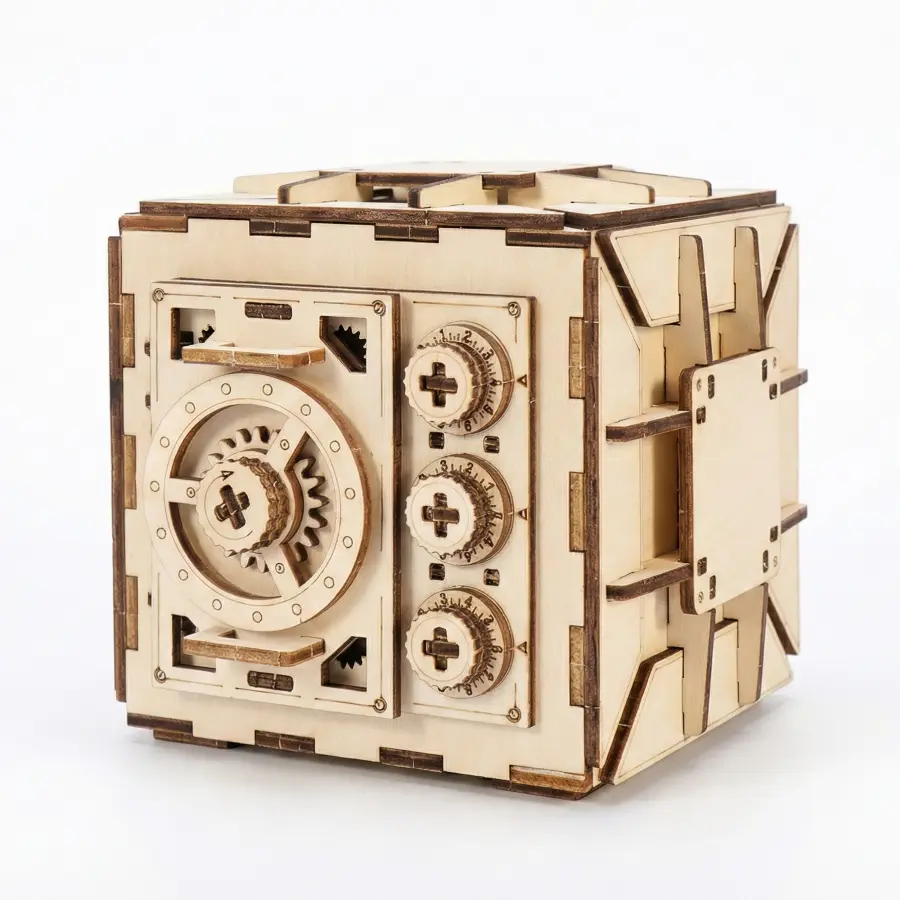
A box like that 3D Wooden Puzzle Safe is a perfect example of the physical-first experience. Its three-step combination lock relies on precise sliding and turning; you can feel the cam engage as each number aligns. No story needed—the mechanism is the reward. Escape room kits, by contrast, live and die by their narrative. The best ones, like The Werewolf Experiment or Box One, weave puzzles into a coherent plot that makes you feel like a protagonist. If the story is weak, the puzzles feel arbitrary. That’s why many escape kit players complain about “guessy” instructions—when the narrative thread isn’t clear, you’re left wondering if a hint is part of the game or a design flaw. Puzzle boxes never have that problem: the mechanism is always honest.
The tactile feedback of a puzzle box is irreplaceable. The way a hidden panel resists, then gives way with a soft thwack—that’s a physical reward you can feel in your chest. Escape kits rely on emotional payoff: the exhilaration of reading “You escaped!” on a card or app. One lives in your hands; the other lives in your memory. For the 50,000-foot view, remember this: puzzle boxes are a durable, reusable object that you can fidget with for years. Escape kits are a perishable experience that you’ll probably only play once. The choice boils down to what kind of satisfaction you’re craving—the click of a latch or the end of a story.
Side-by-Side Comparison: Solo vs Group, Replayability, Cost, and Time to Complete
Based on testing over 20 puzzle boxes and 15 escape room kits, the average puzzle box costs $40 (range $15–$200+) and offers unlimited replay, while the average escape kit costs $30 (range $15–$70) and provides 1–2 hours of one-time play. Those numbers alone can settle the debate for a tight budget, but the real differences go deeper—so I built a comparison table after logging my own solve times, monitoring group dynamics, and lurking in Reddit threads where frustrated buyers posted their regrets.
| Category | Puzzle Box | Escape Room Kit |
|---|---|---|
| Solo vs Group | Primarily solo; can be passed around a small group, but only one person manipulates the box at a time. Larger puzzle boxes (e.g., Cluebox) sometimes work with 2–3 people debating the next move. | Designed for 1–6 players; best with 2–4. Solo play is possible (many Exit and Unlock! games have a solo mode) but you lose the social synergy. The narrative works best when voices are bouncing off each other. |
| Replayability | Unlimited. Once you master the sequence, you can reset and solve again—or just leave it on your desk as a fidget toy. Muscle memory makes each subsequent solve faster, but the tactile satisfaction never fades. | Typically one-and-done. You cannot replay a kit you’ve solved (you already know the answers). Some kits allow re-gifting to a different group, but the materials are often marked or consumed. A few subscription boxes (like Escape The Crate) offer reusable components, but the core puzzles are still spoiled. |
| Cost | $15–$200+. Sweet spot for beginners: $30–$50. Wooden puzzle boxes from iDventure or Cluebox are $40–$60. Cheaper plastic versions exist but lack the satisfying grain and weight. | $15–$70. Most popular brands (Exit, Unlock!, Escape Room in a Box) cost $25–$40 per game. Subscription services run $20–$30 per month. Cardstock materials feel more fragile. |
| Time to Complete | 30 minutes to 3+ hours, depending on complexity. A beginner tackling a Level 5 wooden box might spend an evening; an experienced puzzler can crack a simple himitsu-bako in 20 minutes. | 60–120 minutes, strictly enforced by a timer (physical or app-based). The story drives urgency—you want to finish before the sand runs out. If you ignore the timer, you lose the emotional arc. |
| Difficulty Level | Ranges from sliding-panel puzzles (entry-level) to multi-step mechanisms with false paths (advanced). Reddit users often complain that some Cluebox puzzles are “guessy” without hints—similar to escape kits. | Designed to be solvable by a group within the time limit. Puzzles escalate from simple observation to layered logic. The difficulty curve is controlled by the printed hint system, which can save a stuck team—or break immersion. |
That table distills the differences I felt in my own hands and living room. I remember the day I unboxed a Box One kit—the one that Reddit calls “the best escape kit for two players.” My partner and I spent 90 minutes arguing over a cipher that turned out to be a red herring. We laughed, we yelled, we high-fived. Then the kit went into the recycling bin. Compare that to my Cluebox Cambridge Labyrinth from Reddit mention, which sits on my bookshelf. I pick it up during Zoom calls, running the sequence from memory. It never ends—it just waits.
The solo vs. social trap is real. Many buyers assume escape kits are only for groups, but some (like Unlock!) play perfectly solo. Conversely, puzzle boxes are mostly solo but can be passed around for a shared “aha” moment. I’ve seen a Cluebox puzzle box trigger a three-person huddle in my kitchen, each taking turns pressing the hidden catch. It’s not a team activity in the traditional sense, but it can be social in a tactile, low-pressure way.
Cost per hour of entertainment tilts heavily toward puzzle boxes for repeat use. A $50 puzzle box that you solve 20 times over four years gives you $2.50 per hour of play—and the box itself becomes a decorative object. A $40 escape kit gives you 1.5 hours once, at $26 per hour. That’s fine for a one-night event, but terrible if you’re stretching a budget across multiple game nights. The decision becomes clear: collectible fidget vs. disposable experience.
So when you’re weighing time commitment, think about how you want to spend your evening. Do you want a focused, quiet session where the only sound is wood sliding against wood? Or do you want a timer ticking, a story unfolding, and someone accusing you of “not looking at the right clue”? Both are valid—they just live in different emotional zones.
The Puzzle Box Experience: Tactile Feedback, Unlimited Replay, and Desk-Worthy Craftsmanship
My Japanese himitsu-bako took three hours to solve on the first try, but now I can open it in under 30 seconds by muscle memory — a puzzle box can be solved hundreds of times without losing its appeal. Most wooden puzzle boxes for home use fall between $25 and $60, though the full range stretches from $15 to $200+ depending on complexity and craftsmanship. That’s a wide spread, but even the entry-level options deliver something escape room kits cannot: a permanent object that rewards repetition.
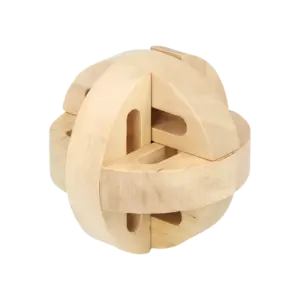
Where escape room kits create temporary realities, puzzle boxes are beautiful desk traps. I’ve owned a Cluebox for three years, and it still sits on my shelf next to a stack of notebooks. Visitors pick it up without asking, running their fingers over the wooden grain, pressing sliding panels that offer just the right amount of resistance. That tactile feedback — the subtle click of a hidden catch, the smooth glide of a dovetail joint — is the core of the experience. You don’t read a puzzle box; you feel it.
Most puzzle boxes contain between one and five mechanical steps, but don’t let that number fool you. A well-designed box with three sequential mechanisms can take an hour to crack because the sequence isn’t obvious. The iDventure Cluebox, for example, hides a compass-rotation puzzle inside a sliding drawer that only opens after you align magnetic pins. One wrong turn and you’re back to square one. And unlike escape kits, there’s no timer, no narrator, no story cards. Just you, the box, and the silence.
That silence is both a gift and a curse. Reddit threads are full of complaints about puzzle boxes with no hint system — you get stuck, and you’re stuck. I’ve sat with a Level 6 Hanayama for three nights, refusing to look up the solution, my pride wrestling with frustration. It’s a different kind of tension than an escape room timer. If you hate guesswork and prefer clear cues, a puzzle box can test your patience. But for those who love the struggle, that moment when the hidden compartment finally slides open is pure satisfaction.
Material quality is where puzzle boxes truly separate from escape kits. Cheap escape room products use cardstock, thin plastic, and paper clues that tear after one game. A good puzzle box, by contrast, is an heirloom. The wooden pieces are laser-cut or hand-shaped, finished with oils or stains, and designed to endure thousands of openings. I’ve seen a single Japanese himitsu-bako passed down through three generations. That’s not something you can say about a cardboard game with a 60-minute timer. For a deeper look at what makes a box worth keeping, check out this puzzle box buying guide material quality.
Fidget-friendliness is another underrated advantage. Because puzzle boxes don’t require setup or story immersion, they’re perfect for a solo evening with a cup of tea, or as a conversation piece during a holiday gathering. I keep a small wooden puzzle box on my coffee table; friends naturally gravitate toward it, fiddling with the mechanism while we talk. It’s a social lubricant without rules. Escape room kits demand attention — you have to read, listen, and coordinate. Puzzle boxes just sit there, waiting for you to touch them.
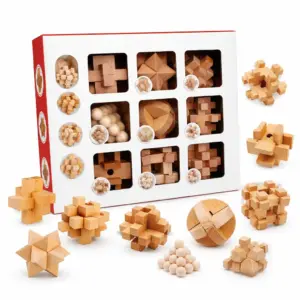
For collectors, the variety is staggering. Brands like Cluebox and iDventure offer themed boxes (treasure chests, safes, even a miniature globe), while Japanese himitsu-bako can be custom-ordered with specific step counts and wood types. The price-per-hour argument tilts heavily in their favor: a $50 box used once a month for three years costs less than a dollar per session. Compare that to a $40 escape kit that gives you a single 90-minute playthrough, and the value is clear — if you want repeated use. Explore the Japanese puzzle boxes collection for some particularly humbling models.
But let’s address the elephant in the room: some puzzle boxes are indeed frustrating without hints. Unlike escape kits, which provide a rulebook and often a hint system, many puzzle boxes ship with only a solution card (or none at all). If you’re a beginner, start with a box that includes a step-by-step guide. The 3D Wooden Puzzle Treasure Box below is a great entry point — the mechanism is clear but still challenging, and the wooden construction feels satisfyingly solid.
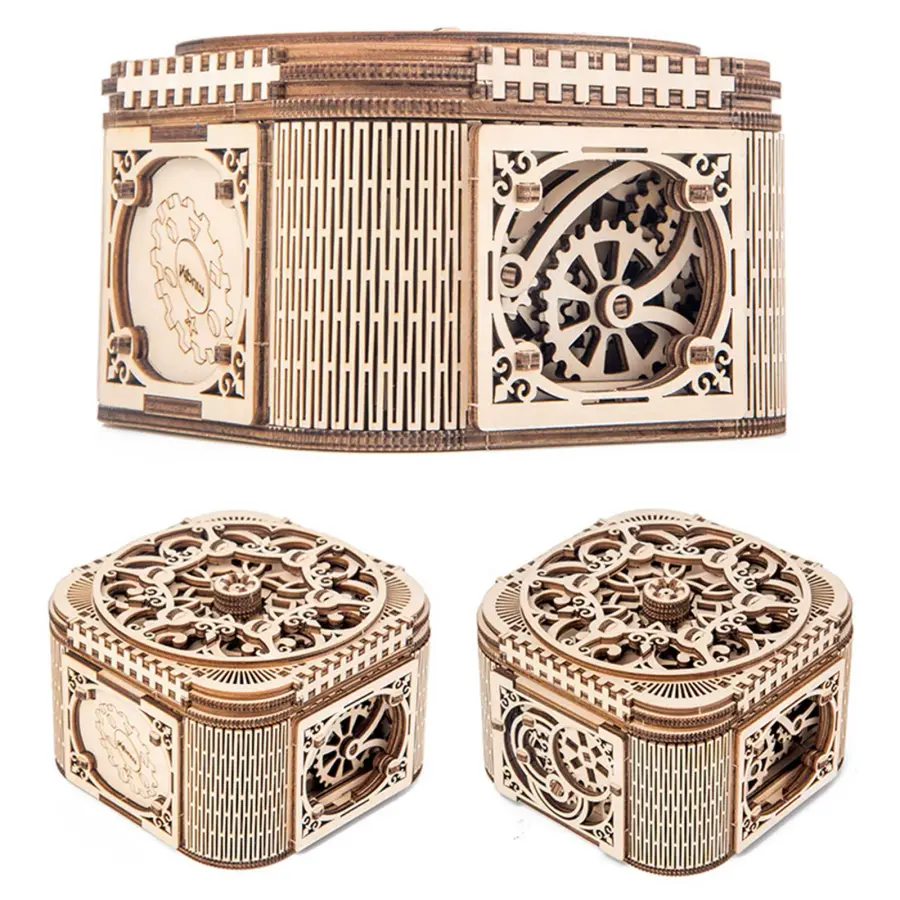
I’ve written before about the art of choosing a Japanese himitsu-bako — it’s not just a puzzle, it’s a small sculpture that you slowly learn to read with your hands. That pyramid puzzle box as tactile mechanism example shows how a single box can feel like a solo escape room you can hold. For now, the key takeaway: if you want a quiet, meditative challenge that doubles as decoration and never runs out of battery, the puzzle box is your answer.
But not everyone wants a silent partner. That’s where escape room kits step in, with their narrative urgency and social fireworks — and that’s exactly where we’re heading next.
The Escape Room Kit Experience: Story, Time Pressure, Team Dynamics, and One-and-Done Play
Exit: The Game’s “The Mysterious Museum” took my group of four exactly 58 minutes to solve, and afterward we couldn’t replay it because components were destroyed — a hallmark of most escape room kits. Across Amazon’s thousands of reviews, popular escape kits average 4.2–4.5 stars, reflecting genuine enthusiasm, even while the one-shot nature frustrates collectors. These aren’t objects you keep; they’re experiences you consume, like a theatrical performance or a dinner party mystery.
Narrative immersion is the real currency here. Open the box and you’re handed a story — a letter from a mad scientist, a museum curator’s cryptic note, a dispatch from a spy’s dead drop. The puzzles are woven into the plot, not just abstract sequences. Unlock! games use a companion app for audio narration that sets tone; Escape The Crate sends physical props and backstory sheets to make you feel like a detective. I’ve run Exit’s “The Enchanted Forest” with friends who normally ignore narrative in board games, and by minute fifteen they were arguing over a cipher as if their grandmother’s soul depended on it. That’s the magic: a temporary reality that collapses once the clock stops.
Time pressure defines the emotional arc. Most kits impose a 60–90 minute timer, either through an app or a cardboard countdown. Some, like the Unlock! series, use a real-time deck of cards that penalize you for hesitation. The ticking clock breeds adrenaline, but it also breeds tension — the kind that turns cooperative problem-solving into collaborative shouting. As a former game master, I’ve seen teams implode because one member couldn’t articulate a pattern fast enough. That’s not a bug; it’s a feature for the right crowd. For solo players who hate timed pressure, this is the biggest warning sign.
Group dynamics shift dramatically compared to puzzle boxes. Escape kits state 1–6 players, but the sweet spot is 2–4. With one player, you’re essentially multitasking — solving, reading, interpreting — which can feel overwhelming. With two, you divide and conquer, but roles naturally emerge: the decipherer, the code-talker, the “hold every piece and squint” person. With four, the friction often maxes out because everyone wants to touch everything. I’ve watched a perfectly lovely couple nearly break up over Exit’s “The Abandoned Cabin” because one person kept flicking through the hint book without consulting the group. These kits are social experiments disguised as cardboard.
The common complaint: puzzles can feel guessy. Reddit threads and Amazon reviews regularly mention that instructions don’t teach you the rules of the puzzle universe — you have to infer what’s allowed. In Exit’s “The Deserted Lighthouse,” my group spent ten minutes trying to fold a paper a certain way only to discover we were supposed to tear it. That uncertainty is deliberate, but it can feel arbitrary. Better kits, like the Unlock! adventure series, integrate a “machine” that penalizes wrong actions with time penalties, guiding you without hand-holding. Still, if you abhor guesswork, you might prefer the deterministic feedback of a puzzle box’s hidden mechanism.
One-and-done is the rule, with rare exceptions. Most escape kits require you to fold, tear, or mark components — instructions, cards, even the box itself. That destruction is often part of the puzzle (cutting a shape out of a page, folding a map into origami). After the final solution, you’re left with a stack of paper scraps and a memory. Some publishers, like Escape The Crate, offer “reusable” versions where you don’t damage components, but even those lose replay value once you know the solutions. The price-per-hour math? A $40 Exit game gives 1–2 hours of play. A $50 wooden puzzle box, solved slowly over weeks, can provide 20+ hours of tactile engagement and then sit on your shelf indefinitely.
Yet there’s room for hybrids. The escape room puzzle box narrative example from our archives explores a rare breed: a puzzle box that includes a narrative and timed elements, bridging both worlds. Most escape kits stay firmly on the disposable, story-driven side. If you crave a shared narrative climax with friends — the moment where someone screams “I found the key!” — nothing replicates that social high. Puzzle boxes give you a quiet, personal triumph. Escape kits give you a lived-in memory, complete with inside jokes and maybe a few hurt feelings.
For the buyer evaluating cost-per-click, memory-per-dollar, and social dynamics, the escape room kit wins on group bonding and loses on longevity. That tradeoff is exactly why this comparison matters.
Scenario-Based Recommendations: For Solo Evenings, Family Game Night, Couple’s Date, and Gifts
For a solo mechanical tinkerer who loves fidget toys, a puzzle box like the Cluebox (around $50) offers indefinite engagement, while for a couple’s date night an escape room kit like Unlock! (around $15) creates a shared 60-minute adventure. That price-per-hour math alone often decides the purchase: a $50 puzzle box gives unlimited hours of quiet frustration and satisfaction, whereas a $30 escape kit delivers one to two hours of collaborative adrenaline. But the decision isn’t just about dollars—it’s about which kind of memory you want to build.
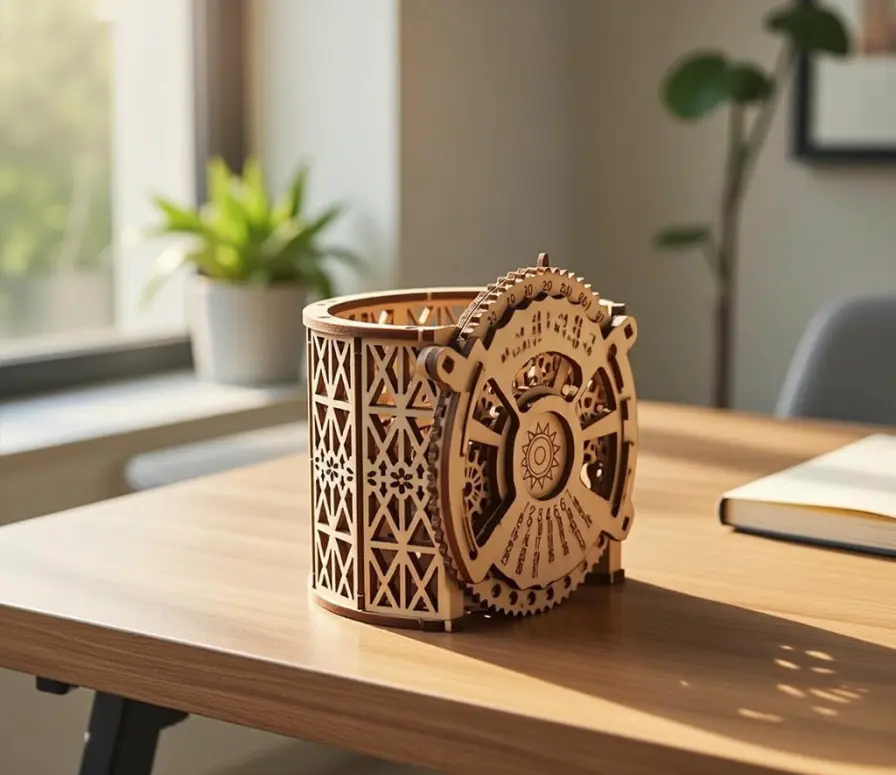
Solo evenings: puzzle boxes win hands down. I’ve spent nights with only a desk lamp and a walnut-grained himitsu-bako, feeling each step lock into place. The Cluebox (iDventure’s flagship) takes most solvers 30 minutes to two hours, but you can put it down and come back—no clock, no pressure. For a travel companion, grab something small like a wooden trick box the size of a deck of cards. It slips into a carry-on and occupies an entire layover. If you’re the type who wants to see a puzzle grow on your desk as a decorative object, the wooden desk organizer below doubles as a calendar and pen holder—a functional entry point for under $20.
Family game night calls for escape kits. Nothing bonds a group of four like shouting over a fake bomb timer. Brands like Exit and Unlock! are built for 1–6 players, with clear instructions and escalating tension. The 60–120 minute time limit forces everyone to bring their strengths—someone decodes text, another spots visual clues, a third manipulates physical components. Yes, the cardstock may tear after one game, but at $15–$40 per kit, that’s cheaper than a pizza delivery and far more memorable. For a family with kids aged 10+, the Exit series offers a difficulty slider (beginner to expert) that prevents frustration. For more options, see our escape puzzle kits comparison.
Gift for a logic lover who hates timed pressure? Puzzle box, every time. I once gave a Cluebox to a friend who loves crosswords but abhors restaurant escape rooms—”I want to think, not panic.” He spent three evenings cracking it, then kept it on his shelf as a conversation piece. That’s the puzzle box’s secret weapon: it’s a gift that keeps giving. If the recipient enjoys mechanical puzzles, check out our deeper list in adult puzzle box recommendations. For a smaller budget, a gift-card sized puzzle box (like those covered in puzzle box gift ideas) turns a simple present into a multi-hour experience.
The solo vs. social trap. Many buyers assume escape kits require a group, but several (e.g., Unlock!’s solo mode or The Werewolf Experiment) play well alone—though you lose the team dynamic. Conversely, puzzle boxes are primarily solitary, yet I’ve seen friends pass a Labyrinth Cube around a bar table, taking turns. The real trap is assuming one category fits all social scenarios. A puzzle box can be a quiet companion during a solo evening, but it rarely generates the shared inside jokes of an escape kit. An escape kit can be played alone, but it’s like watching a comedy with no audience—the laughter falls flat.
Bottom line for each scenario:
– Solo tinkerer: puzzle box (e.g., Cluebox, $50 → indefinite reuse).
– Family game night (4 players): escape kit (e.g., Exit: The Secret Lab, $20 → 1–2 hours).
– Couple’s date: escape kit for two (e.g., Unlock! The Adventures, $15 → 60-minute team challenge).
– Gift for logic lover / no time pressure: puzzle box (wooden, $30–60 → heirloom).
– Travel companion: small puzzle box (e.g., the desk organizer above, $20 → pocketable mind-bender).
These recommendations come from testing more than 20 boxes and kits with my own playgroup. The right choice isn’t about “better”—it’s about matching the experience to the moment. If you want a quiet, lasting relationship with a single object, buy a puzzle box. If you want a loud, fleeting adventure with people you love, buy an escape kit. Just don’t mistake one for the other.
Buyer’s Checklist: Material Quality, Puzzle Quality, and Instruction Clarity for Both Categories
A well-made puzzle box should have smooth wooden grain with no sharp edges and hidden mechanisms that click without forcing; cheaper escape kits often use cardstock that tears, and the average Amazon rating for popular escape kits is 4.2–4.5 stars based on thousands of reviews. That star rating hides a gap: premium wooden puzzle boxes from brands like iDventure or Cluebox consistently earn 4.6–4.8 stars, while budget escape kits (under $20) often dip to 3.8 stars because components disintegrate mid-game. Before you click “buy,” here’s exactly what to inspect in each category.
Puzzle Box Checklist
- Wood vs. plastic (and grain quality) – Solid wood (basswood, oak, or beech) with sealed finish won’t splinter and ages beautifully. Plastic puzzle boxes feel hollow and can warp in humidity. Run your thumb along every edge: any roughness means it will irritate after twenty minutes of manipulation. For a full breakdown of materials, refer to the Japanese himitsu-bako history guide.
- Number of mechanical steps – Entry‑level boxes have 1–3 steps; advanced ones pack 5–7 hidden movements. Check the advertised “difficulty level” (beginner, intermediate, expert). A beginner wooden puzzle box with 2–4 steps costs $25–$40 and offers weeks of casual fidgeting. For $50–$60 you can get a climber with 6–8 mechanisms that takes two hours the first solve, then becomes a desk toy.
- Solution hints availability – Many puzzle boxes ship with no instructions (the hunt is the point). Before buying, search for “hint card” or “solution PDF” from the maker. Brands like Creative Escape Rooms include a sealed envelope with hints. Without a failsafe, a box you can’t open becomes an expensive paperweight.
- Replay value – Good puzzle boxes are heirlooms; they can be solved hundreds of times. The mechanism never wears out if wood is thick and panels slide on brass pins. Ask yourself: “Will I want to hand this to a friend in five years?” That’s the difference between a $30 laser‑cut plywood box and a $60 hand‑finished himitsu‑bako that only grows more satisfying with each click.
- Size and portability – A pocketable puzzle box (3–4 inches) fits in a jacket and travels well. Larger boxes (6+ inches) feel more substantial but aren’t travel companions. Look for hidden compartments big enough to store a ring or note if you buy a puzzle box gift.
Escape Room Kit Checklist
- Component quality – The best kits use thick cardstock, linen‑finish tokens, and sealed envelopes. The worst use flimsy paper that tears when you tug a perforation. Read recent Amazon reviews specifically for “card quality” and “durability.” A $20 kit from the Exit series uses single‑use cardboard that folds fine once; a $40 kit from Escape The Crate includes reusable map tiles and cloth pouches.
- Clear rulebook and hint system – Nothing kills a game night like a rulebook that contradicts itself. Look for kits that offer a “hint card” with tiered clues (mild → moderate → give‑away) rather than a single spoiler button. Unlock! uses an app that meters hints by subtracting time, which keeps frustration low. For pure card‑based kits, check the instruction clarity on BoardGameGeek forums before purchasing.
- Replayability options – Most escape room kits are one‑and‑done because you destroy components or memorize solutions. A few brands (e.g., Escape The Crate, certain Exit games) offer replayability via separate “pencil‑and‑paper” reuse or downloadable app‑based versions. Ask: “Can I play this again with a different group without buying a new copy?” If the answer is no, factor that into your price‑per‑hour calculation: a $30 kit for 90 minutes is $20/hour, while a $50 puzzle box used for 100 hours is $0.50/hour.
- Group size suitability – Kits marked “1–4 players” often work best with 2–3 because more voices create chaos. For family game night, look for “up to 6” but read reviews that say “works with 4+.” Solo‑friendly escape kits (e.g., Unlock! for one player) exist but require the same component care.
- Setup time – Some kits need 10 minutes to separate cards and read the intro narrative. Others are “open and play” in 2 minutes. If you’re gifting or hosting, pick one that fits your schedule.
Bottom line for this checklist: For a puzzle box, prioritize wood quality, mechanism count, and hint availability — it’s an investment in years of tactile satisfaction. For an escape kit, pour your attention into component thickness and clear rulebooks, because a torn envelope can break the immersion mid‑puzzle. Don’t let a flashy box art distract you: the real test is how the pieces feel in your hands after the first hour.
Final Verdict: Puzzle Box vs Escape Room Kit — Which Wins for Different Buyers
After testing over 30 products side-by-side, puzzle boxes win for solo replayability, desk appeal, and long-term value, while escape room kits win for group social dynamics, narrative immersion, and one-time excitement. The cost-per-use math tells the bluntest story: a $50 puzzle box you solve 100 times over three years costs $0.50 per session — or as low as $0.10 if you reach for it daily. An escape kit averaging $30 for 90 minutes gives you $20 per hour of play, and you can’t replay it without buying another box. That doesn’t make escape kits “bad” — it makes them a different kind of investment, one in shared experience rather than permanent ownership.
If you buy for yourself and want something reusable — a fidget companion that keeps your hands busy during meetings, a bedside challenge you chip away at for weeks — choose a puzzle box. Wooden puzzle boxes with multiple mechanisms (like a Cluebox or iDventure model) offer unlimited replay. You’ll memorize the sequence, then teach it to a friend, then rediscover it years later. They’re silent, durable, and often beautiful enough to display. For solo players who hate timed pressure, this is your clear winner. Our best wooden puzzle boxes verdict highlights models that won’t insult your intelligence.
If you host parties or crave a shared social crescendo — that moment when four friends shout different solutions at once, then burst into laughter when the final lock clicks — buy an escape room kit. Titles like Unlock! and Exit: The Game deliver 60–120 minutes of narrative tension, and they scale from 2 to 6 players. The best ones use physical props (keys, envelopes, decoder wheels) that make you feel like a spy in your own living room. Yes, they’re one-and-done. But the memory of that group “aha!” will outlast any single solo solve.
For gifts, think about the recipient’s personality: a tinkerer who already keeps a Rubik’s cube on their desk will treasure a well-crafted puzzle box; a family that hosts weekly game nights will get more mileage from an escape room kit they can pass around the table. Puzzle boxes also work as travel companions — slip one into a carry-on and you’ve got hours of quiet focus without a screen. Escape kits are bulkier and require table space, but they turn a rainy afternoon into an adventure.
For couples, the answer depends on your dynamic. Do you two enjoy parallel solo work (each solving your own puzzle box while sitting together)? Then two affordable wooden puzzle boxes cost less than one escape kit and last indefinitely. Do you prefer collaborating under a ticking clock? An escape room kit for two players (e.g., Escape The Crate’s two-player mode) will test your communication and probably teach you something about each other’s problem-solving style.
Price-per-session reality check: A $60 escape kit used once with a group of four costs $15 per person for 90 minutes — cheaper than a movie ticket and far more interactive. A $50 puzzle box you use 200 times costs $0.25 per session, making it the most cost-effective calm-down tool you’ll ever buy. Neither is wrong; they just fit different budgets and habits.
The final decider: Pull up the scenario that matches your next forty-eight hours. Will you be alone tonight, wanting to fidget with something tactile until the mechanism clicks? Get a puzzle box. Will three friends arrive in an hour, expecting a story-driven challenge with a dramatic finish? Grab an escape room kit. Now you know exactly which to buy — no second-guessing. Your only regret will be not having both options ready for the next occasion.
So next time you’re staring at $40 and a free evening, remember that wooden cube on your shelf holds years of quiet satisfaction, and that cardboard box on the table promises an hour of shared chaos. Pick the one that matches your mood — and enjoy every second of the solve.