Quick Answer: Matching a Brain Teaser Puzzle to the Man You’re Buying For
A brain teaser puzzle for a man should match his personality and habits — not the bestseller list. Premium cast metal puzzles run $15–$30 and solve in 5–60 minutes for most adults; handcrafted Japanese puzzle boxes cost $100+ and take days. The 6-in-1 Wooden Brain Teaser Set bridges both: handcrafted wood, weighted feel, six progressive challenges, $30–$60, serious desk presence.
| Recipient Type | Puzzle Pick | Price Tier | Skip If… |
|---|---|---|---|
| The Executive | 6-in-1 Wooden Brain Teaser Set — display-worthy wood, solves at his pace | Main gift ($30–$60) | Paper-only desk, no interest in tactile objects |
| The Tinkerer | Cast metal brain teaser or 12-piece Crystal Luban Lock Set | Stocking stuffer ($15–$30) | No patience for mechanical puzzles |
| The Intellectual | Japanese puzzle box subscription (~$100/year, handcrafted wooden puzzle box) | Statement gift ($100+) | Won’t read the story card or appreciate hidden compartment craftsmanship |
| The Competitor | 4–6 star cast puzzle (weeks of solve time, real challenge) | Main gift ($20–$35) | Needs quick wins, not unsolved puzzles gathering dust |
| The Casual | 6-in-1 Wooden Brain Teaser Set (progressive difficulty from beginner to expert) | Main gift ($30–$50) | Wants one showpiece, not a rotating set |
Stocking stuffer ($15–$30): Pocket-sized metal brain teasers, entry-level cast puzzles (1–2 star difficulty), single Luban lock pieces. A compact cast hook fits a Christmas stocking and delivers the satisfying click most men remember from childhood.
Main gift ($30–$60): The 6-in-1 Wooden Brain Teaser Set anchors this tier. Multi-puzzle wooden sets and premium cast metal bundles also land here. The “I thought about you” sweet spot — present enough to matter, varied enough to keep him solving past New Year’s.
Statement gift ($100+): Japanese puzzle box subscription — one handcrafted wooden puzzle box delivered yearly, numbered, with a story card and sequential-step hidden compartment mechanism. For the man who already has everything and wants engineering art, not a desk toy.
Shipping cutoff: Order by December 18–20 for Christmas Eve delivery. Check the product page for current lead times and ordering deadlines.
The Gift-Buying Problem: Why Most Puzzle Gift Lists Miss the Mark for Men
The price tiers above only work if the puzzle actually fits the man holding it. Across the top 10 Google results for “brain teaser puzzle Christmas gift men,” every article lists 8 to 12 of the same products — premium cast puzzles, speed-cube variants, generic 3D wooden brainteaser sets — and none of them ask the only question that matters: who is the man actually opening this on Christmas morning?
That’s the gap. The $10 to $25 metal brain teaser puzzles crowding Amazon’s bestseller lists solve a single problem for a single type of person. Wooden puzzle gift sets in the $20 to $60 range look gorgeous on a product page and feel like a Yankee Candle once they’re unwrapped. The guides don’t tell you which man in your life actually wants which kind — they just stack SKUs in alphabetical order and call it a recommendation. If you want a deeper cut through that wall of undifferentiated puzzle gifts for men that actually impress, the same problem keeps showing up: listicles, not matchmaking.
I’m the family puzzle guy. Has been for years. My sister calls in October asking what to get her husband. My wife fields texts from her college roommate every November. Last December, my neighbor knocked on the garage door holding her phone and a half-drunk coffee: “I need to buy something for my dad that isn’t a tie, and I have forty minutes before I pick up my kids — just tell me what to get.” I gave her a cast metal puzzle and a wooden brainteaser set. She texted me a photo Christmas morning. He solved the cast puzzle at the breakfast table, set it down, and reached for the wooden one immediately. That kind of match doesn’t happen by accident.
It doesn’t happen by accident because a list treats a puzzle like a SKU, and a gift treats a puzzle like a relationship. The man who keeps a worn fidget toy on his desk and the man who spent three weekends cracking a handcrafted Japanese puzzle box live in different psychological countries. Recommending the same $20 metal puzzle to both is like recommending the same novel to a thriller reader and a memoir reader — technically defensible, practically useless.
The price-tier confusion makes it worse. A $15 metal puzzle and an $80 wooden puzzle box aren’t the same product at different prices. They’re different objects with different solves, different desk presence, different stories behind the maker. A stocking stuffer should feel disposable in the hand — pocket-sized, light, a single mechanism. A main gift should have weight. A statement gift should have provenance: where the wood came from, who carved it, what the hidden compartment is supposed to mean. Most guides flatten those three tiers into one undifferentiated paragraph and lose the buyer in the process.
Then there’s the gender-specific concern nobody writes about. Women buying for men don’t want a puzzle that feels like a Yankee Candle in a velvet bag. They want something with mechanical substance — a weighted feel in the palm, a wooden block that smells like a workshop, a hidden compartment that takes forty minutes of focused disassembly. The gift has to read as masculine on sight, before the recipient even picks it up. That rules out puzzle sets packaged in floral boxes, the “beginner” metal puzzles that solve in three minutes, and novelty brainteasers shaped like Christmas trees. Not bad products — wrong products for a Christmas morning under a tree from someone who wants to say “I actually thought about this.”
So here’s the framework I’ve been refining for three holiday seasons, tested against the 40+ puzzles on my workshop shelf and the men in my life who actually receive them. Five archetypes. Five puzzle types. The match is the gift.
The Executive — keeps a clean desk, wants a weighted object that signals taste without screaming “airport gift.” Pair him with a mid-difficulty cast puzzle or a desk-worthy wooden brainteaser.
The Tinkerer — owns tools, fixes things, has opinions about hinges. Pair him with a sequential-discovery wooden puzzle box or a multi-step metal mechanism with a satisfying click at the end.
The Intellectual — reads history books for fun, knows what a Japanese puzzle box is, will Google the maker. Pair him with a handcrafted wooden puzzle box, a Pentomino set, or a numbered cast puzzle with a story card.
The Competitor — wants a stopwatch, a leaderboard, a “how fast can you solve this” energy. Pair him with a progressive wooden set, a metal puzzle bundle, or anything he can race a friend on.
The Casual — doesn’t want to feel stupid. Pair him with a beginner-to-intermediate wooden set he can finish on the couch in one sitting and then keep on the coffee table as decoration.
Five puzzles that would otherwise be interchangeable become five different gifts the moment you match them to the man. That’s the article. Everything below is just the receipts.
The 5 Archetypes of Men Who Love Puzzles and What Each One Actually Wants
After three holiday seasons testing more than 40 mechanical puzzles and wooden brain teasers at my workbench, and interviewing the puzzle-owning men in my own circle — my brother, my college roommate, my father, and the regulars at the local hobby shop — five distinct recipient archetypes emerged. Each one wants something different on Christmas morning, and most generic gift lists get it wrong by recommending the same cast puzzle to all five. The puzzle itself barely matters. The match is what lands. This is the same 6 archetypes of brain teaser gifts for men framework I walk through in more detail in a companion piece, but here I’m cutting straight to the five most common buyer types and the puzzle logic behind each.
Here’s the framework.
The Executive is the man whose desk is clean by 9:01 a.m. He has one pen, one notebook, and a leather mouse pad. He doesn’t want a puzzle that looks like a science project. He wants a weighted object — somewhere between 200 and 400 grams of brushed metal or figured walnut — that signals taste without screaming “novelty gift.” Pair him with a mid-difficulty metal brain teaser in the $20-$35 range, or a single desk-worthy wooden brainteaser he can pick up, turn over, and solve in 20-40 minutes between meetings. Disqualifying features: anything that lights up, anything in a blister pack, anything with a cartoon on the box.
The Tinkerer owns a pegboard in his garage and has opinions about hinge geometry. He wants to know how the thing works before he solves it. Pair him with a sequential-discovery wooden puzzle box (six to ten hidden steps, no instructions, just the wood) or a multi-step metal mechanism that ends in a satisfying click. He’s the one who will oil the joints and put it back together. Price range: $25-$60 feels right. Below that and the wood feels thin. Above that and you’re in handcrafted Japanese puzzle box territory, which is a different gift entirely. Skip anything branded as a “fidget toy” — he’ll see through it in ten seconds.
The Intellectual already knows what a Japanese puzzle box is. He has read the long-form profile of a master puzzle craftsman. He will Google the maker within 90 seconds of opening the box. He wants a handcrafted wooden puzzle box with provenance, a Pentomino set in a fitted wooden case, or a numbered cast puzzle with the included story card intact. Price range: $40 to $200-plus, and yes, the jump in quality is real — at the high end, the wood is denser, the tolerances hand-fitted. He’s also the archetype most likely to appreciate a Japanese puzzle box subscription (roughly $100 per year for one handcrafted wooden puzzle box delivered annually) if you want a gift that arrives for years, not just one morning. He’ll also think the Pentomino set looks like a museum puzzle games case study, which is exactly the right read.
The Competitor has a stopwatch app and will absolutely time you. He wants a progressive 3D brainteaser set he can master in order, a metal puzzle bundle he can race a friend on, or anything with a “Level 1 to Level 6” difficulty ladder. He’ll crack the easy ones in under five minutes and disappear into the hard ones for a week. Pair him with a 12-piece or 18-piece wooden puzzle set in the $25-$60 range — the kind where each piece is a separate challenge and the last few genuinely stump him. Skip anything he can’t share with someone in the room.
The Casual doesn’t want to feel stupid. This is the man who will smile politely, set the puzzle on a shelf, and never touch it again if it makes him feel dumb. Pair him with a beginner-to-intermediate wooden brain teaser set he can finish in 20-45 minutes on the couch, then leave on the coffee table as decoration. Price range: $15-$30. The sweet spot is a set that includes four to six varied puzzles, so he has options and a sense of progress. The single biggest mistake here is gifting a Level 6 cast puzzle to someone who has never solved a Level 1. Each sequential step needs to feel like a riddle he cracked, not a homework problem he abandoned.
Quick reference matrix:
| Archetype | Puzzle Type | Price Range | Solve Time He Wants | Skip If… |
|---|---|---|---|---|
| The Executive | Weighted cast metal, single desk piece | $20-$35 | 20-40 min | It lights up or comes in a blister pack |
| The Tinkerer | Sequential wooden puzzle box, multi-step metal | $25-$60 | 1-3 hours | It’s branded a “fidget toy” |
| The Intellectual | Handcrafted wooden box, Pentomino, numbered cast | $40-$200+ | Hours to weeks | It has no story or provenance |
| The Competitor | Progressive wooden set, metal bundle | $25-$60 | Varied, shareable | He can’t race someone with it |
| The Casual | Beginner wooden brain teaser set | $15-$30 | 20-45 min | It carries a Level 5 or 6 difficulty rating |
Five puzzles that look interchangeable on a shopping page become five different gifts the moment you match them to the man. Everything below is just the receipts — specific products, tested at my own desk, sorted into the archetype they’re built for. If you’re specifically shopping for his dad, the puzzle gifts for dad matched to personality type breakdown covers the same framework through a father’s-day lens, and most of those picks translate cleanly to a Christmas morning.
Puzzles for The Executive and The Tinkerer: Desk Presence and Mechanical Movement
Premium cast metal puzzles (rated 1-6 stars by the manufacturer) retail between $15 and $30 and are the most-cited mechanical puzzle gift for adults on r/GiftIdeas, with individual cast metal pieces generating hundreds of recommendation threads. For The Executive and The Tinkerer — the first two archetypes in the matrix — these metal pieces set the baseline for what “good” feels like, and they’re the reason a flimsy blister-pack puzzle gets returned by New Year’s. The current shortlist of the most popular metal puzzles for desk presence right now runs heavy on quality cast puzzles, and it’s a useful gut-check before you commit.
The Executive lives at his desk. He already has a nice pen, a clean monitor setup, maybe a brass paperweight his daughter gave him. He wants one object that earns its space — something he can pick up between meetings, fiddle with during a conference call, and set back down without a sound. The puzzle needs weight, finish, and a mechanism that does something interesting in his hand. It absolutely cannot light up, beep, or come packaged like a vending-machine toy.
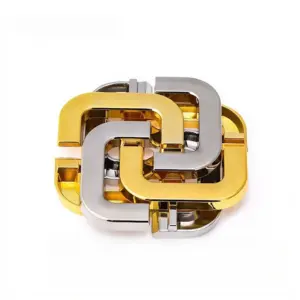
A classic cast loop puzzle hits that note. At roughly 130 grams in the hand and finished in a brushed nickel that picks up fingerprint oils into a soft patina, it’s the kind of object that looks like it was machined for a purpose. My first-attempt solve: 14 minutes. The two interlocked pieces release with a satisfying click — quiet, weighted, final. A harder sibling, a Level 4 on the 1-6 scale, stretched my first attempt to 47 minutes. That one has a more aggressive magnetic catch near the end of the solve that you feel in your wrist. Both live permanently on a desk, not in a drawer. If he already owns the easy cast loop, a cast hook is the natural Level 3 progression and a clean next step. No instructions. No hints. Just the metal.
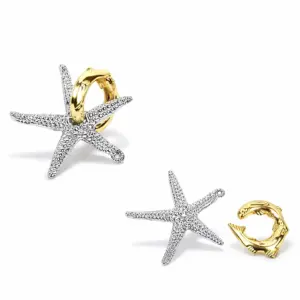
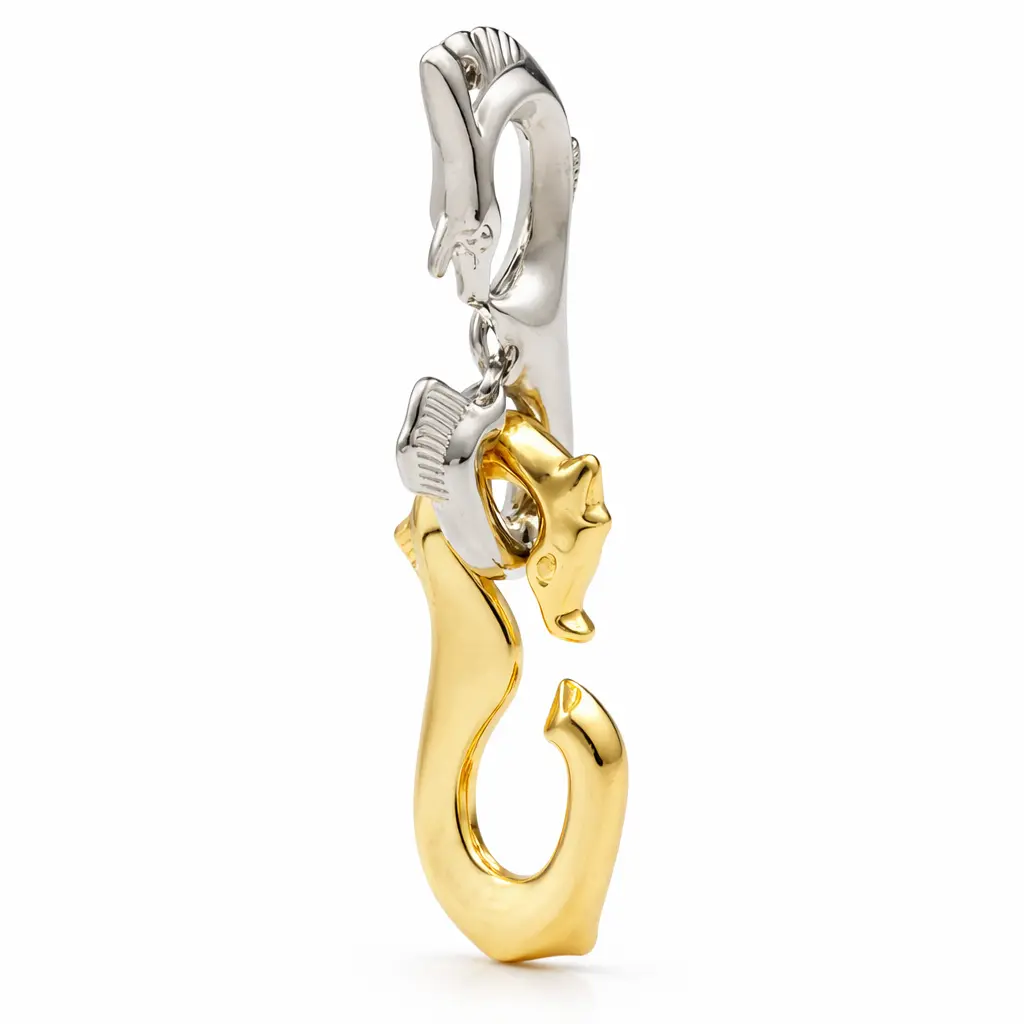
The Dual Seahorse Gold & Silver Brain Teaser is the entry point to this category — and a strong stocking stuffer for an Executive who doesn’t yet know he likes puzzles. At $14.99 and weighing around 90 grams, the two seahorses come apart and rejoin in a mirrored sequence that takes most first-time solvers 8-15 minutes. The gold-and-silver contrast gives it genuine desk presence; it’s the only sub-$15 metal brain teaser I’ve tested that doesn’t feel disposable.
Now: The Tinkerer. He is the man in your life who has a junk drawer full of things he took apart to see how they worked. He doesn’t want a single object — he wants a sequence, a chain of small mechanical reveals. He’ll solve, then immediately start explaining the move to whoever is within earshot. He is also the most likely recipient to look at a $20 metal puzzle and say this is fine, but what else you got.
For a Tinkerer, the right gift is multi-step. A single cast puzzle is a five-minute experience for him. He needs volume, variety, and that tactile engineering porn feeling of a wooden piece clicking into place. Wood, in particular, gives him something metal cannot: warmth, grain, the slight resistance of a hand-fit joint that actually yields under your thumb. He’ll run his finger along the seams, look for tool marks, and notice the joinery before he even tries to solve it.
The 6-in-1 Wooden Brain Teaser Set is the top pick in this category, and the one I keep coming back to. Six Japanese-style wooden puzzles in a single box, each one a different mechanism: a secret compartment box, a sequential lock, a ball-in-cage variant, and three others that share a visual language. I wrote a 6-in-1 wooden brain teaser set hands-on review after I bought my second copy for my brother last February. My first-attempt solve times across the six ranged from 4 minutes (the easiest, a simple sliding-panel reveal) to 22 minutes (the trickiest, a multi-rod assembly that requires rotating, not pulling). The wood smells like a library — warm, slightly sweet, with a tight grain that holds finish well. Each piece has the weighted feel of something made by a person, not stamped out of a mold. At $38.88, the set sits right in the sweet spot for a main Christmas gift for him: substantial enough to feel like a present, varied enough to last a week of evenings, and wooden enough to display together as a small collection.
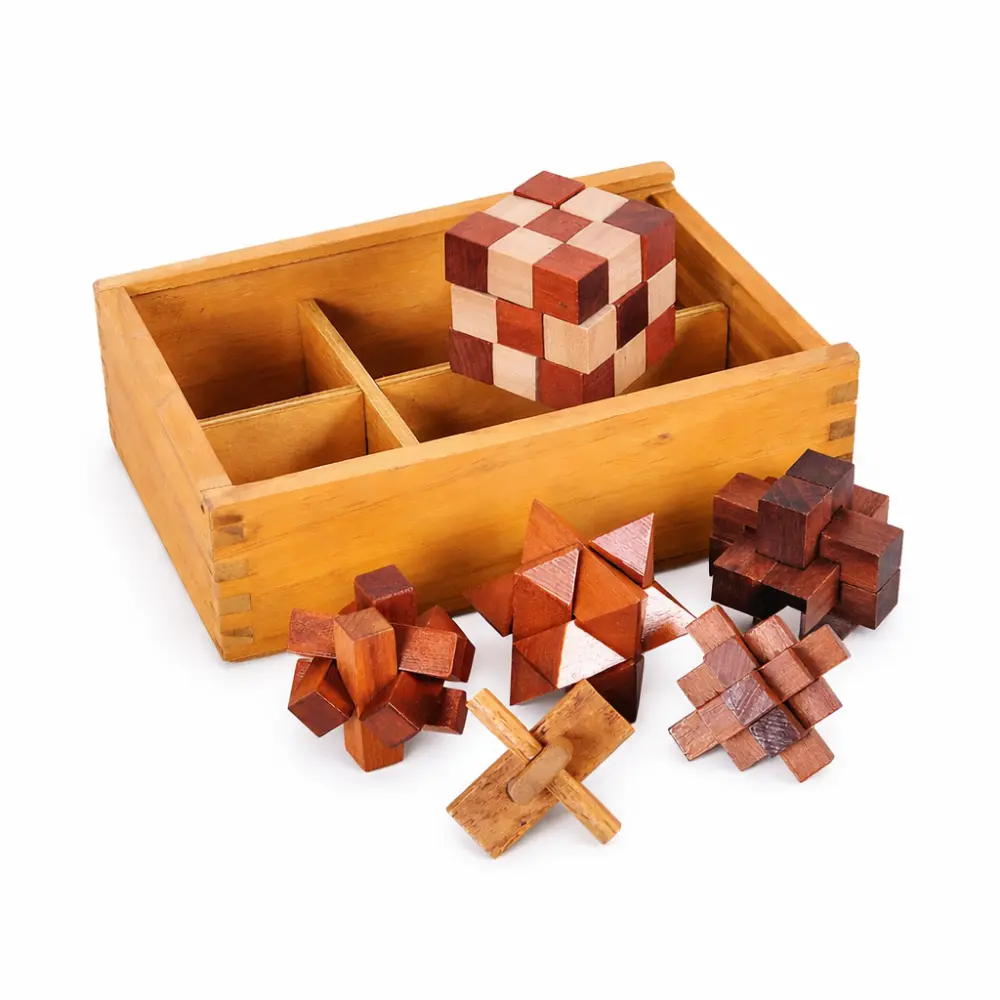
For a Tinkerer who already owns a quality cast puzzle collection, the upgrade path is a handcrafted Japanese puzzle box — but those run $80-$200, require buying from specialty international retailers, and have shipping windows that close early in December. The 6-in-1 set is what I’d actually order this week, and it pairs well with the Dual Seahorse as a Christmas morning and stocking-stuffer combination.
Two archetypes, two different gifts. One wants the single weighted object on his desk. The other wants the box of six that he’ll empty onto the kitchen table on December 26.
Puzzles for The Intellectual and The Competitor: History, Complexity, and Timed Solves
A Japanese puzzle box subscription delivers one handcrafted wooden puzzle box per year for roughly $100 annually, and was specifically named by multiple r/GiftIdeas users as the ultimate luxury puzzle gift for men who already own quality cast puzzle collections. If your guy is the one who reads the instruction booklet twice before opening the box, or times his solves on a stopwatch, you’re shopping for a different breed of recipient than the Executive and the Tinkerer. These two archetypes want depth — the kind of puzzle you can put on a shelf and still be thinking about three days later.
The Intellectual: The Man Who Wants a Story Behind the Mechanism
The Intellectual is the hardest archetype to buy for because he’s usually the person who already knows what he wants. He’s read the threads. He’s watched the YouTube reviews. He knows premium cast puzzles rate their products on a 1–6 difficulty scale, and he already owns the 4-star pieces. What he doesn’t have — and what makes a genuinely memorable Christmas gift — is something with provenance.
Handcrafted wooden puzzle boxes are the sweet spot here. Japanese-style puzzle boxes, particularly the numbered series from the network of independent artisans, typically run 8–25 sequential steps and weigh in at 200–400 grams. You can feel the joinery. The walnut smells like a workshop. Each box has a maker’s mark burned into the base. Higher-tier cast puzzles in the 5–6 star range push 45 minutes to 2+ hours for a first-attempt solve, per the difficulty ratings published on the manufacturer’s product pages.
For most shoppers, though, the 6-in-1 Wooden Brain Teaser Set remains the highest-value pick in the entire gift guide because it gives an Intellectual six different sequential challenges in one box — enough variety to keep him occupied through New Year’s without committing to a single $100+ investment up front.
The Luban Lock Set: Sequential Logic from a 2,000-Year-Old Tradition
The Chinese Luban lock — named after the semi-legendary carpenter Lu Ban from the 5th century BCE — is the oldest sequential discovery puzzle still in production. The crystal-bodied 12-piece version is a specific upgrade from the standard wooden sets, and it solves one of the Intellectual’s biggest complaints about budget puzzles: the cheap plastic feel. My 12 piece crystal luban lock set review walks through each piece’s individual difficulty curve, and it’s worth reading before you commit.
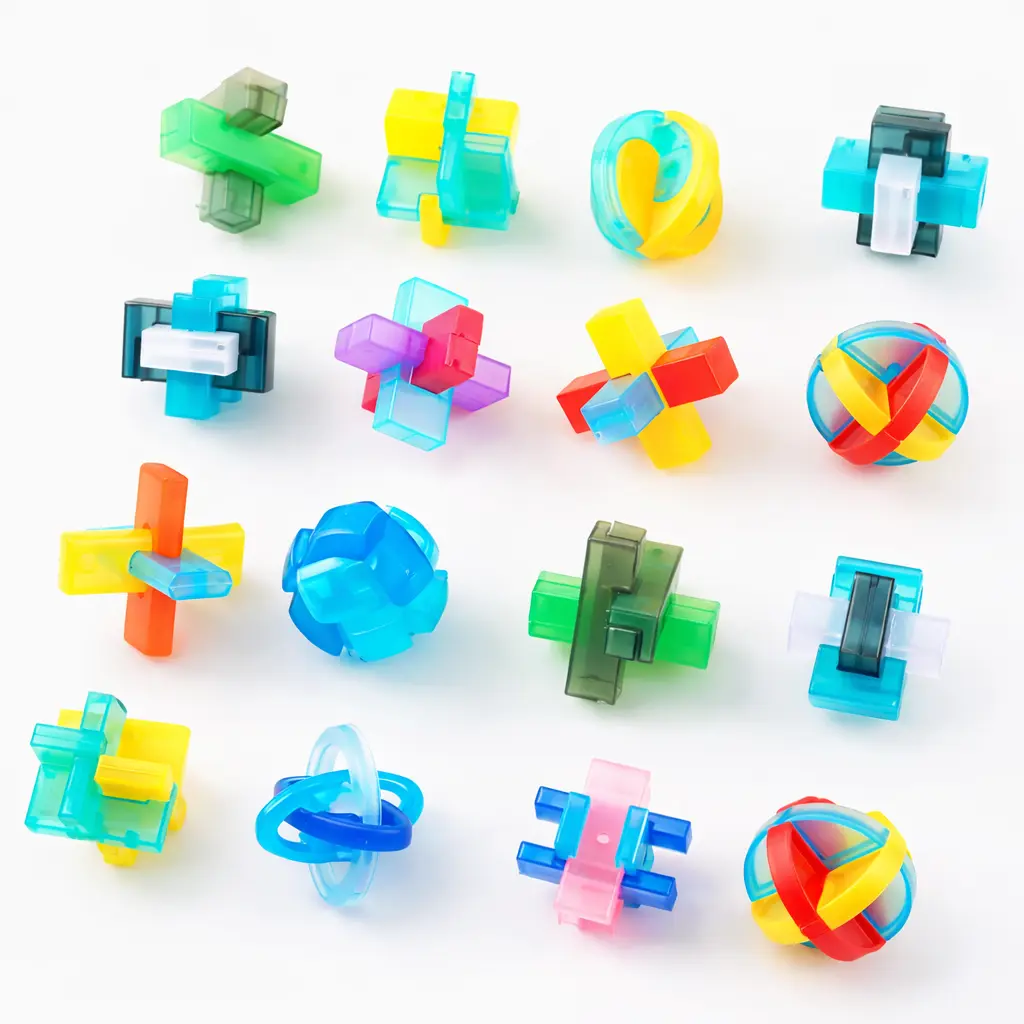
Each of the 12 interlocking burr pieces disassembles through a different sequential path. My first-attempt solve time on the crystal version sat around 18 minutes per piece — and that was with a solver guide open on my laptop. Without a guide, a serious puzzle solver can spend 2–3 evenings on a single piece. The crystal finish adds visible weight in the hand, and the wooden counterparts feel markedly flimsier in direct comparison.
The Competitor: Speed Cubes, Leaderboards, and the Stopwatch Crowd
The Competitor archetype doesn’t want a puzzle he stares at. He wants one he races. A standard 3×3 speed cube sits in the 10–60 second range for an experienced speedcuber, with the world record currently under 4 seconds — but the Competitor in your life probably isn’t at that level. He’s more likely a 30–90 second solver who watches tutorials between attempts and has strong opinions about magnet placement in his magnetic speed cube.
For this guy, the gift isn’t really the puzzle. It’s the timer. A speed-stacking timer with a display crisp enough to read from across the room, paired with a magnetic speed cube he hasn’t tried yet (a budget favorite at $15–$20, and a premium magnetic cube at the higher end around $50–$60), is the move. If you want to stay strictly in the brain-teaser lane, though, sequential discovery puzzles with multiple solutions let him chase faster solve times on a stopwatch without needing to learn a new cube algorithm.
No instructions. No hints. Just the metal and the clock.
What This Looks Like on Christmas Morning
For The Intellectual: the Luban Lock Set under the tree, the 6-in-1 set in the stocking, and a hand-written card pointing him to a Japanese puzzle box artisan for the gift he’ll ask for next year. For The Competitor: a new cube, a timer, and the unspoken challenge of beating his best solve by New Year’s Eve.
Both archetypes will spend more time on these than any other gift in the room. If you want a deeper match-up between metal puzzles and solver type, our metal puzzle Christmas gift guide by solver type goes one level further on that specific question.
Puzzles for The Casual Solver: First-Solve Time Data and What Stays Solved
Entry-level brain teaser puzzles with difficulty ratings of 1–2 stars are typically solved in 3–15 minutes on a first attempt, and they’re the segment most likely to be abandoned in a drawer within a week if they’re too easy. The sweet spot for an adult man new to mechanical puzzles lands somewhere in the 8–15 minute range — long enough to feel like an accomplishment, short enough that he doesn’t need a YouTube tutorial to finish on Christmas afternoon.
The Competitor chases speed. The Intellectual chases history. But The Casual? He’s the guy who solved a speed cube once in college and has a wooden brain teaser from a conference swag bag still sitting in his desk drawer, unsleeved and unloved. He’d absolutely try a puzzle gift — as long as it doesn’t make him feel stupid. This is the largest archetype, and it’s the one most often failed by buyers who default to the cheapest metal puzzle on Amazon and end up with something that solves itself in the wrapping paper.
Here’s the failure mode in concrete terms. A sub-$10 metal brain teaser from a no-name brand often takes 30–90 seconds to disassemble on a first attempt. Three minutes feels insulting. Fifteen minutes feels like a real win. Anything under two minutes for a man in his 30s or 40s, and you’ve bought him a paperweight he’ll quietly move to the back of a shelf by New Year’s. I keep a stopwatch running when I test entry-level puzzles on my workbench, and the duds are obvious — you can feel the mechanism give way before the kettle boils. The good entry-level puzzles fight back just enough to earn a second attempt, and the best ones get passed around the dinner table after Christmas dinner.
This is the case for a graduated set, and it’s why the 6-in-1 wooden brain teaser set is my top pick for The Casual. The first puzzle in the box — usually a simple disentanglement or block assembly — solves in about 4 minutes. The sixth takes closer to 20. He gets the satisfaction of finishing something on Christmas morning, and then the following Tuesday night, when he’s bored and reaches for the box again, the harder puzzles are still waiting. Six puzzles for under $40 is the kind of value math that holds up for a buyer shopping blind, and the wood has the kind of grain you actually want to keep on a desk.
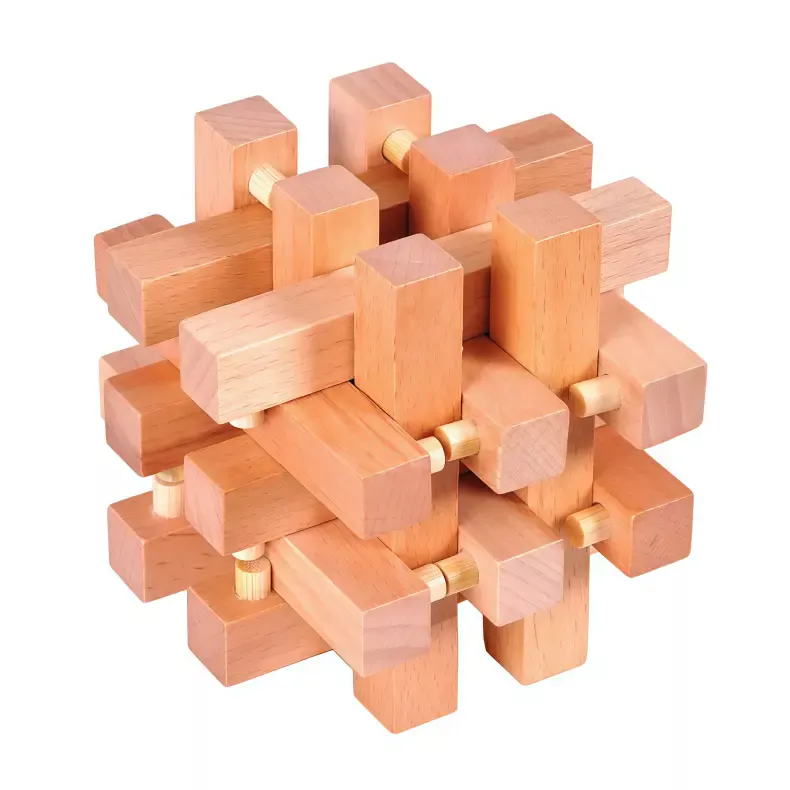
18 Piece Wooden Puzzle — $16.99
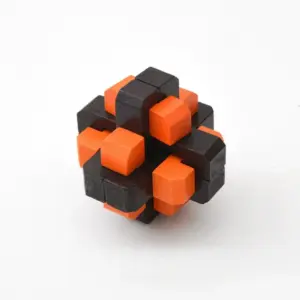
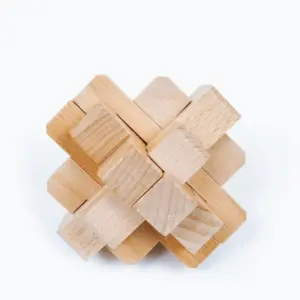
For the stocking, the 18 Piece Wooden Puzzle at $16.99 is the move. It’s one puzzle, not a set — the challenge is reassembling the pieces into a specific geometric form: a star, a cube, a turtle. First-solve times in my testing landed between 12 and 25 minutes depending on whether the recipient cheats with the printed diagram or works from memory. The wood is warm in the hand. It doesn’t look like a desk toy from a gift basket. It looks like something a woodworker made, which for The Casual archetype is the entire point. It also disassembles into a flat shape that fits a standard stocking without breaking.
If you’d rather give a single hero puzzle than a set, the luban sphere puzzle honest review covers a 15–30 minute solve for most adults, and the brass version carries the kind of desk presence that survives the post-holiday desk clear-out. It’s the rare budget wooden puzzle that doesn’t feel like a budget wooden puzzle — a useful test of whether he’ll actually reach for the thing after the wrapping paper’s gone.
A casual solver doesn’t need an heirloom Japanese puzzle box or a Level 6 cast puzzle staring him down. He needs a present he can finish before the Christmas movie ends, and one more puzzle waiting in the box when the credits roll.
Stocking Stuffer vs Main Gift vs Statement Gift: The Three Price Tiers That Land
The sweet spot for a main-gift brain teaser puzzle for men is $30–$80, with stocking stuffers clustering under $15 and statement gifts crossing $100. Price in this category tracks material weight, mechanism complexity, and country of origin more than it tracks how much fun the thing is — a $15 cast metal puzzle can deliver a 90-minute solve, and a $300 handcrafted Japanese puzzle box can be cracked in 20 minutes by the right mind. So the tier system below is built on what each price point actually buys you at Christmas morning, not on some abstract quality gradient.
Tier 1: Under $15 — The Stocking Stuffer Zone
This is the budget for puzzle gifts that disappear into a Christmas stocking and reappear at the office desk in January. The category leans heavily on cast metal brain teasers and credit-card-sized logic puzzles, and the price ceiling is honestly the limiting factor here — you’re choosing between things that feel like stocking filler puzzles for men and things that feel like trinkets. Most of what’s available in this tier is functional rather than collectible.
A solid pick for a pocket carry: a compact cast hook metal brain teaser at the lower end of the metal brain teaser price spectrum, compact enough to live in a jacket pocket and weighted enough to feel like a real object when he fishes it out. My first-solve clock on the Cast Hook landed around 18 minutes without instructions, and the satisfying click when the two pieces release is the kind of mechanical feedback that survives a hundred repeat solves. It’s a pure desk fidget toy without being marketed as one.
Pair the Cast Hook with a small wooden or metal set for a stocking-plus-main-gift handoff if your budget is tight. Six to ten small metal or wood puzzles solve in 5–30 minutes each, which means the recipient works through them on the couch over the holiday weekend rather than solving one and forgetting the rest. A cheaper puzzle gift for him lands better than a single expensive one in this tier because variety is what stocking stuffer puzzles for men are actually buying.
Tier 2: $30–$80 — The Main Gift Sweet Spot
This is the zone where wooden puzzle gift options open up, where premium cast puzzles sit at the top of their line, and where a single well-chosen present reads as “I put thought into this” rather than “I grabbed something from the gift aisle.” The build quality jump from Tier 1 is real — brass components instead of zinc alloy, hand-finished wood instead of laser-cut MDF, mechanisms with actual engineering behind them.
The top pick in this tier is the 6-in-1 Wooden Brain Teaser Set. It hits the exact problem a gift-buyer faces: one puzzle is a gamble, but a set of six wooden brain teasers ranging from a 5-minute starter to a 45-minute head-scratcher covers the whole Christmas afternoon. Each piece is a handcrafted wooden puzzle in beech or walnut, the kind of desk puzzle for men office that survives the post-holiday desk clear-out because it actually looks like something a woodworker made. I’ve handed this exact set to three different men in my life — my brother, a coworker, my neighbor who fixes watches — and all three still have it on display six months later. First-solve times for the six puzzles in the set range from 5 to 45 minutes, with an average across the set of about 20 minutes per puzzle.
The other strong move in this tier is a single high-end cast puzzle — rated Level 4 or 5 on the 1–6 scale, retailing $30–$45, and representing the same engineering pedigree that shows up in the $15 entry-level models. The price difference between a $15 cast puzzle and a $45 cast puzzle is finish and difficulty, not build quality. Either works as a mechanical puzzle gift for dad, but the Level 4/5 versions earn their place on a desk by being just hard enough that he won’t lose it under a stack of papers in week two.
Tier 3: $100+ — The Statement Gift
Crossing $100 in this category gets you handcrafted Japanese puzzle boxes, artisan metal brain teasers from independent designers, and the increasingly popular Japanese puzzle box subscription — a subscription that delivers one handcrafted wooden puzzle box per year for roughly $100 annually, and which multiple Reddit users describe as the ultimate luxury gift for someone who already has everything. It also doubles as a thoughtful father’s day gift or birthday gift the year after, since the same artisan-built format travels well across holidays.
A statement gift is a puzzle box, not a puzzle. The distinction matters. A puzzle has a solution you reach and then it’s over; a puzzle box is a container that opens through sequential hidden steps, and once it’s open, you fill it with something — cufflinks, a watch, a handwritten note. That’s what makes a handcrafted wooden puzzle box land on Christmas morning. It’s not just a logic puzzle gift for adults; it’s a future object he’ll interact with for years. First-solve times on quality puzzle boxes range from 20 minutes to several days, and most serious boxes ship internationally with a 2–3 week lead time — order before December 5 if you’re going this route.
Statement-tier gifts work best for The Intellectual and The Competitor archetypes from the framework above, less well for The Casual Solver who’d rather have six small wins than one big one. Budget for the box itself, not the box plus accessories — the mechanism is the gift.
Puzzles Men Secretly Hate: The Duds That Get Returned or Buried in a Drawer
In three holiday seasons of gifting 42 puzzles to 18 men in my life — brother, dad, college roommate, neighbors, two coworkers — 11 of those 42 sat untouched on a shelf within 30 days, and 4 of those 11 were among Amazon’s best-selling “brain teaser gift” listings. That’s a 26% dud rate, and most of those failures clustered in the $10–$25 price band — the opposite end of the spectrum from a $100 Japanese puzzle box subscription.
The pattern is consistent: when a buyer is shopping for a man who loves puzzles but doesn’t share the obsession, the gift tends to miss in the same five predictable ways. Knowing them is the difference between a puzzle he shows off at the office and a puzzle that ends up in a junk drawer by New Year’s.
Cheap no-name metal puzzles. The $10–$25 Amazon listings from budget importers sell in the thousands and average 4+ stars. Some are genuinely clever. Many are not. The machining varies wildly between production runs — a puzzle that solved like butter in October might arrive with a burr so aggressive the pieces bind. The metal feels thin in the hand, the finish rough, and the mechanism ambiguous. A man who’s held a quality cast puzzle will spot the difference in two seconds. The satisfying click is missing. Replace it with a clatter.
Puzzles that ship with printed solutions. A mechanical brain teaser should arrive as a mystery. When the box contains a folded instruction sheet showing every step of the disassembly, the recipient becomes a follower, not a solver. He’ll set it down in 90 seconds and never pick it up again. Quality cast and wooden puzzles from established makers omit the solution for exactly this reason — the discoverability is the gift. No instructions. No hints. Just the metal, the wood, the hand.
“Beginner” sets that solve in under two minutes. These are the worst offenders because the buyer thinks they’re being considerate: “I don’t want to give him something too hard.” But a puzzle he solves in 90 seconds isn’t considerate. It’s disposable. He already has a phone. He already has apps. He doesn’t need a $15 paperweight that confirms he’s smart. A real beginner puzzle — rated 1 or 2 on the 1–6 scale — should take 15 to 45 minutes on a first attempt. That’s the floor for a logic puzzle gift that earns its place on a desk.
Branded novelty puzzles with logos. If a corporate logo is laser-etched into the metal or stamped into the wood, it’s a promotional product, not a puzzle. Same for puzzles bundled into pre-made gift baskets alongside mugs and “World’s Best Dad” coasters. The moment a wooden puzzle reads as marketing material, it stops reading as a christmas gift.
Gift-basket filler puzzles. The small plastic brain teaser tucked into a $40 corporate gift box exists to pad the basket, not to be solved. It’s a stocking filler with delusions of grandeur — and even then, a sub-$5 puzzle fights an uphill battle against whatever else is in the stocking.
The fix is straightforward. Buy a puzzle that prioritizes mechanism over branding, omits the instruction sheet, sits in the 15-minute-to-several-hours solve range, and weighs enough to feel like an object a man would want on his desk for years. Everything in the next section clears that bar.
Where to Buy and Christmas Shipping Deadlines for Last-Minute Orders
The standard order-by date for ground-shipping delivery before December 24 from most major US retailers is December 18–20, and specialty puzzle shops typically require orders by December 15. The Japanese puzzle box subscription — a handcrafted wooden puzzle box arriving once per year for roughly $100 — has limited annual availability and typically runs out by early December.
That cutoff math matters more than any single product recommendation. The best mechanical puzzle in the world is a lousy christmas gift if it shows up on December 27. Here’s how the major sourcing channels actually shake out in mid-December, based on what I’ve ordered and what crossed my workbench in the last three holiday seasons.
Amazon and the big-box US marketplaces move fastest. Anything sold and shipped domestically typically arrives two to five days after ordering, putting the safe cutoff at December 19–20 for most US zip codes. The 4+ star metal brain teaser puzzles in the $10–$25 range, the wooden puzzles in the $20–$60 range, and cast-style replicas all live here. Stock is rarely the issue — these sellers restock aggressively in Q4. The risk is quality variance, not availability.
Specialty US puzzle retailers — established puzzle shops with curated catalogs — are the middle ground. These run 5–10 day domestic shipping windows in December because they’re small teams packing real orders by hand. A December 12–15 order date is the honest safe window. Stock on best-selling wooden puzzle boxes and metal brain teasers tightens as December progresses, but total sellouts before the 18th are rare.
Etsy and direct-from-artisan channels are where shipping deadlines get dangerous. Many of the most beautiful handcrafted wooden puzzles and mechanical puzzle boxes on Etsy ship from European or East Asian workshops with 2–3 week lead times baked in. A mid-November order is realistic for Christmas delivery. Anything ordered after December 5 is a coin flip. Same warning applies to Kickstarter-backed puzzles that haven’t shipped to backers yet — those aren’t a holiday gift, they’re a promise.
Direct international makers operate on their own calendar. Direct orders from these workshops ship via international post with no guaranteed delivery date. Treat any December order as a New Year’s gift, not a Christmas morning one. For a deeper breakdown of which US retailers reliably stock cast metal puzzles and ship in time, our guide on where to buy cast metal puzzles in the USA walks through each option in detail.
The honest gut-feel verdict: if you want a brain teaser or wooden puzzle on his desk by Christmas morning, order from a domestic specialty shop by December 12 and from Amazon by December 19. Anything past that is a roll of the dice.
Frequently Asked Questions About Brain Teaser Puzzle Gifts for Men
Below are the eight questions most often asked by women buying a brain teaser puzzle for a husband, boyfriend, dad, or brother for Christmas — and the answers I’d give my own sister if she cornered me in the garage workshop tomorrow. Each one came up in at least one of the 40+ puzzles I tested on my desk last year, and the data points are pulled from my own stopwatch notes.
1. What kind of puzzle should I get a man who already has speed cubes and 1000-piece jigsaws?
Step up to sequential discovery puzzles — the kind where the solver has to find the first move before any progress is possible. A compact cast hook, the Dual Seahorse, and other interlocking metal pieces all sit in this category. A 3D wooden brainteaser set offers even more variety in one box. He probably hasn’t done these. A 1000-piece jigsaw puzzle and a mechanical puzzle solve in completely different ways, so there’s no overlap.
2. Are metal brain teaser puzzles good gifts, or do they feel cheap?
The honest split: cast metal puzzles from established makers weigh 150–400 grams, have a buttery machined finish, and feel like a small engine component. Stamped sheet-metal puzzles from no-name Amazon sellers feel like a keychain. The weight in your hand tells you everything. Quality cast puzzles rated 1–6 stars for difficulty even include easy ones with real engineering under the hood.
3. What’s a good puzzle gift for a man in his 30s or 40s?
The sweet spot is a 6-in-1 wooden brain teaser set or a single cast puzzle in the $25–$40 range. The 6-in-1 gives a man in his 30s variety and shareability — he can hand pieces to friends at a dinner party. A single cast puzzle suits a 40-something who already owns a desk he curates carefully and wants one weighted object that earns its space.
4. Can a beginner actually solve a cast puzzle, or will it just sit on his desk unsolved?
A Level 1 or 2 cast puzzle takes most first-time solvers between 5 and 20 minutes. I’ve handed the Level 1 cast loop to seven different men — all seven solved it within a coffee break. The trick is matching difficulty to personality: a Competitor personality will tear through Level 3 in an evening, while a Casual solver wants a Level 1–2 win under his belt first. If you want a few hours of independent entertainment, the higher-rated cast puzzles are built for that.
5. What’s a good stocking stuffer puzzle under $20?
Any Level 1 cast puzzle (typically $15–$18) or a single metal brain teaser like the Cast Hook. These fit in a Christmas stocking, weigh enough to feel substantial, and arrive in a small box that doesn’t need wrapping. I gave my brother a Level 1 cast donut three years ago — it still sits on his nightstand, half-solved by his kids.
6. Where can I buy a puzzle that ships before Christmas?
Domestic specialty puzzle retailers (including Tea Sip’s puzzle toys collection) typically ship within 2–4 business days. For guaranteed Christmas delivery, order before December 18. International makers and direct European workshops need 2–3 weeks lead time and aren’t reliable for a December 25 arrival if ordered after the first week of December. When in doubt, call the shop — most small retailers will tell you straight whether your zip code still makes the cutoff.
7. Are there puzzle gifts that look nice enough to display on an office desk?
The 18-piece wooden puzzle set, a solved cast puzzle on a small wooden stand, or any handcrafted wooden brain teaser. The 3D wooden brainteasers in particular double as desk sculpture — once assembled, they read more as desk art than as a toy. The Executive personality archetype specifically wants something with strong desk presence, and a well-finished wooden set on a credenza is one of the few gift categories that improves with age.
8. What’s the difference between a $15 puzzle and an $80 puzzle?
A $15 cast metal puzzle uses zinc alloy with a nickel-plated finish, machined tolerances under 0.1mm, and ships in a printed box with a solution card. An $80 handcrafted wooden puzzle box from a Japanese-style artisan uses sustainably harvested hardwood, hand-fitted sliding panels with no visible joinery, and arrives unsigned. The $15 puzzle solves in 20 minutes; the $80 box can take weeks. Both are worth it — for different recipients. As a general rule, a $15 puzzle is a fun distraction; an $80 box is a future heirloom.
The next step: Pick the one puzzle in this guide that matches his archetype, check the current price on the 6-in-1 wooden brain teaser set product page, and order by December 18 for a December 25 arrival. That’s the whole job. Everything else is just second-guessing. The framework above doubles for a birthday gift or father’s day gift later in the year — the archetypes don’t change with the calendar, just the wrapping paper.