The Overwhelm and the Algorithm: Staring Down a Scrambled Cube
A kaleidoscope of chaos. A plastic paperweight. An official symbol of frustration you can hold in your hands. You’re not alone in staring down your scrambled puzzle cube, feeling that familiar cocktail of curiosity and dread. I’m right there with you, on my own couch, a fully mixed-up 3×3 cube resting in my palm. This is the precise moment where every solver—from the world champion to the absolute beginner—starts. The moment before the first turn.
That first solve is a memory carved in plastic for me. A rainy afternoon, my dad’s vintage Rubik’s Cube from the garage, and a stubborn refusal to look up the answer. The satisfaction of that final click wasn’t just about aligning colors; it was the pure joy of a system working. Of chaos yielding to order. I want you to feel that click. This puzzle cube tutorial is your map to get there.
Let’s name the overwhelm first. Your cube isn’t just mixed up; it’s in one of 43 quintillion possible configurations. That number is incomprehensible. Trying to solve it through random twisting is like hoping to write a novel by shuffling alphabet soup. The initial paralysis is real, and it’s cognitive: your brain sees a 3D problem with no clear entry point.
This is where the algorithm—and the beginner’s method—becomes your lifeline. An algorithm isn’t a magical incantation. In our world, it’s simply a reliable sequence of moves designed to create a specific, predictable change. Think of it like a recipe. You don’t need to understand the chemistry of yeast to bake bread; you just need to trust that combining specific ingredients in a specific order gets you a loaf. The layer-by-layer method breaks that impossible 3D problem into a series of small, manageable 2D puzzles. We don’t solve the whole cube at once. We solve one piece, then one layer, building a foundation of solved parts that the next steps can depend on.
My background in cognitive psychology taught me that our brains are exceptional pattern-recognition machines, but terrible at holding more than a few moving parts in working memory. The layer-by-layer approach plays to our cognitive strengths. It transforms an abstract puzzle into a concrete, repeatable process. The relief you’ll feel isn’t from a “secret” being revealed, but from the realization that this problem has structure. It’s a maze with a known path.
So, take a breath. Look at your cube. We’re going to stop seeing a monolithic block of confusion and start seeing its components: the fixed center pieces that define each face’s color, the two-colored edge pieces, and the three-colored corner pieces. Your mission, step one, is to move from overwhelm to action—from staring to doing. If you want a foundational overview before diving into the steps, our general guide to solving a puzzle cube is a great place to start.
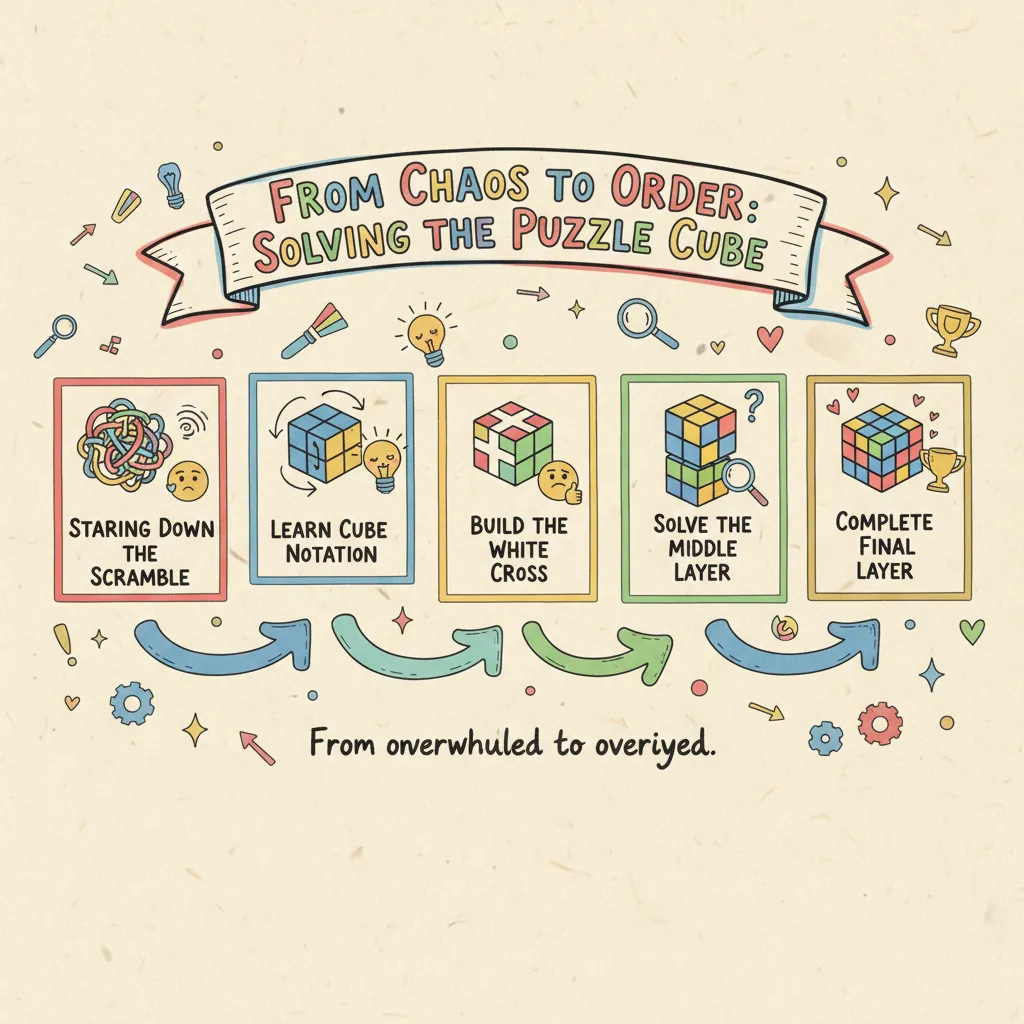
The journey from this scrambled state to that sublime final click follows a clear emotional and logical arc. We’ll build growing confidence with the first layer, hit expected frustration in the second, experience a breakthrough in understanding algorithms for the last layer, and finally, feel the pride and empowerment of a complete solve. It all starts with a single, deliberate turn.
Stuck? Breathe. Every solver has been here. Let’s begin.
Learning the Cube’s Language: A 5-Minute Guide to Notation & Mechanics
That shift from staring to doing begins with learning the cube’s language. Think of it like assembling a burger: you don’t just smash ingredients together; you build in logical, stable layers—bun, patty, lettuce, top bun. The cube works the same way. We build the first layer (like the bottom bun), then the second layer (the fillings), and finally the top layer (the top bun). To do this precisely, we need names for the pieces and a shorthand for our moves.
First, the anatomy. Every 3×3 cube has three types of pieces. The center pieces are fixed. They are the axis of the cube’s mechanism and never move relative to each other. This is the single most important fact to internalize: a red center is always opposite the orange center, a white opposite yellow, and blue opposite green on a standard cube. They are the north stars of your solve. The edge pieces sit between centers and have two colors. The corner pieces have three colors and occupy the cube’s eight corners.
To communicate moves without cumbersome descriptions, we use a universal notation. It’s based on the six faces of the cube, each assigned a letter:
* R (Right): The face on your right-hand side.
* L (Left): The face on your left.
* U (Up): The top face.
* D (Down): The bottom face.
* F (Front): The face facing you.
* B (Back): The face facing away.
A letter by itself means a 90-degree clockwise turn of that face (from the perspective of looking directly at it). A letter followed by an apostrophe (like R’) means counter-clockwise. A 2 (like U2) means a 180-degree turn.
So, if an instruction says R U R’, you execute: Turn the Right face clockwise, then the Up face clockwise, then the Right face counter-clockwise. Practice this sequence a few times. Feel the rhythm. This is a trigger move—a fundamental, finger-friendly sequence that forms the building block of many algorithms.
And that’s our final piece of vocabulary: an algorithm. It’s not a scary tech term. It’s simply a reliable recipe, a pre-defined sequence of moves (like R U R’) that accomplishes a specific task, like moving a piece into place without destroying your progress. You are not performing magic; you are following a tested, logical procedure. Resources like ruwix.com have excellent visual guides for this notation if you ever need a quick reference.
Now, with the pieces named and the notation decoded, you’re no longer just twisting a block of plastic. You’re speaking the cube’s language and ready to build your first, stable layer.
Building Your Foundation: The White Cross and the First Four Corners
Now that you can speak the cube’s language with notation, it’s time to apply it. This is where the abstract becomes physical, and the layer-by-layer method becomes your roadmap. We begin by constructing a solid foundation: the entire first layer, starting with the iconic white cross.
Your goal isn’t just to get four white edges around the white center. The true goal is to build a correct cross, where each white edge piece also aligns with the side center color. Think of it like stacking a burger: the white center is the bottom bun, and each edge is a perfectly aligned ingredient that matches the side of the box it’s in. This alignment is crucial for everything that follows.
Crafting the White Cross (It’s More Intuitive Than You Think)
Forget algorithms for now. This stage is about observation and intuitive moves. Hold your cube with the WHITE center facing down. Yes, down. This is a common speedcubing tip that makes seeing the other colors easier. Now, look at the UP (top) face. We’ll use it as a “workspace” to maneuver pieces.
- Find a white edge piece (a piece with one white sticker). Look on the top layer first.
- Look at the other color on that edge. Let’s say it’s blue.
- Turn the top layer until this white-and-blue edge is directly above the blue center piece on the middle layer. Now, the blue side of the edge is lined up with the blue “face” of the cube.
- Flip it down. If the white sticker is on the top face, a simple F2 (a 180-degree turn of the Front face) will send it down to the white side, perfectly placed next to the white center and aligned with the blue center.
Repeat this hunt-and-align process for the other three white edges. Often, a white edge will be in the middle layer but flipped the wrong way. To fix it, use the top layer as an escape route: turn the cube so the piece is on the Front face, then do an F move to bring it to the top, align it with its center, and F2 to slot it home correctly.
Troubleshooting: The Dreaded “Flipped Edge”
What if your white cross looks right from above, but the side colors don’t match their centers? You have a flipped edge. This is the most common stall point here. Don’t re-scramble. The fix is a simple trigger: (R U R’ U’). Position the misaligned edge on the Front face and execute this sequence. It will pop the piece out to the top layer, letting you re-align and insert it properly. Stuck? Breathe. This is just the cube teaching you its rules.
Anchoring the Corners: Your First Taste of Algorithms
With a perfect white cross, your foundation’s frame is set. Now, we place the four white corners to complete the first layer. This is where we graduate to our first, gentle algorithms—but I prefer to call them “placement recipes.”
Find a white corner on the top layer. It will have three colors: white plus two others (e.g., white, red, blue). Your job is to bring it directly above its “home” corner—the spot where the white, red, and blue faces intersect.
Scenario A: White sticker on the side. Position the corner so its white sticker is either on the Front or Right face. A simple recipe will tuck it into the bottom layer.
- If white is on the Front: Use U R U’ R’ (The “Right Trigger”).
- If white is on the Right: Use U’ F’ U F (The “Left Trigger”).
Scenario B: White sticker on top. This needs a little nudge first. Use R U R’ U’ twice to rotate it until the white is on the side, then apply the correct recipe above.
Scenario C: Corner is already in the bottom layer but wrong or twisted. Don’t panic. Use R U R’ to unhook it, bringing it up to the top layer. Now it’s a Scenario A or B piece, and you know what to do.
This process is pure pattern recognition. You’re not memorizing strings of letters; you’re learning a move that hooks a corner down into its slot. Do this for all four white corners, patiently working around the cube. When you finish, your entire white face will be solved, and—importantly—a solid band of color will surround the first layer. You’ve built your burger’s bottom half perfectly.
For a fantastic visual companion to these steps, I always recommend the How To Solve The Puzzle Cube Guide, which breaks down each trigger move with clear graphics.
You’ve just answered a key user question: Is there a way without complex algorithms? For the first layer, the answer is a resounding yes. The cross is logic, and the corners use two mirrored, finger-friendly triggers. You’re not performing magic; you’re applying a systematic method. This foundation is stable. Now, we’re ready to build the second layer on top of it.
The Confidence Plateau (and Drop): Solving the Puzzle Cube’s Second Layer
You’ve done it. That solid band of color around your completed white layer isn’t just solved plastic—it’s proof. You’ve built a reliable foundation. Now, we build the walls. This is where many puzzle cube solvers hit what I call The Confidence Plateau. Your confidence, having climbed steadily during the first layer, suddenly flattens. Then, with one misplaced piece, it often drops. This is completely normal. You’re transitioning from intuitive building to guided, patterned thinking. The good news? The four middle-layer edge pieces are solved using just two mirrored algorithms—which we’ll call “trigger moves.”
First, understand the battlefield. The second layer consists of the four vertical edges between the corners you just solved. They belong sandwiched between the two center pieces. A solved piece will have its sticker colors matching the centers to its left and right. Flip your cube so your solved white layer is on the bottom. Your workspace is now the top layer and the unsolved middle.
Your goal: Find a top-layer edge piece that does not have yellow on it (since yellow is the opposite face of white and will be our final top layer). The colored sticker facing up on this piece tells you its destination column.
Here is your first true pattern, a dance of three moves. Let’s call it the Right-Hand Trigger.
- Align the piece. Turn the top layer until the edge piece’s top color aligns directly above its matching center piece. Look at the piece’s front-facing color. This tells you whether it needs to go down to the left or the right.
- The Move. If it needs to go to the right: Turn the top layer away from its target side. Then, perform this sequence with your right hand, focusing on the fluid motion, not the notation:
- U R U’ R’ U’ F’ U F
(In words: Top away from target, Right up, Top back, Right down, Top back, Front down, Top toward you, Front up.)
- U R U’ R’ U’ F’ U F
- If the piece needs to go to the left, you use the mirrored Left-Hand Trigger:
- U’ L’ U L U F U’ F’
Practice just the hand-feel. The Right-Hand Trigger starts with a thumb push on the top layer away from you, followed by a rolling right-hand sequence. The left-hand version is its mirror. You’re not memorizing letters; you’re learning a physical pattern that slots the piece home.
▶️ Troubleshooting: When the Second Layer Piece is in the Wrong Place
Stuck? Breathe. The most common snag is finding the edge you need already in the second layer, but in the wrong slot or flipped. This feels like a crisis, but the fix is elegant. You don’t need to disassemble your cube. You simply use the same algorithm to evict it.
Scenario: A middle layer edge is in the wrong spot.
Pick any unsolved top-layer edge (even a yellow one for now). Perform the algorithm as if that top piece belonged in the slot of the misplaced piece. This will pop the wrong piece out into the top layer, replacing it with your sacrificial piece. Now you have your target piece in the top layer, ready to be inserted correctly. This directly answers a key user question: How do I fix an edge piece without messing up solved layers? You use the system itself to correct errors.
Remember, the center pieces are fixed. They are your immovable landmarks. Every move you make is in relation to them. Work methodically around the cube, inserting the red-blue, red-green, orange-blue, and orange-green edges (if white is on bottom and yellow on top). If you can’t find a non-yellow edge in the top layer, it means they’re all incorrectly placed in the middle—apply the troubleshooting step above to free one.
When the second layer clicks into place, that plateau of frustration becomes a plateau of genuine skill. You’ve just internalized your first real algorithms. This breakthrough moment is the core of the beginner’s method—you’re learning a repeatable language of moves that will unlock the final, most intimidating layer of your 3×3 cube.
The Final Layer Breakthrough: Yellow Cross, Positioning, and Orientation
You’ve built a solid foundation—two pristine layers sitting atop each other, a testament to your growing understanding. Now, you face the yellow top layer, a chaotic mosaic that feels like a different beast entirely. This is where the real magic of systematic thinking reveals itself. The final layer isn’t a single, monstrous hurdle; it’s a sequence of three manageable patterns. We’ll solve it in stages: first, we make a yellow cross on the top face (just the cross, not the corners). Then, we position the yellow corners in their correct spots. Finally, we orient those corners to complete the solve. This staged approach is the heart of the beginner’s method, turning overwhelming complexity into a clear checklist.
Stage 1: Forming the Yellow Cross
Look at the yellow face. Ignore the corner pieces for now. What pattern do the yellow edge pieces make?
* A single yellow center (a dot).
* An L shape (a line of two yellow edges plus the center).
* A line of three yellow pieces across the center.
* Or, if you’re lucky, the completed cross.
Your goal is to progress through these patterns in that exact order, using one algorithm. This is your first major final-layer algorithm, and it’s a gentle introduction. Think of it as a trigger move—a short, rhythmic sequence that becomes muscle memory.
Hold your cube with the yellow center on top. The algorithm only uses the F (front), R (right), U (up), and B (back) faces.
The Yellow Cross Algorithm:
* F
* R U
* R’ U’
* F’
Perform this sequence once. Now, check your yellow face again. Did the pattern change? Your goal is to apply this algorithm from the correct orientation to progress from a dot to an L, from an L to a line, and from a line to the cross.
* If you have a dot: Perform the algorithm once. You’ll likely get an L. Reposition the cube so the L is in the top-left corner (like a backwards ‘L’) and perform the algorithm again to get a line.
* If you have an L: Rotate the entire cube so the L sits in the top-left corner. Perform the algorithm. You should get the line.
* If you have a line: Orient the line horizontally. Perform the algorithm. The yellow cross should appear.
This process directly answers the user question about the logic behind moves. You’re not randomly twisting; you’re using a predictable, repeatable process to manipulate a specific subset of pieces—the yellow edges—while leaving your solved first two layers untouched below. Stuck? Breathe. Re-check your starting pattern and orientation.
Stage 2: Positioning the Yellow Corners
With the yellow cross complete, the next step is to get the four yellow corner pieces into their correct positions around the top layer. They don’t need to be facing the right way yet (that’s the final stage); they just need to be in their rightful home. For example, the corner that should be yellow, red, and blue needs to be at the intersection of the yellow, red, and blue faces.
To do this, we use a gentle, intuitive algorithm often called the U-Perm algorithm (specifically, the “Aa-perm”). This is a cornerstone of speedcubing and is beautiful in its simplicity—it cycles three corners around the top layer.
How to find your setup:
1. Look at the top-layer corners. Find one corner that is already in its correct position (the three colors match the three center pieces it touches). It doesn’t matter if it’s twisted wrong.
2. Hold the cube with that correct corner in the front-right-top position.
3. If no corner is in the correct spot, perform the algorithm below from any orientation once. This will place one corner correctly, then you can reposition the cube and perform it again.
The Corner Positioning (U-Perm) Algorithm:
* U R U’ L’ U R’ U’ L
Execute this slowly. Watch what happens: the front-left, front-right, and back-left corners swap places in a predictable three-cycle. After the algorithm, your yellow cross will be temporarily broken but will always restore itself by the end of the sequence—trust the process. You may need to perform it up to two times, always holding a correct corner in the front-right spot, until all four corners are in their correct locations.
Stage 3: Orienting the Yellow Corners (The Easiest Algorithm)
This is it. The final stage. All pieces are in their correct spots. Now, we just need to twist the yellow corners so the yellow faces point upward, completing the solve state.
For this, we use what many cubers agree is the easiest final-layer algorithm to remember: the Sune. It’s short, rhythmic, and creates a satisfying, visual “flip” of the corners. I explain it to my workshop students as “chasing a fish.”
Here’s the mental model. After positioning, look at the yellow face. Some corners will have yellow on top (solved), and some will have yellow on the side. The Sune algorithm is applied based on where an unsolved corner is located.
The Corner Orientation (Sune) Algorithm:
* R U R’ U R U2 R’
How to apply it (The “Fish” Analogy):
1. Hold the cube so that an unsolved yellow corner (yellow facing front or right, not up) is in the front-right-top position.
2. Perform the Sune algorithm.
3. Look at the yellow face again. The pattern will have changed. You may now see what looks like a “fish”—a specific shape where three yellow corner stickers are visible on the top face, forming a small triangle or fish shape.
4. Reposition the cube so the head of the “fish” is pointing to the front-left.
5. Perform the Sune algorithm one more time.
That’s it. After the second Sune, all yellows should snap into place. Your entire 3×3 cube will be solved. This two-Sune approach is a foolproof way to handle the last step without memorizing longer, more complex sequences. It directly answers the user question: What’s the easiest algorithm for the final layer? Sune is the answer—it’s a building block used even in advanced speedcubing methods like CFOP.
The feeling when you perform that final U move and see a solid color on every face is unique. It’s not luck. It’s the breakthrough moment where abstract algorithms translate into tangible, physical order. That final click is the sound of a solved puzzle, and the pride that follows is the empowerment to pick up any twisty puzzle—be it a classic Rubik’s Cube, a keychain cube, or a Sudokube—and understand the layered language of its solution.
When Your Cube Fights Back: A Troubleshooting Guide for Common Snags
That final satisfying click of a solved 3×3 cube is the goal. But between that moment and a fresh scramble lies reality: sometimes, the cube fights back. Even with perfect algorithm execution, you can hit snags that feel like the puzzle is defying logic. This isn’t a failure of your method; it’s a normal part of learning any mechanical puzzle. Let’s troubleshoot the most common issues that stall beginners, directly answering those nagging user questions that forums are full of.
The Single Flipped Edge: A Sign, Not a Curse
You’ve executed the final layer-by-layer steps perfectly, but one edge piece is flipped in place, ruining two completed faces. On a standard 3×3, this is not true parity—it’s impossible on a Rubik’s Cube from a normal scramble. It means the cube was either accidentally reassembled incorrectly or was twisted into an unsolvable state by a well-meaning friend. The fix is straightforward and is a great application of a U-Perm algorithm you may already know.
- Hold the cube so the flipped edge is in the front-right position.
- Perform this sequence, which swaps three edge pieces in a ‘U’ shape without disturbing corners: R U’ R U R U R U’ R’ U’ R2.
- This will move the flipped piece out and back in, correctly oriented. You’ll then need to resolve the top layer using your final layer steps again. It’s a minor setback, not a reset.
The Dreaded “Pop”: Why Pieces Fly and How to Recover
Why does my cube pop pieces when I turn too fast?
This is perhaps the most startling common Rubik’s cube mistake. A “pop” happens when an edge piece or corner piece dislodges from the core. It’s almost always due to a misturn—forcing a move that’s physically blocked because the layers are misaligned. Modern speed cubes are designed to be fast and forgiving, but they can still pop if you’re aggressive with an unsupported slice.
To prevent it: Develop a feel for smooth, aligned turns. If you meet resistance, don’t force it. Look at the cube’s alignment; a slight adjustment of the first layer or second layer is often all you need.
To fix it: Don’t panic. Gently push the spring-loaded center cap back into place. For a more complete reassembly (if multiple pieces come out), start by securing the center pieces to form a cross, then rebuild the first layer corners and edge pieces around them. It’s like reconstructing your solved state one layer by layer. For a deeper guide on keeping your cool during these moments, see our companion piece, How To Solve A Puzzle Cube Without Losing Your Mind.
The Stiff, Grinding, or Misaligned Cube
A cube that turns poorly is a cognitive barrier. It makes practicing finger tricks and sequences feel like a chore. Often, this is simply dust and debris or dried-out factory lubricant. For a new cube, break it in with hundreds of gentle turns. For an older one, consider a dedicated cube lubricant (silicone-based) applied sparingly to the pieces.
If your cube constantly catches or feels misaligned, check for a “corner twist”—where a corner piece is slightly skewed on its stalk. Gently twist it back into alignment. Remember, the puzzle cube is a precise tool. A clean, well-lubricated, and aligned cube doesn’t just turn faster; it makes the beginner’s method feel more fluid and less frustrating.
These hiccups are universal. Every solver encounters them. The key is to recognize them not as walls, but as gates. Understanding why a piece flipped or popped demystifies the cube’s mechanics, turning a moment of frustration into a deeper part of your solve state mastery. For an even more detailed troubleshooting resource, check out this in-depth Rubik’s cube solving method guide.
Beyond the 3×3: How These Skills Unlock Other Puzzle Cubes
That moment of mastery—troubleshooting a popped piece or a flipped edge—does more than fix your 3×3. It unlocks a fundamental truth about twisty puzzles: the layer-by-layer mindset and notation you’ve learned are a universal skeleton key. The scramble in front of you isn’t just a Rubik’s Cube; it’s a training ground for every other puzzle cube you might pick up. So, can you use the same beginner’s method for a keychain cube or a Sudokube? Absolutely. Here’s how your new skills translate.
First, consider the classic keychain puzzle cube—a 2×2. It looks simpler, and in many ways, it is. There are no edge pieces, only corner pieces. Your entire solve is just the corner-solving steps from the 3×3 method. Think of it as solving just the four corners of your white layer, then the four corners of the yellow layer. The algorithms you use for positioning and orienting the final layer corners on a 3×3 (like the right-hand and left-hand triggers) are often the exact sequences you’ll use to solve the entire 2×2. Your brain is already wired for this. You’re not starting over; you’re applying a focused subset of your existing knowledge.
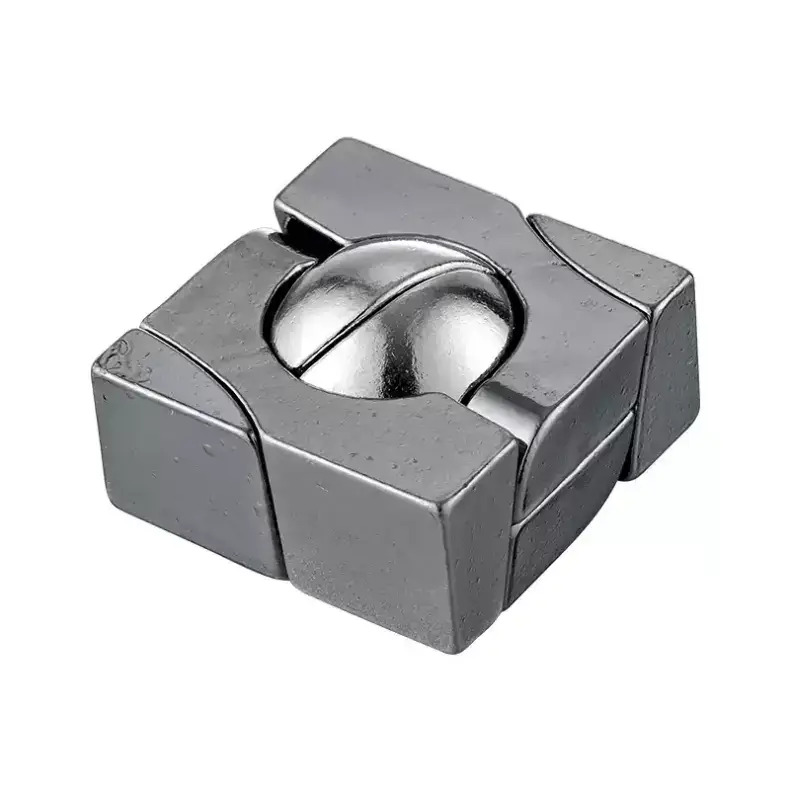
Then there’s the Sudokube, which layers a number puzzle onto a 3×3 cube. The solve state isn’t solid colors, but having the numbers 1-9 on each face without repetition. This shifts the challenge from visual pattern matching to logical constraint solving. Your mechanical skills are identical—you still execute algorithms to move pieces around a 3×3 grid. The new layer is mental: you must plan your “cross” and “corners” around numerical rules. It’s the perfect next step, applying your finger dexterity to a more abstract logic puzzle. For a deep dive into this hybrid challenge, see our guide, How To Solve The Puzzle Cube A Veterans Guide To The 3D Maze.
This is the real power of starting with the classic Rubik’s Cube. You haven’t just memorized steps. You’ve built a mental framework of spatial reasoning, algorithmic thinking, and systematic problem-breaking. These skills are directly transferable to the vast world of mechanical puzzles.
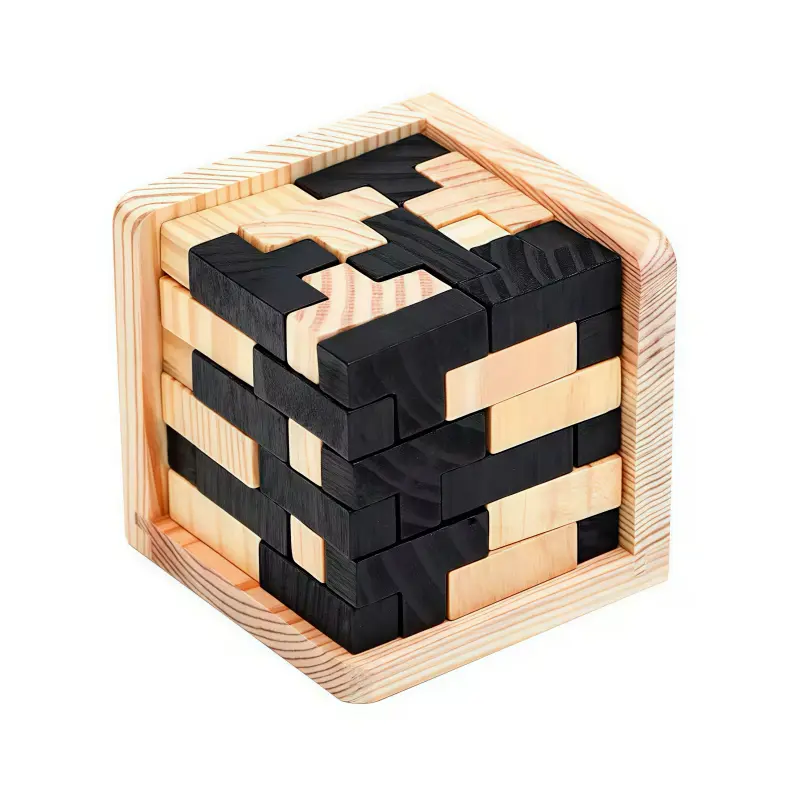
54‑T Cube Puzzle — $18.99
Stuck on a specific mini-cube? The principles remain. Identify your equivalent of a “first layer”—a stable foundation. Isolate the pieces that need to move. Find a sequence that affects only the unsolved parts. Your first scramble taught you patience. Your first solve state taught you process. Now, pick up that keychain cube. Apply the same methodical patience. For a focused walkthrough, check out our How To Solve A Keychain Puzzle Cube Guide. You’re not learning a new puzzle. You’re speaking the same language of turns and sequences, just with a different dialect. The click of that final turn on a new puzzle? It feels just as satisfying.
From First Solve to Fluid Solver: Practice, Mindset, and Next Steps
That final, satisfying click you just heard? It’s the sound of a scramble being conquered. You’ve moved a puzzle from the “impossible” pile to the “solved” pile, proving that systematic thinking works. So, what now? The journey from that first triumphant moment to becoming a fluid speedcubing enthusiast is all about practice, understanding your beginner’s method, and knowing where to look next.
First, be realistic. The average first-time solve time using this layer-by-layer method ranges from 30 minutes to a few hours. Don’t compare yourself to the 3-second world records. Your goal is consistency. Can you solve it again tomorrow without the guide? Practice isn’t about endless repetition; it’s about targeted improvement. Isolate the steps that trip you up—perhaps the second layer algorithm or the final corner orientation—and drill just those sequences until your fingers remember them. This builds the muscle memory that transforms a halting, 15-minute solve into a smooth, sub-5-minute one.
How hard is this compared to other puzzles? Unlike a metal disentanglement puzzle, which requires a single flash of spatial insight, solving a Rubik’s Cube is a structured application of logic and memory. It’s less about a sudden “aha!” and more about trusting a repeatable process. Your patience and methodical approach here translate directly to other mechanical puzzles. As a classic example of the genre, you can learn more about its history and mechanics on the Rubik’s Cube Wikipedia page.
Your current layer by layer method is the foundation. When you’re ready to shave minutes off your time, you’ll graduate to methods like CFOP (the method most speedcubing champions use), which builds on the concepts you already know. Instead of solving piece-by-piece, you’ll learn to solve in blocks and use more efficient algorithms. Resources like the YouTube channel Jperm offer incredible, clear tutorials for this progression, and sites like speedcube.us provide deep dives into technique and gear. If you’re interested in a cube with enhanced stability for faster times, explore options like a magnetic cube puzzles for advanced practice.
For inspiration, look to the World Cube Association (WCA). This global body sanctions competitions for everything from the standard 3×3 cube to one-handed and blindfolded solves. Watching a competition isn’t just about awe; it’s a masterclass in efficiency and focus. It shows what’s possible with dedicated practice.
Your actionable next step? Visit the WCA website, find a local competition or club (many are beginner-friendly), or simply aim to solve your cube five days in a row without notes. The world of mechanical puzzles is vast and fascinating; you can explore its full breadth on Wikipedia. When you’re ready for a completely different kind of spatial challenge, consider tackling an advanced puzzle box challenges for the next level. You’ve cracked the code. Now, make the solving your own.