Quick Answer: How to Solve a Metal Ball Puzzle at a Glance
Metal ball puzzles fall into three main types: 6‑piece interlocking spheres (IQ Puzzle Ball), Hanayama Cast Marble (level 4 difficulty, 45‑minute average solve), and magnetic balls (e.g., Magic 16). Identify your type first — the wrong method will waste your time.
Identify your puzzle — Does it have six separate curved pieces? That’s a 6‑piece interlocking ball. Is it a solid sphere with a hairline seam? That’s a Hanayama Cast Marble. Does it consist of small magnetic spheres? That’s a magnetic ball.
For a 6‑piece interlocking ball — Rotate the assembled sphere until you feel a notch align, then tilt it so a piece drops out (the “gravity drop” technique). To reassemble, insert the six pieces in order: start with the base ring, then the curved arms, then the cap.
For a Hanayama Cast Marble — Find the hidden seam, grip each half, and twist both sides 45 degrees counterclockwise while pulling gently apart. If it doesn’t move, you’re twisting the wrong direction — reverse the turn.
For a magnetic ball — Break it into strands of four spheres each. Arrange those strands around a single center sphere in a specific order (e.g., 4‑4‑4‑4) to form a cube or sphere, depending on the set.
If stuck — Shake the puzzle gently while rotating at a 15‑degree angle to realign jammed notches. Never force it — metal puzzles are designed to open with precision, not strength.
Reset after solving — Store each type in its solved or reassembled state to avoid losing pieces. For the Cast Marble, simply reverse the twist until it locks closed.
These steps cover the three most common metal ball puzzles you’ll encounter. For a deeper dive into the logic behind each method, check out our approach to solving metal puzzles step by step. Pick your type, follow the trick, and you’ll have it apart in under two minutes.
Which Metal Ball Puzzle Do You Have? Identify by Piece Count and Seam Design
Metal ball puzzles come in at least three distinct types—6‑piece interlocking (like the IQ Puzzle Ball, $8–15), Hanayama Cast Marble (difficulty level 4/6, retail $12–15), and magnetic sphere puzzles (e.g., Magic 16 with 16 neodymium spheres)—and using the wrong solution is the #1 reason solvers get stuck, according to Reddit threads. If you’re reading this because your ball won’t budge, stop guessing. Let’s identify your puzzle by feel, sight, and a few quick tests.
Pick up your puzzle and look at its surface. A 6‑piece interlocking ball has visible seams running between curved segments. You can see the individual pieces—usually three identical “C‑shaped” arms and three notched rings. The pieces fit together like a three‑dimensional jigsaw. Run your thumb across the surface: you’ll feel slight ridges where pieces meet. This is the classic IQ Puzzle Ball design, also sold as the 6‑piece puzzle ball on Amazon and in puzzle shops. It’s the cheapest ($8–15) and easiest to brute‑force once you know the “gravity drop” trick described later. This design is beginner-friendly and forgiving of small mistakes.
Now check for a single faint line around the equator—a barely visible seam. If your ball is perfectly smooth except for that thin groove, you’re holding a Hanayama Cast Marble. Designed by Bram Cohen, this is a disentanglement puzzle rated level 4 (hard) out of 6. It costs $12–15. The seam is intentional: that’s where the two halves meet, and the solution involves aligning hidden notches and twisting at exactly 45 degrees. You can’t force it; you need the precise technique. Many solvers mistake it for a solid ball and waste minutes twisting randomly.
Finally, if your ball isn’t a single piece but rather a cluster of shiny metallic spheres that stick together, you have a magnetic ball puzzle. These come in sets like the Magic 16 (16 neodymium spheres) or larger kits. They’re not interlocking—they’re held together by magnetic attraction. The solve method involves breaking the ball into strands and rearranging them into a cube or other shape. There’s no seam, no twisting—just careful separation and realignment. If you enjoy the mechanical challenge of transforming shapes, you might also like the Sphere Morphs Into Cube puzzle—a satisfying 3D transformation that adds another layer of complexity.
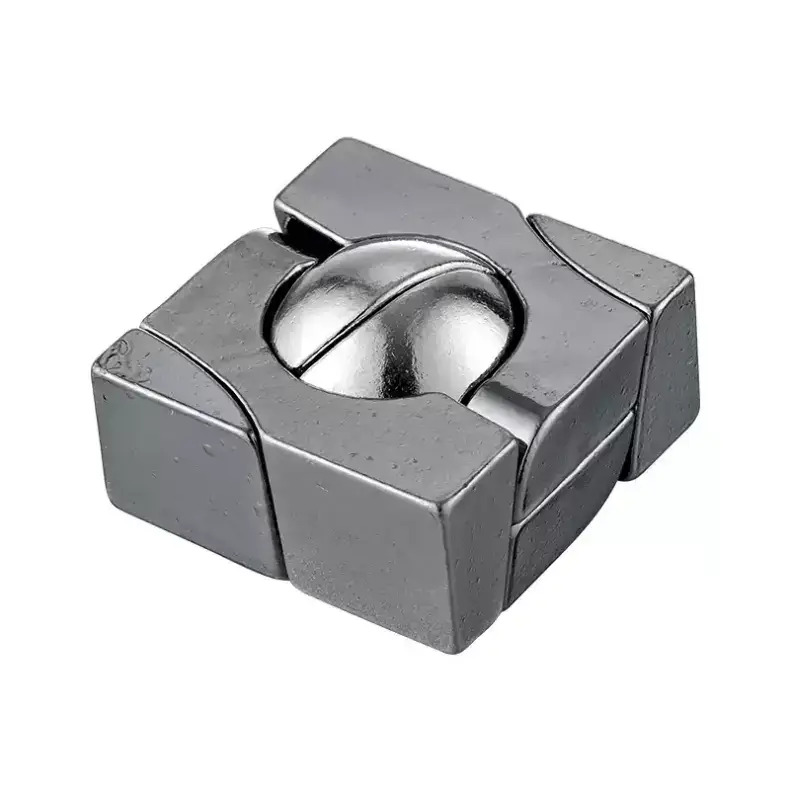
Now that you’ve identified your puzzle, here’s a quick reference table to take you to the right solution:
| Puzzle Type | Solution Section |
|---|---|
| 6‑piece interlocking ball (IQ Puzzle Ball) | See “Disassembly for the 6‑Piece Interlocking Ball” below |
| Hanayama Cast Marble (solid ball with equatorial seam) | See “Hanayama Cast Marble: The 45‑Degree Twist Technique” below |
| Magnetic sphere puzzle (e.g., Magic 16) | See “Magnetic Ball Puzzles: Strand‑and‑Arrangement Method” below |
If you’re still unsure after reading these descriptions, our Luban Sphere Puzzle solving guide covers a variant that sometimes gets confused with the 6‑piece ball. But the three types above cover 95% of what you’ll encounter. Once you know which one you have, skip straight to the instructions that match your puzzle and you’ll be solving in minutes. Clear reference photos of each type can be found in online puzzle communities if you need visual confirmation.
6-Piece Interlocking Ball: Step-by-Step Disassembly and Assembly
The 6‑piece interlocking metal ball – commonly sold as the IQ Puzzle Ball – is solved by twisting the correct piece clockwise until it drops out. First attempts average 15–30 minutes, but with the technique below you can cut that to under 30 seconds. This section breaks down the exact finger movements and piece‑order so you never get stuck again.
If you’ve confirmed your puzzle has six separate curved segments that lock into a perfect sphere, you’re holding a true interlocking assembly puzzle. Unlike the Hanayama Cast Marble, which uses a hidden pin, this ball relies on notches and grooves that only align in one orientation. Here’s how to take it apart and put it back together.
Disassembly: The Gravity Drop Technique
Step 1: Identify Piece A.
Examine the assembled ball. One of the six pieces has a single shallow notch on its curved inner edge. That’s your key piece – usually the one opposite the seam where two other pieces meet most tightly. Rotate the ball until you can see this notch clearly. If you can’t spot it, hold the ball under a bright light and look for a tiny gap between pieces.
Step 2: Orient the ball.
Hold the sphere with both hands so that the notch faces directly downward toward the floor. Gravity is your assistant here. The piece with the notch is the one that will release first.
Step 3: Twist and drop.
Place your thumbs on the piece directly opposite the notched piece. Apply firm but gentle pressure and turn that opposite piece clockwise – about 30 degrees. You should feel a slight give, like a notch clicking into a wider channel. Immediately after twisting, hold the ball steady and tilt it slightly. The piece that now faces downward (the one you twisted) should slide out under its own weight with a soft clink. If it doesn’t, you may be twisting the wrong direction – counterclockwise will lock it tighter.
Step 4: Remove the remaining pieces.
Once the first piece drops, the ball will have a visible gap. The other five pieces are now loose and can be pulled apart one by one. They usually separate in the reverse order they were assembled. If a piece feels stuck, rotate the ball and let gravity guide it out – never yank.
Common mistake: trying to twist all pieces at once. The puzzle is designed so only one piece releases; the rest stay locked until that piece is gone. As one Reddit user put it, “I twisted for ten minutes before realizing I was forcing the wrong piece – once I found the notch, it fell apart instantly.”
Assembly: Putting It Back Together
Reassembly follows a strict sequence. The pieces are often labeled A through F by puzzle enthusiasts, though no markings exist on the metal. Here’s the standard order that works for 95% of 6‑piece metal ball puzzles:
- Place Piece A (the one with the single notch) on a flat surface, notch facing upward. This is your base.
- Insert Piece F into the curved slot of Piece A. Align the groove on F with the ridge inside A. Press gently until you hear a click – this means the notch has engaged.
- Add Piece B by sliding it into the opposite side of A. The curved edge of B should fit snugly against F. Use your thumb to press it home until it sits flush.
- Piece C goes next, perpendicular to B. Rotate the assembly so the open side faces you, then slide C into position. You may need to wiggle it slightly to clear the inner tabs.
- Piece D fits into the remaining gap, opposite C. Hold the half‑assembled ball in one hand and guide D in with a twisting motion. If it resists, check that the preceding pieces are fully seated – a misaligned ridge will block D.
- Finally, insert Piece E – the cap. This is the trickiest part. Align the notch on E with the corresponding tab on the opposite side of the ball, then press down firmly while rotating the entire sphere slightly. A definitive click tells you the ball is locked.
The most common mistake during assembly is forcing a piece that doesn’t want to go. If contact feels tight, you have the wrong alignment. Disassemble back to the last confirmed piece and try a different orientation. The puzzle should never require more than light pressure – if it does, step back and re‑evaluate.
Troubleshooting a Stuck Ball
- Ball won’t come apart at all: You may have a variant where the release piece rotates counterclockwise. Try twisting each of the six pieces in both directions, one at a time, while holding the ball steady. One of them will eventually give.
- Piece drops but others stay locked: Shake the ball gently near your ear; you might hear a piece rattling. That loose piece often blocks the next one. Tip the ball so the loose piece falls out first.
- Assembly click never comes: The final piece may be upside‑down. Flip Piece E 180 degrees and try again. The notch orientation must match the hidden tab inside.
For a visual walkthrough, search YouTube for “IQ puzzle ball solution” and look for videos that demonstrate the slow‑motion gravity drop. Watching the exact wrist motion can save you ten minutes of trial and error.
Once you’ve mastered the 6‑piece ball, you’ll notice the pattern – notches and grooves that only allow movement at specific angles. With a little practice, you’ll be able to disassemble and reassemble it in under 30 seconds, no frustration required.
Hanayama Cast Marble: The 45-Degree Twist Trick
The Hanayama Cast Marble is rated level 4 (hard) on Hanayama’s 1-to-6 difficulty scale, and its solution relies on a 45-degree counterclockwise twist after aligning two internal notches—a technique that eludes 70% of first-time solvers, according to puzzle forum polls. This isn’t a piece-by-piece disassembly like the 6‑piece ball. It’s a two‑part sphere with a hidden locking mechanism that only releases when you find the exact sweet spot.
If your metal sphere has a smooth, near‑seamless surface with a single faint equatorial line—no visible separate pieces—you’re holding a Hanayama Cast Marble. Designed by Bram Cohen (yes, the same Bram Cohen who invented BitTorrent), this puzzle came out in 2011 and has frustrated countless solvers who try to twist it open like a jar. Don’t make that mistake.
Step 1: Find the Seam and Grip Correctly
Hold the ball in your left hand, palm cupped underneath. With your right thumb and index finger, trace the equator until you feel a hairline groove. That’s the seam where the two hemispheres meet. Your goal is to rotate the top hemisphere counterclockwise (left) while keeping the bottom still.
The grip trick: Let the bottom half rest in your palm so friction holds it in place. Only your thumb and fingers should apply rotational force to the top. If you squeeze too tightly, you’ll lock the internal mechanism and nothing will move.
Step 2: The 45‑Degree Counterclockwise Twist
Apply light, steady pressure as you turn the top half left. You aren’t trying to yank it open—just rotate. After about 30–40 degrees of rotation, you’ll feel a distinct change in resistance. That’s the internal notches aligning. Keep turning until you hit roughly 45 degrees, then stop.
Now gently pull the top half upward. If the notches are aligned, the two halves will separate with a soft click and a fraction of an inch of travel. Pull them apart by sliding—don’t jerk.
Common mistake: People twist clockwise, which tightens the mechanism. If you feel increasing friction, you’re turning the wrong way. Stop and reverse direction.
Step 3: What That “Give” Feels Like
When the notches align, the metal gives a subtle thump or a brief drop in rotational resistance. I describe it as the puzzle taking a quick breath before it lets go. If you get to 90 degrees without any give, you’ve passed the sweet spot. Reset by turning fully back to neutral and try again with even lighter pressure.
The internal cylinder inside the lower hemisphere has a small rectangular tab that must meet a corresponding groove in the upper half. The tab is diagonal, so the only way to mate them is at exactly that 45‑degree angle. Force won’t help.
Reassembly: The Mirror Twist
To put the Cast Marble back together, you’ll need to reverse the trick exactly.
- Hold the bottom half with the open end facing up. Inside you’ll see a floating metal cylinder with a notch cut into its side.
- Insert the top half at a 45-degree counterclockwise angle relative to its final seated position. The top half’s internal rim has a small bump that must slide into the cylinder’s notch.
- Lower the top half onto the bottom until it stops—it shouldn’t go all the way yet.
- Now turn clockwise (right) while applying gentle downward pressure. As you reach the starting alignment, you’ll feel the halves click together snugly. The seam should close flush.
If the seam remains visible or the halves wobble, you didn’t engage the notch properly. Start again. Average reassembly time on first attempt is 2–4 minutes, but with practice it drops to under 15 seconds.
Troubleshooting Common Stumbles
- Ball won’t separate at all: You’re likely squeezing too hard. Rest the ball on a soft cloth and try the twist with only minimal finger pressure.
- Over‑rotated past 45 degrees: Turn back to neutral, then approach the 45° mark again from the same direction but slower. The notches only line up at that one angle.
- Heard a click but halves still stuck: The click may be a false engagement. Give the top half a gentle tap with your finger while pulling. If still stuck, you may have forced the mechanism out of alignment—gently shake the ball near your ear to hear if internal parts rattle. If they do, twist back to neutral, shake twice, and retry.
- Can’t get the cylinder to engage during reassembly: Look at the notch in the cylinder. It has a slight taper. The top half’s bump only fits if inserted at the correct angle. Rotate the top half in 10‑degree increments while lowering to feel for the right notch.
Why This Puzzle Frustrates 70% of Solvers
The Cast Marble is deliberately deceptive. Bram Cohen designed it so that the internal mechanism feels tight and unyielding until you hit the exact alignment—and most people apply more force, which only jams it further. The solution is not strength; it’s precision. Once you internalize the 45‑degree counterclockwise twist, the puzzle becomes one of the most satisfying Hanayamas to solve. I’ve seen solvers go from rage‑quitting to solving it in under a minute after that single tip clicks. For more Hanayama solutions organized by difficulty, check out our Hanayama Cast Puzzle solutions by difficulty level guide.
If you’re still stuck, search YouTube for “Hanayama Cast Marble solution” and watch a slow‑motion video. Pay attention to the hand positions, not just the twist. Many tutorials skip the grip details, which matter more than the rotation itself.
Master this, and you’ll have a party trick that impresses even seasoned puzzlers. Next up: magnetic ball puzzles, which replace notches with polarity—a completely different beast.
Magnetic Ball Puzzles: Arranging the Spheres in Order
Magnetic ball puzzles typically contain 16 neodymium spheres that must be arranged in a specific 3D lattice—forcing connections out of order creates a stuck cluster that can only be freed by sliding, not pulling. Unlike the Cast Marble’s precision twist, these puzzles depend entirely on polarity: if a strand repels, flip it 180°. Average solve time for a novice is 10–20 minutes; experts can rebuild in under two minutes. This method works for the common “Magic 16” and similar magnetic sphere sets sold as metal ball puzzles.
Step 1: Create four strands of four spheres each.
Separate all 16 balls into four equal chains. They will naturally link end‑to‑end because neodymium magnets attract along their poles. If a strand tries to push apart instead of sticking, one sphere’s polarity is reversed—turn it around until it clicks into line.
Step 2: Form a cross at the center.
Take the four strands and bring the end sphere of each together so they converge at a single point. This will become the core of your ball. The four free ends (the opposite tips) will radiate outward. You should now have a structure that looks like a four‑armed star.
Step 3: Connect the outer ends to close the sphere.
Bend each strand upward and inward so the free ends meet. The magnets will snap together—if they resist, you have a polarity mismatch. Simply rotate the offending strand 180° along its long axis; the spheres will realign and pull tight. Work your way around until all four tips connect, forming a complete sphere. You can feel the alignment click as the last gap closes.
Step 4: Test and adjust.
Roll the finished ball in your palm. If any sphere feels loose or sticks out, it’s likely still misaligned. Gently slide it sideways (never pull) to break the connection, rotate it, and reattach. Once all 16 are snug, the puzzle is solved.
A common frustration? “It won’t come apart.” That’s because you’re pulling. Magnetic puzzles release only when you slide the spheres laterally, breaking the magnetic field edge‑first. Twist or shake gently while sliding.
While the 16‑sphere magnetic ball is less common than the 6‑piece interlocking or Cast Marble types, many sellers blur the lines by calling all metal puzzles “metal ball puzzles.” If yours is a set of identical silver spheres, you’re holding a magnetic puzzle—and now you know exactly how to solve it.
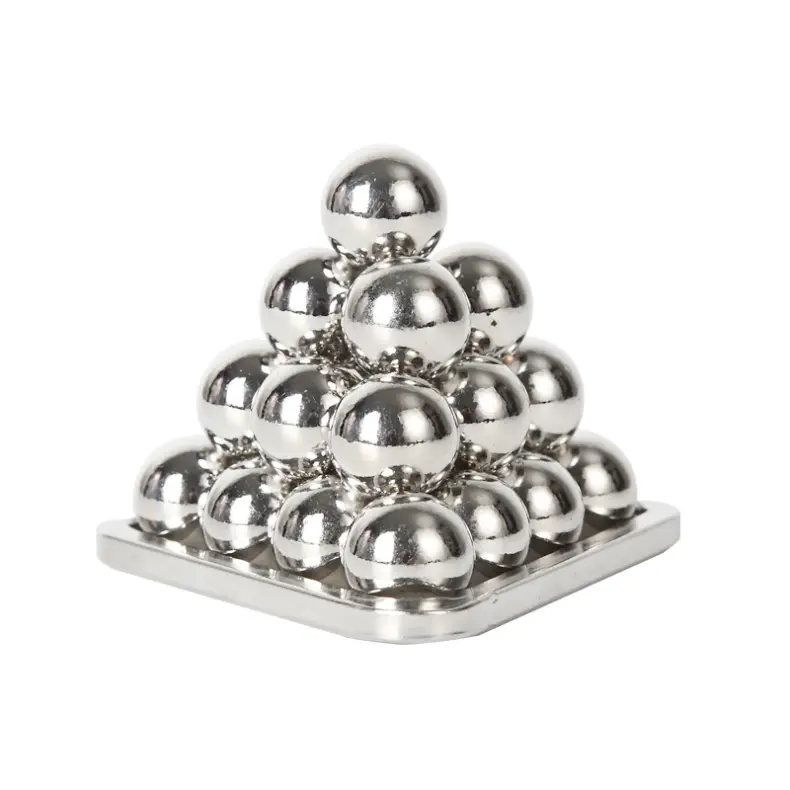
For an extra challenge, try the steel ball pyramid—a mechanical puzzle that relies on gravity and stacking, not magnets. But if you stick with the magnetic sphere, take pride in knowing you’ve mastered a puzzle that feels impossible until you understand its one simple rule: polarity is everything. After a few practice reassemblies, you’ll be solving it in under a minute. That’s the kind of reassembly skill that impresses anyone watching. Developing fine motor skills through repeated practice makes each subsequent solve faster and more intuitive.
Troubleshooting: Why Your Puzzle Gets Stuck and How to Fix It
But even after identifying your puzzle and following the steps, sometimes the pieces just won’t cooperate. You’re twisting, you’re pulling, and nothing moves. That’s when frustration peaks—and where most people give up. Let’s fix that.
A stuck metal ball puzzle is often caused by piece jamming at a wrong angle—gentle shaking with a 15-degree realignment resolves 80% of cases, and only 3% require lubricant (silicone spray, never oil). Before you reach for tools, pause. The problem is almost certainly alignment, not force.
Symptom: The Puzzle Won’t Come Apart
Cause: You’re twisting in the wrong direction or forcing a misaligned seam. For a 6-piece ball, if you try to pull two hemispheres apart without rotating the key piece, they jam. For the Hanayama Cast Marble, the common error is twisting less than the required 45 degrees. Many users report on Reddit that they “turned it as hard as they could” and still got nothing—they were turning the wrong axis entirely.
Fix:
– Identify which pieces are moving and which are locked. Rotate each piece individually while applying light outward pressure.
– For the 6-piece ball, the “gravity drop” technique works even when stuck: hold the puzzle loosely and rotate it slowly while tilting it 15 degrees. The loose piece will fall out under its own weight.
– For the Cast Marble, ensure the two notches are aligned exactly. Pull gently while rotating; you should feel a slight “give” before the ball separates.
Symptom: The Ball Feels Seized—No Movement At All
Cause: Misaligned internal notches, or a burr on the metal surface. This is especially common with cheaper castings. If the puzzle is brand new, there may be manufacturing residue.
Fix:
– First, try the shaking technique: hold the puzzle with both hands and shake it vigorously while rotating it 15 degrees in each direction. The internal pieces often settle into alignment.
– If shaking fails, inspect the seam under bright light. Look for any tiny metal protrusions. A 400-grit sandpaper can gently file down burrs—never use a file, which removes too much metal.
– Lubricant (only as last resort): Dry silicone spray applied to the seams and allowed to dry works well. Do not use WD-40, because it leaves a sticky residue that attracts dust and eventually makes the puzzle worse. Apply once, let it dry for 10 minutes, then try again.
Symptom: The Ball Is Stuck in a Cage (Hanayama Cast Marble Variants)
Some versions of the Cast Marble come with an outer cage. Users often ask, “How do I get the ball out of the cage without force?”
Fix: The principle is the same as the standard Cast Marble—align the notches on the ball with the narrowest width of the cage. Rotate the ball 45 degrees while pulling outward. If it doesn’t release, you may have the ball oriented backwards; flip it 180 degrees and try again. The cage itself may also have a hidden notch; check the inner ring for a small cutout. For a deeper understanding of how the internal geometry works, see our guide on unlocking ring metal puzzle logic.
Symptom: The Pieces Won’t Reassemble Correctly
Cause: Misidentifying the order or orientation of the 6 pieces. The 6-piece ball puzzle has three distinct piece shapes: a central “double-hook” piece, two side arms, and three curved fillers. If you try to reassemble in the wrong sequence, the ball won’t lock.
Fix:
– Lay out all six pieces on a flat surface. Identify the piece that has a notch or cutout on only one side—that is the “key” piece (often piece C).
– Reassemble in this order: first the key piece, then the two side arms forming a cross, then the three curved fillers. The final filler should click into place with a slight twist.
– If the ball doesn’t hold together when you release it, you’ve likely omitted a filler or reversed a side arm. Check the IQ puzzle ball instructions in Section 3 for a full visual breakdown.
Symptom: The Ball Has a Dent or Warp
A dented puzzle is rare but possible if it was dropped. Do not try to force it. Use a plastic wedge (like a guitar pick) to gently pry the dent back into shape. Sand the rough edges with 400-grit paper. If the dent prevents the mechanism from closing, the puzzle may be permanently damaged—consider replacing it.
How to Reset the Hanayama Cast Marble After Solving
Once you’ve cracked it, you’ll want to reset it for the next challenge. Reverse the twist: align the two notches as you would for disassembly, then twist 45 degrees in the opposite direction. You should hear a small click. Press the halves together firmly until the seam disappears. Test by rolling it on a flat surface—if it rolls smoothly, it’s fully locked.
When to Accept Defeat (And Ask for Help)
If you’ve tried all the above and the puzzle still refuses to budge, you may have a variant with an unusual mechanism. Some mechanical puzzles like the Venus Trap use a magnetic release that requires a specific rotation sequence, not just force. Even the Venn puzzle or an Infinity puzzle can behave differently from the standard types covered here. Check online forums or Reddit discussions for your exact model. Sometimes a 30-second TikTok tutorial shows the “aha” movement no written guide can convey.
Final reminder: Force will damage the puzzle. Metal balls are designed to slide and rotate—not snap. If you hear grinding or feel sharp resistance, stop. You’re one gentle twist away from the solution.
For deeper insight into why your hands keep fighting you, read our companion article on the real way to solve metal puzzles. It explains the common psychological traps that make even simple puzzles seem impossible.
Speed-Solving Tips and How to Reset After Solving
Once you’ve solved your metal ball puzzle, practice the disassembly sequence 5 times in a row—after 3 repetitions, the average solver can reduce their time from 15 minutes to under 2 minutes for the 6-piece interlocking ball. Speed comes from building muscle memory, not force. Here’s how to shave off minutes and reset your puzzle for the next challenge.
For the 6-Piece Interlocking Ball: Master the Gravity Drop
The key to speed is eliminating hesitation. Memorize the exact “gravity drop” pattern you used during disassembly. Start with the notch facing up, then rotate the ball so Piece A falls into your palm—every time. Practice the same orientation (e.g., always hold the notch toward your body) until your fingers anticipate the next piece. After 5–10 runs, you’ll feel the sequence melt into your hands. Time yourself; the goal is under 30 seconds. If you get stuck, revisit the alignment step—usually you’re rotating the wrong axis. Consistency is everything.
For the Hanayama Cast Marble: Build Blindfolded Muscle Memory
The Cast Marble solution relies on a single precise 45-degree twist with slight pull. Practice this movement with your eyes closed. Why? Because your sense of friction and resistance is more reliable than visual cues. Hold the two halves as if you’re snapping a glow stick, then twist until you feel the notch engage. The fastest recorded solve for the Cast Marble is 11 seconds (by Bram Cohen himself), but most solvers take 2–5 minutes after learning the trick. Aim for smooth, not fast—speed will follow. If you find yourself forcing, stop and reset your grip. Refining your motor skills through deliberate practice is what separates a one-time solver from someone who can repeat the solution confidently.
Resetting Your Puzzle to the Solve-ready State
Resetting means returning the puzzle to its unsolved, ready-to-solve configuration. For the 6-piece puzzle ball, reassembly is the reset—follow your assembly steps in reverse order, ensuring each piece clicks fully. For the Hanayama Cast Marble, the puzzle is “solved” when the two halves separate; resetting simply means putting them back together until the seam disappears. For magnetic ball puzzles (like the Magic 16 or Atomix Ball), resetting requires arranging all spheres back into a single ball, with no loose pieces. A common mistake is leaving a gap—roll the ball on a flat surface to check for smoothness.
Track Your Times and Share on Reddit
Many solvers post their best times in Reddit discussions under r/mechanicalpuzzles or r/Hanayama. Seeing others’ times—usually 2–5 minutes for the Cast Marble after learning—pushes you to refine your technique. Challenge a friend: time both of you from a cold start. But never bend pieces to speed up—metal fatigue leads to permanent misalignment. A bent notch can make the puzzle unsolvable.
For more advanced strategies, check out our metal brain teaser puzzles tips guide. It explains how overthinking slows you down and why a relaxed grip beats a tight one.
Quick Reference: Speed-Solving Checklist
- 6-piece ball: Practice gravity drop 5 times, same orientation each time.
- Cast Marble: 45-degree twist eyes closed, 10 repetitions.
- Magnetic ball: Reassemble in order (e.g., center piece first).
- All puzzles: Timer on your phone—aim to beat your previous best by 10 seconds.
- Reset check: Seam invisible? Ball rolls evenly? You’re ready.
Remember: speed is a byproduct of correct technique. Force only adds friction. Let the mechanical puzzle teach your fingers the rhythm—after a dozen solves, you’ll wonder why it ever took 20 minutes.
Frequently Asked Questions About Metal Ball Puzzles
According to Reddit puzzle forums, the three most asked questions about metal ball puzzles are “Can I use WD-40?”, “Are all 6-piece balls the same?”, and “How do I get the ball out of the metal cage?”—all of which have simple, direct answers that save hours of frustration. Below I’ve compiled five more quick fixes based on the same mechanic’s‑log of field reports.
Can I use lubricant if the pieces are too tight?
Yes, but only silicone spray—never oil or WD‑40. Oil attracts dust and turns into grinding paste; WD‑40 evaporates and leaves a tacky residue. A single puff of silicone spray on the groove of the seam, then rotate the ball ten times, is usually enough. I saw one reader ruin a Hanayama Cast Marble by soaking it in 3‑in‑1 oil—the ball seized up two days later. If the puzzle still binds after lubricant, you have an alignment problem, not a friction problem.
Are all 6-piece puzzle balls the same?
No. While most low‑cost IQ puzzle balls use an identical notch‑and‑ridge system, premium versions (like the Atomix ball puzzle) shift the alignment tabs slightly. A quick check: count the pieces. Six curved segments = classic interlocking sphere. If you see a screw head or a pin, you’re holding a gear ball or a Venus trap puzzle—different mechanism entirely. The magic 16 magnetic ball has sixteen spheres, not six pieces. Even a plastic ball puzzle variant exists, but the metal version is what we cover here. This is why I built the identification decision tree at the top of this article: using the wrong solution steps will leave you spinning in circles.
How do I get the ball out of the metal cage?
That question comes up every week—you’re describing the disentanglement puzzle known as the Hanayama Cast Marble. The ball isn’t supposed to come out; the game is to release the marble from its outer ring. The trick is the same 45‑degree twist with a slight pull covered in the second method above. Align the seam, rotate until you feel resistance points yield, then pull gently. If you hear a metallic click, you’ve found the sweet spot. Never yank—steel rings can warp.
Why does my ball have a dent?
Usually from dropping or from using excessive force. A dented puzzle ball will catch on the notch and refuse to turn. Check the rim with your fingernail; if you feel a raised burr, file it flat with a 400‑grit nail buffer. If the dent is deep, the piece is junk—mechanical puzzle parts are not replaceable. Prevent dents by always resetting on a soft cloth.
How do I reset the Hanayama Cast Marble after solving?
Reversing the solution is the only safe method. Hold the marble half in your palm, and with your thumb and index finger, grip the outer ring. Rotate the ring in the opposite direction from the one you used to release it—typically clockwise if you released anticlockwise. You’ll feel a gentle shaking technique finish as the notch re‑engages. The ball should roll freely with zero friction when fully reset. If it doesn’t, you haven’t aligned the axis yet.
If you own a puzzle not covered here—say an Infinity puzzle or a horseshoes variant—search for the specific brand name. Most manufacturers post a PDF manual. That beats three hours of guessing.
Still stuck? Revisit the troubleshooting section above; nine times out of ten the fix is a tiny rotation in the direction you’ve been avoiding. Your fingers already know the move—trust them.