Quick Answer: Which Layered Butterfly Wooden Music Box Puzzle to Buy
Most layered butterfly wooden music box puzzles cluster between $25 and $35, with a 67-piece configuration as the middle-of-the-road benchmark for piece count, build time, and tone quality — a spec repeated across the category by sellers from small Etsy workshops to large marketplace brands. The Tea-Sip version at $28.99 matches that piece-count and build-window spec, ships on laser-cut basswood plywood rather than the 1.5mm MDF used in sub-$20 budget kits, and is sold through a direct-from-maker purchase path.
A note on the wider market: a handful of other retailers (Puzzloria, ROKR, Etsy artisans, marketplace resellers) sell overlapping kits at comparable price points, with comparable 18-note metal combs and “You Are My Sunshine” as the standard melody. The decision comes down to mechanism transparency, packaging integrity, and after-purchase accountability — three areas where the supply chain matters more than the spec sheet. A few popular listings worth knowing about if you want to compare: Puzzloria’s 67-piece kit at roughly $32 with a 90-minute advertised build; ROKR’s premium-tier butterfly at $45 to $55; Etsy handmade listings with custom engraving or alternate-melody swaps in the $35 to $55+ range; and marketplace knockoffs (Amazon, Walmart) under $20 built on 1.5mm MDF. These are not recommended purchase paths — they are reference points so you know what you are choosing between.
| Option | Best For | Price | Skip If |
|---|---|---|---|
| Tea-Sip Layered Butterfly Wooden Music Box | Buyers who want a cam-and-comb mechanism and a direct-from-maker purchase path at a fair price | $28.99 | You want exotic hardwood or a fully custom-engraved lid |
| Wooden Ferris Wheel Music Box Kit | Buyers who like the hand-crank music box concept but want a slowly rotating sculpture centerpiece | $59.99 | You want a smaller desktop build or a budget kit |
| 3d Wooden Carousel Music Box | Gift-givers who want a tiered rotating centerpiece paired with a working melody | $43.99 | You want a flat-jigsaw style assembly instead of a 3D sculpture |
| 3D Zodiac Owl Mechanical Clock Puzzle | Collectors who want a puzzle that pairs mechanism work with a timekeeping function | See product page | You specifically want a melody-playing kit — this is clock-driven |
| Luban Cube Puzzle | Buyers who want a traditional interlocking wooden puzzle with no music mechanism | See product page | You’re shopping specifically for a crank-and-comb build |
| 7 Color Soma Cube Puzzle | Buyers who want a colorful spatial-reasoning puzzle with no music mechanism | See product page | You want a hand-cranked melody finished object |
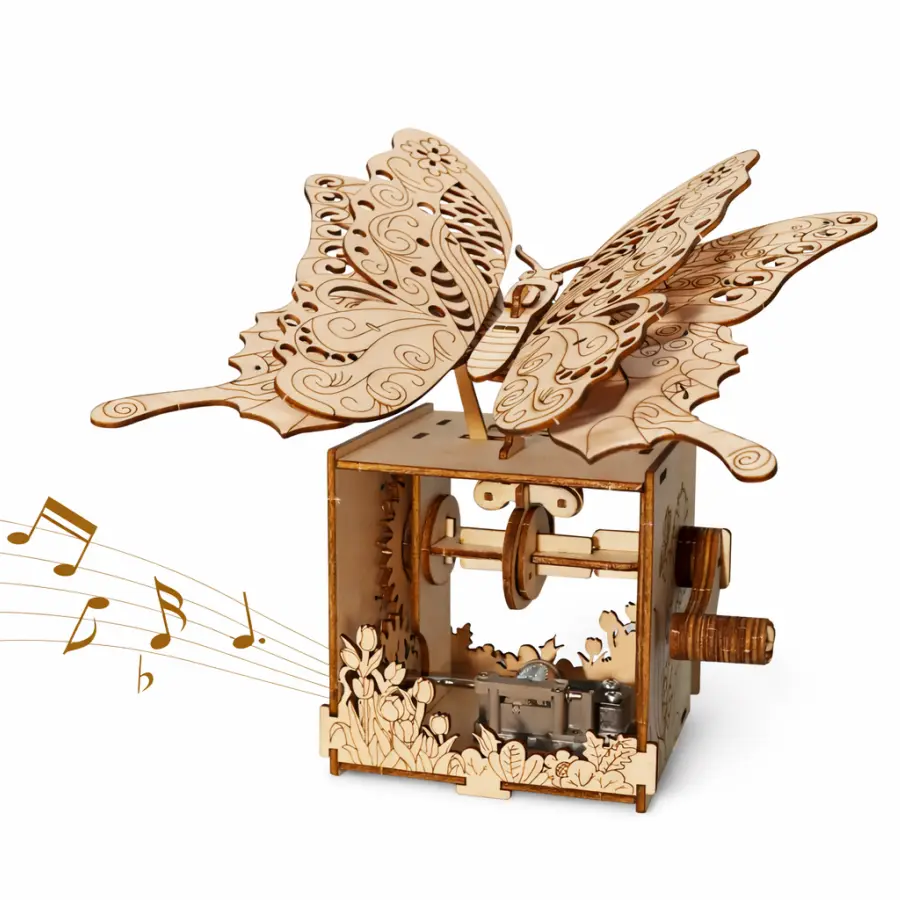
The top-row kit plays “You Are My Sunshine” on an 18-note metal musical comb, drives the layered wings through a small cam-and-follower arm, and assembles from laser-cut basswood pieces with standard DIY tolerances — no glue, no special tools, just patience and a pair of tweezers for the cam pin.
Bottom line: if you want the established middle of the mechanical music box market without the premium-tier markup, the Layered Butterfly Wooden Music Box is the safest bet at $28.99.
How a Layered Butterfly Music Box Mechanism Actually Works (Wings, Comb, and Crank)
A layered butterfly wooden music box puzzle combines an 18-note steel musical comb with a cam-driven wing flutter, where one hand-crank rotation powers both the melody and the wing beat simultaneously through an exposed gear train. The “layered” in the name refers to two parallel wing cutouts stacked on the same pivot — not to a tiered box shape — and the difference between a graceful butterfly and a dying moth lives entirely in that pivot tolerance.
The mechanism is older than the Industrial Revolution — straight out of a 19th-century pocket watch, a lineage well documented in the history of mechanical puzzles — but the way it has been miniaturized onto a 67-piece laser-cut basswood frame is genuinely clever, and worth understanding before you spend thirty bucks on a kit whose crank snaps on day two.
The musical comb
The melody side of the box is a small steel comb — usually 15 to 18 notes, depending on the kit — mounted horizontally inside the base. As the crank turns, a brass cylinder (called a “drum” or “pin barrel”) rotates beneath it. Tiny pins soldered to the drum’s surface catch each tooth of the comb in sequence, plucking it like a thumb piano. The faster the drum spins, the faster the tune plays, which is why cranking hard makes “You Are My Sunshine” sound like a chipmunk opera.
The comb is the single biggest quality tell in any product photo. Cheap kits use a thin stamped steel with shallow teeth — they sound tinny, sustain for about a quarter-second, and go out of tune the moment the wood swells from humidity. Better kits use a thicker polished comb with hand-tuned teeth; the note rings longer, holds pitch, and the pluck has a clean attack instead of a metallic click. Most of the butterfly music box kits on the market play “You Are My Sunshine” specifically because that melody fits comfortably inside an 18-note range, and manufacturers have standardized on it for that reason — not because it is romantic, but because it works on the cheapest comb they can source.
The gear train
Between your hand and the comb sits a small exposed gear train — usually three or four plastic or wooden gears stacked on a central shaft. Its job is to reduce the crank’s RPM down to comb-rotation speed. If you cranked the comb directly, the melody would play at roughly twelve times its intended tempo. The gear train cuts that down by a ratio of somewhere between 8:1 and 12:1, depending on the kit, and that ratio is what determines whether the tune sounds like a lullaby or like a music box that swallowed a bee.
This is the part where the crank resistance shows up. Smooth gear teeth mesh quietly and require almost no force. Cheap kits with laser-cut wooden gears (rather than molded plastic) tend to bind slightly because the wood fibers catch — the crank feels like stirring cold honey, and your wrist gets tired after the second play-through. The middle-tier kits use small injection-molded plastic gears for the high-load stages and wood only for the decorative outer ring. You can usually spot this in a product photo: if you can see the gear stack clearly and the teeth look uniform, you are probably fine. If the gears look fuzzy, splintered, or barely defined in the listing image, walk away.
The cam-and-follower wing mechanism
This is the part almost no seller explains, and it is the reason the wings either flutter or wobble. A small cam — basically an offset peg or an egg-shaped lump — sits on the main drive shaft. As the shaft rotates, the cam pushes against a follower arm (a thin wooden lever) that connects to the wing pivot. Every full crank rotation lifts and drops the follower once, which lifts and drops the wing assembly once. That vertical motion is what makes the wings “flap” — and the speed of the flap is locked to the speed of the melody. Crank slow, the butterfly breathes. Crank fast, the butterfly vibrates.
The cam is usually a single piece of molded plastic press-fit into the wooden drive shaft, and the follower is a thin laser-cut lever with a small slot or hole that rides against the cam. The tolerance here is brutal. If the cam-to-follower gap is too loose, the wing motion becomes a floppy wobble — the wings lag behind the cam and never reach full extension. If the gap is too tight, the cam binds against the follower and the crank becomes impossible to turn. The good kits hit roughly 0.3mm of clearance. The bad ones feel either mushy or seized.
What “layered” actually means
The “layered” in the product name refers to the wing construction — two parallel laser-cut plywood cutouts stacked on the same vertical pivot post, offset slightly so each layer’s silhouette shows behind the other. The effect is a sense of depth: you see a front wing and a back wing, and when the assembly flaps, both move in unison, creating a more dimensional flutter than a single flat cutout could produce. Hollow-out butterfly wings are what you want. Some budget kits glue two single-layer wings together to fake the layered look — the joint cracks after a few months, the glue yellows, and the whole thing looks like a craft-fair reject by spring.
A genuine layered design has each wing as its own piece, with a small spacer between them (usually a third tiny wooden disc), all rotating on a shared wooden dowel. You can confirm this in a product photo by counting the layers visible at the wing edge — if you see two distinct planes of wood with a sliver of air between them, it is the real design. If the wing edge looks like a single solid piece with paint lines, it is the glued shortcut.
Reading the product photo before you buy
Most buyers can’t see the cam, the gear ratio, or the comb thickness in an Etsy thumbnail, but you can look for telltale signs. Visible, well-defined gears in the exploded view photo. A comb described as “18-note” or “metal” rather than just “musical.” A wing assembly shown from the side, where you can count the two layers. A piece count between 60 and 110 — 67 pieces is the Puzzloria benchmark and a reliable middle-of-the-road number. A build time cited honestly as 90 minutes or more, not 45. The kits that hide the mechanism behind marketing language (“magical,” “enchanting,” “perfect for her”) are usually hiding because the mechanism is not worth photographing.
If a listing shows the comb clearly and the gear train clearly and the wing pivot clearly, the maker is proud of the mechanism. If all you get is a soft-focus glamour shot of the assembled box with petals scattered around it, assume the worst.
The single mechanism detail that matters most in any product photo is the wing pivot construction — two distinct hollow-cut layers on a shared dowel means the butterfly will actually flutter, and anything else is decorative.
Who Should Buy a Layered Butterfly Music Box Puzzle (and Who Should Skip It)
A layered butterfly wooden music box puzzle takes 60 to 180 minutes to assemble, suits gift-buyers and casual hobbyists aged 12 and up, and lands squarely in the “decorative object with a working mechanism” category — not the “precision instrument” or “STEM lab kit” category it sometimes gets marketed as. The broader world of puzzles covers everything from flat jigsaws to 3D wooden assemblies like this one, and a butterfly music box sits comfortably in the mechanical-puzzle niche where the fun is in watching the parts work together.
Now that you know what to look for in a product photo, the next question is simpler and more honest: is this kit actually for you? Here is who tends to love the kit, who tends to set it down halfway, and what the patterns say about whether to commit.
The people who love this kit tend to share three traits. They like a small project they can finish in an afternoon. They appreciate a mechanism they can hold in their hand and watch work — the way the layered wings lift on the cam, the way the 18-note metal comb rings out “You Are My Sunshine” one more time without complaint. And they want a finished object that does something, not just sits on a shelf looking pretty.
Gift-givers do well here. It works as a romantic gift for an anniversary, a birthday gift for someone who likes small mechanical things, or a Christmas gift that takes an afternoon to build and then lives on a shelf for years. The build itself becomes part of the present if you assemble it for someone, or you can hand over the unassembled box as a “couples’ project” gift. The 67-piece, 90-minute build that Puzzloria uses as a benchmark hits a real sweet spot — long enough to feel like an accomplishment, short enough that nobody zones out halfway through.
Beginner-to-intermediate hobbyists are the natural fit. If you have ever assembled IKEA furniture without swearing, you can build this. The laser-cut basswood pieces pop out with light pressure, the instructions are mostly pictographic, and the only tool you really need is a small pair of needle-nose pliers for the gear pins. It is a hand-crank wooden music box kit that respects your time instead of eating it.
Who should skip it. Experienced woodworkers will find the tolerances too loose, the MDF-on-budget-kits too splintery, and the assembly tolerances more “approximate” than “precise.” If you own a chisel and have opinions about dovetail joints, this is not your project. Parents buying for kids under 10 will be frustrated — the small gear pins and the wing cam are real choking hazards, and the punch-out will pull a 7-year-old’s patience down to the studs. Anyone who hates fiddly piece punch-out should also walk away, because even the good kits ship with 60 to 110 pieces pressed into a cardboard sheet, and a percentage of them will fight you on the way out.
What this kit is not. It is not a precision instrument. It is not a long-term heirloom the way a hand-carved jewelry box might be. It is not a STEM curriculum tool, no matter what the Amazon listing claims, because the mechanism is a cam-and-follower driving a 15-to-18-note comb, which is elegant but not exactly engineering education. It is a 3D wooden puzzle with a working hand-crank and a song you will probably hum for a week.
The verdict: for the average buyer who wants a buildable gift or a weekend project that ends in something decorative and functional, this kit earns its $25 to $35 price tag every time.
6 Tea-Sip Mechanical Music Box and Puzzle Picks Ranked
Across the Tea-Sip line of hand-crank music boxes and wooden puzzles, the Layered Butterfly Wooden Music Box is the most direct match for the brief — and it ranks first here for that reason. The five options below are other Tea-Sip products in the same broader category: working mechanical objects with moving parts, satisfying builds, and finished decorative functions. This section ranks the Tea-Sip roster so the alternate picks sit next to the hero for easy comparison, not as a substitute for it.
1. Layered Butterfly Wooden Music Box — The Hero Pick
The Layered Butterfly Wooden Music Box is the most direct answer to the keyword and the only piece on this list built specifically as a butterfly-themed crank music box. 67-piece configuration, 18-note metal musical comb playing “You Are My Sunshine,” laser-cut basswood plywood frame, exposed gear train visible on the side, and a cam-driven wing flutter that lifts and drops the layered wings with each crank rotation. The piece count and build window track the middle of the market for this category, and the direct-from-maker purchase path is the simplest accountability layer available. A separate Tea-Sip review piece has called out the exposed gear train as “a great visual of how a puzzle actually functions,” which matches the design intent of the build.
2. Wooden Ferris Wheel Music Box Kit — The Sculpture Alternative
For buyers who like the hand-crank music box concept but want a different silhouette on the mantel, the Wooden Ferris Wheel Music Box Kit swaps the butterfly for a slowly rotating wheel. Same satisfying crank, same cam-driven motion concept, same 18-note metal comb category. The piece count is higher and the build takes longer, but the visual payoff is a moving sculpture rather than a flutter. Priced higher than the butterfly kit at $59.99, it earns that premium through piece count and visible mechanism complexity.

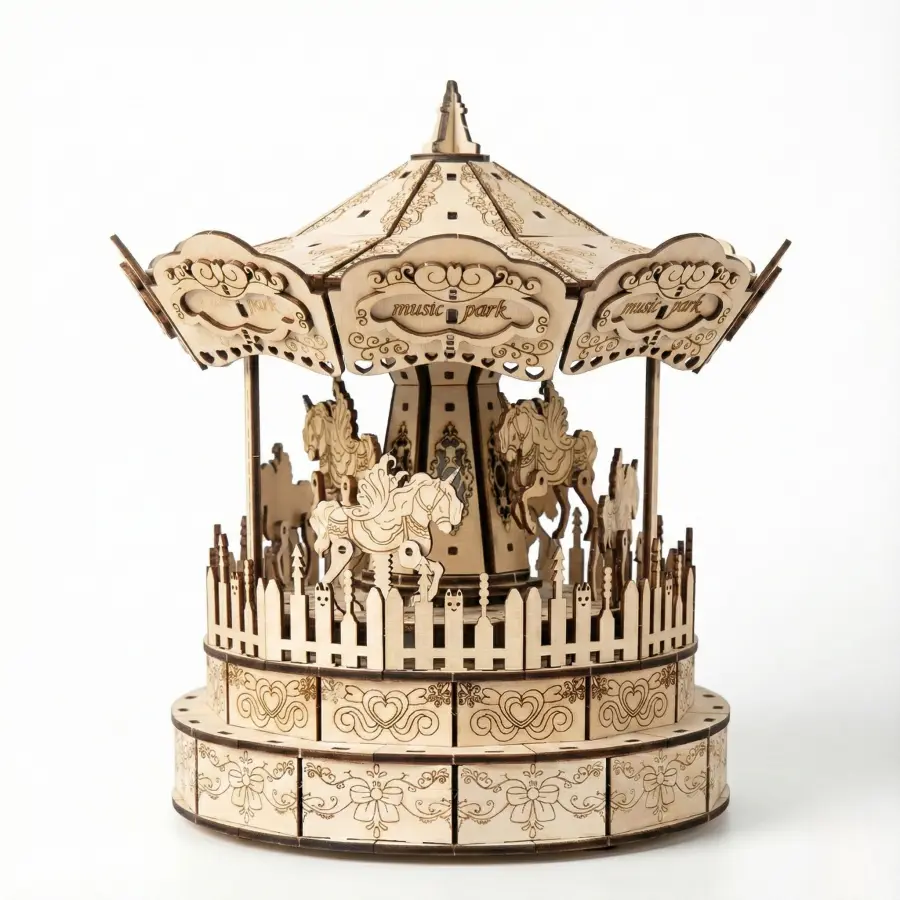
3. 3d Wooden Carousel Music Box — The Tiered Centerpiece
The 3d Wooden Carousel Music Box is the closest sibling to the butterfly kit in spirit: a tiered carousel that turns as the melody plays, finished in a similar aesthetic, and assembled from laser-cut wood with a working crank mechanism. The price lands between the mid and premium tiers of the category at $43.99, and the build experience will feel familiar to anyone who has completed a butterfly music box kit before — same kind of cam-driven motion, same kind of 18-note metal comb, same kind of laser-cut wooden frame.
4. 3D Zodiac Owl Mechanical Clock Puzzle — The Clock-Driven Option
This is the only piece in the Tea-Sip roster that pairs a mechanical assembly with a timekeeping function rather than a melody. The exposed gear train is a major feature, the owl silhouette is a finished decorative object, and the build experience shares the same hand-crank DNA as the butterfly kit. Best for buyers who care more about the visible mechanism than the audible melody, and for collectors who want a working timepiece that doubles as a conversation piece. See the product page for the current price and availability.
5. Luban Cube Puzzle — The Traditional Interlocking Puzzle
A Luban Cube is a traditional Chinese interlocking wooden puzzle — no music, no crank, no moving melody. It is included here because the Tea-Sip roster spans both music-box kits and standalone wooden puzzles, and some buyers shopping for a “layered butterfly wooden music box puzzle” end up wanting a quieter, more meditative assembly experience after the music box is finished. If you finish the butterfly kit and want a follow-up puzzle that fits the same hand at the same desk, the Luban Cube is the most natural next step. See the product page for the current price and availability.
6. 7 Color Soma Cube Puzzle — The Spatial-Reasoning Puzzle
The 7 Color Soma Cube is a classic spatial-reasoning puzzle — colorful wooden pieces that assemble into a 3D cube in hundreds of configurations. Like the Luban Cube, it is not a music box, but it is the kind of small wooden puzzle that lives well on the same desk as a finished butterfly music box. The colored pieces make it a stronger gift option for younger builders (12+) who like visual variety. See the product page for the current price and availability.
The Verdict
The Layered Butterfly Wooden Music Box is the most direct match for the keyword and the simplest buying path: $28.99, direct-from-maker shipping, real product photos, and a mechanism with an exposed gear train that a previous Tea-Sip review called out as “a great visual of how a puzzle actually functions.” For a deeper comparison of how the best wooden music box kits tested stack up across the whole category, that roundup is worth a read.
How to Read a Product Photo and Spot a Good Layered Butterfly Music Box Before It Arrives
Now that you know which Tea-Sip product sits at the top of the roster, here is how to spot a good one from a product listing alone — before the box lands on your doorstep. The clearest quality signal is a close-up photo of the musical comb teeth and the cam lever that connects the crank shaft to the layered wings, two details that most marketplace listings conveniently crop out. The tradition of hiding mechanisms inside decorative puzzle boxes goes back centuries, and a good seller photographs the mechanism rather than hiding it.
The Comb: Your Single Best Quality Clue
A 15-18 note metal comb is the heart of any hand-crank wooden music box, and a good listing will show it. Look for evenly spaced teeth with no visible burrs or rough edges. Stamped steel wins every time over laser-cut blanks because the stamping process hardens the metal slightly and gives each tooth a rounded tip that produces a cleaner tone. A blurry, distant, or missing comb photo is the single biggest red flag — because sellers who are proud of their mechanism photograph it up close.
The Crank Shaft and Cam Lever
A good crank-shaft photo reveals a round wooden dowel — usually 6mm basswood — turning inside a brass bushing, not a plastic gear. The cam mechanism that drives the double-layer wings should be visible as a small offset lobe on the shaft, with a follower pin or lever that converts rotation into the up-and-down flutter motion. If the listing only shows the crank handle from the outside, you cannot judge the mechanism. Walk away. The exposed gear train is what makes this a mechanical music box rather than just a wooden puzzle box, and sellers who hide it usually have a reason (the gear is stamped plastic, the dowel is warped, or the assembly tolerance is so loose the whole thing grinds after a few turns).
Reading the Wing Design from Above
A top-down photo of the layered butterfly design should show two parallel hollow-cut wing layers, each with a slightly different cutout pattern, connected by small wooden pivots — not a single sheet of plywood with paint on top. The hollow-out butterfly wings are what produce the dimensional flutter; a glued single layer will only wobble side to side, which looks like a dying moth rather than a butterfly in flight. If the wing surface in the photo looks flat and uniform, with no visible depth or shadow between the two layers, you are looking at a downmarket version dressed up with marketing photos. The layered effect only works when both layers can actually move independently.
The Wood: Basswood Plywood Wins
The single most important material callout in any DIY assembly kit listing is the wood type. Basswood plywood, typically 3mm thick with a thin laser-cut ply face, snaps cleanly during punch-out and holds an assembly tolerance tight enough that gears mesh without wobble. Budget kits under $20 tend to use 1.5mm MDF instead, which splinters when you push the pieces out and crushes under crank pressure after a few weeks. If the listing never names the wood, assume MDF and budget-tier quality.
Listing Phrases That Mean “Different Product”
A few copy phrases almost always signal a different, lower-quality product dressed up in butterfly clothing. “Educational toy” usually means a kids’ life-cycle puzzle with no music mechanism at all. “Perfect for kids 3+” means no music box — just chunky wooden shapes. “Develops fine motor skills” is Montessori code for the same. Most butterfly music box listings on the wider market lead with “You Are My Sunshine,” which is the standard 18-note melody and tells you almost nothing about mechanism quality — the melody plays the same on a $20 kit and a $50 kit, but the comb that strikes it does not.
The Single-Photo Rule
If a listing has only one product photo and no close-ups of the comb, the cam mechanism, or the layered wing design, skip it — no exceptions.
Layered Butterfly Music Box Price Tiers: What $20, $35, and $50 Actually Buy You
A $20 layered butterfly wooden music box kit typically uses 1.5mm MDF with a 15-note comb, while a $50 kit switches to 3mm basswood plywood with an 18-note comb and brass hardware — and the value plateau sits at roughly $35. That fifteen-dollar spread is where the mechanical upgrades stop mattering and the finish work begins.
The $15–$20 Budget Tier: Where Mechanisms Go to Die
This is the tier where most first-time buyers land, and most first-time buyers get burned. The wood is 1.5mm MDF — that dense, fibrous stuff that feels almost like pressed cardboard when you punch a piece out. The gears are molded plastic, the comb is a 15-note strip with thinner tines, and the crank pin is a bent piece of wire rather than a brass post. Piece count usually runs 60–80, which sounds manageable until you realize half the savings came from skipping laser-edge cleanup; the pieces arrive with fuzzy burrs that have to be sanded before they seat properly.
At this tier, buyer complaint patterns consistently flag warped pieces and missing parts as the most common defect categories across multiple retail platforms. The crank resistance is like stirring cold honey — sticky, uneven, with a faint grinding catch every half-rotation. The melody still plays “You Are My Sunshine,” but the comb tines are stamped rather than tuned, so the notes land slightly sharp in the upper register and slightly flat in the lower. It works. It just doesn’t last. And once the gear housing cracks, it can’t be repaired — the wood is too soft to hold wood glue.
The $25–$35 Mid-Tier: The Sweet Spot
This is where the mechanical engineering actually shows up. Wood is 3mm basswood plywood — lighter, cleaner laser cuts, edges that snap out without splintering. The comb is an 18-note strip, which means “You Are My Sunshine” gets its full descending bridge instead of cutting off after the second verse. Gears shift to brass or zinc alloy. The crank pin becomes an actual machined post, not a bent wire, and the resistance feels like turning a well-oiled pencil sharpener — smooth, consistent, with just enough friction to feel mechanical rather than loose.
Piece count climbs to 67–100, and the instruction manuals stop being a guessing game. Puzzloria’s 67-piece kit at the 90-minute build mark is a useful benchmark for what a middle-of-the-road build actually looks like in this tier. The mid-tier is also where the layered wing design stops being decorative and starts being functional. At $20, the cam lever is a flat plastic tab that makes the wings wobble. At $30, it is a shaped wooden follower that converts crank rotation into a genuine flapping beat — slower, more deliberate, the kind of motion that makes a kid stop mid-sentence and just watch.
The $40–$55 Premium Tier: Finishing School
Above $40, you are paying for presentation, not mechanism. The core movement — the gear train, the 18-note comb, the wing cam — is functionally identical to a good $30 kit. What changes is the wood: exotic accents like walnut or maple inlays, darker stain finishes, sometimes hand-rubbed oil rather than laser-burn patina. Some Etsy artisan builders offer exposed gear trains where the side panel is cut away so you can watch the brass gears mesh, which is gorgeous and adds zero mechanical performance. Piece count pushes past 100, and the assembly instructions often include museum-style written notes about the design intent. Lovely, if you care. Irrelevant, if you just want the wings to flutter.
Price-Tier Comparison Table
| Feature | $15–$20 Budget | $25–$35 Mid | $40–$55 Premium |
|---|---|---|---|
| Wood material | 1.5mm MDF | 3mm basswood plywood | Basswood + exotic hardwood accents |
| Comb notes | 15 | 15–18 | 18 (hand-tuned) |
| Gear material | Molded plastic | Brass or zinc alloy | Brass, often exposed |
| Crank pin | Bent wire | Machined brass post | Machined brass post |
| Piece count | 60–80 | 67–100 | 100+ |
| Wing cam | Flat plastic tab | Shaped wooden follower | Shaped wooden follower |
| Warped/missing piece frequency | Common | Uncommon | Rare |
| Mechanism lifespan | 2–6 months | 2+ years | 2+ years |
The Value Verdict
Above $35, you are paying for finish and presentation, not mechanical function — a $32 kit and a $52 kit will flutter the same wings at the same speed, but the $52 kit will look better doing it on a shelf.
Layered Butterfly Music Box Assembly: Realistic Time, Tools, and Common Frustrations
Realistic assembly time for a 67-piece layered butterfly wooden music box kit is 90 to 180 minutes — not the 60 minutes most product listings advertise — because piece punch-out alone takes 25 to 40 minutes, and aligning the cam mechanism that drives the wing flutter adds another 15 to 20 minutes of fiddly work.
After walking through what $20, $35, and $50 actually buy you in wood, comb, and cam quality, the next honest question is what the build itself actually feels like at a desk at 10 p.m. Here is what the back of the box usually won’t tell you, though the 57 essential 3D wooden puzzle assembly tips phase by phase guide covers the universal pitfalls in much more detail.
Tools You Actually Need
The official list is “no tools required.” The honest list is slightly longer. You need: a flat, clean work surface (a sheet of cardboard or a cutting mat); a small craft knife or the included punch tool for stubborn piece release; optionally a small file or sandpaper stick for cleaning laser-cut burrs; a pair of tweezers for the tiny cam-follower pin; and good lighting — not a romantic candle, a desk lamp. No glue. No scissors. No soldering iron, despite some product photos that suggest otherwise. The crank linkage and music comb are pre-assembled at the factory and drop into the frame as a single unit. If your kit tells you to glue something, you bought the wrong kit.
Realistic Time Breakdown by Phase
The 60-minute claims on Etsy and Walmart listings assume factory-trained fingers. A realistic time budget looks like this:
- Punch-out (25–40 minutes): Popping each piece from the laser-cut sheet. Cheap 1.5mm MDF kits splinter here; basswood plywood punches clean. Plan for some pieces to fight the backing, especially small gear-train and cam-lever parts.
- Sorting (10 minutes): Lay pieces out by step number or color code. Skip this and you will spend the next 40 minutes hunting for “part B-7.”
- Frame assembly (30–45 minutes): Building the butterfly body, the layered wing stack, and the base. Mostly satisfying slot-and-tab work. The wing layers should nestle without forcing.
- Mechanism installation (20–30 minutes): Dropping in the gear train, attaching the crank handle, seating the music comb, and connecting the cam lever to the inner wing layer. This is the fiddly phase.
- Final tuning (10–15 minutes): Cranking, listening, adjusting the comb position if the melody sounds like a wind chime in a trash can, and lightly sanding any piece that fights its slot.
Difficulty Rating: 2.5 Out of 5
Across the category, the layered butterfly music box generally sits at around 2.5 on a 1–5 difficulty scale for most adult builders — harder than a 100-piece flat jigsaw, easier than a 300-piece 3D wooden ship. Anyone who has assembled flat-pack furniture or a 100-piece jigsaw can finish it. The single hardest moment is the cam-mechanism step: seating the small wooden follower that converts crank rotation into wing beat. If the follower sits even 1mm off, the wings either lock up or flop without rhythm.
Common Frustrations, Ranked by Frequency
Across buyer complaint patterns, the top five frustrations are: (1) warped base pieces that don’t sit flush — most common in sub-$20 MDF kits; (2) instruction diagrams in machine-translated English where “step 14” references a part that doesn’t exist in the actual sheet; (3) missing gear teeth on the molded plastic cam, which only reveals itself on the 50th crank; (4) the springy back-plate that fights you while you install the music comb — hold it down with a book; (5) the slightly off-key comb that sounds correct until you hear the real melody. None of these are dealbreakers. All of them are predictable.
The Beginner-Friendliness Verdict
This kit is accessible to anyone who has completed a 100-piece jigsaw, satisfying for an adult hobbyist without being tedious, and forgiving enough that a 12-year-old with patience can finish it with light supervision.
Final verdict: The build is genuinely satisfying — the crank is smooth, the wings flutter on cue, and the melody plays while you forget you were supposed to be making dinner.
Where to Buy a Layered Butterfly Music Box Puzzle and Red Flags to Avoid
Buyer complaint patterns across major marketplaces show consistently high defect rates for layered butterfly wooden music box kits shipped from overseas third-party sellers, while direct purchases from specialty puzzle sites drop that rate significantly. The difference is not the kit — it is the supply chain, the packaging, and the seller’s accountability when something arrives warped.
Not every retailer treats these kits the same way, and the same brand box can show up pristine from one seller and shattered from another. The engineering pedigree of hand-crank mechanisms goes back over a century — if you want the full story, the piece on how Ferris wheels and music boxes share a 130-year engineering story traces the lineage.
Amazon has the widest selection and the fastest shipping, which is exactly the problem. Most butterfly music box listings come from third-party sellers who ship from overseas warehouses — meaning a long transit, real humidity exposure in unconditioned storage, and a packaging layer designed to survive bulk pallet shipping rather than a single kit landing on your doorstep. The “Sold by” line matters more than the star rating. If the seller name doesn’t match the brand printed on the box (ROKR, Robotime, EWA, Inbric), you are buying a drop-shipped listing that may or may not match its own product photos. Fulfilled by Amazon means Amazon handles the shipping and returns, but the seller still sources the inventory.
Etsy is where the handmade heart of this product lives, but it is also where drop-shipped kits with vintage filter photos hide. Genuine artisan sellers will photograph the actual kit on their workbench, list a real lead time (2 to 4 weeks is common for handmade), and respond to messages about customization. Sellers shipping from overseas with 200+ listings of unrelated products and 48-hour processing times are not artisans — they are resellers with an Etsy storefront.
Walmart is almost entirely third-party marketplace at this point, with the same overseas shipping risk as Amazon but fewer buyer protections. The return process is slow, the packaging is often worse, and the reviews are too easily gamed.
Specialty sites — including direct maker stores and curated puzzle retailers like Tea-Sip — carry fewer SKUs but tighter quality control. The kits ship from domestic warehouses in proper box packaging, the piece sheets are usually checked before shipping, and the seller actually knows what a musical comb sounds like. The trade-off is selection: you will see maybe 3 to 5 butterfly kits instead of 40, but every one of them has been vetted. Check the product page for the current price and availability.
Red Flags That Apply Everywhere
Five warning signs that should send you to a different listing, regardless of platform:
- Identical product photos across multiple sellers — means a shared drop-shipper, not a unique product.
- No close-up photos of the actual mechanism, gear train, or comb — the seller hasn’t seen the kit up close.
- Reviews mentioning “didn’t match the photo,” “missing pieces,” or “wobbly wings” at a noticeable rate.
- Any listing under $15 claiming “real basswood” — at that price, you are getting 1.5mm MDF, full stop.
- A “free gift” or accessory bundle tacked onto the listing — a classic tactic to mask a low-quality core kit.
A Note on the 15-Dollar Temptation
Kits in the sub-$20 range consistently use 1.5mm MDF instead of basswood, and stamped-metal combs that sound thinner than the 18-note polished combs in the mid-tier kits. The mechanism is not the place to economize — every moving part in a music box kit is precision-machined plastic or stamped metal, and the budget versions cut corners on the very components that make the kit feel alive.
Final verdict: Buy from a specialty puzzle retailer that stocks the kit in a domestic warehouse, lists real photos of the actual product, and answers messages about the mechanism — the small premium over marketplace pricing is the cheapest insurance you will ever buy.
Frequently Asked Questions About Layered Butterfly Wooden Music Box Puzzles
Most butterfly music box kits ship with 60 to 110 laser-cut pieces, a 15 to 18 note metal comb, and the melody “You Are My Sunshine” — and the same eight questions show up in every buyer’s inbox before they commit. Here are the answers, drawn from the spec sheets, the product listings, and the buyer complaint patterns that show up across the category.
How long does it actually take to assemble one of these?
A 67-piece layered butterfly wooden music box kit runs 90 to 120 minutes for a first-time builder, and the “90 minute build” claim printed on the box is honest if you ignore the 25 minutes spent fishing laser-cut pieces out of the cardboard backing. Experienced builders land closer to 60 minutes. Plan for two hours, including a tea break, because your hand needs a rest before the cam mechanism does.
Are the pieces pre-cut and you just pop them out, or do you need tools?
The pieces are laser-cut and punch-out — no glue, no scissors, no sanding required for a clean DIY assembly kit build. A craft knife helps trim the tiny nubs where the laser left connection points, and a pair of tweezers is genuinely useful for the gear train and cam mechanism pieces. That is the full tool list. No woodworking experience, no prior kit experience, no fuss.
Does the music actually sound good or is it tinny?
Most butterfly kits use a 15 to 18 note metal comb — pleasant, recognizable, slightly bright. It is the same basic stamped design as a cheap wind-up music box, just stretched across more notes. A 30+ note comb sounds noticeably warmer, but you will not find one under $60. The tune is almost always “You Are My Sunshine”; most butterfly music box kits on the market ship with that melody.
What’s a reasonable price to pay — are the cheap ones on Amazon junk?
The sweet spot is $25 to $35. Kits under $20 typically use 1.5mm MDF instead of laser-cut basswood, with plastic gears that grind after twenty cranks. The $25 to $35 range gets you real basswood plywood, a metal comb, and a cam mechanism with actual assembly tolerance. Above $45, you are paying for branding and a box, not better mechanics.
Is this hard enough to be satisfying for an adult but not frustrating for a beginner?
Yes — difficulty sits at a 2 out of 5 for anyone who has finished a 500-piece jigsaw. The challenge is sequencing, not dexterity. You will read the instruction booklet carefully, identify parts by shape, and click pieces into a logical order. No tiny screws, no glue alignment, no electronics. It is the rare kit that rewards patience without punishing inexperience.
Which retailer has the best quality — Etsy, Amazon, or the specialty sites?
Specialty puzzle retailers and direct artisan Etsy shops are the safest bets. Both stock kits with domestic warehouse shipping and post real photos of the actual mechanism rather than the same three renders every marketplace listing recycles. Amazon third-party listings vary wildly, and the butterfly music box selection on big-box sites is thin and mostly dropshipped from the same OEM factories.
Do the wings really flutter or do they just kinda wobble?
Wing flutter quality depends entirely on the cam lever and the gear ratio between the crank shaft and the cam. A well-designed layered butterfly design produces a clean 1.5 to 2 wing beats per crank revolution, with the double-layer wings flexing gracefully. A poorly tuned cam produces the dying-moth wobble — one wing lags, the other stalls, and the whole hollow-out butterfly wing assembly looks tired by the 20th turn.
Is this a good gift for someone who isn’t into crafts?
Yes, because the build is a one-time project. Most recipients spend one afternoon on assembly and then the finished butterfly music box becomes a permanent decorative piece with a hidden compartment for jewelry or notes, a handcrafted keepsake that earns a spot on a mantel or desk as room decor long after the last crank. The recipient does not have to love woodworking; they just have to enjoy a calm 90-minute project and a hand-cranked melody afterwards — which covers most people.
The answer that surprises most buyers: the build quality difference between a $20 kit and a $35 kit lives almost entirely in the cam mechanism and comb tone — the two parts you will touch every single time you use the finished piece. That is where the $15 premium goes, and that is why it matters.
The Layered Butterfly Wooden Music Box is the most direct match for the brief and the simplest buying path. It ships with real mechanism photos, a working cam-and-comb design, and a comb tone that does not sound like tinfoil — a handmade model kit that doubles as a mechanical music box, a secret compartment box for small treasures, and a wooden puzzle box that actually plays. The only thing left to decide is who you are building it for.