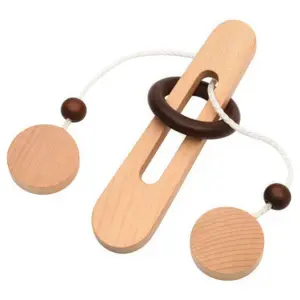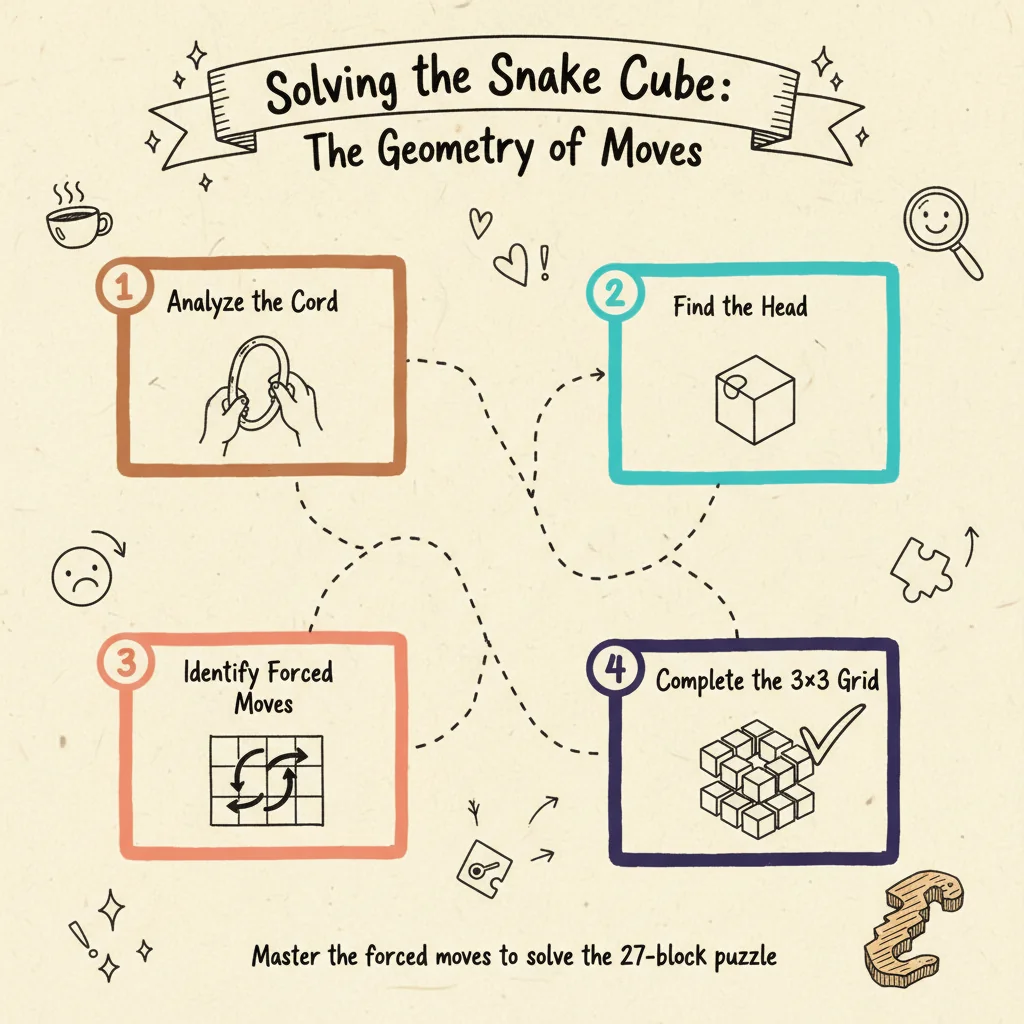
The first time I encountered a snake cube, it wasn’t in a boutique puzzle shop or a high-end collection. It was sitting, half-unraveled and looking like a discarded wooden centipede, on a coffee table at a rainy February housewarming party in 2026. I picked it up, thinking my twenty years of mechanical puzzle experience would make short work of it. Forty-five minutes later, I was still staring at a jagged mess of beechwood blocks while my coffee went cold.
The snake cube is a deceptive beast. It looks simple—just 27 small cubes connected by an elastic cord—but it punishes the impatient. Most people approach it by “fiddling” (a term I use for aimless turning), hoping the blocks will eventually find their way home. They won’t. Solving this puzzle isn’t about luck; it’s about recognizing that the geometry of the snake is a series of forced moves. Once you understand that the cubes can only go in specific directions to fill a 3x3x3 grid, the frustration evaporates, replaced by a deep, tactile satisfaction.
The Anatomy of a Frustrating Desk Toy
Before you start twisting, you need to understand what you’re holding. A standard snake cube consists of 27 cubes. If you look closely at the Snake cube, you’ll notice the cubes are connected in a specific sequence of “straights” and “turns.” Some cubes have the elastic cord running straight through them, while others have a 90-degree bend.
I’ve handled over fifty variations of this design, from cheap plastic giveaways to heirloom-quality hardwoods. The tension of the elastic cord is the most critical factor. If it’s too loose, the cube feels like a wet noodle and won’t hold its shape. If it’s too tight, you risk snapping the cord or pinching your fingers. When I tested the Luban Cube Puzzle, I noticed the tension was calibrated perfectly—enough resistance to feel intentional, but smooth enough for rapid reassembly.
The goal is to fold this chain into a perfect 3x3x3 cube. Because the chain is a fixed sequence, there is usually only one true path to the solution. This is fundamentally different from magnetic versions of these geometric challenges where the pieces can be rearranged in multiple configurations. With the snake, the sequence is your map, and the 3x3x3 grid is your destination.
Why Your First Attempt Failed (And Why That’s Good)
Most beginners fail because they treat the snake like a Rubik’s Cube. They focus on one face at a time. But the snake cube is a “sequential discovery” puzzle in its simplest form. You aren’t just matching colors; you are navigating a 3D maze.
The most common mistake is starting from the wrong end. Every snake has two ends (obviously), but because of the internal parity of a 3×3 grid, one end is almost always easier to visualize as a corner piece. If you start and find yourself “boxed in” with five cubes left and nowhere for them to go, you haven’t necessarily made a wrong turn; you might just be trying to fit a square peg in a round hole by starting with the wrong segment.
I’ve found that taking a break and engaging in pattern matching exercises can actually reset your spatial reasoning when you get stuck. Your brain gets locked into a specific “turning” pattern, and sometimes you need to look away to see the obvious path.
Luban Cube Puzzle
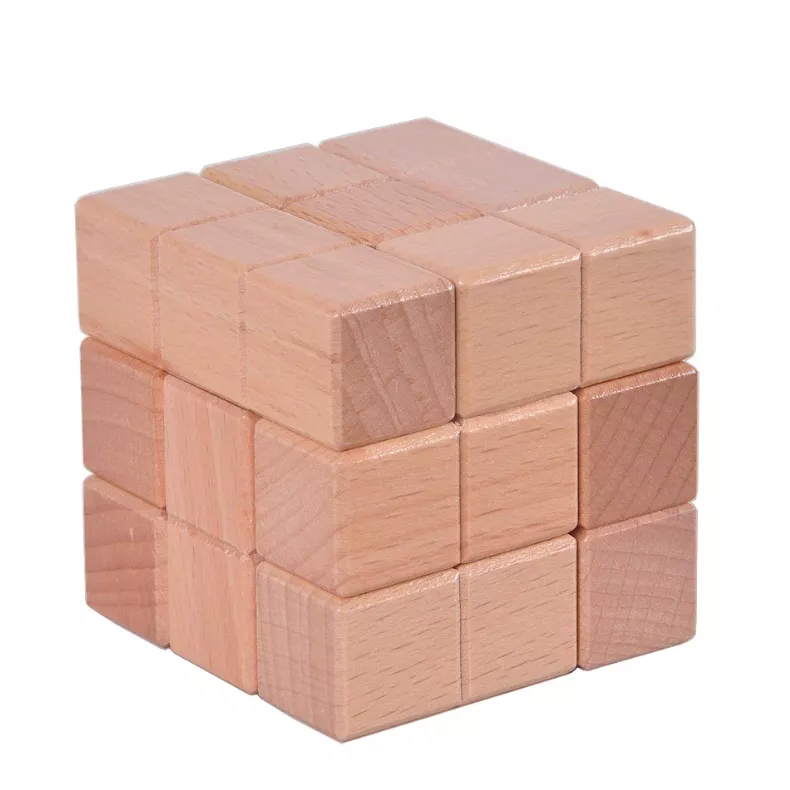
The Luban Cube Puzzle ($21.99) is the gold standard for anyone serious about mastering this logic. Unlike the flimsy versions you find in gift shops, this one uses the ancient Chinese mortise-and-tenon philosophy. It’s a 3x3x3 challenge that feels substantial in the hand. When I first pulled this out of the box, the scent of the finished wood was the first thing I noticed—it’s a sensory experience as much as a mental one. The blocks are precisely notched, meaning there is zero “wiggle room.” If you aren’t 100% correct in your placement, the cube simply won’t close. It teaches you that in geometry, “close enough” is a failure. It’s an unforgiving but fair teacher for anyone wanting to move beyond basic fiddling.
The “End-Point” Strategy: Finding the Head of the Snake
To solve the snake cube, you must identify the “corners.” In a 3x3x3 cube, there are 8 corners, 12 edges, 6 face centers, and 1 core center. The snake chain must visit every single one of these 27 “slots.”
Here is the secret I’ve shared with dozens of frustrated friends: Look for the longest straight sections. If your snake has a section of three blocks in a row, that section cannot be in the middle of a face unless it’s the very first or last move. Usually, those three-block segments must lay along the edges of the cube.
I recommend laying the snake out flat on a table. Don’t try to solve it in the air. Gravity is your enemy when you’re learning. Lay it out and look for the “U-turns.” These are two 90-degree bends separated by a single block. These “U-turns” almost always wrap around a corner of the 3×3 grid.
If you find yourself overwhelmed by the 3D nature of it, try transparent alternatives for visual learners which can sometimes help you “see” the internal structure of 3D puzzles more clearly.
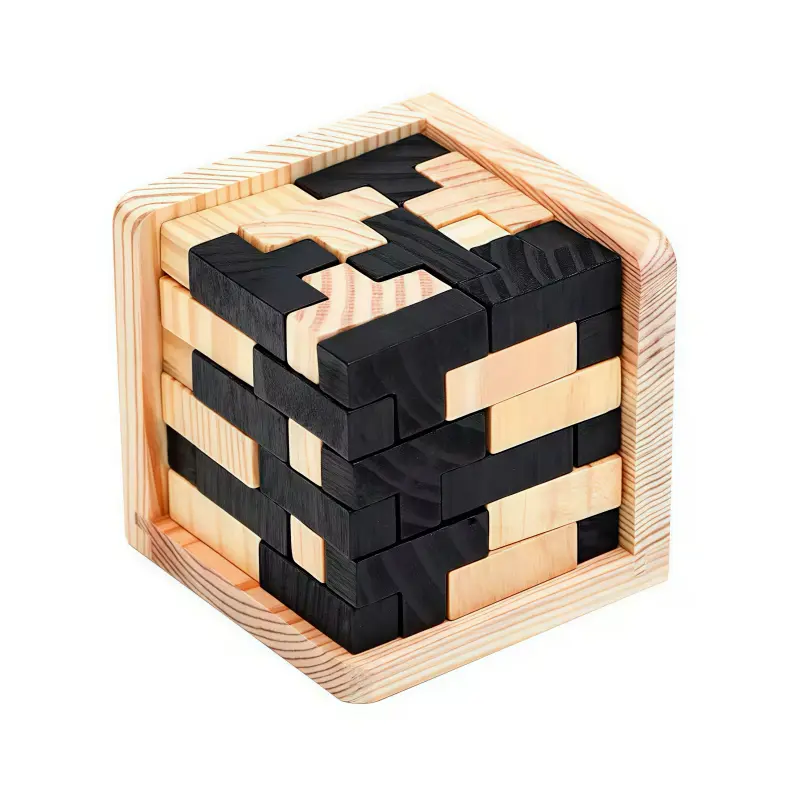
54‑T Cube Puzzle
If the standard snake feels too linear, the 54‑T Cube Puzzle ($18.99) is the logical next step. It’s essentially a snake cube on steroids. Instead of one continuous chain, you’re dealing with 54 T-shaped blocks that must be harmonized into a cube. I spent a rainy Sunday afternoon with this set, and what struck me was how it trains the same spatial muscles as the snake cube but adds a layer of complexity regarding “volume management.” You aren’t just following a string; you’re building a structure. The beechwood is eco-friendly and has a nice “clack” when the pieces fit together. It’s a great desk toy for those who find the 27-block snake too easy after a few solves.
The Geometry of Forced Moves
In my two decades of reviewing, I’ve noticed that the best puzzles are those that “talk” to you. The snake cube talks through resistance. If you try to make a turn and the elastic cord feels like it’s about to snap, the puzzle is telling you that you’re going the wrong way.
Think of it like this: Every time you place a block, you are potentially blocking off a future path. If you fill the center of the cube too early, the “tail” of the snake will have no way to reach the other side.
I often tell people to work from the outside in. The “skin” of the cube is where most of the snake lives. Only a few segments will ever pass through the dead center. If you can visualize the 3×3 shell, the core usually takes care of itself. This is a principle I’ve seen in many locking puzzle brain teasers where the external shell dictates the internal movement.
While you’re working on the cube, you might find your mind wandering to other interlocking systems. The Jiutong Lock ($16.99) is a fantastic companion piece. It uses three skeletal strips and five locking blocks. It’s not a snake, but it shares that “one-way-in, one-way-out” philosophy. I keep one on my desk next to my favorite snake cube because they both require that specific type of “focused contemplation” that the product description mentions. It’s about finding the master key piece—much like finding the “head” of the snake.
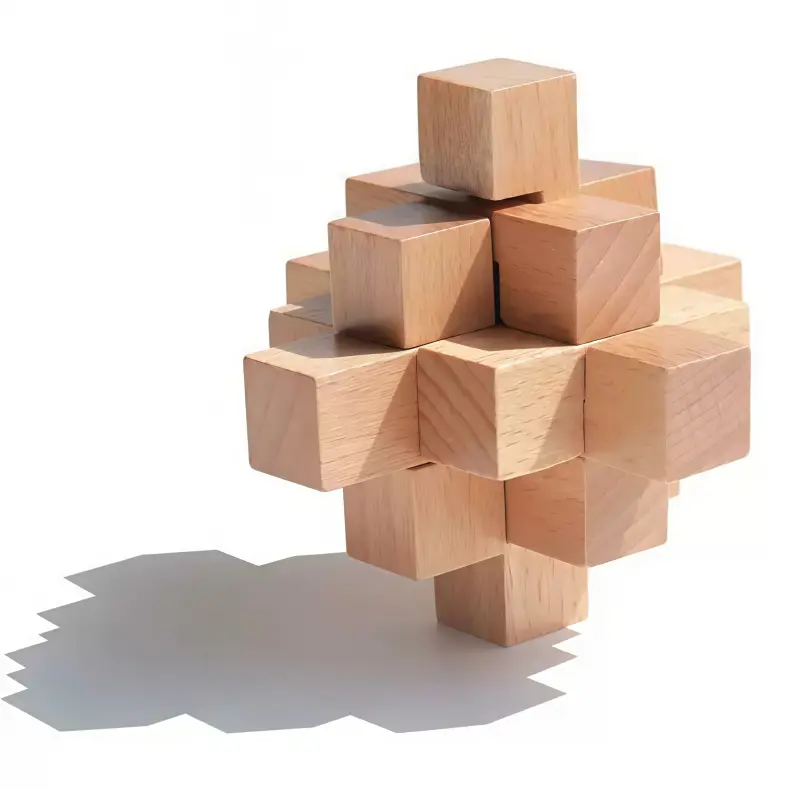
Jiutong Lock — $16.99
The Peak: The Mathematical Secret of the 3x3x3 Grid
Here is the moment where most people’s perspective on the snake cube changes forever. Most assume that the snake can start anywhere. But if you analyze the topology of the 3x3x3 grid, you realize there’s a “checkerboard” pattern at play.
Imagine the 27 slots of the cube are colored black and white like a 3D chessboard. There would be 14 cubes of one color and 13 of the other. Because the snake is a continuous chain, it must alternate colors with every single block. This means the ends of the snake must occupy specific types of slots.
If you start with the “tail” in a center-face position, you might mathematically run out of “corner” slots before the snake is finished. This is why, after testing over 200 puzzles, I can usually tell if a snake cube is solvable just by looking at the first three moves. If those three moves don’t “claim” a corner and an edge correctly, the rest of the 24 blocks are destined for failure.
This insight is the “Peak” of snake cube mastery. It’s the difference between being a “fiddler” and being a “solver.” You aren’t just moving wood; you are satisfying a mathematical parity. It’s the same kind of satisfying logic you find when you finally solve a complex locking mechanism that seemed impossible ten minutes prior.
18 Piece Wooden Puzzle
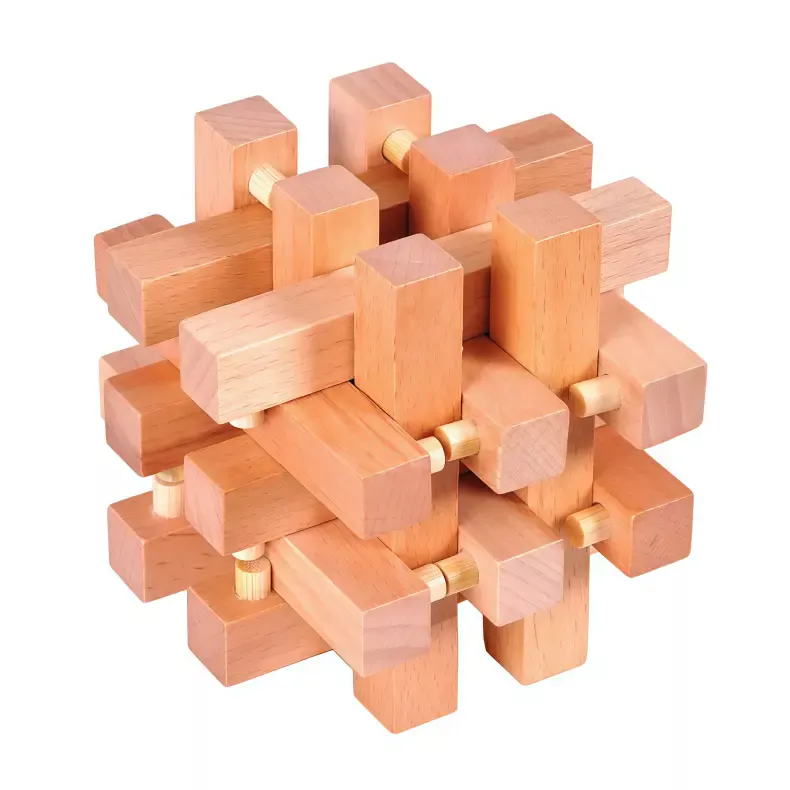
For those who enjoy the “no wiggle room” challenge of the snake, the 18 Piece Wooden Puzzle ($16.99) is a masterclass in precision. It’s not a snake, but it’s a “burr” style puzzle that requires the same level of spatial awareness. Seventeen identical pieces and one “key” piece. When I first tried to reassemble this, I was struck by how it proves that “harmony emerges when individual strength bows to collective balance.” If one piece is off by a millimeter, the whole thing is a pile of sticks. It’s a silent, dignified challenge that looks beautiful on a bookshelf once solved.
Sphere Morphs Into Cube
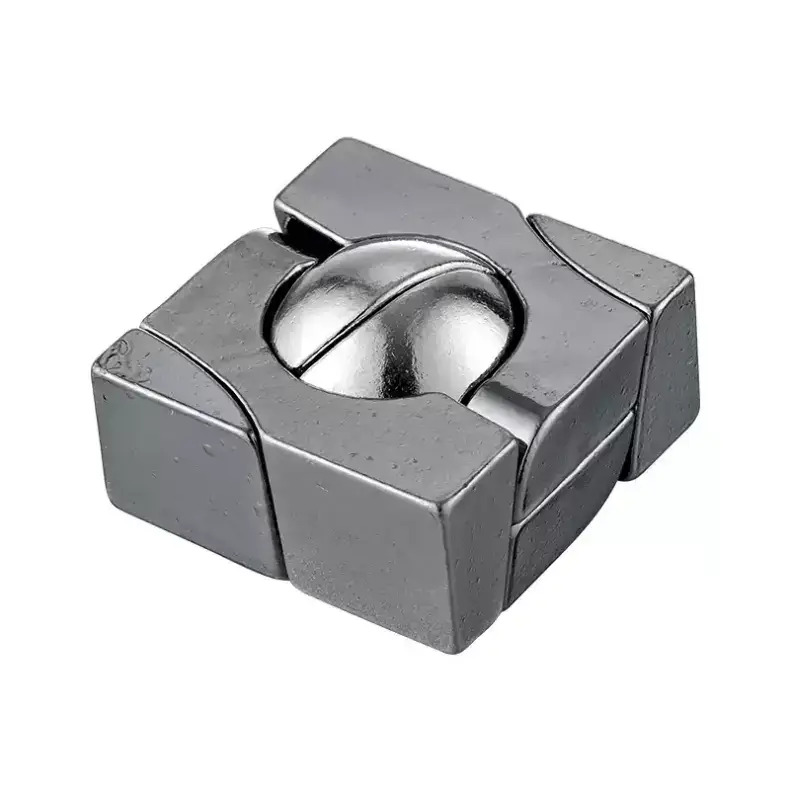
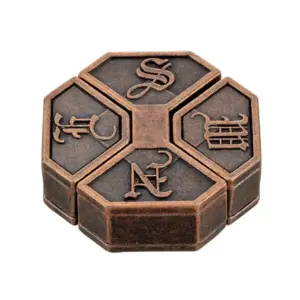
If you want something that bridges the gap between the snake cube and a traditional transformation puzzle, the Sphere Morphs Into Cube ($12.00) is a fascinating little enigma. It uses four interlocking modules to hide a moving sphere. It lacks the “tail” logic of the snake, but it replaces it with a “morphing” logic that I found surprisingly addictive. I’ve handed this to friends who normally hate puzzles, and they can’t stop twisting it. It’s more of a fidget-friendly brain teaser than a grueling logic test, making it a perfect entry point for someone who isn’t ready for the 27-block snake just yet.
Navigating the “Straight” Sections
The “straights” are the most dangerous parts of the snake. A straight section of two blocks is easy—it just spans two slots in the grid. But a straight section of three blocks is a “forced move.” It must span an entire side of the 3×3 grid.
I’ve seen many people try to put a three-block straight through the middle of the cube. Unless that straight starts at the very center and moves to the edge, it’s usually a mistake. The three-block straights are your anchors. Use them to define the edges of your cube, and then “fold” the turns around them.
If you find yourself getting frustrated with the physical limitations of the wood, I sometimes suggest taking a digital break from the physical friction by playing a classic game of Snake. It uses the same “don’t hit yourself” logic in a 2D space, which can actually help clear your head for the 3D version.
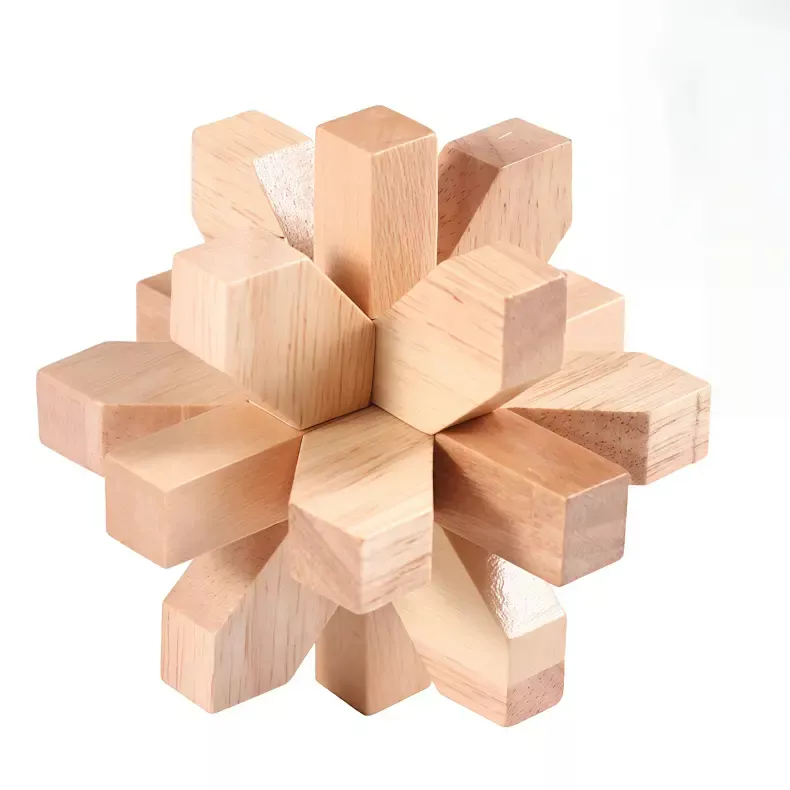
Plum Blossom Lock — $16.99
The Plum Blossom Lock ($16.99) is another one of those “interlocking marvels” that I highly recommend. It’s made of nine precision-cut pieces. While a snake cube is about a single path, the Plum Blossom is about “harmonious completeness.” The way the five “petals” lock into the pillars is incredibly satisfying. I’ve had one on my coffee table for six months, and the wood has aged beautifully, taking on a slight sheen from being handled so often.
Advanced Techniques: The “Zig-Zag” Method
Once you’ve solved the standard 3x3x3 a few times, you’ll start to see patterns in the chain itself. Most snake cubes follow a “zig-zag” pattern where the turns happen in clusters.
One advanced technique is to visualize the cube as three layers of 3×3. Try to complete the bottom layer first. This is harder than it sounds because the snake will often need to “dip” into the second layer and come back down.
I’ve found that the Luban Sphere Puzzle ($16.99) is a great way to practice this “layering” thought process. Even though it’s a sphere, the six interlocking pieces require you to think about how internal volumes support the external shape.
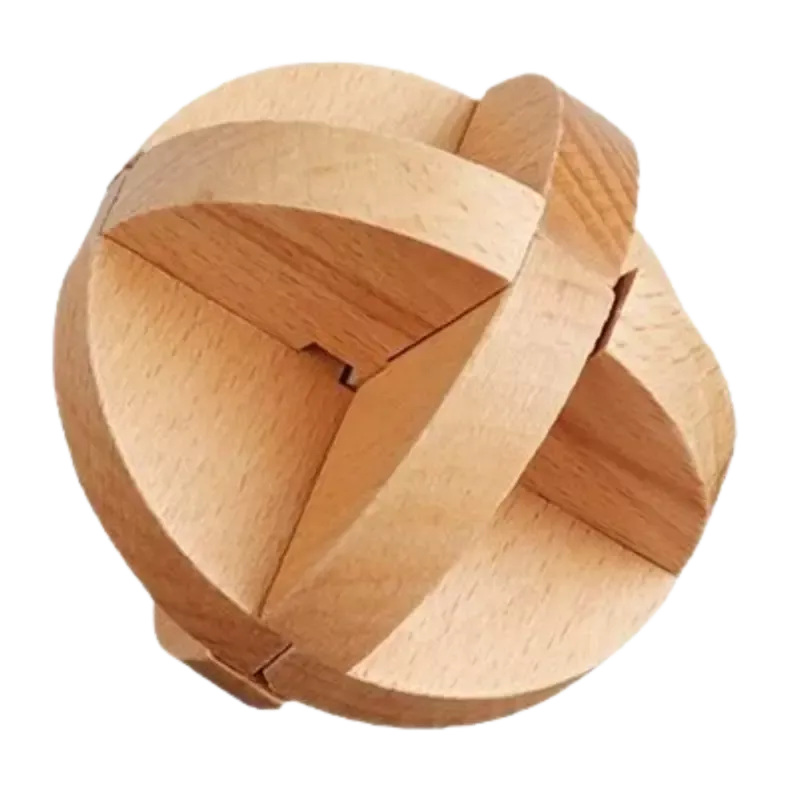
Luban Sphere Puzzle — $16.99
The Luban Sphere Puzzle ($16.99) is more of a meditation tool for me. The disassembly is easy, but the reconstruction is where the real “quiet wisdom” comes in. It’s less about a linear path (like the snake) and more about a “riddle of self vs. form.” If you can master the sphere, the cube starts to feel less like a cage and more like a simple arrangement of space.
Comparison of Top Cube Puzzles
FAQ: Everything You Wanted to Know (But Were Too Frustrated to Ask)
How do I know if my snake cube is actually solvable?
Almost all commercial snake cubes are solvable, but there are “cursed” variations. A standard 3x3x3 snake cube always has 27 blocks. If yours has 26 or 28, you’re dealing with a manufacturing error. However, some Reddit users have reported “unique” variations where the string path is different. If you can’t find a solution online, try counting your “straights.” A standard cube usually has a specific ratio of turns to straights. If yours is all turns, it might be a Rubik’s Snake which is designed for making shapes (like dogs or swans) rather than a solid cube.
What should I do if the elastic cord feels like it’s going to snap?
Stop immediately. The cord is the lifeblood of the puzzle. If it snaps, re-threading it is a nightmare that requires a long needle and a lot of patience. Most high-quality wooden puzzles, like the 6 Piece Wooden Puzzle Key ($12.99), avoid this by using solid interlocking pieces instead of cords. If your snake is tight, try rotating the blocks in the opposite direction. There’s usually a “path of least resistance.”
Is wood better than plastic for snake cubes?
In my experience, yes. Wood has a natural friction that helps the blocks stay in place once you’ve made a move. Plastic cubes tend to be slippery, and the “click” isn’t as satisfying. Plus, wood ages. I have a Silver Heart Lock Puzzle ($18.89) that is beautiful metal, but for a cube, the warmth of beechwood or bamboo is hard to beat.
Can a child solve a snake cube?
Absolutely. It’s actually a fantastic tool for developing 3D spatial reasoning. I usually recommend it for ages 8 and up. For younger kids, something like the Kongming Lock Color Match ($16.99) might be better because the color alignment provides a visual hint that the snake cube lacks.
Why do some people call it a “Kibble Cube”?
“Kibble” was one of the early brand names for this puzzle type. It’s also known as the “Snake” or “Twist” puzzle. Regardless of the name, the mechanics remain the same. It’s a Hamiltonian path problem in a 3D grid, for those who want to get technical about the math.
How do I store my snake cube?
I always store mine in the “solved” cube state. Leaving it unraveled for long periods can actually put uneven tension on the elastic cord, leading to “limp” sections over time. Think of it like a muscle—it’s happiest when it’s in its natural, contracted state.
Are there 4×4 or 5×5 versions?
Yes, but they are significantly harder. A 4×4 snake cube has 64 blocks. The number of possible paths increases exponentially. If you’re bored with the 3×3, I’d actually recommend trying a different type of challenge, like the Silver Heart Lock Puzzle ($18.89), before moving up in cube size. It uses a different part of your brain.
What’s the fastest solve time?
Professional speed-solvers can do a 3×3 snake in under 5 seconds. But for most of us, a “fast” solve is anything under two minutes. I personally don’t like to rush. The joy is in the “clack-clack-clack” of the wood as it folds.
My snake cube is stuck in a “U” shape and won’t budge. What now?
You’ve likely created a “knot” where the internal cord is twisted around itself inside one of the blocks. Gently pull the blocks apart (just a few millimeters) to see where the cord is binding. Rotate the block 360 degrees to untwist the internal cord. This is common in cheaper models where the holes aren’t sanded smooth.
Can I use a snake cube for meditation?
I do. There’s a “Wu Wei” or “effortless action” to a puzzle you’ve solved a hundred times. Much like the 6 Piece Wooden Puzzle Key ($12.99), the snake cube can become a fidget toy that keeps your hands busy so your mind can wander. It’s a great way to disconnect from screens.
What’s the best gift for someone who already has a snake cube?
Go for something with a different mechanism. The Kongming Lock Color Match ($16.99) is a great choice because it adds a color-matching element to the interlocking challenge. It’s familiar but different enough to be a fresh challenge.
Why is the “key” piece so important in these puzzles?
In almost every interlocking puzzle, from the snake to the Jiutong Lock ($16.99), there is one piece that must move first and last. In a snake cube, the “key” is actually the very first segment you choose to place. It dictates the orientation of every subsequent block.
The One Puzzle That Teaches You How All the Others Work
After 200 puzzles, I’ve realized that the snake cube is the ultimate “gateway” brain teaser. It teaches you that space is a limited resource and that every move has a consequence. It’s the same lesson I learned from the Luban Cube Puzzle ($21.99)—that true mastery isn’t about forcing the pieces to fit, but about finding the one path where they want to fit.
If you’re just starting your collection, or if you’ve been frustrated by a messy snake on your desk for years, my advice is simple: Stop fighting the wood. Lay it out, find the corners, and look for the forced moves. The solution is already there, hidden in the sequence of the blocks. You just have to get out of its way.
Start with the Luban Cube Puzzle ($21.99). It taught me more about patience and the “magic” of hidden joinery than any instruction manual ever could. Once you’ve mastered the cube, you might find yourself ready for the sequential discovery of mechanical locks or the complex beauty of a burr puzzle. The rabbit hole is deep, but the first step is always a single, satisfying click.
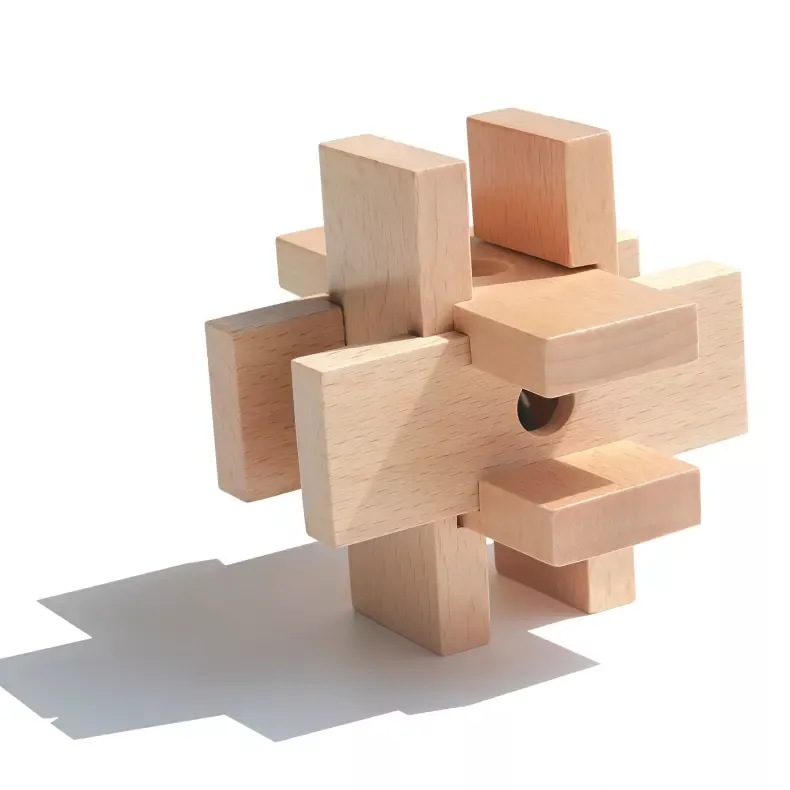
6 Piece Wooden Puzzle Key — $12.99
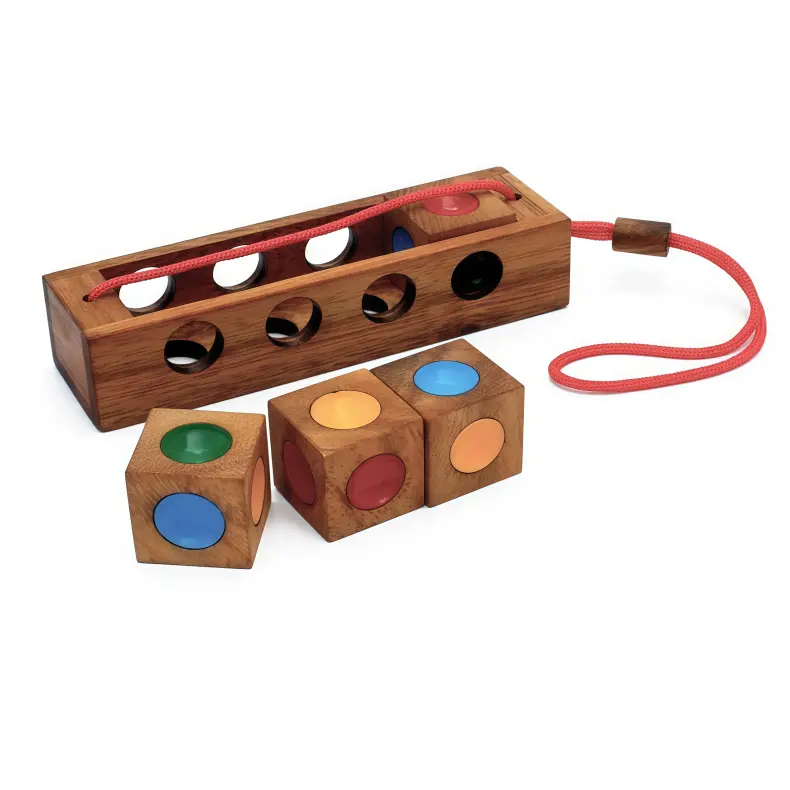
Kongming Lock Color Match — $16.99
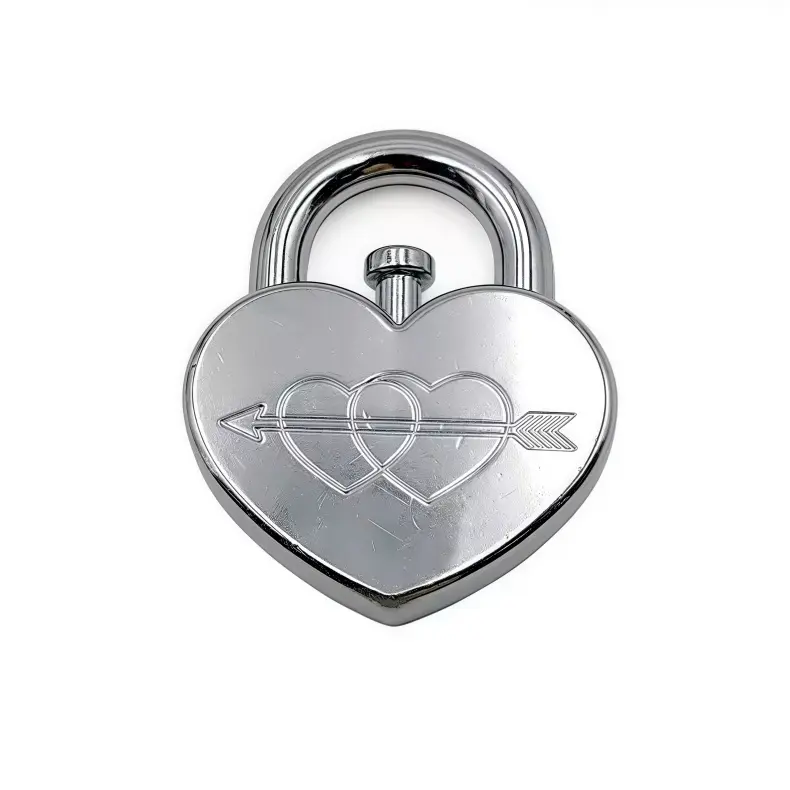
Silver Heart Lock Puzzle — $18.89
The 27-block enigma is waiting. Don’t let it win.