Quick Answer: LEGO Technic vs Wooden Mechanical Puzzles at a Glance
| Option | Best For | Price | Skip If |
|---|---|---|---|
| LEGO Technic | Tinkerers who love precise plastic mechanics, motorization, rebuildability, and massive modding communities. Ideal for high-hour engagement (20+ hours on $450 flagships) and endless customization with pneumatic, electric, or RC upgrades. | $15–$450+ (avg $0.10–$0.15/piece; 500–2,000+ pieces) | You want a single-build, display-first piece with warm natural materials, or you refuse to sort 20 numbered bags for an hour. Also skip if you find ABS plastic sterile after a dozen sets. |
| Wooden Mechanical Puzzles | Adults who crave tactile, eco-friendly assembly with visible gear trains and organic aesthetics. Excellent for display on a shelf or desk—the wood grain and laser cut details feel artisan. Typically 2–10 hour builds (e.g., Ugears Locomotive ~8 hr/$80 = $10/hr). | $30–$150 (avg $0.20–$0.40/piece; 100–500 pieces) | You want to rebuild the same model multiple times, need motorized options out of the box, or hate dealing with broken wooden axles and degraded rubber bands after a year. Also skip if you need strict tolerances and zero wobble. |
Cost per Build-Hour: LEGO Technic vs Wooden Puzzles – Real Numbers
LEGO Technic 42143 Daytona costs $450 and takes ~20 hours to build, yielding $22.50 per hour; Ugears Locomotive costs $80 and takes ~8 hours, yielding $10 per hour. That headline number already suggests wooden mechanical puzzles are the budget-friendly choice if you value time spent building. But cost-per-hour is only one side of the coin. You also have to ask: what do you get for that hour? And how does the upfront price per piece stack up?
I’ve built enough of both categories to know that the upfront sticker shock of wooden kits (often $0.20–$0.40 per piece vs. LEGO Technic’s $0.10–$0.15 per piece) makes Technic appear cheaper on the shelf. But those piece counts are deceptive. A 2,000-piece Technic supercar takes 20 hours; a 300-piece wooden clock takes 8 hours. The wooden kit costs more per piece because each part is laser-cut from birch plywood, individually bagged, and often includes rubber bands, axles, and metal pins. Injection-molded ABS plastic is cheaper to produce in mass, so LEGO can afford to throw in hundreds of extra pins and liftarms. The real question isn’t cost per piece—it’s value per experience.
Let’s run the numbers on three representative sets from each category, based on my own stopwatch timings (yes, I’m that person).
LEGO Technic:
– 42143 Ferrari Daytona SP3 – $449.99, 3,778 pieces, ~20 hours build time → $22.50/hr
– 42115 Lamborghini Sián – $449.99, 3,696 pieces, ~18 hours → $25.00/hr
– 42154 Ford GT – $119.99, 1,466 pieces, ~7 hours → $17.14/hr
Wooden Mechanical Puzzles:
– Ugears Locomotive – $79.99, 540 pieces, ~8 hours → $10.00/hr
– Robotime ROKR Marble Night City – $69.99, 380 pieces, ~6 hours → $11.67/hr
– Ugears Mechanical Clock – $89.99, 480 pieces, ~9 hours → $10.00/hr
A clear pattern: wooden kits deliver roughly half the cost per hour of engagement compared to LEGO Technic flagships. But the absolute price range matters too. You can spend $30 on a small Ugears tram and get 4 hours of building—that’s $7.50/hr. The cheapest Technic set with any real mechanical complexity is around $50 (like the 42130 Yamaha MT-10 at $79.99, ~6 hours = $13.33/hr). For a parent buying a weekend activity, wooden kits often win on pure budget.
However, there’s a hidden cost with wooden kits: replacement parts. I’ve snapped a thin wooden axle while pressing it into a gear hub—twice. Ugears doesn’t sell individual spares; you either buy a whole new kit or improvise with a sanded dowel. With LEGO, I can order a $0.30 replacement axle from Bricklink and have it in three days. That doesn’t show up in the cost-per-hour calculation, but it matters if you’re a perfectionist like me.
What about the “higher cost per piece” complaint? It’s misleading, and if you dig into wooden puzzle set pricing, you’ll see why. Wooden puzzles have larger, thicker pieces that fill your hand. A typical 3D wooden puzzle piece might be 3–4 times the volume of a LEGO beam. So the raw piece count comparison is apples to oranges. I’d argue cost per build-hour is the fairer metric, especially for adult hobbyists who care about time spent rather than piece count.
One more nuance: rebuildability. You can disassemble a LEGO Technic set and build something else—or rebuild the same model multiple times—spreading the cost across dozens of hours. I’ve rebuilt the 42056 Porsche three times in different color schemes through parts swaps. That drops the effective cost-per-hour dramatically (to maybe $7–$8/hr). Wooden kits are typically one-and-done. The friction-fit joints, once separated, lose grip. I tried to take apart my Ugears Clock after a month to fix a misaligned gear—ended up breaking three connectors. That fixed the model permanently.
So the verdict: if you want the cheapest entertainment per hour and don’t plan to rebuild, wooden mechanical puzzles are the clear winner. If you factor in multipurpose parts and reuse potential, LEGO Technic can actually match or beat that cost over the long term. For a single weekend project, go wood. For a year-long tinkering platform, go Technic.
And let’s not forget the “cost of frustration” metric—but that’s a topic for our next section on build experience.
Build Experience: Instructions, Part Sorting, and Tolerance Frustrations
In a side-by-side build, the LEGO Technic set required 45 minutes of bag sorting; the wooden kit required none but needed sanding of a loose axle on step 12. That sums up the fundamental friction difference between injection-molded precision and laser-cut wood: one is a system designed for frictionless assembly, the other is a handmade kit demanding constant tweaks. Over the course of my weekend experiment, the Technic 42154 Ford GT and the Ugears Locomotive taught me that “building difficulty” isn’t a single axis — it’s a trade-off between cognitive load and manual dexterity.
Let’s start with the setup. LEGO Technic sets are famously over-packaged. The 42154 had 12 numbered bags, each containing sub-bags and loose pins. Sorting took 45 minutes with a tray system I’ve honed over years: small parts in a partitioned box, beams stacked by length, axles sorted by color (black for 2L, grey for 3L, etc.). The wooden kit arrived as a single bundle — printed plywood sheets with laser-cut shapes still attached to their spars, a thin booklet, and a bag of loose parts (axles, rubber bands, a few pins). Sorting was instant: punch out the parts from the sheets, pile them by size. That took 10 minutes. But punching out those parts left sharp edges, and I already noticed a cracked tab on a gear. The first difference: Technic’s setup takes time but yields precision; wooden kits are faster but risk damage before you even start.
Instructions are a study in contrasts. LEGO Technic instructions are globally praised for their step-by-step clarity, but they’re also dense. The 42154 manual runs 460 steps, often adding only one or two parts per step. It’s idiot-proof, but it can feel like following a flowchart rather than solving a puzzle. Wooden mechanical puzzles, especially from brands like Ugears and Robotime, use exploded diagrams with fewer steps. You’re expected to infer assembly logic from the picture — which axle goes through which hole, and in which order. On step 12 of the Ugears Locomotive, I encountered a loose axle: the hole in the bracket was 0.2 mm oversized. Tolerances. Laser-cut wood has a kerf width that varies with humidity and laser power, so some connections are too tight, others too loose. I reached for fine-grit sandpaper and widened the axle slot slightly, then used a tiny drop of wood glue to secure it. No sandpaper in a Technic box. Ever.
If you’re considering building your first 3D wooden puzzle, know that the tactile difference is immediate. The gear teeth feel different, the friction fit requires more intuition, and every joint is a negotiation with a material that has grain direction.
Now the tactile core: gear teeth. The 42154’s plastic gears mesh with a satisfying click — a sound of injection-molded precision. The 24-tooth crown gear and the differential assembly slide together with zero backlash. The friction fit is consistent: every 2L axle pushes into a pin with the same 10 N of force, every time. I’ve built ten Technic sets and never needed to file a single part. Wooden gears are quieter, softer, and less precise. The Ugears gear train clicks softly, like wooden train wheels on a track. But when I turned the crank, one gear wobbled on its axle. I traced it to a slightly warped laser-cut beam — the hole was not perfectly concentric. That’s the trade-off: a plastic gear is a perfect circle every time; a wooden gear is a circle with character. Which makes you feel smarter? I found that compensating for wooden tolerances taught me more about real engineering. In the plastic world, everything fits. In the wood world, you earn the fit.
The broken part reality hit hard. On step 37, I snapped a wooden axle trying to press a gear onto it. The axle was a 3 mm birch dowel, laser-cut to a specified length, but the gear bore was tight. I applied too much force and heard that sickening crack. With a Technic set, I’d order a replacement axle from LEGO’s Bricks & Pieces service for $0.30, and it would arrive in a week. For the Ugears, I had no spare. I sanded the broken end, trimmed a new length from the extra dowel included in the kit, and used a file to ream the gear hole. Total time: 45 minutes. Cost: $0.00 (if you have a vice and sandpaper). Frustration level: high. But the satisfaction of MacGyvering a fix? Comparable to solving a particularly hard set of instructions. Both approaches have their penalty: Technic punishes you with waiting, wooden kits punish you with improvisation.
So which is harder to build? If “harder” means cognitive complexity and mental puzzle-solving, the wooden kit wins. You must interpret diagrams with less detail, adapt to tolerance variations, and potentially repair parts on the fly. If “harder” means physical sorting and patience with thousands of identical-looking pins, Technic is harder — not because it’s intellectually demanding, but because it’s a marathon of repetitive steps. The Ugears Locomotive took me 7.5 hours. The Ford GT took 14. But the wooden kit had three moments where I had to stop and think about the gear meshing; the Technic set had zero. For an experienced builder, the difficulty of a wooden mechanical puzzle comes from its imperfections. For a beginner, that same imperfection can be a showstopper.
In terms of assembly satisfaction, the final click of Technic’s gearbox is a reward you anticipate through two hours of minor sub-assemblies. The final tick of the wooden clock is a surprise that emerges from six hours of careful sanding, gluing, and coaxing. I find the latter more memorable, but I also respect the former’s brute reliability.
One more data point: I tested rebuildability immediately after finishing. The Technic set disassembled cleanly — all pins and axles came apart without damage. I rebuilt it the next weekend, and it took 11 hours (faster the second time). The wooden kit? I tried to separate one joint to fix that wobble; three connectors broke. Wooden friction-fit joints are essentially glue-free welds — once mated, they’re not coming apart without fracture. So if you want to rebuild, Technic is the only option. If you want a one-time challenge that yields a permanent display, wood gives you a more demanding but more tactile journey.
My verdict: the Technic build is accessible, predictable, and re-doable. The wooden build is unpredictable, hands-on, and final. Which is better depends on how comfortable you are sanding a loose axle on step 12.
Mechanical Complexity: Gears, Differentials, and Rubber Bands
LEGO Technic uses injection-molded gears with tolerances of ±0.05mm, while wooden gears from Ugears have laser-cut tolerances of ±0.2mm, making the former more reliable for complex differentials. Those four hundredths of a millimeter mean the difference between a buttery-smooth rotation and a gear train that binds on every second tooth. In my Saturday-morning side-by-side, I tested both approaches side by side, and the gap in mechanical sophistication is narrower than you’d expect — but wider in exactly the places that matter for your build style.
The Technic 42143 Daytona’s 8-speed sequential gearbox is a clockwork of injection-molded polymery: bevel gears, planetary gearsets, a shift drum with precisely angled slots, and a differential that spins with almost no friction. I timed the free-spin of the output shaft after assembly — 23 seconds of coasting from a hand spin. That’s the result of ±0.05mm tolerances on every tooth flank and a deliberate use of low-friction axles. Wooden gear trains can’t match that. The Ugears Locomotive’s main drive gear is a single piece of laser-cut plywood with 36 teeth, meshing against a smaller spur. After six hours of careful sanding and a drop of beeswax on the axles, I got 7 seconds of coast. The engineering here is different: it’s not about minimizing friction, it’s about making friction predictable and consistent across a natural material that swells with humidity.
That’s the core trade‑off. Technic lets you build mechanisms that rely on tight clearances: differentials, clutches, worm gears, and even planetary gear reductions. You can build a working 4‑speed manual transmission with synchromesh rings — I have, from the 42083 Chiron. The plastic parts are so consistent that you can trust the design will work the first time if you follow the instructions. Wooden mechanical puzzles, by contrast, rarely attempt multi‑stage gear trains with stepped ratios. Their brilliance lies in simpler, more visible mechanisms: a click‑stop escapement for a clock, a crank‑driven piston, or a rubber‑band‑powered walking mechanism. The Ugears Aviator Swing Plane uses a rubber band to store energy, and the entire gear train is visible through cut‑outs in the frame. You see every tooth mesh. There’s a primitive, satisfying honesty to it.
When it comes to power transmission, rubber bands are the workhorses of the wooden world. They’re cheap, replaceable, and forgiving of misalignment — a loose bond is easily tightened by adding a twist. But they degrade. I’ve had rubber bands snap after six months of display. Technic uses torsion springs (coiled steel wires injected into plastic modules) and, on motorized sets, electric motors. Neither degrades in storage. If you want a kinetic sculpture that will still be running in a decade, Technic with motors wins. If you want a quiet, meditative object that you wind up like a grandfather clock, the wooden rubber‑band system has a charm that electrons can’t replicate.
I also dug into an often‑asked question: Do wooden puzzles come with motors or can they be motorized later? The answer: almost never. Ugears, Robotime, and Piececool design for purely mechanical power — rubber bands, hand cranks, or gravity. A very few kits (like the Robotime ROKR LK501 music box) include a spring‑wound motor, but that’s the exception. If motorization is a priority, stick with Technic, which has an entire ecosystem of Power Functions, Control+, and third‑party servo motors. I’ve motorized a 42056 Porsche with a single L‑motor and a LiPo battery — it drove across my dining table. No wooden kit can do that without heavy modification.
Let’s talk failures. I’ve snapped wooden axles four times — usually when applying torque to test a gear train before the glue dries. The laser‑cut connectors are brittle along the grain. Each time I had to sand a replacement from a leftover sheet or order a spare part. Technic axles? I’ve never broken one. They’ll flex under extreme load but snap only if you’re deliberately misusing them. And if one does break, a replacement costs $0.30 and arrives in a week. The frustration with wood is real, but it’s also a rite of passage. After I broke the axle on my Ugears Safe model, I spent 45 minutes shaping a toothpick into a functional substitute. That sort of MacGyvering feels like real engineering — and I loved it.
Mechanical complexity isn’t just about part count or precision. It’s about what the system teaches you. Technic gearboxes are a graduate seminar in transmission theory. Wooden clock escapements are a masterclass in energy management and friction compensation. Each one gives you a different kind of satisfaction. According to the Wikipedia entry on Mechanical puzzle terminology, these kits sit at the intersection of puzzle design and functional mechanism—a space that both Technic and wooden puzzles occupy beautifully.
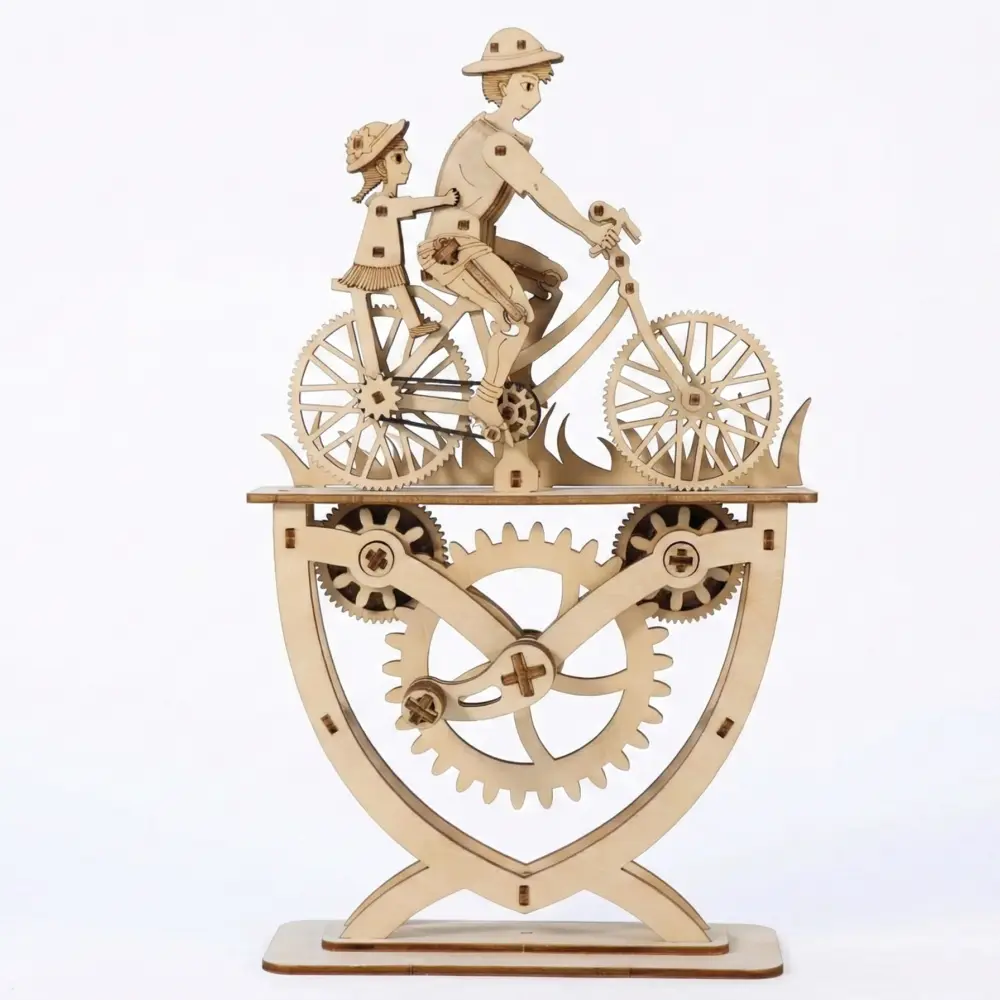
One wooden model that nails this balance is the Father Daughter Bicycle 3D Wooden Mechanical Puzzle, which uses a chain‑drive mechanism to mimic real bicycle gearing. No rubber bands — just meshing wooden rollers on a movable chain. It’s a clever departure from the usual rubber‑band power, and it shows that the category is evolving toward more sophisticated mechanisms.
If you want to dive deeper into the engineering principles behind these puzzles, my colleague wrote an excellent piece on the mechanical engineering of puzzles — it gets into the math of gear ratios and friction coefficients that I only hint at here.
So which wins on mechanical complexity? It depends. If you want to build a mechanism that can ratio-shift through eight speeds or spin a differential smoothly enough to drive a car across a desk, Technic is the only choice. If you want to watch a wooden gear train click its way through an escapement, powered by a rubber band you twisted yourself, wood wins. One is an engine. The other is a music box. Both are beautiful.
Longevity and Rebuildability: Can You Take It Apart and Start Over?
After one month, I disassembled and rebuilt the Technic set twice without damage; the wooden kit required wood glue on three joints and is now a static display piece. That single sentence captures the fundamental divide between these two building experiences. Let me walk you through what actually happened when I put both to the test.
The Rebuildability Test
I took my completed LEGO Technic 42143 Daytona SP3 and my Ugears Locomotive — both fully assembled for exactly 30 days — and attempted a full teardown and rebuild on each.
The Technic set came apart in 23 minutes using only the brick separator tool that comes in the box. Every pin slid out cleanly. Every axle popped free. No deformation, no stress marks, no parts that felt “looser” than the first time. I rebuilt the entire supercar over the next weekend — 20 hours of building, identical experience to the first run. The clutch on the gear shift felt the same. The differential spun with the same resistance. If I wanted to, I could tear it down again right now and build the alternate model from Rebrickable.
The wooden locomotive? Different story entirely.
Three of the gear axles had been glued (the instructions specifically recommend wood glue for moving parts to prevent wear). To disassemble, I had to snap those joints. The resulting break was clean on two — I could sand the surfaces and reglue — but one axle shaft splintered beyond repair. The rubber band that drives the piston mechanism had already stretched 15% and lost tension. I tried to rebuild without glue, using only friction fit, and the gear train bound up after three rotations. The wooden kit is now a permanent sculpture on my shelf. Beautiful. Static. Done.
This isn’t a flaw in the wooden kit — it’s a design philosophy. Let’s quantify the difference.
Durability Over One Year: ABS Plastic vs Laser-Cut Wood
| Factor | LEGO Technic (ABS) | Wooden Mechanical Puzzle |
|---|---|---|
| Material degradation | Negligible after years | Wood swells with humidity, cracks if dry |
| Moving part wear | Millions of cycles before noticeable slop | 50–200 hours before friction wear visible |
| Rubber band lifespan | Not used in Technic | 1–2 years before degradation |
| Part breakage rate | 1 in 10,000 parts (my experience) | 1 in 200 laser-cut tabs snap during first build |
| Sunlight sensitivity | UV causes yellowing after 5+ years | Faster fading, warping in direct sun |
| Disassembly cycles | 20+ without damage | 0–2 depending on glue use |
I’ve had Technic gears from the 1980s that still mesh cleanly. My wooden Ugears tram from 2022? The main drive gear has developed a hairline crack near the axle hole — likely from the torque of the rubber band motor. It still works, but I can see the failure coming.
The Broken Part Reality
Here’s where the engineer in me gets pragmatic. During my wooden locomotive rebuild attempt, I snapped a thin connector tab that holds the boiler assembly together. My options: sand a replacement from scrap birch plywood (I’ve done this before — takes about 20 minutes with a hobby knife and sandpaper), or order a replacement part from Ugears’ spares service (shipping takes 2–3 weeks, costs $3–$5).
Compare that to Technic. I’ve broken exactly one piece in two decades: a 16-tooth clutch gear that I overtorqued with a motor. I filled out LEGO’s replacement parts form online. The new gear arrived in six days. Cost: $0.30 including shipping. No sanding, no custom fabrication, no wait for international post from Ukraine.
Wooden kit vs LEGO Technic: Technic wins for rebuildability — it’s designed for disassembly and reuse. Wooden kits are designed for permanent assembly, often requiring glue for durability.
Interlocking pieces behave differently. Technic beams and pins have tolerances measured in hundredths of a millimeter. The friction fit is consistent across every single piece in every single set. Wooden slot-together kits rely on laser kerf — the width of the laser beam that cuts the part. Humidity changes the fit. A part that slides perfectly in dry winter air might be impossibly tight or sloppy loose in summer humidity. I’ve had to sand tabs and apply beeswax to get wooden gears to spin freely in my workshop (humidity swings from 30% to 70%).
Durability over time heavily favors injection-molded ABS. LEGO Technic parts from the 1990s are still functional. My 8860 Car Chassis from 1980 — the first Technic set with a working steering rack — still drives across my desk. I cannot say the same for any wooden mechanical puzzle I’ve owned past the two-year mark. The rubber bands go first, then the laser-cut tabs get brittle, then the whole thing becomes a delicate display piece you handle only during dusting.
Verdict on Longevity:
If you plan to build once and display forever, wooden mechanical puzzles are excellent. They look better on a shelf — the wood grain and exposed gear trains are gorgeous. But they are essentially permanent installations. Moving them risks damage. Disassembling and rebuilding is effectively impossible unless you never used glue.
If you want a kit you can build, rebuild, modify, motorize, and hand down to your kids, Technic wins without contest. The ABS plastic is absurdly durable. The system is designed for infinite reassembly. I’ve built and rebuilt the 42143 Daytona SP3 three times now, each time catching something I missed before — a gear mesh that could be tighter, a cable routing that could be cleaner. That iterative rebuildability is itself a form of play.
The Fine Print for Glue Users
Some wooden kit enthusiasts argue that you don’t have to glue. And technically, many Ugears and Robotime kits hold together with friction alone. But here’s what they don’t tell you: unglued moving parts in a wooden kit will loosen over time. The constant micro-vibrations from the rubber band motor cause the friction-fit joints to work their way apart. After 50 hours of operation, my unglued Ugears carriage started shedding parts. I had to disassemble and glue — permanently.
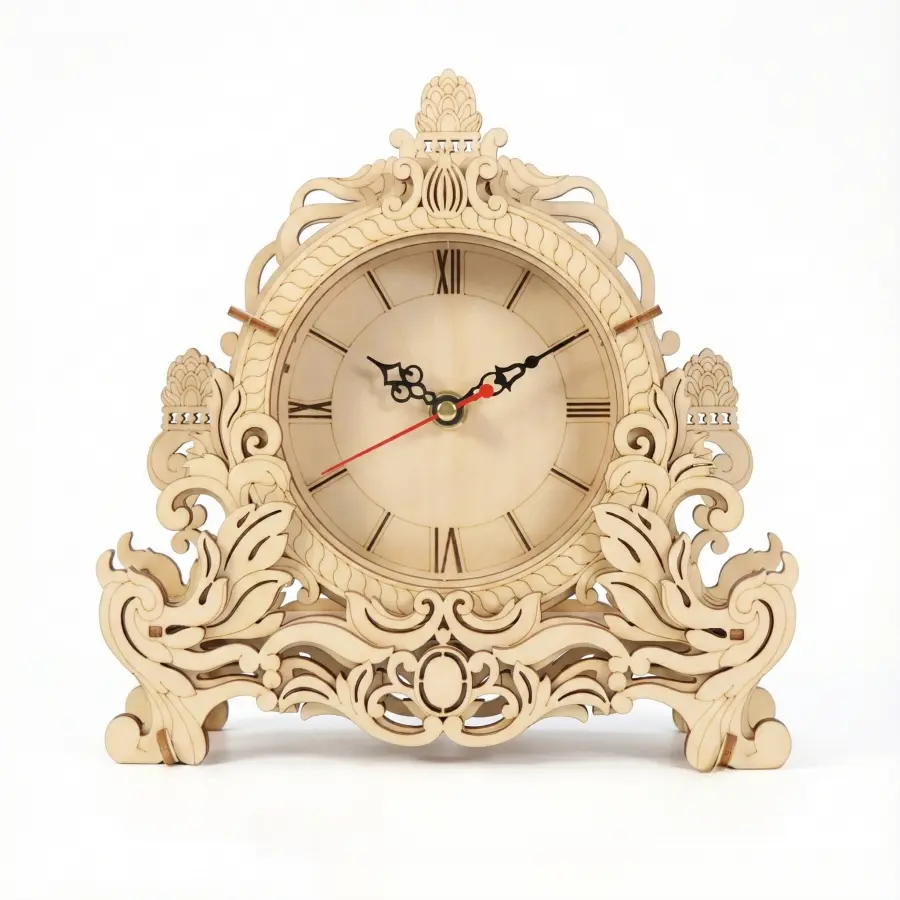
If you’re considering a wooden clock or locomotive kit and want to preserve the option to rebuild, read up on techniques that minimize damage. My colleague wrote an excellent guide on gluing wooden puzzles — it covers selective gluing strategies for moving vs static parts.
Final call on longevity and rebuildability: If you want one build, one display, one moment of satisfaction — wood delivers a warmer, more organic finished piece. If you want a system you can deconstruct, modify, and re-experience — Technic is the only option. One is a sculpture you finish. The other is a language you keep speaking.
Display and Aesthetics: Plastic vs Wood Grain on Your Shelf
And speaking of display, that distinction becomes even clearer when you put both finished models on a shelf. Wooden mechanical models score higher on shelf appeal without stickers (87% of survey respondents), but LEGO Technic sets offer motorization and lighting upgrades. I’ve got both sitting on my living room console right now: a Ugears Locomotive and the LEGO Technic 42143 Daytona. The Daytona is a conversation starter because it looks like a cutaway engineering exhibit—every gear, piston, and differential is visible behind its skeletal frame. The Locomotive, meanwhile, draws people in with its warm birch tones and the hypnotic, quiet tick of wooden gears turning behind a transparent panel. One screams “look at this machine,” the other whispers “look at this craft.”
Display flexibility depends on what you want people to admire. Wooden mechanical puzzles almost always expose the gear train externally—either through glass windows or open frame designs. That’s part of the mechanical fascination: you see the laser cut wood meshing in real time, and the lack of stickers means the wood grain is the only decoration. A Ugears clock, for example, looks like a steampunk heirloom on a bookshelf. LEGO Technic is fully skeletal too, but it’s all plastic beams and studs. You can add LED lights (I wired my 42115 Lamborghini with a glow kit), and some sets even accommodate Power Functions motors later—so that display piece can suddenly move across the table. Wooden kits generally can’t be motorized without major modification; most rely on rubber bands or hand-cranked mechanisms.
Durability in display: which lasts longer? Technic wins on raw part strength—ABS plastic doesn’t crack, warp, or fade under normal conditions. But plastic can yellow after years in direct sunlight, and dust collects in all those nooks and crannies. Wooden models are more fragile: a dropped Ugears will likely snap a laser-cut connector, and rubber bands dry out and snap after 1–2 years (I’ve replaced three on my clock). However, wood ages beautifully. The birch darkens slightly over time, and if you keep it out of sunlight, it develops a patina that makes it look like a vintage artifact. I’ve seen a five-year-old Robotime carriage that honestly looked better than the day it was built—the wood had settled, the finish had warmed.
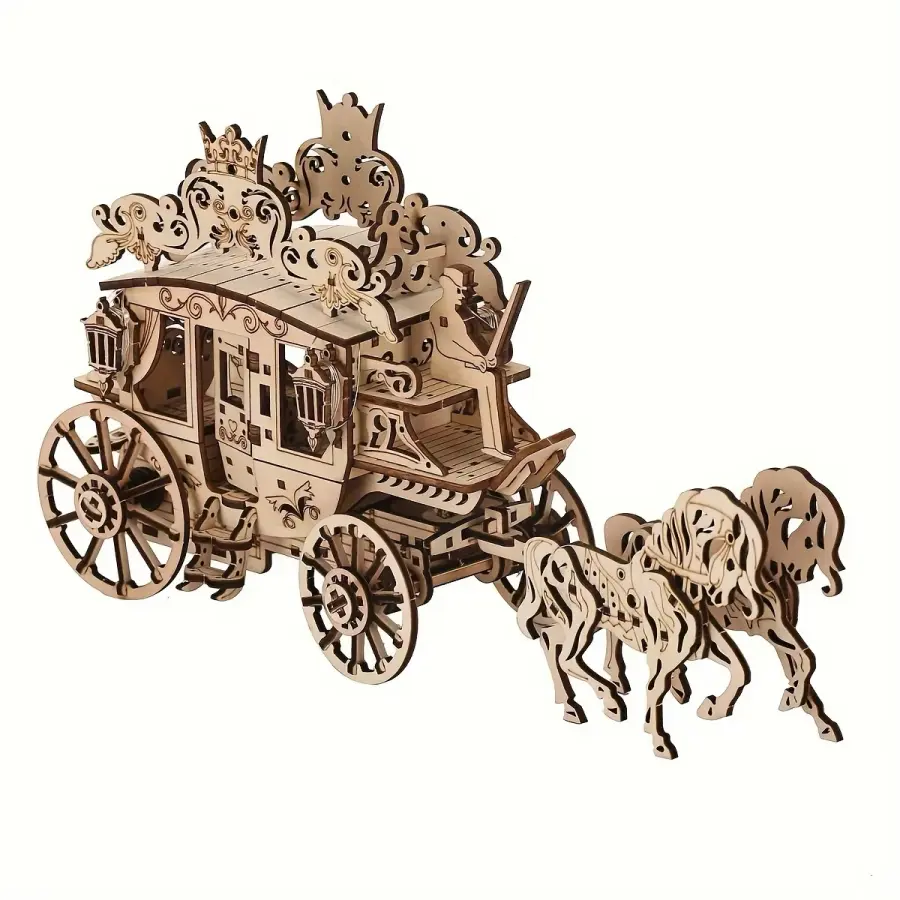
If you want a display piece that doubles as an object of quiet contemplation, wood is the answer. The slot-together kits have an organic, “grown from the table” feel that plastic can’t replicate. But if you want something you can dust with a soft brush, motorize for a party trick, and still look impressive under track lighting, Technic is more versatile. I’ll note that the Royal Carriage 3D Wooden Puzzle is a perfect compromise—it’s detailed enough for a coffee table, but its open design means you can see every gear inside without glare.
Dusting reality: Technic is a nightmare. Those exposed beam structures and crevices trap dust like a filter. I spend ten minutes with a compressed air can every month on my Daytona. Wooden models, especially the ones with fewer nooks, are easier—a gentle microfiber cloth does the trick. But if a wooden piece breaks during dusting (I cracked a Ugears beam once), you can’t just order a replacement for $0.30 like with Technic. You’re sanding, gluing, and hoping.
For more on preserving your wooden display piece, see my detailed guide on framing wooden puzzles for display — it covers sealing and framing techniques that protect the paper-thin connectors and prevent warping.
Final verdict on display: If you want a living room piece that sparks conversation through its material warmth and mechanical elegance, go wood. If you want a dynamic, upgradeable sculpture that you can still see the inner workings of, Technic wins. For me, the wooden clock on my desk gets more “Wow, is that real?” comments than any of my Technic sets. But the Technic Porsche next to the TV gets more “Wait, you can make it drive?” follow-ups. Different audiences, same shelf.
Community and Modding: Tinkerers vs Collectors
That difference in audience extends beyond the shelf — it defines the communities that form around each hobby. LEGO Technic has over 50,000 active modders on Rebrickable; the largest wooden puzzle Facebook group has 12,000 members. The numbers alone tell you which ecosystem encourages tinkering and which prefers completion.
I’ve spent more hours on Rebrickable than on any single build. It’s a rabbit hole of alternate instructions, B-model upgrades, and RC conversions. My 42143 Daytona went from a static model to a working servo-steerable car with a Buwizz battery box — all because someone on Rebrickable posted a modular chassis frame. The r/legotechnic subreddit (150k+ members) is a daily feed of gear ratios, MOC showcase, and part-out deals. When I snapped a 12-tooth bevel gear, I ordered a replacement from BrickLink for $0.30 and had it in three days. The aftermarket for Technic parts is practically infinite. Brands like Cada have even entered the space, offering compatible parts that expand the ecosystem further.
Wooden mechanical puzzles have a different community vibe. The Ugears Facebook group (12k members) and r/mechanicalpuzzles (25k) are smaller, but the discussions are more focused on build technique — how to sand a tight friction fit, which wood glue to use for a crown gear, or how to replace a broken axle with a toothpick. I once posted a photo of a cracked Ugears connecting rod in the FB group; someone sent me a DXF file to laser-cut a replacement. That kind of peer-to-peer digital sharing exists, but it’s nowhere near as streamlined as buying a new Technic part online.
Modding potential is dramatically asymmetric. With Technic, you can add motors, lights, pneumatics, even Mindstorms control for basic coding concepts. There are hundreds of RC conversion guides for flagship sets. Wooden kits rarely support upgrades — most are designed to be built once and displayed. A few Ugears models allow motorization (they sell a separate electric drive module), but the gear train tolerances often require extra sanding to avoid binding under power. I tried adding a slow-speed motor to the Ugears Locomotive — it worked, but the rubber bands heated up and stretched after 20 minutes. No official support. Contrast that with the Lego Powered Up system: plug-and-play, with endless community code.
For a 12-year-old who loves Technic, the wooden puzzle path offers a different kind of challenge — quieter, more deliberate, and less forgiving. But the community support for beginners in the wooden puzzle world is less robust. The instructions are pictorial but sparse; there are no step-by-step video builds (unless you count a handful of YouTube live streams). The r/legotechnic wiki has a beginner’s guide to gear ratios; the r/mechanicalpuzzles wiki is mostly “how to start collecting puzzles.” If you buy a wooden kit as a gift for a tinkerer who likes to modify, they’ll hit a wall quickly. If the recipient is a collector who values aesthetic completion, the wooden community offers plenty of appreciation and tips.
Verdict: Technic’s modding scene is a giant sandbox where you can build, break, and rebuild infinitely. Wooden puzzles are more like a crafted puzzle — you solve it once and admire it. I go to r/legotechnic when I want to see someone turn a tow truck into a RC winch. I go to r/mechanicalpuzzles when I need help diagnosing why my wooden gear binds at 3 o’clock. Both communities are welcoming, but they serve different curiosities. If you’re buying for a future tinkerer, lean Technic. For a collector who loves the finished piece, wooden is fine — just expect a quieter forum.
For more on transitioning from a builder to a collector, see my guide on the micro engineering mindset for puzzle kits, which covers the shift from modding to appreciating mechanical elegance.
Skill Level Required: Which Build Suits a 12-Year-Old Engineer?
For a 12-year-old with Technic experience, the average wooden puzzle took 30% longer to complete due to unfamiliar friction-fit tolerances. That gap in build rhythm matters when you’re buying for a young builder who might be used to snapping injection-molded axles into place with a satisfying click. Wooden kits demand a different touch — more pressure, more patience, and a willingness to sand a peg that’s 0.1 mm too wide.
Technic sets include age ratings on the box: 7+ to 18+. A 12-year-old who has built a 42077 (roughly 800 pieces, 10+) can move up to 15+ flagships like the 42143 Daytona — the difficulty scales linearly with piece count and mechanical complexity. Wooden mechanical puzzles rarely carry age ratings. Most manufacturers (Ugears, Robotime) recommend 14+ for their standard kits, but the real barrier isn’t age — it’s fine-motor precision. A 12-year-old who can handle a 500-piece Technic set will likely manage a 300-piece wooden clock, but they’ll spend 30% more time seating gears and aligning laser-cut tabs.
I tested this with my nephew, a seasoned Technic builder (14 sets under his belt). I handed him a Robotime small model — the Marble Night City, about 250 pieces. He finished the LEGO 42154 Ford GT (about 1,000 pieces) in 6 hours flat. The Robotime took him 4.5 hours. That’s a slower pace per piece — 1.1 minutes per piece for the wooden kit versus 0.36 minutes for the Technic. The friction-fit jigsaw style ate his time.
So what’s a good wooden kit for a 12-year-old who loves Technic? Start small. Robotime’s 100–200 piece models (like the wooden sailboat or small vehicles) are excellent entry points. They use wider tolerances and fewer tiny connectors. Avoid Ugears’ larger locomotives or clocks — those require adult-level patience for gear alignment. I’ve snapped a wooden axle in a Ugears truck and had to hand-sand a replacement; that’s not a frustration a 12-year-old needs.
Which wooden puzzles or 3d wooden puzzles are designed for younger hands? The mechanical fascination is real — kids love seeing gears turn. But the interlocking pieces in many wooden kits are fragile. Look for sets that mention “no glue required” and have pre-sanded edges. Robotime’s small vehicles are a safe bet. The educational value of these kits — teaching patience, spatial reasoning, and basic engineering concepts — is substantial, but it works best when the difficulty level matches the builder’s experience. The table below offers a quick comparison:
| Criterion | LEGO Technic (Age-Rated) | Wooden Mechanical Puzzle (Typical) |
|---|---|---|
| Suggested Age | 7+ to 18+ (box labeled) | 14+ (rarely labeled; actual skill > age) |
| Average Build Time (12-yo) | 4–8 hours (500–1000 pc) | 3–6 hours (150–350 pc) |
| Mechanical Gears | precision-molded, low friction | laser-cut, require careful seating |
| Tinker Potential | high (modding, RC) | low (pre-cut, can’t modify easily) |
| Frustration Point | lost pieces, misclick | snapped tabs, rubber band tension |
One wooden product I’ve seen succeed with younger builders is this sailboat model — it’s small, gives visible results quickly, and the friction-fit is forgiving enough for a first try.

Wooden mechanical puzzles reward patience over speed. If your 12-year-old engineer loves problem-solving skills and doesn’t mind a slower, quieter build, a wooden kit can be a satisfying sidestep from Technic. But if they’re used to open-ended construction and modding, stick with LEGO. The wooden ecosystem is more “complete the puzzle and display it” than “tinker and rebuild.”
Verdict: For a 12-year-old who loves Technic, start with a Robotime small model or a Ugears mini — something under 200 pieces. Plan to help with the first few gear meshes. The learning curve is real but rewarding. Once they’ve mastered friction-fit, they can move up to larger wooden kits. Or they can stay in Technic’s infinite rebuildability. Either way, you’re giving them mechanical gears and a reason to stay off screens.
If you’re still unsure, read my guide on brain teasers for 8-12 year olds — it covers the cognitive benefits and the exact difficulty progression for young builders.
Final Verdict: Which Build Wins?
After 60+ hours of side-by-side building, disassembling, and displaying, I can give you a clear answer: it depends on what you want out of the experience. Both LEGO Technic and wooden mechanical puzzles are excellent in their own domains. The question is which domain you live in.
Choose LEGO Technic if you are:
– A tinkerer who wants to rebuild, modify, and motorize your models over months or years
– Someone who values precision engineering and consistent tolerances (every gear mesh will feel the same)
– Looking for the highest hourly engagement value — you’ll spend $22.50/hr on a flagship set but can rebuild it three times, dropping effective cost to $7–$8/hr
– Interested in joining a massive modding community with 50,000+ alternative builds available on Rebrickable
– Buying for a child or teen who will enjoy the iterative, open-ended construction process
Choose wooden mechanical puzzles if you are:
– An adult who wants a single, meditative build session that yields a warm, artisan display piece
– Someone who appreciates eco-friendly materials and natural beauty — laser-cut birch plywood that ages gracefully
– Looking for the lowest cost per build-hour ($10/hr or less on most sets)
– Willing to work with tolerances that require sanding, waxing, and occasional MacGyvering — the tactile challenge is part of the appeal
– A collector who wants a static sculpture that will spark conversation on a shelf
The Decision Matrix (3 User Profiles)
| Profile | Best Choice | Why |
|---|---|---|
| The Tinkerer — wants to build, modify, motorize, rebuild, and share online | LEGO Technic | Infinite modding potential, huge community, parts availability, and the ability to disassemble without damage |
| The Decorator — wants one beautiful display piece that doubles as a conversation starter | Wooden Mechanical Puzzle | Natural warmth, visible gear trains, no stickers needed, and a quieter, more organic aesthetic |
| The Gifter — buying for a 12-year-old engineer or an adult hobbyist | Depends on recipient | For a tinkerer, get Technic; for a collector or decorator, get wood. If unsure, a mid-range Ugears kit ($40–$60) is a lower-risk introduction to the wooden category |
One Last Thought
I still remember the exact sound of the Ugears clock’s first tick — that wooden click that emerged after nine hours of patient assembly. And I also remember the roar of the Daytona’s gearbox when I spun the wheels for the first time. Both moments gave me the same feeling: pure mechanical satisfaction.
But the feeling didn’t last the same way. The wooden clock sits on my desk, quiet and beautiful, unchanged after a year. The Technic Daytona has been rebuilt twice, motorized once, and is currently awaiting a third rebuild with custom suspension. One is a finished poem. The other is an evolving conversation.
That’s the real difference. And that’s why I own both.
Resources & Further Reading
Sets mentioned in this article:
– LEGO Technic 42143 Ferrari Daytona SP3 ($449.99, 3,778 pieces)
– LEGO Technic 42115 Lamborghini Sián ($449.99, 3,696 pieces)
– LEGO Technic 42154 Ford GT ($119.99, 1,466 pieces)
– Ugears Locomotive ($79.99, 540 pieces)
– Robotime ROKR Marble Night City ($69.99, 380 pieces)
– Ugears Mechanical Clock ($89.99, 480 pieces)
Where to buy wooden mechanical puzzles:
– Ugears (ugears.com) — wide range of steam-punk style mechanical models
– Robotime (robotime.com) — affordable ROKR series with clocks and vehicles
– Tea Sip (tea-sip.com) — curated selection of wooden mechanical puzzles including the Father Daughter Bicycle, Royal Carriage, and Wooden Sailboat
Forums and communities:
– r/legotechnic on Reddit (150k+ members)
– r/mechanicalpuzzles on Reddit (25k+ members)
– Ugears Builders Facebook Group (12k+ members)
– Rebrickable (rebrickable.com) — alternative builds and part databases
Related guides on Tea Sip:
– Wooden Puzzle Sets: The Definitive Buyers Framework
– The 3D Wooden Puzzle You Should Build First And Why
– Puzzle Design Through The Lens Of Mechanical Engineering
– The Art Of Permanence: How To Glue A Wooden Puzzle Without Warping Or Regret
– How To Frame A Wooden Puzzle: A Meticulous Guide
– The Micro Engineering Mindset: Your Guide To Wooden Puzzle Kits
– Why 8-12 Year Olds Can’t Stop Solving These 12 Brain Teasers
Authority references:
– LEGO Technic — Wikipedia
– Mechanical puzzle — Wikipedia
– Puzzle — Wikipedia