Quick Answer: 3D Wooden Cello Puzzle Model Kit Review: Which Is Worth It?
3D Wooden Cello Puzzle Model Kit is the top pick for a mechanical 3D wooden cello music box under $30 — buy it if you can commit 3-6 hours to a 199-piece desk-display build, skip it if you want instant gratification, a real cello tone, or a child’s first kit. Three conditions decide whether a cello puzzle earns shelf space or joins a pile of half-finished projects.
Three conditions that change the verdict
| Condition | Buy it if… | Skip it if… |
|---|---|---|
| Build tolerance | You can spare 3-6 hours and tolerate tight mortise and tenon fits in the final bow-arm section | You want a relaxing weekend project with no friction |
| Music expectation | You want a wind-up music box movement that plays a short mechanical tune | You expect a cello tone or player-piano quality |
| Intended recipient | An adult hobbyist, music lover, or someone who enjoys mechanical puzzles | A child under 14, or a non-puzzler expecting a finished display piece |
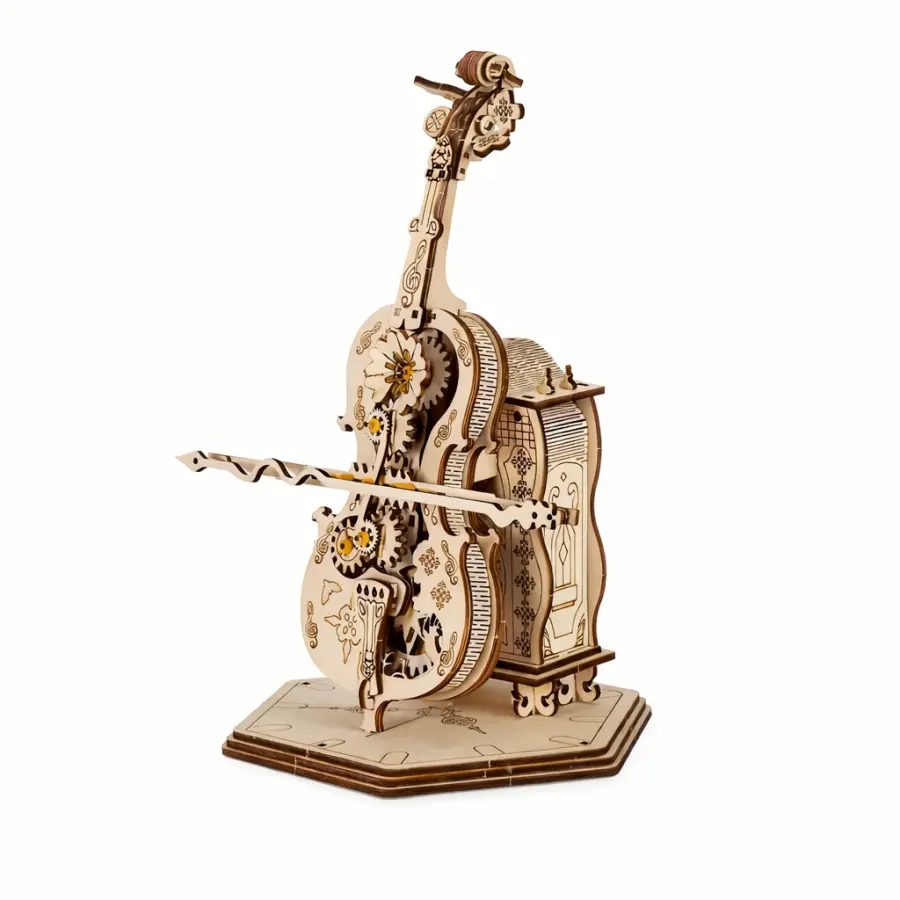
The 1:5 scale produces a finished model about 20 cm tall — roughly the size of a coffee mug. The scroll, f-holes, and bridge are laser-cut plywood pieces that snap together without glue, and the full kit is a self-contained mechanical puzzle that runs on a wind-up music box movement.
Bottom line: Match the build to the recipient, not the recipient to the build. If those three checks pass, the 3D Wooden Cello Puzzle Model Kit at $29.99 is the category pick — check the product page for the current price.
01. What the ROKR Magic Cello (AMK63) Actually Is and How It Works
The ROKR Magic Cello (model code AMK63) is a 199-piece laser-cut plywood mechanical music box built to look like a cello — not a playable instrument. The finished model stands roughly 20 cm tall and runs on an internal wind-up music box movement, not strings; the music comes from a metal comb and pinned cylinder hidden inside the body.
The “1:5 scale” label on retailer listings means the model is one-fifth the size of a real concert cello. A full-size cello is roughly 120 cm tall, so one-fifth works out to about 24 cm. The Robotime product page lists the AMK63 at 8.1 × 7.3 × 9.3 inches, which lines up with that ratio once you include the wooden base. For a buyer, the practical question is simpler than the math: will it fit on a desk, a piano top, or a standard bookshelf? At under 25 cm in every direction, the answer is yes for most display surfaces.
The mechanism is what separates this kit from decorative wooden cello models. The Robotime product page describes the AMK63 as using a mortise and tenon joint structure with precise laser cutting — each plywood piece slots into a matching recessed socket rather than being glued. That joint system is what holds the cello’s scroll, f-holes, bridge, and bow arm in place without adhesive. Wind the small key on the back and the internal music box movement plays a pre-set tune while a lever inside moves the bow across the strings, producing the “self-playing” effect that Robotime and The Gadgeteer both describe in their product copy.
The Gadgeteer review frames the kit as “a 3D wooden mechanical puzzle that results in a functional music box in the form of a self-playing cello,” which is the most accurate one-sentence definition of the category. A mechanical puzzle, in the standard sense, is any puzzle solved by manipulating its parts into a working configuration. The AMK63 fits that definition exactly: the build is the puzzle, and the reward at the end is a working music box, not a silent ornament.
A buyer should know that the visible cello details — scroll, f-holes, strings, bridge, bow — are decorative plywood pieces that complete the silhouette. The actual sound-producing parts are the metal comb and pinned cylinder inside the body, identical in principle to a stand-alone wind-up music box. The visible bow movement is a cam-and-lever linkage, not a real bow drawing across real strings, so the tune you hear is whatever the cylinder is pinned to play, not a cello note.
The 199-piece count matters for time budgeting. A 1:5 scale model with mortise and tenon joints and a working music box movement is not a 30-minute project. The 3D Wooden Cello Puzzle Model Kit at $29.99 sits in this same self-playing-music-box category and is the kit the rest of this guide builds toward — check the product page for the current piece count, dimensions, and tool list before you commit. For the cultural context of the instrument this kit replicates, see the cello’s 500-year Italian craftsmanship history.
02. How Hard Is the Build, and Where Do Owners Report Stalling
The ROKR Magic Cello is a 3-6 hour intermediate build that holds steady through most of the steps, then tightens noticeably at the final bow and bridge assembly. The build is a hands-on mechanical puzzle before it is a display piece, so expect a flat, clutter-free workspace, a pin tool or small flat-head screwdriver for tabs, and a clear plan to leave pieces on the original laser-cut boards until each step calls for them. If a buyer is comparing 199-piece kits, the deciding factor is not the total piece count — it is whether the final 10% of the build requires forced alignment.
Reddit owner threads match that pattern. In r/Hobbies, one builder summed up the experience by asking, “Did you also struggle with the final section around the end?” while showing their finished cello, and the r/Cello thread on the same model describes “some frustrating parts, but overall the instructions were really clear.” The Gadgeteer’s review of the AMK63 frames the kit as a genuine mechanical-puzzling challenge, not a decorative kit, and Robotime’s own product page lists it as a “difficult 3D wooden puzzle to assemble” alongside a display-ready finish. Taken together, the evidence points to one consistent bottleneck: the section where the bow arms slot over the cam linkage and the bridge seats above the f-holes.
This is the section where warped plywood becomes a real risk. A bowed arm pulled across an out-of-flat piece will spring back over time, so the practical check before starting is to lay every board on a flat surface and reject any piece that rocks. Buyers should also verify the cam lever seats flush against the music-box cylinder; if it sits crooked, the bow either jams or fails to clear the strings, and the music-box still plays but the signature bow-motion illusion is lost. The Gadgeteer review notes the model needs real mechanical-puzzling patience, not casual assembly, which is consistent with these final-stage failures.
A side-by-side with the Wooden Town 58-piece plywood cello makes the contrast explicit. That kit uses a pin-and-slot system with no music movement and finishes in well under two hours, so it is the correct fit for a first-time or younger builder, not the 199-piece mechanical-music-box category. The 3D Wooden Cello Puzzle Model Kit at $29.99 sits in the same self-playing music-box family, so the build-time and final-section warning apply; confirm plywood flatness, keep the workspace clear, and budget the full evening before opening the boards. For a phase-by-phase walkthrough of assembly at this difficulty tier, see the 57 essential 3D wooden puzzle assembly tips.
03. ROKR vs Hands Craft vs Wooden Town: Which Cello Puzzle Matches Which Buyer
The cello-puzzle category splits into three distinct products, and confusing them is the most common buyer mistake. ROKR makes a 199-piece wind-up music box (AMK63) with a mechanical cam that pulls a small bow across the strings. Hands Craft sells a separately branded “Magic Cello” with hidden mechanisms that move the bow back and forth. Wooden Town offers a 58-piece pin-and-slot plywood display with no music function at all. Matching the right kit to the right expectation is the single check that prevents a wasted $30–50.
| Feature to check | ROKR AMK63 | Hands Craft Magic Cello | Wooden Town 58-piece |
|---|---|---|---|
| Piece count | 199 pieces | Varies by listing | 58 pieces |
| Mechanism | Wind-up music box with cam-driven bow | Hidden mechanism moves the bow back and forth | Pin-and-slot static display |
| Music plays | Yes (wind-up cylinder) | Yes (mechanism-driven) | No |
| Assembly type | Mortise and tenon, laser-cut plywood | Laser-cut, glue-free | Pin-and-slot, laser-cut plywood |
| Build difficulty | High (per Gadgeteer and Reddit owners) | Moderate to high | Low (under 2 hours) |
| Best for | Hobbyist who wants the full mechanical-music-box challenge | Buyer who prioritizes the moving-bow illusion over build depth | First-timer, younger builder, or display-only purchase |
The brand confusion is real. Both ROKR and Hands Craft sell a “Magic Cello,” and listing photos show similarly shaped wooden instruments with miniature bows. The naming overlap pushes buyers into the wrong cart. The verifiable difference: ROKR’s AMK63 is a 199-piece mechanical music box whose whole body opens to show internal gears (Walmart listing confirms the see-through structure), while the Hands Craft version is described on its own product page as having hidden mechanisms that animate the bow. Neither spec sheet explains which is harder or louder; that is something to confirm on a video review before purchase.
The Wooden Town 58-piece is a different product category entirely. Its product page states the plywood parts “pop out cleanly and fit together precisely using a pin-and-slot system” and contains no music movement. It is a decorative desk model, not a mechanical puzzle in the Wikipedia-defined sense of a puzzle solved through manipulation of moving parts. A buyer who picks this expecting a music box will be disappointed; a buyer who picks it because they want a fast, giftable build will be satisfied.
The decision rule: pick ROKR AMK63 when the buyer wants the genuine wind-up music-box challenge and accepts a 3–6 hour build with the final-section difficulty documented in the prior section. Pick Hands Craft when the moving-bow illusion matters more than gear-count or scale. Pick Wooden Town when the recipient is a first-time builder, a younger hobbyist, or someone who simply wants a display piece with no moving parts.
04. Who Should Buy the ROKR Magic Cello and Who Should Skip It
The ROKR Magic Cello AMK63 is built for adult hobbyists who want a 3–6 hour build and a desk display, not for children or buyers expecting a playable instrument. The wind-up music box, 199 laser-cut plywood pieces, and tight final-section assembly all point to a single buyer profile. Anyone outside that profile should skip this kit or pick a different cello-shaped build.
Adult puzzler or music lover (buy). This is the audience the AMK63 is engineered for. A buyer who has finished at least one wooden model kit before will read the 199-piece count as a weekend project, not a marathon. The Gadgeteer describes the final product as a 3D wooden mechanical puzzle that results in a functional music box in the form of a self-playing cello. A music lover who understands the kit is decorative — not a playable instrument — will enjoy winding the scroll-driven mechanism on a desk. The f-holes, bow arm, and mortise-and-tenon joints are display details that reward the right recipient.

Gift buyer for a non-puzzler (skip or set expectations). This is the highest-risk profile and the one most listings ignore. A buyer who assumes the cello is a 30-minute stocking stuffer will be wrong. The r/Hobbies thread asked whether other builders also struggled with the final section — meaning the build is not casual, and the recipient will not be able to read a single evening of work. If the recipient has never opened a 3D wooden puzzle, the ROKR cello is the wrong first kit. A simpler mechanical model is a safer gift.

Parent buying for a child under 12 (skip). The retail age recommendation is 14+, and the final-section difficulty reported by adult builders on Reddit supports that. Tight mortise-and-tenon joints, a bow arm that can warp if forced, and a 199-piece count all exceed what a younger child can finish alone. A parent who wants a cello-shaped kit for a child should pick a simpler pin-and-slot plywood model with no moving parts — not the wind-up AMK63.
The three opening conditions map cleanly onto these profiles. Build tolerance: if the recipient needs the kit finished in under two hours, skip. Music expectations: if the buyer thinks the cello will play a real cello tune, skip. Intended recipient: if the recipient is under 12 or has never built a wooden model, skip the ROKR and choose a different kit. Buyers who want a structured pre-build routine can follow the universal 6-step method for 3D wooden puzzles to validate fit before opening the boards.
The ROKR Magic Cello AMK63 is the right buy when the recipient is an adult who accepts a 3–6 hour build, treats the wind-up movement as a desk curiosity rather than a musical instrument, and is patient enough to handle the final-section bow assembly. For that profile, the 3D Wooden Cello Puzzle Model Kit is the version that matches the spec — check the product page for the current price.
05. Music Quality, Display Longevity, and What to Check Before Checkout
The ROKR Magic Cello AMK63 plays a short mechanical tune from a wind-up music box movement — not a cello recording and not a recognizable classical piece. Display longevity depends on keeping the laser-cut plywood dry, out of direct sun, and away from dust; Reddit owners who built the kit in humid rooms report warped bow arms and loose joints within months. A buyer who treats the finished model as a desk curiosity will be satisfied; a buyer who wants real cello sound should look at an actual instrument.
What the music actually sounds like. The Gadgeteer review describes the AMK63 as “a fully functioning mechanical music box once you get it assembled,” but the sound is the thin, chime-like tone of a standard wind-up cylinder, not a bowed string. Owners on r/Cello confirm the same: the build quality is praised, the tune is treated as ambient. Anyone expecting a Bach suite will be disappointed. A buyer who prioritizes the music-box mechanism over the cello shape may prefer a different form factor with a larger movement. For a broader comparison of music-box kits across difficulty levels, see the 5 best wooden music box kits from beginner to pro.
Bow arm and plywood durability. Reddit owner reports and the Gadgeteer build notes both flag the same weak points. The bow arm is thin laser-cut plywood; if forced into position or stored in a humid room, it warps and the friction-fit joints loosen. The scroll and f-holes hold up well, but the bow and bridge are the failure points. Plywood is also dust-magnet — the see-through gear structure advertised in the Walmart listing collects lint in the open bays. Buyers who want a cleaner-looking display often retrofit a small acrylic cover, but that is an aftermarket step, not a kit feature.
Three pre-purchase checks. Run these before sealing the box at checkout or within the return window:
- Wind the music movement by hand before assembly. It should turn smoothly with a soft click per tooth. A gritty or skipping movement is a warranty issue, not a build issue.
- Inspect the bow arm and bridge pieces for warping. Lay them flat on a table; any visible curl means the plywood was stored poorly and will not seat cleanly during the final section.
- Photograph the parts layout. The 199 pieces come on laser-cut sheets; missing parts are easier to claim with a timestamped photo than after assembly has begun.
Storage and care. Once built, keep the AMK63 on a stable shelf away from windows, radiators, and bathrooms. Dust it with a soft brush every few weeks; avoid wet cloths, which swell the plywood grain. Wind the movement gently — forcing the key stalls the cylinder teeth, which is the most common long-term failure mode reported on hobby forums.
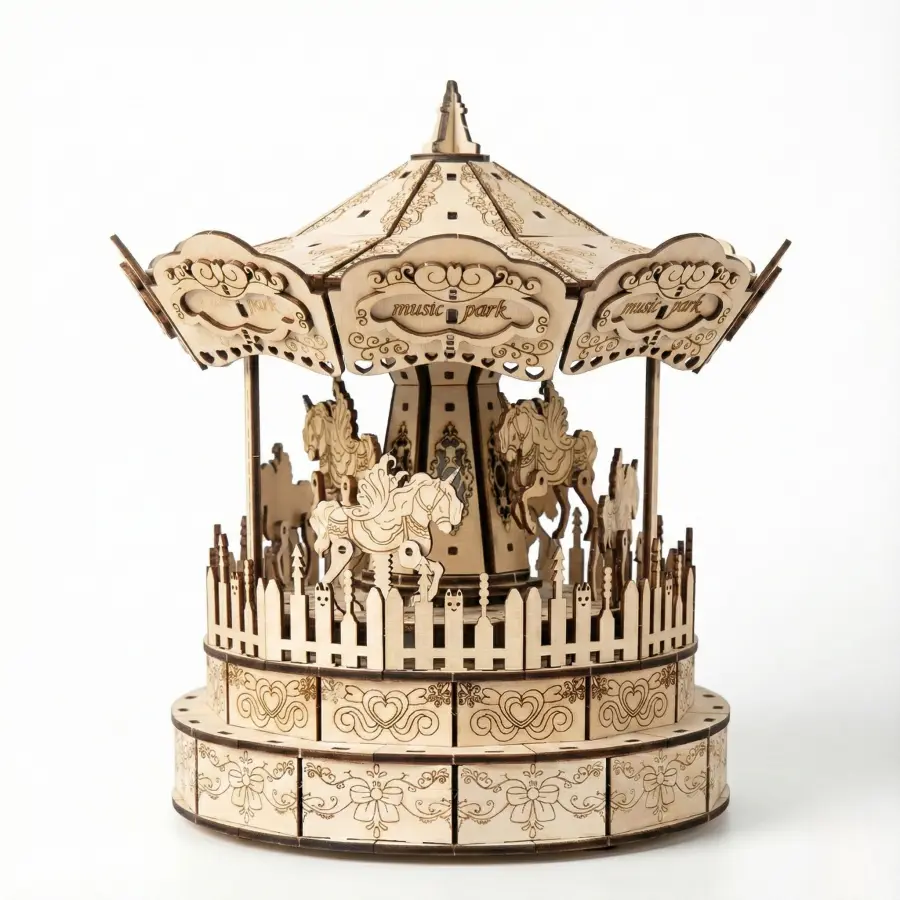
For a buyer who wants a different mechanical music box form factor with a more prominent movement, the carousel is a natural alternative in the same category.
The cello music box is worth buying only if the buyer accepts a wind-up chime as the audio payoff and commits to keeping the plywood dry. Run the three pre-purchase checks above before committing the build hours.
Frequently Asked Questions
These answers address the final questions that come up after the pre-purchase checks. Each maps to a verifiable condition the buyer can confirm on the product page or in the Reddit owner threads.
How hard is the ROKR Magic Cello for a first-time builder?
The Gadgeteer review calls it “quite the challenge,” and Robotime’s product page lists the kit as both a puzzle and a display piece. First-time builders should expect a multi-hour build and a final-section stall on the bow arm. Plan for patience, not speed.
Does the music actually sound like a cello?
No. The wind-up movement plays a short chime melody, similar to other mechanical music box puzzles. Reddit owners on r/Cello describe the finished build as “amazing” but stop short of comparing the sound to a real instrument. Treat the audio as a reward chime, not a performance.
What is the difference between ROKR and Hands Craft cellos?
Both are cello-shaped 3D wooden music box kits, and the similar naming causes buyer confusion. ROKR AMK63 specifies 199 pieces at 1:5 scale with mortise and tenon joints. Hands Craft sells a separate product with its own piece count and bow mechanism. Compare the current product page specs side by side before ordering.
How long does assembly take?
ROKR’s official listing does not publish a time estimate. The Gadgeteer review and Reddit owner threads converge on a careful build that takes most of an evening. Budget several hours, not a lunch break.
Is the finished cello fragile?
Plywood bow arms are the most reported weak point. Owners on r/Hobbies mention struggling with the final section that secures the bow and bridge. Keep the finished model dry, away from windows, and treat the bow as decorative, not as something to flex.
What tools are required?
None. The mortise and tenon joint system and laser-cut parts snap together without glue. A flat surface, good lighting, and tweezers for small gears are useful.
Is the ROKR cello a good gift for a non-puzzler?
Only if the recipient has finished at least one 100+ piece puzzle before. The Gadgeteer review frames it as a “challenge like no other,” which is fair warning — a first-time builder may stall at the bow assembly and abandon the build.
How does the ROKR cello compare to other wooden music box kits?
The AMK63 sits at the higher end of the mechanical-music-box category in both piece count and build difficulty.
For readers who want a lower-piece alternative with the same instrument shape, the Wooden Town 58-piece plywood cello is a static display build with no music box movement. If the build tolerance and the wind-up chime both pass the checks, the 3D Wooden Cello Puzzle Model Kit is the right place to commit the build hours — check the product page for the current price.
Where to Start
If the difficulty, mechanism, and use-case checks above match, start with 3D Wooden Cello Puzzle Model Kit. Check the current product page for the specifications that matter to your choice.
Sources and verification
- Product details and current specifications: Tea-Sip product page
Last updated: August 1, 2026