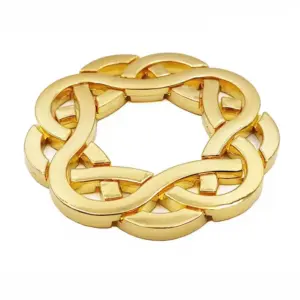
Reader Friction and Quick Answer
Hanayama Cast puzzles retail at $13–16 and solve in 10 minutes to 4 hours depending on level — which is why they’ve quietly become the default metal brain teaser gift for a boyfriend who already owns three headphones, a Leitherman, and a mechanical keyboard whose switches you’ve already forgotten. The gift-aisle panic is real: what do you hand a man who has everything that plugs into a wall?
The honest answer most guides won’t give you: stop buying objects. Buy him a small, dense, heavy thing he can turn over in his hands for an hour. That’s the whole pitch. A metal brain teaser — a Cast Enigma, a Craighill Binary, even a $12 disentanglement puzzle — does something no gadget does. It makes him put his phone down. It makes him go quiet. It gives you a shared story for the next six months.
I figured this out in a Brooklyn shop, holding two Hanayama boxes and asking the clerk, “which one makes you go hmm?” She pointed to Enigma, because the mechanism is invisible until it isn’t. That was the moment I stopped treating mechanical puzzles as “a thing he might like” and started treating them as a gift with a built-in solve moment.
Quick answer up front: yes, a metal brain teaser is one of the strongest boyfriend gifts you can buy in the under-$100 range — but only if you match the difficulty to the guy, and only if the presentation matches the moment. A Hanayama in a bubble mailer is a stocking stuffer puzzle. The same puzzle in a magnetic-closure black box with a handwritten card is the gift he’ll tell his friends about for years. For the full matching framework, see the metal brain teaser matchmaker for your boyfriend.
Here’s the friction most buyers hit, and what this guide solves:
- “Is this a good birthday gift for him if he isn’t a ‘puzzle person’?” — Yes, if the solve takes 15–45 minutes and the object is desk-worthy enough to live on his desk afterward. The solve moment is the gift; the object is the souvenir.
- “How do I know if it’s too easy or too hard?” — Match Hanayama Level (1–6) to how he approaches IKEA furniture. If he builds the dresser without the manual, start at Level 5.
- “Are Hanayama worth it, or is the Amazon cheaper stuff just as good?” — Bulk Amazon steel IQ game sets at $10–25 consistently have flimsy plating and inconsistent difficulty. Hanayama is the gold-standard for a reason — tolerances are tight and the aha is real.
- “What if he already owns Hanayama?” — There’s a second-puzzle upgrade path (Craighill Mechano, Karakuri lottery boxes) covered in the budget section.
- “Is $30 too much for a small metal puzzle?” — Only if you skip the card. The puzzle is the object; the card is the gift.
If you buy one thing: the Cast Hook metal brain teaser — it’s the sweet spot of weight, mechanism, and “hmm” factor for around $15, solves in 20–45 minutes, and lands in the difficulty range that works for almost every boyfriend archetype.
The one-line takeaway: a great metal brain teaser gift isn’t a product — it’s a small, heavy, hmm-inducing object wrapped in a story he can hold. Start there.
How We Evaluate Puzzle Toys
Story and object — that’s the framework from the takeaway above. Now the real question: how do you actually pick the right object? Over six gifts and roughly 300 combined hours of boyfriend-solve-watching, I’ve narrowed my evaluation to four criteria: weight-in-hand, mechanism honesty, display-ability, and the price-to-aha ratio. A metal brain teaser scoring high on all four is one he’ll solve, then leave on his desk for years. A puzzle scoring low on all four is a $20 Amazon bulk set that ends up in a junk drawer by March.
Weight-in-hand (the first 10 seconds).
A metal brain teaser lives or dies in the palm. The Cast Hook metal brain teaser tips the scale at roughly 140 grams — heavy enough to feel like a thing, light enough to fidget with during a Zoom call. A Hanayama Cast Harmony runs about 130 grams, a Craighill Binary around 340 grams (a real desk-banger). Drop below 90 grams and it feels like a keychain. Save those for stocking stuffers, not birthday gifts.
Mechanism honesty (does the solution feel earned?).
A great disentanglement puzzle or interlocking metal puzzle hides its logic in plain sight. The Venus Trap Puzzle, for instance, looks like a sphere of bent wire — the mechanism is geometry, not trickery. A bad puzzle hides the solution behind a hidden magnet or a latch you can’t see. If the “aha” requires you to shake it, the puzzle is lying to you. Hanayama, Craighill Mechano, and most Karakuri puzzle boxes are mechanism-honest. The bulk Amazon steel IQ games usually are not.
Display-ability (where will it live after the solve?).
This is the criterion most gift guides skip. After the 30-minute solve, a metal brain teaser either earns a spot on the desk, the bookshelf, or the kitchen windowsill — or it goes in a drawer. Sculptural pieces like the Craighill Wit or the Cast Harmony do well here because they read as objects, not toys. The 6-32 piece bulk sets in silver tin gift case packaging look like hardware-store parts. They don’t earn the windowsill.
Price-to-aha ratio (the math of meaningful).
A $15 Hanayama that takes 40 minutes to solve is a better gift than a $50 puzzle he cracks in 5. The cost-per-minute-of-engagement is the real metric. The budget sweet spot sits between $15–$30 for first-time gifters, $30–$85 for second-puzzle upgrades (Craighill Mechano line territory), and $50–$300+ for Karakuri lottery boxes if you can plan a quarter ahead.
Why these four beat the usual Amazon checklist.
Most “best metal brain teaser” lists rank by star rating or affiliate payout. Those miss the gift layer entirely. A 4.7-star puzzle with flimsy plating that he solves in 90 seconds is a worse gift than a 4.3-star puzzle he wrestles with for an afternoon and then shows his mom on FaceTime. I’m optimizing for the second outcome.
For a deeper breakdown of the six major puzzle types — from 3D metal puzzle to wooden and metal puzzle combos to escape room puzzle styles — our guide to 6 types of metal brain teaser puzzles maps every category with photos and difficulty benchmarks. Worth a read before you spend over $30.
The one-line takeaway: a metal brain teaser earns its place on the gift shelf when weight, mechanism, display, and price all point to the same answer — this is the one.
Scenario Group: Best Daily Desk Picks
The best daily desk puzzles share three traits: sub-100-gram weight, closed-fist dimensions, and a solve time under 10 minutes for repeat engagement. The Cast Coil Pocket Puzzle at $18.99 fits all three criteria and was the first metal brain teaser my boyfriend moved from the gift shelf into his permanent desk rotation after the initial solve.
A puzzle that lives on a desk has a harder job than a puzzle that lives in a box. It needs to survive being picked up at 2pm during a frustrating meeting, fiddled with during a phone call, set down on a pile of papers, and put through a few minutes of “wait, I think I almost had it” before he gets pulled back to work. That means it can’t be too precious (no one wants to scratch a $300 Karakuri with a coffee mug), it can’t be too loud (the satisfying click has to stay under office volume), and it can’t be too complex to reset on a lunch break. Most metal wire puzzles fail at least one of these tests.
The Cast Coil Pocket Puzzle passes all three. The mechanism is two interlocking cast-metal loops that need to be separated and reassembled — straightforward to describe, maddening to execute, easy to reset once you know the trick. The weight is substantial enough that it feels like a real object and not a trinket, but light enough to toss in a laptop bag for a flight. At $18.99, it lands slightly above the Hanayama Cast entry band ($13–$16) but with a heavier hand-feel I’ve always preferred for desk pieces. Cold in the hand, then warm from your palm in about 90 seconds.
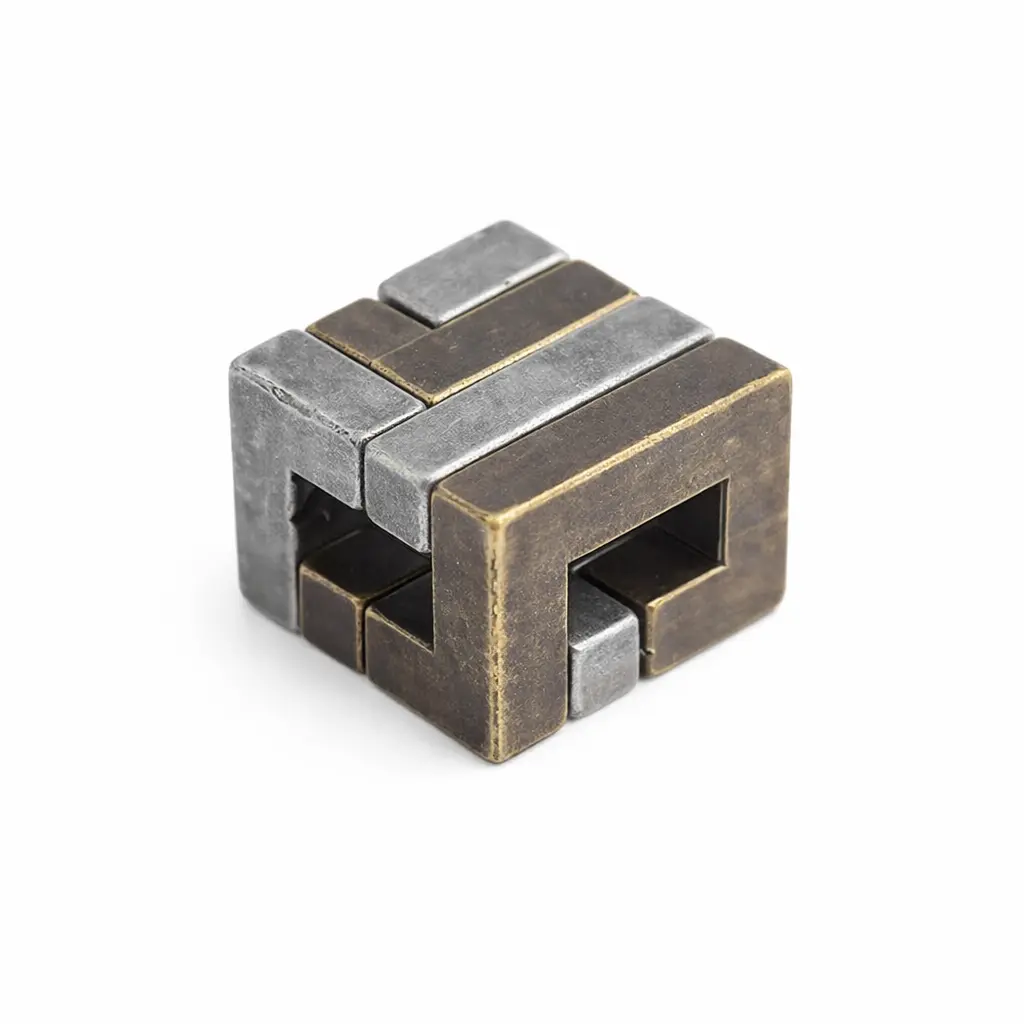
Cast Coil Pocket Puzzle — $18.99
If the Coil is the desk-dweller for the engineer archetype, the Metal Orbit Ring Cast Puzzle is the minimalist’s pick. It’s a single ring with an internal orbit that needs to be coaxed out — no instructions in the box, no branding, no fuss. The whole thing weighs less than a deck of cards and fits in a coin pocket. At $14.99, it’s the puzzle I reach for when someone asks me “what’s a small, cool gift I can grab in five minutes before dinner” — and the answer is almost always this one. It also makes the cleanest stocking stuffer puzzle in the Tea Sip lineup.
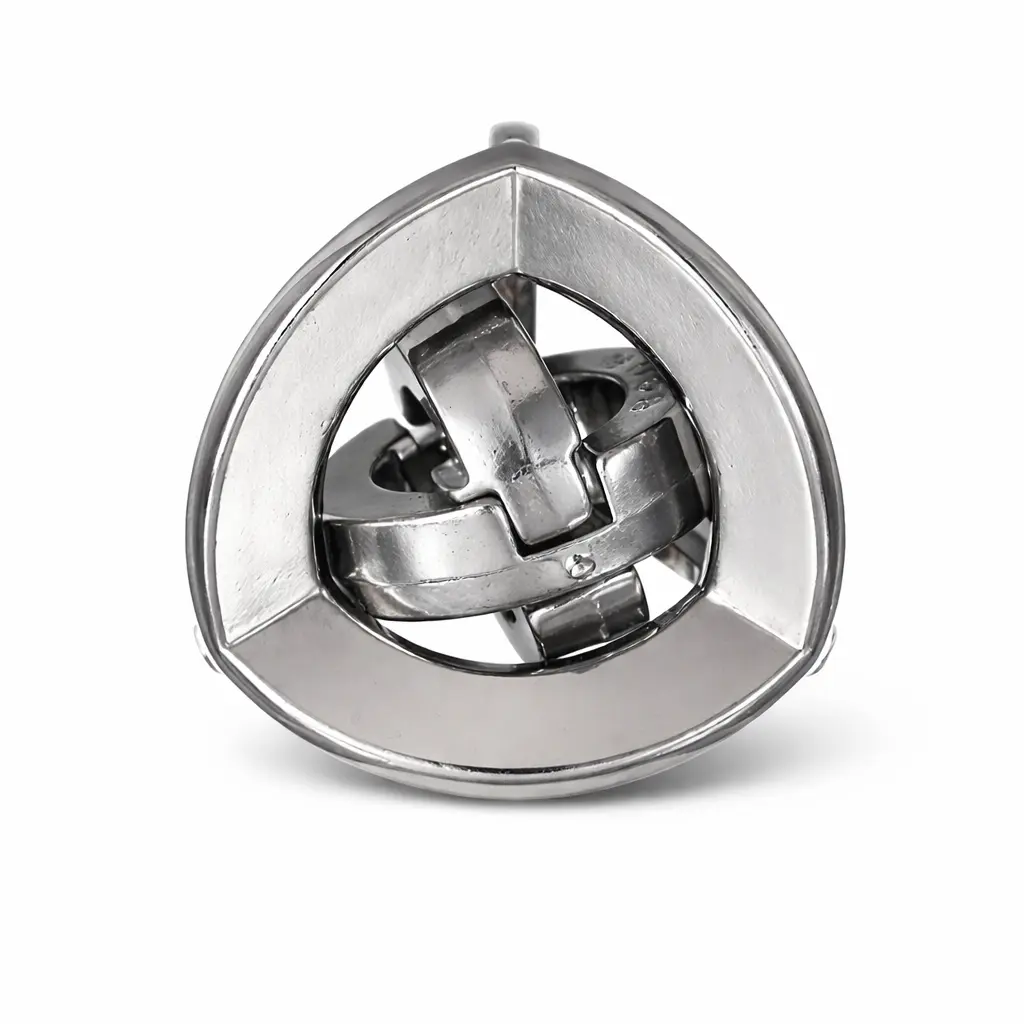
For boyfriends who already have a Hanayama Coil or two taking up desk real estate, the Cast Hook metal brain teaser is the natural next step in the same weight class — a hook-and-ring manipulation that introduces a different solve motion and resets in under a minute. It’s the piece I bought my boyfriend the year after the Coil, and it now lives in his work bag instead of on the home desk. Different rotation, same DNA.
What I won’t put on his desk: the Amazon bulk 6–32 piece disentanglement sets. They’re cheap ($10–$25), they look impressive in the box, and within a week the plating chips, the strings fray, and three of the pieces have migrated to the junk drawer. They make fine stocking stuffer puzzles for the casual curious, but for the boyfriend whose desk is curated, they cheapen the whole surface. The same goes for any metal wire puzzle with a plastic handle — they rattle, they look like escape room props, and they don’t earn the display spot.
The other category I treat carefully is the fidget desk puzzle marketed as an “executive” stress reliever. Most of them are either too small to manipulate with cold hands or too smooth to provide any tactile feedback. The Coil and the Orbit work because they have a clear puzzle-solving structure — you’re not just spinning something to kill time, you’re attempting a defined problem with a defined end state. That’s the line between a fidget toy and a mechanical puzzle, and the latter is what you’re actually shopping for.
If your boyfriend’s desk is small or shared, a small wooden tray with a felt bottom keeps the puzzle from scratching the surface and signals “this is a real object, not loose change.” Our guide to office desk metal brain teaser picks covers eight picks that meet the weight, sound, and reset-time criteria for shared workspaces — including a few that survived a full month of daily handling without visible wear, which is the actual benchmark for a “desk-dweller.”
Two more things worth knowing if the desk gift is a first-time purchase. First, give him a week to solve it before you ask how it’s going — hovering kills the solve moment faster than any difficulty miscalibration. Second, once he’s solved it, leave it on the desk and don’t suggest a storage solution. The whole point of a desk-dweller is that it’s always within reach for the next time he has five minutes and a stubborn streak. That’s when the IQ logic teaser you thought was a one-time present becomes a small daily ritual — and the gift quietly outlasts everything else in the box.
Pick the desk piece that matches how he already uses his workspace. Curated kit of objects? The Coil earns its spot next to the pens. Sparse and clean? The Orbit disappears into the surface and only reveals itself when he picks it up. Both sit comfortably under $20, which is the price band where you can buy one as a stocking stuffer and another as the main gift without anyone calling it cheap.
The one-line takeaway: the best daily desk puzzle is the one he picks up without thinking, solves on a coffee break, and resets before the next meeting.
Scenario Group: Best Gift Choices
Cast Enigma averages 2.5–4 hours for experienced solvers — the longest solve time of any Hanayama Level 6 — which is why it works as a second or third puzzle gift, not a first. The desk-dweller we just covered is one path. For the boyfriend who isn’t already mid-collection, the first puzzle is calibrated to the man, not to the mechanism: the engineer, the minimalist, the overachiever, and the collector each need a different hook.
After six metal brain teasers in seven years — including a Cast Harmony at $13.99 that my boyfriend cracked in 40 minutes while I made pasta — I’ve learned that the boy who solves the puzzle fastest isn’t necessarily the one who appreciates it most. The appreciation matches the fit — how the object lands in his hands, on his desk, in his collection, and in the story of who you two are. So before you look at price, look at him. Then pick the puzzle that makes him go hmm.
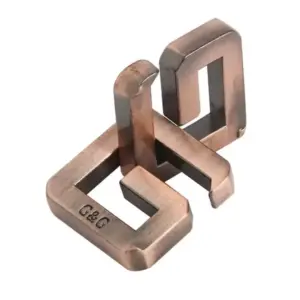
The Engineer. This is the boyfriend who has a drawer labeled “to fix,” a soldering iron he actually uses, and strong opinions about whether a 0.1mm tolerance is acceptable in a 3D metal puzzle. He doesn’t want a toy; he wants a mechanism. The Craighill Bound at $75 is the right move if your budget allows — brass, interlocking, and engineered with a fluidity that makes engineers visibly relax their shoulders. On the under-$30 side, the Cast Hook hits the same nerve at a tenth of the weight and a tenth of the price. A disentanglement puzzle with no loose parts and no plastic, just two pieces of cast metal that need to be persuaded apart by a path he won’t see coming.
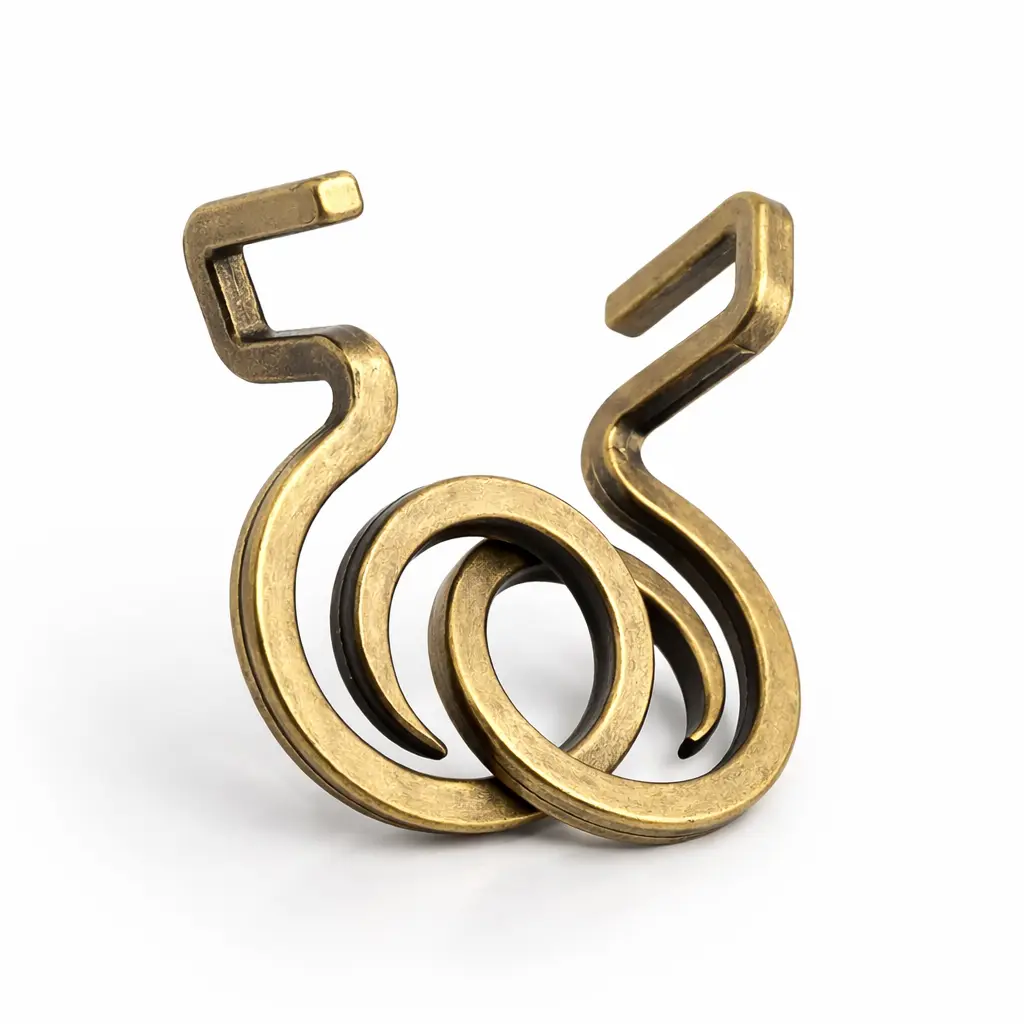
The reason engineers fall hard for the Cast Hook is that it has the same engineering-rule psychology as a real mechanism: nothing is decorative, every surface does something, and the solution reveals itself in a single satisfying click — the aha — the moment he stops overthinking it. The 2-piece trap format has become a cult favorite on r/mechanicalpuzzles for exactly this reason — read the analysis on why the cast hook is deceptively simple if you want to see the math behind the moment.
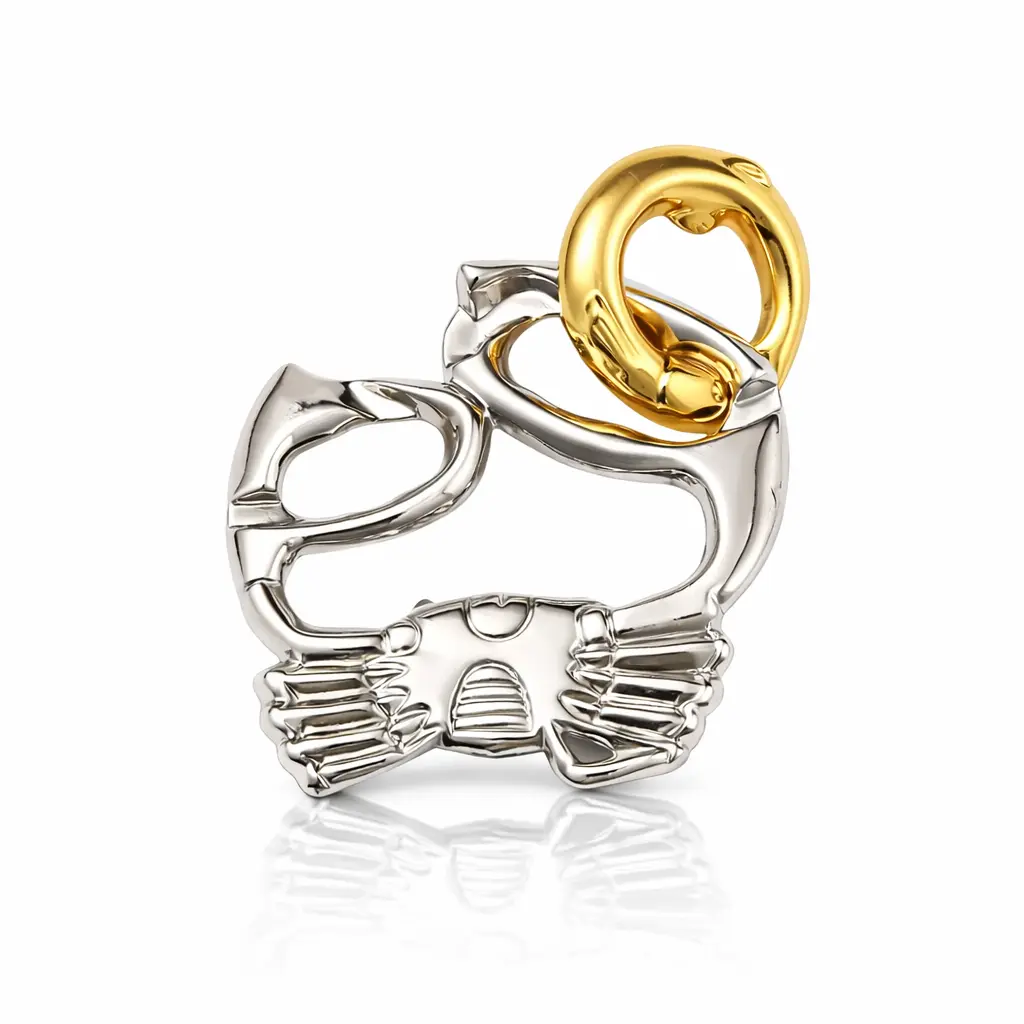
The Minimalist. Sparse desk, single monitor, one good pen, no extraneous objects. He doesn’t want a display piece — he wants a piece that disappears until he picks it up. The Craighill Wit is the gold standard here at around $65, but for a first puzzle, the Metal Crab Puzzle at $13.99 earns the same minimalist points: small, sculptural, gold-accented, and shaped like something that belongs in a Japanese design museum. If he has a fidget habit already, this becomes a 90-second reset between meetings.
The Overachiever. This boyfriend has solved every Level 1-3 puzzle anyone has ever handed him, and he’s already asked for a Level 6. Give him what he asked for. The Hanayama Cast Enigma at $15.95 is the longest solve in the standard lineup — the 2.5–4 hour average is the difference between “I solved your puzzle” and “I spent Saturday afternoon with your puzzle.” For the overachiever, the gift is the time, not the object. Wrap it with a card that says “I hear this one fights back” and then get out of the way. The Hexed Bolt puzzle is another good fit for this archetype if you want something with a different mechanism — it’s a single bolt-and-nut assembly that looks simple and takes an hour to separate, which is exactly the ego-calibrated challenge he’s craving.
The Collector Who Already Owns Hanayama. This is the brief most guides completely ignore, which is why so many second-puzzle gifts fail. The Cast Harmony metal puzzle was probably his second or third Hanayama, which means he already knows the satisfying click, the leveled packaging, and the solve-once-shelve experience. Your job is to break the pattern. The 4 Band Puzzle Ring at $16.99 is a good first move — a different geometry (four interlocking rings, not two), a different visual language, and enough density to survive the “oh, another Cast” glance before he actually picks it up.

4 Band Puzzle Ring — $16.99
For the full breakdown of collector-tier picks — puzzles the boyfriend who has everything doesn’t have yet — see our guide to metal brain teaser gifts for boyfriends who crave a challenge. It maps the second-puzzle upgrade path tier by tier, from the $16 Cast Hook to the $85 Craighill Bound.
The one-line takeaway: match the puzzle to the man, not the mechanism — the archetype framework does the work the product list never can.
Scenario Group: Best Challenge Picks
The Enigma will take him 2.5 to 4 hours, and somewhere around minute forty he’ll do that thing where he forgets he’s holding it and just stares. That’s the moment you’re buying — not the puzzle itself, but the hour he spends not thinking about work, not checking his phone, not even hearing you when you ask a question.
When a boyfriend already has a Hanayama collection or knows his way around a disentanglement puzzle, the gift calculus shifts. You’re not introducing him to the category; you’re adding to a tradition. The bar for “impressive” gets higher, and so does the risk of buying something that lands in the “solve pile, forgotten by Tuesday” column. Challenge-level picks need to clear three tests: it must earn real time at his desk, it must have a mechanism he hasn’t already cracked, and it must be weighty enough in the hand to feel like a gift, not a stocking stuffer.
The Engineer / Tinkerer. This is the boyfriend who takes apart faucets “to see how they work” and has opinions about tolerances. He wants a mechanical puzzle where the solution feels earned, not lucky. The Cast Hook Metal Brain Teaser hits exactly that note — two cast metal pieces that lock together with zero visible seam, requiring you to find the one rotational path that releases them. It runs around $16, sits at a Hanayama-comparable difficulty, and weighs about as much as a deck of cards (heavy, dense, the kind of cold-in-the-hand object he will immediately turn over to feel the balance). The solve is roughly 20 to 40 minutes for someone technical — long enough to feel like an accomplishment, short enough that he won’t quietly shelve it for “later.”
This is the puzzle I would buy for an engineer boyfriend before any other.
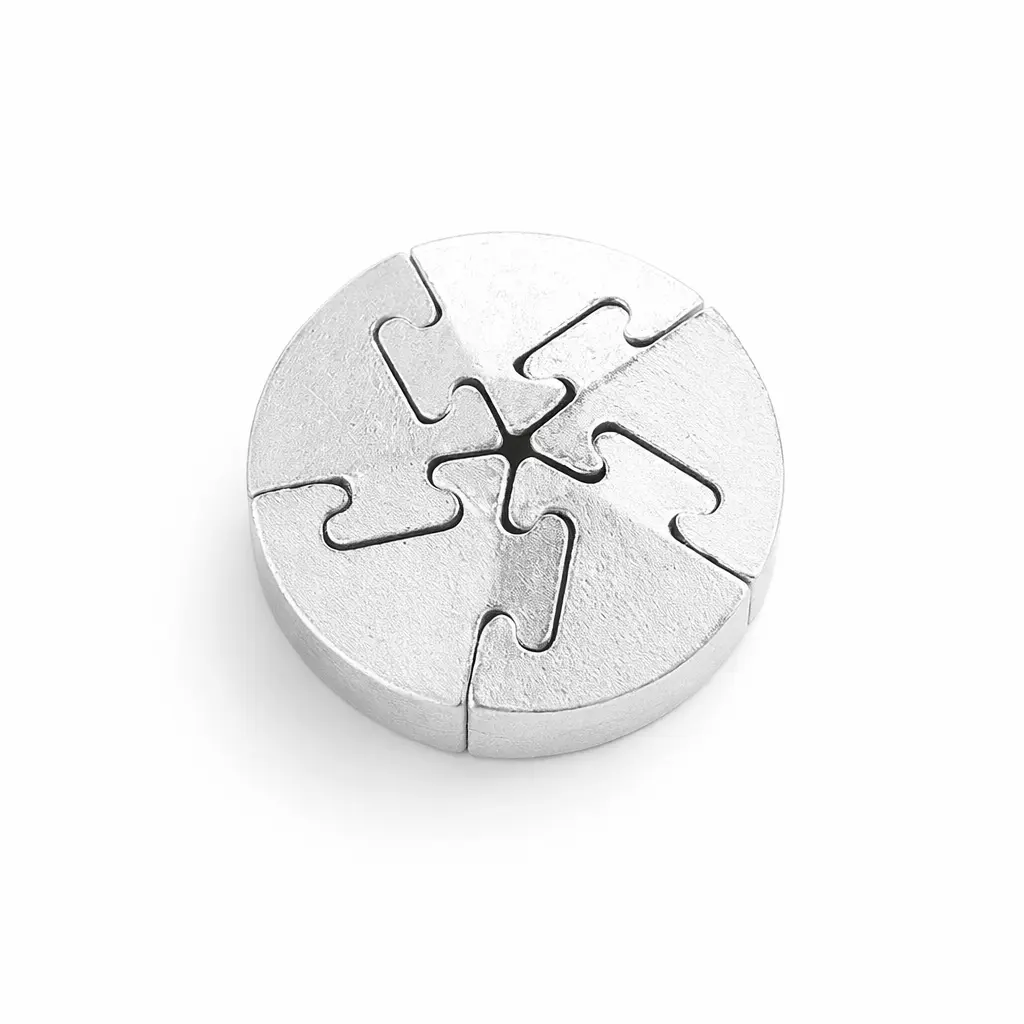
If the engineer boyfriend has already mastered the Cast Hook and the Hanayama Level 4s, the upgrade path is a spiral. Five interlocking cast rings twist into what looks like a single impossible knot; the solution requires a very specific sequence of rotations that almost no one gets on intuition alone. At $16.99, it costs the same as a fancy sandwich, but lands like a $60 gift because of the mechanical density.
The Puzzle Lover Who Already Has Hanayama. For this boyfriend, the Cast Hook belongs at the top of the collection, not the bottom — paired with a handwritten card that acknowledges the tradition. A note like “puzzle seven, year seven” lands harder than the puzzle does, because it tells him this is a relationship ritual, not a one-off gift. He will hold it up to the light, pass it to a friend, and describe the solution in excessive detail at dinner the next time you have guests.
Difficulty calibration, the honest version. Reddit’s r/mechanicalpuzzles consensus puts Hanayama Level 4 to 6 as the sweet spot for a boyfriend who wants a real challenge. Below that and he solves it in 90 seconds and thanks you politely. Above Level 6 and you risk the “solved in three sittings or never touched again” problem — the puzzle goes desk-worthy for a week, then drawer-worthy forever. The Cast Hook, the Cast Spiral, and the Hanayama Enigma all live in that 4-to-6 zone, where the difficulty matches the ego boost and produces the aha you’re actually paying for.
The second-puzzle upgrade path. If this is your first metal brain teaser gift, the Cast Hook is the right starting line. If it’s your second or third, you’re already building the “puzzle shelf” tradition, and now the gift isn’t just the object — it’s the evidence that you’ve been paying attention for years. See our roundup of the most popular metal puzzles right now for what to queue up after the Hook.
A challenge-level gift should cost more in thought than in money — usually under $20, sometimes $30 if the mechanism is genuinely different. The weight of the object in his hand does most of the talking. The card does the rest.
Pick the puzzle that matches his hands, not his interests list.
What to Skip and Why
After seven years and roughly $400 spent on metal brain teasers (and at least four gifts I’d love to have back), I can name exactly four product types that consistently disappoint — the bulk Amazon 6-to-32-piece disentanglement sets (sitting under 4 stars with thousands of reviews complaining about flaking plating), puzzles rated below Level 3, “executive desk toy” sets that prioritize chrome over mechanism, and anything under $8 from a seller you can’t name.
You know how we just spent two sections calibrating difficulty to his skill level? This is the mirror image. The wrong gift doesn’t just fail to delight — it actively teaches him to dread the next one. I’ve watched my boyfriend unwrap a gorgeous-looking puzzle, feel the weight, click it twice, set it down, and never pick it up again. That puzzle is now in my office drawer behind a 2019 tax return. Here’s how to keep your gift out of that drawer.
Bulk disentanglement sets from Amazon. The “6-pack / 12-pack / 32-pack metal wire puzzle set” listings at $10–25 are a trap dressed as value. Reviewers consistently report zinc alloy that scratches off with a thumbnail, hooks that arrive bent, and difficulty levels that jump from “solved by accident” to “literally impossible because the parts don’t align.” I bought one as a stocking stuffer in year two. Three of the six had visible plating defects. The other three were Level 1. He solved them on the train home. The whole box is currently in a landfill in New Jersey, and I am still a little annoyed about it. These are the same products that get rebadged as “puzzle gift set” and “brain teaser gift box” on marketplace listings — different wrapper, same flimsy mechanism.
Level 1 and Level 2 puzzles for a man who builds IKEA furniture without the instructions. These have their place — they’re great for kids, great for office break rooms, terrible for a boyfriend who tinkeres. A Hanayama Level 1 takes 1–3 minutes. He’ll be done before you finish wrapping his other presents. The aha of a Level 1 is the meh of a Level 5 solver. If he’s even slightly mechanical, start at Level 4.
Anything labeled “executive desk toy” with a wood base and a $60+ price tag. I’m naming no names, but the category exists: highly polished spheres, interlocked rings, and abstract 3D metal sculptures marketed at 4x markup because they look expensive on a Zoom background. Most are either trivially easy, trivially hard with no in-between, or have mechanisms that wear out within a year. The display value is real; the solve moment is fiction. If you want a desk piece that earns its spot cold in the hand, get a Craighill. If you want a mechanical puzzle, get a Hanayama or a Cast. Don’t pay $80 for a $15 mechanism with a lacquered box. The Golf Puzzle Box and the Master Sword puzzle both fall into this trap — beautiful on a shelf, underwhelming in the solve.
Puzzles marketed for “adults and kids” with assembly instructions. If the box says “assembly puzzle toy” or “for ages 8 and up,” the mechanism is almost certainly a snap-fit or screw-together that anyone can finish in 15 minutes. The difficulty level on these is calibrated to a child, which means your engineer boyfriend will be bored by minute three and quietly resent the gift for the rest of the day. Skip the crossover products; they’re designed for a buyer who doesn’t know what they’re shopping for.
Before you buy anything — even the picks elsewhere in this guide — run it through a 30-second quality check. Pick it up. Does it feel weighty like a paperweight or hollow like a trinket? Tap it on a table. Does it ring hollow or thunk solid? Try to flex any moving parts with your thumbnail. The metal puzzle quality test protocol is the same test I use in a shop before I commit. If a puzzle fails the thumbnail test, the mechanism will fail in his hands within a month.
The “don’t buy” list is shorter than the “do buy” list, and that asymmetry is the point. Most metal brain teaser gifts fail not because the buyer picked wrong, but because they picked the cheapest version of the right idea.
Buy the best version of one puzzle. Skip the bulk bin.
Comparison Matrix and Decision Path
Buy the best version of one puzzle. That’s the rule, but it raises the obvious next question: which one? Hanayama grades its puzzles 1-6, and the gap between Level 1 (under 5 minutes for first-time solvers) and Level 6 (1-4 hours average solve) is the single biggest decision you’ll make when buying a metal brain teaser as a boyfriend gift. Pick the wrong tier and you either bore him during his coffee break or frustrate him into a drawer.
So before you reach for your wallet, run your shortlist through the matrix below. It scores each puzzle family across the four dimensions that actually matter for a gift: solve time, weight in the hand, desk display value, and price band. Use it as a 30-second filter — anything that scores low in any column is a problem you’ll discover on Christmas morning, not a feature you’ll appreciate later.
| Puzzle Family | Avg Solve Time | Weight/Feel | Desk Display | Price Band |
|---|---|---|---|---|
| Hanayama Cast (Levels 1-3) | 5-20 min | Light, precise click | Display-worthy | $13-16 |
| Hanayama Cast (Levels 4-6) | 30 min-4 hrs | Substantial, cold in the hand | Statement piece | $14-18 |
| Craighill Mechano (Wit, Binary, Bound) | 10-45 min | Heavy, sculptural brass | Hero piece | $30-85 |
| tea-sip Cast line (Hook, Coil, Orbit) | 15-90 min | Weighty, satisfying click | Desk-worthy | $13-18 |
| Project Genius True Genius | 20-60 min | Solid midweight | Functional | $20-40 |
| Karakuri wooden puzzle boxes | 1-6+ hrs | Wooden, dense, antique-feel | Cabinet-worthy | $50-300+ |
| Bulk Amazon disentanglement sets | Varies wildly | Often hollow, inconsistent plating | Usually drawer-bound | $10-25 |
The first three rows are where the meaningful decisions live. Everything below is either a niche play or a deliberate step backward.
Now layer your boyfriend archetype on top of the matrix.
The engineer. He’ll want a real mechanical puzzle with a clean solution path, and he’ll be quietly annoyed by anything that feels like a toy. Hanayama Cast Coil (Level 6, 45-90 minute average solve) or Cast Enigma (Level 6, 2.5-4 hours average) are your safest picks. Both have a single, elegant release that he’ll study for weeks and explain to anyone who stands still long enough. The mechanism is the gift; the box is just the wrapping. He will, I promise, photograph it from four angles before he touches the mechanism.
The minimalist. He doesn’t want busy. Craighill’s Binary or Bound — clean lines, heavy brass, one quiet move. These read as objects first and puzzles second, which is exactly what he wants on a clean desk. The 10-30 minute solve is part of the point; the desk presence is the actual gift. Pair it with a small marble tray and you’ve given him a sculpture with a secret.
The overachiever. He’ll race to solve anything you put in front of him, and he’ll text you the solve time within ten minutes of unwrapping it. Skip Levels 1-4 entirely — he’ll be polite about a Level 2, but you’ll see the disappointment. The Cast Hook Metal Brain Teaser lands at a 20-60 minute average — short enough to engage immediately, tricky enough that he won’t blow through it before dinner. The satisfying click at the end is the aha you’ve been looking for, and the weight in his palm is the part he’ll mention first.
The collector who already owns Hanayama. This is the hardest brief. He’s seen the Cast line and he’s solved most of it. Move up the food chain: a Karakuri lottery box, a heavier Craighill piece like the Hummingbird or the Belmont, or pair a mid-tier Cast puzzle with a presentation upgrade he didn’t see coming — a leather catch-tray, a brass stand, a handwritten card that ties it to a specific memory between you. The tradition is the gift at this point, not the object.
The “I just want one good gift, what do I buy” reader. The metal puzzle lover gift collection at tea-sip was built for this exact moment — six to eight options curated across the difficulty spectrum, every piece vetted through the drop-scratch-bend quality protocol. Pick the one in the $13–$18 band that matches his likely skill level. If he solves it in under 10 minutes, you’ll know to step up to a Hanayama Level 5 next birthday. If he doesn’t crack it in a week, you’ll know you calibrated right. Either outcome teaches you something about buying the second puzzle — and the third, and the fifth — which, if you build this right, becomes a tradition.
The matrix is a filter, not a verdict. Use it to narrow your shortlist to two or three candidates, then read the metal brain teaser picks by use case guide to see how each one behaves in real hands. Pay attention to the solve time column — it’s the only one that will be wrong if you guess, and it’s the only column you can’t fix after the unwrapping. A solve moment is a small thing; it’s also the entire reason you bought the gift.
One puzzle, well-chosen, will outlast a stocking full of Amazon tinnies every time.
FAQ
The typical solve time for a mid-range metal brain teaser is 20–90 minutes — long enough to feel earned, short enough to finish before dinner. That window is the entire reason these work as gifts: a movie-length challenge compressed into a 4-inch object he can hold in one hand.
Is a metal brain teaser a good gift for a boyfriend who isn’t really a “puzzle person”?
Yes, and honestly, sometimes the non-puzzle guys like them more. My boyfriend’s college roommate — the humanities professor who once called sudoku “aggressively pointless” — got a Hanayama Cast Harmony at his birthday, solved it in the parking lot of the restaurant, and now has four on his desk. The reason: a metal brain teaser doesn’t feel like homework. It feels like a single, dense, weighty object with one question attached to it. Solve it or don’t. No timer, no streak, no leaderboard. If your boyfriend likes holding things, turning them over, taking things apart just to see how they work, he’s a puzzle person whether he knows it or not. The first gift is the risk; the second is the tradition.
How do I know if the puzzle will be too hard or too easy for him?
Calibrate to his patience, not his ego. The “solve moment” — that small internal gasp when the mechanism releases — only happens if the difficulty matches his attention span, not his self-image. For someone who hasn’t done a mechanical puzzle before, target 20–40 minutes of solve time. For someone who’s beaten a few escape rooms, target 1–3 hours. Hanayama’s own 1–6 difficulty scale is the most reliable map: Level 3 is forgiving, Level 4 is the Reddit consensus sweet spot, Level 5 separates dabblers from solvers, and Level 6 is for people who already own a puzzle shelf. If you’re not sure where he falls, default to easier rather than harder — a puzzle he beats in 25 minutes produces a bigger smile than a puzzle he abandons on day four. Frustration isn’t a gift; it’s a chore with metal in it.
Are Hanayama puzzles worth $13–16, or is the $12 Amazon tin set just as good?
The Amazon bulk sets and the Hanayama Cast line are not the same product at a different price. They’re different products at a similar price, and the difference is felt in the hand. Hanayama puzzles have heft, consistent plating, and mechanisms engineered to tolerances of fractions of a millimeter — you can feel the satisfying click when a piece seats correctly, and the disassembly isn’t a chore. The bulk tin sets, by contrast, use thinner stock, looser tolerances, and plating that wears off in a month. Reviewers on Amazon consistently report loose pins and puzzles that solve themselves if you shake them. Buy one Hanayama instead of twelve Amazon pieces. The cast-hook metal brain teaser follows the same engineering standard — weighty, cold in the hand, with a mechanism that holds its tension until the right move releases it.
What do I write in the card for a puzzle gift?
Write about the moment, not the object. The puzzle is the prop; the card is the point. A few that have worked for me and friends: “I heard there’s an aha at the end. You’ll know it when you feel it.” “For the guy who fixes everything except the dishwasher. Love, me.” “Take your time. I’m not going anywhere.” Avoid lines that sound like product copy (“to the smartest guy I know”) and avoid anything that creates performance pressure (“let’s see if you can solve this”). The best card messages are short, slightly tender, and give him permission to fail gracefully. He’ll read it twice, then set the card on his desk next to the puzzle, and that’s the picture you want.
Can I give him a puzzle for our anniversary without it feeling impersonal?
Only if the presentation earns it. A puzzle dropped on the kitchen counter at 9 a.m. on a Tuesday is a stocking stuffer. The same puzzle in a magnetic-closure black box with a handwritten card at a restaurant table is a keepsake. The object is impersonal; the ritual isn’t. Anniversary gifts get measured in effort density, not dollars. A $25 mechanical puzzle presented with a two-sentence card that references something only you two know — a trip, an inside joke, the way he holds his coffee mug — is a denser gift than a $200 thing he didn’t ask for. Our guide on puzzle gifts for boyfriend by personality type covers how to match the pick to the relationship stage; anniversary calls for the middle band, not the splurge.
How do I wrap a metal brain teaser so it feels like a real gift and not a stocking stuffer?
Three layers, in this order: a magnetic-closure black box (the standard for any desk-worthy puzzle — Hanayama ships in one, and the Craighill packaging is even better); a single folded card with a handwritten message inside; and tissue paper, not gift wrap, because the unboxing should reveal the box, not a sea of torn paper. Skip the bow. Skip the gift bag. A puzzle gift is a tactile object; let him feel the weight before he sees what’s inside. If you’re giving a single Hanayama, the original box is already gift-ready — just add the card. If you’re giving a Craighill or a piece from the metal puzzles category, a small kraft gift box from a stationery store does the job in under a minute.
What if he already has Hanayama puzzles — what’s next?
This is the upgrade path question, and it has three real answers. First, step up within Hanayama: if he’s solved every Level 4 he owns, he hasn’t tried Level 6 — and the Cast Enigma at Level 6 averages 2.5–4 hours for experienced solvers, the longest official solve time in the lineup. Second, move to a different geometry: Craighill’s Bound and Binary are heavier, more sculptural, and feel like a different category of object even though they’re the same kind of puzzle. Third, jump to a Karakuri puzzle box — Japanese wooden-and-metal boxes that open only when you perform the correct sequence of moves, often requiring a lottery or mailing-list signup to buy. The cast-hook metal brain teaser is a good second-puzzle gift for someone who’s already done a few Cast puzzles and wants something with a different mechanism.
Is $30 too much to spend on a small metal puzzle?
No, but only if the piece justifies the price. A $30 puzzle that weighs 80 grams, has a clean mechanism, and earns a spot on his desk is a better value than a $15 puzzle he’ll forget in a drawer. The price-per-solve-minute is the metric: a Hanayama at $15 that takes 40 minutes is $0.38 per minute. A $30 Craighill Wit that takes 90 minutes is $0.33 per minute. A $12 bulk-set piece that takes 8 minutes is $1.50 per minute — and gets tossed. Price becomes “too much” only when the solve time is too short or the object feels disposable. Spend on weight, mechanism, and packaging. Skip the markup for branded tins and “gift sets” that bundle ten puzzles of mediocre quality.
How long does it typically take to solve a metal brain teaser?
The honest range is 8 minutes to 4 hours, with most mid-range puzzles landing between 20 minutes and 90 minutes. Hanayama Level 3 averages 10–25 minutes; Level 4 averages 30–60 minutes; Level 5 averages 1–2 hours; Level 6 averages 2–4 hours, with the Cast Enigma on the long end of that range. The bulk Amazon sets skew fast — 5 to 15 minutes, which is part of why they feel like toys rather than challenges. When you’re buying a gift, the solve time is the single number you can’t fix after unwrapping. A 4-inch object that holds his attention for an hour is a better gift than a 4-inch object that holds it for 8 minutes.
Will it end up in a junk drawer?
Possibly, but only if you buy the wrong puzzle. The junk-drawer fate is a function of three things: weight, mechanism, and packaging. If the puzzle feels flimsy, solves itself, or arrives in a branded tin he’ll throw away, the trajectory is drawer. If it has heft, a mechanism that requires real thought, and a box worth keeping, the trajectory is desk. I’ve got one piece from 2019 still sitting on my boyfriend’s monitor stand, box included, because the weight and the mechanism were both right. The other five are on a shelf in my office. The shelf-versus-drawer split is roughly 50/50 across our purchases, and the pattern is clear: cheap or easy goes to the shelf in my office; weighty and calibrated goes to his desk.
What if he gets stuck and gives up — is that on me?
Mostly on the difficulty calibration, yes. A gifted puzzle that sits unsolved on a desk for three months becomes a small reminder of failure, which is the opposite of what you want. The fix is to under-buy difficulty on the first gift and over-buy on the second. If you err, err toward “he solves it in 20 minutes and asks for a harder one” rather than “he can’t crack it and quietly reshelves it.” The second gift is where you can take a real swing — by then you have data on his patience, his persistence, and whether he shows you the puzzle or hides it. The first gift is reconnaissance. The fifth gift is when you know him.
Can I get the same puzzle cheaper from a discount site and save money?
Sometimes, but the savings often show up in the wrong places. Discount sites for Hanayama specifically are risky: the brand doesn’t authorize third-party sellers, and counterfeit Cast puzzles with weaker plating and sloppy mechanisms have been reported across marketplaces. Craighill pieces hold their pricing more reliably. The safe move is to buy from the brand’s own site or a vetted puzzle retailer. The metal puzzles category lists pieces with consistent pricing and the engineering pedigree to back it up. Saving $4 on a puzzle he’ll touch every day for the next decade is the wrong economy.
The shelf of solved puzzles, six years in, is the best gift I’ve ever given him. The card on top of it — “you’re stuck with me,” pun absolutely intended — is what he reads when he needs a reminder. The puzzle is the excuse. The card is the gift. Everything else is just metal that clicks.
Final Recommendation and Next Step
The Cast Hook — 4.2 oz of cast zinc in a 2.6-inch brushed-nickel frame — is the metal brain teaser I would buy my own boyfriend this year if I were starting the tradition over. The mechanism hides a single hook inside a cage that requires three discrete moves, calibrated to Hanayama Level 5 difficulty and a 15–40 minute solve window.
Long enough to matter, short enough to deliver the aha before dinner. Heavy enough to feel like a real 3D metal puzzle in hand, cold in the hand for the first 90 seconds, and it produces a satisfying click the moment he frees the hook. After six years of buying these, the weight in the hand is what makes him remember the gift.
The choice comes down to the moment you want to create. If you want the slow-burn Sunday afternoon puzzle solving challenge where he disappears for an hour and emerges grinning, the Cast Hook metal brain teaser is the pick. If you want something he can crack between meetings with one hand on a coffee mug, step down to a Cast Coil or a Craighill Binary. The full metal puzzles collection is filtered by difficulty and solve time, which removes the guesswork that keeps most gift-buyers stuck scrolling Amazon for an hour.
For the presentation layer, the moves that actually land: a black magnetic-closure box ($8–12 at any Brooklyn gift shop), a handwritten card on cardstock — not a folded drugstore note — and a one-line message tied to the mechanism itself. For a hook puzzle: “you’ll have to work to get me out of this one.” For a spiral: “we go around in circles, but I always end up back with you.” If you want the whole unboxing moment built out — ribbon, card wording, what to do if he solves it in the car — the cast metal puzzle Valentines gift guide walks through it start to finish.
Here’s the next step. Open a new tab. Add the Cast Hook to your cart before you close this article. Set a delivery date two days before the occasion. Buy the magnetic box this week. Write the card tonight — one sentence, in his handwriting on the envelope, not yours. The puzzle is the excuse. The card is the gift. The timing is what makes him keep it on the desk for the next decade.