
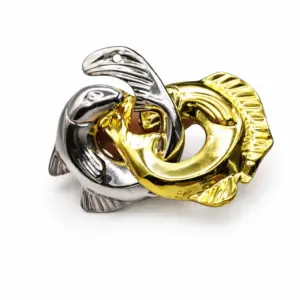
Gold Fish & Silver Coral Reef Cast Metal Puzzle — Free the Fish Two-Piece Brain Teaser
A gold fish is trapped inside a silver coral reef. Your hands say pull. The puzzle says no.
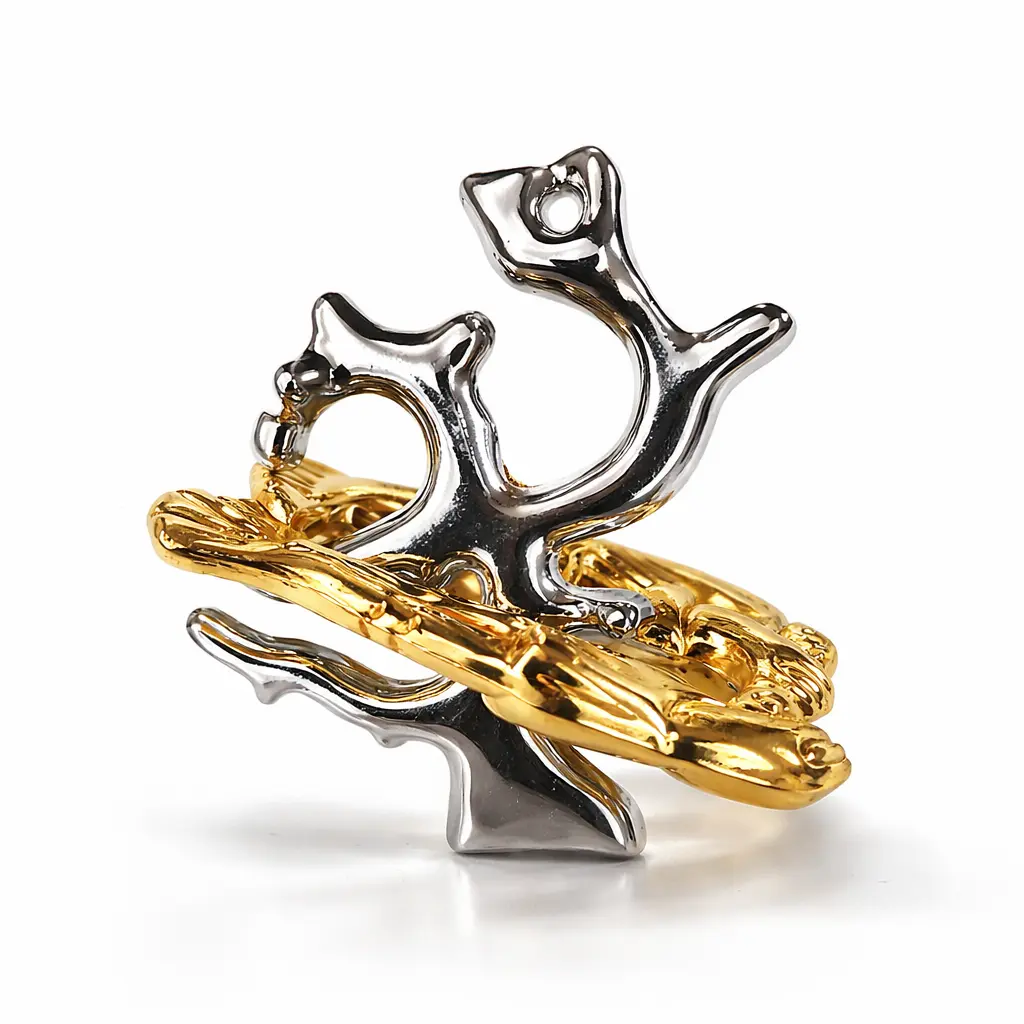
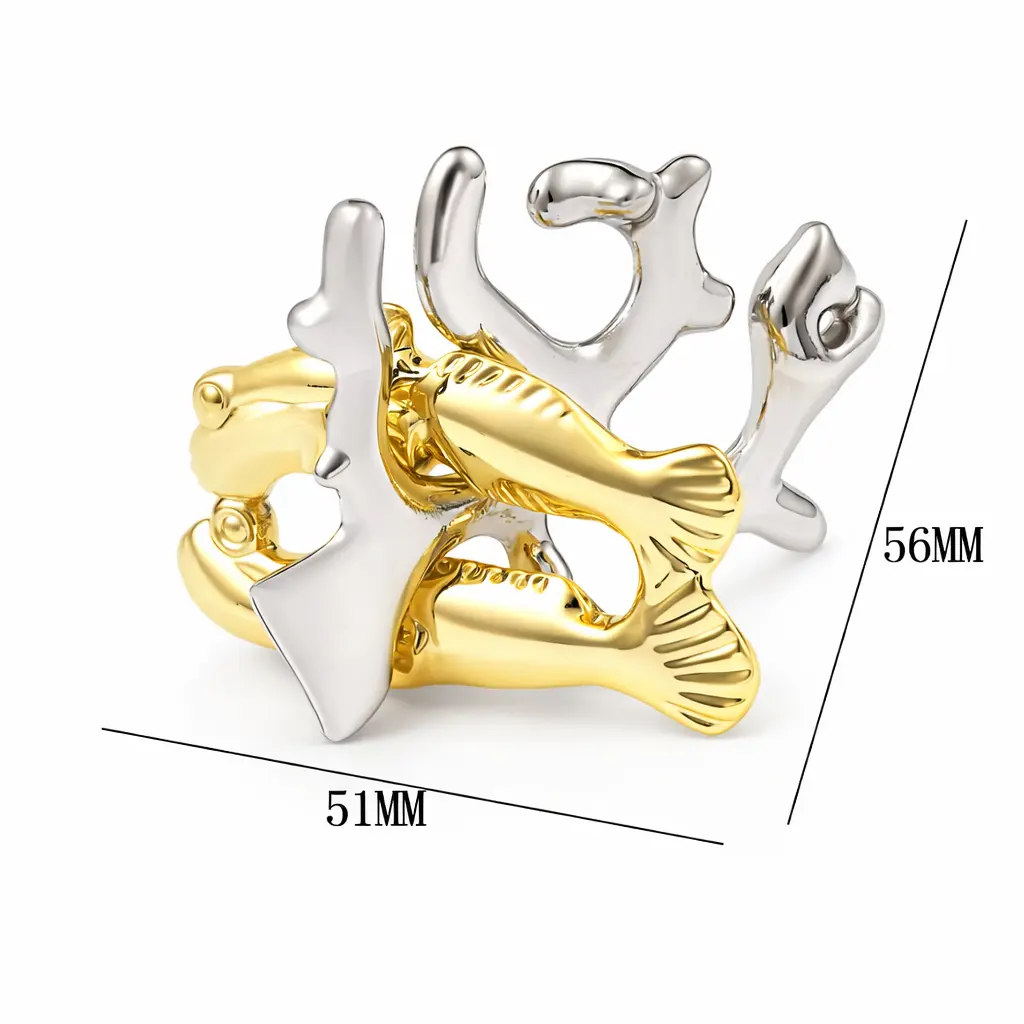
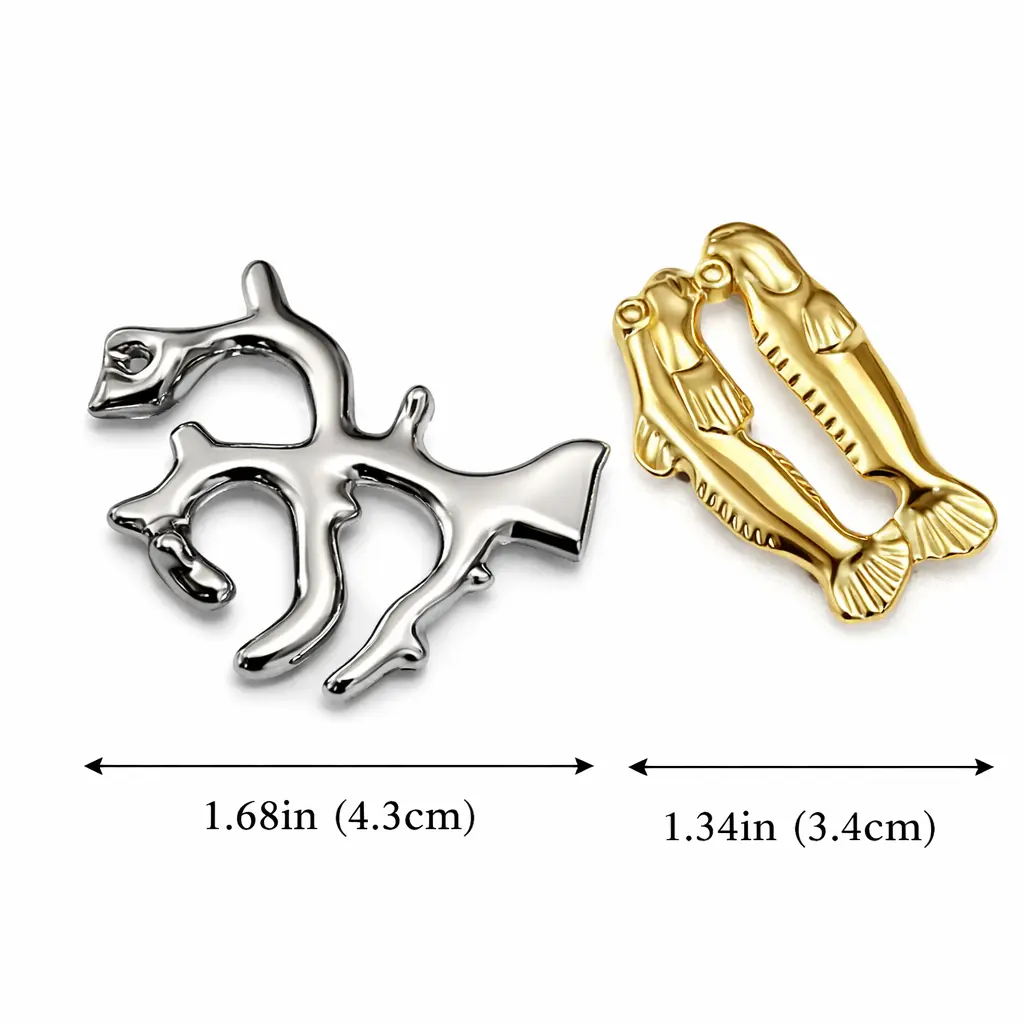
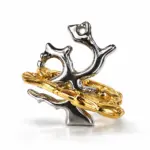
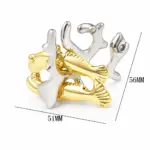
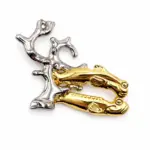
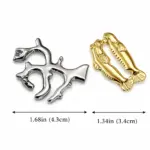
This is a two-piece cast metal disentanglement brain teaser. The gold piece is a fish — fins, scales, tail — locked inside a silver coral form with branching arms that block every obvious exit. The goal is direct: find the path that frees the fish, then reverse it to lock the fish back in. At approximately 51 × 56 mm, the whole thing sits in your palm and weighs enough to feel real.
What makes this puzzle interesting is the mismatch between how simple it looks and how stubbornly it resists force. The coral’s arms appear to have wide openings. The fish looks like it should slide right out. It does not. The channels only align at specific angles, and finding those angles requires slow rotation and careful observation — not grip strength or speed.
The one who excels at winning does not engage through force.
If you have worked with other cast metal brain teasers before, you know the category. If this is your first, you are starting with a clear premise: one fish, one reef, one way out.
What you are actually looking at
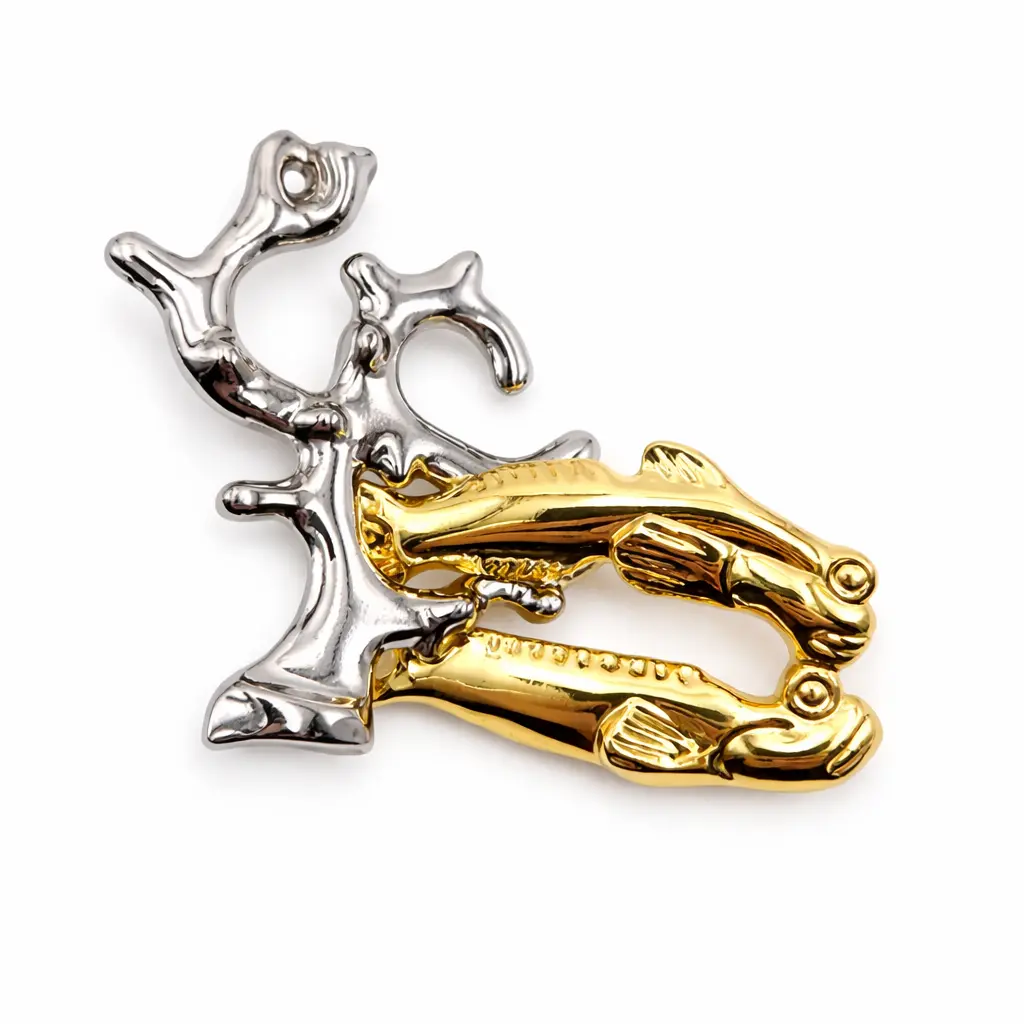
The gold piece is a fish. Not an abstract shape, not a geometric form — a fish with visible scale texture, defined fins, and a curved tail. Under light, the gold finish shifts from warm amber to bright yellow depending on angle. Running your thumb across the scales gives light tactile feedback.
The silver piece is a coral reef. It branches outward in organic, uneven arms — three or four protrusions that curve around the fish and create what looks like a cage. The silver finish is cooler, smoother, and reflects light differently from the gold. That contrast matters: when you are rotating the puzzle, the color boundary between fish and coral helps you track which piece is moving and which is standing still.
Together, assembled, they read as a small marine sculpture. The fish appears caught mid-swim, surrounded by reef. People who see it on a desk do not immediately recognize it as a puzzle. They pick it up, try one twist, realize the fish does not come free, and the conversation starts.
Polished cast metal at this size means fingerprints show. That is the tradeoff for a reflective finish. A soft cloth after handling keeps it clean. If daily fingerprint maintenance sounds annoying, know that matte-finish puzzles exist — but they do not catch light the way this one does.
How the mechanism works (no spoilers)
The fish is nested inside the coral’s branches. To free it, you need to find the sequence of rotations and slides that navigates the fish body through the coral’s openings. Only one path works. Everything else dead-ends.
This is not a trick puzzle with a hidden button or spring. It is pure spatial reasoning. You rotate, test an angle, observe what moves and what blocks, then adjust. The coral’s arms create gates — narrow passages that only accept the fish at a specific orientation. If a movement feels jammed, you are not on the right track. Back up and try a different angle.
One useful parallel: think of it as turning a key in a lock you have never seen before. You cannot force the key sideways. You have to find the exact tumbler positions. Except here, the lock is three-dimensional and your hands are the only tool.
For many users, the reassembly — locking the fish back into the coral — is harder than the initial escape. The muscle memory of how the pieces fit together fades quickly once they are apart. That makes this puzzle repeatable in a way that one-and-done brain teasers are not. If you have read about why two-piece metal puzzles defeat smart people, the same dynamics apply here.
Typical first-solve time for this category seems to range from 10 to 30 minutes. Your experience will vary depending on how quickly you stop forcing and start observing.
Six scenes where this puzzle earns its space
1. Midday desk reset. You close a spreadsheet, open the drawer, and pull out a trapped fish. Three minutes of slow rotation. The spreadsheet feels less heavy when you go back.
2. Commute companion. Jacket pocket, no charger required. The fish sits in your palm on the train, in the waiting room, in the airport gate area. It asks nothing of you except attention. The pocket-size coil brain teaser occupies the same niche if you want a non-marine alternative.
3. Study break with a hard stop. Between reading blocks, you need a break that does not become a scroll hole. A physical puzzle with two pieces gives you that: pick up, test a few angles, put down. Clean restart.
4. Coffee table provocation. The fish shape draws hands. Guests grab it without asking, try to pull the fish free, fail, and suddenly the room is talking about something more interesting than the weather.
5. Gift with a story built in. At $13.99, it costs less than most candles and lasts longer than all of them. The marine theme and two-tone finish make it feel curated, not generic. Strong for anyone who values screen-free alternatives.
6. End-of-day unwind. Screens off, fish out. A few minutes of slow, hands-on problem-solving can bridge the gap between work brain and rest brain. No scores. No notifications. Just a fish that needs freeing.
Why the “fish in coral” design works better than you’d expect
Most pocket-size cast puzzles are abstract: rings, bars, disks, spirals. Functional, but hard to explain to someone who has never seen one. “It’s two metal shapes you take apart” does not start a conversation.
“It’s a fish trapped in a coral reef — you have to find the way out” starts a conversation every time.
The marine narrative does three things that abstract shapes cannot. First, it gives the puzzle a goal that non-puzzle-people instantly understand. Free the fish. No instruction card needed. Second, it makes the assembled state visually appealing — it looks like a small sculpture, not a brain teaser that lost its box. Third, it adds an emotional arc. You are not just separating two metal pieces. You are performing a rescue. That sounds trivial, but it changes how people engage. They care slightly more. They try slightly longer.
The two-tone color split supports the mechanism as well. When both pieces are the same color, rotational tracking is harder — you lose orientation and repeat failed moves without realizing it. Gold against silver gives you a constant visual anchor. You always know which piece moved and which held still.
If you are drawn to the marine cast family specifically, Tea Sip carries several companions. The dual seahorse gold-silver brain teaser uses two matching marine creatures interlocked together — a different dynamic where neither piece is the “cage.” The metal starfish puzzle ring offers a flatter form with a ring-around-star mechanism. And the metal crab puzzle with gold ring introduces a ring element into a crustacean-themed challenge.
For a broader view of how different cast puzzle categories feel in practice, the cast puzzle handling guide covers mechanism types and what to expect from each.
Who this is for — and who should skip it
Strong fit:
Desk workers who want a physical micro-break between tasks. The size, weight, and silent operation make it practical in shared offices. One fish, three minutes, back to work.
People who prefer puzzles with a clear narrative. “Free the fish from the coral” is more engaging than “separate two abstract metal shapes” for many buyers. If the story matters to you, this format delivers.
Gift shoppers who want something under $15 that does not feel cheap. The polished marine design and cast metal weight signal more value than the price suggests. Works well for teens 14+ and adults.
Collectors adding variety across cast metal forms. If your shelf already has rings and disks and spirals, a marine silhouette adds visual and thematic range. The mechanical puzzle collection guide helps with planning a balanced set.
Fidgeters who want something screen-free and purposeful. This gives your hands engagement without turning into a distraction loop, because the puzzle has an endpoint — the fish is either free or it is not.
Not a good fit:
Buyers who want instant satisfaction. If your patience expires after 60 seconds of no visible progress, this format will frustrate before it rewards.
Children under 14. The small metal pieces require careful handling and the mechanism gives no hints. This is not a toy for unsupervised play.
People who dislike trial-and-error. This puzzle does not have instructions. You learn by testing, failing, adjusting, and testing again. If that loop is not appealing, this is not your format.
Anyone expecting a large display piece. At 51 × 56 mm, this is pocket-scale. It sits on a desk or shelf comfortably, but it does not anchor a room.
Users who solve through force. The coral will not yield to pulling or twisting harder. If your instinct under frustration is to increase pressure, this puzzle will teach you to override that instinct — or it will frustrate you completely.
The one who is good at using others places himself beneath them. In puzzles as in most things, yielding works better than insisting.
Honest limits before you order
Limit 1: Polished surfaces show everything. Fingerprints, light handling marks, and minor tarnishing are normal for reflective cast metal. A soft cloth keeps it presentable. It will not stay showroom-new with daily use.
Limit 2: Small size means tight movement windows. At 51 × 56 mm, the passages between coral arms are narrow. Larger hands may need more precise micro-rotations. This is manageable but worth noting.
Limit 3: No solution guide confirmed. The product listing does not confirm a printed solution is included. If you get stuck, the approach-based articles on breaking through brain teaser blocks help without spoiling the actual path.
Limit 4: Reassembly is often harder than the escape. Once the fish is free, finding the way back into the coral is a separate challenge. For some users, that is a bonus. For others, it is a frustration. Know which type you are.
Limit 5: This is a patience puzzle. The mechanism does not reward speed. Short, calm sessions with controlled movements produce better results than long, frustrated grind sessions. If you want a puzzle that you can power through, a multi-piece assembly format may suit better.
Tips for getting more from this puzzle
Run short sessions. Five to fifteen minutes is the productive window. Beyond that, fatigue leads to force. Walk away. The path does not move, but your fresh eyes will see it differently next time.
Hold the coral still, move the fish. Most failed attempts come from moving both pieces simultaneously. Anchor the silver coral in one hand, rotate the gold fish with the other. Observe what shifts. Switch when you need new information.
Change one variable at a time. If the fish does not pass through at angle A, do not flip the entire puzzle. Adjust the angle by a small increment and test again. Systematic narrowing beats random experimentation.
Use the color difference. Gold and silver exist for a reason beyond aesthetics. Track which piece moved, which held still, and whether the fish is deeper in the coral or closer to escaping. That visual feedback prevents you from repeating failed moves.
Try both orientations. The coral reef is not symmetrical. Flipping it 180° changes which channels are accessible. Some movements that are blocked from one side become available from the other.
If you want a light cognitive warm-up before tackling the fish, the yin-yang balance game exercises the same kind of spatial-balance thinking in a screen-based format.
Frequently asked questions
1. What’s the goal — do I separate the fish from the coral?
Yes. The gold fish is locked inside the silver coral reef. Your job is to find the sequence of rotations and slides that frees the fish completely, then — if you want the full challenge — reverse the path to lock it back in.
2. How hard is this for a first-timer?
Likely medium difficulty. The concept is simple (free the fish), but the execution requires spatial reasoning and patience. First-time users with no cast puzzle experience often spend 15–30 minutes on the initial solve. Experienced solvers may crack it in under 10.
3. Can I put the fish back into the coral after freeing it?
Yes, and most people find the reassembly harder than the escape. The path that freed the fish must be reversed precisely. It is essentially a second puzzle built into the first.
4. Is the finish durable?
The cast metal body is durable. The polished reflective surface will show fingerprints and handling marks with regular use — that is normal. A dry soft cloth restores the shine. No special cleaning products needed.
5. Does it make noise?
Metal pieces produce soft clicking and sliding sounds during manipulation. Quiet enough for a shared office. Audible in a silent room.
6. Is this appropriate for a teenager?
The supplementary product info suggests ages 14 and up. The mechanism requires careful handling and gives no hints. Younger teens who enjoy logical challenges should be fine. Younger children who tend to force objects may struggle and risk damaging the finish.
7. Is $13.99 fair for this size?
For cast metal with a polished two-tone finish and a genuine disentanglement mechanism, $13.99 is typical for the category. The material cost, casting process, and dual-finish plating justify the price relative to stamped or plastic alternatives.
8. What if I get stuck and there is no solution guide?
Avoid looking for direct spoilers. Instead, treat each stuck point as useful data about the mechanism’s boundaries. For process-based strategies, the articles on desk brain teaser problem-solving are practical without giving away specific solutions.
9. How does this fit into a marine cast puzzle collection?
It occupies the “creature trapped in environment” slot — different from the “two matching creatures interlocked” format (like the seahorse pair) or the “creature with accessory” format (like the crab with gold ring). Owning all three gives you thematic variety within the same marine cast family.
10. Can I bring it on a plane?
Cast metal puzzles at this size typically pass carry-on screening without issues — no sharp edges, no batteries, no prohibited materials. Security policies vary by airport and country, so use your judgment.
Final take
One fish. One coral reef. One path out that you will not find by pushing harder.
At $13.99, this is a quiet, screen-free, pocket-size challenge that does what it promises. It frees the fish when you stop forcing. It decorates your desk when you stop solving. And it teaches patience whether you intended to learn or not.

DeskFidgetDan – office worker –
Just got this Gold Fish & Silver Coral Reef Cast and I’m impressed with the cast metal (zinc alloy) construction. The medium difficulty level is perfect for a desk toy, helping me focus during long work hours. It’s satisfying to handle and great for stress, but I deducted a star due to the slight sharpness of the metal edges.
Logan –
I love this puzzle toy, it’s great for stress and helps me focus. The disentanglement mechanism is satisfying to handle and I often find myself playing with it during meditation breaks.