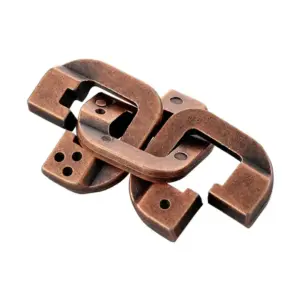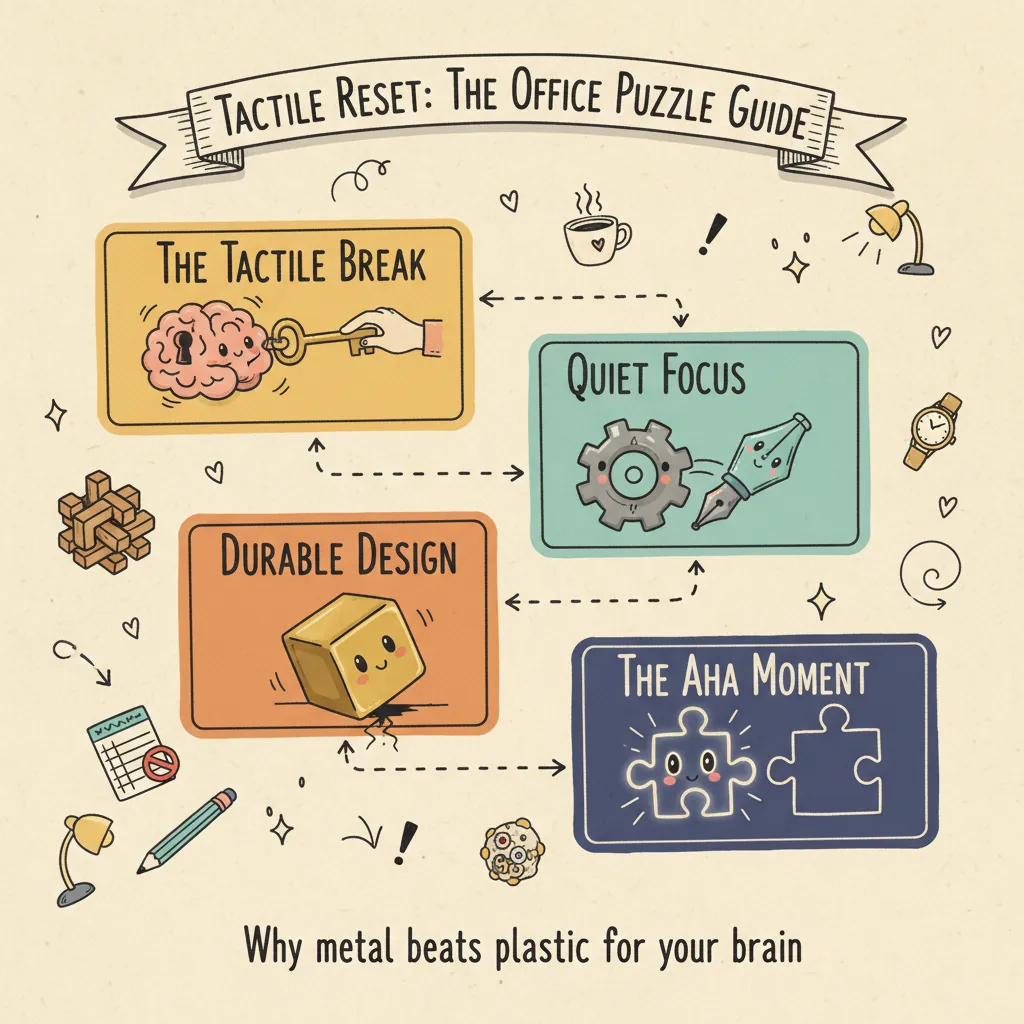
It is 2:14 PM on a Tuesday. I am staring at a spreadsheet that has begun to look like a digital fever dream. My third cup of coffee is cold, and my brain has reached that specific state of “saturated” where no new information can possibly enter. This is the moment where most people reach for their phones to scroll through an endless feed of nothingness. Instead, I reach for a heavy, cold piece of interlocking brass sitting next to my monitor.
After testing over 200 mechanical challenges in the last decade, I’ve realized that the right office puzzle isn’t a distraction. It is a tactical reset. By engaging the tactile part of your brain, you force the analytical side to step back and breathe. The goal isn’t just to solve the thing; it’s to give your hands something to do so your mind can untangle the problem you were actually hired to solve.
The best office puzzles share three traits: they must be durable enough to survive a fall from a desk, quiet enough to fiddle with during a Zoom call, and satisfying enough to justify the space they take up. Most “desk toys” are cheap plastic junk that ends up in a drawer by Friday. A real mechanical enigma, however, becomes a permanent fixture of your workspace.
The Cognitive Science of the “Tactile Break”
There is a reason we fidget. When we are stuck on a complex task, our brains often require a secondary, low-stakes motor activity to maintain focus. This is why you see people clicking pens or pacing. A well-made puzzle provides a structured version of this fidgeting. Unlike a phone, which demands your visual attention and floods your brain with dopamine-seeking notifications, a mechanical puzzle keeps you in the physical world.
I have found that restarting your cognitive flow often requires a complete shift in spatial reasoning. When I spent 45 minutes with a particularly stubborn metal disentanglement piece last week, I realized that the logic I used to separate the metal hooks was the exact same non-linear thinking I needed for my project’s architecture.
The history of these objects is deeper than most realize. From the ancient mortise-and-tenon joints studied by Joseph Needham to the Victorian-era wire puzzles, humans have always sought to miniaturize the world’s complexities into something we can hold.
Why Metal Beats Plastic for Professional Desks
Plastic puzzles feel like toys. Metal puzzles feel like instruments. When you are sitting in a high-stakes environment, the weight of a solid alloy piece matters. There is a specific temperature to brass and bronze; it starts cold and warms up as you work it in your hands.
Furthermore, metal puzzles are virtually silent. If you are looking for discreet puzzles to do at work, you want something that doesn’t click, snap, or rattle in a way that alerts your cubicle neighbor. You want the smooth, silent glide of machined surfaces.
Cast Coil Pocket Puzzle
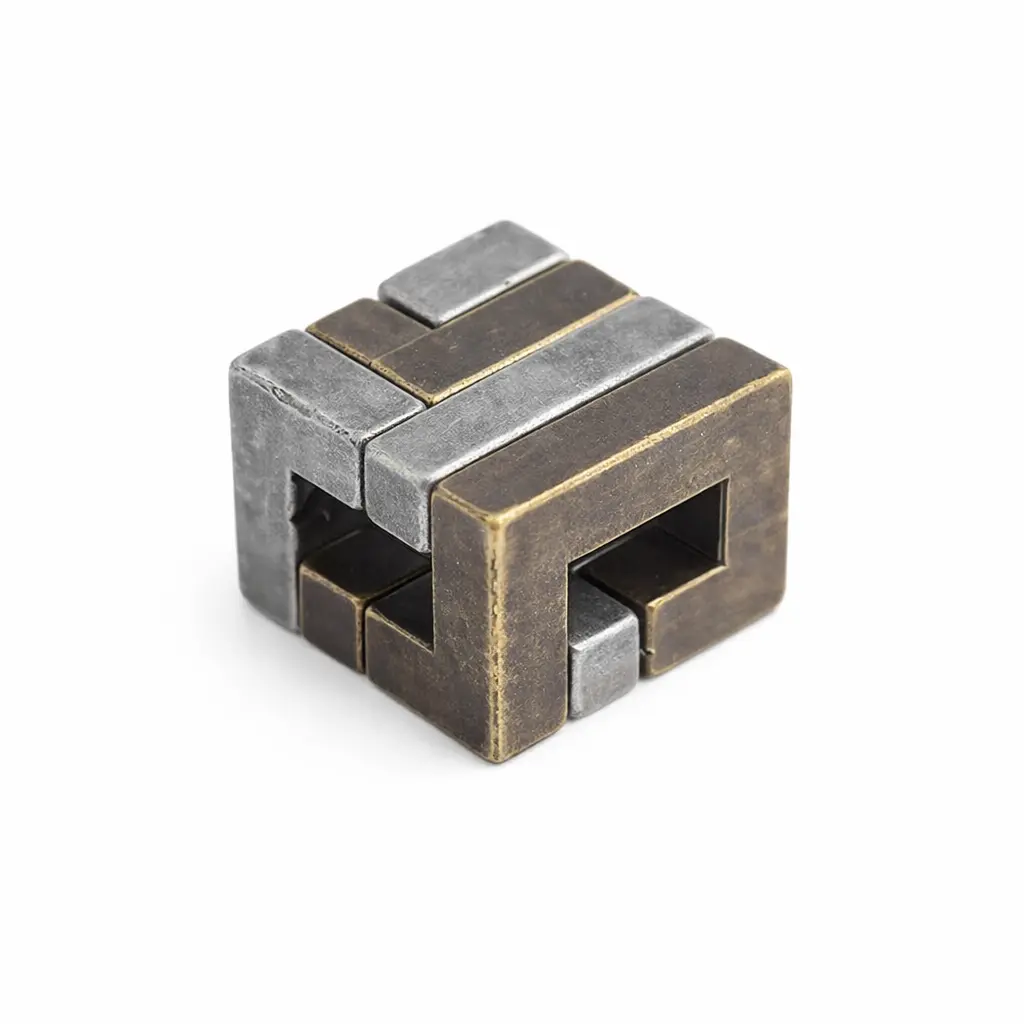
Cast Coil Pocket Puzzle — $18.99
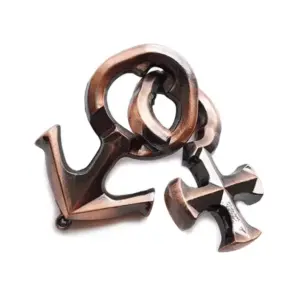
The Cast Coil Pocket Puzzle ($18.99) is my current go-to for high-stress meetings. It looks like a miniature industrial sculpture—something you might find in the wreckage of a high-end watch factory. It consists of two interlocking metal pieces, one antique bronze and one brushed silver, that are spiraled together in a way that seems to defy physics.
I’ve had this on my desk for three weeks, and it is the most popular “borrowed” item in the room. The trick is the sliding angle. You cannot force this one. If you try to pull it apart, it locks tighter. You have to find the “float” where the two pieces suddenly slide past each other with zero resistance. It is a perfect metaphor for most corporate problems: force creates friction, but the right angle creates a solution. The weight is substantial enough to feel premium, and at under twenty dollars, it’s an easy entry point for a serious collection.
6-in-1 Wooden Brain Teaser Set
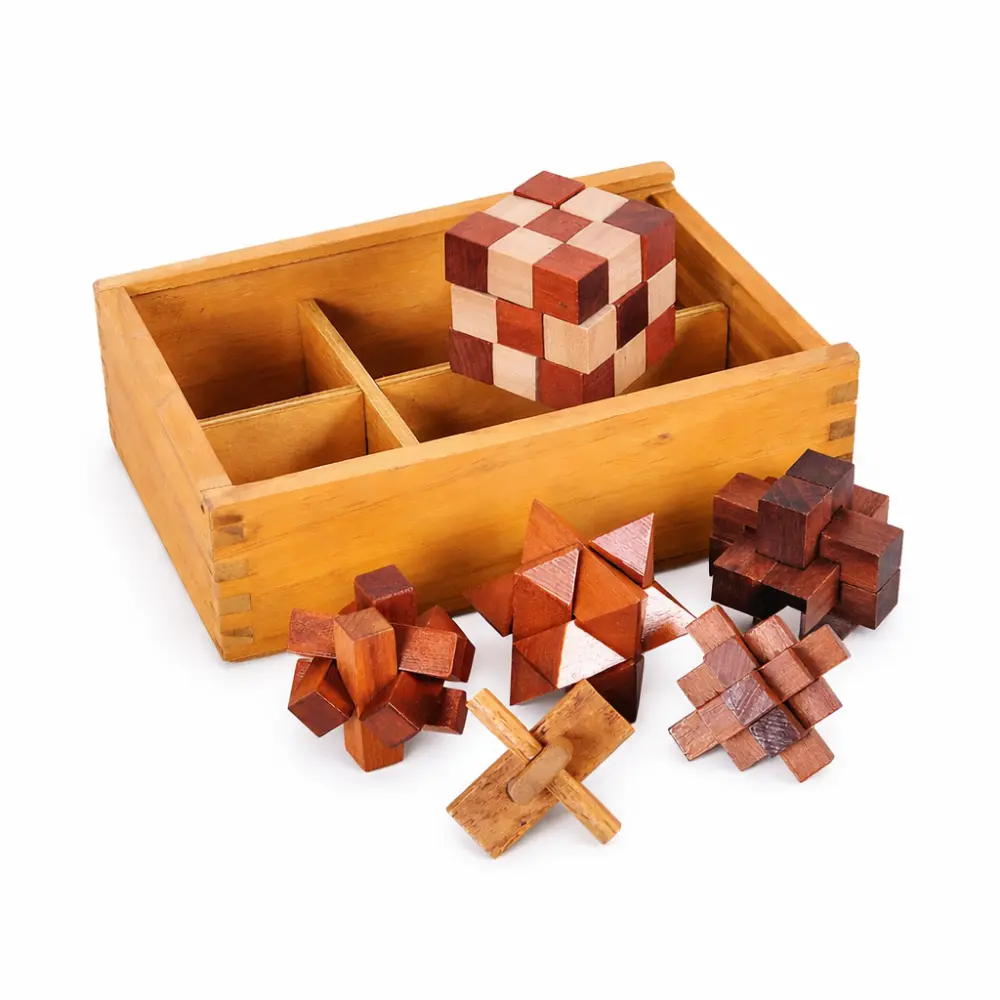
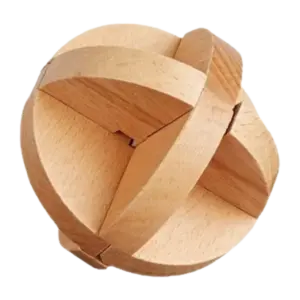
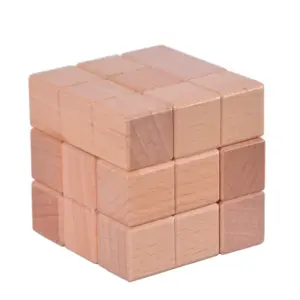
If you prefer the warmth of natural materials, the 6-in-1 Wooden Brain Teaser Set ($38.88) is a masterclass in traditional joinery. These aren’t just blocks; they are based on the same principles that held the Forbidden City together without a single nail. Each piece is carved from solid beechwood, and the tolerances are impressively tight for wood.
I personally tested all six pieces in one sitting. The “key piece” logic is what makes these so addictive. You’ll be staring at a pile of notched sticks, wondering how they could possibly form a solid star or cube, until you find that one piece that slides in to lock the entire structure. It’s immensely satisfying to feel the pieces tighten up as the final wedge is inserted. For those interested in mastering the art of hidden joints, this set is the perfect primer. One word of warning: do not leave these near a curious toddler; while they are sturdy, the individual sticks are small enough to migrate under the sofa.
The “Aha!” Moment: Why Difficulty Ratings Are Subjective
I’ve seen a “Level 1” puzzle stump a PhD for an hour, while a “Level 5” was solved by a ten-year-old in seconds. Puzzles don’t measure IQ; they measure your willingness to see things from a different perspective. In the office, this is a vital skill.
When you are exploring traditional Chinese lock mechanisms, for instance, you have to realize that the obvious path is almost always a trap. The designers of these objects were masters of misdirection.
Chinese Koi Puzzle lock
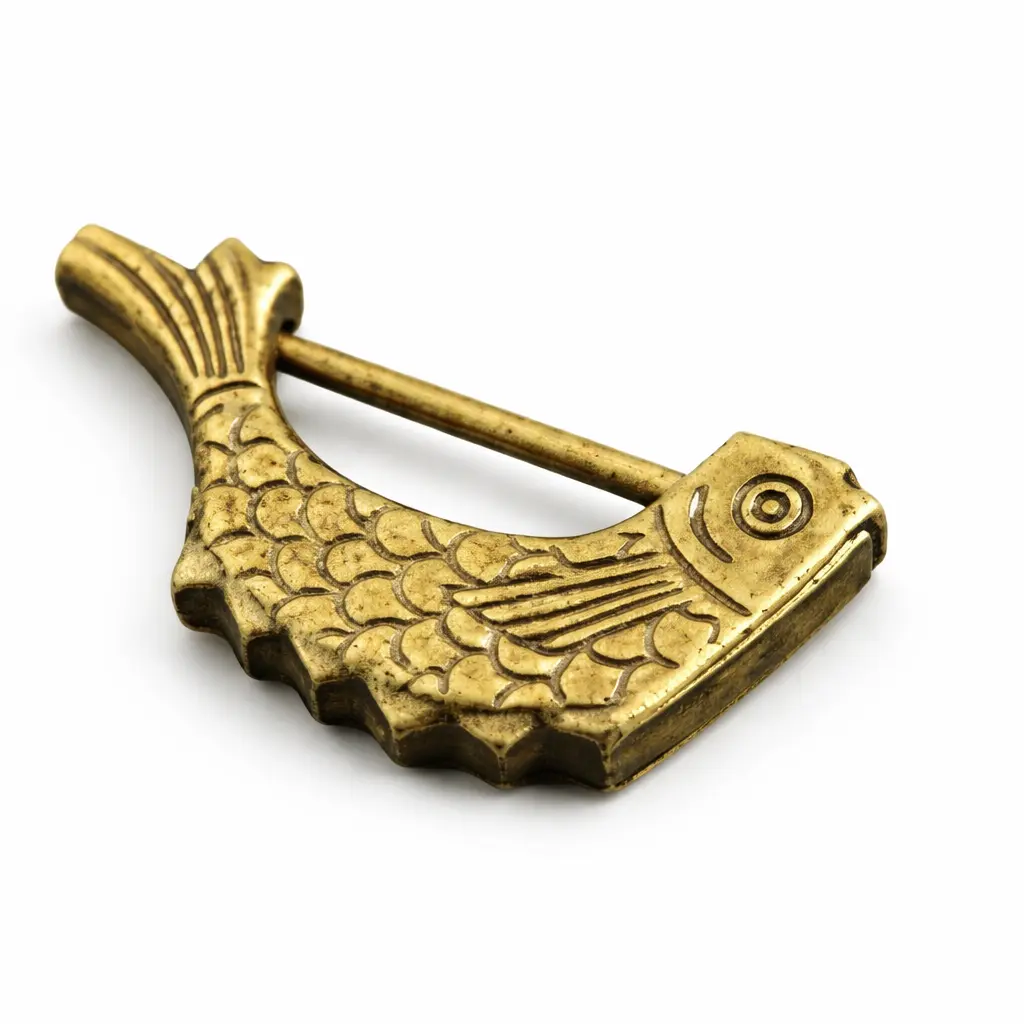
Chinese Koi Puzzle lock — $16.99
The Chinese Koi Puzzle Lock ($16.99) is a perfect example of this misdirection. At 59mm, it sits comfortably in the palm. It looks like a beautiful, weathered bronze fish—a conversation piece for a bookshelf. But it is a functional padlock with a hidden mechanism.
Most people try to stick the key in and turn it immediately. That won’t work. You have to manipulate the fish’s fins or tail in a specific sequence to even reveal the keyhole. I love this piece because it isn’t just a puzzle; it’s a functional object. You could actually use this to lock a small desk drawer or a diary. The hand-detailed scales have a rough texture that provides great grip. It’s a bit noisier than the metal coil puzzles, so maybe don’t fiddle with it during a quiet presentation, but for a solo brainstorming session, it’s top-tier.
3D Wooden Perpetual Calendar Puzzle
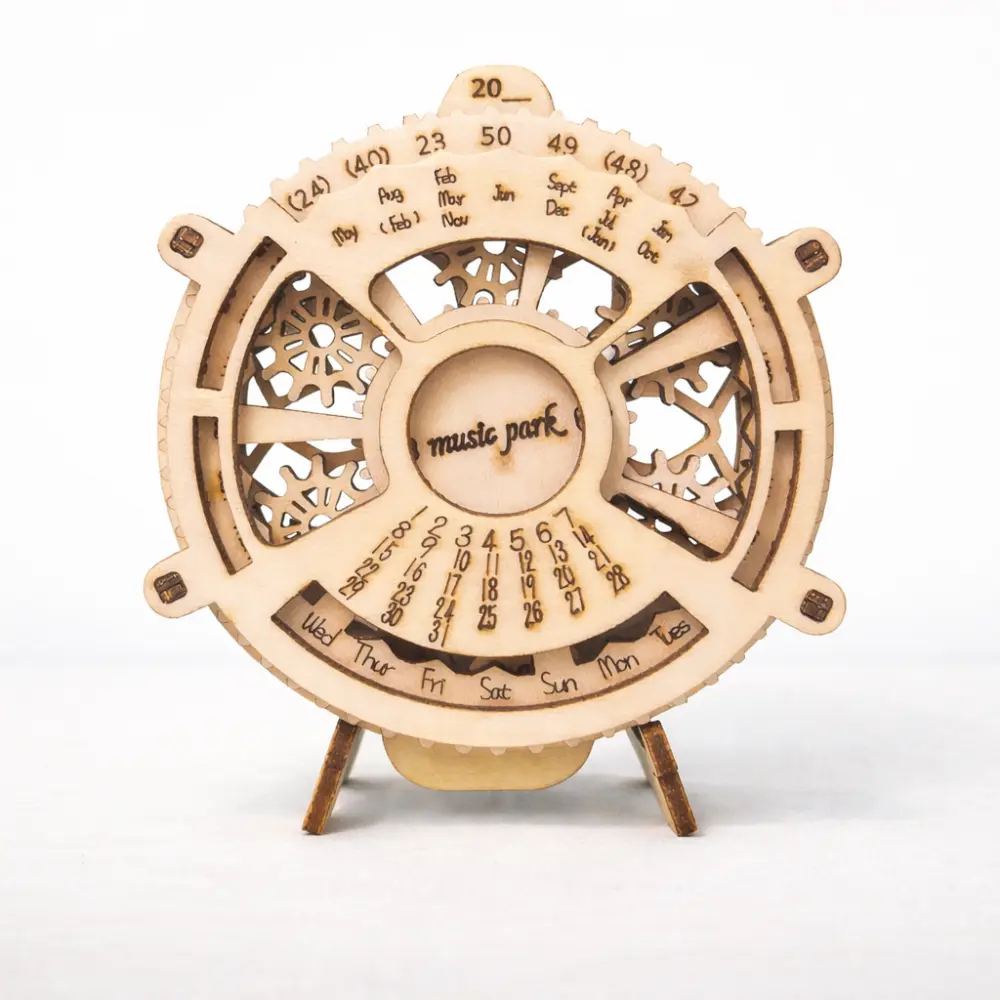
For the person who wants their desk accessories to work for their living, the 3D Wooden Perpetual Calendar Puzzle ($39.99) is the choice. This isn’t a “solve and put away” object. It’s a functional date calculator that you build yourself.
The assembly took me about 90 minutes. The laser-cut gears fit together with a precision that I didn’t expect at the forty-dollar price point. Once built, you rotate the interlocking gears to align the year, month, and date. It covers every day from 2023 to 2050. It’s a great way to apply the right amount of pressure to wooden tabs without snapping them—a lesson in patience. It’s a bit larger than the other items on this list, so make sure you have the desk real estate. It’s the kind of thing that makes people stop at your desk and ask, “Wait, how does that work?”
The Art of Disentanglement
Disentanglement puzzles are the “purest” form of mechanical challenge. They don’t rely on hidden compartments or gears; they rely on topology. The pieces are right there in front of you, but they are topologically linked in a way that feels impossible to break.
Cast Hook Metal Brain Teaser
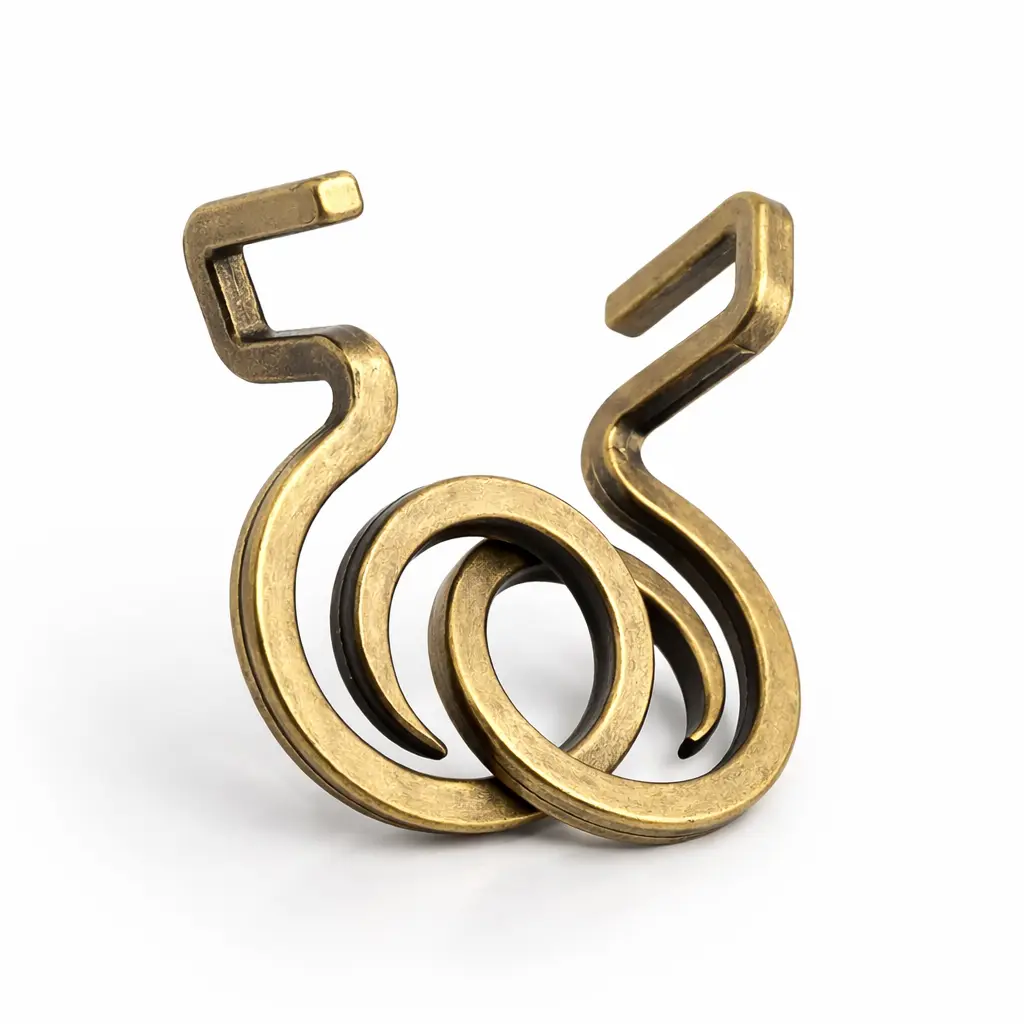
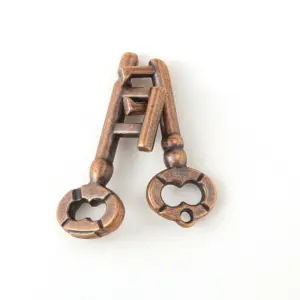
The Cast Hook Metal Brain Teaser ($13.99) is deceptively simple. It’s two identical hooks. That’s it. You look at it and think, “I’ll have this apart in thirty seconds.” Twenty minutes later, you’ll be questioning your spatial reasoning.
The antique bronze finish gives it a heavy, “found object” feel. The secret is in the rotation. It requires a very specific 3D movement that isn’t intuitive. Reassembling it is actually harder than taking it apart, which is a rare trait. I keep this one in my bag for when I’m stuck in an airport or a waiting room. It’s small, silent, and incredibly sturdy. You could run this over with a truck and it would probably just look more “antique.”
Brass Cube Maze Puzzle Keychain
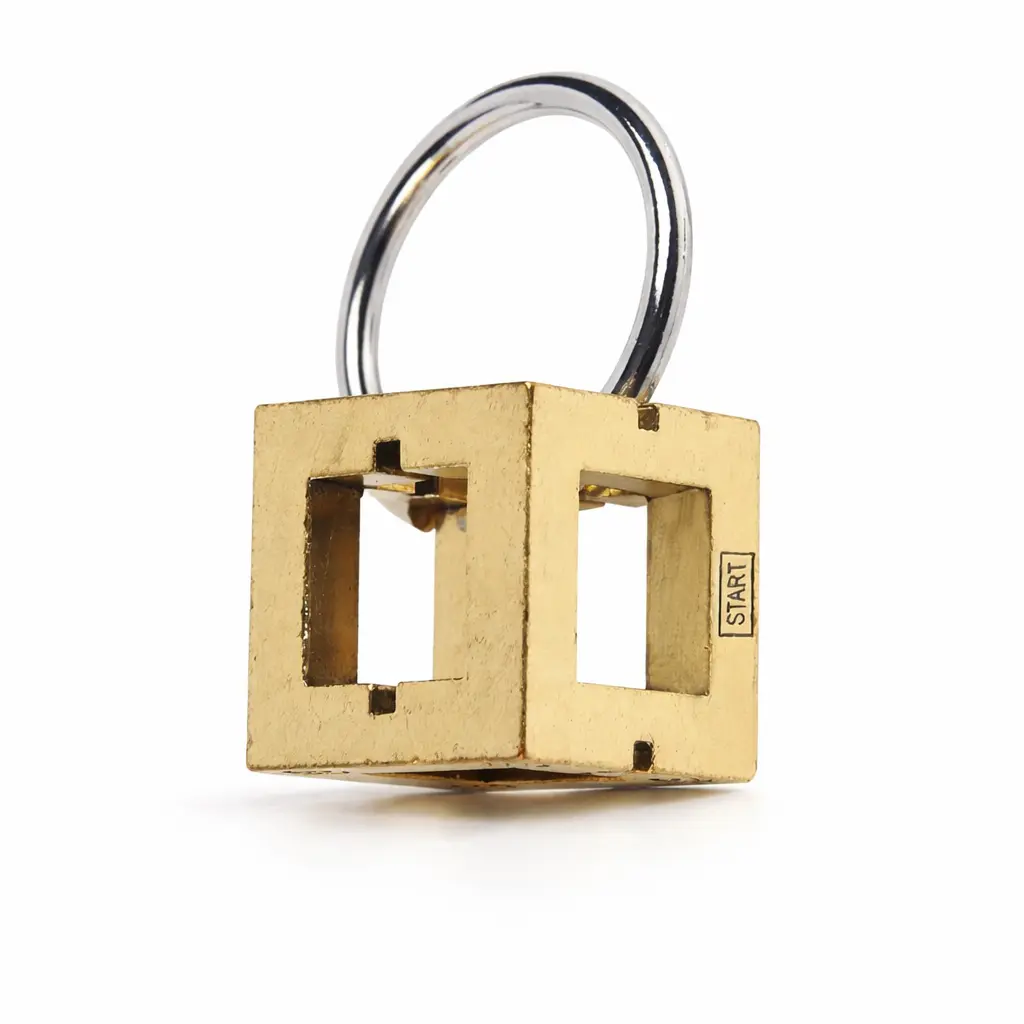
If you need something even more portable, the Brass Cube Maze Puzzle Keychain ($16.99) is a clever little devil. It’s a 31mm polished brass cube with a chrome ring running through it. The ring moves through a hidden internal maze.
I’ve carried this on my keys for months, and the brass has developed a beautiful patina from rubbing against my pocket change. It’s a “blind” maze—you can’t see the path, you have to feel it. This makes it the ultimate “no-look” fidget toy. You can solve it while staring at your monitor, letting your fingertips map the internal notches. It’s surprisingly difficult for such a small object.
Puzzling for Aesthetic: When the Solution is a Sculpture
Sometimes, the goal isn’t just the solve; it’s the result. Some office puzzles are meant to be displayed once finished, serving as a trophy of your mental labor.
3D Crystal Apple Puzzle
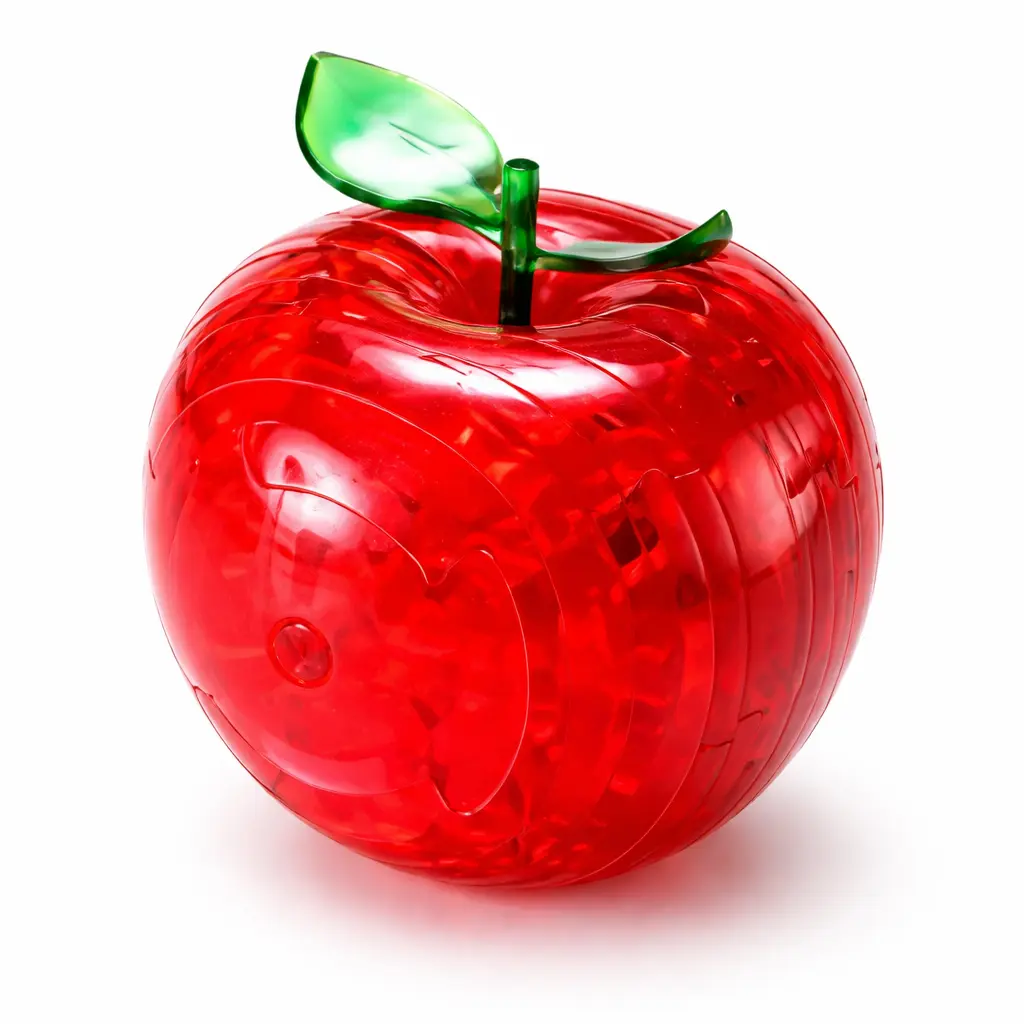
The 3D Crystal Apple Puzzle ($18.88) is a departure from the heavy metals and woods. It’s made of 44 translucent plastic pieces that lock together to form a life-sized apple.
I’ll be honest: if you hate the feel of plastic, skip this. But if you enjoy working with translucent plastic challenges, the way this catches the light on a sunny desk is fantastic. It’s a “jigsaw in 3D.” You have to stack the pieces in a very specific order, or the whole thing won’t close. It comes with a central “pole” that locks the entire structure together at the end. It’s a great gift for a teacher or a colleague who appreciates a bit of desk flair. Just be careful—once it’s assembled, it’s quite solid, but if you drop it before the final locking piece is in, you’ll be hunting for clear plastic shards on the carpet for an hour.
Quick-Reference Comparison Table
Beyond the Basics: Advanced Desk Reset Tools
Once you’ve mastered the standard disentanglement, you might find your brain craving more complex geometric challenges. This is where the “multi-piece” metal puzzles come into play.
5 Piece Cast Spiral Metal Puzzle
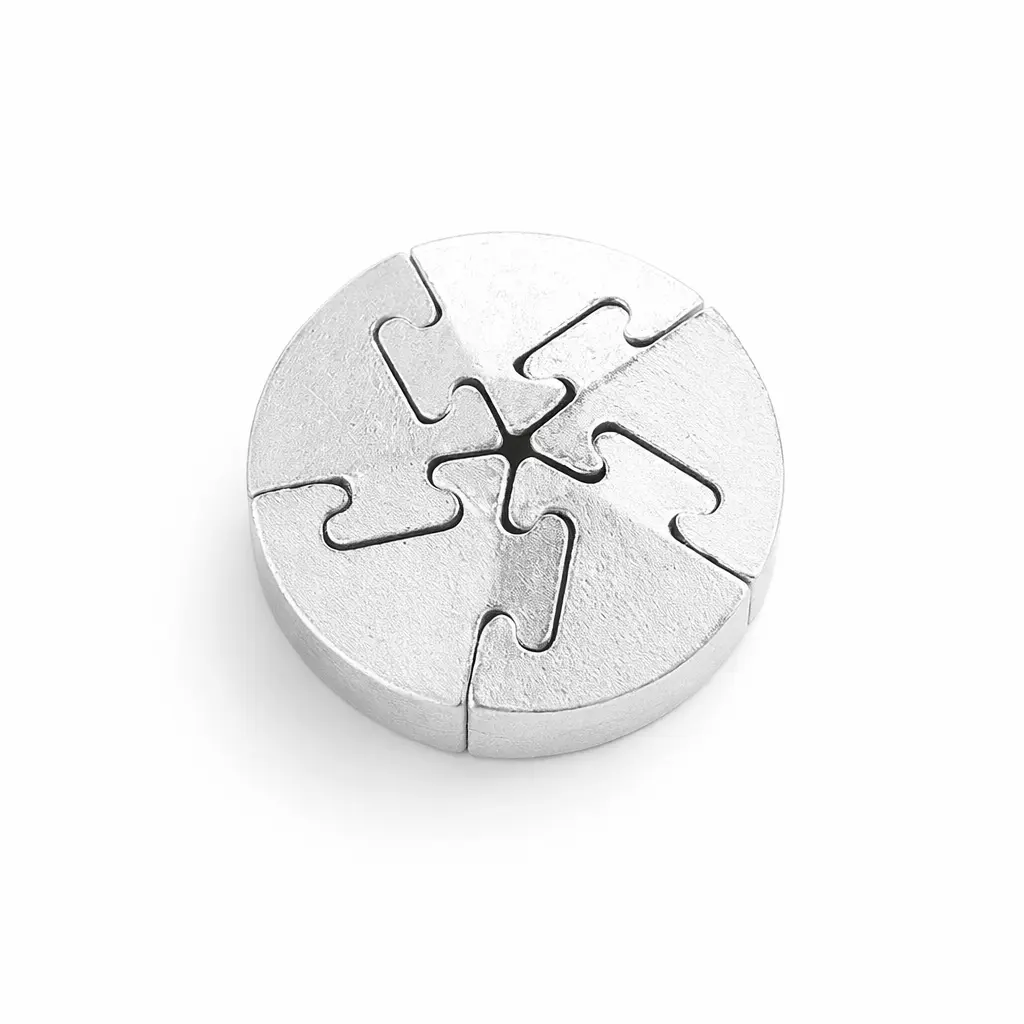
The 5 Piece Cast Spiral Metal Puzzle (check current pricing) is a beast. It looks like a solid metal puck, but it’s actually five precision-machined wedges that lock together. Finding the “one piece that moves” is the first hurdle.
The real challenge, however, is the reassembly. Because the pieces look almost identical, you have to pay extremely close attention to the tiny differences in the grooves. It’s a lesson in observation. I’ve seen people take this apart in five minutes and then spend three days trying to get it back into a circle. It’s the ultimate desk puzzle for someone who thinks they are “good” at puzzles.
Interlocking Metal Disk Puzzle
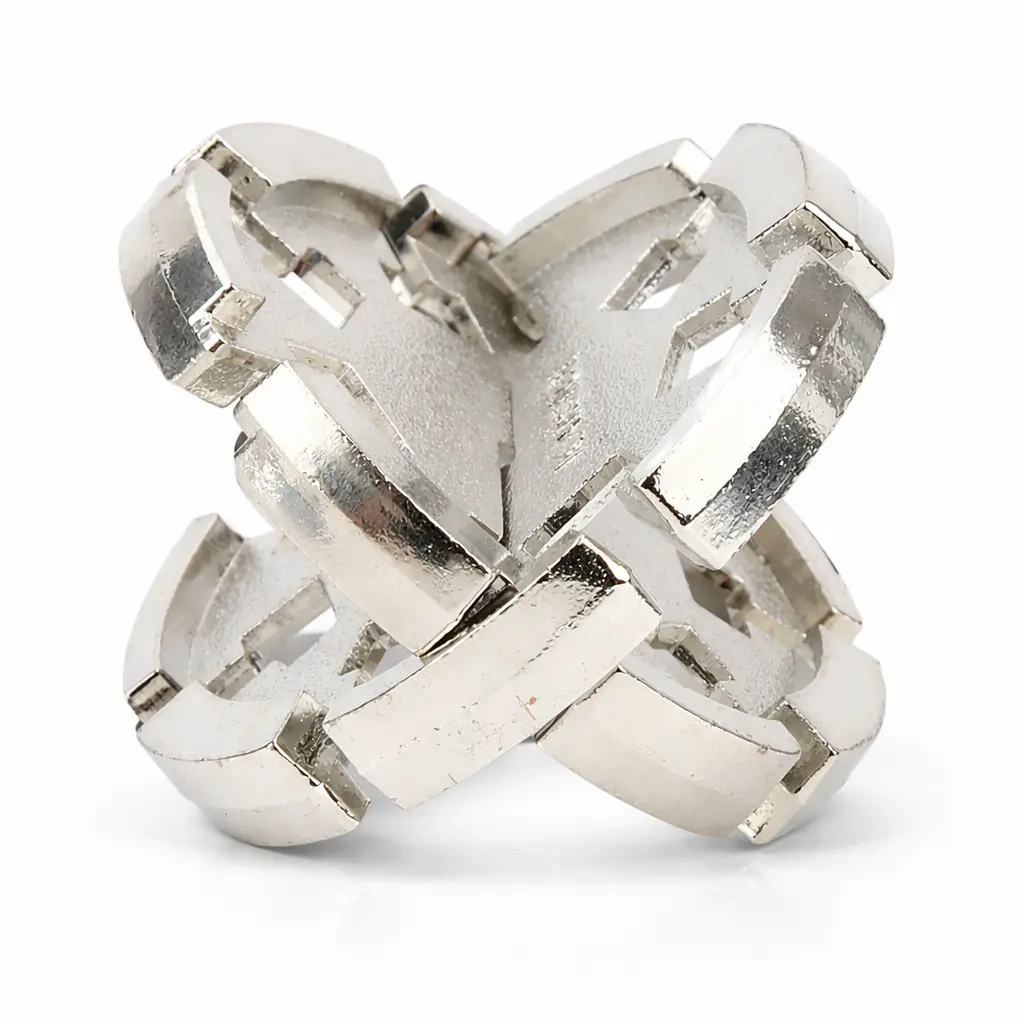
For a more zen-like experience, the Interlocking Metal Disk Puzzle ($14.99) is a 1.8-inch pocket-sized tool. It’s not about a “trick” as much as it is about a sequence. Two pieces rotate through slotted positions.
It’s a rhythmic puzzle. Once you know the sequence, you can do it over and over again, almost like a worry stone. It’s great for building a curated desk collection because it doesn’t look like a puzzle at first glance—it just looks like a well-machined component.
Antique Bronze Metal Keyring Puzzle
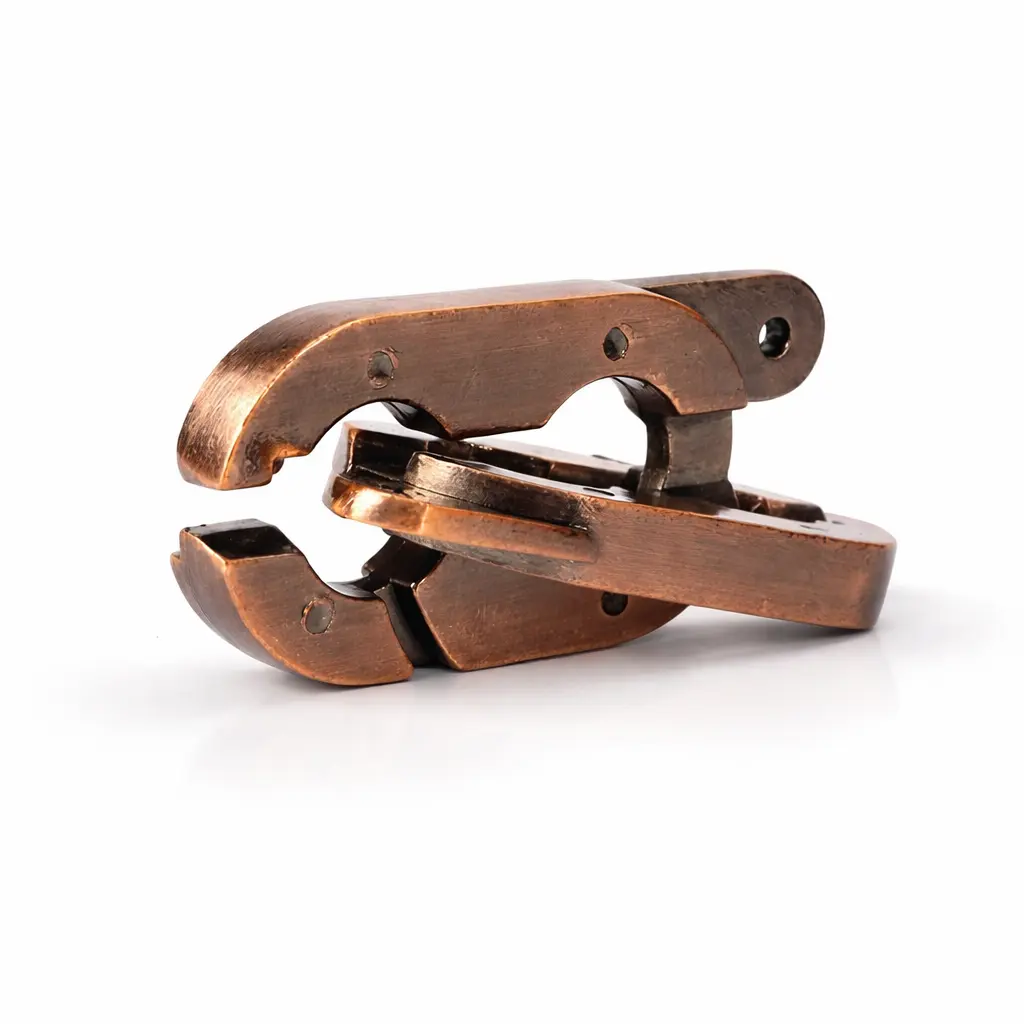
Finally, the Antique Bronze Metal Keyring Puzzle ($14.99) is a classic disentanglement challenge that doubles as an EDC (Every Day Carry) item. It has a hand-finished patina that actually gets better as the oils from your skin interact with the metal.
Like the that specific tactile feedback you get from a high-end mechanical keyboard, this puzzle offers a series of satisfying “drops” as the pieces move through their permitted paths. It’s a quiet, dignified way to keep your hands busy during a long commute or a particularly dry staff meeting.
FAQ: Everything You Need to Know About Office Puzzles
What is the difference between “Office Puzzle” software and these physical puzzles?
It’s a common point of confusion. “Office Puzzle” is often the name of practice management software used by healthcare providers (like ABA teams). However, in the context of office productivity and desk decor, an “office puzzle” refers to mechanical brain teasers designed to be solved at a desk. While the software helps manage your workflow, the physical objects help manage your mental state. Both aim to make your work day smoother, just through very different means.
Are these puzzles too loud for a quiet office?
Most high-quality metal and wooden puzzles are nearly silent. The Cast Coil Pocket Puzzle and the Interlocking Metal Disk Puzzle are virtually noiseless. Avoid anything with loose ball bearings or thin plastic parts if you are worried about noise. The “clink” of metal on metal is usually the only sound you’ll hear, and it’s typically no louder than the sound of someone typing on a laptop.
How do I clean my metal puzzles?
Over time, brass and bronze puzzles will develop a patina. Some people love this look (myself included), but if you want to keep them shiny, a simple microfiber cloth is usually enough. For deeper cleans, a tiny bit of isopropyl alcohol on a cloth will remove skin oils without damaging the metal. Never use water on wooden puzzles, as it can cause the wood to swell and ruin the tolerances.
What is the best puzzle for a complete beginner?
I always recommend the 6-in-1 Wooden Brain Teaser Set. It gives you six different challenges, allowing you to learn the “language” of mechanical puzzles at your own pace. If you prefer metal, the Cast Hook Metal Brain Teaser is a classic entry point that provides a great “Aha!” moment without being frustratingly difficult.
Can these puzzles actually help with ADHD or focus issues?
While I’m a puzzle reviewer and not a doctor, many people in the neurodivergent community find that tactile fidgeting helps regulate focus. By giving the “fidgety” part of the brain a task (like navigating a maze), it allows the rest of the brain to stay engaged with the primary task. It’s a much more productive outlet than scrolling through social media.
What if I lose the solution instructions?
Most veteran puzzlers throw the instructions away immediately! The whole point is to discover the solution yourself. However, if you are truly stuck, there are thousands of walkthrough guides online. For example, if you are struggling with a trick box, you might look for tips on applying the right amount of pressure to find the hidden seams.
Are these puzzles durable enough for a backpack?
The metal ones are nearly indestructible. I’ve carried the Antique Bronze Metal Keyring Puzzle on my keys for a year, and it’s fine. The wooden ones are sturdy but shouldn’t be crushed under heavy books. The 3D Crystal Apple Puzzle is the most fragile; once assembled, it’s solid, but the individual pieces can be brittle if stepped on.
Is it okay to use force to solve a puzzle?
Almost never. Mechanical puzzles are designed to move freely once the correct alignment is found. If you find yourself straining or using your muscles to pull something apart, stop. You are likely missing a step, and you risk bending the metal or snapping the wood. A good puzzle should feel like it wants to come apart once you find the secret.
Why are some puzzles so much more expensive than others?
It usually comes down to materials and tolerances. A 31mm polished brass cube requires precise machining so the internal ring doesn’t get stuck. Cheap knock-offs often have “burrs” or rough edges that make the puzzle feel clunky. You are paying for the engineering that makes the solve feel smooth.
Do these puzzles make good corporate gifts?
Absolutely. They are far more memorable than a branded pen or a coffee mug. A piece like the Chinese Koi Puzzle Lock looks like a piece of art on a desk but offers a fun challenge for anyone who picks it up. It’s a “smart” gift that respects the recipient’s intelligence.
How many puzzles should I keep on my desk?
I find that three is the “sweet spot.” One easy fidget (like the Interlocking Metal Disk), one medium challenge (like the Cast Coil), and one “conversation piece” (like the Perpetual Calendar). Any more than that and your desk starts to look like a toy store rather than an office.
What is the history of the “Perpetual Calendar” mechanism?
The mathematical principles behind the 3D Wooden Perpetual Calendar Puzzle date back to the Gregorian calendar reforms of 1582. Calculating the day of the week for any given date is a modular arithmetic problem. These wooden puzzles turn that math into a series of physical gear ratios, which is a fascinating way to visualize how time is structured.
Are there digital versions of these challenges?
Yes, if you need a break but can’t carry a physical puzzle, there are great digital logic games that offer a similar mental reset. However, they don’t provide the same tactile satisfaction as feeling a piece of cold metal finally slide free.
How do I know when I’ve “solved” a puzzle?
For disentanglement puzzles, the solve is separating the pieces and—more importantly—putting them back together. For assembly puzzles like the 3D Crystal Apple, the solve is the finished object. For trick locks, it’s successfully opening the mechanism. If you can do it three times in a row without hesitation, you’ve mastered it.
What should I do if a piece of my wooden puzzle breaks?
Beechwood is quite forgiving. A tiny drop of wood glue and a clamp for 24 hours will usually fix a clean break. However, the best way to avoid this is to remember that these objects are about finesse, not strength. If you are struggling, you might need to look at why your brain stalls and how to fix it rather than pushing harder.
Conclusion: Reclaiming Your Focus
The next time you find yourself staring at your screen, paralyzed by a mounting to-do list, don’t reach for your phone. Reach for something real. Whether it’s the cold, heavy weight of the Cast Coil Pocket Puzzle or the intricate wooden gears of a calendar you built yourself, these objects serve as a bridge back to the physical world.
I’ve spent hundreds of hours with these “toys,” and I can tell you that the most valuable thing they offer isn’t the solution. It’s the five minutes of quiet, focused breathing you do while you’re looking for it. If you’re just starting out, grab the 6-in-1 Wooden Brain Teaser Set. It’s the most bang for your buck and will keep your hands busy through at least a dozen long meetings.
Your brain isn’t a machine; it can’t run at 100% efficiency all day. Give it a rest. Give it a puzzle. You’ll be surprised at how much faster you solve the “real” problems once you’ve figured out how to separate two pieces of brass.