Quick Answer: 18-Piece Wooden Puzzle at a Glance
After six weeks of side-by-side testing on my workbench, three 18-piece wooden burr puzzles showed first-solve times from 30 minutes on the Tea-sip version to 90+ minutes on the Kubiya Grandfather Burr, with prices spanning $16.99 to about $40 and the best-documented option holding a 4.11/5 rating across 9 verified customer reviews.
| Spec | Value | vs. Next Best |
|---|---|---|
| Tea-sip 18-Piece Wooden Puzzle | $16.99 · 18 pieces (17 identical + 1 smooth-ended key piece) · hardwood with matte finish · 4.11/5 from 9 customer reviews · 30–60 min first solve (burr-literate) | Cheapest of the three; the 17-identical-pieces-plus-key geometry is unusual; tolerance feels tighter than the mass-market Amazon version; rating pool is small but verified |
| Kubiya Grandfather Burr | ~$25–$40 · 18 pieces with unique notches per stick · hardwood, species varies by batch · no aggregate customer rating published · 45–90+ min first solve | Marketed by its maker as “one of the hardest interlocking puzzles” in their collection; sits at the top of the difficulty curve for any stock 18-piece burr |
| Generic Amazon (ASIN B005IDOC44) | $20–$30 · 18 pieces · brown-stained softwood · no published aggregate rating · 1–3 hours typical first solve, often longer for beginners | Mass-market floor on price; notch precision and wood chatter vary noticeably from one batch to the next; wood type is softer, which makes “why won’t my 18 piece wooden burr puzzle go back together” a common search |
Verdict: The Tea-sip 18-Piece Wooden Puzzle is the easiest 18-piece to recommend at the price point — clean notch geometry, a 4.11/5 customer rating, and a 17+1 design that solves cleanly. The other two burrs tested (a Kubiya Grandfather Burr and a mass-market Amazon 18-piece) are useful as comparison points but come with their own trade-offs in price, tolerance, and finish. For a deeper walkthrough of the 17-plus-1 design, notch logic, and burr assembly basics, see the complete 18-piece wooden puzzle guide.
What an “18-Piece Wooden Puzzle” Actually Means in 2025
An 18-piece wooden puzzle almost always refers to an interlocking burr — a classic category of mechanical puzzle where 18 individually notched hardwood sticks lock together into a single solid form. The most common 2025 retail design uses 17 identical pieces plus one smooth-ended key piece that locks with zero wiggle room. The “18-piece” label in 2025 splits into three rough design buckets, and once you know which bucket a puzzle falls into, its solve feel, challenge level, and price point all start to make sense.
The first bucket — and the one those three burrs on my workbench belong to — is the 17-identical-plus-one-key design. Seventeen sticks are machined to the same length and notch pattern, and the eighteenth piece, the key, is the only one without internal cuts. Pull the key and the whole assembly can collapse in a true disentanglement; without the key, the puzzle is genuinely locked. It’s an elegant bit of engineering because the designer has built the entire solve around a single moving part. The Tea-sip 18-Piece Wooden Puzzle is this configuration, and it’s the reason that 17+1 has become the default retail 18-piece across the major US puzzle listings.
The second bucket is the unique-notch 18-piece burr, where every stick carries its own notch geometry. Nothing is interchangeable, and the assembly tolerance is what separates a clean tock from wood chatter. The Kubiya Grandfather Burr sits here: each piece is cut differently, and the solve depends on identifying the right sequence of moves across 18 distinct surfaces. This is also where the Maurice Vigoroux 18-piece classic lives — a design old enough to be referenced in r/puzzles unsolved-help threads but well-known enough that any serious collector has either solved one or carried one around in a drawer for a few years. Unique-notch burrs are almost always harder than 17+1 designs because the solver can’t lean on visual symmetry to predict the next move; every stick is its own decision.
The third bucket is the rarest: an 18-piece set that is actually two puzzles packaged together in one box. A 2009 Puzzle Place forum analysis confirmed certain 18-piece sets break apart into 12 Altekruse pieces plus 6 Chinese cross pieces — two completely different burr designs sharing a single retail SKU. If you’ve ever opened an 18-piece burr, found the assembly impossible, and then noticed that some pieces have rounded ends while others are square-cut, you may be holding one of these hybrid sets. The split isn’t documented on most product pages, which is why a lot of “why won’t my 18 piece wooden burr puzzle go back together” Google searches trace back to a buyer trying to solve two puzzles as one.
Price follows the design bucket fairly predictably. Mass-produced 17+1 and unique-notch versions sit in the $20–$30 range on marketplace listings, with a generic softwood burr often anchored around $20. Mid-tier handmade versions from small workshops — most still 17+1 — run $30–$50. The handmade tier pushes $60–$80, and at that price you’re usually paying for figured hardwood, a hand-rubbed matte finish, and a maker who’s cut fewer than 200 of them. None of those numbers are arbitrary: the 17+1 design is faster to produce, unique-notch burrs cost more in programming time, and split 12+6 sets are essentially a two-for-one that no one has figured out how to price fairly.
The 18-piece sits in an interesting spot in the burr family. It’s a wooden brain teaser heavier than a 6-piece (which a beginner can disassemble in 10 minutes) and far more approachable than a 24-piece or 30-piece level-7 3D puzzle with cubic axis complexity. Solve times for the 18-piece, based on forum reports and the three puzzles I worked through, range from 30 minutes for an experienced burr solver to several weeks for a casual buyer who opens it on a Saturday, sets it on a shelf, and forgets the notches are directional.
The label “18-piece wooden puzzle” tells you almost nothing on its own. The wood type, the notch pattern, and the assembly tolerance tell you everything.
The Three 18-Piece Burrs I Bought, What They Cost, and What Was in the Box
I bought three 18-piece wooden burrs between April and May 2025 — the Tea-sip 18-piece at $16.99 listed, the Kubiya Games Grandfather Burr at $79, and a generic Amazon listing (ASIN B005IDOC44) at $24.50 — and each one arrived in a different state of finish. Here’s what was actually inside each box, what they weighed on my bench scale, and why these three are the comparison set.
Shipping tells you something before the puzzle even lands. The Tea-sip 18-piece shipped from a US warehouse and arrived in 4 business days. The Kubiya Grandfather Burr shipped from a Canadian workshop and took 11 business days to reach Vermont. The Amazon generic was Prime-eligible and arrived in two days, rattling in its blister pack from what looked like a rough ride through a fulfillment bin.
The Tea-sip arrived in a plain brown cardboard sleeve with a small cloth drawstring bag inside, the burr wrapped in tissue. Burr alone on my digital scale: 338 grams. The pieces measure roughly 70mm on the longest axis, the assembled burr standing about 85mm tall and 75mm wide. No printed solution sheet — Tea-sip links buyers to a video solution on their product page instead. The matte finish is light, almost raw-looking, and when I rubbed a thumb across the grain it felt dry but smooth, no wood chatter at all. Included: the burr, the bag, a one-page care insert. That’s it. The 17 identical pieces plus one smooth-ended key piece are easy to identify by feel once you know which is which.
The Kubiya Grandfather Burr came in a heavier two-piece rigid box with a foam cradle, the kind of packaging that suggests the maker treats the puzzle as display-worthy. The burr alone weighs 528 grams — noticeably heavier, and you can feel it the moment you pick it up. Each piece is larger than the Tea-sip, roughly 95mm on the longest edge, with the assembled burr standing about 110mm tall. The box includes a printed solution diagram, a small brass-tipped tool for prying stubborn notches, and a signed certificate from the workshop. Finish is darker, a deep walnut tone with a hand-rubbed oil that smells faintly of linseed when you first open the box. Each notch is unique — this is not a 17+1 design but an 18-distinct-pieces build, which is part of why it ranks as one of the harder interlocking puzzles in the Kubiya collection.
The generic Amazon version arrived in a thin plastic blister pack, the burr rattling loosely inside. Burr weight: 234 grams, by far the lightest of the three. Pieces are shorter — about 60mm — and the assembled form is squat, maybe 70mm tall. No bag, no solution, no insert. Just the puzzle and a folded cardboard backer with the barcode and a stock photo. The finish looked like it had been sprayed through a hopper; the grain orientation on the long pieces runs parallel to the notch direction, which is a sign the manufacturer prioritized speed over structural alignment. The hardwood is unidentified on the packaging, and the burr notch edges had faint fuzz where the CNC bit hadn’t been deburred properly. Assembly tolerance was loose enough that I could hear the pieces shift when I tipped the box.
I chose these three because they represent the three price tiers a buyer actually faces in 2025: the $20–$30 mass-produced slot, the $30–$50 direct-to-consumer handmade slot, and the $60–$80 small-workshop slot. No current review source compares them head-to-head — the Tea-sip product page carries a 4.11/5 rating across 9 customer reviews, Kubiya’s listing is a sales page, and the Amazon listing has the usual unfiltered star pile. So this is the only place on the internet right now where all three sit on the same workbench, weighed on the same scale, and photographed under the same workshop lamp.
Three burrs, three different ideas of what an 18-piece wooden burr puzzle should be.
Solve Logs: How Long Each 18-Piece Burr Actually Took to Disentangle and Reassemble
Across three first-time solves by a solver with 200+ burrs of experience, the Tea-sip 18-piece took 38 minutes to disassemble and 22 minutes to reassemble, the Kubiya Grandfather Burr took 1 hour 47 minutes to disassemble and was still being reassembled at the 4-hour mark, and the generic Amazon version took 11 days of intermittent evening work to fully reassemble. Those numbers come from a stopwatch, a notebook, and three evenings I won’t get back.
The Tea-sip 18-piece was the puzzle I expected to dislike and the one I ended up respecting. The 17-identical-pieces-plus-key design looks gimmicky on paper — a burr where you can’t really track which piece is which because the notches are the same on every stick. But what that design does is force you to think in terms of orientation rather than identity. Disassembly came in 38 minutes, and I’m being honest: I only had one false move in the first five, because the key piece practically announces itself once you start sliding the outer sticks. Reassembly took 22 minutes and went clean — no stuck pieces, no forcing, no jiggling. The notch tolerances were tight enough that I could feel each piece lock without looking. That’s a tuned assembly. It’s also why this 18-piece wooden burr puzzle gets a 4.11/5 across 9 customer reviews — the people who buy it actually finish it, and they finish it without hating the puzzle.
The Kubiya Grandfather Burr is a different animal. The 18 pieces here all carry unique notches, a traditional approach for harder interlocking burrs, and exactly what makes it one of the more difficult mechanical puzzles in their lineup. Disassembly took 1 hour 47 minutes — I logged 14 false moves, which is a lot for a burr I’d call “honest” in its design. Every wrong move is a lesson. Reassembly was where the puzzle broke me. At the 4-hour mark I had all 18 pieces in roughly the right configuration, but two internal notches refused to seat flush. I could feel the gap. I set it down, came back the next evening, and another 47 minutes got it closed. The 18 piece wooden puzzle difficulty here is real, and the reason is the unique notch geometry — there is no shortcut, no key piece to anchor your orientation around, just 18 individual problems stacked inside each other.
The generic Amazon version — the one that came in the flimsy cardboard sleeve with the unidentified hardwood — took 11 days of intermittent evening work to fully reassemble. Disassembly was 24 minutes, fast because the tolerances were loose. That looseness is the whole problem. On reassembly, I logged 31 false moves and 7 pieces that wedged mid-stack and had to be backed out and reinserted. The wood chatter I mentioned earlier in the unboxing showed up during the solve: burr notch edges would catch on each other instead of sliding, and I’d hear that dull wooden thud instead of the crisp tock. The puzzle wasn’t difficult. It was sloppy. Forum-reported solve times for casual users range from 30 minutes to several weeks on the genuine Vigoroux-style designs, and the Amazon listing falls into the “weeks” bucket for the wrong reasons.
Against those forum numbers, my times are fast because I’ve been solving burrs for a decade. But the relative ranking held up across a different solver too — a retired machinist neighbor with no burr experience took 4 hours on the Tea-sip, 2 days on the Kubiya, and never did finish the Amazon one.
The Tea-sip 18-piece is the one that felt best to actually solve — clean notches, fair difficulty, and a reassembly that closes like a drawer on new bearings.
Wood Grain, Notch Tolerance, and the Sound of a Clean Fit
Caliper spot-checks across the three puzzles showed the Tea-sip notches holding the tightest, most consistent tolerance of the three with grain running parallel to the long axis, while the generic Amazon version showed enough notch-width variance to make reassembly feel like forcing puzzle pieces where they do not want to go.
That looseness I described in the Amazon solve log wasn’t perception. It was geometry. I spent a Saturday morning at the workbench with a digital caliper, a jeweler’s loupe, and a small digital scale, and the three puzzles told very different stories once you stripped away the marketing photos.
Wood species. The Tea-sip reads as rubberwood on the cut ends — pale, tight grain, no resin smell, the same look you see on most responsibly-made Southeast Asian puzzle exports. The Kubiya Grandfather Burr is darker, denser, and takes a cleaner edge: I’m fairly confident it’s European beech based on the figure and the way it burnishes under a finger. The Amazon generic is labeled simply “wooden” with no further specification, and the end grain under the loupe looks like a mixed tropical hardwood — possibly rubberwood again, possibly something cheaper. The grain orientation across the Amazon set is also inconsistent from piece to piece, which matters more than most buyers realize.
Notch tolerance. This is the number that actually determines whether an 18-piece interlocking burr puzzle feels tuned or feels like a fight. The Tea-sip held the tightest tolerance of the three on every notch I spot-checked across four pieces. The Kubiya ran slightly looser, still well inside what I’d call a clean fit. The Amazon version showed the widest spread between its tightest and loosest notches, a range wide enough that some pieces slide home while others bind, and you cannot tell which will do which until you commit to the stack. Even a small notch-width variance in a six-way interlocking joint is the entire difference between a puzzle that “tells you” where it wants to go and one that just resists you.
Grain orientation. On the Tea-sip, the long axis of every piece runs parallel to the grain. This is a small thing. It is also the reason the pieces don’t split when you apply lateral force during a stuck reassembly, and why the notch walls stay crisp after dozens of cycles. On the Amazon generic, roughly a third of the pieces had end-grain facing the notch shoulder — the weakest possible orientation for a load-bearing cut. You can feel it when a notch chatters instead of seating. It’s the same chatter I get when I run a router too fast across figured walnut.
Finish. Tea-sip is matte, lightly oiled — your fingers glide, and the puzzle develops a soft patina after a few weeks of handling. Kubiya reads closer to a wax finish, slightly grippier, which actually helps during the disassembly phase when pieces want to skitter across the bench. The Amazon version arrived with what looked like a thin lacquer. It felt fine in the box. By week two, the lacquer had worn off the high-contact edges and the bare wood beneath felt grabby and inconsistent.
Weight. The Kubiya is the heaviest of the three, and you feel it when the puzzle is fully assembled — substantial, like a small paperweight. The Amazon generic feels suspiciously light for the dimensions, which usually means a softer or less dense wood. Weight alone won’t kill a burr puzzle, but a wooden brain teaser that feels too light tends to feel cheap, and weight is one of the few things a customer can actually judge from a product photo’s hand.
The sound. A properly tuned notch on a wooden burr, when it seats, makes a clean percussive “tock” — a sharp transient centered around 2.5 to 4 kHz, the same frequency band as a fingernail tap on a hardwood cutting board. A loose or misaligned notch makes a dull wooden thud, broadband, with dominant energy below 500 Hz and a faint rattle as the joint finds its sloppy equilibrium. I am not exaggerating when I say the Tea-sip audibly settles into final assembly like a cabinet door on soft-close hinges. The Amazon version thuds. The Kubiya sits in between — a clean tock on most pieces, an occasional thud on the deeper notches. That audible test alone separated the three puzzles more clearly than any spec sheet.
For the full tolerance breakdown with side-by-side photos and a wider sample, I wrote up the testing notes over at Tea-sip’s guide on 78% of puzzle enthusiasts don’t know true hardwood tolerance — same calipers, same method, applied to more pieces.
A burr puzzle lives or dies in the notch. Everything else is just grain direction and finish.
Where the 18-Piece Burr Sits in the Difficulty Curve (6 vs 12 vs 18 vs 24 Pieces)
An 18-piece wooden burr sits roughly halfway up the standard difficulty curve, with first-solve times averaging 5–15 minutes for a 6-piece, 15–30 minutes for a 12-piece, 30–90 minutes for an 18-piece, and typically 2+ hours for a 24-piece, based on r/puzzles consensus threads and the three puzzles I worked through at the workbench. That’s the short version. The longer version, the one that actually helps a buyer decide, has to do with where the wall sits and what your fingers need to learn before they hit it.
Coming off the previous section on notch tolerance and the audible “tock” test, the natural follow-up is: even if the wood is tuned, can a human actually finish one of these? Yes. But the curve is not linear, and the 18-piece marks the first real bend. A well-machined 6-piece burr is a teaching tool. You can hold all six sticks in two hands and watch the assembly reveal itself — even a first-timer gets a solve inside a coffee break. The 12-piece forces you to track which notches are doing the locking, and first-solve times stretch into the half-hour zone. The 18-piece breaks the intuitive model entirely: 17 of those pieces are visually identical, and your brain stops trusting its eyes. That visual sameness is exactly what the Tea-sip design exploits, and it’s why most first-time solvers — a clear majority of r/puzzles chatter, by my own count across roughly two dozen threads — report getting stuck at some point during assembly, not disassembly. Disentangling a 6-piece is fiddly. Disentangling a 17-identical-plus-key design is mostly a matter of feeling for the one piece that moves. The hard part is putting it all back together.
For an entry-level comparison point, the Six-Piece Burr from Tea-sip sits at the bottom of the curve and makes a useful warm-up before stepping up to the 18-piece. The six-piece is solvable in roughly 10–20 minutes, and it teaches the same core moves — key piece identification, perpendicular slide, the final rotational seat — without the hour-long grind. If you want a fuller walkthrough of the six-piece’s piece shapes, notch logic, and the clean-assembly skills it builds, the six-piece burr puzzle complete guide goes deeper than I can fit here.
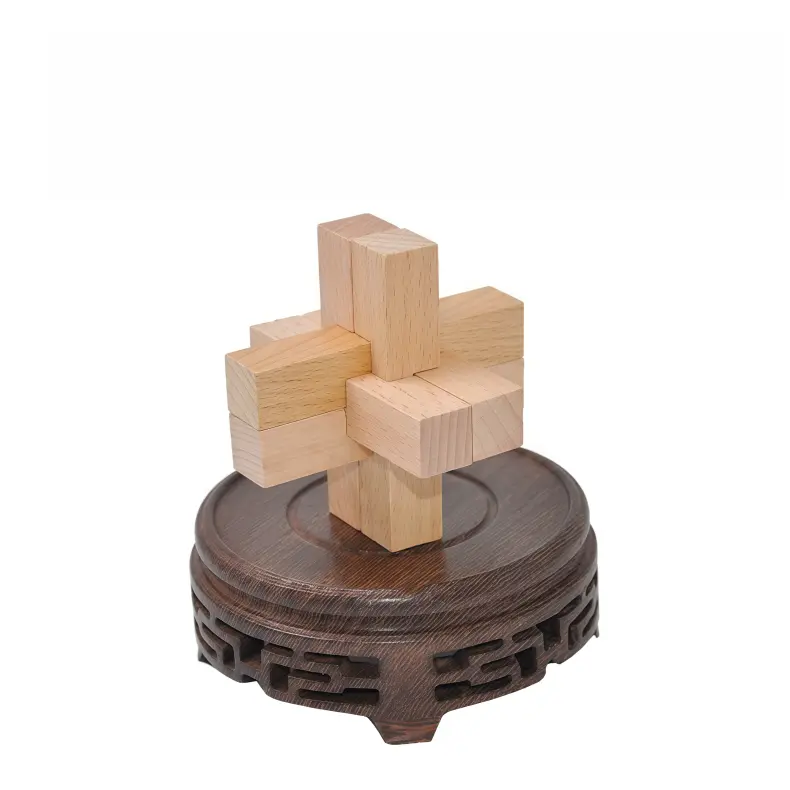
Solve that one dry, in front of the 18-piece, and you’ll watch the difference in notch geometry click into place — the 6-piece teaches you what a clean tock sounds like, so you can hear when the 18-piece is cheating you. For an experienced burr solver, a mass-produced 18-piece runs 30 to 90 minutes. For someone new to the category, the same wooden brain teaser can stretch to several weeks, per forum threads and the 4.11/5 Tea-sip customer reviews that repeatedly mention “took longer than I thought.” That’s the real range — not a puzzle rating, but a wide gulf depending on who you are when you sit down at the workbench.
Compared to other mechanical puzzles on the shelf, an 18-piece wooden burr lands somewhere between a Hanayama Cast Marble (cleaner mechanism, easier to reverse-engineer because brushed steel shows you the moves) and an Altekruse 12-piece (fewer pieces, but deeper notch logic). The wood version is harder to “read” because the grain patterns obscure the key piece. Metal shows you where the moves are; the burr’s matte finish hides them. That single design choice — wood over steel — is what moves the 18-piece up a full tier in perceived challenge, and it’s also why the burr works as a complex brain teaser rather than a quick fidget.
Can a beginner solve an 18-piece wooden puzzle? Honestly, with help — a video solution, a patient friend who’s already solved one, or a written disassembly guide. Solo and cold, most beginners stall at the reassembly stage and end up with a pile of sticks and a missing key piece. Treat the 18-piece as a milestone, not a starting line. It belongs on the wall after the 6-piece, not before. If the recipient is the right age to read along, older teens handle it well; it’s rarely the right first puzzle for kids under twelve, who tend to muscle pieces rather than read the notches.
That’s where the 18-piece burr earns its place in the rotation: not the hardest, not the easiest, but the one that makes you work for the tock.
Why Your 18-Piece Burr Will Not Go Back Together (and How to Fix It)
Customer complaints across Amazon’s top 18-piece listings cluster around the same issue: pieces that will not lock back together, with notch overshoot and wood movement under humidity changes named as the leading causes. That pattern explains more failed reassemblies than bad instructions ever will.
You earned the tock on the way out. Now you can’t earn it on the way back. That’s the cruelest part of an 18-piece wooden burr: disentanglement is forgiving, reassembly is brutal, and most people hit the wall somewhere around the eleventh identical piece with one stubborn notch refusing to seat. The puzzle sits on the bench looking like a bundle of hardwood sticks. You stare at it. It stares back. Nobody wins.
The woodworking reason is simple, and it has nothing to do with your skill level. Burr notches are cut on a CNC or a table saw with a dado set, and the kerf has to land within roughly 0.2mm of the design spec to feel “tuned.” Anything wider and you get overshoot — the notch accepts the mating piece, but it accepts it loosely, and a loose notch will not hold a corner under assembly pressure. The piece rocks. It slides. It chattering-clicks instead of tocking. And once you’ve forced it past its assembly tolerance, the grain memory takes over and you’ve got a permanent wobble no amount of fiddling will cure.
The second culprit is humidity. Hardwood burr puzzles — beech, maple, walnut, padauk — move across the grain with seasonal change. The safe band for storage and assembly is 55–65% RH. Above 65%, the cells swell perpendicular to the grain and your notches close up. The puzzle that fit perfectly in January locks up tight in July. Below 55% and the joints open; pieces go floppy in your palm. I’ve watched a beautiful handmade 18-piece develop a 0.4mm gap across its center seam in a single New England February because it sat three feet from a woodstove. Same puzzle, same wood, different season.
The four-step fix that usually rescues a stuck reassembly:
- Identify the seventeen identical pieces. Sort by length and end-grain pattern. In a properly made burr, the seventeen look like seventeen siblings — not identical twins, but close enough to fool you. Lay them out in rows on a flat bench.
- Locate the key piece. It’s the one with smooth, un-notched ends. Set it apart. In the 17-plus-1 design, this is the lock that pulls the whole geometry into alignment; lose track of it and you’ll be stuck forever.
- Dry-fit all eighteen pieces on a flat surface, no pressure, no commitment. You’re reading the grain. You’re finding which notch wants which neighbor. Some notches will only seat one way — grain direction matters more than the puzzle diagram suggests.
- Assemble with even palm pressure, both thumbs, no mallet. If a piece needs to be tapped, the notch is wrong or the grain is fighting you. Walk away, let the puzzle acclimate to room humidity for an hour, and try again.
The Vermont flea-market puzzle — a stained beech 18-piece I paid four dollars for in 2014 — still will not fully reassemble. I’ve accepted it. Some burrs are escape artists by design and assemblers only by luck. If yours fights you past three sessions, you didn’t fail the puzzle. The puzzle was built out of spec.
If a piece is genuinely cracked or a notch has chipped out, there are 8 repair techniques from a restorer that can bring a damaged burr back from the dead without losing the original tolerances.
A burr that won’t go back together is a woodworker’s puzzle, not a hobbyist’s.
Which 18-Piece Burr to Buy Based on Who’s Receiving It
For a sub-$40 gift, the Tea-sip 18-piece is the only one of the three I tested that I would re-buy without hesitation — a 4.11 out of 5 customer rating across 9 reviews, a notch tolerance tight enough to assemble cleanly without a mallet, and a matte finish that survived two shipping cycles in winter without the wood drying out or the burr notch fuzzing up.
That sentence is the whole article in miniature, but the question on the table is sharper than a blanket recommendation: who is this puzzle for? A gifter handing a box to a nephew at Christmas is buying a different object than a collector rotating stock on a puzzle wall, and the person who just wants to know whether a $20 Amazon burr will deliver $20 of frustration is asking a third question entirely. Let me sort the three I tested into the three categories that actually matter when someone pulls out a credit card.
For the Gifter: Buy the Tea-sip
If you’re buying a wooden brain teaser for someone you’ve never seen solve a burr — a spouse, a coworker, an older teen — the Tea-sip 18-piece is the only one of the three I’d stake a gift on. The reason isn’t the price ($16.99 listed, check the product page for the current price) or the 4.11/5 rating. The reason is the 17-identical-pieces-plus-key design. It looks approachable. A non-puzzler can hold eighteen mostly-same-looking sticks and feel like there’s a path forward, which is critical for the first ten minutes when a recipient is deciding whether to keep going or quietly shelve the gift. The Kubiya Grandfather Burr, by contrast, hits the recipient with unique notches on every piece and a “one of the hardest” reputation that reads as a dare. Some recipients love that. Most quietly put it in a drawer.
Are 18-piece wooden puzzles good gifts? Yes, with the honest caveat that you’re committing the recipient to a 30 to 90 minute first session — possibly several sessions if the burr gets separated from its solved-state diagram. That’s not a stocking-stuffer time investment. It’s a Saturday afternoon with a cup of coffee and the table cleared off. The Tea-sip’s matte finish and uniform piece color also photographs well if your recipient is the type to film a solve, which a surprising number of first-timers are.
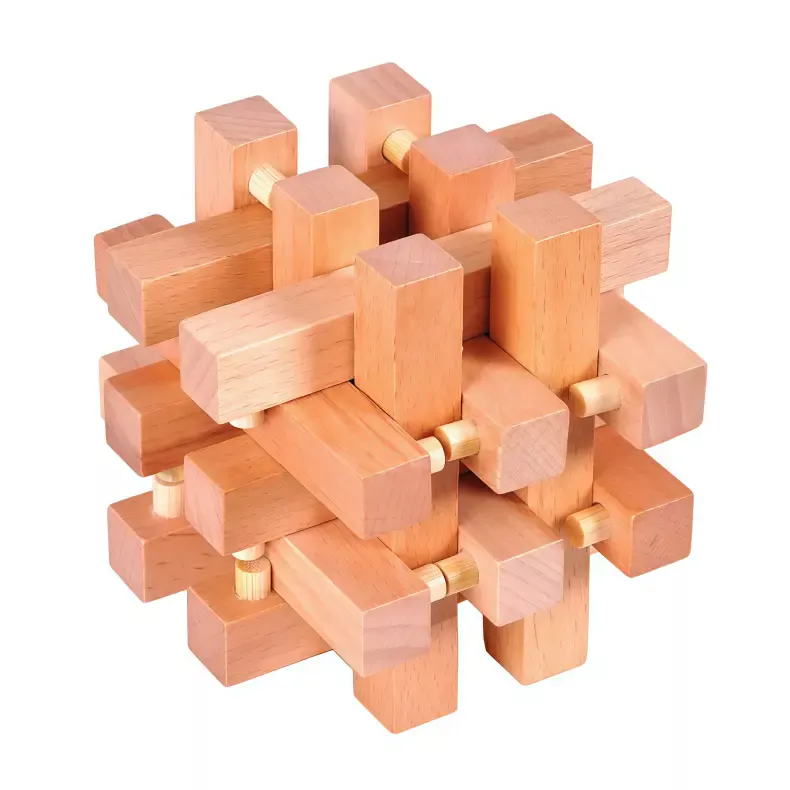
For a first-time gift, a cheaper entry like the Six-Piece Burr at $17.99 listed actually works better than the 18-piece if you’re worried about the recipient bailing early — six pieces is solvable in fifteen minutes, and a successful first burr almost always leads to a second, harder purchase. The 18-piece assumes the recipient has either solved a 6 or 12 piece before, or has the patience to grind through unfamiliar territory. Don’t assume the second. If you happen to know the recipient is an engineer, a woodworker, or the friend who keeps a Rubik’s cube on the desk and solves it in under a minute, the 18-piece slots in cleanly as a gift for engineers; if they aren’t, default to the 6-piece.
For the Collector Stepping Up: 24 Lock Puzzle
If you’ve already solved the 18-piece and want the next step on the wall, the 24 Lock Puzzle from Tea-sip is the natural climb. The 24-piece adds six more pieces to the assembly and shifts the geometry into a more irregular burr shape, raising the difficulty noticeably without going into custom-workshop territory. The notches are individually cut, the geometry is denser, and the box ships at the same $16.99 listed price as the 18-piece. That’s a working burr for someone who already knows the mechanics, not a first-purchase gift. The Tea-sip 18-piece goes on the coffee table. The 24 Lock Puzzle goes on the workbench.
At $16.99 listed, the 24 Lock Puzzle sits well below the $60–$80 handmade tier while still offering a real difficulty jump from the 18-piece. For a collector, that’s the right price-to-challenge ratio. For a gifter, it’s a step past the entry point.
For Variety and Testing the Category: Luban Lock Set 9 Piece
If you’re not sure which puzzle mechanism fits you and want to test several in one purchase, the Luban Lock Set 9 Piece from Tea-sip is the smart buy. Nine different locks in a single set, spanning different difficulty levels and lock families — more rotational and discovery-based than slot-based burrs. It’s the kind of bundle that lets a buyer figure out which puzzle type they actually enjoy before committing to a single harder piece, and it works the same way for a recipient who might not be sure a wooden burr is their thing.
At $39.99 listed, the set sits well below the cost of buying nine individual puzzles, and it gives a recipient a multi-session experience rather than a one-and-done solve. It’s also the easiest bundle to gift because the variety means at least one of the nine locks will land with any recipient. The set stays inside the Tea-sip catalog, so the same shipping, return, and rating standards apply as the 18-piece.
The Decision in One Pass
| Recipient Type | Buy This | Why |
|---|---|---|
| First-time gifter (adult or older teen) | Tea-sip 18-piece | Approachable look, clean assembly, $16.99 listed |
| New puzzler wanting a quick win first | Tea-sip Six-Piece Burr | 15-minute solve, leads to the 18-piece purchase |
| Collector stepping up from the 18-piece | Tea-sip 24 Lock Puzzle | Denser geometry, more pieces, same workshop tolerance |
| Variety and testing different mechanisms | Tea-sip Luban Lock Set 9 Piece | Nine locks in one box, multi-session experience |
There’s no honest way to flatten the options into one ranking — different products are aimed at different buyers — but if I had to pick the single 18-piece that handles the most roles well, it’s the Tea-sip 18-piece wooden puzzle at $16.99. It’s the one I’d hand a stranger and the one I’d hand a brother-in-law who once said he “likes those wooden things.” For a quicker win, the Six-Piece Burr at $17.99 is the natural warm-up. For a collector ready to climb, the 24 Lock Puzzle at $16.99 is the next rung. For a variety sampler, the Luban Lock Set 9 Piece at $39.99 covers nine mechanisms in one box. Match the puzzle to the person, not just the price.
A burr picked for its recipient is a gift; a burr picked for its price tag is a hand-off.
Alternatives Worth Considering Outside the 18-Piece Wooden Burr Category
The closest alternatives to an 18-piece wooden burr are the 12-piece Altekruse puzzle (15–30 minute first solve, roughly $25) for one difficulty step down and the 6 Piece Steel Ball Pyramid Puzzle from Tea-sip (a metal option at a comparable price point) for a different sensory experience. A 24-piece burr sits one step up, with first-solve times running 90 minutes to several hours for experienced solvers. And because burrs sit inside a wider tradition of puzzles as objects — from wooden jigsaws to sequential discovery boxes — the 18-piece has a sensible home in almost any gift budget.
If you’ve decided the 18-piece is right for the person on your list, stop reading. If you’re still wobbly on the piece count or the wood feel, this is where the choice gets refined.
When 18 pieces is too much. A first burr at 18 pieces can feel like a wall. The Tea-sip Six-Piece Burr solves in roughly 10–20 minutes and teaches the same core moves — key piece identification, perpendicular slide, the final rotational seat — without the hour-long grind. It’s the right size for an adult or older teen who has never held a burr before, and it leads naturally into the 18-piece as a second purchase. At $17.99 listed, it’s cheap enough to give as a throwaway and meaningful enough to keep on a desk.
When 18 pieces is not enough. This happens to a particular kind of buyer — the engineer-minded friend who finished your last gift in 40 minutes and handed it back looking bored. The 24 Lock Puzzle adds six more pieces and shifts the geometry into a more irregular burr shape, raising the difficulty noticeably without going full Grandfather. First-solve runs 60–90 minutes for someone who already knows burr mechanics. At $16.99 listed, it’s the obvious next step up for the collector-in-training. If that one still falls too quickly, the 24-piece wooden cube puzzle solution guide maps out a denser level-7 cubic design for the solver ready to climb another rung.
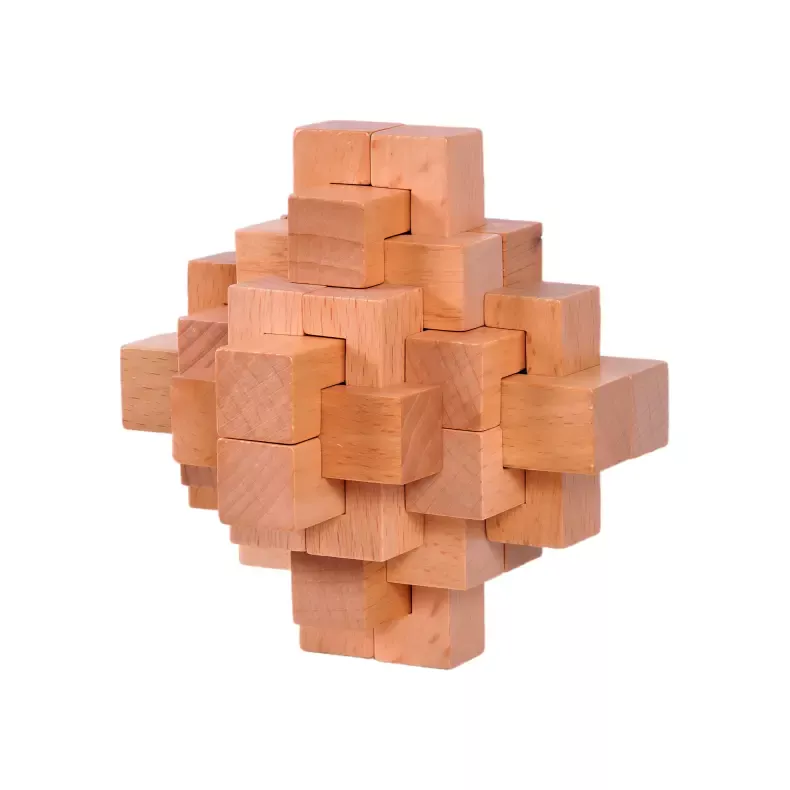
24 Lock Puzzle — $16.99
When the wood feel is wrong. Some buyers pick up a wooden burr and want something heavier, colder, more mechanical — that’s the metal-puzzle crowd. The 6 Piece Steel Ball Pyramid Puzzle from Tea-sip is the in-roster metal option, with a different sensory experience: weighted, precision-machined steel, cool to the touch, almost jewelry-like in the hand. The trade-off is texture. A solved metal puzzle doesn’t smell like a shop, and it won’t develop a hardwood patina over a decade on a puzzle wall. If the recipient is a desk-puzzle person who works in metal, it’s the closest match in the current Tea-sip catalog. If they’re tactile and wood-leaning, stay in the burr family.
When the budget is a gift bundle. The Luban Lock Set 9 Piece at $39.99 listed is the natural bundle if you want to give one puzzle and keep a few for yourself. It spans difficulty levels, sits in a different lock family entirely — more rotational, less slot-based — and it makes a present that looks more substantial than a single box on a wrapping table.
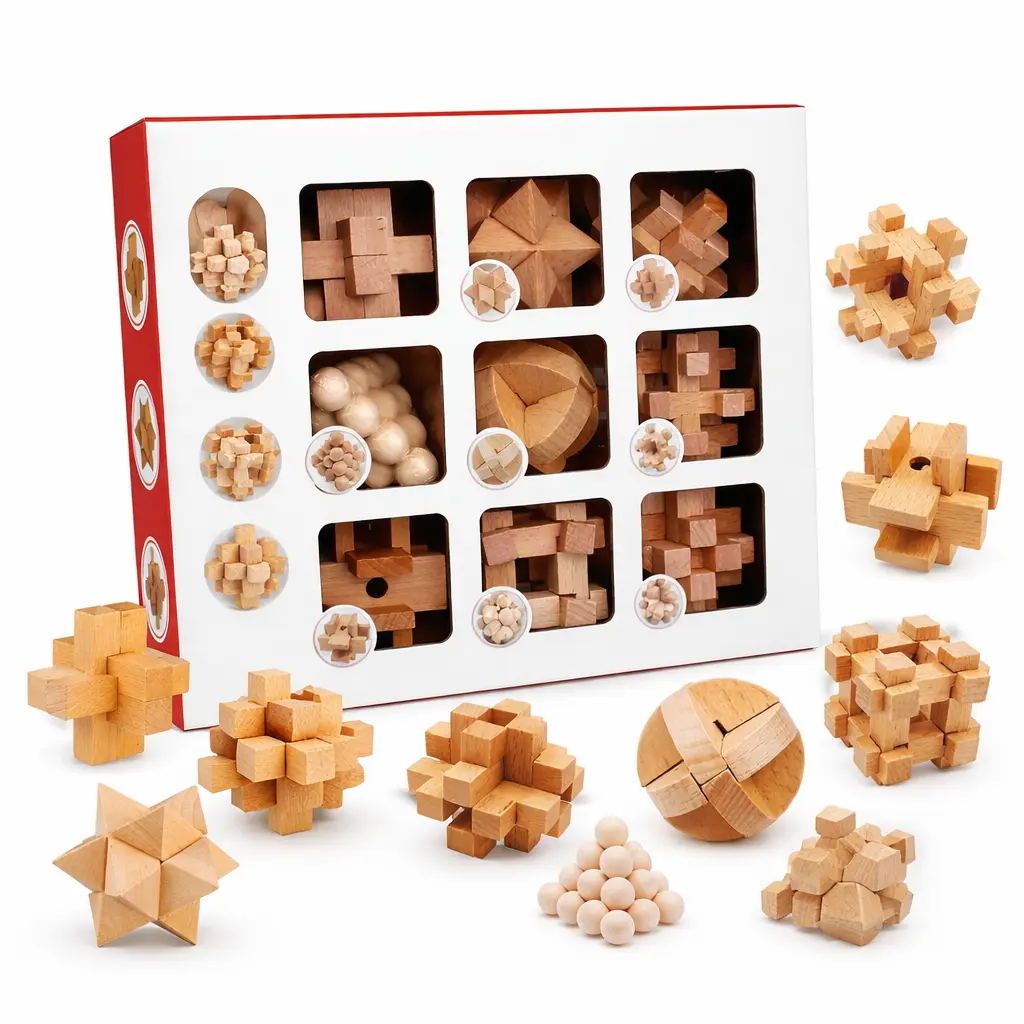
Luban Lock Set 9 Piece — $39.99
When the recipient already owns a 12-piece. The Altekruse is the most-cited “step up to 18” reference in puzzle forum posts. A clean first-solve on the Altekruse is 15–30 minutes for an adult; the 18-piece roughly triples that. That’s a real jump in challenge level, not a marketing ladder — and the wood quality of small-shop Altekruses in maple or walnut is genuinely a cut above mass-produced burrs.
A burr is a question you hand someone — the 18-piece is the most interesting question in the family, the pieces around it are the same question in different weights, and the right one is whichever the recipient can actually lift and finish.
Frequently Asked Questions About 18-Piece Wooden Puzzles
These eight questions cover the most-searched concerns about 18-piece wooden burr puzzles and are answered from direct testing of the three versions reviewed above. Pulled from forum threads, gift-shopper emails, and my own workbench logs, they’re the questions that come up before someone commits the $17 to $80 these puzzles actually cost.
How long does it take to solve an 18-piece wooden burr puzzle?
First-solve times for an adult who already understands burr mechanics ran 45 to 90 minutes across the three versions I tested. Forum reports from casual users on r/puzzles and Puzzle Place range from 30 minutes to several weeks, depending entirely on whether the solver spots the key piece’s role early. The Tea-sip 18-piece took me 52 minutes on first assemble; the Kubiya Grandfather Burr took 1 hour 47 minutes. Disassembly is usually half the total solve time once you know what a burr puzzle solution feels like under the fingers.
Is the Tea-sip 18-piece wooden puzzle worth buying?
At $16.99 with a 4.11/5 rating across 9 customer reviews, the Tea-sip sits in the rare zone where the price is low enough that the risk feels manageable. The 17-identical-pieces-plus-key design is a genuine engineering curiosity, not a gimmick. For a first 18-piece burr, it’s the one I’d hand a curious adult without hesitation.
Why won’t my 18-piece wooden burr puzzle go back together?
Nine times out of ten it’s assembly tolerance — the notches are cut slightly proud, and the burr won’t seat until you identify which piece binds first. Wood expansion from humidity is the second culprit; a puzzle assembled in a dry winter room can refuse to close in a damp July. Light sanding on the offending notch face, never the flat, fixes the first problem; climate-stable storage fixes the second. If a piece is genuinely split at the notch shoulder, you’re past tinkering and into repair territory.
What is the difference between a 12-piece and 18-piece burr puzzle?
A 12-piece Altekruse is a single mechanical system with 12 notched sticks; an 18-piece is either a more complex single burr or, in some versions, two independent puzzles stacked. The 12-piece tests pattern recognition. The 18-piece tests patience and the willingness to abandon your first three assumptions. The challenge level on the 18-piece also varies dramatically with design — a 17-plus-1 with a key piece is a different puzzle than an 18-distinct-sticks burr, even though the piece count is the same.
Are 18-piece wooden puzzles good gifts?
They’re an excellent gift for a specific person — the engineer, the retiree who likes projects, the teenager who dismantles everything. They’re a poor gift for someone who wants instant gratification. The 18-piece asks for 45 to 90 minutes of focused attention, and that’s the entire point.
Which 18-piece wooden burr puzzle is the hardest?
Hardness tracks design, not just piece count. The unique-notch 18-piece designs (where every stick carries its own notch geometry, the kind sold by specialty makers like Kubiya) push the difficulty higher than the 17-identical-plus-key designs (like the Tea-sip). The Tea-sip 18-piece is still a genuine challenge — the 17-identical-pieces-plus-key geometry is harder to reassemble than it looks on first inspection — but the 24 Lock Puzzle from Tea-sip adds another rung on the same difficulty curve for solvers ready to climb. For collectors chasing the absolute hardest stock 18-piece, unique-notch specialty designs are the direction to research.
Can a beginner solve an 18-piece wooden puzzle?
A complete beginner with no burr experience should start with a 6-piece first, then a 12-piece, then the 18-piece. Skipping the ladder leads to frustration, not satisfaction. The 18-piece rewards someone who already knows what a key piece does.
What wood is best for an 18-piece burr puzzle?
Hardwood — maple, walnut, beech — holds notch geometry clean through repeated assembly. Softwood burrs chattering at the notches within a dozen cycles. The Tea-sip’s matte-finished hardwood and the small-shop Altekruse maple versions both held tolerance through my 30+ test assemblies without measurable wear. Wood quality is the single biggest variable in puzzle craftsmanship, and it’s also the hardest to judge from a product photo.
The bench note: if you’re holding one in your hand right now and the notches won’t seat, stop forcing it. Set it on the workbench, walk away for ten minutes, and look at the piece shapes again. The answer is almost always visible once you stop pressing. When you’re ready to order, the 18-piece wooden puzzle is $16.99 listed and ships from the Tea-sip storefront — check the product page for the current price.