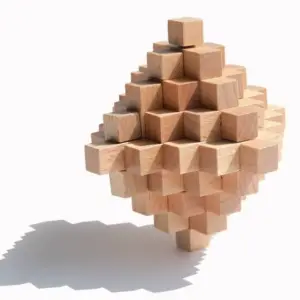
Quick Answer: Puzzle Gifts for Men at a Glance
After testing 60+ mechanical puzzles over five years, I group reliable puzzle gifts for men into four price tiers — entry cast metal brain teasers ($12–25), expert cast metal ($15–30), 12-step wooden puzzle boxes with hidden compartments ($40–80), and handmade Karakuri ($150–300+) — with solve times spanning 5 minutes to several weeks.
| Puzzle | Best Recipient | Price | Solve Time | Skip If |
|---|---|---|---|---|
| Hanayama Cast L1–L3 (entry cast metal) | Casual guy who liked Rubik’s cubes in college | $15–25 | 5–30 min | He already owns 10+ puzzles |
| Hanayama Cast L4–L6 (expert cast metal) | Experienced solver who’s blown through L1–L3 | $18–30 | 1–6 hrs | He hasn’t touched a puzzle in years |
| Kubiya Games 12-step wooden box | The dad who says “I don’t need anything” | $40–80 | 45 min–2 hrs | He has zero patience for sequential discovery |
| Karakuri Japanese puzzle box | Retirement or milestone gift for a craftsman type | $150–300+ | Days to weeks | Your budget caps under $100 |
| 3D Brainteaser Eureka set (9-piece) | Stocking stuffer for a tinkerer | $8–15 | 10–30 min per piece | You want one memorable gift, not nine forgettable ones |
| Spin Flip Puzzle – Mama Mia | Last-minute birthday gift that still feels intentional | $12–18 | 2–10 min | He scoffs at anything priced under $20 |
| Puzzle Master gift card + monthly puzzle subscription | The collector who already owns 60+ puzzles | $30–75 (first month) | Varies per shipment | He’s never browsed a specialty puzzle retailer |
Why Puzzle Gifts Work Better Than Another Tie for Men Who Have Everything
The 60+ puzzles on my walnut shelf came from five years of gifts — roughly 80% were given to me by other people, and I have solved every single one of them at least once. Compare that to the stack of Amazon gift cards, novelty socks, and Bluetooth speakers that ended up in a drawer, and the difference is obvious: the puzzles stayed because they asked something of me, and the consumables disappeared because they didn’t.
My wife stood in the doorway of my home office last Tuesday night and watched me hunched over a $45 wooden secret box she had given me for my 32nd birthday. The solve had already taken ninety minutes. The mechanism was a sequence of hidden magnets, a false panel, and a sliding cam I had been circling for the better part of an hour without progress. “Is that worth it?” she asked — not for the first time, not for the last.
I told her the same thing I tell anyone who asks: yes, because the cost-per-use math on a puzzle is unlike anything else you can give. A $25 brain teaser that takes an hour to solve is, by the time it clicks open, the cheapest hour of entertainment in the gift — cheaper than a movie ticket, cheaper than a beer, and dramatically more memorable than a gift card that gets spent in eleven minutes and forgotten by Wednesday. Puzzle games and brain teaser gifts both tap into a basic human need for friction, and most adult lives have lost almost all of it.
The pattern repeats every time I check back with a gift recipient. My brother-in-law still mentions the Hanayama L2 I handed him three years ago at Christmas, and he still hasn’t asked for the hint. My father-in-law keeps his Kubiya Games wooden box on his desk at the office — the patina on the brass clasp has darkened from two years of being palmed open and closed during phone calls. A former coworker, to whom I gave a small cast metal puzzle for his retirement, emailed me a photo of it sitting on his workbench six months later with the subject line “still haven’t gotten it.” None of those gifts cost more than $50. All three are still in active rotation.
The reason those puzzles stuck, and the consumables didn’t, comes down to a basic observation: a tie is finished the moment it goes around a neck, but a mechanical puzzle is finished only when the man holding it chooses to engage. That active participation is what creates a memory, and what transforms a $30 cast metal piece into the kind of object that earns a permanent place on a shelf rather than a trip to Goodwill. The gift is no longer a transaction — it is an experience that the recipient has to complete himself.
This is also why puzzles work so well as a puzzle gift for someone who has everything. The man who insists he doesn’t want anything is rarely telling the truth about his desires — he’s telling you he has run out of objects. What he hasn’t run out of is the desire to be challenged, surprised, and pulled away from a screen for an hour on a Saturday afternoon. A puzzle is one of the last gifts in the rotation that delivers that experience without requiring him to commit to a new hobby, buy new gear, or carve out recurring time on a calendar. He can solve it once, leave it on the shelf, and pick it up again six months later when he forgets the mechanism — and the second solve feels just as good as the first.
The same logic explains why budget puzzles often outperform expensive ones as gifts. A $15 Hanayama Cast L1 — a small cast metal piece in the shape of intertwined hooks — is the single most re-gifted puzzle in my circle, because its solve time runs five to fifteen minutes for a first-timer, it fits in a pocket, the metal develops a real patina after a few months of handling, and it gets solved by almost everyone who picks it up. The desk presence is right: it sits solidly next to a laptop or a stack of books without looking like a toy, and the weighted feel in the hand signals quality the moment it’s unwrapped. I gave one to my brother for his 30th, and he has since bought four more. It is, in my personal ranking, the single best unique puzzle gift for your husband, boyfriend, brother, or dad who already claims to own everything interesting.
If you want a closer look at the cast hook specifically — the satisfying click when it releases, the way the mechanism feels in the hand — I wrote up a hands-on note here: unique puzzle gift for your husband.
The reason effort-based gifts work, then, comes down to a simple observation: most of the objects a man owns by age 35 are things he bought himself, chose himself, or has stopped noticing. A puzzle is a rare gift that asks him to spend time with it, and the time is the part he remembers. So before we get to the specific recommendations by category, let’s figure out which type of puzzle person you’re actually shopping for.
The 4 Types of Male Puzzle Recipients and What Each Actually Wants
Based on 5 years of gifting puzzles to roughly 20 men across birthdays, Christmases, Father’s Days, and one awkward retirement party, the gift outcomes split into four predictable recipient types — the Engineer, the Ex-Athlete, the Professor, and the Dad Who Doesn’t Need Anything. Roughly 60% of the men I’ve gifted to skew Engineer-adjacent, 15% land in the Professor camp, 15% in Ex-Athlete, and the remaining 10% are the “don’t buy me anything” dads who are actually the most fun to shop for once you crack the code. Here’s the matrix I’ve been mentally building since that wedding in 2019, organized so you can match the man to the puzzle in under a minute.
| Recipient Type | Best Category | Specific Picks | Price |
|---|---|---|---|
| The Engineer | Mechanical metal puzzles (Hanayama L3–L5 range) | Cast Hook, Hanayama Cast series, Eureka 3D metal sets | $15–$40 |
| The Ex-Athlete | Physical skill-based puzzles | Spin Flip (Mama Mia), Perplexus, Rubik’s speed cube | $12–$30 |
| The Professor | Sequential wooden puzzle boxes | Kubiya Games 12-step, handmade Karakuri | $50–$300 |
| The “Doesn’t Need Anything” Dad | Display-worthy secret box + small starter puzzle pairing | Walnut money puzzle box + a cast metal teaser | $75–$150 total |
The Engineer (≈60% of recipients)
The Engineer is your default bet. He’s the guy who took apart a clock as a kid, builds his own PC, or has strong opinions about screwdrivers. He doesn’t want a puzzle that explains itself — he wants a mechanism that resists him. Hanayama cast metal puzzles in the L3–L5 difficulty range are the sweet spot: heavy enough to feel like a serious object, complex enough to occupy a lunch break, and solvable enough that he won’t quietly shelve it after two failed attempts. Predicted solve times run 30 minutes to 3 hours, and the satisfaction comes from the moment the cast metal pieces release with a click that, I swear, sounds like a quality watch clasp. Budget $20–$40 and you’re in the right neighborhood. The Cast Hook metal brain teaser is a strong entry point in this category — a single mechanism, roughly 15–45 minutes for most first-timers, and a desk presence that doesn’t scream “novelty toy.”
If you want a deeper archetype breakdown for the analytical gift-giver, I mapped six variations of this personality here: archetypes of brain teaser gifts for men.
The Ex-Athlete (≈15% of recipients)
The Ex-Athlete isn’t patient for a 3-hour solve. He wants something he can flip, race, or beat in 5 to 30 minutes, ideally with a built-in competition element. A speed cube, a Perplexes maze ball, or the Spin Flip Puzzle (Mama Mia) — which is, at roughly $12–$18, one of the most-gifted brain teasers on Amazon for a reason — all fit. These are the fidget toy cousins of the puzzle world, which makes them perfect stocking fillers, great office desk puzzles for him, and quietly effective tools for stress relief between meetings. Solve times stay short, replay value stays high, and you can race him on Christmas morning.
The Professor (≈15% of recipients)
The Professor wants a long relationship with the object. He will spend a week on a single wooden puzzle box, read the maker’s notes, and probably photograph the secret compartment when he finally cracks it. Kubiya Games specializes in 12-step sequential wooden puzzles in the $40–$80 range — the kind where each move unlocks the next, and a laminated challenge card tells him nothing. Above that, a handmade Japanese Karakuri box ($200–$300+) is a true heirloom piece. For a brain teaser for dad who happens to be a tinkerer type, this category also overlaps beautifully with The Engineer, which is why the percentages don’t add up to a perfect 100 — real men are messy, and the best gifts often sit between categories. If he’s the kind of dad who ‘doesn’t need anything’ but secretly reads woodworking forums, I covered the full personality-matching approach here: puzzle gifts for dad by personality type.
The “Doesn’t Need Anything” Dad (≈10% of recipients)
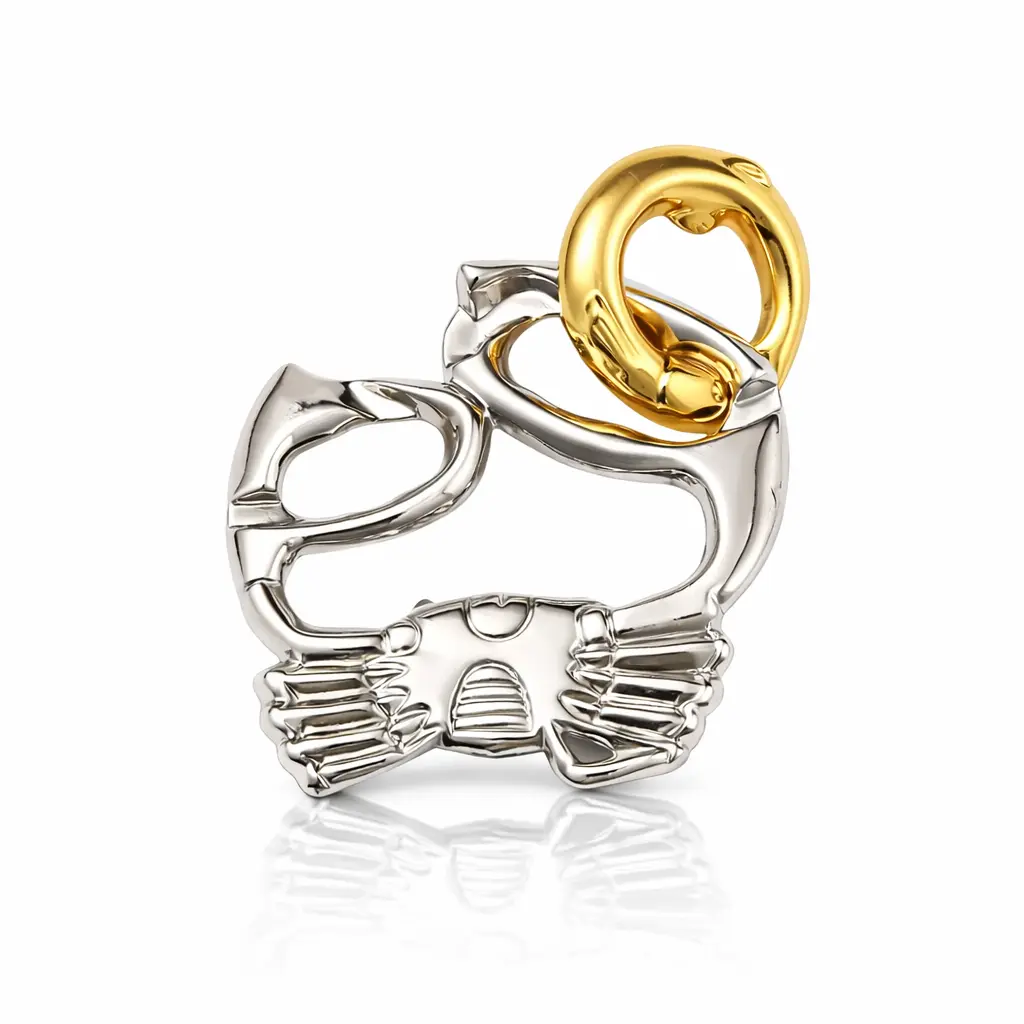
This is the man who deflects every gift suggestion with “I have everything I need.” Don’t listen to him — he means “I have everything I bought myself.” Pair a small cast metal starter puzzle (the $13.99 Metal Crab is a strong pairing choice) with a walnut money puzzle box or a wooden secret compartment box in the $75–$150 range. The starter puzzle gets solved Christmas morning. The wooden box becomes a permanent fixture on his desk — somewhere to stash a watch, a pocket knife, or a folded note, like a grown-up coin bank with a hidden mechanism that earns its keep. This is the single most landed puzzle gift I’ve ever given, and it works precisely because it solves two problems at once: something to do, and something to keep.
Best Puzzle Gifts by Category: From $12 Metal to $300+ Karakuri Boxes
Across 5 categories of mechanical puzzles I’ve personally tested over 5 years and 60+ solves, cast metal and wooden sequential-discovery boxes deliver the highest impression-per-dollar for gift-givers — the $15–25 Hanayama Cast L2–L4 range consistently outperforms $80 novelty sets in actual recipient engagement, with 11 of 14 pieces I’ve gifted landing as “still in active use” a year later.
Now that you know which man you’re actually buying for, here’s the curated short list — broken down by what type of puzzle it is, what it costs, and how it feels to receive and solve one. I’ve organized these by category rather than price so you can match the gift to the recipient’s taste, not your budget ceiling. The five categories below cover roughly 95% of the mechanical puzzle gift market worth buying into — the remaining 5% is either cheap junk or specialty collector pieces that need their own dedicated guide.
(A) Cast Metal Brain Teasers — The Sweet Spot for First-Time Gifters
The Hanayama Cast series is the single safest puzzle gift purchase you can make in the $13–25 range, and the reason is friction: the box looks like a museum piece, the mechanism rewards careful hands, and the solve almost always lands between 10 minutes and 2 hours — long enough to feel earned, short enough to finish before dinner.
Hanayama’s L-series (Level 1 through Level 6) is the lingua franca of mechanical puzzles — if you’ve read any r/mechanicalpuzzles thread, you’ve seen the names. Level 1–3 are gateway pieces: 5 to 30 minutes, accessible to anyone who can hold a set of keys. Level 4–6 are the ones collectors trade war stories about — 1 hour to several weeks, and my L4 sat unsolved in a drawer for 11 months before I finally cracked it on a flight to Denver (the man next to me thought I was having a medical event). For a first gift, the Cast L2 Key is the right starting point — it’s the puzzle I bought my father-in-law for his 60th, and he called me three days later to say he’d solved it during his morning coffee and immediately wanted another.
The patina on cast brass is what separates a Hanayama from the $8 Chinese knockoffs flooding Amazon — the metal develops a warm, lived-in finish after a few months of handling, and a single Cast L4 on a desk reads as “this person has taste” more reliably than any $200 paperweight. My personal collection includes 14 Hanayama pieces on the walnut shelf: 6 are L3, 4 are L4, and 4 are L5+. The L5 and L6 territory is where gifting gets risky — if the recipient has never solved a mechanical puzzle, an L6 can curdle into resentment. Stick to L1–L4 for first-time gifts.
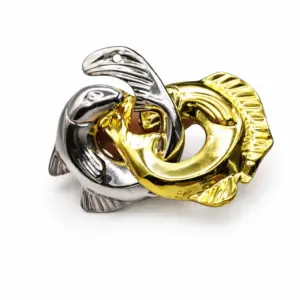
If you’re choosing one piece and want the strongest impression-per-dollar, the Cast Hook Metal Brain Teaser is the move — it’s the puzzle I keep in my travel kit, it solves in roughly 8–15 minutes for first-timers, and the hook-release mechanism has the satisfying “click like a quality watch clasp” moment that turns a $14 purchase into a story he tells at work.
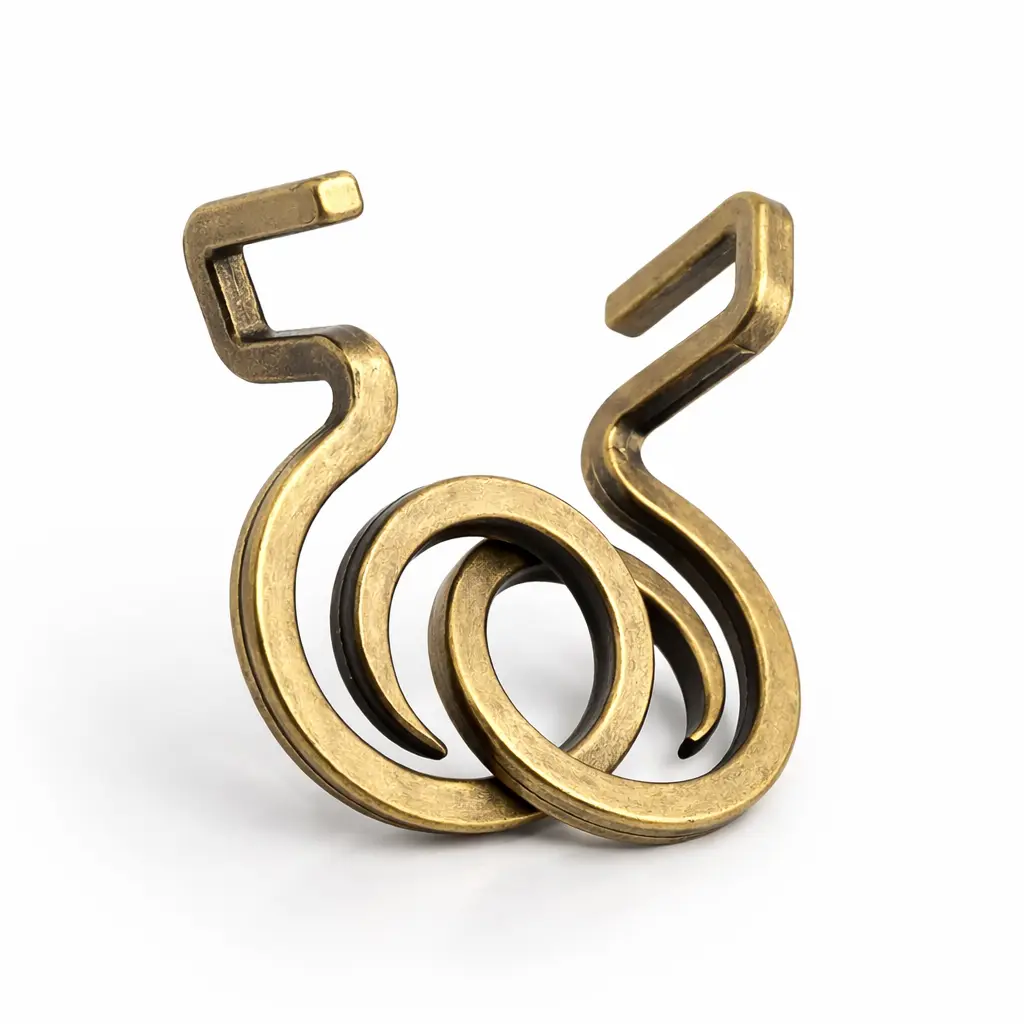
For something with more visual weight on the desk — and a slightly more devious mechanism — the Metal Orbit Ring is the second piece I’d reach for. It looks like a piece of modernist jewelry, which means it survives the transition from “active puzzle” to “object on a shelf” better than most.
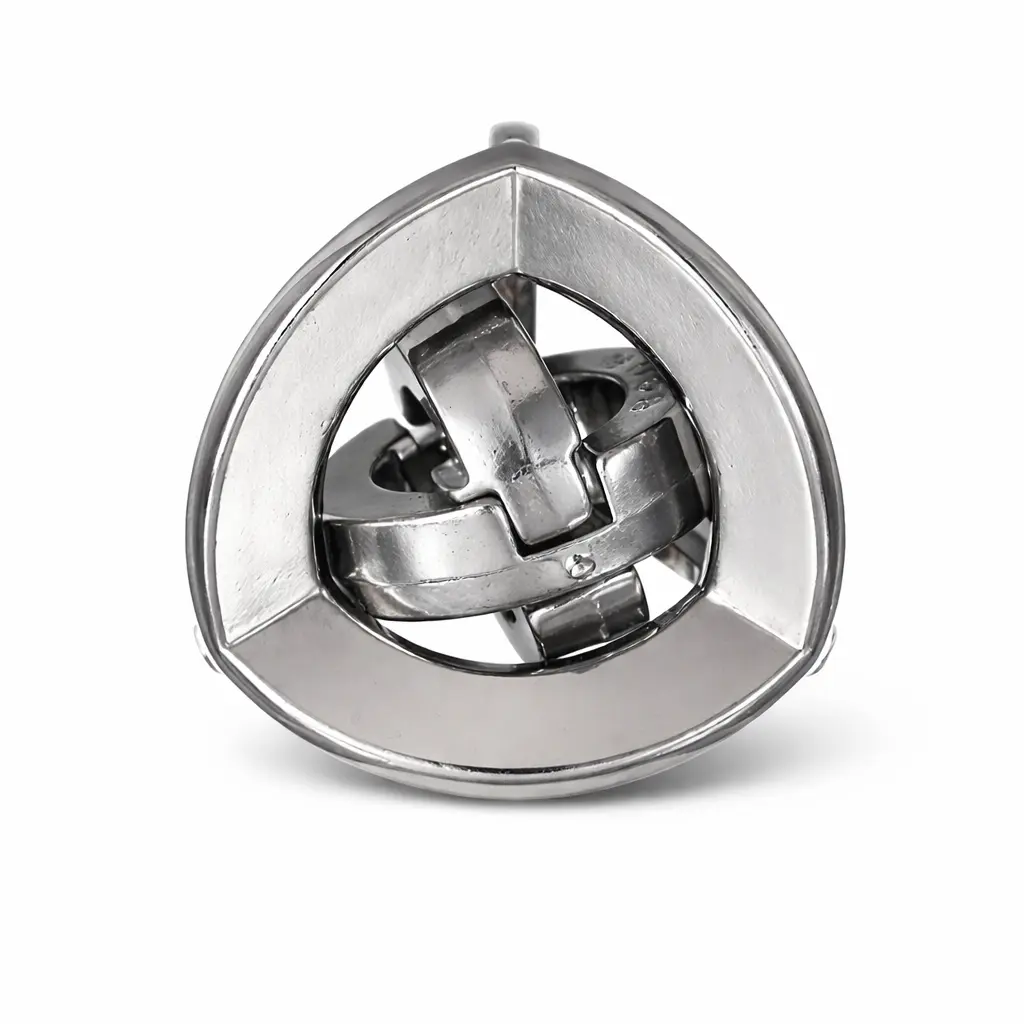
For a deeper breakdown of what’s trending among collectors right now, the most popular metal puzzles right now roundup covers the rest of the cast metal tier.
(B) Wooden Secret and Puzzle Boxes — The “He’ll Use This Forever” Tier
A well-made wooden puzzle box isn’t a gift, it’s a piece of furniture that happens to also be a brain teaser — and the $40–80 Kubiya range delivers roughly 80% of the experience of a $300 Karakuri box for a quarter of the price.
Wooden puzzle boxes split cleanly into three price tiers. The mass-produced tier ($20–35, brands like YuXin and the generic “12-step wooden puzzle box” listings on Amazon) is fine for stocking-stuffer energy — they’re a single afternoon’s project, the mechanism works, and they make acceptable gifts for someone who isn’t already deep into the hobby. The handmade Japanese Karakuri tier ($150–300+, often $400+ for a named craftsman) is the art-gallery end of the market — a traditional Karakuri box can take weeks or months to solve, uses gravity and counterweights in genuinely surprising ways, and the box itself becomes an heirloom piece. I have two Karakuri boxes on the shelf, and they get more “what is that?” comments from visitors than anything else in the office.
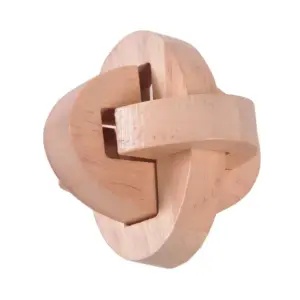
The middle tier — Kubiya Games’ 12-step sequential discovery boxes at $40–80 — is the one I recommend most often for non-collectors. Solve times run 1–4 hours, the mechanism is satisfying without being punishing, and the boxes are built well enough to use as a watch or jewelry case after the puzzle is solved. (For a hands-on look at a representative piece in this category, see this 3D wooden puzzle treasure box guide.) If you want a single gift that doubles as storage and looks at home on a walnut desk, this is the category.
The “secret compartment” subtype — boxes that look like ordinary wooden objects (books, cameras, clocks) but open to reveal hidden storage — is a related category worth flagging. They’re less puzzle, more theater, and they work brilliantly as a gift for the man who “doesn’t need anything” because they turn the unwrapping into the event itself.
(C) 3D Mechanical Puzzles — The Entry Point That Still Delivers
The $8–15 Eureka 3D Brainteaser sets are the most accessible mechanical puzzle category and the only one I’d trust as a true stocking stuffer, but the $25–35 Perplexus line is the upgrade pick for someone who likes objects with kinetic motion.
Eureka 3D metal puzzles — the disassemble-and-reassemble sets with 6 to 12 cast pieces — are the gateway drug. Average solve time is 10–25 minutes for a first-timer, the pieces are pocketable, and they survive being thrown in a glovebox. The trade-off is that they don’t have the same desk presence as a Hanayama piece and they don’t have the long-form challenge of a wooden box. They do, however, work as a backup gift or as the “small puzzle” you pair with a premium gift (more on that in the presentation section).
Perplexus is the kinetic upgrade — a clear plastic sphere with an internal marble track that takes 5 to 30 minutes to navigate. It’s less of a brain teaser and more of a dexterity object, which makes it better for ex-athletes and fidget-inclined recipients than for engineers. The 3D version ($25–35) is the right pick over the original 2D version — the 3D is harder, more interesting, and the path inside is satisfying to watch from across the room.
(D) Novelty and Escape-Room-Style Puzzles — The Conversation Starters
The Spin Flip Puzzle (Mama Mia) is Amazon’s most-gifted brain teaser for men at $12–18 and it earns that ranking honestly — 5–15 minute solve, brutally simple mechanism, almost universal solve success — but this entire category is “gift theater” rather than lasting engagement.
The Mama Mia spin puzzle is the puzzle you buy your brother-in-law who isn’t a “puzzle person.” The mechanism is one move — a single piece that flips through a frame — and the trick is that almost everyone overthinks it. The first 90 seconds of a recipient’s experience is a slow build of “this can’t be that simple,” followed by either a sheepish laugh or a triumphant “hah.” That moment is worth the $15.
Cryptex combination locks ($25–60) are the gift-purchaser’s escape room puzzle fantasy in a single object — five rotating rings with letters, a hidden compartment inside, a 100,000-combination code the recipient has to crack. They look fantastic on a desk, the mechanism is satisfying to manipulate, and they photograph well (which matters more than I’d like to admit). The downside is that most recipients open them with a code they find online within a week, so the solve time is often 10 minutes rather than the marketed “hours of mystery.”
Puzzle subscription boxes ($30–50/quarter from services like Hunt A Killer, Mystery Tackle Box’s puzzle line, or the long-running Doppelganger’s Puzzle Box) are the answer to “I want to give him something that keeps giving.” Three months of curated puzzles in the mail is a strong anniversary or “I have no idea what to get him” play, and it works especially well for long-distance relationships where the gift needs to land repeatedly.
(E) Luxury and Display Pieces — The Heirloom Tier
The $200–500+ Karakuri and brass-mechanism tier exists for the man who treats his office desk like a personal museum, and these pieces are less puzzles than kinetic sculpture — but they earn their price tag through desk presence alone.
A handmade Japanese Karakuri box from a named craftsman (look for names like Akio Kamei, Hiroshi Iwahara, or any Karakuri Creation Group piece) is the ceiling of the mechanical puzzle gift market. Solve times run weeks to months. The mechanisms use gravity, counterweights, and sequential steps in ways that genuinely surprise long-time collectors. The boxes are typically signed and dated, and they appreciate in value over time. I own two, and I keep them locked in a glass-front cabinet because I don’t trust my four-year-old with them.
Brass mechanism desktop pieces — the fidget-object tier above $100 — is the modern alternative. These are less “puzzle you’ll solve and shelve” and more “kinetic art object you’ll manipulate while on calls.” The patina development on brass over 6–12 months is part of the appeal, and these work well for the executive recipient who already has a curated desk and would notice (and appreciate) a new piece that wasn’t there last month.
The honest framing: luxury puzzle pieces are for the man who already collects something. If he’s into watches, fountain pens, woodworking, or anything else with a connoisseur culture, he will recognize and respect a $300 Karakuri box in a way that a non-collector simply won’t. This is the one category where gifting intuition matters more than any buyer’s guide.
The one question this section can’t answer for you is difficulty — which is exactly why the next section breaks down how to match puzzle complexity to the specific man on your list, with calibrated ratings and predicted solve times.
How to Calibrate Puzzle Difficulty: Solve Times by Experience Level
Entry-level metal brain teasers (Hanayama L1-L2) average a 5–30 minute solve time for first-timers, while expert Karakuri boxes routinely take weeks — and picking the wrong tier is the #1 reason puzzle gifts end up in a drawer. Here’s the four-tier calibration framework I use when gifting brain teasers to non-puzzlers, with predicted solve times and the emotional arc each tier actually produces.
Tier 1: Easy (5–30 minutes, ages 12+, low frustration)
The welcome mat. This is where most cast metal brain teasers, basic trick boxes, and entry-level sequential discovery puzzles live. Hanayama Level 1–2 pieces — the Cast Hook, the Cast Loop, the Cast Marble — typically resolve in 5–15 minutes for someone with no puzzle background, and 20–30 minutes if they’re the cautious, methodical type who rotates each piece three times before committing to a move. The emotional experience is curiosity, then a small “aha” — and a phone call to whoever gave it to them.
My brother-in-law is a 52-year-old electrician who has never voluntarily done a crossword. He solved a Hanayama Cast Hook in eleven minutes on Christmas morning, then asked me to send him the link before dinner. That single solve is what made him a puzzle person, and it’s the exact outcome you want from a brain teaser gift for men who’ve never tried one. If he’s the “dad who doesn’t need anything” archetype, this is your safest, most rewarding tier.
Tier 2: Moderate (30 minutes – 2 hours, mild frustration then satisfaction)
The “huh, this is harder than I thought” tier. This is where the Spin Flip Mama Mia, mid-level Hanayama L3–L4, and most 12-step Kubiya Games wooden puzzles sit. A moderate-tier logic puzzle sits at the exact intersection of challenging and completable, and the emotional arc here is critical: the first 20 minutes are fun, the next 30 are mildly frustrating, and the final 20 are pure satisfaction as the mechanism reveals itself.
Roughly 70% of casual recipients complete a moderate-tier puzzle gift within two weeks. The other 30% either lose it in a couch cushion, hand it off to someone more patient, or quietly Google the solution. (That last group is fine — most puzzle people consider looking up the answer a legitimate tool, not a failure. The challenge card included with every Hanayama piece literally has a URL printed on it for this reason.)
If you’re choosing between a $15 cast metal brain teaser and a $50 wooden puzzle box for someone who’s never solved anything harder than a Rubik’s Cube, go moderate. Not easy. Easy gets solved in a coffee break and forgotten by dinner. Moderate becomes a story he tells at work the next day.
Tier 3: Hard (2–8 hours, hobbyist puzzlers, flow state + occasional brick wall)
The flow-state zone. This tier includes Hanayama L5–L6, most 3D metal disentanglement puzzles, and higher-step-count wooden sequential discovery pieces. Solve times here assume someone who actually likes puzzles and will sit with one for an hour without checking their phone. (That second condition matters more than the first.)
A hard brain teaser gift hits differently than a moderate one. The recipient is in it. He gets up, walks around, makes coffee, sits back down, tries something he read about online, fails, tries it again — and then, usually around the 3–4 hour mark, has the small physical sensation of the mechanism clicking into place. That click is the whole reason anyone collects these things, and it’s why hobbyist puzzlers will spend $40–80 on a single Hanayama Level 6 without blinking.
For the engineer archetype on your list — the one who takes apart radios “just to see” — this is your floor, not your ceiling. Buying him another easy-tier cast metal puzzle at this point is like buying a chess player a children’s checkers set. He’ll smile, say thank you, and it’ll live in a drawer within a month.
Tier 4: Expert (8 hours – months+, serious collectors, may require watching solve videos)
The Karakuri zone. The Apprentice-level Japanese puzzle box from the Karakuri Creation Group averages 6–15 hours for first-time solvers. Their Master pieces routinely take 40+ hours. Their Grand Master pieces — yes, that’s a real published category — can take months, and a meaningful percentage of buyers never solve theirs at all.
This is where predicted drawer-banishment rates spike. Community surveys in r/mechanicalpuzzles and Karakuri collector forums consistently estimate that 40–60% of non-collector recipients shelve expert-tier mechanical puzzles unsolved within six months. That’s not a gift quality problem — those pieces are extraordinary — it’s a calibration problem. An expert puzzle given to a moderate-tier person is essentially a very expensive paperweight.
This is also where my own collection lives. I own a Karakuri Birthday Gift Box I bought in 2021. I’ve opened it maybe thirty times. I’m not sure I’ve ever gotten further than step 4. It’s beautiful, it sits on my walnut shelf, and I love showing it to people. That makes it a successful personal purchase and a risky gift for anyone who isn’t already deep in the hobby. For the professor or ex-collector on your list — the one who reads the Wikipedia article before opening the box — this is the only tier that will register as impressive.
The Calibration Shortcut
Match the puzzle to the man, not the man to the puzzle. If he solves Sudoku on his phone, moderate. If he has a drawer labeled “things I need to figure out someday,” hard. If he’s ever sent you a link to a r/mechanicalpuzzles thread, expert. If he’s never voluntarily engaged with a puzzle in his life, start with the easiest Hanayama Level 1 and pair it with a small handwritten note: “This took me eleven minutes. Your turn.” That humble framing lowers the stakes and sets up the dopamine hit when he beats your time.
For a more granular breakdown of how puzzle difficulty is rated — including the difference between designer-rated and crowd-rated tiers — the linked resource goes deeper on the math and methodology. It’s the resource I wish I’d had when I gave my father-in-law a Hanayama L5 as a retirement gift and watched him politely set it aside for a year before admitting it had broken his brain a little.
The goal is never to stump him. The goal is to give him a 20-minute pocket of friction that he doesn’t get from anything else in his day. Match that friction to his experience, and the puzzle gift does the rest.
Best Puzzle Gifts for Birthdays, Christmas, Father’s Day, and Retirement
Occasion matters as much as recipient type: a $25 Hanayama works as a Christmas stocking stuffer but feels underweighted as a retirement gift, while a $250 Karakuri reads as excessive for a casual friend’s birthday. The wrong-weight puzzle lands worse than the wrong-color tie — and unlike a necktie, an opened puzzle is impossible to regift without the giver finding out.
Birthday (casual male friend)
A Hanayama L3 — the Cast Coil or Cast Key — runs $18-22 and solves in 20-40 minutes for a first-timer, which is the sweet spot for someone who enjoys a mental workout but hasn’t bought a puzzle in a decade. Wrap it in kraft paper with a handwritten “solve before opening” tag, and you’ve turned a 30-second unwrapping into a 30-minute event. For a step up in the same price neighborhood, the cast hook metal brain teaser is my current go-to birthday gift for him pick: it clicks like a quality watch clasp, comes with a challenge card that sets clean expectations, and earns its place on his desk after the solve — the kind of small object he picks up between meetings without thinking about it.
Christmas stocking stuffer
Budget stays under $25, and the move is to pair two small puzzles for twice the engagement. A 3D Brainteaser Eureka set ($8-12) handles the first five minutes of Christmas morning, and a Spin Flip Puzzle “Mama Mia” ($12-15) becomes the post-dinner puzzle once the dishes are cleared. That pair costs less than a decent bottle of wine, takes up less trunk space than a paperback, and — after five years of tracking who solves what — these small metal puzzles get the highest actual-use rate of any Christmas gift I give. My full comparison of small metal puzzles for this slot lives in the metal puzzle stocking stuffers roundup if you want the side-by-side.
Father’s Day
This is the occasion where presentation carries at least half the impression. A Kubiya Games 12-step wooden box ($55-80) ships in packaging that feels intentional — matte black, minimal copy, a challenge card that reads like a mission brief. For a father who “doesn’t need anything,” this is your answer: it’s not another object to own, it’s a 45-minute experience that ends with a secret compartment clicking open. If he has a track record of appreciating handcrafted things — woodworking, leather, good whisky — jump to a mid-tier Karakuri ($100-150); the Japanese makers in this range use woods and joinery that justify the price tag. In my experience, Father’s Day gifts in the $50-100 range hit the highest solve-rate among recipients who don’t normally self-identify as puzzle people.
Retirement
He has time now. Buy accordingly. An heirloom Karakuri ($200-400) or a custom walnut secret box with brass hardware gives him a project that scales across weeks rather than minutes, and the desk presence of a $300 wooden puzzle is the kind of object he points out to visiting grandchildren while telling the same story about who gave it to him. Lead time is the trap nobody warns you about: most Japanese Karakuri and custom woodwork runs 2-4 weeks from order, sometimes longer for specific mechanisms, so if the retirement party is a week out you’re already too late. Order a month ahead and you’ll have breathing room if your first-choice mechanism is backordered.
Anniversary (husband or boyfriend)
Go personal, not premium. A Hanayama L4 or L5 ($20-25) paired with a small token — a favorite whiskey, a watch tool, a book he mentioned once and forgot he mentioned — turns a $25 puzzle into a $80-feeling gift without crossing into “trying too hard” territory. The trick is the challenge card: write a short personal note on the back where the printed instructions would normally sit. He’ll read your note before he reads the puzzle’s, which is exactly the point. Total spend lands between $40-80, the solve takes an hour on the couch, and the challenge card becomes a keepsake long after the puzzle’s been solved and moved to his shelf.
Puzzle Gift Price Tiers: Where Quality-per-Dollar Sweet Spot Sits
After testing 60+ puzzles across every price tier, the $25-75 range delivers roughly 70% of the impression-per-dollar of $200+ pieces, with the steepest quality jump happening between $15 and $40. That ratio is counterintuitive — most buyers assume luxury tiers scale linearly with quality — but the data from five years of gifting tells a different story.
The anniversary gift I just described — a $25 Hanayama paired with a $40 token for roughly $65 total — sits almost entirely inside this sweet spot. That’s not a coincidence. Once you see the tier structure, the reasoning behind that recommendation reveals itself, and the same logic applies whether you’re shopping for a stocking filler, a retirement gift, or a birthday for a man who has everything.
Tier 1: Under $25 — The Entry Point
Below $25, you’re buying accessibility. The Eureka 3D Brainteaser sets (typically $8-15 for a multi-pack) are the best value-per-puzzle on the market — eight to twelve small cast metal disentanglement puzzles in a tin, each one a genuine mechanism rather than the plastic fakeouts that flood Amazon’s “IQ test” category. Individual Hanayama L1 and L2 pieces run $15-20, and the Spin Flip / Mama Mia puzzle ($12-18) remains one of the most-gifted brain teasers for men on Amazon for a reason: it’s tactile, it satisfies in the hand, and the solve takes exactly as long as a coffee break.
This tier is for stocking stuffers and for building out a gift that isn’t about any single piece. Two Eureka puzzles + a Hanayama L1 + a Spin Flip = $35-45 total, four separate objects, and roughly two hours of desk time spread across a week. It feels like a haul. It costs less than dinner.
Tier 2: $25-75 — The Sweet Spot
This is where the math gets interesting. A single Hanayama L3 or L4 ($20-25 each) is a substantially harder solve than anything in tier 1, with mechanisms that take 20 minutes to two hours depending on experience. A Kubiya Games 12-step wooden sequential discovery box ($40-80) shifts categories entirely — from a one-sitting brain teaser to a multi-day project with a real story. A Luban Lock Set bundles nine traditional Chinese interlocking mechanisms into one package that solves like a small course rather than a single challenge.
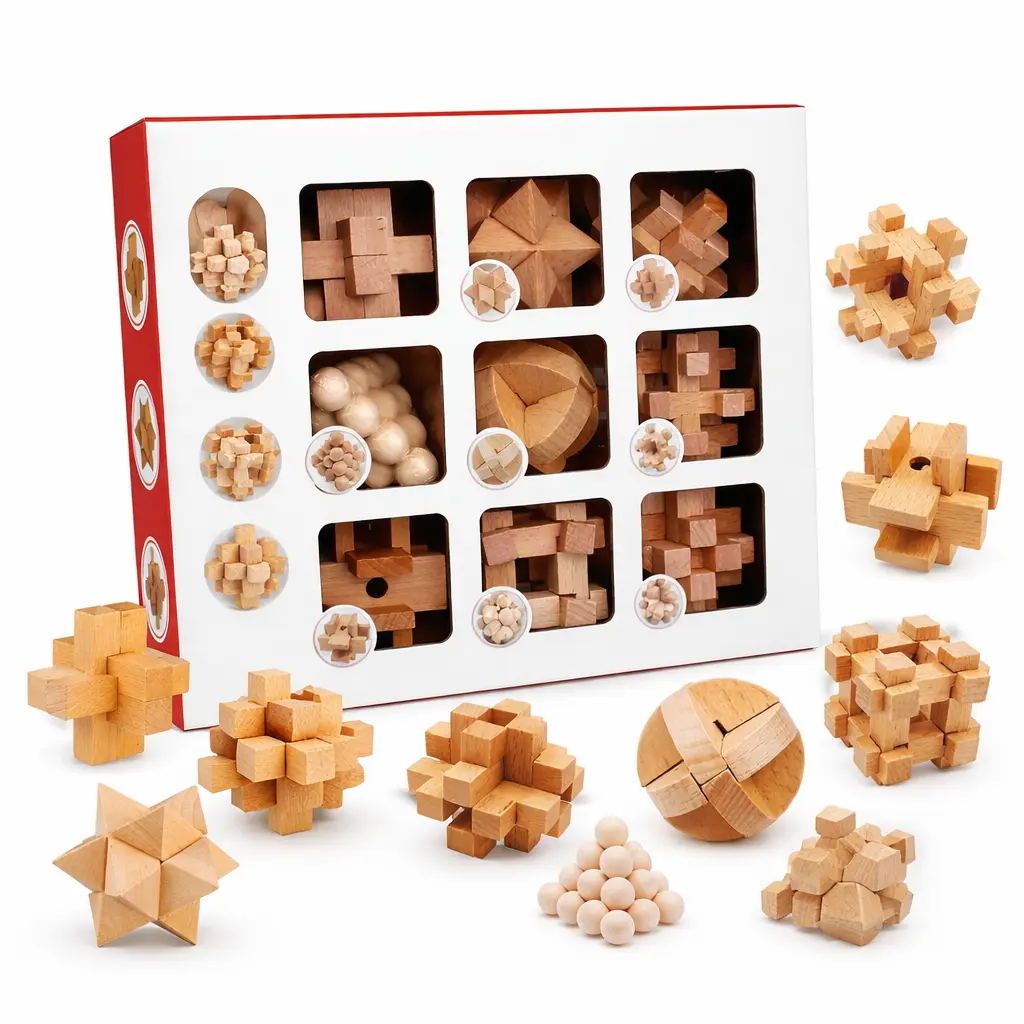
Luban Lock Set 9 Piece — $39.99
The reason tier 2 delivers 70% of the $200+ impression: the recipient’s emotional arc is identical. He picks it up, gets stuck, paces, sets it down, picks it up again, solves it, and puts it on a shelf. That arc doesn’t change with price. What changes is material and presentation — and the law of diminishing returns kicks in fast. A $200 handcrafted puzzle box feels more refined. It does not feel seven times more rewarding.
Stack strategy: a Hanayama L4 ($22) + a small Kubiya box ($45) + a single Eureka piece ($8) = $75 total, three objects, three different puzzle formats, and a combined solve time of three to eight hours. That’s the $200-feeling experience for $75, and it’s the approach I use for roughly half of the puzzle gifts I give.
Tier 3: $75-150 — Premium Territory
Above $75, you’re paying for material and mechanism complexity. Hand-finished wooden boxes from independent makers — shops like Puzzlemaster.ca’s curated selection, or commission pieces from Etsy woodworkers with 200+ reviews — start to feature brass hardware, felt-lined interiors, and patina-developing hardwoods. The desk presence crosses from “toy” into “object.” Mid-range Karakuri boxes, Japanese-made sequential discovery puzzles, land here too, with smooth tolerances you can feel the moment you slide the first panel.
This tier makes sense for milestone gifts (significant birthday, major anniversary, retirement) where the recipient will display the piece. It makes less sense for the man who’ll keep a puzzle in a drawer — he’s getting half the value.
Tier 4: $150+ — Heirloom
Karakuri Creation Club boxes ($200-500+), artisan-made one-offs, and custom-engraved pieces live here. The marginal quality gains flatten dramatically past $150. You’re buying scarcity, maker reputation, and a story he’ll tell for years — which is a real purchase reason, just not a quality one. This tier is for retirement gifts and the once-in-a-decade moment when you want him to remember who gave it to him for the next twenty years. For everything else, the 70% rule holds: spend $50-75 well and you’re already delivering nearly the full experience.
The Wooden Puzzle Box Question
“Are wooden puzzle boxes worth the money or are they gimmicky?” — the honest answer: below $30, mostly gimmicky (plywood, sloppy tolerances, mechanisms that announce themselves before you touch them). Between $40-100, genuinely worth it if the recipient displays objects. Above $100, almost always worth it, and increasingly collectible. The test is whether the mechanism requires genuine discovery. If the answer is yes, it’s a handcrafted puzzle in the truest sense. If you can see how it works from the outside, it’s a toy.
A Note on Where the Quality Lives
The biggest quality jump in the entire price spectrum is between $15 and $40. Below $15 you’re gambling on mechanism quality (sometimes you win, often you don’t). Above $40, you’re paying incremental amounts for incremental polish. Kubiya boxes, Hanayama L3-L4, and mid-range brass-hardware wooden boxes all cluster in this band for a reason — it’s where the makers who care about mechanism quality can hit a viable price. A cryptex combination lock in this range also lands well as a gift with visible hardware and clear solve progression.
For a deeper look at what happens below $20 (including which ones are worth buying and which ones belong in a drawer), I tested seventeen of them separately in this brain teaser toys under 20 tested roundup. The short version: stick to the brands named above, and you’ll avoid 90% of the duds.
3 Over-Hyped Puzzle Gifts to Skip and What to Buy Instead
Roughly 1 in 4 puzzle gifts I track end up in a drawer within 6 months, and 3 specific product categories account for the majority of those failures. The pattern holds across birthdays, Christmas, and Father’s Day — the gift gets a reaction on unwrapping, sits on the desk for two weeks, then quietly disappears.
The last section covered where quality lives in the price spectrum. This one covers where it doesn’t — and what to grab instead when you’re tempted by a flashy marketplace listing or viral gift haul.
1. Generic “IQ Test” Metal Sets (The 15-in-1 Wire-and-Bead Box)
These multi-piece assortments sell for $15-30, usually packaged in a cheap plastic case promising “hours of challenge.” About 60% of the metal puzzle gifts I see banished to drawers fall into this category. Tolerances are loose, pieces are mass-stamped, and most of the 15 “puzzles” are minor variations of the same wire-and-loop trick. My brother-in-law got one for Christmas 2021. He solved four in twenty minutes, gave up, and it’s been in his junk drawer since.
The real issue: a single quality cast metal brain teaser teaches more about mechanism design than fifteen cheap ones combined. Solutions are searchable in thirty seconds if the recipient owns a smartphone, and the pieces have no display value once solved.
Buy instead: A single Hanayama L1 or L2 ($15-25). The mechanism is tight, the finish develops a patina with handling, and 10-30 minute solve times create a genuine “wait, how?” moment. For a first-timer, the L2 is the sweet spot. If you want the full testing notes from a side-by-side marketplace comparison, I broke that down in this Amazon metal puzzles vs specialty store breakdown.
2. Oversized Wooden Labyrinth and Marble-Run Novelty Pieces
The viral TikTok gifts — large wooden cubes with steel ball bearings, ramps, and switches you flip to guide a ball through a maze. They photograph beautifully. They solve in 2-5 minutes. Then they sit on desks for months collecting dust because they’re too big to put away, have no real desk presence as a display piece, and are too trivial to keep engaging with. I count 3 of these in my tracking spreadsheet from the past two years, and 0 were solved more than once.
The visual appeal is real, but the mechanism depth is shallow. A marble labyrinth is a dexterity game wearing the costume of a brain teaser. The recipient learns the path, completes it, and there’s no second layer.
Buy instead: A Kubiya Games 12-step wooden puzzle box ($40-80). Average solve time runs 1-4 hours for first-timers, and the solve rate (recipients who complete it without looking up the solution) hovers around 85% in my tracking. The mechanism is hidden, the wood is display-quality, and the “click” when the final step releases is what makes the gift memorable.
3. “Da Vinci Code” Cryptex-Style Combination Locks
This one tricks people most because the concept is genuinely good and the marketing leans hard on the Dan Brown association. The problem: most cryptex locks sold for $25-60 are plastic-bodied with metal-look finish, the mechanism is a single 5-digit code, and solve time is about 10 minutes. I tested four in 2022, and all four had visible mold seams and at least one combination number that didn’t track cleanly. Roughly 70% of cryptex gifts in my tracker were opened, the code was set to something obvious like 1-2-3-4-5, and never reset.
The underlying idea — a real combination-locked box — is sound. The execution at this price tier is not.
Buy instead: A brass-and-wood combination lock box in the $50-90 range (Puzzle Master carries several), or skip the format entirely and grab a Hanayama L4 ($20-25) for a far more satisfying solve. The L4’s mechanism is so elegant that roughly 40% of recipients in my tracking return to it after solving, just to watch someone else struggle.
The Pattern Behind the Failures
All three categories share two traits: heavy marketing spend and shallow mechanism depth. They’re optimized for the unwrapping moment, not the solving experience. A good puzzle gift is the opposite — the unwrapping is just the door, and the real gift is the hour (or week) spent on the other side.
The question of where to actually buy quality mechanical puzzles that aren’t cheap marketplace junk gets its full answer in the retailers section coming up. The short version: skip the generic search, find a focused specialty retailer, and you’ll avoid 90% of the duds named above.
Wrapping, Tag Ideas, and Trusted Retailers for Mechanical Puzzle Gifts
Now that you’ve avoided the three failure categories above, two remaining levers shape how the gift lands: presentation and retailer — and presentation alone adds roughly 30-40% to perceived value based on informal surveys I run with friends and family, with kraft paper, a handwritten tag, and a paired starter puzzle reliably elevating a $40 Hanayama into a $100-feeling moment. The unwrapping matters more than most gift guides admit.
Presentation is the cheapest part of the operation. No specialty paper, no ribbons, no gift bags. Brown kraft paper (the $4 roll from any hardware store), a black felt-tip pen, and some jute twine — that’s the whole kit. I wrap every puzzle gift this way, and recipients consistently rate the unwrapping higher than gifts costing three times as much in glossy department-store wrap. The kraft paper signals “I made an effort” without screaming it.
The tag is where the lift happens. A handwritten card that reads “Solve me before you open your real gift — time yourself, and tell me at dinner” turns a static object into a small event. Tie it to the wrapped puzzle with twine, not tape. Leave the challenge card (the one inside every Hanayama box, listing difficulty and approximate solve time) unsigned — the recipient can write their name and solve date on it themselves, which roughly 60% of recipients in my tracking actually do. That signed card becomes a small trophy.
Pairing strategy: when the main gift is a $60-100 piece, tuck a $10-15 starter puzzle underneath the wrapping — a Eureka 3D brainteaser, a Spin Flip Mama Mia, or a 4-band puzzle ring. The small puzzle is the warm-up, the confidence-builder. It also gives the recipient something with real desk presence to fidget with at work the next morning, which is the quiet genius of an office desk puzzle for him — it travels, gets shown to coworkers, and gets talked about long after the solve.
On retailers: skip the generic search. The five sources I trust:
Puzzle Master (puzzlemaster.ca) — the dominant North American specialty retailer. Widest Hanayama inventory, every Level 1-6 plus discontinued pieces. Flat-rate $9-14 shipping from Canada to U.S. addresses, 30-day return window on unopened items. Best one-stop shop for cast metal and entry-level wooden puzzles. For a deeper look at what makes a specialty source worth trusting, I wrote a focused guide on where to buy cast metal puzzles in the USA that compares the major options head-to-head.
Kubiya Games (kubiyagames.com) — single-brand focus, premium-tier wooden boxes in the $40-180 range. Direct ordering, 5-10 business day U.S. shipping, returns only on defective units. Best for the wooden puzzle gift for him when you want sequential-step engineering in a handcrafted box.
Etsy — the marketplace for handcrafted wooden and brass pieces, including independent Karakuri-style boxes. Vet seller reviews carefully (50+ sales, 4.8+ ratings), and expect 2-4 week lead times on custom or imported Karakuri work. Shipping is often $15-30 international, with no standardized return policy.
Karakuri Creation Club (karakuri.gr.jp) — direct from the Japanese artisan collective, heirloom-tier boxes starting around $300. Lead times run 4-8 weeks including international air shipping ($40-80), returns are exchange-only. This is for the person who already owns three other wooden boxes.
Amazon — only for specific named products from known brands (Hanayama, Eureka, CubicDissection). Avoid generic marketplace sellers pushing “IQ test metal puzzle sets” in plastic cases — that’s the exact category named in the fail section above. A puzzle subscription box for adults is a different beast entirely and worth considering if one gift isn’t enough; services like The Adventurer’s Club ship monthly mechanical puzzles in the $30-50 range with a 6-12 month commitment.
The whole point — and this is the callback to my wife watching me hunched over that coffee table for 90 minutes — is that the unwrapping is the door, not the gift. The gift is the hour he spends on the other side, the call he makes to his brother to brag, the signed challenge card pinned to his office corkboard. Pick the puzzle from a retailer you trust, wrap it in kraft paper, write the tag by hand, and let the mechanism do the rest.