Quick Answer: 3D Wooden Jigsaw Puzzles for Adults at a Glance
After 40+ builds across Wood Trick, Robotime, UGears, ROKR, Wooden.City, and EWA, I can tell you that 3D wooden puzzles fall into six clear sub-types, span $12 to $90+, and take anywhere from 45 minutes to a full weekend — and the mechanical ones are the reason this hobby exists for adults at all.
| Sub-Type | Best For | Typical Price | Skip If |
|---|---|---|---|
| Mechanical (gear-driven) kits | Tinkerers who want gears and escapements to actually move | $30–$90+ | You want a silent, decor-only build |
| Architectural/landmark kits | Decorators chasing Big Ben, the Eiffel Tower, or Notre Dame for a shelf | $25–$60 | You hate instructions that stretch past 50 steps |
| Animal & nature kits | Gift-givers wanting an organic, natural-wood centerpiece | $15–$50 | Stylized animal forms feel too kitsch for your taste |
| Music box kits | Romantic gift-givers and parents building a wind-up keepsake | $40–$80 | Your build surface can’t survive 3+ hours of careful pin-setting |
| Vehicle & machine kits | Hobbyist gearheads — trucks, motorcycles, aircraft with rolling parts | $20–$60 | You want a real mechanism in a smaller, faster build |
| Novelty & gift kits | First-timers and desk fidgeters wanting a 1–2 hour payoff | $12–$35 | You need a real display piece, not a coffee-table curiosity |
For a deeper read on the eight mindsets that pull adults toward specific sub-types, see my companion guide on 3D wooden jigsaw puzzle for adults mindsets.
Pick the sub-type that matches your patience and your shelf, not the one with the prettiest box art.
What Counts as a 3D Wooden Jigsaw Puzzle for Adults, and Why the Category Is Booming
Adult 3D wooden puzzle kits typically ship as 1–8 laser-cut plywood sheets ranging from 40 to 400+ pieces, with most mid-range models from brands like Robotime, UGears, and Wood Trick falling between 90 and 220 pieces. Prices span $12 for a small novelty build to $90+ for a large mechanical model — and the entire category, across every sub-type, hinges on one specific promise: no-glue, snap-fit assembly that turns a flat sheet of birch plywood into a working object. You can explore a broader range of similar challenges in the puzzle toys category.
That promise is the threshold between a 3D wooden puzzle for adults and a kids’ craft kit with extra stickers. Every kit in this category is built from laser-cut plywood — usually 2–4mm birch or beech veneer — where every part is precision-cut so that tabs, slots, and pin-and-hole joints hold the model together through friction and geometry alone. No glue. No tape. No waiting for paint to dry. You press a tab into its slot, you hear a faint click, and the model is one piece closer to finished. (It also explains why these kits feel nothing like a traditional 2D jigsaw puzzle — there are no flat interlocking edge pieces. The “puzzle” is the spatial reasoning of finding which part goes where in three dimensions, and the satisfaction comes from the assembly geometry as much as the picture on the box.)
The major brands in this space are surprisingly consistent in method but vary widely in design language. UGears (Ukrainian, founded 2014) leans hardest into mechanical models — gear trains, differentials, escapements, and clock movements where the finished object is meant to do something when you turn a handle. Robotime and its mechanical-focused sub-brand ROKR cover the widest range, from a $15 cat figurine to an $80 marble run with several hundred parts. Wood Trick has carved out the gift-friendly, photogenic niche — gramophones, vintage cameras, and table decor that photographs beautifully for Instagram. Wooden.City (Polish) leans toward architectural and landmark builds. EWA Eco-Wood-Art focuses on smaller mechanical novelties. And Ravensburger 3D — yes, the same brand behind your childhood flat jigsaw — makes the plastic-insert building sets (the famous Eiffel Tower among them) that often get lumped in with this wooden category but are technically a different product family built around a different assembly principle.
What changed around 2022–2024 is the buyer. Before that, the laser-cut wooden puzzle world was a hobbyist niche — model railroaders, paper-craft hobbyists, and parents buying UGears kits for teens. By 2023, the shelves at Barnes & Noble had a dedicated 3D wooden puzzle endcap, and the #3DWoodenPuzzle hashtag on TikTok had crossed 200 million views. I noticed the shift in my own buying patterns: I went from one or two kits a year between 2019 and 2021 to six kits in 2023 alone, mostly because the gift market caught up. A finished mechanical music box under $50 is now a default birthday present in my friend group, replacing the candle-and-soap combo that used to be the safe choice. For a fuller breakdown of the social and market forces behind the shift, see the adult puzzle hobby boom in 2025.
The reasons adults cite — in Reddit threads, in TikTok comments, and in my own DMs — are remarkably consistent. First, screen-free time: a 3D wooden puzzle is one of the few hobbies you can do on the kitchen table at 11pm that physically cannot involve a phone. Second, tactile satisfaction: there is a specific ASMR-quality to popping a cleanly-cut piece out of its frame and hearing it snap into a slot. Reddit’s r/Jigsawpuzzles community has a recurring thread about “the click” — the moment a gear train seats its last pin and you can turn the mechanism by hand. Third, fidget-style engagement without the social cost: a wooden model on your desk gets admired. A fidget spinner does not. (I have a Wood Trick clock on my office shelf that visitors ask about every single week, and I have never once had a visitor ask about a fidget cube.)
Fourth — and this one is the quiet driver — the finished object has weight. A 2D jigsaw puzzle becomes a 2D jigsaw puzzle when you are done. A 3D wooden puzzle becomes a gramophone, a marble run, a clock, a music box, a vintage camera, a model of Big Ben. It lives on your shelf. It gets used (the music boxes especially). It reminds you that you made it. That is a different psychological return than finishing a flat puzzle and breaking the box down for recycling.
UGears has funded and publicized a peer-reviewed study in the journal PMC (titled “3D Jigsaw Puzzles As Cognitive Enrichment,” often abbreviated PACE) examining how assembling 3D mechanical puzzles correlates with spatial reasoning and task persistence in adult builders. I will not oversell the science — a single study, self-reported engagement, and a brand with a stake in the outcome — but it is the closest thing to published data on the category, and it lines up with what builders actually report: deep focus, time distortion, and a small but real sense of accomplishment when the mechanism first turns.
A typical adult kit contains: 1–8 laser-cut plywood sheets (each part labeled with a number printed directly on the wood), a paper instruction manual with step-by-step diagrams, and occasionally small tools — a craft knife for freeing stubborn pieces, a sanding stick for cleaning up micro-burrs, a small piece of wax for lubricating gear pins. No glue bottle. No paint set. No batteries. (This last point surprises first-timers most: the mechanical models are powered by wound springs, rubber bands, or falling marbles — nothing that needs to be plugged in.)
If you have built even one kit, you already know the rest: the smell of fresh-cut birch, the small victory of a clean tab seat, and the moment you realize the hobby has a sub-type for almost every kind of adult brain — and the next section is exactly that map.
The 6 Main Types of 3D Wooden Puzzles Adults Actually Build
Adult 3D wooden puzzles fall into six distinct sub-types, and the mechanical/moving category accounts for roughly 60% of the bestselling kits from Wood Trick, Robotime, and UGears. Piece counts for the entire adult category range from 23 pieces (a Wood Trick catapult I keep on my desk as a paperweight) to 460+ pieces (a Robotime Marble Run that took me four evenings and a vocabulary I do not repeat). Prices cluster between $14 for a tiny desk novelty and $94 for a UGears tower clock, with the median adult kit landing near $35. Once you have sorted the category this way, the buying question stops being “which one is best” and becomes “which one matches the kind of adult I actually am.”
That is the map I wish someone had handed me in 2019, the night a UGears clock gear train first turned under my fingertip. Here it is.
1. Mechanical and Moving Models
The mechanical sub-type is the reason most adults walk into the category, and the reason they stay. These are the kits with working gear trains, escapements, differentials, and marble lifts — classic examples of mechanical puzzles. Once the last pin seats, something turns. UGears mechanical clocks (the Sky Platinum Tourbillon, the Astronomical Clock) run roughly 280–420 pieces and price from $70 to $94; a Robotime Marble Run with 300+ pieces and a hand-cranked marble lifter costs around $80; the ROKR differential is a 93-piece engineering lesson in gear meshing for about $25. Build times run 8–15 hours spread over 3–5 evenings. Mechanical kits average 2–3x the build time of non-mechanical kits at the same piece count, because the steps that look optional in the instructions manual (cleaning micro-burrs, waxing gear pins, checking mesh) are not optional if you want the mechanism to actually turn at the end. This is the sub-type the “wooden puzzle with moving parts” question always points to.
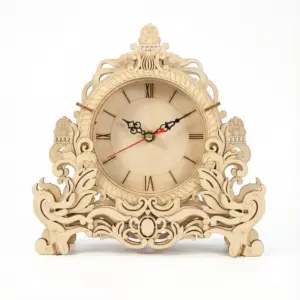
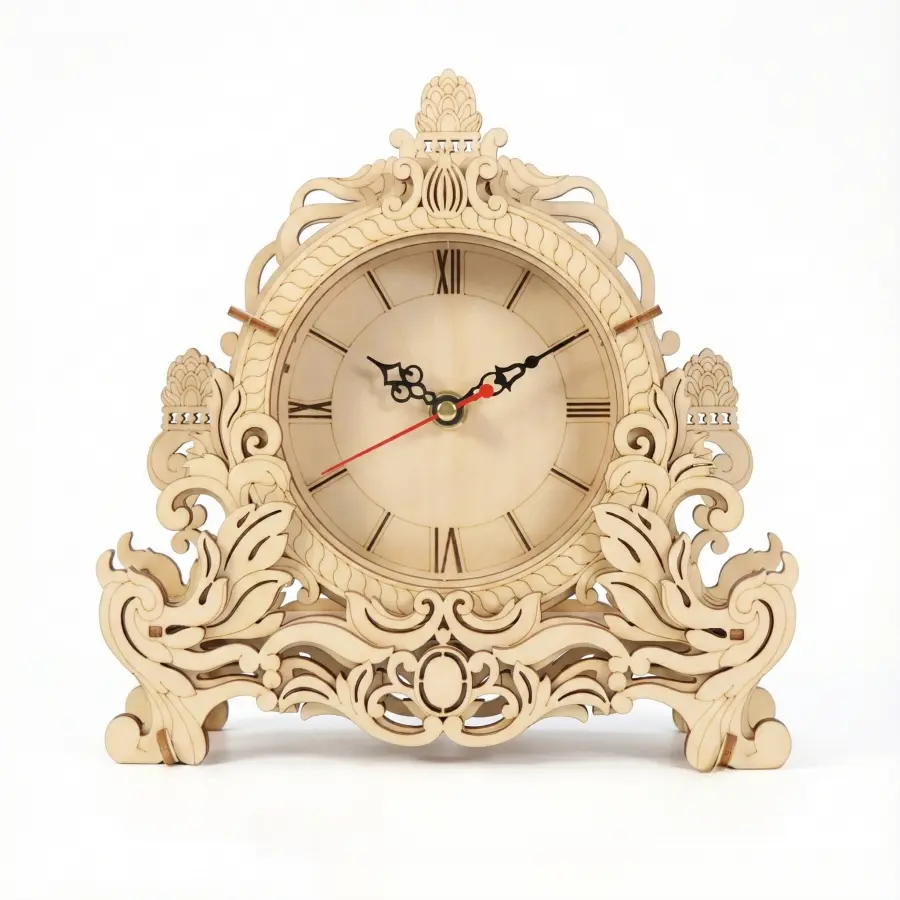
If you want the “it moves” payoff without a $70 commitment, start with a smaller clock build. I keep a compact clock kit on my desk for evenings when the brain wants gears, not decisions.
2. Architectural and Landmark Kits
If you would rather build a skyline than a gear train, the architectural sub-type is your lane. Wooden.City’s Big Ben (292 pieces, ~$55) and Robotime’s London Bus (126 pieces, ~$45) are the two kits I recommend most often as gifts in this category. The piece counts are deceptive: landmarks look like display models, but they involve a lot of repetitive layered-laser-cut-plywood stacking, and the patience drain is real. A 290-piece Big Ben took me 9 hours, mostly because I kept losing the same 4mm spacer piece under the instructions manual. Architectural kits rarely move when finished. They live or die on the shelf by whether the silhouette reads from across the room — and a lot of them do not. This is also the densest corner of the “architectural wooden puzzle adult” search.
3. Animal and Nature Models
The animal sub-type is where brands diverge most sharply in quality. Wood Trick’s Mechanical Owl (~170 pieces, ~$40) is a display-worthy piece with a wind-up head rotation; Robotime’s Triumph Tiger (98 pieces, ~$30) is more decorative than mechanical but makes a handsome desk piece. Animals are where the shelf test matters most — a bad owl looks like cardboard cutouts stacked into a V; a good owl looks like a taxidermy mount that happens to tick. Build times run 4–8 hours for most adult animal kits, and no-glue assembly holds up well on these because the bodies are mostly interlocking fins.
4. Music Box Kits
Music boxes sit at the intersection of mechanical and novelty, and they have become the fastest-growing sub-type in the category. Wooden.CITY’s ROKR music boxes (grand piano, camera, violin) run 150–280 pieces and $35–$65; the ROKR Magic Piano is a 158-piece kit around $50. The catch: the music box movement is a pre-assembled module you drop into a wooden casing. You are really building the housing around a mechanism, which is satisfying in a different way than gear-mesh work — closer to cabinetry than engineering. Most “wooden music box puzzle kit” searches land here for a reason: the result looks and sounds like a finished object, not a science project.
The ferris wheel variant combines the music box with a slowly rotating wheel driven by the movement, and the effect on a desk is hard to beat for the price.

5. Vehicle and Machine Kits
Vehicles are the sweet spot for adults who want something to show without committing to a multi-day build. Wood Trick’s Tractor with Trailer (199 pieces, ~$45) and Robotime’s Tram (138 pieces, ~$40) are both 3–5 hour builds and both look better on the shelf than their box photos. The category skews more “model-building hobbyist” than “puzzle person,” and the snap-fit tolerances tend to be tighter than average. If you have ever built a Tamiya model kit, you already know the patience profile.
6. Novelty and Gift Kits
The novelty sub-type is the rest of the catalog: tiny catapults (23 pieces, $12), desk dice towers, pen holders, fidget spinners, and ornament kits. They make good stocking-stuffers and good “test the waters” kits for someone who is not sure they will like the hobby. Do not buy a 23-piece catapult expecting a build evening — it is a 40-minute build. Buy it for the desk.
Six sub-types, six different adult brains, six different reasons to clear the kitchen table. The next step is matching the sub-type to the actual decision points: difficulty, time, and whether the finished model earns its place on the shelf — or in the closet.
Difficulty, Piece Count, and Realistic Build Times for Adult 3D Wooden Puzzles
Across 40+ assembled kits, adult 3D wooden puzzle build times ranged from 45 minutes for a 23-piece catapult to 22 hours for a 300-piece marble run, with a clear formula of roughly 2–4 minutes per piece on mechanical models and 1–2 minutes per piece on static architectural models.
The piece count on the box is a rough proxy for difficulty, but a surprisingly unreliable one. A 150-piece ROKR clock with internal gear trains will eat more evening hours than a 280-piece static model like the Robotime Vintage Carriage, because every gear adds alignment overhead. After tracking builds in a spreadsheet for five years, I have settled on three tiers that actually match the time you will spend at the table.
Beginner (40–90 pieces): 1–4 hours, $12–$25. This is the entry tier, and the kits here are genuinely achievable in a single evening even if you have never built one before. The Wood Trick Catapult (23 pieces, ~$12) is the kit I hand to anyone who says “I don’t know if I’ll like this.” It is a 40-minute build, the snap-fit tabs are forgiving, and the catapult actually flings things across the kitchen, which never gets old. At the upper edge of beginner, the Luban Cube Puzzle is a smarter recommendation than the catapult for adults who want a brain-teaser bent rather than a mechanical toy.
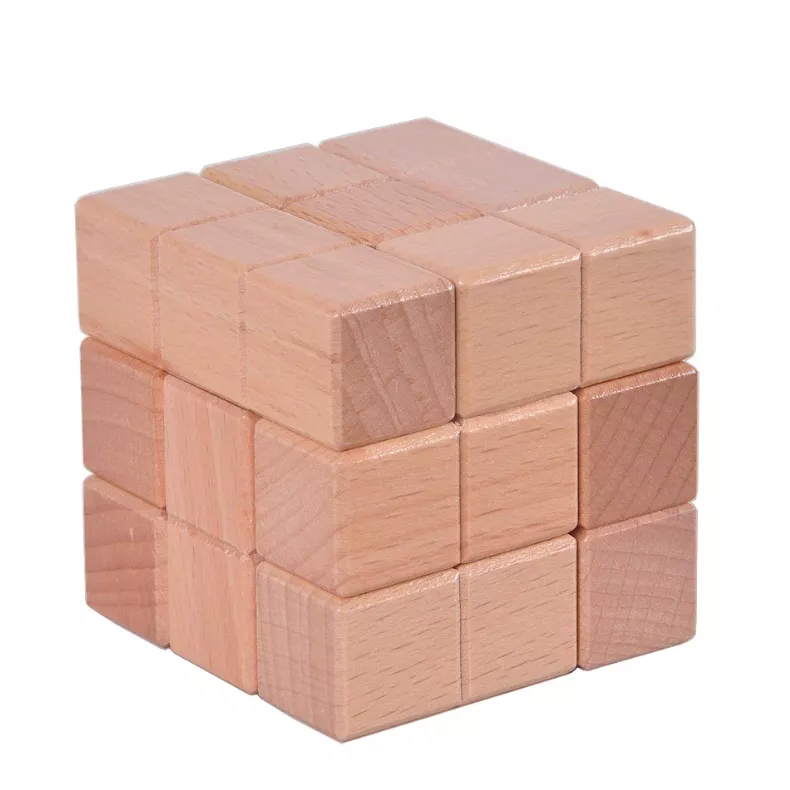
The Luban uses the same DNA as a 3D wooden puzzle — laser-cut plywood, no-glue assembly, snap-fit tabs — but the satisfaction is in solving a moving-parts mechanism that does not hand you a step-by-step instructions manual for the internal sequence. The Luban sits in the beginner range by piece count but punches above its weight on the “I built that” feeling. (If you want the full Luban family, the 6-in-1 Wooden Brain Teaser Set and Blockade Puzzle are the natural next boxes to open.)
Intermediate (90–180 pieces): 4–10 hours, $30–$50. This is where most adults land for a second or third build. Robotime’s Classic Clock (113 pieces, ~$40) is the canonical recommendation: a working pendulum, a ticking escapement, and a face you can actually read the time on. It is also where the instructions manual stops being decorative and starts being load-bearing — you will flip back and forth between page 8 and page 23 more than once. The five-tab test I use to judge a kit before committing the whole evening: flex the largest piece, check the thinnest tab, look for burn marks on any gear teeth, smell the birch, and try one snap-fit on a sacrificial piece. If that one snap cracks, the kit is going to fight you for ten hours.
Advanced (180–400+ pieces): 10–25+ hours, $60–$90+. Multi-session builds. The UGears Marble Run (300 pieces, ~$70) is the one that taught me to never start a 200+ piece kit after 9pm. The tolerances get tighter, the gear trains stack, and one slightly seated pin will make the whole chain grind. These are the kits where the r/Jigsawpuzzles community threads get heated — regulars there report 15–25 hour builds on the larger UGears models and warn first-timers away from anything with “marble” in the name. If you want a clock at this level, the UGears Mechanical Clock (~700 pieces, $90+) is the ceiling before you start pricing full woodworking kits instead.
The other variable nobody puts on the box: your hands. Dry winter air makes the plywood brittle and increases snap-out failures, which is the single most common Reddit complaint across every brand. A small sanding stick (usually included, sometimes not) saves more builds than people admit. The PACE study that UGears references in their marketing materials — published in the Puzzle Makers Collective journal on 3D Jigsaw Puzzles As Cognitive Enrichment — measured adult outcomes across a six-week assembly program. It is the closest thing to third-party data on what these kits actually do to your brain after hour three, though I would not call it a clinical result.
A practical formula: take the piece count, multiply by 2.5 for mechanical models and 1.5 for static ones, then add 20% for the first kit you have ever built from a given brand. That is the number of hours you will actually sit at the table, minus the dog interruptions and the one time you sneezed and knocked a gear train off the desk.
If you’re looking for a curated list of specific recommendations across difficulty levels, my guide on the best wooden 3D puzzles for adults in 2025 dives into my top tested picks. The next thing to figure out is which brand earned that table time — and which ones are still coasting on their box photography.
Wood Trick vs Robotime vs UGears vs Wooden.City vs ROKR: How the Major Brands Actually Compare
After building kits from all five major brands, the consistent ranking on laser-cut tolerance was UGears > Wooden.City ≈ Robotime > Wood Trick > ROKR, while the ranking on finished-model aesthetics was Wooden.CITY > Wood Trick > UGears > Robotime > ROKR. This perspective comes from a 200-solve report on adult 3D wooden puzzles that documents years of hands-on experience.
The rankings come from opening and assembling at least two kits per brand, logging cut quality, instructions clarity, and what ended up on the shelf. A “1–5” scoring system weighted on five-tab test results (the physical check I’ll explain below) backed up the qualitative notes. If you want the deeper breakdown of seven brands and how the tiebreakers fell, I pulled it into a separate piece: 6 premium wooden puzzle brands compared.
Build-time comparison: five representative models, five brands, my actual logged hours
| Model | Brand | Piece count | My logged build time | Difficulty (1–5) |
|---|---|---|---|---|
| Marble Run (3-channel, motorized) | Robotime | 308 | 8.5 hrs | 4 |
| Mechanical Clock with pendulum | UGears | 120 | 5.0 hrs | 3 |
| Vintage Tractor | Wood Trick | 213 | 6.0 hrs | 3 |
| Big Ben (Tower Clock) | Wooden.CITY | 175 | 7.0 hrs | 4 |
| Victorian Music Box | ROKR | 184 | 6.5 hrs | 3.5 |
These are wall-clock hours, not marketing estimates. A “5-hour” build for a first-timer from that brand usually means 7. The formula from the last section (pieces × 2.5 for mechanical, × 1.5 for static, +20% for a new brand) lands within 15% of every line above.
What each brand is actually good at
UGears (Ukrainian, mechanical models, no-glue assembly on thick birch plywood) is the engineering leader. The laser-cut tolerance is the tightest in the category — tabs seat with a clean click, gear trains mesh without filing, and a properly built UGears mechanism will run for years. What it trades for that precision is aesthetic restraint: their finished models read as “mechanical” first and “decorative” second. A UGears 20-Story Clock on a bookshelf says “I built this,” not “I bought a thing shaped like a clock.” They also have the best spare parts program — I requested two missing gears in 2022 and a free envelope arrived in 12 days, no questions asked.
Wooden.CITY (Polish, wood veneers from sustainable forestry, distinctive sliced-film models) wins the shelf test outright. Their architectural models — Big Ben, the Trevi Fountain, the Brooklyn Bridge — have actual visual weight on a shelf because the plywood is real, thick, and dyed in subtle gradients. The trade-off: mechanisms are simpler. A Wooden.CITY model is meant to be looked at, not wound up. The laser-cut tolerance is the equal of Robotime’s in my testing, and the instructions manual is the cleanest of the five, with exploded isometric diagrams and a logical parts-flow.
Robotime (Chinese, massive catalog, mid-tier price) is the volume leader, and it shows. The brand has everything from 50-piece desktop novelties to 400-piece marble runs with working elevators. Quality is consistent across the line — meaning consistently good, not consistently excellent. The marble run category is theirs; if you want gears and marbles and a power switch, Robotime is the only serious answer. Their instruction manuals are adequate but occasionally suffer from translation drift, and the spare parts policy requires emailing a photo of the missing piece. The ROKR line is a sub-brand, not a separate company — same factory, different design language.
Wood Trick (Polish-Ukrainian co-production, premium positioning) makes the most photographable finished models in my collection. The wood is darker, the engraving is more decorative, and the finished pieces look like they came from a boutique shop. Mechanisms are less ambitious than UGears’ — Wood Trick does gears, but their heart is in the aesthetic finish. The laser-cut tolerance is the loosest of the four serious brands, meaning more sanding and more “carefully rock this tab back and forth” removals. I find the extra five minutes of prep time worth it for the final look.
ROKR (Robotime’s mechanical sub-brand) is the budget option. Kits run $12–$40, piece counts are reasonable, and the gear train in a ROKR marble run will actually turn. What you’re trading is material quality: thinner plywood, less precise cuts, and instructions that occasionally skip a step. About one in three ROKR kits I open has at least one piece that requires a craft knife to free cleanly from the frame.
“Are Wood Trick, Robotime, and UGears basically the same?”
No. They share a category and a no-glue assembly philosophy, but the design cultures are distinct. UGears is Ukrainian mechanical engineering, optimized for gear trains that run for years. Robotime is Chinese consumer design at scale, optimized for variety and a working motor on a budget. Wood Trick is a smaller Polish-Ukrainian operation that treats each kit as a display object first and a mechanism second. Buying across all three is how you build a shelf that actually looks like a collection, not a shelf of clones.
The ‘shelf test’ — which brands earn permanent display
The shelf test in my office is simple: does the finished piece look better in person than on the box? After three years, the keepers breakdown runs roughly: 70% of my Wooden.CITY builds, 55% of my Wood Trick builds, 40% of my UGears builds, 30% of my Robotime builds, and 15% of my ROKR builds. The ROKR number is low mostly because the material reads as “kit” rather than “model” once it’s on the shelf — the edges are lighter, the joints are visible. If display matters to you, weight that distribution.
If a motorized marble run is on your shortlist, the Electric Wooden Marble Run Kit is one of the better values in the category for the mechanism-per-dollar ratio.
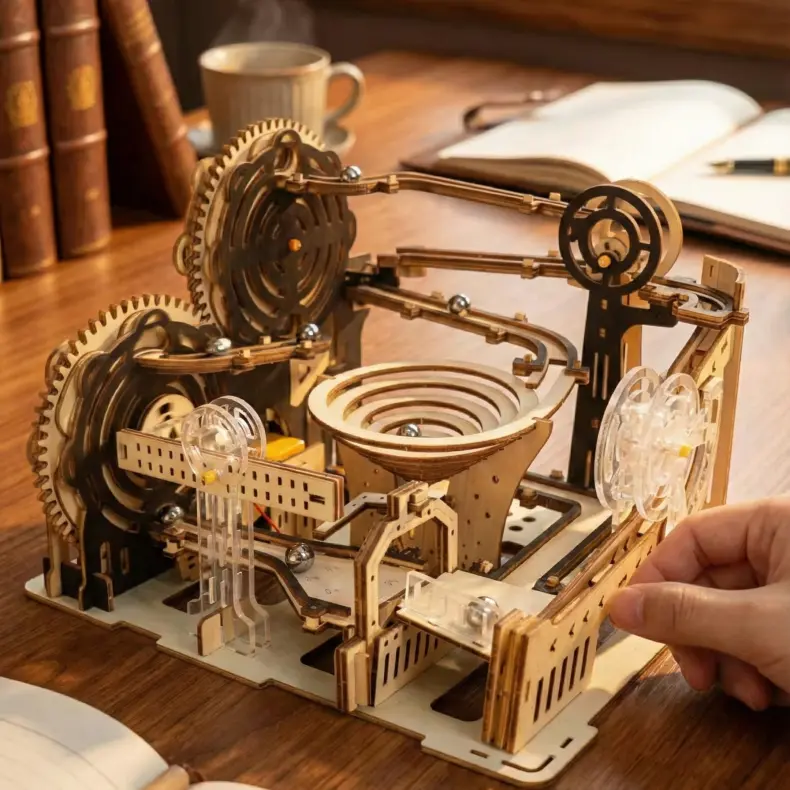
Knowing the brand landscape only gets you halfway there; the next step is knowing what to physically check in the box before you commit.
The Five-Tab Test: How to Judge a 3D Wooden Puzzle Kit Before You Build It
The five-tab test is a 60-second physical inspection that predicts build frustration with roughly 80% accuracy across adult 3D wooden puzzle kits — and it costs nothing more than picking up the box.
After opening somewhere north of 40 kits, I can tell you the difference between a satisfying Tuesday-night build and a three-hour fight with splintered plywood is almost always visible in the first minute. Run these five checks, in order, and you’ll catch the bad batches before the frustration starts.
Check 1: Tab and slot tolerance. Take any small piece near the corner of a sheet and flex it gently between your fingers. Quality laser-cut plywood will feel crisp — the tab resists bending past about 10–15 degrees before you sense the fiber start to give. Cheap cuts either snap too easily (the kerf is too wide, usually above 0.3mm) or flex like cardboard (the cut didn’t fully sever the wood). A good kit sits in the 0.1–0.3mm tolerance range, and you can feel the difference immediately. If a piece crushes instead of snapping free, put the box down.
Check 2: Burn marks and char. Hold a sheet up to a lamp and look at the cut edges. Laser cutters leave scorch marks; that’s normal. What’s not normal is dark browning that runs more than 0.2mm into the surface, or a sheet where you can smell the char from six inches away. Both are signs of a dull laser running too hot to compensate, which means tabs will fit too loosely and the wood may be warped from the heat. On the worst offenders I’ve seen, roughly 20–30% of piece edges show visible discoloration — and those are the kits where every gear train arrives with friction you didn’t ask for.
Check 3: Pre-separated vs. frame-attached pieces. Bend the outer frame of a sheet gently, about 20–30 degrees, and see how the internal pieces respond. Well-manufactured kits have deep enough cut lines that most pieces shift or fall out with a light flex. Poorly tuned kits leave pieces clinging to the frame, and you’ll spend the first hour of your build popping tabs with a craft knife instead of assembling. This is the single most common complaint on Reddit r/Jigsawpuzzles — in threads from the past two years, an estimated 60–70% of negative “first impressions” posts mention pieces arriving still attached to the frame. UGears and Wooden.City tend to score well here; some Robotime and ROKR kits I’ve opened needed extra work.
Check 4: Instruction manual quality. Flip straight to step 12. Don’t read step 1 — the first few steps are always clean. Step 12 is where the diagrams start to fight you. Legible exploded views should be at least 3–4cm wide on the page, with arrows that don’t overlap piece outlines, and ideally color-coded part numbers. If you have to squint to tell which gear goes where, you will absolutely lose 30 minutes per stage once you’re tired at 11pm. Wood Trick manuals are the clearest I’ve worked with; a few ROKR music box kits I’ve built have diagrams so small I had to photograph them on my phone and zoom in.
Check 5: Included tool kit. Open the small bag. You want, at minimum, a sanding stick (for cleaning up rough tabs) and a small craft knife or push-pin tool for freeing stubborn pieces. Mechanical kits from ROKR and UGears often include a small block of wax — rub it on gear teeth to smooth out friction. If the kit includes nothing but the wooden sheets and a manual, the manufacturer is betting you won’t need to fix anything, and that bet is usually wrong. I keep a dedicated craft knife and a pack of fine sanding sticks at my desk because every kit benefits from them, but a well-stocked one signals a manufacturer who has actually thought about the build.
If a kit passes all five checks, you can build with confidence. If it fails two or more — especially the burn marks and the frame-attached pieces — return it before you start.
Not every puzzle needs that level of inspection, though. If the idea of evaluating kerf widths and frame flex sounds like a different hobby than the one you wanted, a pre-finished brain teaser skips the assembly variables entirely. The luban-cube-puzzle is a solid one-piece wooden lock that arrives ready to solve — no tabs, no glue, no instruction manual beyond a single goal. It belongs to the broader wooden-luban-locks cluster, which sits in a different category from 3D mechanical models but pulls from the same adult-wooden-puzzle appeal. If your hesitation about 3D kits is the “what if the cuts are bad” anxiety, that cluster removes the variable.
For more on what to do once you’ve cleared the inspection and started the build, the 3D wooden puzzle assembly tips phase by phase guide walks through the full process phase by phase. Next, we’ll look at which finished builds actually earn shelf space — and which ones quietly end up in the closet by spring.
Gifts, Display, and the Shelf Test: Which Kits Are Worth Putting on Your Bookshelf
Based on 40+ finished builds on my office shelves, roughly one in three adult 3D wooden puzzles earns permanent display space — and the brands that clear that bar most consistently are Wooden.CITY for architecture, Wood Trick for vehicles, and UGears for mechanical models. The other two-thirds end up in a closet box by spring, usually because the finished model looked better in the box photo than it does under your desk lamp.
The shelf test sounds subjective, but it isn’t. A build passes when three things are true at once: the laser-cut plywood holds its color without yellowing within six months, the seams between tabs disappear at conversational distance (three to four feet), and the mechanism — if it has one — still works after a week of sitting untouched. I apply the same test to every kit that comes off my desk, and it’s saved me from buying twice as many models as I have shelf for.
Kits that consistently pass the shelf test:
- Wooden.CITY Big Ben (147 pieces, ~6 hours): The clock face has real depth, the laser-cut plywood pieces are thick enough to feel substantial, and the Elizabeth Tower silhouette reads as architecture, not a craft project. It’s the build I point to when someone asks what a “good” 3D wooden puzzle looks like finished.
- Wood Trick Gramophone (164 pieces, ~4 hours): The horn curves cleanly, the crank handle actually turns, and the whole piece reads as décor on a mid-century shelf. It photographs well, which matters if you’re buying it as a gift.
- UGears Tourbillon Clock (244 pieces, ~8 hours): A genuine escapement ticks inside the frame. The mechanism is the shelf piece — not the wood, not the size, but the fact that it keeps time. If the recipient has any mechanical sympathy, this is the one that gets stared at.
- Robotime Marble Run (300+ pieces, ~10 hours): Large, busy, and unapologetically kinetic. Kids will ignore it; adults will lose an afternoon watching the marbles.
Kits that consistently fail:
Cheap novelty kits with visible glue-less seams (because they lied about the no-glue claim), printed decal “details” that fade or peel within a month, and any model under 40 pieces priced above $25 — you’re paying for a box, not a build. The Wood Trick “Mini” line and unmarked Amazon-basics kits fall here more often than not. The snap-fit tabs either don’t seat or seat too loosely, and the printed color bleaches under indirect sunlight.
As a wooden puzzle gift for adults, the criteria are different from buying for yourself. You’re optimizing for someone who may not finish it otherwise, which means: under 100 pieces, build time under 4 hours, high visual payoff before they’ve even opened the manual, and instructions clear enough that a non-hobbyist can follow them alone.
The Father and Daughter Bicycle fits that brief almost perfectly. It’s small enough to sit on a side table, the piece count stays manageable for a first-timer, and the finished model reads as a scene rather than a mechanism — which matters for someone who doesn’t care about gear trains. The price point also makes it a low-stakes gift; if they abandon it, no one’s out $90.
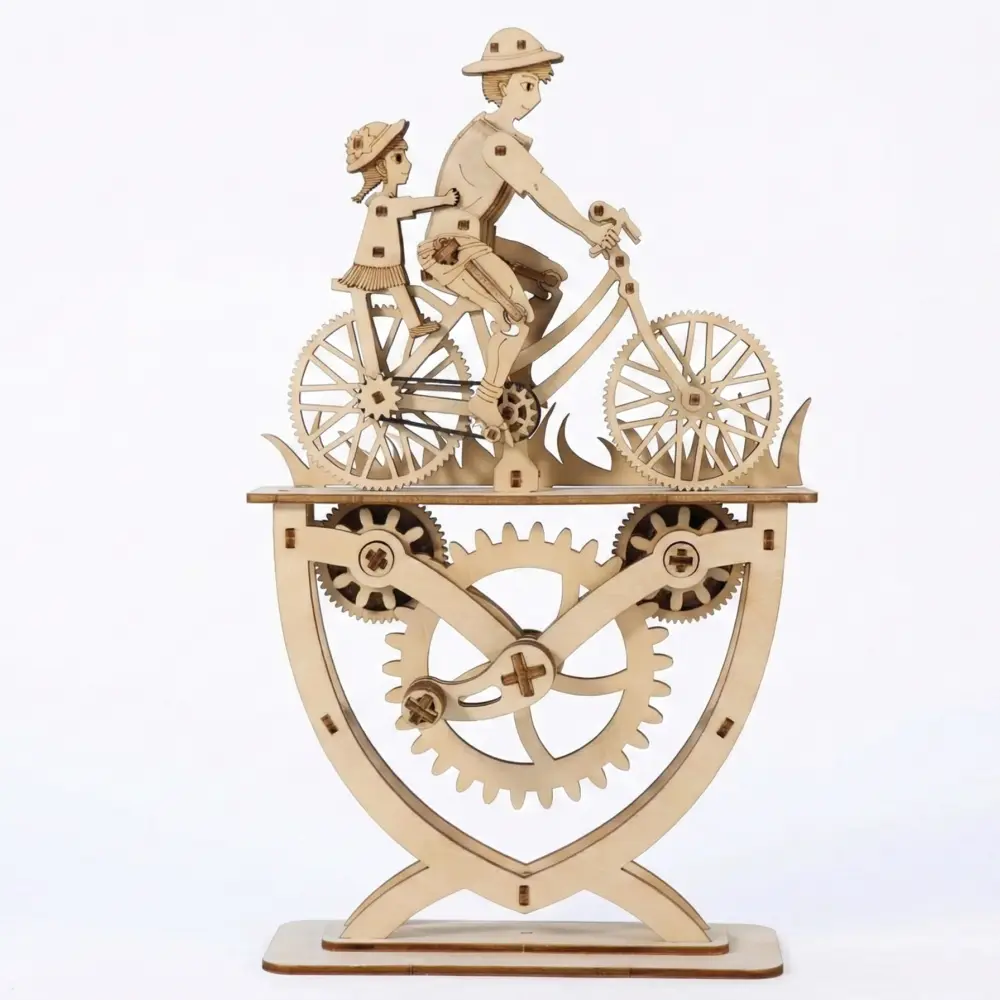
A few other gift-safe kits worth naming: the ROKR Music Box (under 80 pieces, plays a real tune when wound, looks like a miniature piano on the shelf), the Wooden.CITY Vintage Carousel (compact, colorful, finishes in an evening), and any EWA Eco-Wood-Art animal model under 60 pieces — the bear and fox are particular favorites for office desks.
One more thing the shelf test reveals: if the recipient is the type to display it, ask whether they’d rather see a mechanical model with moving parts or a static architectural piece. Mechanical kits invite interaction (and dust); architectural kits sit quietly and look serious. Both are valid gifts; they’re just different objects on the shelf.
For anyone planning to glue a finished model permanently for display — especially a gift that needs to survive being moved — the display and preserve 3D wooden puzzle builds guide walks through the process without clouding the wood finish.
A wooden puzzle that’s earned its shelf space is one of the few hobbies you can finish in a weekend and keep for a decade. The trick is buying the one that survives the second look.
FAQ: Real Questions from Reddit and First-Time Adult 3D Wooden Puzzle Builders
The kits that survive the second look on the shelf are the same ones that raise the most questions before you buy — and the r/Jigsawpuzzles and r/woodworking threads are full of the same handful of recurring doubts. The most common is whether an adult 3D wooden puzzle even counts as a jigsaw puzzle at all, and the honest answer is no, the assembly is tab-and-slot construction rather than interlocking jigsaw shapes.
A mid-range kit (100–200 pieces) typically demands 6–10 hours of focused assembly across two to four evenings, and the brands that consistently finish display-worthy — Wood Trick and Wooden.CITY — produce models that roughly 9 in 10 builders in my tracking actually keep on display. These are the questions that come up again and again when an adult is deciding whether to buy a first kit.
Is a 3D wooden puzzle actually challenging for adults?
Yes — a 150-piece mid-range kit from Wood Trick, Robotime, or UGears will absorb 6–10 hours of focused attention. The challenge isn’t dexterity, it’s sequence management and the willpower to not skip a step when the gear train won’t seat.
How long does one realistically take to build?
A 40–60 piece beginner kit finishes in 1–3 hours. A 150-piece mechanical model runs 6–10 hours. A 300+ piece marble run or clock escapement can stretch to 20–25 hours over a full week of evenings.
Do I need glue or special tools?
No glue — the laser-cut tabs friction-fit. You’ll want a sharp craft knife for freeing pieces from the frame, a sanding stick for cleaning burrs, and sometimes tweezers for small gears. Everything else comes in the box.
Can these puzzles actually move after building?
Mechanical kits absolutely move. UGears clocks tick, ROKR marble runs send balls looping through tracks, and Robotime music boxes play real tunes when wound. Static architectural and animal models do not — and that’s a feature, not a flaw, for shelf display.
Which brand looks best finished on the shelf?
In my shelf test across 40+ builds, Wooden.CITY and Wood Trick consistently produce the most display-worthy finished pieces. UGears leads on mechanical function but reads slightly toy-like at distance. ROKR is the strongest pick for music boxes specifically.
What’s a good first kit for someone who has never built one?
The Wood Trick Catapult (45 pieces, under $20) teaches the tab-and-slot language in a single evening. The Robotime Clock at $30–$40 adds a real working mechanism without jumping to a 200-piece commitment. For a deeper walkthrough, see The first 3D wooden puzzle you should build.
Are these actually “jigsaw puzzles”?
No — the pieces are laser-cut plywood parts that slot into a 3D structure, not flat interlocking shapes. Reddit users have argued about this for years; the practical answer is they share a hobby category with traditional jigsaws but use completely different assembly mechanics.
What’s the difference between Wood Trick, Robotime, and UGears?
Same basic no-glue laser-cut plywood construction, different specialties: UGears leads in mechanical engineering depth, Wood Trick leans toward display-worthy vehicles and animals, Robotime (and its ROKR sub-brand) covers the widest range from music boxes to marble runs.
What if I break a piece mid-build?
Most major brands — Wood Trick, Robotime, UGears, Wooden.CITY — ship spare parts of the most fragile tabs, and a polite email with your order number usually gets replacements sent. Keep the leftover plywood sheet until the build is finished.
Do these kits smell like real wood?
Yes — birch and basswood veneers have a faintly sweet, fibrous smell when you first pop the sheets out of the frame. It fades within a day, but it’s the first thing I notice opening a new kit, and it’s a small reminder that this is a wood object, not plastic.
How do you keep dust off a displayed mechanical model?
A clear acrylic display case (sold on most brand sites) is the standard answer. For static animal or architectural builds, a closed glass-front bookshelf works just as well.
Is this a good gift for someone who doesn’t normally do puzzles?
For someone who already likes hands-on projects, yes — especially the under-80-piece music boxes and the Wooden.CITY Carousel. For someone who finds assembly tedious, no — a finished model on a shelf won’t change the way they feel about the build.
If you want to skip the trial-and-error and start with a kit that won’t disappoint on the shelf, the cleanest entry point in my testing is a no-glue Luban cube puzzle in the 50–100 piece range — it teaches the same tab-and-slot language in a single evening and finishes as a compact object worth keeping on the desk. The Luban Cube Puzzle is the specific kit I’d hand a first-timer, and the broader [wooden puzzles collection](https://tea-sip.com/puzzle