If your life runs on calendars, Slack pings, caffeine, and “just one more thing,” you’ve probably felt it: the modern anxiety loop. More output. More urgency. More tabs. More “I’ll rest after I finish this week.” And then—your body rebels, your mood gets sharp, your work gets weirdly sloppy, and even your downtime feels like another task.
Here’s the non-mystical translation of yin–yang that actually holds up in modern life: it’s a systems model for how energy turns into results—and how results collapse when energy has no container. It’s not about being “spiritual.” It’s about being sustainable.
In this article, we’ll translate classic yin–yang ideas into modern language, modern schedules, and modern problems: burnout, screen fatigue, decision overload, procrastination, and the strange feeling of being busy but not better. You’ll also get a short, repeatable practice you can start tonight (11 minutes), plus practical “if-then” rules for different personality types and life seasons.
First, delete the wrong definition: yin and yang are not “good vs. bad”
A lot of Western pop culture treats yin–yang like decorative philosophy: light vs. dark, positive vs. negative, chill vs. intense. That’s not only shallow—it’s actively unhelpful, because it turns a useful model into a personality test.
A more practical definition is this:
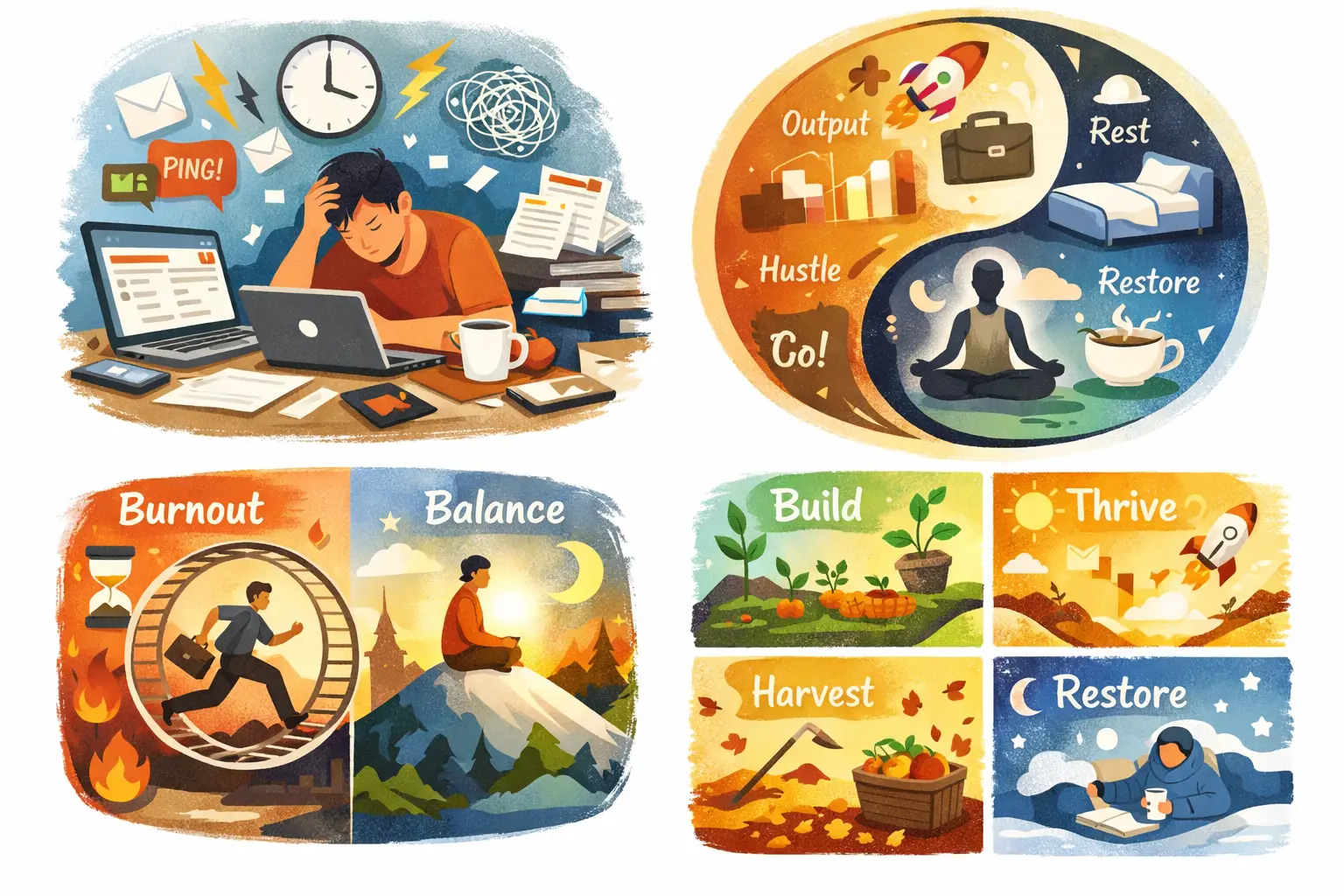
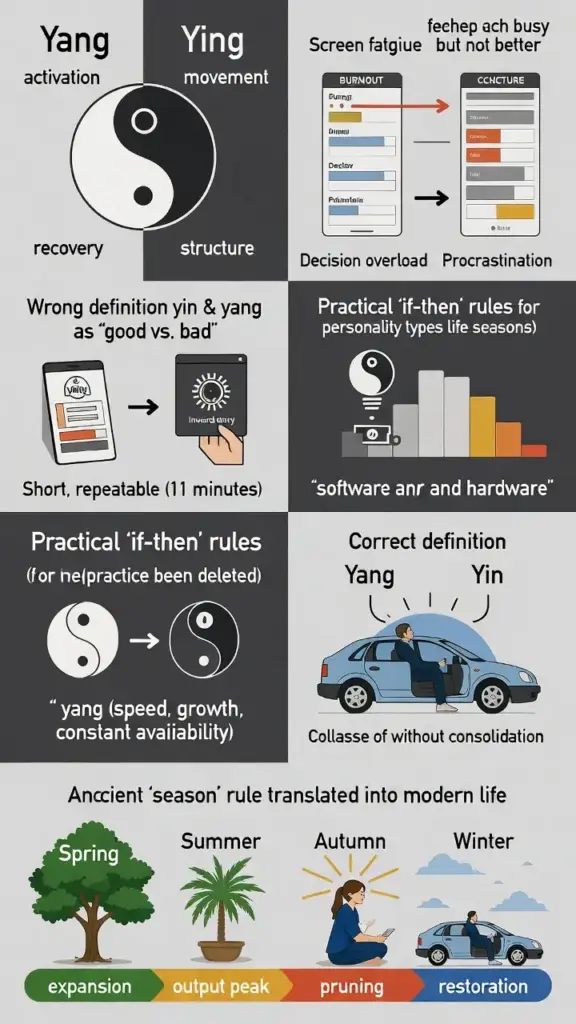
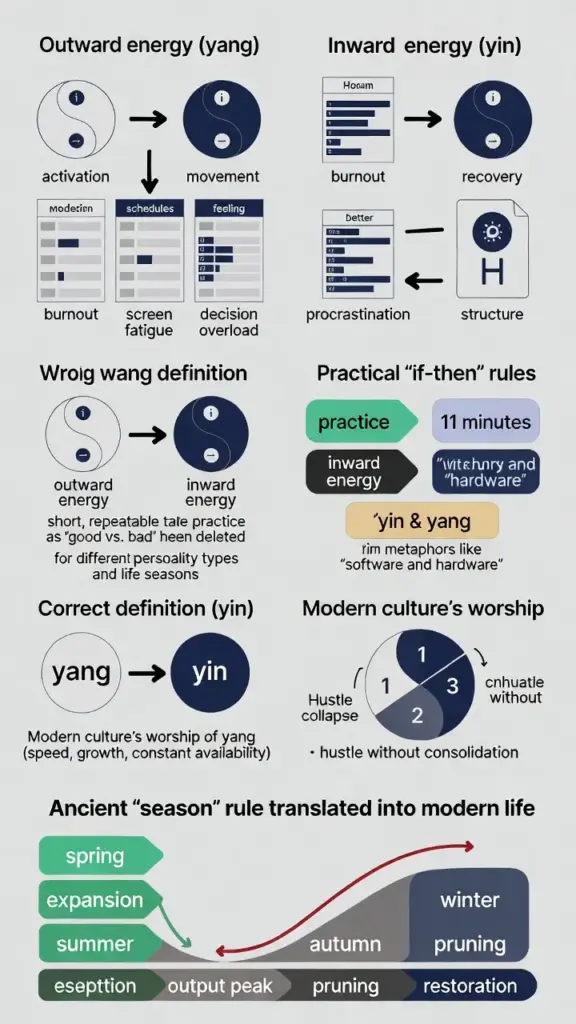
- Yang = outward energy. Activation. Output. Movement. Expansion. “Do the thing.”
- Yin = inward energy. Recovery. Input. Consolidation. Structure. “Let the thing settle.”
Think “software and hardware,” not “angels and demons.” Yang is what your system does. Yin is what your system is made of. A brilliant strategy (yang) without cash flow, sleep, and structure (yin) is just a motivational speech with a timer attached. Meanwhile, structure (yin) without movement (yang) is a beautiful plan that never ships.
If you’ve ever felt like your mind is sprinting while your body is dragging a suitcase—congrats, you’ve experienced a yin–yang mismatch. Your “software” is running a Ferrari lap, and your “hardware” is on 12% battery.
This is why, when people say “I know what to do, I just can’t do it,” the issue often isn’t intelligence. It’s that the system doesn’t have the right balance between activation and containment.
If you want a quick companion piece that frames yin–yang with modern examples, Tea-sip has a readable take here: a practical yin–yang reset for modern life. We’ll go deeper in this article, but that one is a solid “warm start.”
“No one survives on pure yang”: why hustle collapses without consolidation
Modern culture quietly worships yang: speed, growth, constant availability, “grind,” “execute,” “scale.” We treat intensity like virtue—and rest like a reward you earn after you become a different person.
But the body doesn’t negotiate. Stress is real physiology, not a moral failure. Public health and clinical organizations consistently describe stress management as a set of small, repeatable behaviors—not a dramatic mindset makeover. If you want a plain-language place to start, see the CDC’s overview of healthy ways to cope with stress, and the APA’s quick stress management tools.
Here’s the yin–yang framing:
- Yang-heavy life: you push output faster than your system can rebuild. You get results… until you don’t.
- Yin-heavy life: you protect comfort so aggressively that growth never happens. You feel “safe”… but also stuck.
Balance isn’t “50/50 every day.” Balance is timing: knowing when to expand and when to consolidate, knowing when to push and when to recover, knowing when to build and when to prune.
The simplest modern test: If your output is rising but your recovery is shrinking, you’re borrowing from the future. The bill always arrives—often as sleep problems, irritability, brain fog, or the sudden inability to care about things you used to care about.
Translate the ancient “season” rule into modern life: build season vs. harvest season
One of the most useful yin–yang ideas sounds poetic but is painfully practical: growth and consolidation are not enemies—they’re phases.
Think of a year:
- Spring: expansion begins (yang rises). You plant, you start, you experiment.
- Summer: output peaks (yang strong). You execute, you ship, you run hot.
- Autumn: pruning and refinement (yang “cuts,” yin stores). You simplify, remove waste, improve margins, improve habits.
- Winter: storage and restoration (yin dominant). You rest, repair, rebuild capacity, set foundations.
The mistake many people (and companies) make is trying to live in permanent spring: constant new initiatives, constant scaling, constant “next.” That works for a short burst, and then the system destabilizes. You can see versions of this pattern in many high-growth stories: expansion that outpaces the ability to build durable structure, then a painful correction.
The yin–yang point isn’t “don’t grow.” It’s: grow when the system can contain it, and consolidate before expansion becomes fragile.
If you’re building a personal routine, the same is true. “More habits” isn’t automatically better. A smaller number of habits—done consistently—often wins because it respects the yin part: structure, repeatability, recovery.
The hidden danger: when energy can’t move, it hardens into the wrong kind of structure
Here’s a concept that sounds intense in old language but becomes obvious once you translate it: when energy doesn’t circulate, it congeals.
In health, we have many metaphors for this: tension that never releases, stress that never resolves, insomnia that becomes “normal,” or anxiety that turns into constant vigilance. Even in mainstream discussions, the theme is the same: chronic stress without recovery tends to correlate with worse outcomes over time, and managing it usually requires habits that regulate daily load. The NHS offers a simple list of stress reduction tips that are basically “yin–yang hygiene” in modern language: move your body, connect with people, make time to unwind, work smarter, not harder.
In organizations, the pattern shows up as bureaucracy. Early-stage teams are often high-circulation: information flows, decisions happen, feedback is fast (yang moving). As systems grow, structure is necessary (yin), but it can become pathological: layers of approvals, meetings replacing action, “process” as a substitute for clarity. When the structure starts consuming the energy it’s supposed to support, you don’t have stability—you have inertia.
In personal life, this can look like:
- Procrastination that becomes identity (“I’m just not disciplined”).
- Overthinking that feels like planning but produces no movement.
- “Rest” that isn’t restorative—because it’s still full of stimulation.
- A schedule so dense that even weekends feel like a sprint.
So the goal isn’t to eliminate structure or eliminate intensity. The goal is to keep energy circulating through the right channels. Which leads to a surprisingly effective tool most adults underestimate: tactile, screen-free problem solving.
Why hands-on puzzles fit this model (and why your brain likes the “click”)
Screen fatigue isn’t just “too much phone.” It’s too much rapid context switching, too much novelty, too much micro-stimulation, too little completion. Your attention gets chopped into confetti.
A good hands-on puzzle does something different: it compresses your world into one object, one constraint set, one feedback loop. You get immediate information (this piece fits / doesn’t fit), and the reward is not a dopamine spike—it’s a clean sense of resolution.
This is where yin and yang quietly cooperate: the puzzle provides yin (a container, a boundary, a physical structure), and your solving provides yang (movement, attempts, iteration). It’s “safe intensity”—effort that doesn’t spill into your entire life.
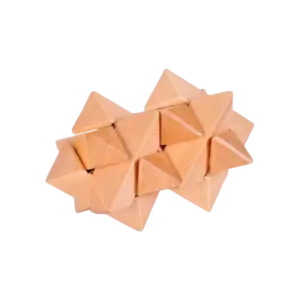
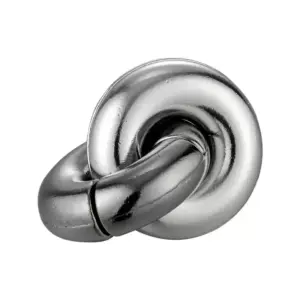
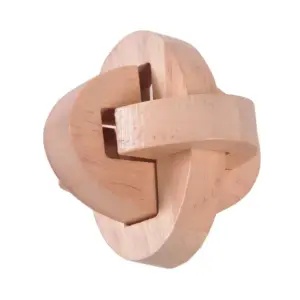
If you want desk-friendly options, browse the puzzle board picks for calm focus. If you’re more into lock-style challenges, the puzzle box guide is a good overview. And if you want a variety set you can rotate through without thinking too hard, the 6-in-1 wooden brain teaser set is built for short sessions.
The point is not “puzzles cure stress.” They don’t. But as a habit container, a puzzle can support a short, repeatable reset that many people find calming—especially when it replaces scrolling. This fits the cautious, evidence-aware framing used by mainstream sources on mindfulness and stress: practices may help, effects vary, and consistency matters. For a balanced overview, NCCIH’s meditation and mindfulness fact sheet is refreshingly careful about what is and isn’t known.
The “fish-eye” principle: the escape hatch hiding inside the problem
The classic yin–yang symbol isn’t two separate halves. Each side contains a small dot of the other—the “fish-eye.” In modern language: extremes contain the seed of reversal.
Practically, this means: when you’re in a negative state (yin-heavy), there is usually a small actionable signal (yang seed) you can use to pivot. And when you’re in a high-output streak (yang-heavy), there is usually a hidden weakness (yin seed) that needs attention before it becomes a crash.
Here are everyday examples:
- Harsh feedback (yin): there may be a 5% useful signal you can extract and apply.
- Sudden success (yang): it often hides a structural limit—sleep, staffing, cash, health, or boundaries.
- Procrastination (yin): it often contains a tiny “yang handle”—a first step small enough to begin.
- Overworking (yang): it often hides the “yin debt”—recovery you’re postponing.
The fish-eye move is not “be positive.” It’s: find the smallest real lever inside the state you’re in. The lever might be a 10-minute walk, a 2-minute breathing reset, a single clarified next action, or (for many people) a short tactile task that re-centers attention.
If your version of “fish-eye” is a small, repeatable focus ritual, you might enjoy the article what most people miss about adult desk puzzles, because it treats puzzles less like toys and more like attention tools.
The 11-minute Yin–Yang Reset (screen-free, realistic, repeatable)
This is a short-cycle practice designed for real life: between meetings, after the commute, before dinner, or as a “hard stop” after work. It’s not a spiritual ritual. It’s a nervous-system-friendly reset that combines downshifting (yin) with clean activation (yang).
Step 0: Set the container (30 seconds)
- Put your phone face down (or in another room if you can).
- Set a timer for 11 minutes.
- Pick one tactile task: a small puzzle, a simple build step, or a short logic game.
Step 1: Yin downshift (2 minutes)
Sit. Unclench your jaw. Drop your shoulders. Do slow breathing—nothing fancy. If you like structure, use a simple pattern: inhale through the nose, longer exhale through the mouth. This aligns with mainstream stress guidance that emphasizes simple, repeatable calming skills. The CDC’s stress pages and the NHS stress guides both include breathing and “take breaks” style practices (see CDC stress basics and NHS stress help).
Step 2: Yang within yin (6 minutes)
Now solve—or attempt—one focused challenge. The goal is not to “win.” The goal is one stable attention stream. Choose difficulty based on your current state:
- If you’re fried: choose something easy-to-enter, like one piece from a variety set (for example, the 6-in-1 set).
- If you’re restless: choose something slightly harder, like the Luban lock set (9 pieces) where you can “try one, switch if stuck.”
- If you want a short, ego-check challenge: try a transparent interlock like the 12-piece crystal Luban lock set—seeing the mechanism doesn’t automatically make it easy.
- If you want a calmer visual build: a small sculptural piece like the 3D crystal apple puzzle can feel like “quiet progress.”
No puzzle on hand? Use a short on-site game that’s still single-tasking and bounded. The thermometer puzzle game is an example of a constraint-based logic reset that’s very different from doomscrolling. (Key rule: stop at 6 minutes even if you “almost have it.” That’s the yin boundary.)
Step 3: Yin consolidation (3 minutes)
Close the loop. Put the puzzle down mid-progress if needed (yes, on purpose). Ask two questions and write one line each:
- What state am I in now? (calmer, sharper, still wired, still heavy)
- What is the next smallest real action? (one email, one task, one boundary, one break)
This step matters because it converts “a nice moment” into an operational shift. It’s the difference between temporary relief and a repeatable habit.
When to use it
- After work: to prevent “work mode” from leaking into dinner and family time.
- Midday: when your attention starts fragmenting.
- Pre-sleep: as a gentle bridge into wind-down (especially if screens are your default).
If you’re using it as a pre-sleep bridge, pair it with evidence-based sleep hygiene basics. The AASM’s healthy sleep habits guide and the NIH/NHLBI healthy sleep habits page are both solid, practical references. No magic—just basics that work better than people expect when done consistently.
Personalized rules: what to do if you’re yang-heavy vs. yin-heavy
The same advice doesn’t work for everyone, because different people get stuck on different sides of the system. Below are common “types” (not diagnoses—just patterns) with specific counter-moves. Use the one that feels uncomfortably accurate.
Type A: The Overclocked Achiever (yang-heavy)
Signs: you’re productive, but edgy. Sleep is lighter. Rest feels “unearned.” You keep pushing even when your results start to degrade.
Rule: If you notice irritability + sloppy mistakes + late-night scrolling, treat it as a “yin deficit” day.
- Do the 11-minute reset before you eat dinner.
- End your workday with a hard stop ritual (same time, same sequence).
- Choose puzzles that are finite and tactile. For example, one lock from the 9-piece Luban set or one short desk challenge from the puzzle board topic.
Type B: The Frozen Overthinker (yin-heavy)
Signs: you research, plan, and “mentally rehearse,” but you don’t move. You feel tired without having done much. You confuse safety with stasis.
Rule: If you’re stuck, do 90 seconds of motion before you think again.
- Start with the smallest action: open the doc, write the first line, send the first message.
- Use puzzles as “activation training”: 6 minutes of attempts teaches your brain that movement is safe.
- Choose something that gives fast feedback (you’ll feel it in your hands): the crystal Luban minis or a simple quick game like Breakout for a bounded burst (then stop).
Type C: The Perfectionist Loop (yang on top, yin underneath)
Signs: you push hard, but only if you can do it “right.” When it’s messy, you freeze. You’re both intense and avoidant.
Rule: If the task feels too big, shrink the definition of “done.”
- Set a 12-minute cap: you’re practicing completion, not brilliance.
- Pick a puzzle that’s allowed to be unfinished—leave it mid-solve on purpose. That trains your nervous system to tolerate “incomplete” without panic.
- Read the no-fluff approach here: unbox wooden puzzles without the fluff—it’s oddly good at cutting perfectionist noise.
Type D: The Caregiver/Manager (yin overloaded)
Signs: your life is containers for everyone else: family needs, team needs, emotional labor. You’re doing “yin” all day—holding, stabilizing, absorbing—so you feel depleted.
Rule: If your day is constant containment, you need clean, selfish yang in small doses.
- Schedule a 15-minute block that belongs to nobody else.
- Use a tactile challenge as “protected activation.” Try a short build step from a display-worthy kit like the wooden Ferris wheel music box kit—progress is visible and doesn’t require emotional negotiation.
- If you want a gifting angle for family nights (so the habit becomes social), the screen-free gifts guide is a good starting point.
Type E: The “I’m Fine” Burnout (yang masking a yin crash)
Signs: you can still perform, but joy is low. Everything feels like effort. You’re “fine,” but you’re not okay.
Rule: If your baseline joy drops for weeks, treat it seriously and consider professional support. Lifestyle tools help some people, but they are not substitutes for care.
- Start with sleep and boundaries—two levers with outsized impact. The AASM sleep habits page is a straightforward checklist.
- Use the 11-minute reset daily for 10 days. If nothing changes at all, that’s useful data: you may need a different intervention.
- For gentle, evidence-informed framing of mind-body practices, Harvard Health has a balanced discussion on movement and mindfulness for stress.
Common mistakes (that make you more anxious instead of better)
If you’ve ever tried to “fix your life” with a new routine and ended up more stressed, you’re not alone. Here are the most common traps—and the yin–yang correction.
Mistake 1: Turning “balance” into another performance metric
You start tracking meditation streaks, sleep scores, steps, productivity systems… and now rest is also work. Correction: balance is not a grade. It’s feedback. Your goal is fewer red alerts, not a perfect dashboard.
Mistake 2: Using yin as avoidance (“I’m resting” but you’re actually numbing)
Scrolling, bingeing, and “checking one more thing” can look like rest—but it often doesn’t restore. Correction: true yin restores capacity. If you feel more scattered afterward, it wasn’t yin. Try a bounded activity with an end: a 6-minute puzzle attempt, a short walk, or a wind-down routine.
Mistake 3: Using yang as aggression (“If I push harder, I’ll feel better”)
Sometimes action helps. Sometimes action is just panic with a to-do list. Correction: if your body is wired and your mind is brittle, you don’t need more pushing—you need better containment. Start with downshift, then focused effort.
Mistake 4: Trying to change everything at once
This is peak yang: big declarations, big plans, big collapse. Correction: pick one anchor habit for two weeks. If you want a low-friction anchor, choose a “desk-friendly brain teaser” and keep it visible. (If you need ideas, browse wooden puzzles for tangible challenges.)
Mistake 5: Treating this as a replacement for medical or mental health care
Yin–yang framing can be a helpful self-management model. It is not a diagnosis, and it is not treatment. If stress, anxiety, or sleep issues are severe, persistent, or worsening, please seek professional help. For general mental health framing at a public-health level, the WHO’s overview of mental health is a useful reminder that these issues are common and treatable—and not a personal failure.
FAQ
Q1: Is yin–yang a religion?
Not in the way most people fear. You can treat it like a systems metaphor: activation and recovery, expansion and consolidation, output and container. If the language bothers you, rename it “capacity management.” The model still works.
Q2: Do I have to meditate to use this?
No. Meditation is one tool, not the gate. Many people benefit from simple breathing, movement, or tactile focus without formal meditation practice. If you want an evidence-aware overview of meditation and mindfulness that doesn’t oversell, NCCIH’s eight things to know is refreshingly honest about variability and potential downsides.
Q3: How often should I do the 11-minute reset?
If you’re stressed daily, do it daily for 10 days. If you’re stable, use it 3–4 times a week as maintenance. The key is consistency, not intensity. Think “brushing teeth,” not “training for a marathon.”
Q4: Will this actually reduce stress?
It may help for some people, especially as a screen-free interruption that combines calming + focused attention. But it is not guaranteed, and it’s not medical treatment. Stress is influenced by workload, relationships, finances, sleep, health, and many other factors. Public-facing resources like the CDC’s stress coping guidance and the APA’s stress resources emphasize multiple approaches—because stress is multi-causal.
Q5: What if I try a puzzle and get more frustrated?
Great question—and very normal. Use the “difficulty rule”: if frustration spikes above a 6/10, downshift difficulty. That’s not quitting; that’s regulation. Choose a variety set where you can swap puzzles quickly, like the 6-in-1 set, or use a curated guide so you’re not guessing, like the crystal Luban lock topic.
Q6: Can I do this at the office without looking weird?
Yes—if you keep it small and bounded. A 6-minute “one-puzzle attempt” looks like a normal desk break (no different than coffee). If you want office-appropriate ideas, mindful brain teasers for office focus is literally built around that scenario.
Q7: What’s the fastest way to start tonight?
Do this: phone down, timer 11, slow breathing 2 minutes, solve attempt 6 minutes, write one next action 3 minutes. Then pick a sleep-friendly boundary: dim lights, reduce late caffeine, keep bedtime consistent. If you want a practical checklist, see the AASM’s healthy sleep habits page.
Q8: How do I choose the right puzzle (or gift) without overthinking it?
Use “state + setting”:
- Desk reset: short, tactile, easy to pause → start with desk-friendly puzzle board picks.
- Travel: small, varied, pocketable → crystal Luban minis.
- Family night: shareable, giftable, not too punishing → screen-free gift ideas.
- Collectors / builders: display-worthy, slower projects → Ferris wheel music box kit or other traditional wooden puzzles.
If you want a quick “difficulty calibration” game, this post is fun: rate these 12 brain teasers. It helps you avoid the most common gifting mistake: buying something that’s either too easy (boring) or too brutal (rage gift).
A simple summary you can remember on a bad day
If you remember nothing else, remember this:
- When you feel chaotic and scattered, you don’t need more stimulation—you need a container (yin).
- When you feel heavy and stuck, you don’t need more thinking—you need a small movement (yang).
- When you feel “fine but brittle,” you are probably living on borrowed recovery.
- Balance is timing: expand, then consolidate; push, then restore; act, then integrate.
Yin–yang isn’t a vibe. It’s a feedback loop. And the best feedback loops are boring in the best way: small inputs, repeated often, with real results over time.
If you want a gentle, practical companion read that keeps the tone modern and grounded, you might like the yin–yang framework for better decisions. Then come back here and run the 11-minute reset for ten days. Let the system prove itself in your calendar—not in your beliefs.
Medical disclaimer
This article is for general educational purposes only and is not medical advice. It does not diagnose, treat, cure, or prevent any disease. If you have persistent or severe stress, anxiety, depression, sleep problems, or other health concerns, please consult a qualified healthcare professional. If you feel unsafe or in crisis, seek immediate local emergency help.