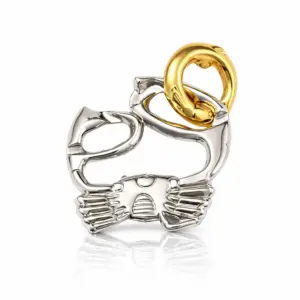
The metal crab puzzle looks simple for about ten seconds. Then your hand slows down, your eyes start hunting for angles, and the gold ring rejects every obvious move. That moment is the point. A good cast metal puzzle is rarely difficult because it has lots of parts. It is difficult because one valid path exists, and your brain keeps choosing the wrong one.
This is a medium-difficulty, two-part disentanglement puzzle: a crab-shaped cast body and a gold ring. Tea Sip lists it at 55 x 56 mm and 56 g, which puts it in a useful middle ground between pocket toy and desk object. The short version is simple: it is portable, replayable, and more technical than it looks. The full version is what follows: mechanism, material behavior, solve experience, buyer fit, and clear no-buy scenarios.
This is written for serious shoppers and puzzle people who want evidence before checkout, not generic praise afterward.
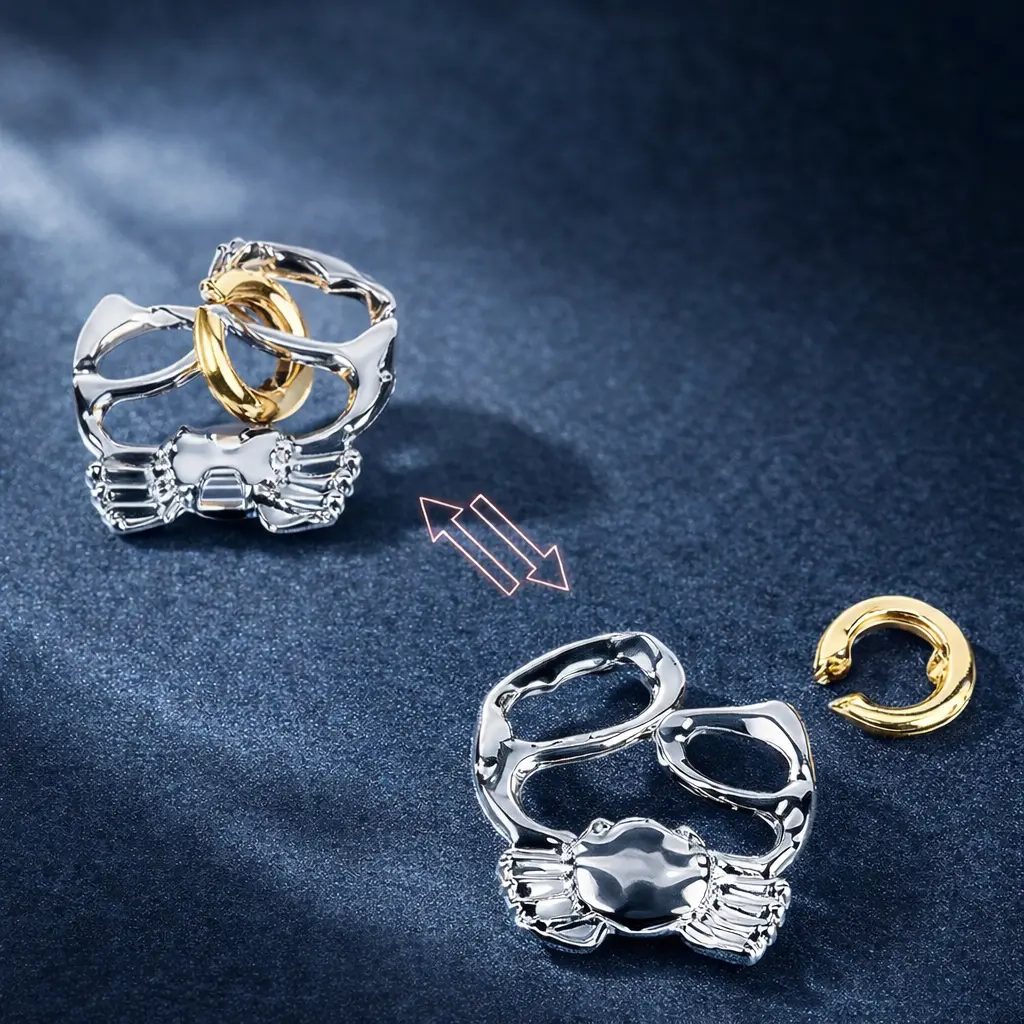
Why This Puzzle Type Still Works
Mechanical disentanglement puzzles have been around for centuries. Collections such as the Jerry Slocum archive at Indiana University document how long this puzzle family has lasted, while museum collections show the same core idea repeated across eras: shape is the mechanism (Indiana University Lilly Library, Smithsonian National Museum of American History).
That is exactly what is happening here. The metal crab puzzle has no spring, latch, or hidden moving assembly. The lock is geometric. The ring is constrained by form, and your task is to find a legal path through that form.
This is also why these puzzles stay replayable. Once you solve it, you are not done. Reassembly is its own challenge, and usually a harder one. The first solve often gives you an outcome. Reassembly forces you to understand the mechanism.
If you want to browse this category before or after reading, Tea Sip has useful adjacent pages like metal puzzles, the mechanical puzzle collection guide, and the seahorse separation problem.
What Solving It Actually Feels Like (Timed Session)
I ran this puzzle in a strict no-force session with a timer and one rule: no outside hints until minute 35. That rule matters because this category punishes impatience faster than it rewards brute effort.
Minute 0 to 4: False Confidence
The first impression is visual, not logical. The silver crab body and gold ring create obvious contrast. At 56 g, it feels substantial in hand without feeling heavy. I tried three obvious exits in the first two minutes. All failed. That is normal for cast disentanglement puzzles: visual “openings” are often angle traps.

Minute 5 to 11: First Frustration Spike
I kept rotating around the claw area, assuming symmetry meant mirrored exits. Wrong. The puzzle looks balanced, but the solve path is asymmetric. This is where most people begin over-handling and lose track of what they already tested.
Minute 12 to 18: Pattern Recognition Kicks In
Instead of hunting for an exit, I started mapping “allowed” and “blocked” orientations. That changed everything. Once you log blocked states, the search space shrinks quickly. The crab body stops feeling random and starts acting like a guide rail.
Minute 19 to 26: Breakthrough
One narrow orientation let the ring pass a contour that looked impossible earlier. The key insight was not force, it was move order. The ring had to rotate first, then translate. Reversing that order failed every time.
Minute 27 to 31: Separation Achieved
The ring came free with almost no resistance once the path aligned. That low-resistance finish is a quality signal in this category. A good no-force puzzle should feel impossible, then suddenly smooth.
Minute 32 to 35: Reassembly Reality Check
Reassembly was harder than expected. The first solve gave me “what,” not “why.” Reassembly demanded a full mental model. That is exactly why two-part cast puzzles keep their replay value: disassembly and return are different cognitive tasks.
If you want another medium-tier object with similar hand feel but different geometry, metal orbit ring cast puzzle is a useful next test. If you want a form shift while keeping two-piece logic, dual seahorse gold-silver brain teaser gives a different interlock behavior.
How the Mechanism Works, and Why It Feels Difficult
1) Mechanism Type: Constrained-Path Disentanglement
The metal crab puzzle is best understood as a constrained-path system. The ring remains trapped until orientation, rotation direction, and entry order all align. In other words, the shape itself is the lock.
Historically, ring-based disentanglement logic appears in older puzzle families documented in both collections and patent literature. For example, modern ring-puzzle patents still reference classical disentanglement traditions as mechanism ancestry (Google Patents US10850188B2).
2) Material Behavior: Why Cast Metal Feels Different
Tea Sip lists this model at 56 g. That weight class is practical: enough inertia for precise rotational feedback without hand fatigue in short sessions.
I cannot verify the exact alloy grade from public product data, so composition details should not be treated as confirmed specs. This category commonly uses zinc-based die-cast alloys for precision and finish stability. Safety frameworks for metal toys also focus on burr control, edge safety, and physical hazards, not just composition claims (CPSC toy safety guidance, ISO 8124-1:2022, EU toy safety framework).
Practical takeaway: avoid force, avoid loose carry with keys and coins, and clean with a soft dry cloth. Most visible wear in this segment is cosmetic friction wear, not structural failure.
3) Cognitive Load: Why “Only Two Pieces” Still Feels Hard
People often underestimate two-part puzzles because the part count looks low. Spatial cognition research suggests that is the wrong model. Difficulty often comes from transformation planning, not object count.
Large-scale evidence links spatial training with transfer effects into formal learning tasks (Nature Human Behaviour study via PubMed). Studies on puzzle activity and visuospatial cognition also show that puzzle solving recruits multiple spatial subskills, including mental rotation and working memory (PubMed: jigsaw and visuospatial cognition). Experimental work on game-like spatial interventions reports measurable performance shifts, though effect size depends on task type (Frontiers in Psychology).
That maps directly to the hand experience this puzzle creates:
- You build a temporary spatial model.
- You test rotational hypotheses.
- You revise after error states.
- You compress the solution into motor memory.
If you want a deeper engineering framing of puzzle mechanism decisions, this Tea Sip article is worth reading next: puzzle design through the lens of mechanical engineering.
Should You Buy It? Honest Fit and Misfit Cases
Short answer: buy it if you want a medium, no-force, portable cast challenge with high pass-around value. Skip it if you want extreme difficulty, or if shape-based disentanglement already frustrates you.
Where It Delivers
- Clear tactile identity at pocket size and 56 g.
- Medium difficulty that rewards method, not strength.
- Reassembly adds real replay value.
- Looks good enough for gift scenarios without becoming shelf-only decor.
Real Limitations
- Not an expert-level multi-hour puzzle.
- No built-in step-by-step card for people who want guided solving.
- If you dislike repeated angle testing, fatigue can appear quickly.
Who Should Skip It
- You only enjoy high-complexity, multi-piece disassembly chains.
- You expect instant success in under two minutes every time.
- You strongly dislike no-force trial-and-error solve loops.
Best-Fit Buyer Scenarios
– Desk decompression user: You want a handheld reset between focused tasks. This works better than passive fidgets because it creates a defined cognitive loop.
– Gift buyer for adults or teens: You want something compact, conversation-starting, and reusable.
– Starter collector: You are building a cast collection and want a medium anchor before moving up.
If you need easier entry, antique bronze metal keyring puzzle is a softer first step. If you want harder progression, 5-piece cast spiral metal puzzle raises complexity and sequence demand. For ring-family variety, metal starfish puzzle ring gives a different contour language in the same broad class.
Price-to-Use Value
At listed pricing in the low-teens USD on Tea Sip, this puzzle sits in a practical decision band: low enough for impulse gifting, high enough that buyers still expect real quality in finish, tolerances, and replay value.
Value depends on your use mode:
– If you want a one-and-done novelty: value is moderate.
– If you use it as desk decompression: value is high.
– If you gift it and replay socially: value is very high.
A useful way to judge value is cost per meaningful session. If the puzzle gives you ten focused sessions across first solve, reassembly, speed improvement, and pass-around play, price-to-use is excellent. If you solve once and shelve forever, value drops.
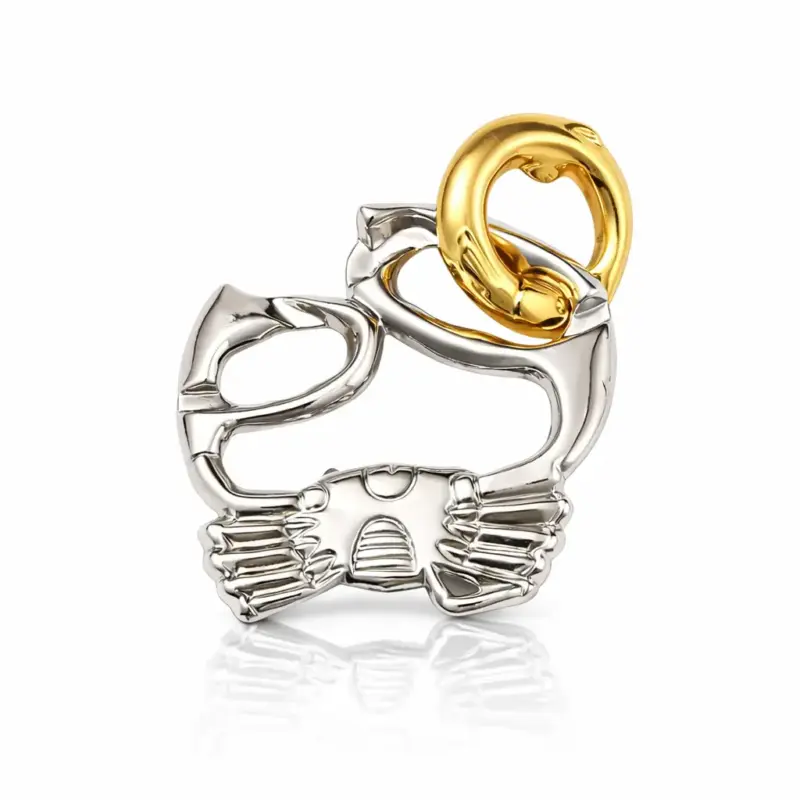
Metal Crab Puzzle Cast Brain Teaser with Gold Ring
Metal Crab Puzzle Cast Brain Teaser with Gold Ring: a two-piece cast metal disentanglement puzzle from Tea-Sip. A polished silver-toned crab locks a gold ring in its claws with no springs or latches — the cast shape itself is the lock, and one hidden sequence of rotations frees it. Palm-sized at 55 × 56 mm and 56 grams, rated hard, made for adults who want a screen-free spatial challenge or a gift that keeps someone happily quiet.
In this segment, honest decision support matters more than hype. The right expectation is not “life-changing difficulty.” The right expectation is repeatable 5-to-30-minute focus loops, plus occasional longer sessions.
What to Know Before You Buy
1. No-force discipline is part of ownership. If you tend to apply pressure when frustrated, this category will punish finish quality.
2. Reassembly is not optional if you want full value. Separation alone gives partial satisfaction.
3. Medium difficulty is still real difficulty for first-time users. Plan a calm session, not a rushed one.
4. Surface wear is normal in active use. Cosmetic patina is part of metal-object life cycle.
If these four points sound acceptable, the fit is strong. If they sound annoying, choose a different puzzle type first.
A Practical 7-Day Ownership Protocol
If you want faster mastery and better retention, follow this short protocol:
– Day 1: Free exploration, no hints, max 35 minutes.
– Day 2: Solve again, then immediate reassembly practice.
– Day 3: Timed solve with a written note of blocked states.
– Day 4: Pass it to one friend and observe their failure points.
– Day 5: Explain the mechanism verbally without showing full solution.
– Day 6: One clean no-force solve and one clean reassembly.
– Day 7: Decide your next progression product based on what felt hard: orientation memory or sequence planning.
This protocol turns the puzzle from object into skill practice. It also helps you decide whether to stay with two-piece cast designs or move up to multi-piece sequence puzzles.
Common Mistakes That Make This Puzzle Feel Harder Than It Is
Most stalled solves come from repeatable mistakes, not from lack of ability. If you avoid these, your success rate improves fast.
1. Forcing “almost” angles. If a move feels like it needs pressure, it is usually wrong. Back out and reset.
2. Spinning without tracking. Random rotation creates motion, not progress. Track at least a few blocked states.
3. Ignoring reassembly practice. Many people separate once and stop. Reassembly is where understanding gets built.
4. Trying to solve in noisy context. This is a short-focus puzzle. Distraction kills pattern memory.
5. Assuming symmetry means mirrored paths. The shape looks balanced, but the solve sequence is not fully symmetric.
A simple rule that works: slow hands, active eyes, no force. If your pace drops by even 20 percent, you usually notice the path constraints sooner. If you want to strengthen that skill across other models, rotate between this puzzle and one adjacent shape family on Tea Sip, then compare where your failures occur. That comparison habit, more than any single trick, is what turns “I got lucky” into repeatable solving.
FAQ
1) Is the metal crab puzzle hard for beginners?
It is medium difficulty, which means beginners can solve it, but usually not on the first random attempt. Expect a learning phase where you realize move order matters more than force. If you are new, give yourself 20 to 40 minutes and treat the first session as mapping, not racing. Once you can track blocked versus allowed angles, the puzzle becomes much easier to read.
2) How long does it usually take to solve a cast metal crab puzzle?
For first-time solvers, 10 to 40 minutes is common. Some sessions run longer if you keep restarting without tracking failed states. Experienced puzzlers may finish much faster, but reassembly still slows many people down. The better metric is not raw speed. It is whether you can separate and reassemble cleanly without outside hints.
3) Is this puzzle safe for kids, and what age is realistic?
Use practical caution. This is a solid metal object with a detachable ring, so maturity matters more than interest. A realistic audience is older kids, teens, and adults who can handle small metal objects responsibly. If you need compliance details for your market, review local toy safety and age-grading requirements before buying (CPSC, EU framework).
4) Can I damage the puzzle by forcing the ring out?
Yes. You can damage the finish or edges if you force the wrong orientation. This type of disentanglement puzzle is designed as a no-force path problem. If the ring binds, stop and reset. A correct release should feel unexpectedly smooth once the path aligns. Force means the sequence is wrong, not that you are close.
5) Does this work as a daily pocket puzzle or EDC item?
Yes, size and weight are pocket-friendly. The tradeoff is cosmetic wear. If you carry it loose with keys, coins, or clips, the plated surface will mark faster. For better long-term finish, keep it in a small pouch or separate pocket slot. Many users alternate between desk use and short pocket carry rather than all-day metal-on-metal contact.
6) What is the difference between a disentanglement puzzle and an interlocking puzzle?
Disentanglement puzzles focus on separating constrained components through path navigation, often rings, loops, or hook shapes. Interlocking puzzles usually involve multi-piece disassembly sequences that build a solid body. The metal crab puzzle is primarily a constrained-path disentanglement design. For broader category context, see locking puzzle brain teasers.
7) Why does reassembly feel harder than first solve?
Because first solve can include a lucky final move, while reassembly requires a full path model. You need to remember not just the winning orientation, but the order of small rotations that made it legal. That memory gap is why medium cast puzzles stay replayable. Reassembly trains the explainable version of your solve, not just the successful outcome.
8) What should I buy after this if I want a harder challenge?
If you enjoy this puzzle and want a clear step up, move to a multi-piece cast sequence like the 5-piece cast spiral metal puzzle. If you want to stay in ring-family logic first, compare shape-driven alternatives in Tea Sip’s cast puzzle selection guide. The best next buy depends on whether you prefer longer sequence complexity or tighter two-piece geometry.
9) Does solving this kind of puzzle help attention and spatial thinking?
It is not a medical intervention, but puzzle-style spatial tasks do recruit attention control, mental rotation, and working memory. Research on spatial training and puzzle activity supports meaningful cognitive engagement, especially in visuospatial domains (PubMed 34017098, PubMed 30327598). Treat it as structured cognitive exercise with immediate feedback, not as a guaranteed performance cure.
10) Is this a good screen-free gift for adults and teens?
Yes, especially if you want a gift that creates interaction, not just display value. The metal crab puzzle is compact, tactile, and naturally social because people pass it around and compare attempts. It pairs well with other compact challenges in Tea Sip’s screen-free gifts topic. If you want a short digital break between physical sessions, a lightweight logic game like Memory Match fits the same habit loop.
Final Verdict
The metal crab puzzle is a strong mid-tier cast metal puzzle for people who value tactile quality, portable size, and repeatable solve tension more than raw difficulty bragging rights.
This puzzle does not test how hard you pull. It tests how accurately you think in motion.
If that is the challenge you want, start here: Metal Crab Puzzle Cast Brain Teaser with Gold Ring. Then build outward through metal puzzle category pages and mechanical puzzle topic collections.