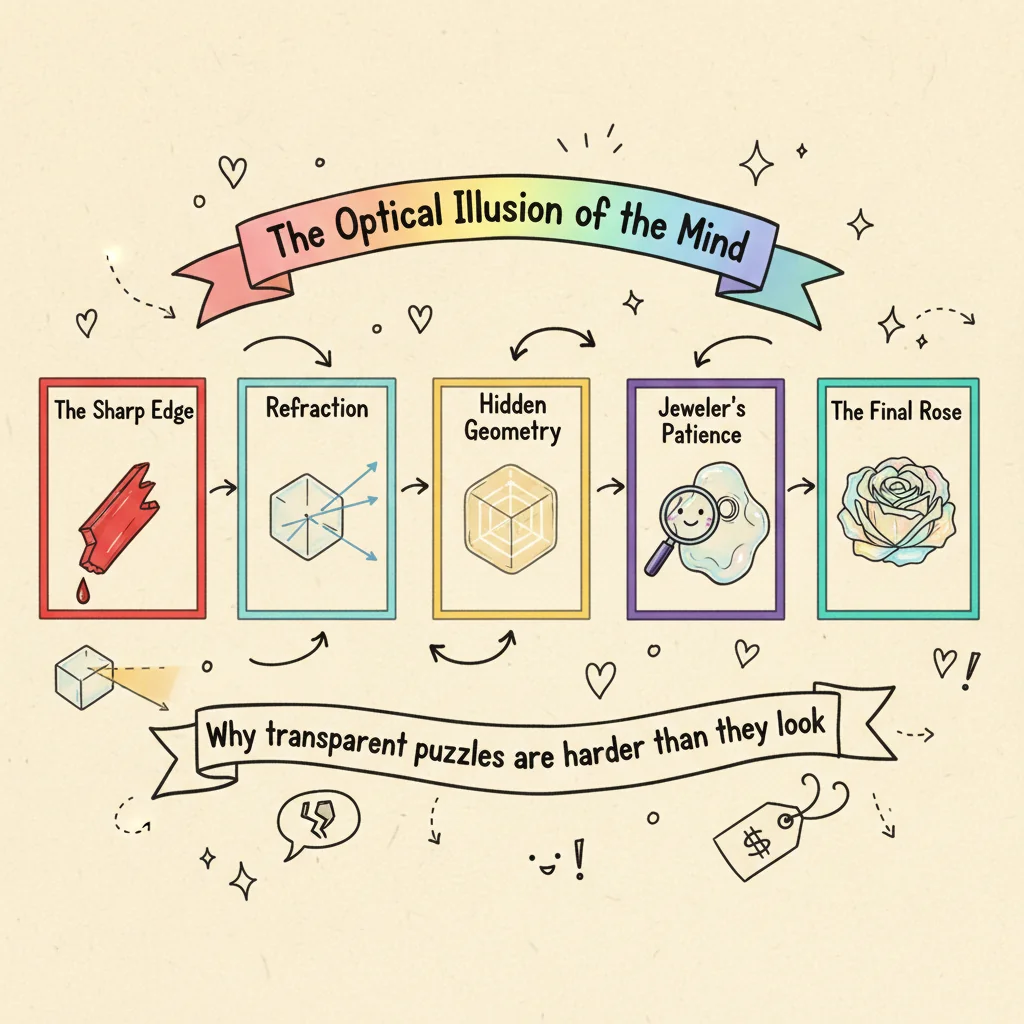
The afternoon sun hit the pile of jagged, translucent red plastic on my desk, and for a moment, I wasn’t looking at a puzzle. I was looking at a heap of broken glass. My thumb found a particularly sharp edge on piece number fourteen, a reminder that while these objects look like delicate nursery decor, they are surprisingly aggressive in their design. I’ve spent twenty years dismantling mechanical puzzles made of brass, steel, and exotic hardwoods, but there is a specific brand of humility that only a 3D crystal puzzle can provide.
The challenge isn’t just spatial; it’s optical. When you’re working with solid wood, a shadow tells you where a joint sits. With these translucent polymers, light passes right through the internal structure, blurring the lines between the piece in your hand and the core you’re trying to build. You aren’t just fighting geometry; you’re fighting refraction.
My thesis is simple: Crystal puzzles are the most underrated “bridge” in the hobby. They occupy the space between the casual jigsaw and the hardcore sequential discovery box. They demand the patience of a jeweler and the spatial reasoning of an architect, yet they cost less than a decent lunch. If you think they’re just toys for kids, you’ve clearly never tried to find the locking pin in a clear plastic rose while your eyes are playing tricks on you.
The Invisible Seam: Why Transparency Changes Everything
Most puzzles rely on what you can see. A traditional jigsaw is all about surface-level pattern recognition. A wooden burr puzzle is about understanding the hidden voids within a solid block. But a crystal puzzle—often categorized as a three-dimensional jigsaw puzzle—forces you to look through the object.
This transparency creates a unique mental fatigue. After thirty minutes, the edges of the pieces seem to vibrate. I’ve found that I have to change the lighting in my office at least twice during a build. If the light is too direct, the glare hides the tiny ridges that indicate a proper fit. If it’s too dim, the deep reds or blues of the plastic become opaque. It is a constant negotiation with your own environment.
There is also the matter of the “click.” In the world of high-end metal puzzles, we talk about tolerances in microns. In crystal puzzles, we talk about the snap. These pieces are designed to interlock with a friction fit that is remarkably tight. If you force a piece, you risk snapping a plastic tab—a death sentence for the final aesthetic. But if you don’t push hard enough, the whole structure remains a wobbly mess until the final locking rod is inserted.
The Anatomy of the Build
Every crystal puzzle follows a predictable but punishing lifecycle. You start with a pile of pieces that look identical. You spend twenty minutes just sorting them by the “steps” or “levels” they seem to represent. Then comes the foundation. Usually, two or three pieces form a base that feels like it’s held together by nothing but hope and the oil from your fingertips.
The middle stage is where most people quit. This is the “wobbly phase.” You have ten pieces stacked, but they aren’t locked yet. One sneeze, and you’re back to the beginning. It’s a test of manual dexterity that reminds me of the steady hand required for classic tabletop strategy. You have to hold the core together with your non-dominant hand while hunting for the next interlocking layer with your right.
Finally, there is the locking pin. This is the “Aha!” moment. Every crystal puzzle has a central rod or a final key piece that slides through the entire assembly, pulling the tension tight and turning a pile of plastic into a solid, glass-like sculpture. It is one of the most satisfying “thunks” in the puzzling world.
3D Crystal Rose Puzzle
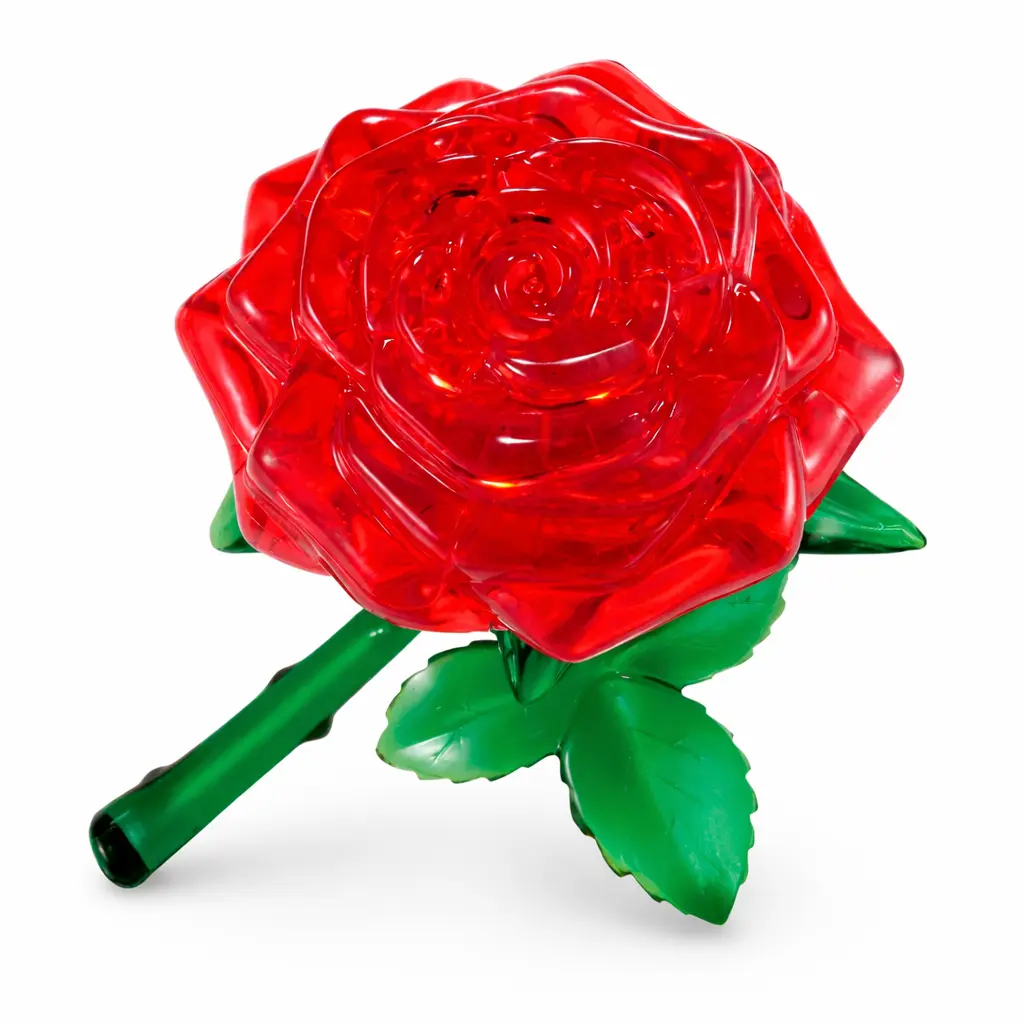
I bought this for my wife, but I ended up spending two hours at the kitchen table finishing it myself after she hit the “wobbly phase” and nearly threw it across the room. The 44-piece crystal rose ($19.99) is a masterclass in organic geometry. Unlike a building or a vehicle, a rose has no straight lines. Every piece is a series of sweeping, translucent curves.
The red plastic is exceptionally deep—it catches the light in a way that truly mimics a jewelry store display. However, be warned: the stem and leaves are a different beast entirely. They are thinner and more prone to stress marks if you’re too aggressive. My verdict? It’s the ultimate “apology” gift. It says, “I know I forgot our anniversary, but I spent three hours of mental labor building you a flower that won’t die.” If you’re interested in the process, I’ve written more about the specific frustrations and rewards of building this flower.
Ancient Logic in a Modern Shell
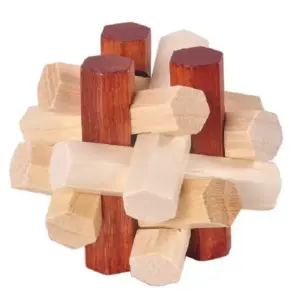
While these look like modern inventions, the DNA of the crystal puzzle goes back centuries. The way the pieces interlock without glue or fasteners is a direct descendant of the Chinese Luban lock. The original carpenters used wood and complex joinery to create puzzles that stayed together through tension and friction.
When you transition from the organic shapes of a rose or an animal to a geometric lock set, the difficulty spikes. You lose the “visual map” of a recognizable object. You can’t say, “This looks like a petal.” You have to say, “This is a 45-degree notch that must accommodate a sliding bar.” This is where the hobby gets serious.
12 Piece Crystal Luban Lock Set
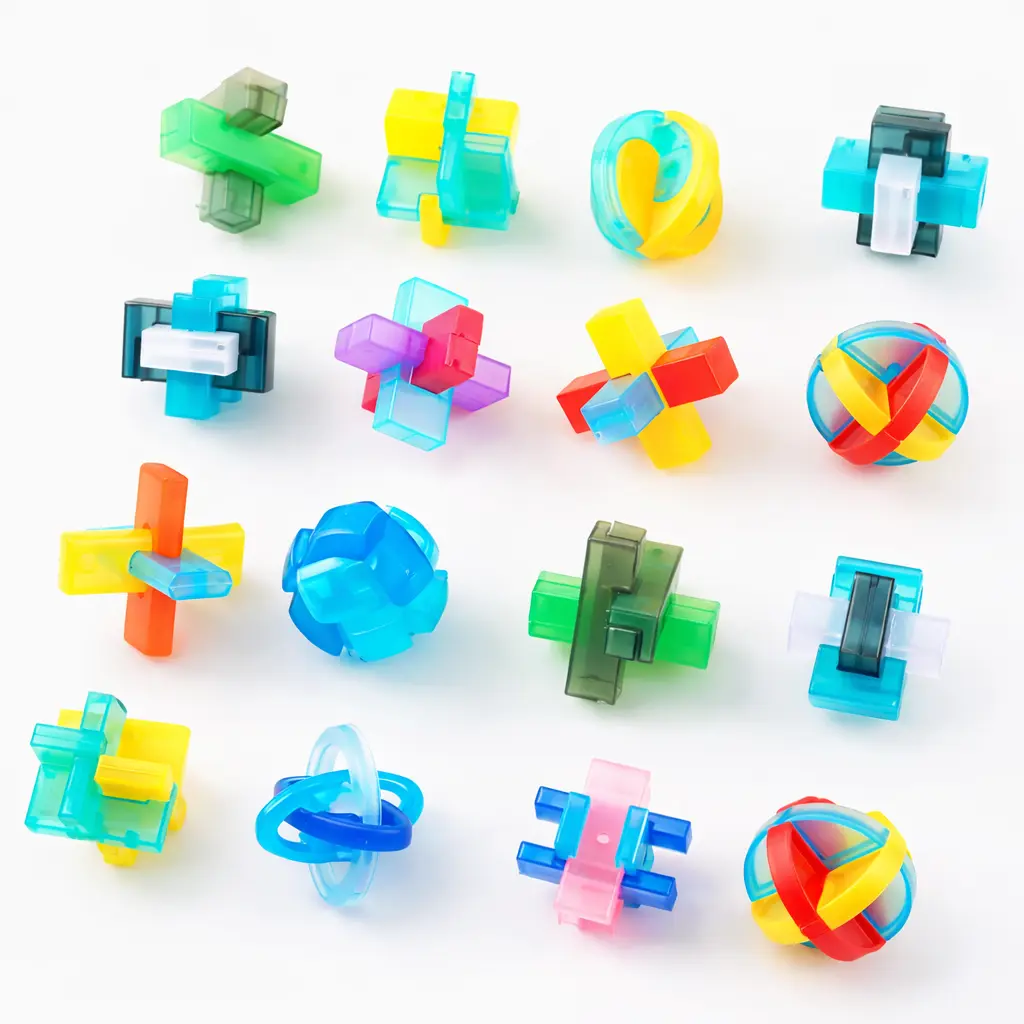
If you are the type of person who finds the 44-piece sculptures too “artsy,” this set of 12 mini crystal Luban locks ($28.88) is your reality check. Do not buy this if you have large, clumsy fingers. These are pocket-sized enigmas that distill the history of ancient Chinese joinery into clear, colorful resin.
Each lock in the set presents a different internal logic. Some are six-piece crosses; others are more complex stars. Because they are clear, you’d think you could just see the solution. You can’t. The refraction hides which piece is the “key” that slides out first. It’s a brilliant exercise in frustration. I keep one in my pocket during long meetings—it’s a much more sophisticated fidget toy than a spinner, though I have dropped a piece under a conference table more than once.
The Aesthetics of the Desk Toy
Let’s be honest: part of the appeal of these puzzles is how they look when you’re done. A completed wooden puzzle looks like a brain teaser. A completed metal puzzle looks like a piece of hardware. But a crystal puzzle looks like art.
I’ve had the crystal apple on my office desk for six months. At least once a week, a client or a coworker picks it up, assuming it’s a solid glass paperweight. The look on their face when they realize it’s actually dozens of interlocking pieces is worth the eighteen-dollar entry fee alone.
3D Crystal Apple Puzzle
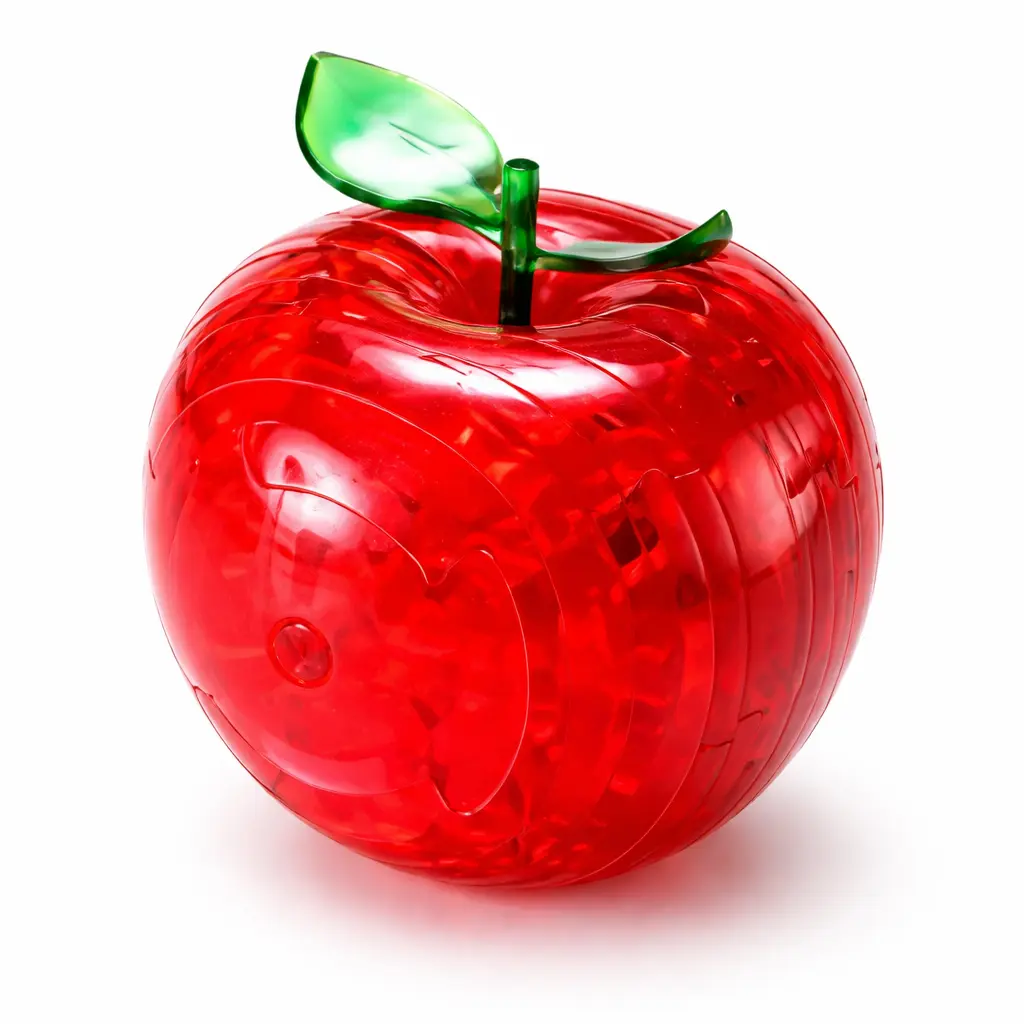
The 44-piece crystal apple ($18.88) is the most “solid” feeling of the bunch. Because the final shape is a sphere-adjacent object, the pieces have more mass and surface area than the spindly petals of the rose. It feels heavy in the hand. The build is roughly an hour for an adult, though the internal stem piece can be a bit finicky to line up.
It’s the quintessential “entry-level” crystal puzzle. It isn’t as punishing as the Luban locks, but it’s more structured than the floral designs. If you want something that doubles as genuine desk decor without screaming “I’m a nerd,” this is the one. Just keep it out of direct sunlight for years on end; like any plastic, the vibrant red can eventually fade if it’s baked in a window every day.
Material Matters: Plastic vs. Everything Else
I often hear purists complain that crystal puzzles are “just plastic.” They aren’t wrong, but they are missing the point. The material choice—usually a high-grade ABS or acrylic—is what allows for the translucency that makes the puzzle difficult. You couldn’t do this with wood, and doing it with glass would make the puzzle cost $500 and weigh three pounds.
When you compare these to selecting a high-quality metal brain teaser, you realize the experience is entirely different. Metal is about cold, hard logic and precise movements. Crystal is about visual interpretation and delicate assembly. It’s a softer type of challenge, but no less valid.
For those who find the plastic a bit too light, I recommend comparing the tactile differences of wooden puzzles. Wood has a warmth and a smell that plastic lacks, but it can’t compete with the light-catching brilliance of a well-made crystal piece.
The “Dust Magnet” Reality
I try to be fair in my reviews, so here is the honest negative: crystal puzzles are dust magnets. Because of the static electricity inherent in the plastic and the dozens of tiny crevices between the pieces, they will collect a fine layer of gray fuzz within a month.
Cleaning them is a chore. You can’t really wipe them down without risking moving the pieces or getting cloth fibers caught in the seams. My secret? A can of compressed air once a week. If you let the dust build up, the “crystal” effect is ruined, and it just looks like a dirty toy. If you’re a perfectionist, this might drive you crazy.
Why We Keep Coming Back
Why do I have a shelf full of these? It’s the “one more piece” syndrome. Because you can see the progress through the translucent body, you always feel like you’re just one step away from completion. It’s a different psychological hook than a hidden-mechanism puzzle where you might go hours without any visible sign of success.
When the brain gets tired of the intense logic required for comprehensive 3D puzzle strategies, a crystal puzzle is a palette cleanser. It’s a sensory experience. The clack of the plastic, the way the colors shift as you rotate the object, the finality of the locking pin—it’s a complete cycle of tension and release.
If you find yourself getting too frustrated, I genuinely suggest taking a mental break with a round of digital snake. It resets the spatial centers of the brain. Then, come back to the plastic. The piece that didn’t fit five minutes ago will suddenly slide into place with a perfect, audible snap.
FAQ: Everything You’re Afraid to Ask About Crystal Puzzles
Are 3D crystal puzzles hard?
They are “differently” hard. If you are good at jigsaws, you’ll have a head start on the piece-matching. If you are good at mechanical puzzles, you’ll understand the locking mechanisms. The real difficulty is the visual distortion caused by the clear plastic. On a scale of 1 to 10, most 44-piece sets are a solid 6. They aren’t impossible, but they aren’t a “five-minute distraction” either.
What happens if I lose a piece?
In short: you’re toast. Because these are precision-molded to fit together in a specific sequence, a single missing piece usually means the puzzle cannot be completed or won’t stay together. Unlike a 1,000-piece jigsaw where you might not notice a missing bit of sky, a missing piece in a 3D crystal puzzle is a structural failure. I recommend working on a high-contrast puzzle mat so you can see if a translucent piece has gone rogue.
Are these suitable for children?
The boxes usually say “Ages 12+,” and I agree with that. A 7-year-old will have the manual dexterity to snap the pieces together, but they likely won’t have the spatial patience to handle the “wobbly phase.” It’s a great “parent-and-child” project, but if you leave a kid alone with the 12-piece Luban set, expect to find half the pieces under the sofa by dinner time.
Do I need glue?
Absolutely not. In fact, using glue is a sin in the puzzle community. These are designed to be held together by internal tension and a final locking key. If you feel like you need glue, you’ve likely put a piece in the wrong place. The beauty of these objects is that you can take them apart and rebuild them whenever you want.
How do I clean them?
As mentioned, compressed air is your best friend. For deeper cleans (like if you’ve been eating chips while puzzling—don’t do that), a dip in lukewarm water with a tiny drop of dish soap works wonders. Avoid harsh chemicals or Windex, as some plastics will “craze” or develop tiny internal cracks when exposed to alcohol-based cleaners.
Are the instructions helpful?
They are… utilitarian. Most come with a numbered list of pieces and a vague diagram. However, the real enthusiasts throw the instructions away immediately. The fun is in the discovery. If you use the instructions, you’re just following a manual; if you don’t, you’re solving a mystery.
Why are some pieces numbered?
Look closely at the flat edges of the pieces. You’ll often see a tiny, embossed number. This is your “emergency exit.” If you are truly stuck, you can sort the pieces numerically to find the assembly order. It’s a nice safety net, but try to ignore them for the first hour. It’s much more satisfying to find the fit through logic than through a numbering system.
Do they break easily?
The ABS plastic is surprisingly durable, but the “tabs”—the little bits that stick out to lock into the next piece—are the weak points. If you are forcing a piece and it won’t go, stop. The plastic will turn white (stress marks) before it snaps. If you see white, back off and re-evaluate your geometry.
How long does a typical 44-piece puzzle take?
For a first-timer, expect 90 minutes to two hours. Once you understand the “language” of how these pieces are molded, you can probably knock one out in 45 minutes. The Luban locks are faster—maybe 10-15 minutes each—but there are 12 of them, so the set will keep you busy for a whole afternoon.
Can they be taken apart easily?
Yes, once you find the locking pin. You just slide the pin out, and the whole thing usually collapses into its component parts. It’s actually a great way to store them if you run out of shelf space. Just keep the pieces in a Ziploc bag so you don’t lose the “key.”
Is there a difference between brands?
Yes. The original designs from companies like Jeruel (marketed as Bepuzzled in the US) tend to have much tighter tolerances and clearer plastic. “Knock-off” versions often have mold lines (flashing) that make the pieces fit poorly or look “cheap.” The products on Tea-Sip are vetted for this—you want that crisp, glass-like finish, not a blurry, matte plastic.
Why are they called “crystal” puzzles?
It’s purely an aesthetic term. They are made of plastic, but the way they are molded with multiple facets allows them to refract light similarly to lead crystal. When finished, they have a “gemstone” quality that makes them feel more premium than a standard plastic toy.
The Final Snap
I remember the first time I finished the crystal apple. I sat it on the windowsill, and the evening light turned the whole thing into a glowing ember. It didn’t matter that it was plastic. It didn’t matter that it cost less than twenty dollars. What mattered was the hour of quiet, focused concentration it took to get there.
The world of puzzles is often divided into the “easy” stuff and the “impossible” stuff. Crystal puzzles sit right in the middle, offering a tactile, visual reward that few other hobbies can match. They are a reminder that sometimes, the most beautiful things are the ones we have to piece together ourselves, one translucent “clack” at a time.
If you’re looking for a place to start, grab the apple. If you want a challenge, go for the Luban locks. And if you want to impress someone, build the rose. Just remember to keep a can of compressed air nearby—and maybe a high-contrast mat so you don’t lose your mind when a piece inevitably slides off the table.