The third time the brass pin on a Japanese Himitsu-Bako slipped past my thumb without engaging the internal catch, I didn’t throw it across the room. I set the box down, walked into the kitchen, and made a fresh pot of coffee. That is the secret of veteran solvers that no marketing blurb will ever tell you: the puzzle isn’t the wood or the metal in your hands. The puzzle is your own mounting impatience.
Among the 200+ mechanical objects I’ve disassembled and (mostly) reassembled over the last decade, the most profound lesson is that your brain is a liar. It tells you a panel should slide because it looks like a slide. It tells you a key should turn because it’s a key. Modern life has conditioned us to expect immediate haptic feedback, but these objects operate on a different timeline. They require a specific kind of “slow-brain” thinking that feels almost revolutionary in 2026.
This breakdown isn’t a catalog of toys. It’s an analysis of the friction between human logic and physical geometry. Whether you are looking for a desk-side distraction or a weekend-long engineering project, the following challenges represent the best ways to test your spatial reasoning without actually breaking anything—except maybe your ego.
The Psychology of the Hidden Compartment
There is a primal satisfaction in finding a secret space. Historically, these objects weren’t just games; they were the 18th-century equivalent of an encrypted hard drive. According to the History of Science Puzzles, trick boxes were used to hide everything from jewelry to political correspondence that could get the owner beheaded.
When you engage with a modern puzzle trick box guide, you are participating in a lineage of security theater. The “challenge” is rarely about strength. In fact, if you find yourself white-knuckling a piece of laser-cut plywood, you’ve already lost. The solution is almost always a gentle “give” that occurs only when three or four conditions are met simultaneously.
I’ve watched brilliant software engineers get humiliated by a simple six-piece burr puzzle ($17.99) because they tried to solve it through brute-force iteration rather than observing the grain of the wood. The wood tells you where it wants to go; you just have to stop talking long enough to listen.
Metal vs. Wood: Choosing Your Poison
If you are new to this hobby, the material choice matters more than the difficulty rating. Metal puzzles—often called “Cast” puzzles—are about tolerances. They feel cold, heavy, and industrial. When you solve a metal puzzle, the “click” is audible and definitive.
Wooden puzzles, particularly the 3D kits that have dominated the market recently, are about the journey of construction. You aren’t just solving a mystery; you are the architect of it. There is a specific scent to laser-cut birch—a smoky, campfire aroma—that makes a three-hour build feel like a meditative retreat.
For those who prefer a tactile, pocket-sized enigma, metal is the way to go. If you want something that looks like a museum piece on your bookshelf after the solve, wood is the superior choice. I usually keep a metal piece in my bag for commutes and a wooden kit on my dining table for rainy Sundays.
Cast Keyhole Gold & Silver
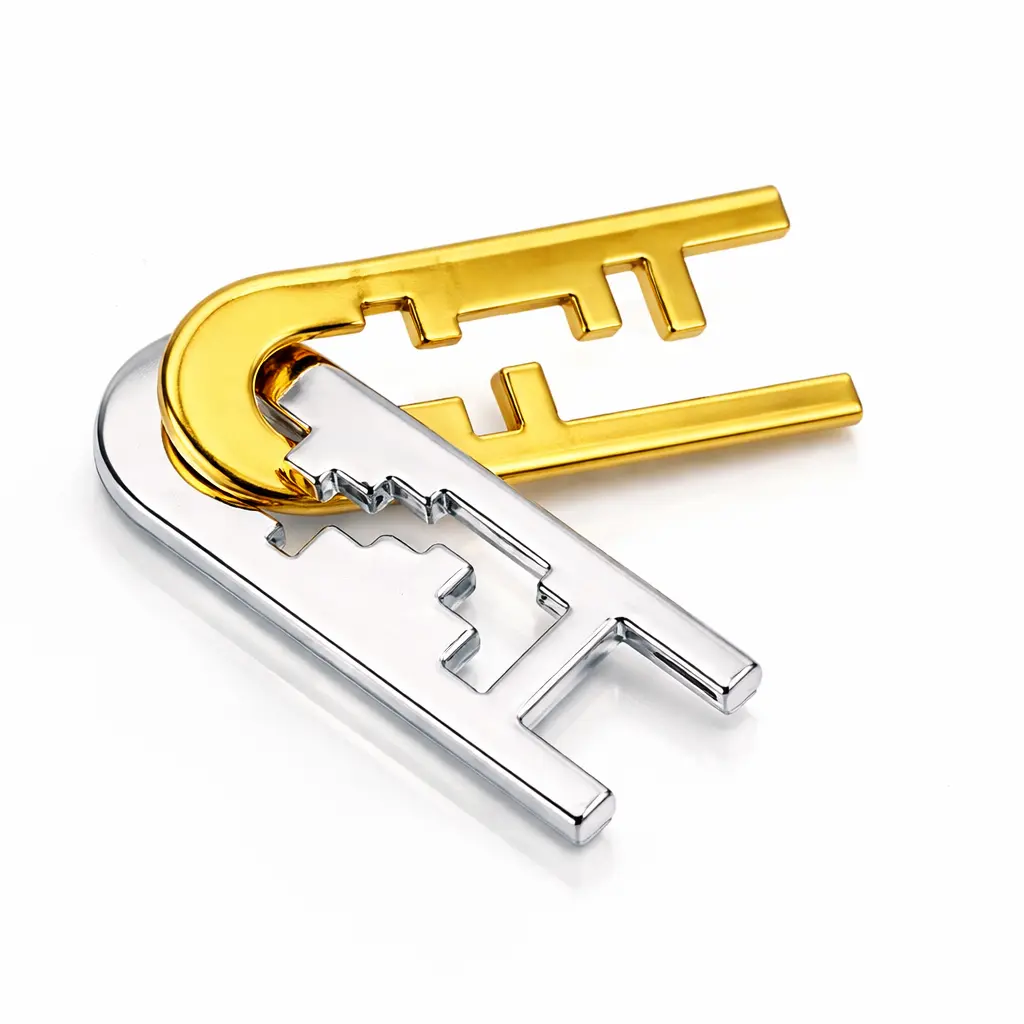
Cast Keyhole Gold & Silver — $13.99
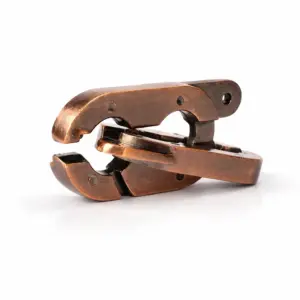
The Cast Keyhole Gold & Silver ($13.99) is the ultimate “liar” puzzle. At first glance, it’s just two flat pieces of metal with some notches. You think, “I’ll have this apart before the waiter brings the check.” Twenty minutes later, you’re still spinning them in circles. The flat surfaces hide a 3D maze that you have to navigate by feel alone.
What I love about this specific piece is the weight. It’s 75mm of solid, polished alloy that feels significant in the palm. The gold and silver tones aren’t just for show; they help you track your orientation as you navigate the internal “grooves” you can’t see. It’s a Level 4 challenge that feels like a Level 6 the first time you try to put it back together. Separation is one thing; restoration is where the real sequential discovery boxes prove their worth. This is the one I hand to friends who claim they are “good at puzzles” just to watch their confidence evaporate.
3D Wooden Puzzle Safe with Combination Lock
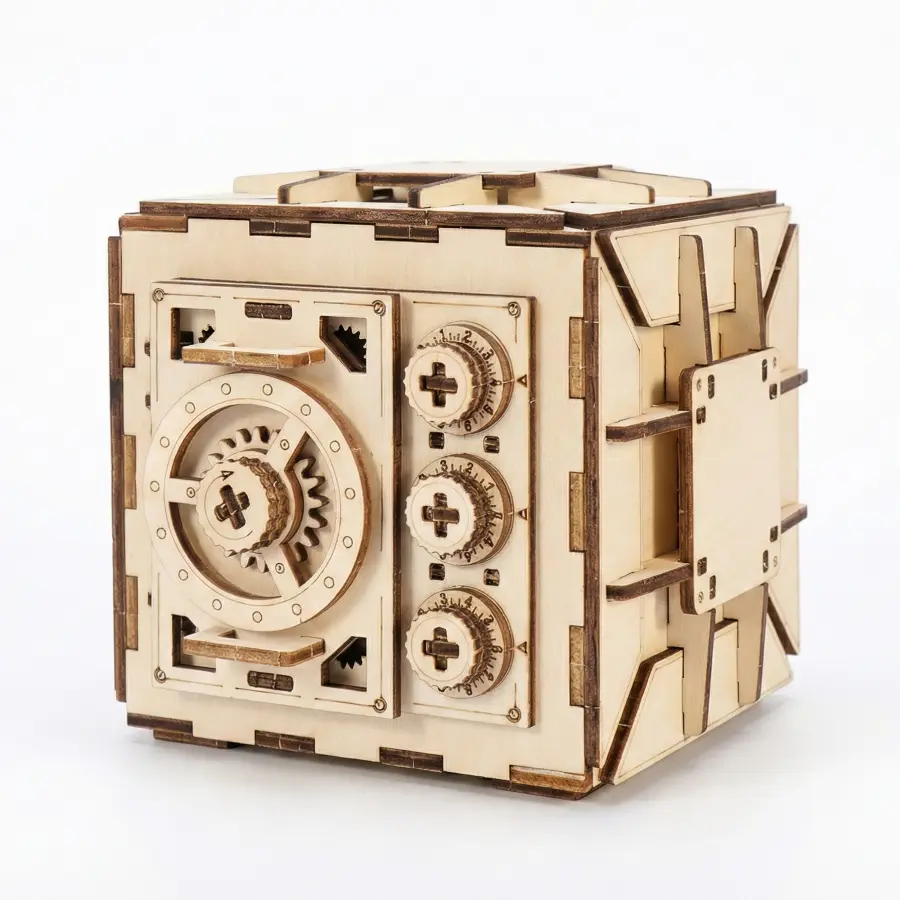
If you’ve ever wanted to feel like a high-stakes safecracker without the risk of jail time, the 3D Wooden Puzzle Safe with Combination Lock ($30.99) is the gold standard for entry-level mechanical kits. This isn’t a “box” in the traditional sense; it’s a fully functional 3-digit safe made from 111 precision-cut pieces.
The assembly takes about 90 minutes, and the tolerances are tight. I’ve built three of these over the years as gifts, and I’ve learned that the secret is in the waxing. If you don’t wax the gears (use a standard tea light candle), the mechanism will bind. But when you get it right? The sound of the tumblers falling into place is pure dopamine. It’s a perfect example of how puzzles designed for group solving can turn a boring afternoon into a genuine engineering workshop. It’s satisfying, functional, and actually holds a decent amount of “treasure” once finished.
3D Wooden Puzzle Treasure Box
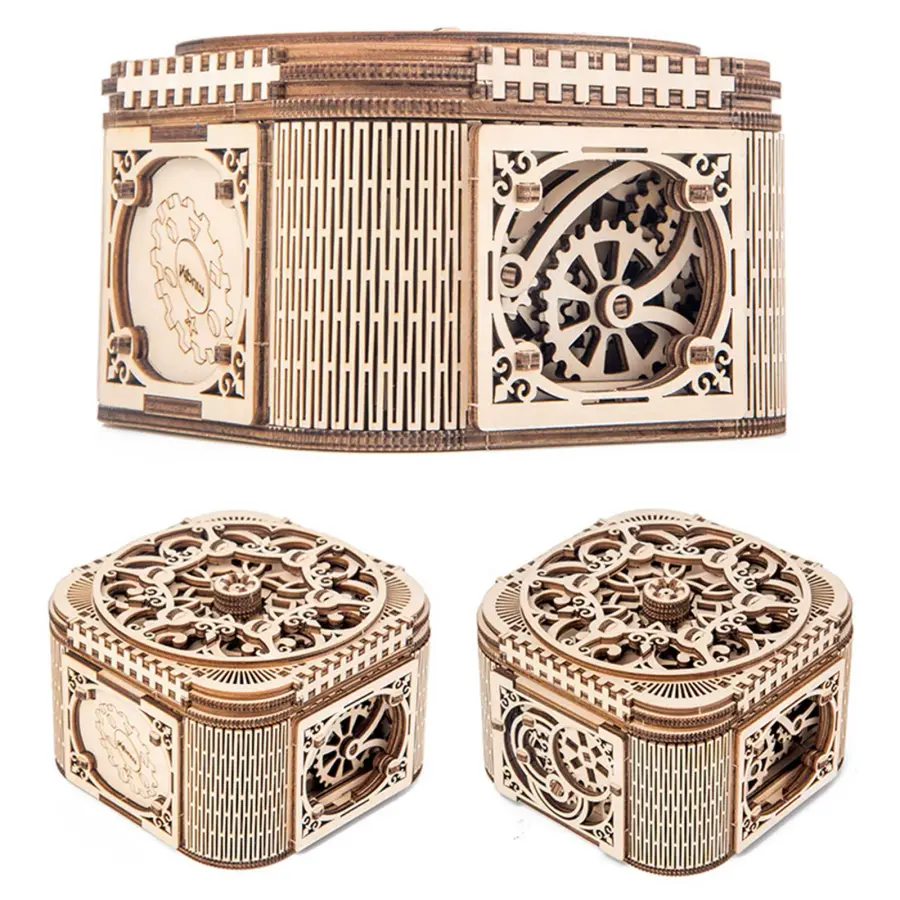
The 3D Wooden Puzzle Treasure Box ($29.99) occupies that rare space between a hobbyist project and a piece of functional decor. While the Safe is rugged and mechanical, the Treasure Box is elegant. It features visible gear mechanisms that move in synchronization when you turn the key.
I spent a Tuesday evening putting this together, and the most impressive part was the “no glue” engineering. Every piece stays in place through friction and geometry—a concept known as mechanical puzzles in the broader academic sense. It uses about 150-200 pieces, making it a bit more complex than the safe. The way the lid lifts and the side panels expand feels like something out of a Victorian clockmaker’s shop. If you’re looking for a gift that doesn’t look like a “toy,” this is the one.
Luban Lock Set 9 Piece
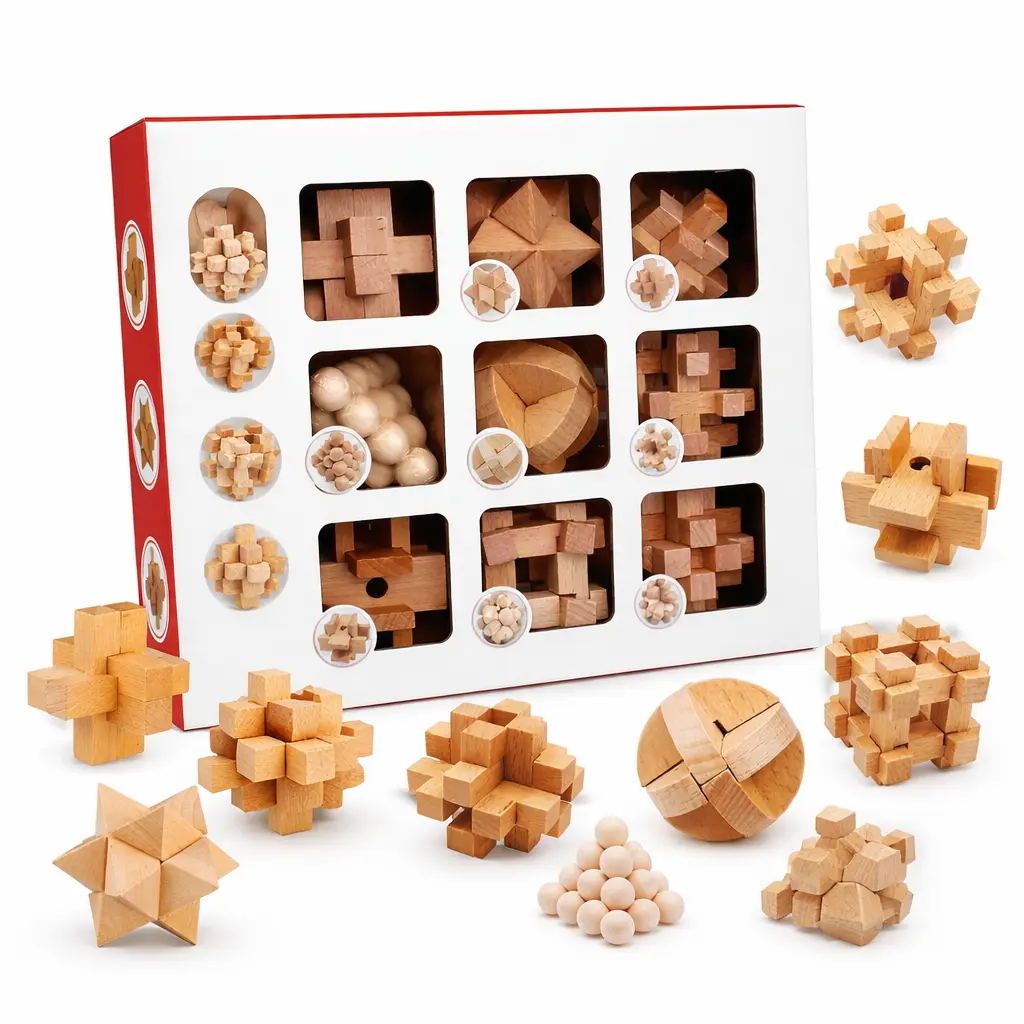
We need to talk about the Luban Lock Set 9 Piece ($39.99). This is essentially a history lesson in a box. These are based on 2,500-year-old Chinese carpentry techniques. No nails, no glue, just mortise-and-tenon joints that hold together because the math says they have to.
The set includes nine different designs, ranging from “I figured this out in five minutes” to “I am going to leave this on the shelf forever because I can’t find the first piece.” The beauty of these is their simplicity. They are the antithesis of the complex sequential discovery boxes. There are no hidden tools or magnets. It’s just wood against wood. I find that these are the best “fidget” puzzles for a home office. They are tactile, silent, and deeply rewarding when the final piece slides into the core and locks the entire structure into a solid mass.
Six-Piece Burr
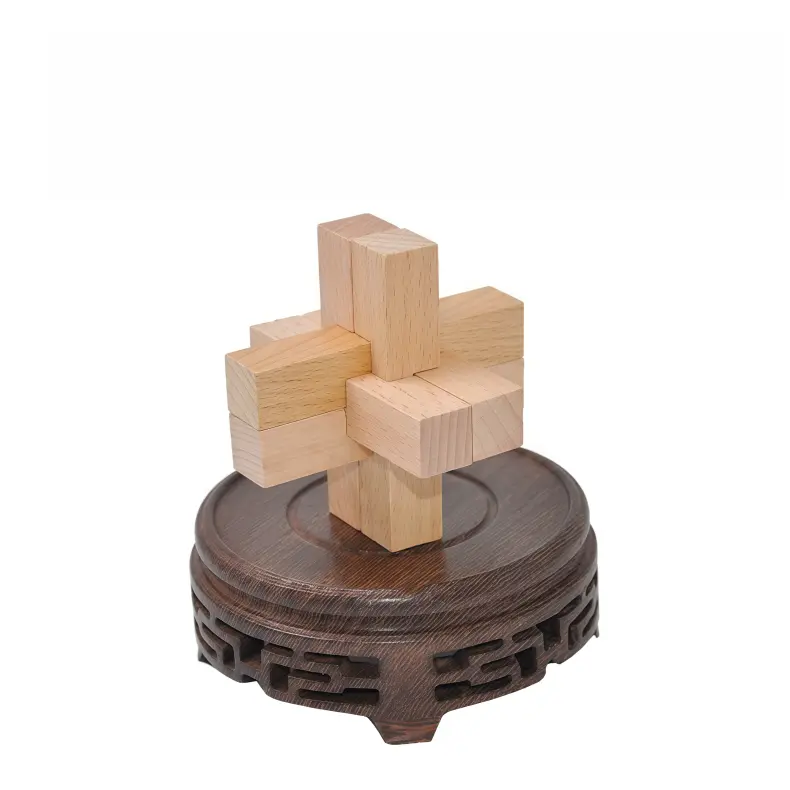
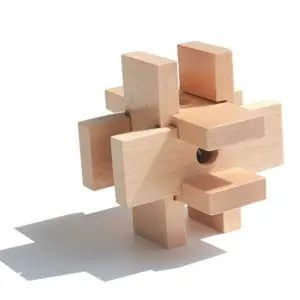
The Six-Piece Burr ($17.99) is the “Final Boss” of the interlocking world for many beginners. It looks like a simple cross, but it’s a masterclass in Daoist philosophy—specifically the idea that the path is only revealed when you stop pushing.
I’ve had this specific burr on my desk for three months. Even now, after solving it dozens of times, I still occasionally get “lost” in the reassembly. It’s a screen-free way to reset your brain after a long day of staring at spreadsheets. At under twenty dollars, it’s probably the best value-per-hour of frustration you can buy. It doesn’t scream for attention, but anyone who picks it up will be stuck for at least twenty minutes.
The Peak: The Engineer’s Curse vs. The Child’s Intuition
I once conducted a small, informal experiment in my living room. I handed the 3D Wooden Puzzle Safe ($30.99) to a neighbor who is a senior structural engineer. I gave the same model to his 11-year-old daughter.
The engineer spent the first twenty minutes studying the instruction manual, looking for the mechanical “logic” and trying to calculate the gear ratios in his head. He was looking for the system. His daughter, meanwhile, just started clicking pieces together. When she hit a snag, she didn’t analyze it; she just tried a different angle.
She finished the safe 40 minutes before he did.
This is the “Peak” insight of the puzzle world: Over-education is a handicap. We are trained to look for complex solutions to complex problems. But most puzzle box challenges are built on simple, elegant physical truths. The engineer was looking for a complicated reason why the door wouldn’t close; the daughter just noticed a tiny burr on the plywood and sanded it down with her fingernail.
When you approach a puzzle like the Luban Lock Set ($39.99), try to turn off the part of your brain that wants to “solve” it. Instead, engage the part of your brain that wants to “play” with it. The solution isn’t a destination; it’s a byproduct of exploration. If you find yourself getting angry, you’ve stopped playing and started working. And nobody should work for free on a Saturday night.
Expanding the Collection: Beyond the Box
Once you’ve mastered the secret compartment, you might find yourself craving different types of mechanical engagement. Not everything has to be a “box” to be a challenge. Sometimes, the puzzle is the assembly itself.
For instance, the Galleon Ship 3D Wooden Puzzle Model Kit ($22.99) isn’t a “trick” puzzle, but it requires the same level of spatial precision. You are recreating 16th-century naval engineering in miniature. It’s a great way to transition from pure brain teasers into the world of visual recognition exercises that improve your focus.

Similarly, if you find the mechanical aspect more interesting than the “secret,” something like the 3D Wooden Puzzle Tanker Truck Kit ($22.99) offers a different kind of payoff.

It features rolling wheels and opening cabin doors that rely on the same “snap-fit” logic as the safe. It’s less of a “how do I open this?” and more of a “how does this work?” which is a subtle but important distinction in the hobby.
If you’re feeling overwhelmed by the wooden kits, you can always take a break with some digital logic games to keep your reflexes sharp. But eventually, the call of the physical object always brings you back. There is something about the Steampunk Airship 3D Wooden Puzzle ($26.66) that a screen just can’t replicate.
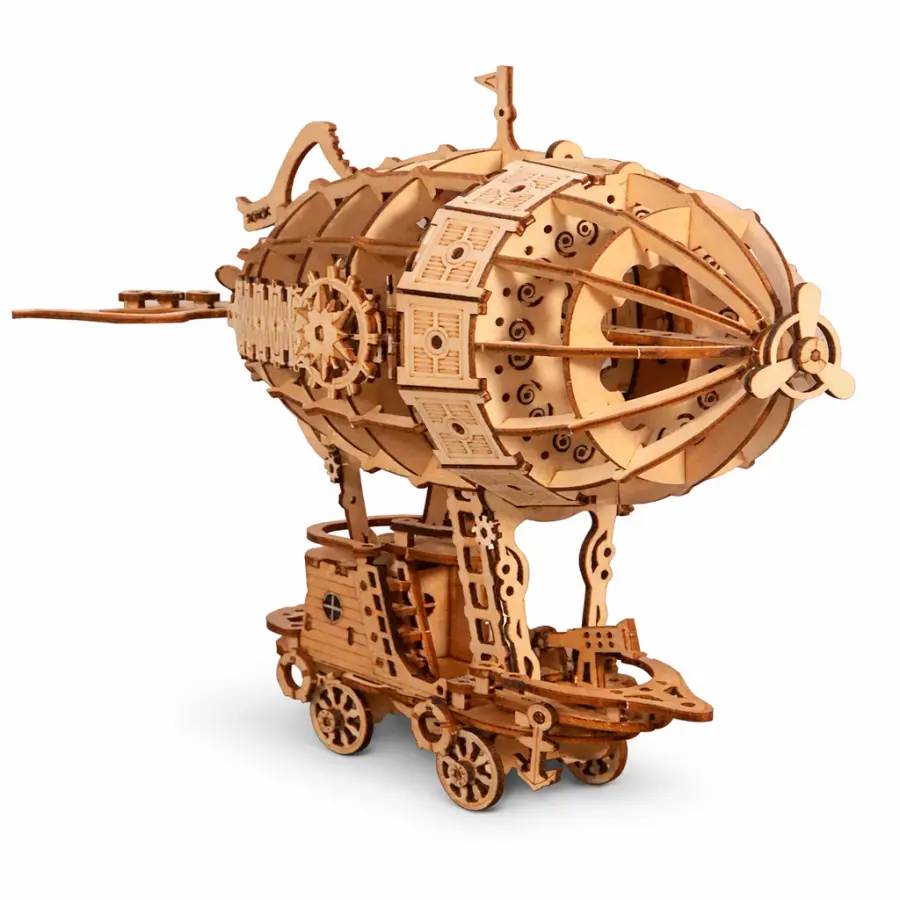
The airship is a one-hour build that imagines a Victorian future. It’s a conversation starter, sure, but it’s also a testament to how far laser-cutting technology has come. The propeller actually spins, and the wheels roll—all without a single drop of glue.
For the musically inclined, the 3D Wooden Cello Puzzle Model Kit ($29.99) offers a beautiful aesthetic challenge.

It uses those same steampunk engravings and mechanical gears to recreate a 16th-century instrument. It’s the kind of project that reminds you that mechanical puzzles are just as much about art as they are about math.
Finally, for those who want a quick “fiddle” puzzle that fits in a pocket, the Tricky Wooden Ring Puzzle ($12.89) is a classic.
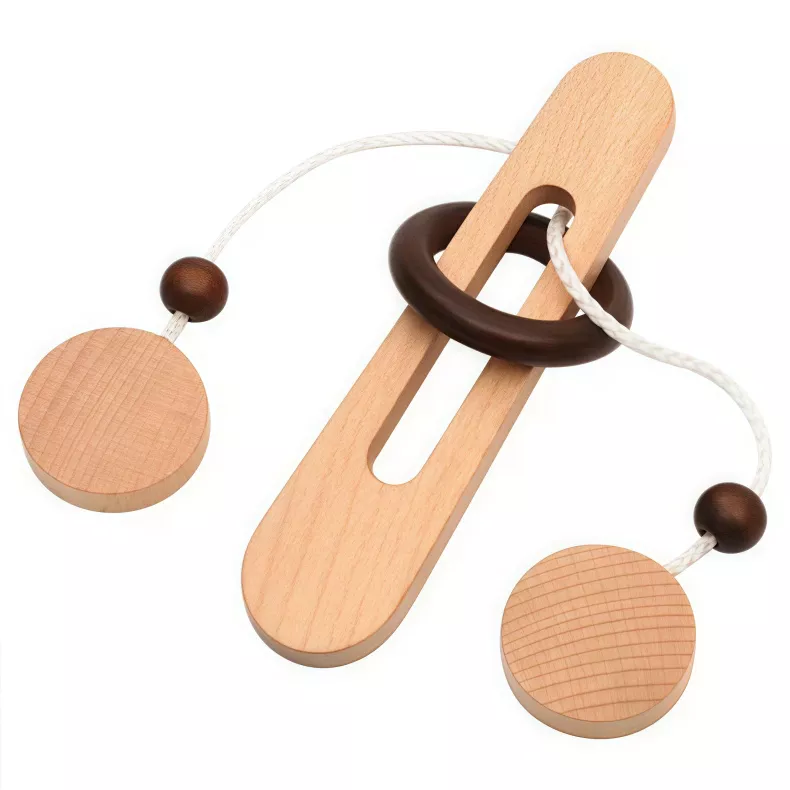
Tricky Wooden Ring Puzzle — $12.89
It’s inspired by historical “ring and string” puzzles but executed in clean, minimalist wood. It’s the perfect thing to hand to a guest while you’re finishing up in the kitchen. It looks impossible, but the solution is a single, elegant movement that feels like magic once you find it.
Quick-Reference Comparison Table
FAQ: Everything You Wanted to Ask While Stuck on Step 4
How do I solve a Japanese puzzle box without the instructions?
The vast majority of traditional puzzle boxes rely on a “sliding panel” mechanism. Start by placing the box in both hands and applying light pressure with your thumbs to every single surface. You aren’t looking for a button; you’re looking for a panel that moves even a fraction of a millimeter. Once one panel moves, it usually unlocks the next. If you get truly stuck, there are mechanisms behind secret compartments that often involve centrifugal force or magnets, though traditional boxes are purely mechanical.
Are wooden puzzle boxes durable enough for kids?
It depends on the age. For anyone over 14, a kit like the 3D Wooden Puzzle Safe ($30.99) is perfectly durable. However, younger children tend to use force when they should use finesse. Plywood is strong, but the small interlocking tabs can snap if twisted. If you’re looking for puzzles designed for group solving, I recommend the metal cast series as they are virtually indestructible.
What is the difference between a “sequential discovery” puzzle and a regular puzzle box?
A regular puzzle box usually just requires a series of moves to open. A sequential discovery puzzle, like those found in the Riddler Box series, requires you to find tools hidden within the puzzle itself to progress. For example, you might find a small pin in the first compartment that you must then use as a key for the second. It’s a much deeper, more narrative experience.
Why are some puzzle boxes so much more expensive than others?
You are paying for three things: material, tolerances, and design. A $300 puzzle from a designer like Jesse Born uses exotic hardwoods and internal mechanisms machined to a thousandth of an inch. A $30 kit like the Treasure Box ($29.99) uses laser-cut plywood. Both are fun, but the high-end versions offer a level of “smoothness” and complexity that mass-produced kits can’t match.
Can I reset a puzzle box if I accidentally solve it?
Yes, but reassembly is often harder than the solve. For interlocking puzzles like the Six-Piece Burr ($17.99), I highly recommend taking a photo of the pieces as they come apart. If you scramble them, you might be looking at a several-hour project to get them back into their original shape.
Do these puzzles actually help with brain health?
While “brain training” is a controversial term in science, research suggests that visual recognition exercises and spatial reasoning tasks can help maintain cognitive flexibility. More importantly, they provide a much-needed break from the dopamine-loop of digital devices. They teach patience, which is a cognitive skill we are all losing.
What should I do if a piece snaps in a wooden kit?
Most modern kits come with a few spare parts for the most delicate pieces. If you snap something that doesn’t have a spare, a tiny drop of wood glue and a toothpick will usually fix it. Just make sure the glue is completely dry before you continue assembly, or you might accidentally glue your puzzle shut forever.
Are the metal puzzles plated or solid?
Most, like the Cast Keyhole ($13.99), are made from a zinc alloy and then plated in chrome, gold, or copper tones. This gives them the weight of solid metal without the astronomical cost of solid brass or silver. The plating is generally very durable, though it can develop a patina over years of heavy use.
Why is my wooden safe mechanism sticking?
Ninety percent of the time, the issue is friction. Use a candle or a bit of beeswax on every moving gear tooth and every sliding surface. If it still sticks, check for tiny “nubs” left over from when you popped the pieces out of the wooden frame. A quick pass with a piece of sandpaper (usually included in the kit) will solve most issues.
Is the Luban Lock set too hard for a beginner?
The Luban Lock Set 9 Piece ($39.99) is actually great for beginners because it offers a progression. Start with the simplest 3-piece cross and work your way up. It’s better to have nine small challenges than one massive one that you give up on after an hour.
Can I store real valuables in the wooden safe?
It’s a puzzle, not a Fort Knox. While the 3D Wooden Puzzle Safe ($30.99) has a working combination lock, anyone with a hammer could get into it in three seconds. Use it for “valuables” like spare keys, emergency cash, or jewelry—things you want to keep away from prying eyes, not professional thieves.
What’s the best way to clean a metal puzzle?
A simple microfiber cloth is all you need. Avoid using harsh chemicals or metal polishes, as these can strip the plating over time. If the puzzle feels “gritty,” a drop of dry lubricant (like the kind used for bicycle chains) can help, but usually, just solving it a few times will wear down any internal manufacturing burrs.
How do I know if a puzzle is too hard for me?
Check the level ratings. Most brands use a 1-6 or 1-10 scale. If you’ve never done a mechanical puzzle before, don’t start at the top. A Level 4 like the Cast Keyhole ($13.99) is the “sweet spot”—challenging enough to be rewarding, but not so hard that you’ll want to delete your browser history and move to the woods.
Do these make good office desk toys?
They are the best office toys. They look professional, they don’t make noise, and they give your brain a different type of problem to solve during long calls. I’ve found that having a Tricky Wooden Ring Puzzle ($12.89) on my desk actually helps me focus during meetings.
What is the most common mistake people make?
Using force. If you have to strain your muscles, you are doing it wrong. These are tests of logic, not grip strength. If a piece won’t move, it’s because you haven’t found the prerequisite move yet. Take a breath, let go of the tension in your hands, and try again.
What 40 Hours of Brass and Frustration Actually Taught Me
The coffee I made at the start of this article is long cold. But that’s the point. When you engage with a truly great puzzle box challenge, time becomes elastic. You think you’ve been at it for five minutes, and you look up to find the sun has set.
If you’re looking to start this journey, don’t buy the most expensive or the most complex thing you can find. Start with the Cast Keyhole Gold & Silver ($13.99). It’s small, it’s elegant, and it will teach you more about the “lie of the flat surface” than any book ever could. It’s the perfect gateway into a hobby that rewards the quiet, the observant, and the persistent.
Once you’ve mastered the metal, the sequential discovery boxes are waiting for you. Just remember: the box isn’t locked because it wants to keep you out. It’s locked because it wants to see if you’re willing to slow down enough to be let in. Stop pushing, start feeling, and eventually, the wood will give way. That final, silent slide of a hidden panel is worth every minute of the frustration that preceded it.