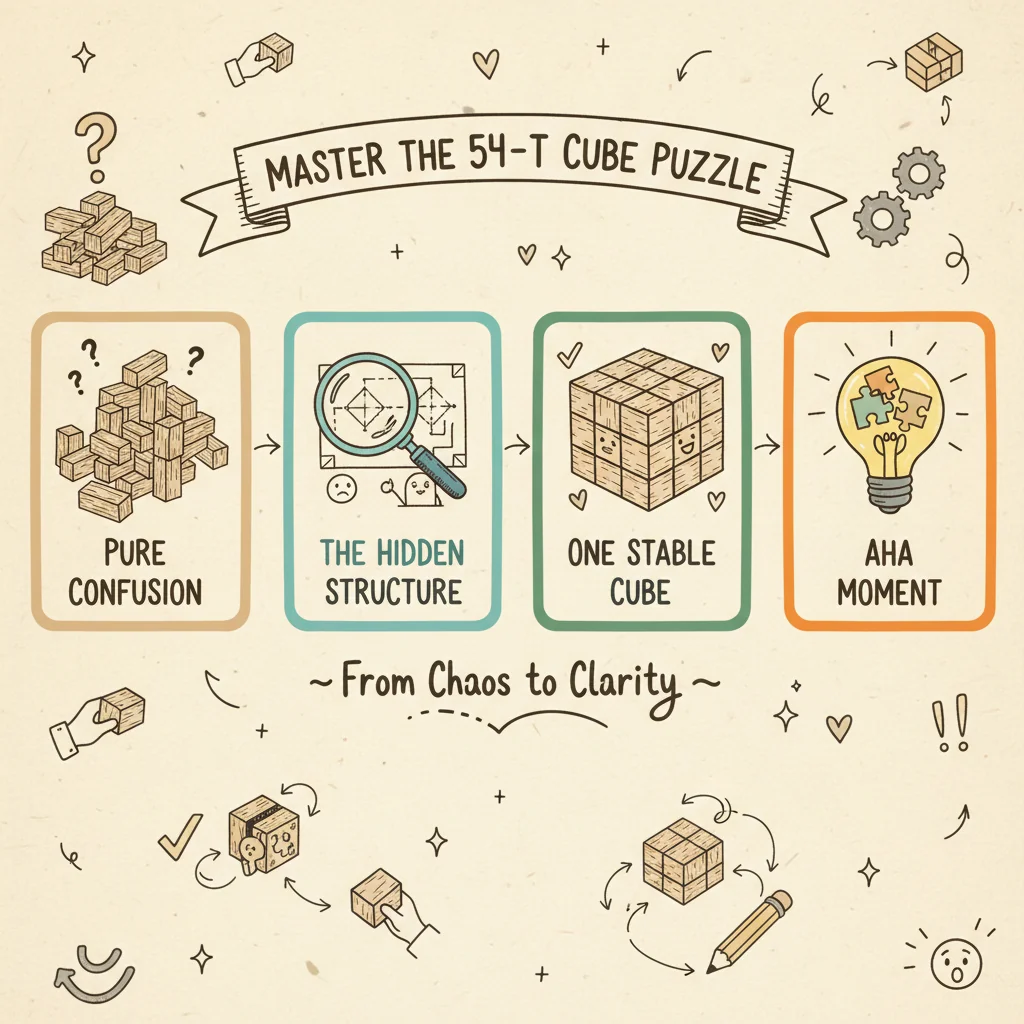
The First Five Minutes of Pure Confusion
You open the box and pour out 54 identical, smooth wooden blocks. They clatter onto the table, a small mountain of beige T-shapes. Your first thought is logistical: How do I even start sorting this? There’s no instruction sheet, no picture of the solved state—just the blocks and the quiet, empty box. The initial assumption is that this is a simple stacking game, a 3D jigsaw. You grab a handful and try to interlock them randomly. They fit together in a few ways, but the resulting shape is a lopsided, unstable mess that immediately collapses. This isn’t a puzzle you can brute-force with patience alone.
Within two minutes, a subtle frustration sets in. Unlike a Rubik’s Cube where the mechanism guides you, or a Soma cube with its seven distinct pieces, this is a problem of pure, undifferentiated volume. The challenge isn’t just assembly; it’s discovering the invisible internal structure. You’re not solving a puzzle so much as reverse-engineering a secret architecture from its most basic, repetitive component. It feels less like playing a game and more like being given a single brick and told to deduce the blueprint for the entire cathedral. This is the 54-T Cube’s first, and most important, lesson: you are not building a cube. You are uncovering the one stable structure hidden within the chaos.
What You’re Actually Holding in Your Hands
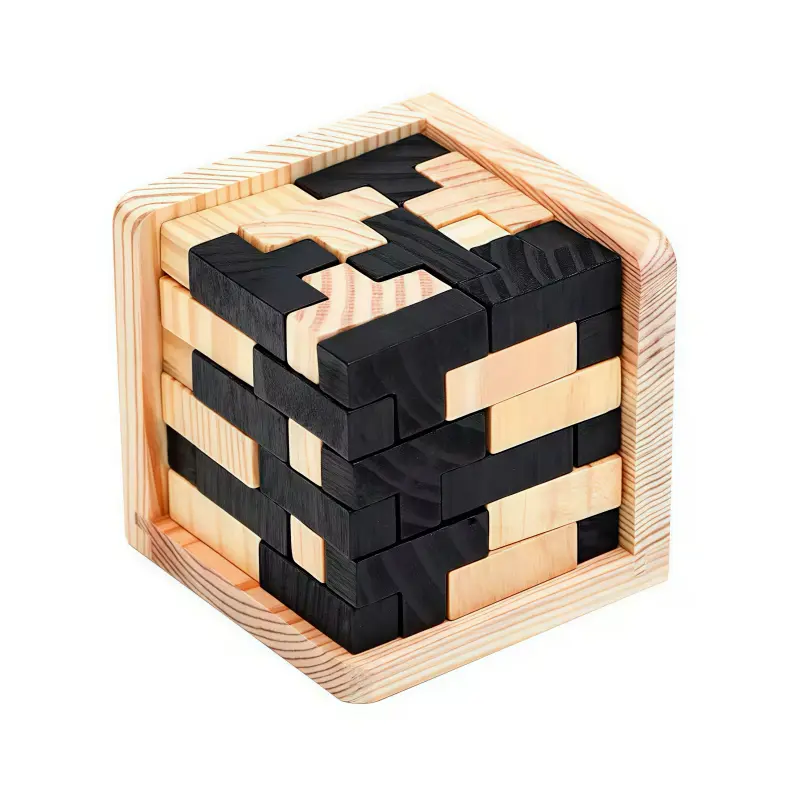
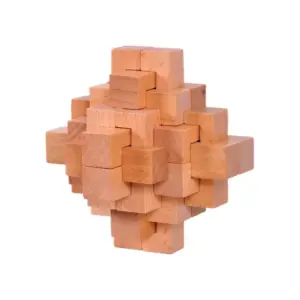
54‑T Cube Puzzle — $18.99
The 54-T Cube Puzzle is a study in deceptive simplicity. The set arrives as 54 identical, smooth beechwood blocks, each shaped like a capital letter “T” with equal-length arms. Each piece measures roughly 3.5cm from tip to tip, and the entire collection fits neatly in a compact, minimalist cardboard box. The wood is unfinished but sanded to a soft, almost velvety texture that feels warm and organic in your hands. There’s no varnish or dye, just the natural grain—a clear signal this is an eco-friendly, tactile-first experience. The first thing you notice is the weight. For $18.99, you get a surprisingly substantial handful of wood; it has a satisfying heft that feels more like a premium tool than a disposable toy. The pieces clack together with a soft, solid sound, not a hollow plastic rattle.
This is where the puzzle’s core identity emerges. Unlike a magnetic speed cube or a twisty puzzle with moving parts, the 54-T Cube is a static assembly puzzle. Its challenge is purely spatial and structural. You are not manipulating a mechanism; you are acting as the architect and the builder, using gravity and friction as your only allies. The goal is audaciously clear: assemble all 54 T-shaped blocks into a perfect, solid 3x3x3 cube. The reality is a brilliantly frustrating constraint. Because every piece is identical, the solution relies entirely on their specific, non-intuitive orientation relative to one another. There is no color pattern to follow, no key piece that looks different. The “aha” moment isn’t about finding a special block; it’s about recognizing the invisible, interlocking lattice they must form.
My honest first impression contained a minor negative: the lack of any guide, even a picture of the solved state, feels intentionally daunting. For a beginner, that blank slate can be paralyzing. It’s the polar opposite of something like the 7 Color Soma Cube Puzzle ($21.88), which provides brightly colored, distinct pieces that visually suggest how they might fit together. The Soma cube is a logic puzzle; the 54-T Cube is a structural enigma.
The feel is also distinct from metal puzzles. Where the Cast Coil Triangle Puzzle ($25.99) offers the cold, precise click of machined brass and bronze, the 54-T Cube is silent, organic, and demands you provide all the precision yourself. There’s no satisfying “snap” of completion—just the gradual, silent realization that the structure in your hands has finally stopped wanting to fall apart.
What you’re truly holding is a lesson in emergent stability. Individually, each T-block seems incapable of creating a flat surface, let alone a cube. The genius lies in how they cross-support each other when layered correctly, creating a dense, interwoven matrix that is remarkably rigid. Getting to that point, however, means abandoning every instinct you have about simple stacking. This isn’t about making layers; it’s about creating a three-dimensional internal scaffold where every piece locks its neighbor in place. The puzzle doesn’t guide you. It waits for you to discover its single, hidden rule.
The 54‑T Cube vs. Other Wooden Brain Teasers
To understand where the 54‑T Cube fits, you need to see the landscape of wooden brain teasers. It’s not a twisty puzzle, a disentanglement, or a sequential discovery box. It belongs to the subcategory of assembly puzzles, where the goal is to construct a specific shape from a set of pieces. Even within that family, its philosophy is distinct.
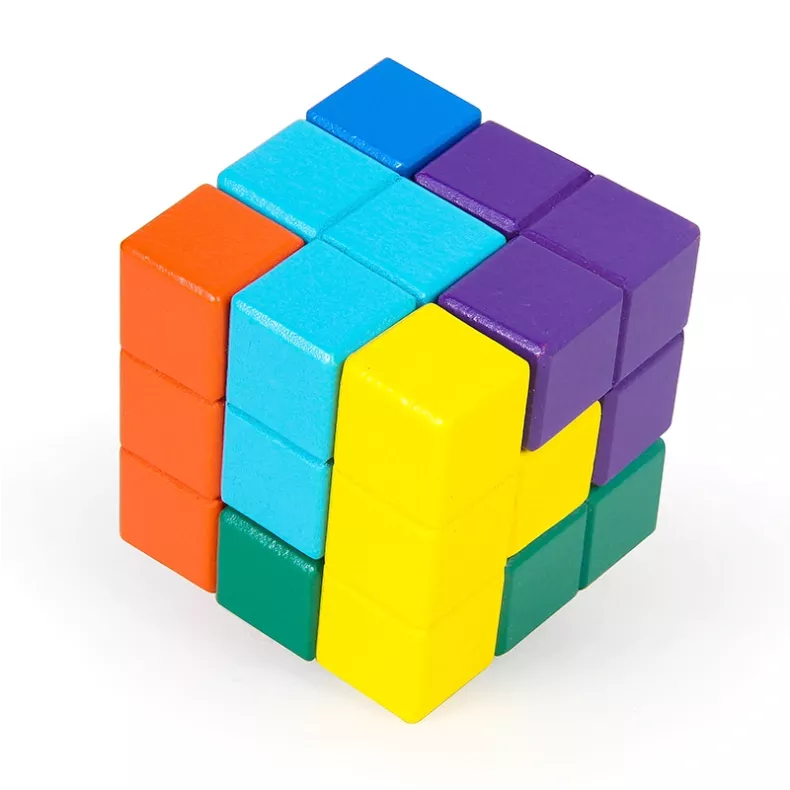
7 Color Soma Cube Puzzle — $21.88
Consider the classic 7 Color Soma Cube Puzzle ($21.88). It’s a brilliant exercise in spatial reasoning, where seven fixed polyominoes must form a 3x3x3 cube. The pieces are chunky, satisfying, and color-coded. The challenge is visual and logical: you mentally rotate shapes to find their home. It has hundreds of possible assemblies, but only a few correct solutions. The Soma Cube teaches you to think in three-dimensional negative space. The 54‑T Cube, in stark contrast, is about mass and gravity. Its 54 identical pieces offer no color cues or unique shapes to guide you. The challenge isn’t visualizing a final form from unique parts; it’s discovering the hidden structural lattice that allows a swarm of identical, awkwardly-shaped blocks to achieve stability. One is a logic puzzle with pieces; the other is an engineering problem with components.
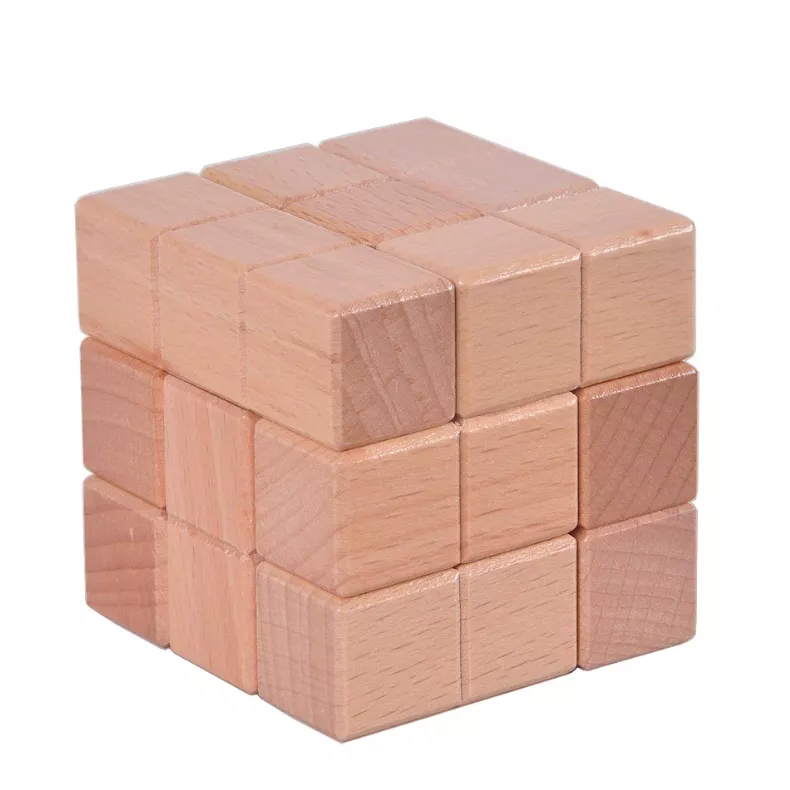
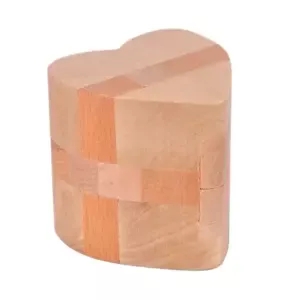
Luban Cube Puzzle — $21.99
Then there’s the Luban Cube Puzzle ($21.99), inspired by ancient Chinese joinery. Here, 6 or 7 notched wooden blocks interlock without glue or nails to form a cube. The satisfaction is in the precise, almost magical fit—the moment when the final piece slides into its exact groove and the entire structure becomes solid. It’s about precision craftsmanship and a single, elegant solution. The 54‑T Cube has no such “click” of perfection. Its solution is messier, more granular. Stability emerges gradually as you add more pieces in the correct orientation; there’s no final piece that completes the puzzle. You build until you can’t add any more, and then you hope it holds. The Luban Cube is a locked secret; the 54‑T Cube is a fragile consensus.
This distinction highlights the 54‑T Cube’s unique difficulty curve. Most assembly puzzles get progressively easier as you place pieces, reducing the number of remaining options. The 54‑T Cube does the opposite. The first 10 pieces are simple—you’re just making a messy pile. The real struggle begins around piece 20, when the structure becomes wobbly and top-heavy, and every new addition threatens a collapse. Your mistakes aren’t immediately apparent; they compound silently, leading to a frustrating avalanche 15 minutes later. This makes it a puzzle of patience and structural intuition more than pure logic.
For a different kind of wooden challenge entirely, consider the 3d Wooden Carousel Music Box ($43.99). This isn’t a brain teaser in the traditional sense but a mechanical kit—a 281-piece, glue-free build that results in a functional wind-up music box. The satisfaction here is in following instructions to create a beautiful, complex object. It’s a meditative, craft-oriented project with a clear, rewarding endpoint. The 54‑T Cube offers no instructions, no diagram, and no decorative payoff. Its reward is purely intellectual and tactile: the quiet triumph of imposing order on chaos through your own discovered principles. One is about guided creation; the other is about unguided discovery.
So, who wins? It’s not a competition. If you want a colorful, logical spatial challenge with multiple solutions, the Soma Cube is your pick. If you crave the “aha” of a perfect mechanical fit, choose the Luban Cube. If you desire a lengthy, rewarding build project, the Carousel Music Box is ideal. But if you want a puzzle that feels less like solving an equation and more like building a dry-stone wall—where the challenge is physical, iterative, and deeply satisfying in its emergent stability—then the 54‑T Cube’s unique, granular struggle is for you. It’s the puzzle that teaches you why buildings stand up, one tiny, identical T-block at a time.
My Solving Timeline: From Overwhelm to “Aha”
I set a timer. I cleared my desk. I poured the 54 T-shaped blocks into a chaotic pile, the beechwood pieces clattering softly. My goal was simple: assemble them into a perfect 3x3x3 cube. I had no instructions, no hints, and a naive confidence that my spatial reasoning was up to the task. What followed was a three-hour journey through distinct, almost emotional phases of problem-solving that I suspect is the real, unspoken value of this puzzle. It’s not about the solution; it’s about the process it forces you to endure and the lessons you learn along the way.
Minutes 0–15: The Chaotic Foundation
My first instinct was to start building from the ground up, like Lego. I grabbed a handful of blocks and tried to form a flat 3×3 base. This was my first critical mistake. The T-blocks, with their three-cube length and one-cube protrusion, don’t lock or clip. They balance precariously on each other. I’d get four or five pieces in a rough square, only to have the entire fragile structure collapse when I tried to add the sixth. The sound of tumbling wood became the soundtrack to this phase. I realized this wasn’t a stacking puzzle; it was a packing puzzle. I was trying to build a house by piling bricks, but the game required me to assemble the entire wall flat on the ground and then stand it up as a single, interlocked unit. I spent these minutes fighting the puzzle’s fundamental nature.
Minutes 15–45: The Systematic (and Failed) Search
Frustrated by collapse, I shifted tactics. I decided to brute-force the combinatorial logic. If there are 54 blocks forming a 27-cube volume (3x3x3), then each of the 27 positions must be filled by one arm of a T-block. I started trying to mentally map placements, laying pieces out in possible configurations on the desk. This is where the puzzle’s deceptive simplicity shines—and frustrates. Every block is identical. There is no color, no unique shape to track. I quickly lost count of which pieces I’d “used” in my mental plan. I’d devise a beautiful, theoretically sound layer, only to find I needed seven T-blocks to fill it when the math only allowed for nine blocks total for all three layers. I was drowning in identical units. This phase ended with a pile of wood and a creeping doubt. I checked the time. I was 45 minutes in and hadn’t successfully locked two layers together. The scale of the challenge finally sank in: this was a serious spatial reasoning test.
Minutes 45–90: The Structural Insight
I took a break, walked away, and made a coffee. This is a necessary step the instructions don’t tell you about. When I returned, I looked at the pieces not as 54 individual problems, but as a material to be shaped. I recalled a principle from the ancient Chinese puzzles known as Luban locks, where the strength comes from mutual tension and interlocking cross-sections. I realized the cube wouldn’t be stable if it was just blocks sitting on top of each other; they had to be woven together, with the arms of the T’s passing through the empty spaces in adjacent layers.
I started building a corner. Instead of building a full layer, I focused on creating a stable 2x2x2 sub-cube. This was the breakthrough. By working small, I could see how the pieces meshed. The protrusion of one block filled the “L”-shaped gap created by two others. For the first time, a small cluster of four blocks held together with a satisfying solidity when I picked it up. I wasn’t just stacking; I was integrating. This tactile feedback—the shift from wobbly pile to firm cluster—was the first real reward. You can learn more about this interlocking principle in our guide to traditional wooden brain teasers and their mechanisms.
Minutes 90–150: The Iterative Climb and the Great Collapse
Emboldened, I expanded my 2x2x2 corner into a full 3×3 first layer. It was slow, methodical work, testing each new block’s orientation to see if it would lock with the existing structure. I completed the bottom layer. It was a solid, interlocked slab. Elation. Then came the second layer. This is where the puzzle’s true devilry appears. Adding the middle layer isn’t about placing blocks on top; it’s about slotting them into the top of the first layer while also connecting to each other. Halfway through, my cube was a precarious, top-heavy mess. I tried to adjust one block on the lower layer to make room, and the dreaded domino effect occurred. A soft clatter-rattle-thump. Total collapse. All progress gone. The psychological blow was real. I was now two-and-a-half hours in, back to a pile of sticks. This moment separates the persistent from the defeated. It taught me that the solution isn’t linear; it’s a fragile equilibrium, and you have to build with the entire final structure in mind.
Minutes 150–180: The “Aha” and the Final Lock
Resigned but stubborn, I started again. This time, I had muscle memory. I rebuilt the first layer faster. My approach to the second layer changed. I stopped building it independently and instead focused on adding each new block so it simultaneously connected to the layer below and to the block I would place next to it in the middle layer. I was no longer building horizontal layers; I was building vertical columns and cross-braces. The final piece of the middle layer slid into place, locking the entire core of the cube with an audible firmness. The top layer, almost anti-climactically, went on in about five minutes. The final block—a perfect, satisfying press-fit into the last remaining hole.
The “aha” wasn’t a single trick. It was the accumulated understanding that the cube is a three-dimensional grid where every T-block occupies three specific cells, and its orientation determines the empty spaces around it. The solution is about managing negative space as much as positive placement. The finished cube in my hand was remarkably dense and heavy, a testament to the efficient packing. There was no glue, no magnets—just pure, clever geometry holding 54 independent pieces together as one.
Difficulty Context: Where This Fits
So, how hard is it? On a spectrum of tea-sip.com puzzles, it’s a different kind of hard. The 7 Color Soma Cube Puzzle ($21.88) is easier for a first-time solve because the colors and varied shapes give you clues and multiple solution paths. The Luban Cube Puzzle ($21.99) is harder in terms of precision fitting, but you’re only assembling 6-7 large, uniquely notched pieces; the 54‑T Cube is harder in terms of volume management and combinatorial overload. It’s less about finding the one right piece and more about orchestrating 54 identical pieces into a coherent whole. If the Soma Cube is like solving a colorful logic puzzle, and the Luban Cube is like fitting a 3D jigsaw, the 54‑T Cube is like conducting an orchestra where every musician plays the same note. The challenge is in the coordination, not the melody.
Who This Puzzle Will Delight (and Who It Will Frustrate)
The 54‑T Cube Puzzle isn’t a universal crowd-pleaser. Its unique blend of meditative repetition and combinatorial chaos makes it a perfect fit for specific mindsets and a guaranteed source of frustration for others. Choosing it wisely is the difference between a satisfying, multi-session project and a box of wooden blocks that ends up in a drawer.
Buy This Puzzle If:
- You crave a “flow state” project, not a quick win. This isn’t a 10-minute fidget. It’s for the person who wants to clear the coffee table on a Sunday afternoon and immerse themselves in a single, tangible task for a few hours. The process of sorting, orienting, and stacking becomes a rhythmic, almost Zen-like activity. If you find satisfaction in methodical tasks like assembling complex LEGO sets or detailed model kits, this puzzle delivers that same deep-engagement payoff.
- You’re a tactile learner or a spatial thinker. For hands-on learners, engineers, or anyone who understands the world better by manipulating it, this puzzle is a gym for your spatial reasoning. You don’t just see the solution; you feel it develop in your hands as the structure gains stability. It’s the physical embodiment of a 3D packing problem.
- You need a screen-free activity that demands full attention. This puzzle is a cognitive vacuum cleaner. It sucks all your focus into the physical world. You cannot half-solve it while watching TV or scrolling your phone. For anyone seeking a true digital detox or a way to quiet a racing mind by giving it a single, concrete problem to chew on, this is an excellent tool. It’s the antithesis of the quick dopamine hit from a fidget toy.
- You appreciate minimalist, material-centric design. You’re the type who enjoys the feel of solid wood, the sound of blocks clicking together, and the aesthetic of a pure geometric form. The value here is in the substance and the concept, not flashy colors or gimmicks. The finished cube is a beautiful, weighty object that feels like an accomplishment you can display.
Avoid This Puzzle If:
- You have low frustration tolerance or expect immediate gratification. If you get irritated easily when progress isn’t linear, walk away. The first 30 minutes can feel like you’re getting nowhere. Pieces will tumble. Your initial approaches will fail. This puzzle requires patience and a willingness to dismantle and restart. It’s a lesson in graceful failure.
- You prefer logic clues or varied pieces. If you love the deductive reasoning of a traditional Soma Cube or the “key piece” hunt of a Luban lock, the uniformity of the 54‑T blocks might feel boring or overwhelming. There are no colors to guide you, no unique notches to match. The puzzle provides zero inherent clues beyond the shape of the block itself. Some solvers find this liberating; others find it paralyzing.
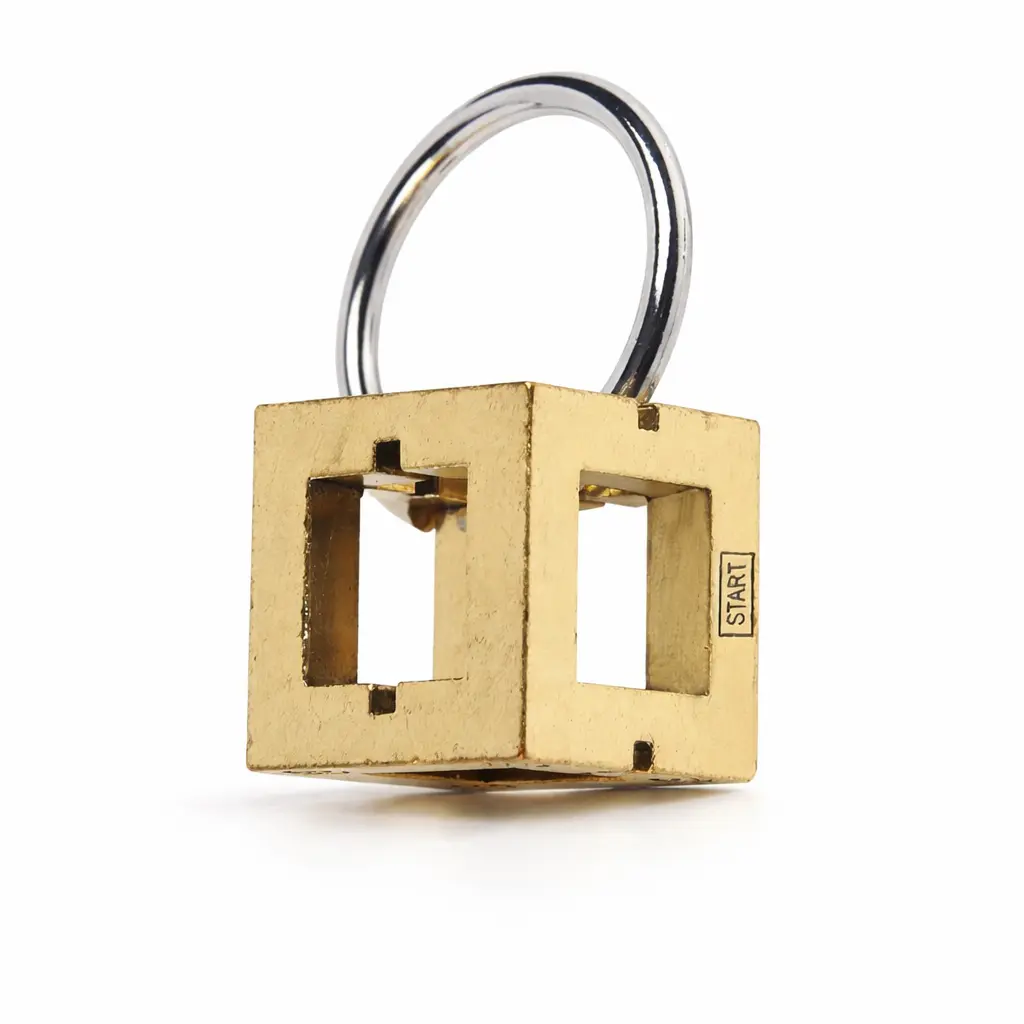
- You want a portable, quick-break puzzle. This is not a pocket puzzle. At $18.99, it’s a fantastic value for the material and experience, but that experience is a stationary, table-top endeavor. It requires a stable surface and a bit of space. For a tactile, take-anywhere challenge, a metal puzzle like the Brass Cube Maze Puzzle Keychain ($16.99) or a pocket-sized Crystal Luban Lock ($28.88) is a far better fit.
- You’re buying for a very young child (despite the “3+” label). While the blocks are safe and chunky, the sustained focus and fine motor control needed for a successful build is typically beyond a preschooler. They’ll enjoy stacking and playing with the blocks freely, which is great, but expecting them to solve the cube will lead to frustration for both of you. It’s better suited for a patient child of 8+ or, more realistically, an adult or teen.
The Price-to-Experience Verdict
At $18.99, the 54‑T Cube Puzzle sits in a sweet spot. You’re not paying for electronic components, magnets, or intricate laser-cut art. You’re paying for a substantial volume of solid beechwood and a brilliantly simple, deeply engaging conceptual challenge. Compared to a one-time-use craft kit or a movie ticket, the hours of engagement and the reusable, display-worthy result offer strong value. However, if your primary goal is decorative display over interactive challenge, that same budget gets you a stunning finished artifact like the 3D Crystal Rose Puzzle ($19.99), which you build once and keep forever as a sculpture. The 54‑T Cube’s value is in the doing, not just the having.
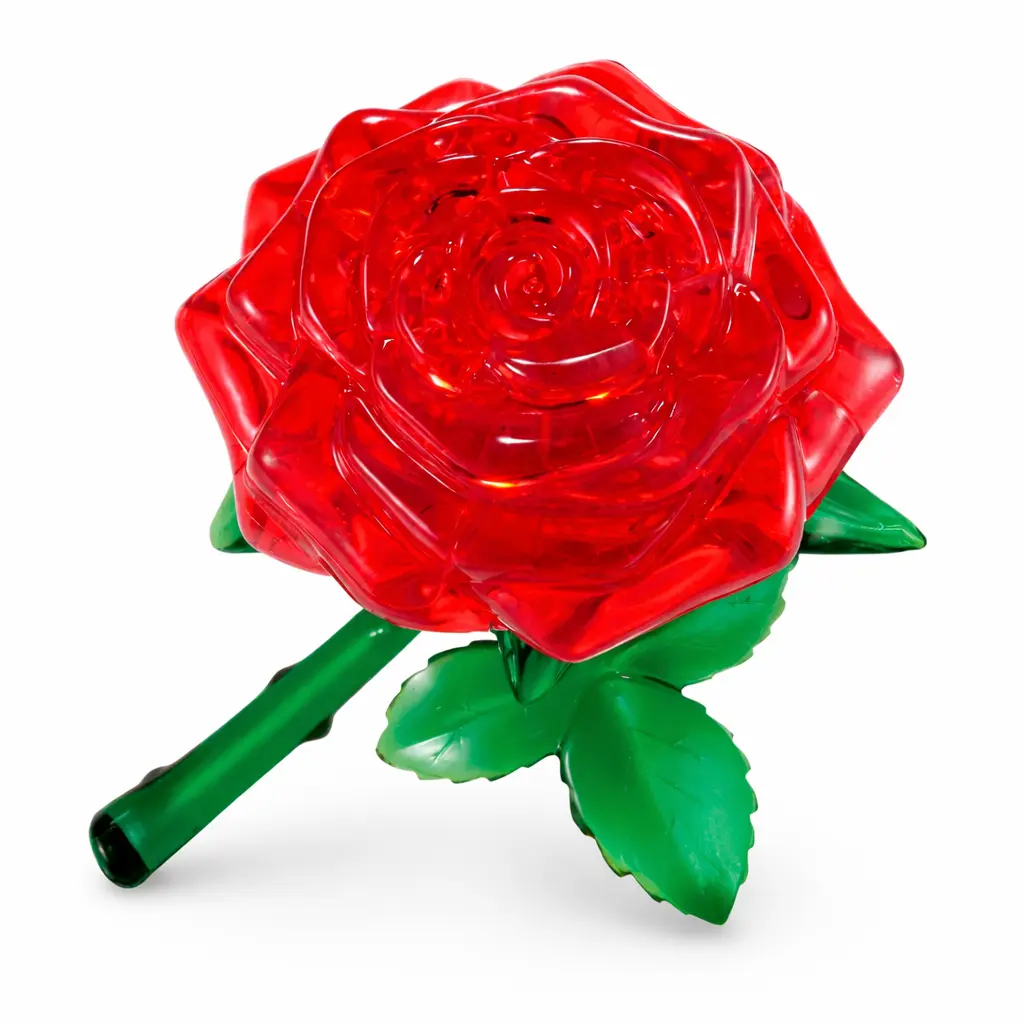
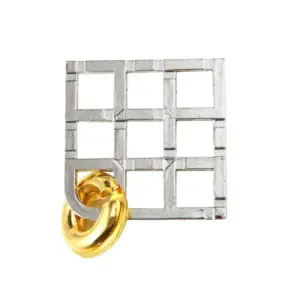
3D Crystal Rose Puzzle — $19.99
5 Tactical Tips I Learned the Hard Way
After my first successful solve, I disassembled the cube and immediately got stuck again. The solution isn’t a one-time trick you memorize; it’s a spatial principle you must internalize. Here are the tactical insights that bridge the gap between random stacking and deliberate building.
1. Start with a Stable “T” Foundation, Not a Corner. Your instinct will be to build a corner of the cube first. Resist it. The most reliable foundation is a flat, plus-sign-shaped layer of five “T” blocks. Arrange four blocks with their stems pointing outward to form a cross, and use the fifth to lock the center by having its stem point upward. This creates a stable, interlocked base layer that gives you a clear horizontal plane to build upon. It’s the structural equivalent of building the first floor of a house before worrying about the walls.
2. Sort Your Blocks by Stem Orientation Before You Begin. Dumping all 54 pieces into a pile is a recipe for visual overload. Before your first attempt, spend two minutes sorting. Create four piles: stems pointing left, right, up, and down (relative to how you hold the block). This simple organization cuts the cognitive load in half. When you need a block with a specific orientation to fill a gap, you’re scanning a pile of 12-15 instead of 54. It transforms the puzzle from a chaotic 3D jumble into a manageable procurement problem.
3. The Middle Layers Are a Logic Puzzle, Not a Jigsaw. The outer layers are somewhat forgiving. The brutal, make-or-break challenge lives in the middle. Here, every block must serve two functions: completing the shape of the layer below and providing the foundational structure for the layer above. The key is to think in terms of “stem sockets.” Look at the exposed ends of the stems from the layer below. Each one creates a negative space that must be filled by the stem of a block in the new layer. Plan your middle-layer blocks by identifying these socket patterns first, rather than trying to cover empty square spaces.
4. When Stuck, Deconstruct the Top Two Layers, Not the Whole Cube. You’ve built up four layers and the fifth just won’t fit. The frustration is real. The catastrophic mistake is to smash the whole thing apart. Instead, carefully remove only the top one or two offending layers. This preserves your hard-won, correct foundation. Ninety percent of my dead-ends were solved not by a full reset, but by reworking the last 10-20 blocks. This approach saves immense time and preserves your morale. It teaches you that complex structures are built in correct, reversible stages.
5. Your Final “Aha” Will Be About Compression, Not Completion. The last block never just slides in. The final move requires you to gently compress the entire, seemingly complete cube by a millimeter to allow the last piece to engage. You must hold the cube firmly in both hands and apply even, slight pressure from opposite sides. If you’ve built it correctly, you’ll feel the structure tighten and a final gap appear. This moment is the ultimate test of your build’s integrity. If it collapses, your internal geometry was off by a single block’s orientation. If it holds and locks, you’ve achieved mechanical perfection. This isn’t a flaw; it’s the brilliant, tactile proof that you solved it correctly.
What to Try When You’ve Mastered the 54-T Cube
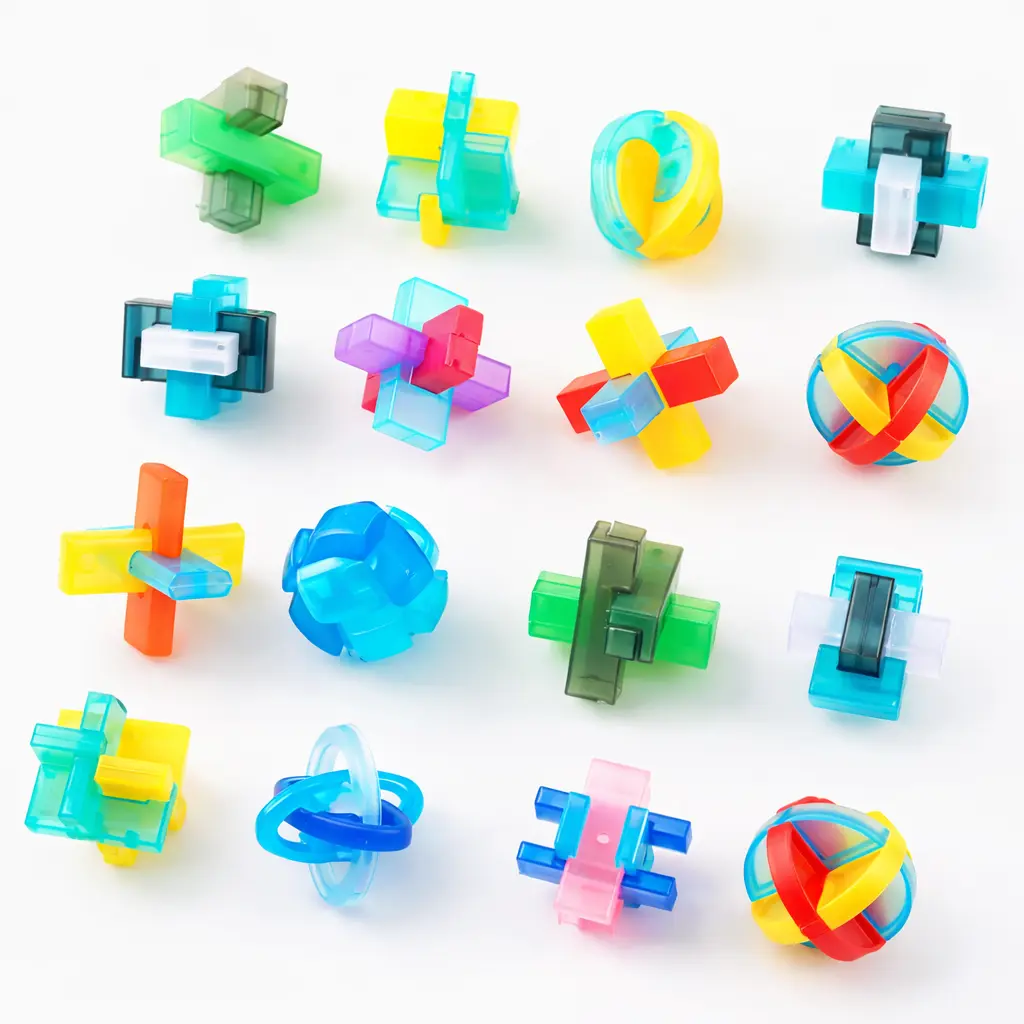
Once the core principle clicks, you’ll crave a new spatial language. For a more artistic, freeform building challenge with similar interlocking logic, graduate to the 7 Color Soma Cube Puzzle ($21.88). Its seven irregular pieces can be assembled into the classic 3x3x3 cube, but also into hundreds of other shapes, pushing your 3D visualization further. If you loved the precise-joinery satisfaction, the ancient Chinese inspiration behind the Luban lock is your next deep dive. Start with the classic Luban Cube Puzzle ($21.99), which uses 6 or 7 notched blocks to form a cube, offering a different kind of “key piece” logic. For a complete shift from assembly to disassembly, try the fidget-friendly, pocket-sized challenge of the 12 Piece Crystal Luban Lock Set ($28.88). Seeing the transparent mechanism doesn’t make solving it any easier, providing a fascinating new twist on the puzzles you’ve just learned to conquer.
Where to Go From Here: Your Next Puzzle Challenge
The 54-T Cube is a gateway. Its elegant, singular solution teaches you a specific dialect of spatial reasoning—the language of interlocking T’s. Once fluent, you’ll want to explore other dialects. Your journey can branch in three distinct directions: deeper into wood, toward metallic tactility, or into full-blown mechanical artistry. Here’s your map.
If wooden assembly remains your comfort zone, but you want more creative freedom, your logical next step is the 7 Color Soma Cube Puzzle. While the 54-T has one perfect solution, the Soma Cube’s seven polyomino pieces can be assembled into the classic 3x3x3 cube and hundreds of other imaginative shapes—a dinosaur, a chair, a sofa. It transitions you from a fixed goal to open-ended spatial play, a fantastic boost for flexible thinking. For a deeper dive into ancient joinery wisdom, the Luban Cube Puzzle is essential. It feels like a cousin to the 54-T but operates on a different principle: finding the one key piece and sequence that allows the others to lock into a perfect cube. It’s less about bulk stacking and more about precise alignment and hidden order.
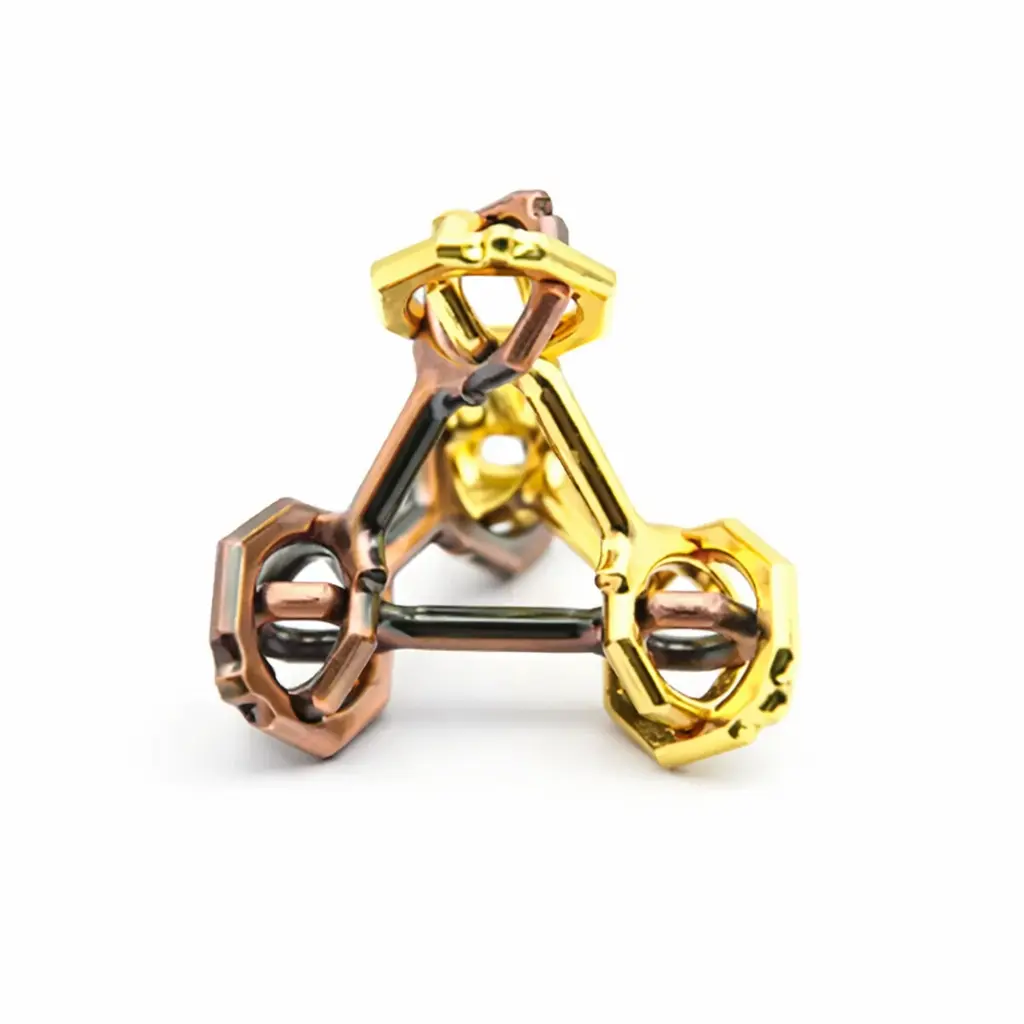
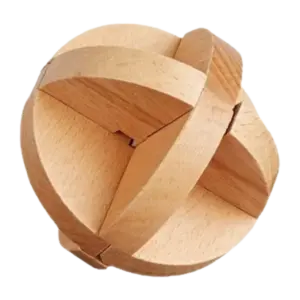
Cast Coil Triangle Puzzle — $25.99
Perhaps you’re craving a different sensory experience altogether. If the warm, quiet click of beechwood has you curious about cold, precise metal, start with the Cast Coil Triangle Puzzle ($25.99). This isn’t an assembly puzzle but a disentanglement challenge. Three geometric rings are interlocked into a triangle; your task is to free them. The dual-tone brass-and-bronze finish feels substantial and luxurious in hand, and the solution relies on understanding spatial pathways rather than stacking. It’s a brilliant desk piece that offers a satisfying, fidget-friendly challenge with a completely different tactile feedback—smooth metal sliding against metal.
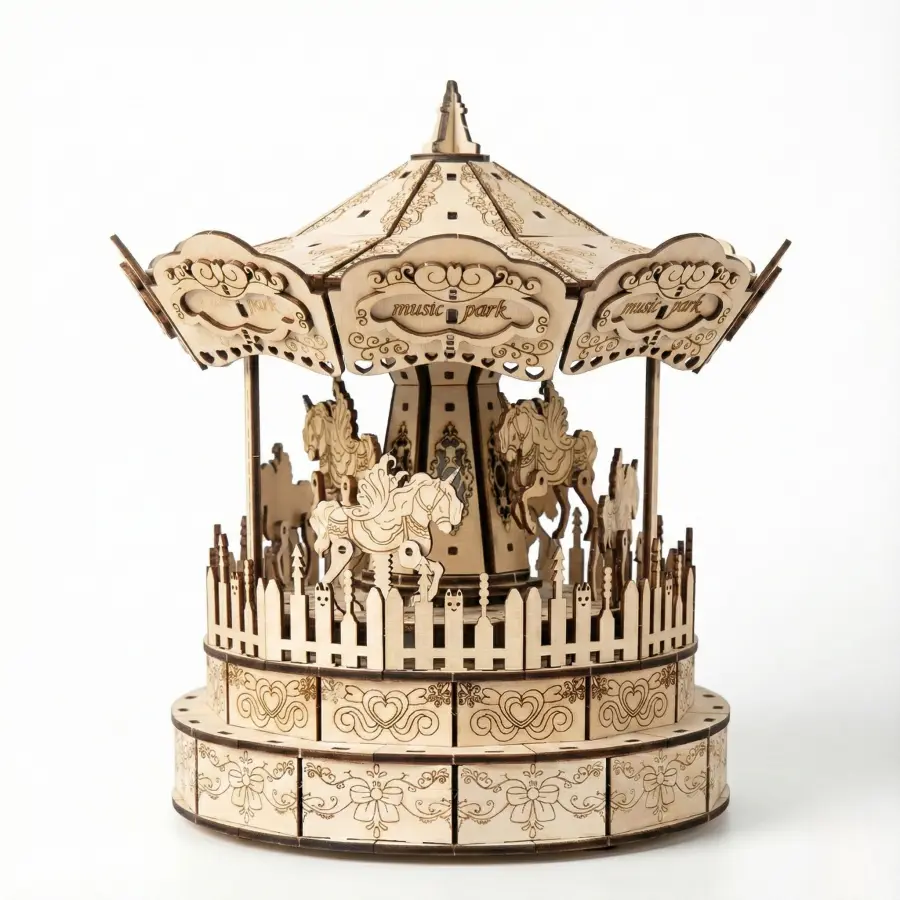
For those who discovered a love for the process of building with the 54-T’s 54 pieces, and want to channel that focus into creating something functional and beautiful, the ultimate progression is a mechanical kit. This is where puzzle-solving merges with model-making. The 3D Wooden Carousel Music Box ($43.99) is a masterpiece in this category. With 281 laser-cut pieces, it’s a significant, rewarding project (2-4 hours) that results in a working wind-up music box with rotating horses. It teaches gear logic, sequential assembly, and offers the profound satisfaction of creating a kinetic sculpture from a flat sheet of wood. It’s the 54-T Cube’s focus, amplified and transformed into art.
Your path doesn’t have to be linear. Use this simple decision matrix:
| If you loved this about the 54-T Cube… | Then your ideal next challenge is… |
|---|---|
| The “Eureka!” of the one right solution | The Luban Cube Puzzle – another cube, a different locking logic. |
| The open-ended, creative building | The 7 Color Soma Cube – build a cube, then a zoo of shapes. |
| The tactile, hands-on focus time | The 3D Wooden Carousel – a longer, more immersive build project. |
| Wanting a durable, fidget-ready desk toy | The Cast Coil Triangle – metal, portable, and endlessly pick-up-able. |
For a broader look at exceptional wooden puzzles beyond the cube, our dedicated guide to the best wooden brain teasers breaks down styles, difficulty, and ideal gifting scenarios. And if you ever need a complete mental reset from spatial thinking, our quick-play number logic games offer a refreshingly different kind of puzzle break. The goal is to keep your mind engaged, curious, and rewarded. You’ve solved the first layer; a whole world of mechanical intrigue awaits.
Frequently Asked Questions
How long does it take to solve the 54‑T Cube Puzzle for the first time?
Your first solve will likely take between 45 minutes and 2 hours, depending on your experience with spatial puzzles. The initial 15-20 minutes are usually spent in a productive “exploration” phase, trying different stacking patterns. The real time sink is the final third of the build, where you’re searching for the specific orientation of the last 10-15 pieces that allows everything to lock. Don’t be discouraged by a longer time; the process of elimination is the core of the challenge. If you get it in under an hour on your first try, you have exceptional 3D visualization skills.
Is it too difficult for a beginner or a child?
It’s accessible but demanding. The puzzle is rated for ages 3+, which speaks to its safety (no small parts, non-toxic wood), not its logical difficulty. A bright, patient 8-10 year old with Lego experience could eventually solve it, likely with some collaborative help. For a true adult beginner to puzzles, it’s a perfect “first serious” challenge—harder than a simple take-apart toy but with a single, logical solution, unlike open-ended construction. The key is managing frustration; setting it down and coming back later is a valid and often necessary strategy.
I’m stuck! Are there solutions or hints available?
Officially, no printed solution is included, which is intentional. The best hint is structural: focus on the corners first. The cube has eight corners, and each must be formed by the end of a T-block. Start by building the cube’s skeleton—its eight corners and the 12 edges connecting them—before trying to fill in the center of each face. This “frame-first” approach dramatically narrows your options. If you truly need a visual guide, searching for “54 T cube puzzle solution” will yield videos, but resisting that urge makes the eventual solve far more rewarding.
How does this differ from a Soma Cube or a Luban Lock?
While all are wooden cube-assembly puzzles, their core logic is distinct. The 7 Color Soma Cube uses seven fixed, irregular polycubes to build a 3x3x3 cube, with hundreds of possible assemblies. It’s about shape-matching. The Luban Cube Puzzle uses 6-7 notched pieces that interlock via mortise-and-tenon joints; it’s a 3D jigsaw with one exact fit. The 54‑T Cube is a volume-packing puzzle. Every piece is identical, and the challenge is discovering the one arrangement where 54 specific volumes occupy a 3x3x3 space without gaps. It’s a purer test of spatial reasoning and systematic trial.
Will it fall apart easily once solved?
Yes, and that’s by design. Unlike an interlocking Luban lock, the solved cube is held together by gravity and friction alone. It’s stable enough to carefully pick up and admire, but a firm shake or bump will scatter it. This isn’t a flaw—it transforms the puzzle from a static display piece into a repeatable experience. The value isn’t in keeping it assembled on a shelf; it’s in the knowledge that you can rebuild it. For a puzzle that stays together as a durable desk object, consider a cast metal brain teaser like the Coil Triangle.
Is the quality good for the price?
At $18.99, the beechwood quality is fair and functional. The pieces are smoothly sanded with no splinters, and the laser-cutting is precise enough that pieces fit without forcing. You’re not paying for luxury hardwood or a fine furniture finish; you’re paying for the precision of the cut and the intellectual property of the puzzle design itself. Compared to a mass-market plastic toy, it feels substantial and thoughtful. For a deeper dive into why well-made wooden puzzles command this price range, our wooden brain teaser guide explains material and craft considerations.
Can you build shapes other than a cube?
The product description focuses on the cube, but creative builders can make other structures. The identical T-shape is a versatile building block. You can create walls, pyramids, or symmetrical patterns. However, these are free-form creative exercises, not puzzles with defined solutions. If your primary joy is open-ended building with colorful blocks, a set of standard unit blocks might be more satisfying. The 54‑T Cube’s genius is in its constrained, singular solution.
Is this a good gift for a puzzle enthusiast?
Absolutely, with a caveat. It’s an excellent gift for someone who enjoys solitary, logical deduction challenges—the kind of person who likes Sudoku or non-twisty mechanical puzzles. It’s a poor gift for someone who prefers fast, kinetic puzzles like a Rubik’s Cube or who gets easily frustrated without incremental progress. As a gift, pair it with a note acknowledging the challenge: “For when you need to disconnect and deeply focus.” For more gifting ideas across different puzzle types, see our roundup of engaging desk puzzles beyond the fidget cube.
How do I store all 54 loose pieces?
The puzzle does not come with a storage box, which is a notable omission. A zip-top bag or a small, lidded container is essential. Many owners repurpose a nice-looking tea tin or small wooden box, which also enhances the giftability. This isn’t a puzzle you leave out on a coffee table; it’s an activity you take out, engage with fully, and then put away. The need for storage actually reinforces its nature as a dedicated focusing tool, not a permanent ornament.
What’s the benefit of this over digital puzzle games?
The benefit is entirely tactile and psychological. Physically manipulating the blocks engages proprioception (your sense of body position) and creates a direct, unmediated connection between your mental model and the physical world. There’s no undo button, no hints menu. The friction is real, and therefore the accomplishment is more visceral. Studies on embodied cognition suggest this physical engagement can deepen learning and focus. It forces a complete break from screens, providing a cognitive reset that digital games, still on a device, often cannot.
My pieces seem to fit in multiple ways. Am I missing something?
You’re experiencing the puzzle’s central trick. Each T-block can be oriented in many ways, and locally, small clusters will seem to fit together perfectly. The deception is that these locally stable clusters often prevent the global solution. The puzzle teaches you to think about the entire system, not just local connections. If you’ve built a section that seems solid but then can’