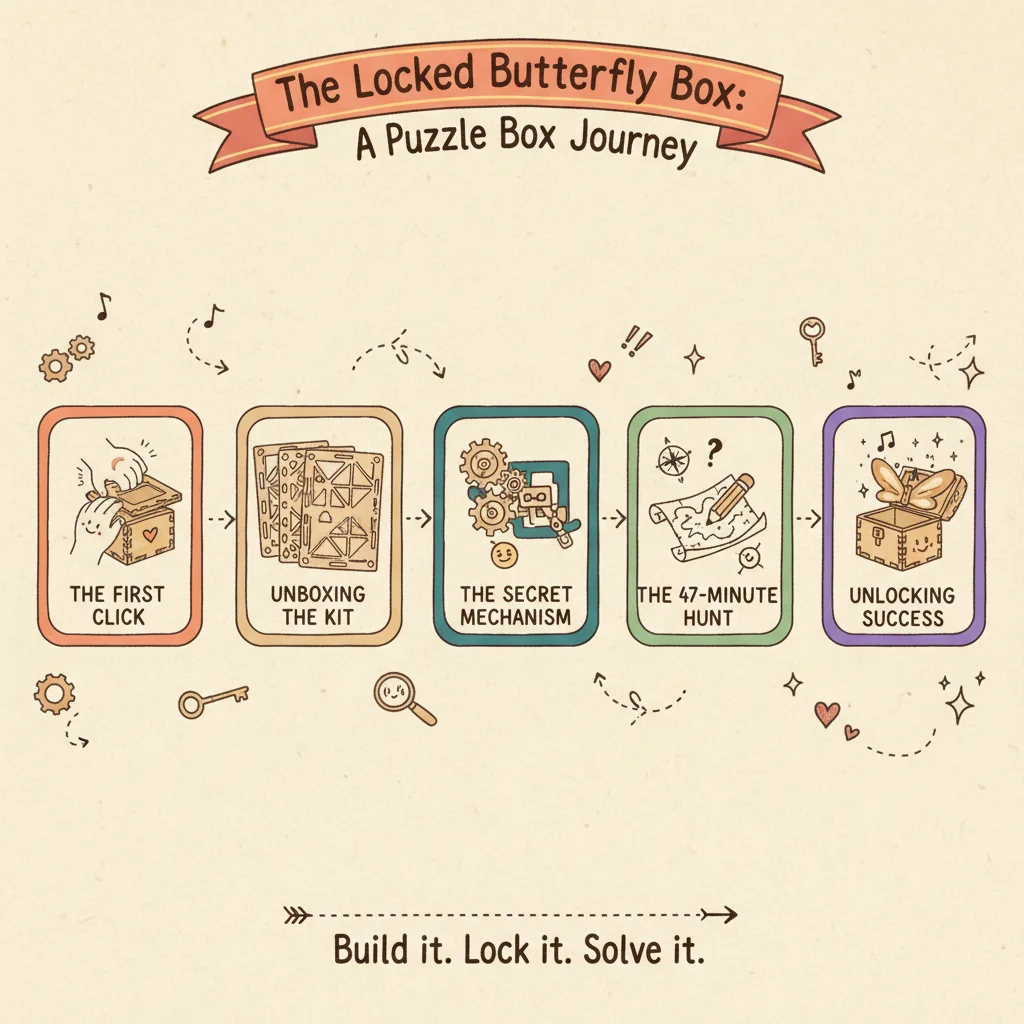
The First Click That Changed Everything
I picked up the Layered Butterfly Wooden Music Box expecting a quiet, decorative craft project. Thirty seconds in, my assumption was wrong. The first click wasn’t from the music mechanism—it was the sound of a small, internal wooden latch dropping into place as I slid the lid shut. I tried to open it again. It wouldn’t budge. This wasn’t just a model to build; it was a functional, secretive locking puzzle box I had just accidentally activated. That moment of self-inflicted confusion is the core thesis of this piece: the Butterfly Box is a gateway into the world of mechanical puzzles, blending the tangible reward of assembly with the cerebral “aha!” of discovery. It’s a two-stage experience where you first build the lock, and then you must learn how to pick it—with your own mind.
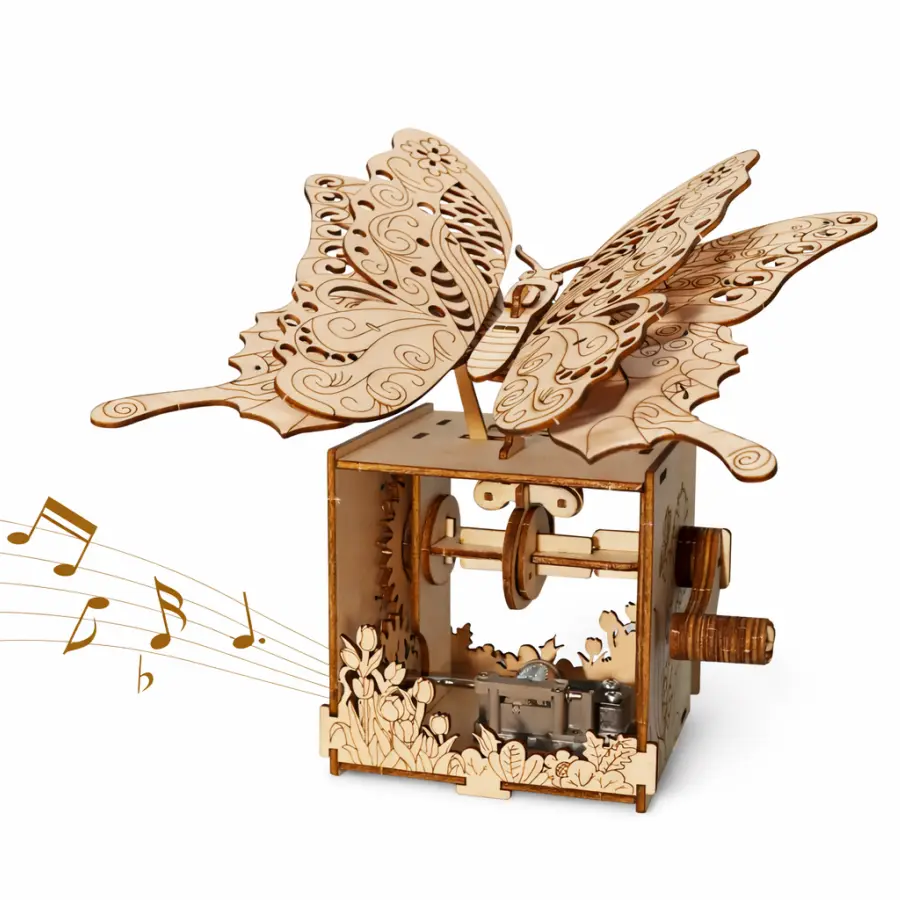
Unboxing the Butterfly: What You Actually Get for $28.99
Opening the box reveals a satisfyingly organized kit. You’re not handed a finished product; you’re given the raw components of a secret. The main pieces are laser-cut birch plywood sheets, about the size of a standard notebook. The wood has a clean, pale grain with a faint, pleasant scent. There’s no rough splintering—the laser cutting is precise, leaving smooth edges that pop out with gentle pressure. Alongside the wooden panels, you’ll find a small bag containing the brass music movement, a metal winding key, a tiny vial of glue (mostly for decorative accents), and a set of illustrated instructions. The total weight in your hands is light but substantial, around 1.5 pounds, promising a project with heft, not flimsiness.
The honest first impression is one of elegant complexity. The wooden sheets are densely packed with gears, frames, and the iconic layered butterfly wings. It’s immediately clear this is more intricate than a simple 3D puzzle treasure box for jewelry ($29.99), which focuses on creating a functional container. The Butterfly Box is about creating a performance—a mechanical ballet you set in motion. The instructions are visual, relying on exploded diagrams. If you’re someone who needs verbose, step-by-step text, you might feel a moment of hesitation. This is a universal language of assembly, but it demands your spatial attention from the outset.
What sets this apart from other puzzle kits is the integrated “lock” you build yourself. Unlike a pre-assembled metal lock puzzle you simply try to solve, here you are the engineer of the very mechanism that will later confound you. You’ll assemble a visible gear train that connects to a hidden wooden tumbler. When you later close the lid, that tumbler drops, engaging a latch. The “puzzle” isn’t just putting pieces together; it’s understanding the system you’ve built well enough to reverse-engineer its release. It’s a lesson in cause and effect, making the final solve profoundly personal. For your money, you get a hybrid: a detailed wooden model, a functional music box, and a legitimate brain teaser, all rolled into one deceptively compact form.
The Build: Where This “Puzzle” Really Begins
The assembly is the true first act of this puzzle. You’re not just building a box; you’re constructing the very logic you’ll need to defeat. The process took me just over two hours, a period that oscillated between meditative focus and moments of genuine problem-solving. The first 30 minutes are straightforward, slotting together the laser-cut plywood layers that form the ornate butterfly-shaped base and lid. The pieces fit with a satisfying, friction-tight snap—no glue required. This initial phase builds confidence and familiarizes you with the kit’s precision. However, around the 45-minute mark, you reach the heart of the project: the gearbox and locking mechanism.
This is where the “puzzle box” concept earns its name. You’re presented with a small wooden music movement, a series of interlocking gears, a drive shaft, and the mysterious wooden tumbler block. The diagram shows how they connect, but not why. As I fitted the drive gear to the shaft, I realized I was literally building the key. The side crank turns this primary gear, which meshes with a smaller gear on the music box cylinder, and that cylinder’s rotation is what eventually, through a clever cam, lifts the locking tumbler. Assembling it forces you to trace the kinetic chain. If you place the cam in the wrong orientation, the lock will never disengage. I did this. I had the entire mechanism assembled, only to test it and hear a depressing thud instead of the click of release. I had to backtrack, disassemble the gear train, and study the cam’s position relative to the tumbler’s resting state. This wasn’t a failure; it was the essential learning. You cannot solve the locked box later if you don’t understand the physics you’re installing now.
The final stage is installing the comb and cylinder of the music movement itself. This is a delicate operation, aligning the tiny steel teeth of the comb with the pins on the cylinder. One misaligned pin can cause the melody to stutter. When I finally turned the handle and the first clear, bright notes of “You Are My Sunshine” played alongside the smooth rotation of the visible gears, the payoff was immense. The butterfly’s wings, connected to a separate, simpler gear, fluttered in time. I had built a working machine.
This build experience sits in a fascinating middle ground. It’s more involved and mechanically insightful than assembling a static 3D model, yet more guided and contained than a pure, abstract disentanglement challenge like the
5 Piece Cast Spiral Metal Puzzle (check current pricing), which offers zero instructions and is pure spatial deduction. The Butterfly Box teaches you its own rules through construction. By the time you place the final decorative layer and close the lid for the first time—hearing that definitive click as the internal tumbler falls—you’re not facing a black box. You’re facing a system you built with your own hands. You know a solution exists because you put it there. The real question shifts from “How do I open this?” to “How do I remember the path I just created?” It turns the builder into the solver, a uniquely satisfying loop.
The Locking Mechanism: A Deceptively Simple Core
That final click of the lid is the moment the puzzle truly begins. You’ve built a beautiful music box, but you’ve also assembled a lock. The transition from creator to challenger is immediate. You pick it up, turn it over, and the first wave of questions hits: Where is the locking point? Is it magnetic? Is there a hidden button? The elegant, seamless exterior gives nothing away.
This is the genius of its design. The locking mechanism isn’t a complex series of hidden levers or a magnetic maze. It’s a single, classic wooden tumbler latch, cleverly integrated into the gear train you just assembled. The key—literally—is the side handle. During construction, you connected this handle to the main drive gear. That gear doesn’t just turn the music cylinder; it also controls a small cam. When the handle is in its default, “locked” position, this cam holds a simple wooden latch in place, blocking the lid from lifting. To unlock it, you must turn the handle through a precise, non-intuitive sequence.
My first hour of solving was a masterclass in frustration based on incorrect assumptions. I tried pressing on every decorative layer, thinking a panel might slide. I shook the box gently, listening for rattles. I examined the seams with a flashlight, looking for a hidden gap. Nothing. The breakthrough came when I stopped treating it as a mysterious “puzzle box” and started treating it as the machine I had built. I recalled the feel of the gears meshing. I remembered there was a slight resistance at one point in the handle’s rotation during my final test. I began experimenting with partial, quarter, and full rotations of the handle, listening not for music, but for a different, subtler click.
The solution path is a short but brilliant sequence of three distinct handle movements. It’s not random. It follows a logical, mechanical progression that directly mirrors the interaction of the cam and latch. The first turn partially retracts the latch but introduces a new block. The second, a reversal, re-engages the mechanism differently. The final turn completes the retraction. When you feel that second, deeper, more mechanical thunk (distinct from the musical cylinder’s ratcheting), you know you’ve found it. The lid lifts freely, silently.
This mechanism’s beauty is in its pedagogical clarity. Once solved, you can open the box in under ten seconds. More importantly, you understand why it works. It’s a perfect example of a sequential discovery puzzle—you must discover a series of non-obvious actions, each enabled by the last, to reach the goal. It lacks the sheer, opaque complexity of a premium sequential discovery box costing hundreds of dollars, but it delivers the same core “aha” structure in an accessible package.
Its difficulty is perfectly pitched. It’s more straightforward than a pure disentanglement challenge like the
Four-Square Lock Puzzle ($12.98), where the solution path is purely spatial and offers no mechanical feedback. Conversely, it provides a more tangible, cause-and-effect satisfaction than abstract deduction puzzles. The feedback is physical and auditory. You’re not just thinking; you’re listening and feeling your way to the solution.
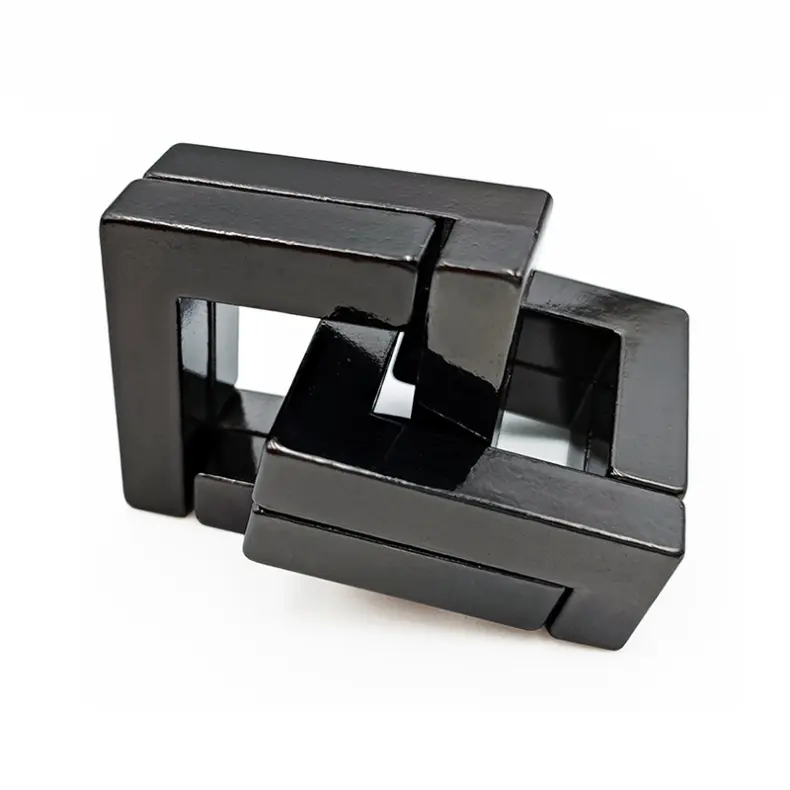
Four-Square Lock Puzzle — $12.98
This is where the Layered Butterfly Box separates itself from being merely a craft kit. The build is the tutorial; the lock is the exam. And because you wrote the textbook, passing the exam feels less like luck and more like earned insight. It teaches a fundamental principle of mechanical puzzles: the solution is always married to the construction. For a deeper dive into the philosophy and history of these ingenious contraptions, the Wikipedia entry on puzzle boxes provides excellent context on how hidden mechanisms have fascinated us for centuries.
The lock isn’t punishing. It’s patient. It waits for you to stop searching for secret buttons and start analyzing the system in front of you. When that final, correct sequence of turns aligns and the lid releases, the victory is quiet but profound. You didn’t beat a trick; you understood a machine. And then, of course, you can turn the handle and let “You Are My Sunshine” play, a celebratory fanfare for a puzzle perfectly solved.
The Solving Experience: 47 Minutes of Wrong Turns
With the box assembled and the locking pin in place, the real puzzle began. I set a timer, placed the closed box on my desk, and began. My goal: open it without forcing anything. The first five minutes were pure, unfiltered exploration. I turned the side handle. The butterfly fluttered, the music played, but the lid stayed shut. I pressed on every laser-cut floral accent, thinking one might be a hidden release. I tried sliding the entire top panel in different directions. Nothing. I shook the box gently near my ear, listening for a telltale rattle of a loose component. All I heard was the solid thunk of well-fitted wood. My initial assumption—that the solution was external and obvious—was already crumbling.
By minute 15, frustration’s first whisper arrived. I knew the answer was tied to the crank. The music box mechanism was the only moving part I hadn’t built from scratch; it was the pre-fabricated “black box” in my otherwise transparent creation. I started experimenting with the crank’s rotation. A full clockwise turn played the melody. A counter-clockwise turn produced only resistance and a worrying gear-grinding sound. I tried partial turns, quarter-rotations, back-and-forth sequences. The lid remained immovable. I set the box down and walked away, a classic sign I was overcomplicating things. This is the phase where most people, as noted in our exploration of common puzzle box challenges, apply brute force or give up, missing the elegant simplicity hiding in plain sight.
Returning at minute 25, I adopted a more systematic, diagnostic approach. I re-examined the internal gear train visible through the side window. Turning the crank moved a central shaft that drove the pinned music cylinder. But I noticed something I’d glossed over: the shaft didn’t just spin the cylinder; it also had a very slight lateral movement—maybe a millimeter of play along its axis. This was the first genuine clue. Could pushing or pulling the crank do something? I pulled the handle straight out. It moved a tiny bit, but with firm, spring-loaded resistance. Letting go, it snapped back. My pulse quickened. This was a defined mechanical action, not loose tolerances.
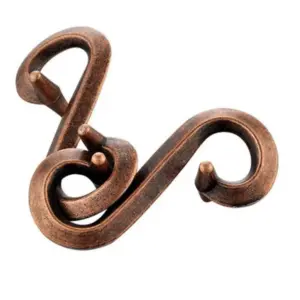
The next 20 minutes were a lesson in precision and patience. I discovered that the crank had three distinct states: fully in (its default playing position), pulled out about 5mm against spring pressure, and a rare, tricky “twisted-and-pulled” intermediary state. I began cataloging sequences: Pull out, turn clockwise. Pull out, turn counter-clockwise. Turn halfway, then pull out, then complete the turn. Each failed sequence felt like a dead end, but I was slowly mapping the puzzle’s limited vocabulary. I compared it mentally to the Two Bull Head lock Puzzle, another tea-sip.com favorite. That puzzle is about finding the single, precise alignment point between two seemingly identical pieces. The Butterfly Box was similar but sequential; it required finding the correct order of a few simple actions, like a miniature combination lock where the dial is also the bolt.

Two Bull Head lock Puzzle — $14.99
The breakthrough came at minute 47. I had the crank pulled out. On a whim, instead of turning it, I gently pushed it inward past its original resting point. It clicked. A soft, internal, metallic click that was utterly different from any wood-on-wood sound I’d heard so far. I released the crank. The music didn’t play. The butterfly was still. But now, when I tried the lid, it lifted freely, silently, and perfectly. The “aha” moment was profoundly quiet. There was no dramatic reveal, just the smooth operation of a clever mechanism I had finally, respectfully asked the right question of.
The emotional payoff wasn’t euphoria; it was deep satisfaction. I hadn’t stumbled upon the solution. I had methodically eliminated every wrong path until the correct one was the only option left. The feeling was one of earned understanding. I closed the lid, reset the lock with a push of the crank, and solved it again in under 30 seconds. The puzzle hadn’t gotten easier; my mental model had become accurate. This is the core reward of a great mechanical puzzle: the transition from confusion to competence is permanent.
Difficulty Assessment: On a scale of tea-sip.com puzzles, the Layered Butterfly’s solving phase is moderately challenging—more straightforward than the abstract, spatial reasoning required for the Four-Square Lock Puzzle, but more involved than simply taking apart the 5 Piece Cast Spiral. Its true difficulty is front-loaded in the build. If you successfully assemble it, you possess all the mechanical intuition needed to solve it; you just have to apply that intuition in a new way. The challenge lies in resisting assumptions and observing the machine’s actual behavior, not the story you’re telling yourself about it. For those who enjoy this blend of construction and deduction, the journey from wrong turn to right path is the entire point.
Who This Wooden Music Box Is For (And Who It Will Frustrate)
The Layered Butterfly isn’t a universal pick-up-and-play brain teaser. Its value is intensely specific, and misaligned expectations are the fastest route to disappointment. Based on my hands-on time, here’s who will find it worth every penny of its $28.99 price, and who should look elsewhere.
Buy this if:
- You want a project, not just a puzzle. This is for the person who sees “assembly required” as a feature, not a warning. If the idea of spending a focused, quiet evening following diagrams to build a functional machine sounds appealing—akin to a compact, musical model kit—you are the ideal customer. The satisfaction is cumulative, built piece by piece.
- You value the “why” behind the “how.” This puzzle rewards curiosity about mechanics. You’ll enjoy it if you’re the type to peer into a watch or a music box, wondering how the gears interact. The build demystifies the locking mechanism, turning the subsequent solve into an exercise in applied logic rather than random fumbling.
- You need a tactile, screen-free ritual. It’s perfect for someone seeking a deliberate replacement for scrolling. The entire cycle—building, solving, resetting, and simply winding it to hear the melody—creates a 45-minute oasis of focused attention. It’s a physical object with a clear beginning, middle, and end, which is a rare feeling in the digital age.
- You’re looking for a thoughtful, multi-layered gift for a patient person. This isn’t a last-minute present. It’s for birthdays, holidays, or “thank you” gifts where the message is, “I think you’re clever and will enjoy the journey.” The recipient gets the immediate joy of building, the challenge of solving, and a lasting decorative keepsake.
Avoid this if:
- You want an instant, portable challenge. If your goal is a mental workout you can pull from your pocket during a commute, this is the wrong tool. The Two Bull Head lock Puzzle or the 5 Piece Cast Spiral Metal Puzzle are far better for that. The Butterfly requires a table, time, and a willingness to engage in a multi-stage process.
- You dislike following instructions or lack fine motor patience. The build, while not overly complex, requires careful attention to the manual. If you’re prone to frustration when small wooden pieces need precise alignment, or if you just want to jump straight into solving a hidden secret, consider a pre-assembled option like a locking puzzle box designed for immediate deduction.
- You’re buying for a young child or someone easily discouraged. The recommended age of 14+ is accurate. The combination of detailed assembly and a non-obvious locking mechanism will overwhelm a casual or impatient solver. For family fun with younger participants, look for dedicated puzzle games designed for cooperative, quicker wins.
- You only care about the “lock” and not the “box.” If your sole interest is the intellectual purity of a disentanglement or sequential discovery puzzle, the money is better spent on a dedicated, precision-metal challenge like the Four-Square Lock Puzzle. The Butterfly’s lock is elegant but simple; its magic is in the holistic experience of creating and then unlocking a beautiful object.
Price & Value Verdict: At $28.99, this sits in a compelling middle ground. It’s significantly more substantial and engaging than a $15 mass-produced trinket, offering the deep engagement of a hands-on project. Yet, it’s far more accessible than a $100+ artisan puzzle box. You’re paying for three experiences in one: a satisfying build kit, a legitimate mechanical puzzle, and a working piece of decor. If any two of those appeal to you, the value is clear. If you only want one, a more specialized product will serve you better.
Five Tips I Wish I Had Before Starting Assembly
Assembling the Layered Butterfly Music Box is the puzzle before the puzzle. Skipping these steps won’t just make the process harder—it can compromise the final function and feel of the box. Here’s what I learned the hard way.
1. Sort, Then Sort Again. When you first open the package, you’ll see several sheets of laser-cut plywood. Don’t just start popping pieces out. Lay each sheet on a flat surface and identify the major components: the large base and lid panels, the smaller gearbox walls, the intricate butterfly and floral layers, and the bag of tiny pins and axles. Group them on your workspace. This initial five-minute investment prevents the frantic “which piece is this?” search thirty minutes in and dramatically reduces the risk of applying pressure to the wrong part of a delicate piece.
2. The “Friction Fit” is a Lie (At First). The instructions tout a glue-free assembly, which is true. But “friction fit” implies pieces snap together easily. For the first few connections, especially the main gearbox frame, the fit is extremely tight. You will need to apply firm, even pressure. My mistake was being too tentative, which left joints slightly loose and caused alignment issues later. Use a flat, hard surface like a tabletop to press pieces together squarely. A soft cloth between your hand and the wood can protect the finish while you apply the necessary force.
3. Test the Music Movement Immediately. Before you enclose the gearbox, you must install the brass music movement. The critical step everyone misses: turn the movement’s key before final assembly. Ensure the mechanism winds smoothly and the comb plucks correctly to play the tune. I didn’t, and after sealing the box, I discovered a slight hitch in the melody. I had to partially disassemble the gearbox to reseat the movement. A ten-second test saves twenty minutes of rework.
4. Mind the Mirror. One of the most stunning features is the mirrored panel that sits beneath the butterfly. Handle this piece only by the edges and clean it with a microfiber cloth before final placement. Any fingerprints or wood dust trapped behind it during assembly will be magnified and visible forever. Place it as the absolute last interior component before adding the decorative top layers.
5. The Lock Engages Before the Box is Sealed. This is the most crucial tip for the puzzle aspect. The locking pin and its channel are inside the gearbox. As you assemble it, you’ll see how the pin slides. Do not glue or permanently fix the side handle in place until you have tested the lock’s action multiple times through the open frame. Ensure the pin retracts and engages cleanly as you turn the handle. If it binds, a slight sanding of the pin’s path with the provided fine-grit sandpaper can make the difference between a satisfying click and a frustrating grind. For a deeper dive into the principles behind these clever mechanisms, the Wikipedia entry on puzzle locks offers fascinating historical context.
Finally, be patient with the butterfly layers. They are fragile. If a connection feels forced, you’re probably aligning the interlocking tabs incorrectly. Step away for a minute, look at the diagram from a different angle, and try again. The reward for this meticulous assembly isn’t just a music box; it’s the profound understanding of its mechanics that makes solving its secret lock later so much more satisfying. If you enjoy this process of building to understand, your next logical step is a more complex functional build, like the 3D Wooden Carousel Music Box ($43.99), which applies these same principles on a grander, more decorative scale.
If You Liked This, Try These Three Related Challenges
The Layered Butterfly Music Box sits at a wonderful intersection of mechanical assembly, aesthetic payoff, and a subtle locking challenge. If that blend resonated with you, your next puzzle should build on one of those core pleasures. Here are three curated next steps from the same collection, each extending a different thread from this experience.
For those who loved the “build-it-yourself” revelation of seeing gears turn and a mechanism come to life, the logical progression is a more ambitious kinetic sculpture.
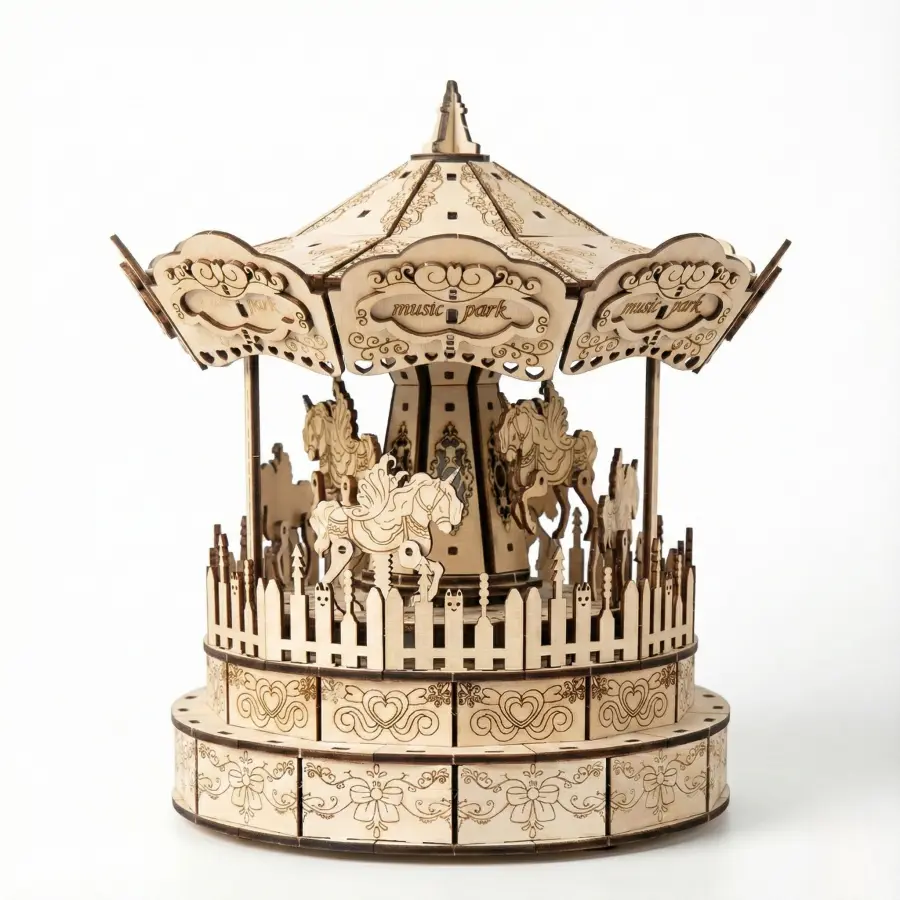
The 3D Wooden Carousel Music Box ($43.99) is the master class in this category. With 281 laser-cut pieces, this 2-4 hour project builds a stunning, fully functional wind-up music box where miniature horses actually rotate on a carousel. It trades the Butterfly’s intimate, personal-scale engineering for a true centerpiece display. The assembly complexity is higher, demanding more patience and spatial reasoning, but the payoff—a working, melodic Victorian-style carousel—is unparalleled. It’s for the builder who finished the Butterfly and immediately thought, “I want more gears, more movement, and a bigger wow factor.”
If your favorite part was the final “Aha!” of discovering and manipulating the secret lock, and you want to dive deeper into pure, tactile deduction, shift from wood to metal.
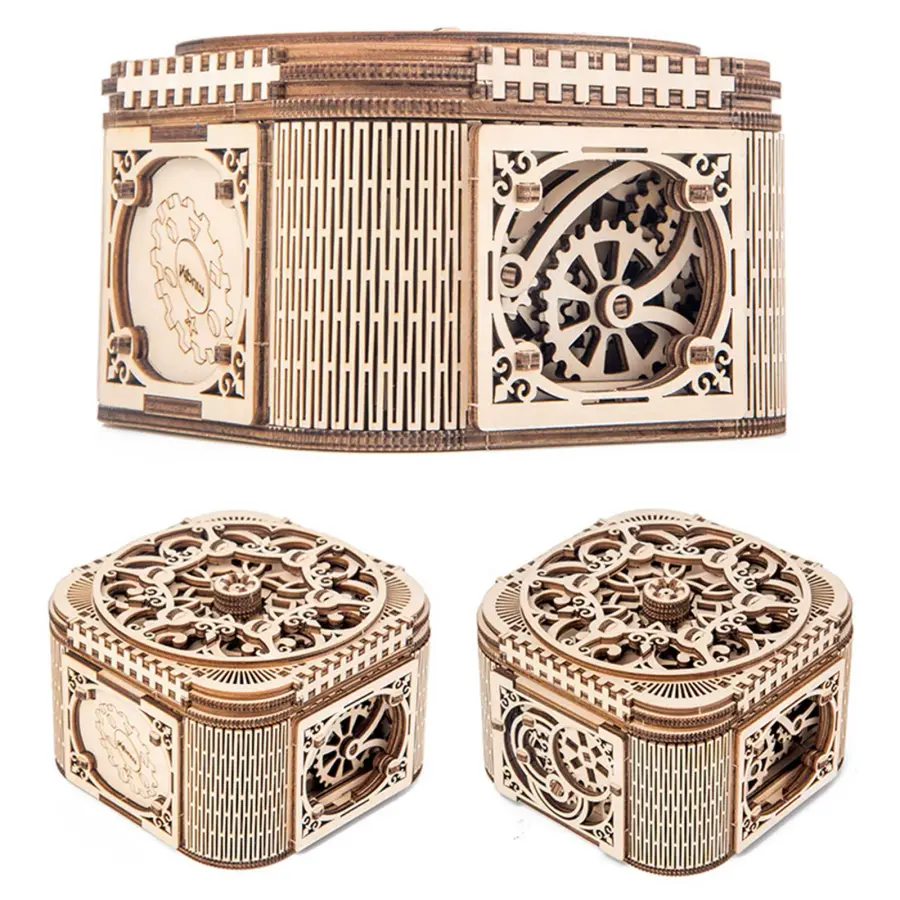
The 3D Wooden Puzzle Treasure Box ($29.99) focuses the challenge entirely on the lock itself. This isn’t a music box; it’s a functional jewelry box with a completely concealed mechanical puzzle lock. You assemble the beautiful wooden box with its visible external gears, but opening it requires solving a non-obvious sequential discovery puzzle. It takes the “hidden latch” concept from the Butterfly and makes it the entire point, offering a more traditional and challenging puzzle box experience perfect for storing small treasures or as a devilish gift box.
Finally, if the brief metal locking puzzle within the Butterfly was your highlight, and you crave a purer, pocket-sized version of that tactile, “find-the-path” challenge, a dedicated cast metal puzzle is your answer.
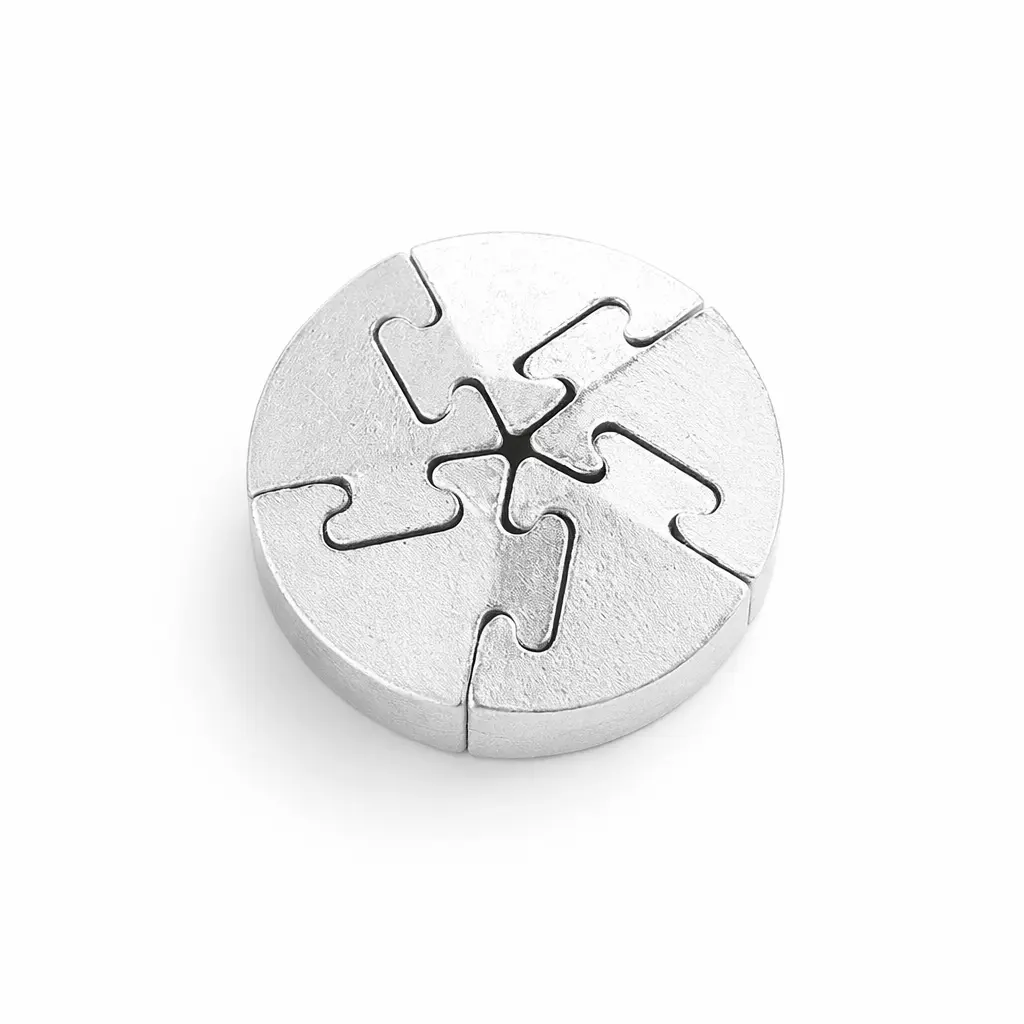
The 5 Piece Cast Spiral Metal Puzzle distills the locking concept down to its essence. This palm-sized alloy disc, made of five interlocking wedges, presents a seemingly impossible 3D disentanglement. Like finding the latch pin in the Butterfly, solving it revolves around identifying the one key piece that moves. It offers the same satisfying click of release but in a compact, durable form you can solve and re-solve anywhere. It’s for the solver who appreciates the elegance of a single, clever mechanical trick, stripped of all assembly and decoration. For a deeper exploration of this category of brain teaser, our overview of locking puzzle brain teasers provides excellent context.
Frequently Asked Questions: From Assembly to “Aha!”
How long does it take to assemble and solve the Layered Butterfly Music Box?
Plan for a single, focused session of 2 to 3 hours from unboxing to the first full play of the melody. The assembly of the layered wooden body and gearbox is straightforward and takes most people 60-90 minutes. The real time variable is the locking puzzle mechanism. Solving it to access the music movement can take anywhere from 10 minutes to an hour, depending on your familiarity with sequential discovery puzzles. It’s a perfect project for a quiet afternoon. If you get stuck, stepping away for a few minutes often provides the fresh perspective needed to spot the solution.
Is it too difficult for a beginner?
Not at all, but it depends on your mindset. If you’re a beginner to wooden model kits, you’ll find the assembly process well within your reach with clear instructions. If you’re a beginner to mechanical puzzles, the locking box portion will be a genuine but fair challenge. The key is patience. Unlike a jigsaw where progress is constant, puzzle boxes involve exploration and dead ends. If you enjoy tactile problem-solving and don’t mind a period of frustration before the “aha!” moment, this is an excellent and rewarding entry point. For those completely new to the concept, reading about how puzzle boxes work and their fascinating history can build helpful foundational knowledge.
Do I need glue or special tools?
No. One of the design’s strengths is that it’s a true friction-fit model. All wooden pieces press or slot together securely without adhesives. The only tool you might want is a small piece of sandpaper (not included) to gently smooth the occasional laser-cut edge for a perfect fit. Your fingers are all the tools required for the puzzle mechanism itself.
What song does it play?
The music movement plays a bright, classic music box melody. The specific tune is often a non-copyrighted public domain piece, similar to “Greensleeves” or “Twinkle, Twinkle, Little Star.” The focus is less on the specific song and more on the charming, slightly nostalgic sound quality produced by the pinned cylinder plucking the steel comb—a signature of authentic music box mechanics you can learn more about through authoritative sources on mechanical puzzles.
Can it be re-solved after the first time?
Yes, absolutely. Once you know the secret to opening the locking compartment, you can easily reset it. Simply close the lid and re-engage the latch. This allows you to use it as a true puzzle box repeatedly—you can hide a small note or trinket inside and challenge a friend to open it, or just re-solve it yourself for the satisfying tactile ritual. The assembly is permanent, but the “puzzle” function is fully reusable.
Is it sturdy enough for a child?
This is designed for ages 14 and up. While the assembled box is reasonably sturdy for gentle handling and display, it is a precision wooden model, not a toy. The layered wood and small internal components could be damaged by rough play or excessive force. It’s ideal for a mature teen or adult who will appreciate the craft and challenge. For family-friendly puzzle activities, you might explore our curated page on puzzle box fun for all ages.
How does the difficulty compare to other puzzles on your site?
The Layered Butterfly sits in a sweet spot of medium difficulty. The assembly is easier than the intricate 3D Wooden Carousel Music Box ($43.99), which has more pieces and a more complex gear train. Its locking puzzle is more accessible and tactile than the purely cerebral, abstract challenge of the Four-Square Lock Puzzle ($12.98). It’s less portable but offers more visual and auditory payoff than a pocket metal puzzle like the Two Bull Head lock Puzzle. Think of it as a hybrid experience: easier to build than advanced models, more rewarding to solve than simple trinkets.
What’s the most common mistake people make when trying to solve it?
Applying force. The mechanism is precise and requires finesse, not strength. If you find yourself pushing or pulling hard on any component, you are on the wrong track. The correct solution involves subtle shifts, slides, and presses. Another common error is overlooking the integrated nature of the “key.” Solvers often search for a separate tool, when the unlocking method is ingeniously part of the box’s own structure. Remember the first principle of puzzle boxes: everything you need is already in your hands.
Can the music box mechanism be replaced or rewound?
The mechanism is a standard, key-wound 18-note music movement. It is not designed to be user-replaceable without disassembly, but it is a reliable component. It winds via a small metal key (included) inserted into the side of the gearbox. It plays for about 2-3 minutes per full wind. The mechanism itself is not a puzzle to solve; it’s the reward for solving the box.
Are there multiple solutions to the lock?
Typically, a well-designed puzzle box like this has one intended, elegant solution path. While you might stumble upon different sequences of moves that achieve the same result, the core mechanical trick—the specific alignment and manipulation that releases the latch—is unique. The satisfaction comes from discovering that engineered solution. For a deep dive into the design philosophy behind such mechanisms, the Wikipedia entry on puzzle locks offers great technical insight.
What if I get permanently stuck?
First, take a break. Mental fixation is the enemy of puzzle-solving. If you’re still stuck, it’s okay to seek a hint. While we don’t provide full solutions here (that spoils the fun), the puzzle community is a great resource. The design principles often discussed in forums, like those for creating a general locked-box problem, can gently nudge your thinking in the right direction without giving the answer away. The solution, once discovered, will feel obvious and clever.
Is it worth $28.99?
From a value perspective, yes, if you value the experience over a simple commodity. For that price, you’re not buying a pre-made trinket. You’re purchasing 2-3 hours of engaged, screen-free activity, a beautiful display piece, a functional music box, and a legitimate mechanical puzzle. Compared to a movie ticket or a video game, the cost-per-hour of engagement and the lasting physical object you keep tip the scales in its favor. It’s a premium experience over a simple plastic toy, which is why it resonates as a thoughtful gift. For more on why this type of puzzle makes a memorable present, see our analysis on why the best gift wraps punish impatience.
My Verdict: Why This Puzzle Box Earns a Permanent Spot on My Desk
The Layered Butterfly Wooden Music Box isn’t just a puzzle I solved and shelved. It’s become a fixture. It sits on my desk not as a trophy, but as a tool—a physical reset button for my brain. When I’m stuck on a digital task or need a three-minute mental palate cleanser, I don’t reach for my phone; I wind the handle. Watching the gears turn and the butterfly flutter to that bright melody is a tiny, deliberate act of focus that pulls me out of the scroll. It’s a functional reminder of a completed challenge, which is a powerful motivator.
This is the core value proposition that cheaper, disposable puzzles miss. You get the deep satisfaction of solving a locking puzzle brain teaser, the creative engagement of building something beautiful, and a lasting kinetic sculpture that provides ongoing joy. It bridges the gap between a one-time brain teaser and a piece of interactive decor. For anyone feeling the drain of digital distraction and seeking a tangible, rewarding alternative, this is a compelling entry point. It proves that a good puzzle isn’t about confinement, but about liberation—freeing your attention through focused play.
Your next step is clear: If this blend of hands-on assembly, mechanical intrigue, and lasting function speaks to you, start with the Layered Butterfly Wooden Music Box for $28.99. It’s a single, multifaceted experience that teaches patience through action and leaves you with more than just the memory of a solution.